Specs are compiled from manufacturer listings and verified buyer reviews and can change over time — please confirm the key details on the product page before buying.
A squat rack is the one piece of home gym gear that has to be right the first time, because a rack that walks across the floor under load is worse than no rack at all. The short answer: most lifters are best served by a rack rated well above the weight they actually move, with safety arms long enough to catch a failed rep and a footprint that genuinely fits the room you train in. The picks below are sorted by how solidly each one handles those three jobs, from compact half racks up to full cages with pulley systems.
This guide is built by comparing the manufacturers’ published specifications and the patterns across verified customer reviews, so you get each pick’s real strengths and trade-offs instead of marketing spin.
The racks below split into two honest families: simple half racks built for squats and bench work, and all-in-one cages that add cables, storage, and pull-up bars. The FLYBIRD SR1 leads because it balances 950 lbs of rated capacity with a footprint small enough for a spare room — a combination worth knowing about when you shop for a weight lifting squat rack.
Top Picks


How To Choose The Best Weight Lifting Squat Rack
Most first-time buyers pick a rack by its listing photo instead of its specs. Racks look similar in a listing photo, but the two numbers that decide whether you can train alone at home safely are the rated weight capacity and the safety arm length. Get those two numbers wrong and a missed rep will find the floor.
Capacity: buy well above your working weight
A rack’s rated capacity is the static load it is built to hold, not the weight you should routinely drop onto the safety arms. A dynamic miss carries far more force than a racked bar, so the smart move is to pick a rack rated far above your heaviest squat. The half racks here start at 950 lbs and climb from there; the full cages reach 2000 lbs and higher.
Safety arms and hole spacing
Safety arms are the horizontal bars that catch the barbell if you stall at the bottom of a squat, and their length is your margin for error. A rack with 16.7″ extended arms gives you noticeably more catch room than a stubby pair. Hole spacing is the vertical distance between adjustment holes: the tighter it is, the closer you can set the arms to the exact bottom of your squat. One listing here uses a 1.5″ spacing, which is finer than the 1″ standard many budget racks use.
Footprint and ceiling height
Measure your floor space and ceiling height twice before ordering. A half rack with arms tucked in fits a garage corner, while a full cage with a lat pulldown needs real clearance overhead for pull-ups. Check the assembled height against your ceiling before you order, and leave yourself room to load plates on both sides.
Steel and stability
Uprights are usually described by their outer dimensions, like 2″ x 2″ or 50mm x 50mm square tube. Thicker-gauge steel and a wider base cut down on sway during pull-ups and cable work. If your rack will live on a hard floor unbolted, look for rubber feet or floor anchors in the listing.
Side-by-Side Comparison
| Model | Best For | Rated Capacity | Adjustment Range | Weight | Amazon |
|---|---|---|---|---|---|
| FLYBIRD SR1★ Best Overall | Small rooms, squats and bench | 950 lbs | 22 height settings | 68 lbs | Amazon |
| BEKING All-in-ONEBest Entry Cage | Tight budgets, full cage | 1000 lbs | 21 levels | 63.9 lbs | Amazon |
| CANPA MultifunctionBest For Small Spaces | Pull-up variety on a budget | 800 lbs | 17-hole arms, 6 frame levels | — | Amazon |
| SunHome Power Cage | Cable training at home | 1500 lbs | 28 positions | 115 lbs | Amazon |
| CAP Barbell Full Cage | Low ceilings, full cage | 500 lb catches | — | 116.8 lbs | Amazon |
| JELENS S11 | Heavy loading plus cables | 2000 lbs | 13 heights | — | Amazon |
| Iron Crush i200 | Fine height tuning | — | 1.5″ hole spacing | 65 lbs | Amazon |
| Sportsroyals Power Rack | Loaded accessory kit | 1200 lbs | 14 levels | 150 lbs | Amazon |
| Mikolo F4 2.0 | Lat pulldown with leg hold-down | 1200 lbs | 27 positions | 252 lbs | Amazon |
| MAJOR FITNESS Drone3 | Heaviest loads, dual pulley | 2500 lbs | 19 heights | — | Amazon |
| MAJOR FITNESS F22 | Two people training together | 1600 lbs | — | 243 lbs | Amazon |
Detailed Reviews
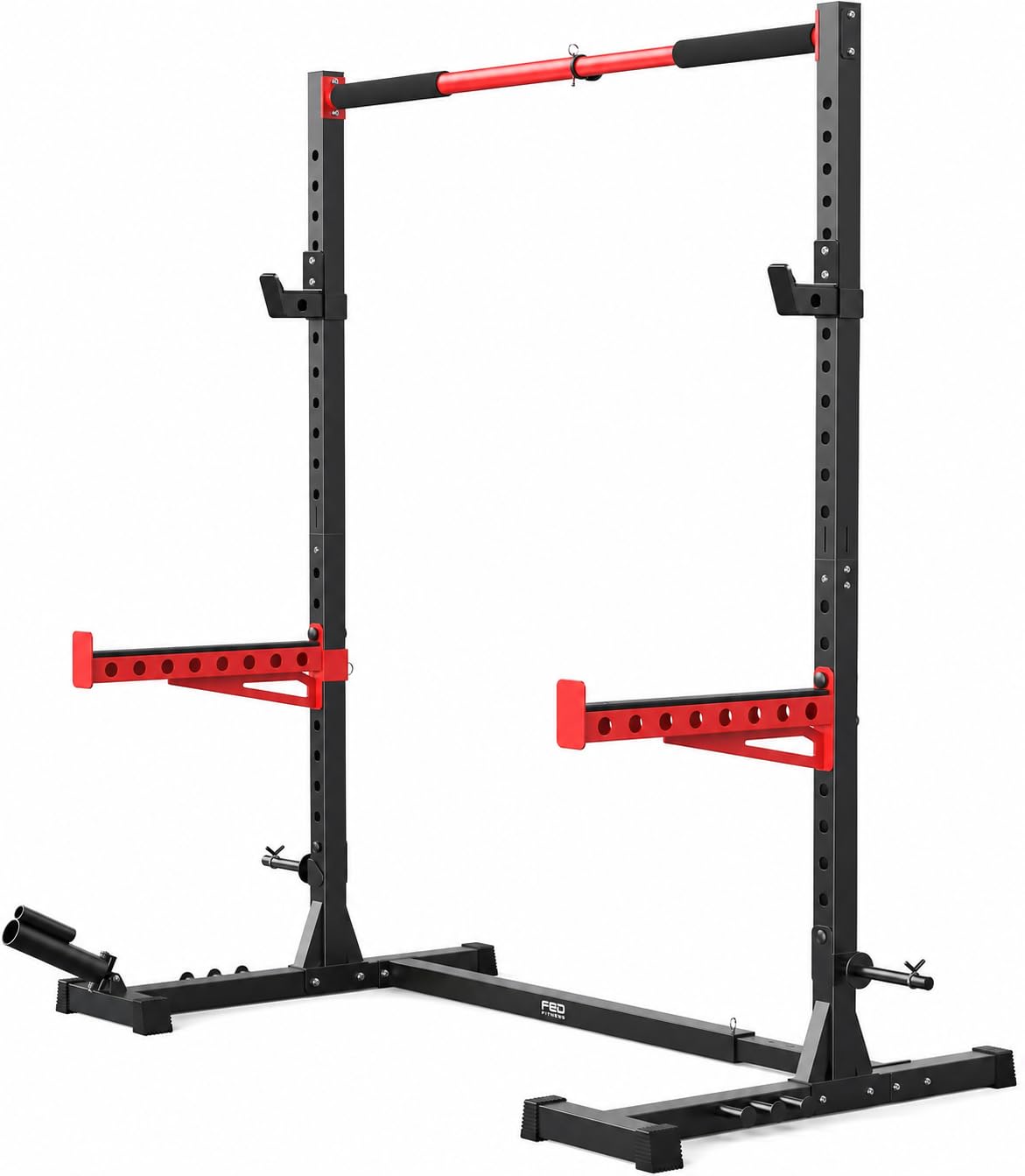
1. FLYBIRD SR1 Squat Rack
Our pick — 4.5+★ from 300+ verified ratings; the strongest balance of quality and price.
The half rack that lets you squat alone in a spare room without a spotter in earshot.
Here is the number that decides it: a 950 lbs rated capacity on 2″ x 2″ commercial-grade steel uprights. That is a lot of headroom for a home lifter, and the reinforced frame is built to stop the wobble that makes a cheap rack feel sketchy mid-squat. It also tips the scale at 68 pounds, so you can actually move it around your garage without a second person. Compare that with the SunHome cage at 115 pounds and you see the trade: the FLYBIRD gives up built-in storage and cables to stay manageable.
The 22 height settings with 1″ standard holes cover squats, bench presses, and shoulder presses, and those same holes accept most standard rack attachments, so the rack grows with your workout. The safety arms are the real story for solo training — 16.7″ of extended reach built from 1.2″ x 1.2″ solid steel, with protective liners that soak up the impact of a dropped barbell and save the knurling. The adjustable width handles most 6 ft and 7 ft bars, and the compact 39″ L x 41.3″ W x 83″ H footprint tucks into rooms, garages, or basements. A landmine attachment, 6 resistance band pegs, and a foam-padded pull-up bar round out the working options.
The trade-off is honest and specific: those extended safety arms and the fixed 83″ height mean you need real headroom above you, and a bar shorter than 6 ft will not fit the adjustable width. This is a rack for the lifter who wants squats and bench work done right in a small space — not for someone chasing cable crossovers or a lat pulldown.
What earns the top spot
- 950 lbs of rated capacity on 2″ x 2″ steel, so heavy squats stay steady
- 22 height settings with 1″ holes, matching most standard attachments
- 16.7″ extended safety arms with impact-absorbing liners for solo lifting
- Fits 6 ft and 7 ft bars and slips into a compact 39″ L x 41.3″ W footprint
Where it asks you to give
- No pulley system or weight storage built in
- 83″ assembled height needs clearance overhead for pull-ups
- Adjustable width will not grip bars shorter than 6 ft
Reach for this if: you want one rack that handles squats, bench, and presses in a small room and you train alone.
Look elsewhere if: you need cables, a lat pulldown, or a rack that fits under a low ceiling.
2. BEKING All-in-ONE Power Rack Cage
A full cage with storage pegs and a pull-up bar, built to fit a cramped basement corner.
For the money, this is the most complete cage in the list. A 1000 lbs maximum capacity on torsion-free 2″ x 2″ steel uprights gives you a sturdy training base, and it comes with 4 floor anchors plus rubberized feet so the frame stays put and your concrete stays unmarked. It also undercuts the JELENS cage on capacity — 1000 lbs versus 2000 lbs — which is the cleanest way to see where your money goes at the entry tier. If your working weight sits comfortably under 1000 lbs, that gap costs you nothing.
The 21-level J-hooks adjust from 20.5″ to 68.9″, so you can dial in bench press, squat, and overhead press without fighting the frame. Thick rubber padding protects your bar’s knurling and cuts noise, which matters if you train early or late near other people. The multi-grip angled pull-up bar works your back and shoulders, and integrated plate storage pegs plus barbell holders keep plates off the floor instead of stacked against the wall.
Where it pulls ahead of the FLYBIRD for bench work is the improve rear support bar, which leaves full clearance for your bench to slide back so you get proper leg drive. The other side of the coin is that it is a bigger footprint at 41.3″ D x 45.1″ W x 79.1″ H, and the 63.9 pound frame is lighter than the beefier cages, so heavier pull-up work benefits from those anchors.
Built for real benches: the raised rear bar is a thoughtful touch that most budget cages skip, and it makes the bench press feel less cramped.
The honest limit: the lighter 63.9 pound frame means floor anchoring is a step you should not skip.
The cage to buy first: a beginner or intermediate lifter who wants storage, a pull-up bar, and a bench-friendly layout without spending premium money.
Step past it if: your working weights approach that 1000 lbs ceiling or you want cable training built in.
3. CANPA Multifunction Power Rack with Pull Up Bar
An 800 lbs rack with a pull-up bar that does double duty in tight corners.
This rack wears its price tag on its sleeve. The front and rear double support frame is built to hold 800 lbs, which is the lowest ceiling in the group — the BEKING tops it at 1000 lbs — so this is a rack for a lifter who is honest about their working weights. What it does well is variety. A single side carries 17 holes for the barbell support arms, and the main frame adds 6 levels of height adjustment, with standard 1″ holes that accept most accessories on the market. The multi-direction pull-up bar lets you vary your grip and hit different muscles.
The back of the frame has an Olympic plate storage bar, which keeps plates off the floor and adds a little ballast to the base. The 43.03″ D x 40.75″ W x 85.71″ H frame is tall, so check your ceiling before ordering, and the 800 lbs ceiling means you should think about where your squat program is heading before you commit.
Fit is the honest caveat here. Some owners find the width too narrow for a comfortable bench press setup, while others fit it into small home gyms without trouble, so measure your bench and your bar path first. It is a reasonable first rack for a genuinely tight home gym with modest working weights.
What it does well: lots of adjustment options for the money — 17 arm holes plus a 6-level frame — and a pull-up bar you can grip several ways.
The catch to measure for: that 800 lbs rating is the ceiling, and narrower owners may find bench pressing a snug fit.
Fits best when: you have a tight corner, modest working weights, and want pull-up variety built in.
Try another if: you bench heavy or plan to grow your squat numbers well past the 800 lbs rating.
4. SunHome Power Cage with Pulley System

The cage that adds a cable crossover so you can train back and arms without a spotter.
Where this cage separates from the half racks is the cable crossover system bolted to the frame, which turns a squat station into a full-body gym. That is a lot of capability, and it is matched with a 1500 lbs maximum capacity on 2″ x 2″ steel tubes — a clear step above the FLYBIRD’s 950 lbs and the BEKING’s 1000 lbs. The catch is the weight of the thing: 115 pounds of steel means it is not a rack you will want to shuffle around the garage weekly.
For getting your stance right, the 28 adjustable positions for the J-hooks and spotter arms are the most on this list. You change from squat to bench press by moving the catches, and the frame itself is built as 2″ x 2″ alloy steel. The bench capacity on the platform is another 660 lbs, so heavier lifters can press with room. Storage is handled with 4 weight plate posts and 2 barbell hooks, so plates stay slotted away instead of creating a trip hazard mid-set.
The honest trade-off is footprint and commitment. At 46.9″ D x 42.4″ W x 84.9″ H this is a substantial frame, and you will want to leave it assembled rather than move it. If rows and cable work are part of your program, that footprint buys real exercise variety.
The standout: a genuine cable crossover plus 28 catch positions and 4 plate posts, all on a frame rated to 1500 lbs.
Measure the room first: at 115 pounds and nearly 85 inches tall, this is a leave-it-in-place rack that needs real clearance.
The one to pick when: cable work matters as much as squats, and you have a garage bay to dedicate to the cage.
Pick a half rack instead if: you want to fold gear away after each session or your ceiling sits under 85 inches.
5. CAP Barbell Full Cage Power Rack

The full cage built for basements where the ceiling stops you short.
At 72″ assembled height, this cage is the shortest here, and that is the whole reason to consider it if you train in a basement or a room with a low soffit. The frame uses 12- and 14-gauge steel tubing with gusseted uprights, which the maker says lets it meet and exceed industry standards. The rated static weight capacity is 500 lbs for the catches and 750 lbs for the pull-up bar — both real numbers to check against your working weight, because this is not a 2000 lbs monster like the JELENS.
Build quality shows in small places. It has a powder coat finish and industrial zinc hardware, which is a maintenance-friendly combination. Catches and safety bars are included, the pull-up bar handles arms and core, and it assembles without heroics. If your basement ceiling rules out taller cages, the 72″ height alone can justify the lower 500 lb catch rating.
The honest caveat is stability when it is left unanchored. Some owners find it sturdy as-is and others find it wobbles without anchoring, so plan on bolting it down or weighing the base well. At 116.8 pounds it has enough mass to feel planted once set.
The low-ceiling answer: 72 inches tall, so it fits rooms where taller racks simply will not.
Plan for anchoring: unanchored stability is hit or miss, so budget the time to bolt it down.
Choose it for: a basement gym with a low ceiling where capacity matters less than fit.
Skip it for: a heavy powerlifting program — the 500 lb catch rating is far from the top of this list.
6. JELENS S11 Power Cage
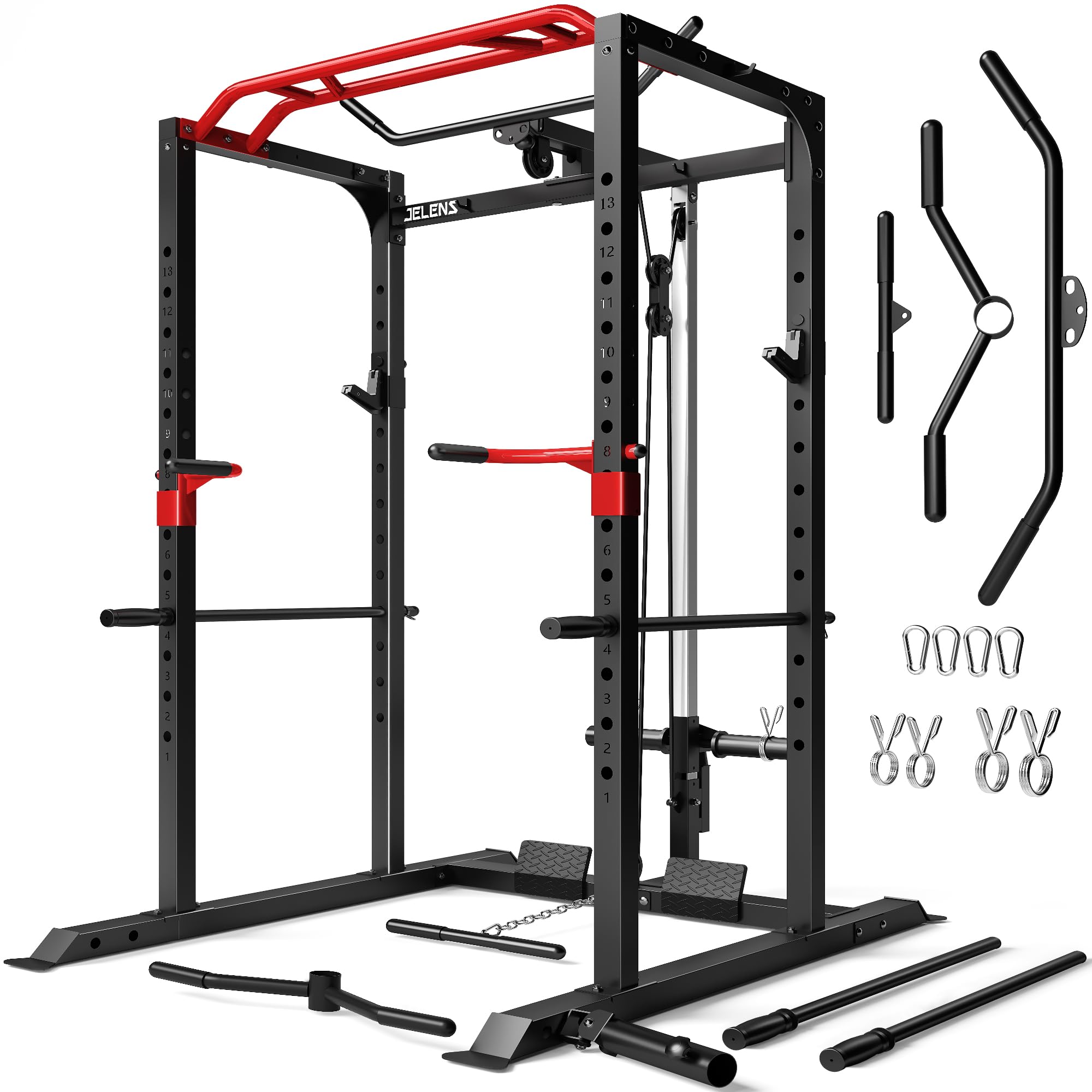
A 2000 lbs cage that ships with enough attachments to skip a second machine purchase.
If you want one frame to do nearly everything, start with the load number. The S11’s 50mm x 50mm heavy-duty steel pipes are rated for 2000 lbs, which is literally double the BEKING cage’s 1000 lbs and comfortably above the Sportsroyals at 1200 lbs. The steel surfaces are polished by high-speed sandblasting to resist rust, and the 13 height positions are marked with laser-cut numbers so you can find your setting by eye instead of counting holes.
The pulley system is the other reason to pick it. An up-and-down pull-down setup with precision steel shaft pulleys and polished solid steel wire rope runs smoother and quieter than cheap cable rigs, which keeps early-morning sessions quiet. The accessory kit is genuinely complete: a lat pull-down bar, cable bar, T-bar, pull-down bar, two J-hooks, two safety rods, a 360° landmine, and four counterweight racks with clamps. Each piece pops on and off quickly so you can switch from squats to cable rows in seconds.
The honest limit is assembly. It ships in two boxes and needs a proper setup session, and the taller 82.6″ frame combined with the 57.48″ depth wants a real chunk of floor. This is the cage for someone building a serious home gym around a single frame.
What you get for the load: a 2000 lbs rating, 13 numbered heights, and a full cable and landmine kit in one frame.
Set aside the time: two boxes and a full attachment set means you are building this, not unboxing it.
This one earns its place if: you want maximum load capacity plus cable work without stacking two machines in the garage.
Think twice if: you have limited assembly time or a shallow floor space under 58 inches deep.
7. Iron Crush i200 Power Rack

A 2×2″ rack that brings premium-precision 1.5″ hole spacing down a tier.
Most 2×2″ racks space their holes at 1″, which leaves gaps where the safety arms sit too high or too low for your exact squat depth. This one uses 1.5″ spacing, which is tighter and lets you set the catches closer to the bottom of your lift — a detail that usually lives on far more expensive racks. The uprights are built from 2mm thick steel, and the powder coat is made to resist chipping through heavy use. It is a lighter rig at 65 pounds, so it is easier to position but benefits from being set in a stable spot.
The pull-up bars are multi-grip and reversible — you can flip them to lower the height if your ceiling is tight, and you get wide, narrow, and hammer grip options. The J-hooks are solid with UHMW plastic pads that protect your bar and cut the clank. Assembly is straightforward, and the frame holds up under normal home training loads.
The thing to be honest about is that the listing does not publish a total weight capacity, so you should treat this as a rack for moderate working weights and confirm the rating with the seller if you lift heavy. It is a smart pick for a lifter who cares more about catch precision than about maximum load.
The precision angle: 1.5″ hole spacing lets you set the bars closer to your true squat depth than a standard 1″ rack.
Confirm one number: the total weight capacity is not published, so verify it against your program before ordering.
Made for: a careful lifter who wants precise catch placement and a reversible pull-up bar on a lighter frame.
Not for: a max-effort powerlifter who needs a published, high weight rating.
8. Sportsroyals Power Rack
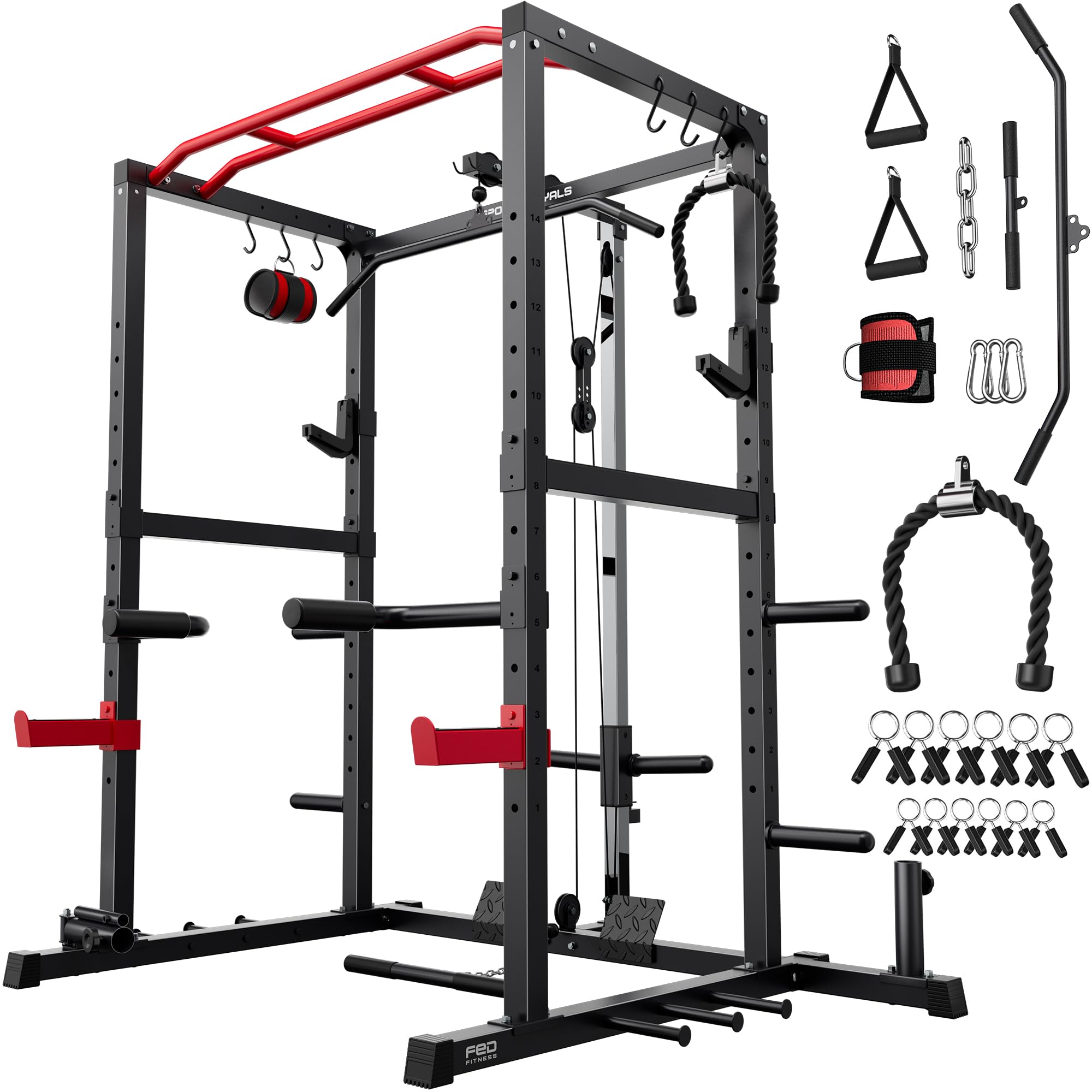
A cage that ships with a full accessory kit so you can train every muscle on day one.
Value is what wins people over on this rack. The frame is 50 x 50mm steel square tube at 1.5mm thickness, tested to support 1200 lbs, and it weighs 150 lbs with 2 reinforcing tabs that add stability during training. The pulley system is the standout: precision bearing pulleys and fully electroplated telescopic poles run smooth, and the upgraded PU-coated steel cable is rated to hold up to 500 lbs — plenty for any cable movement you will do at home.
The parts list reads like a full gym: 14 adjustable height levels, a rowing bar, four weight plate storage spots, six band pegs, safety arms and safety bars, a lat pull-down bar, dip stands, a tricep rope, an ankle strap, six barbell clamps, two cable handles, a wide and narrow pull-up frame, a 360° landmine, and a foot board. The plate storage fits both 2″ Olympic and 1″ standard plates. It also has a barbell storage holder and six handle storage hooks to keep the floor clear.
The honest caveat is stability. At 61.6″ L x 56.0″ W x 82.6″ H, the frame is wide, and some owners find it wiggles slightly in place even when the parts are correct. It ships in two boxes that can arrive on different days, and you should plan on 2-3 people for assembly.
Where the money goes: a 500 lb cable, 14 height levels, and enough attachments to fill a gym bag — all on a 1200 lb frame.
The catch: a slight wiggle is common, and the two-box shipment means you may wait a day between boxes.
Worth it for: someone who wants a wide set of attachments and smooth cable work without buying add-ons later.
Pass if: you need a dead-planted frame without shimming or a single-box delivery.
9. Mikolo F4 2.0 Power Cage
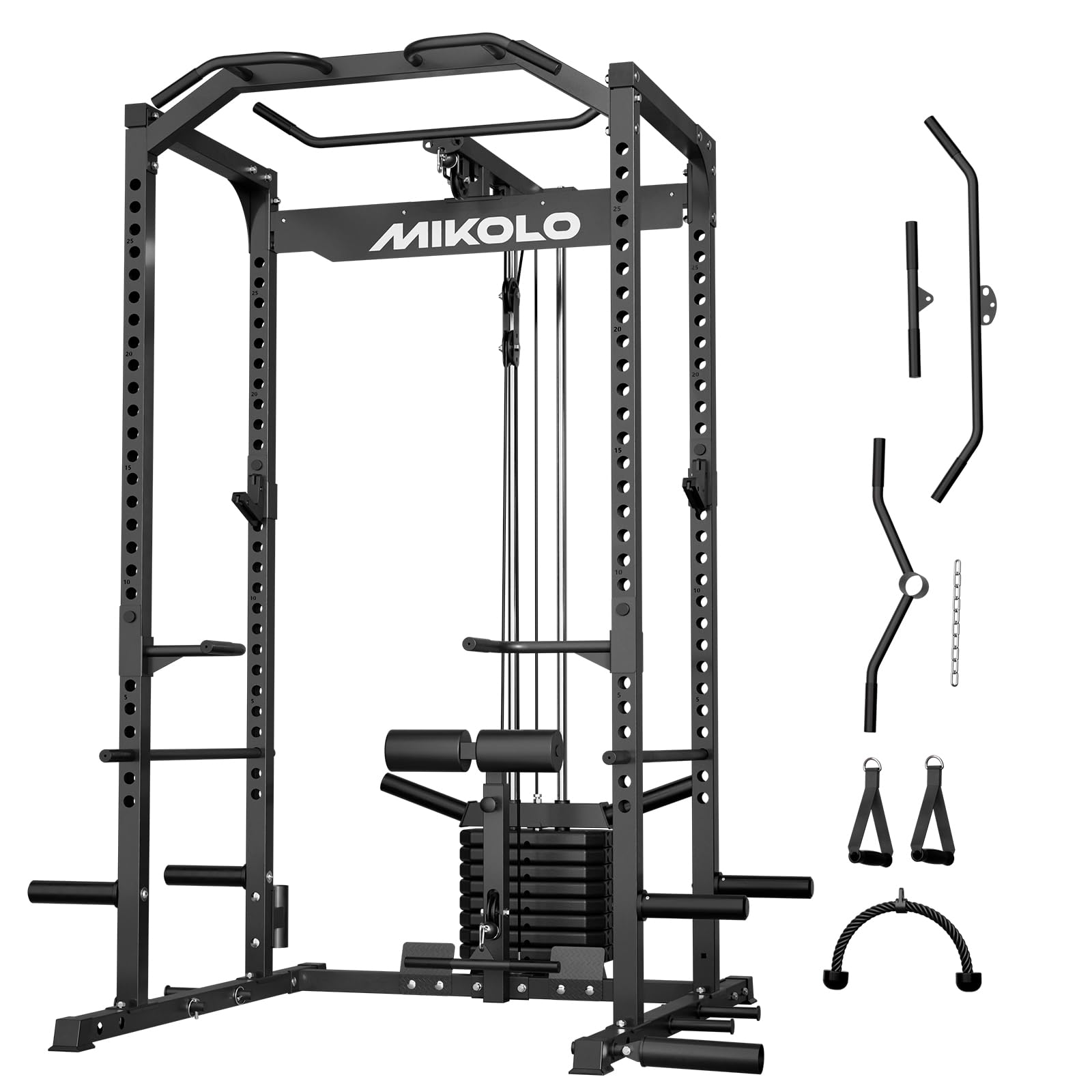
The cage with a built-in 100LB weight stack, so cable work never needs loose plates.
What sets the F4 2.0 apart is right there in the spec sheet: a 100LB integrated weight stack, which is rare for a rack in this class. Instead of dragging loose plates onto a loading pin, you pin-select your resistance and start pulling. The dual-track pulley system uses two precision steel guide rods instead of a single post, which runs smoother and does not tilt under load, and the aircraft-grade cables handle up to 500 lbs. The frame is 50mm x 50mm gauge steel with a tested 1200 lb static capacity and 27 adjustable height positions. It is a heavy rig at 252 pounds, which tells you how much steel is behind that stability.
The leg roller is the detail heavy lat pull-down pullers will love. A 5-level adjustable leg hold-down anchors your thighs so your body does not lift off the seat during hard pulldowns. The package covers squat rack, cable row, dip station, and a 360° landmine, with a lat bar, cable handles, T-bar, and J-cups included. Quick pin-select weight changes make switching between exercises fast.
The real constraint is that 252 pounds of steel needs a dedicated spot, and the built-in stack means you are locked into that resistance range rather than loading an unlimited amount of plate. If your cable work stays within the 100LB stack, the pin-select convenience is worth the fixed resistance.
The differentiator: a 100LB weight stack and a 5-level leg hold-down make heavy lat pulldowns feel anchored and quick to set up.
Know the trade: 252 pounds of frame wants permanent floor space, and cable resistance is capped by the stack.
Ideal when: lat pulldowns and cable rows are a core part of your training and you want fast pin-select changes.
Not ideal if: you need to break the rack down between sessions or load cables beyond the stack.
10. MAJOR FITNESS Drone3 Power Rack
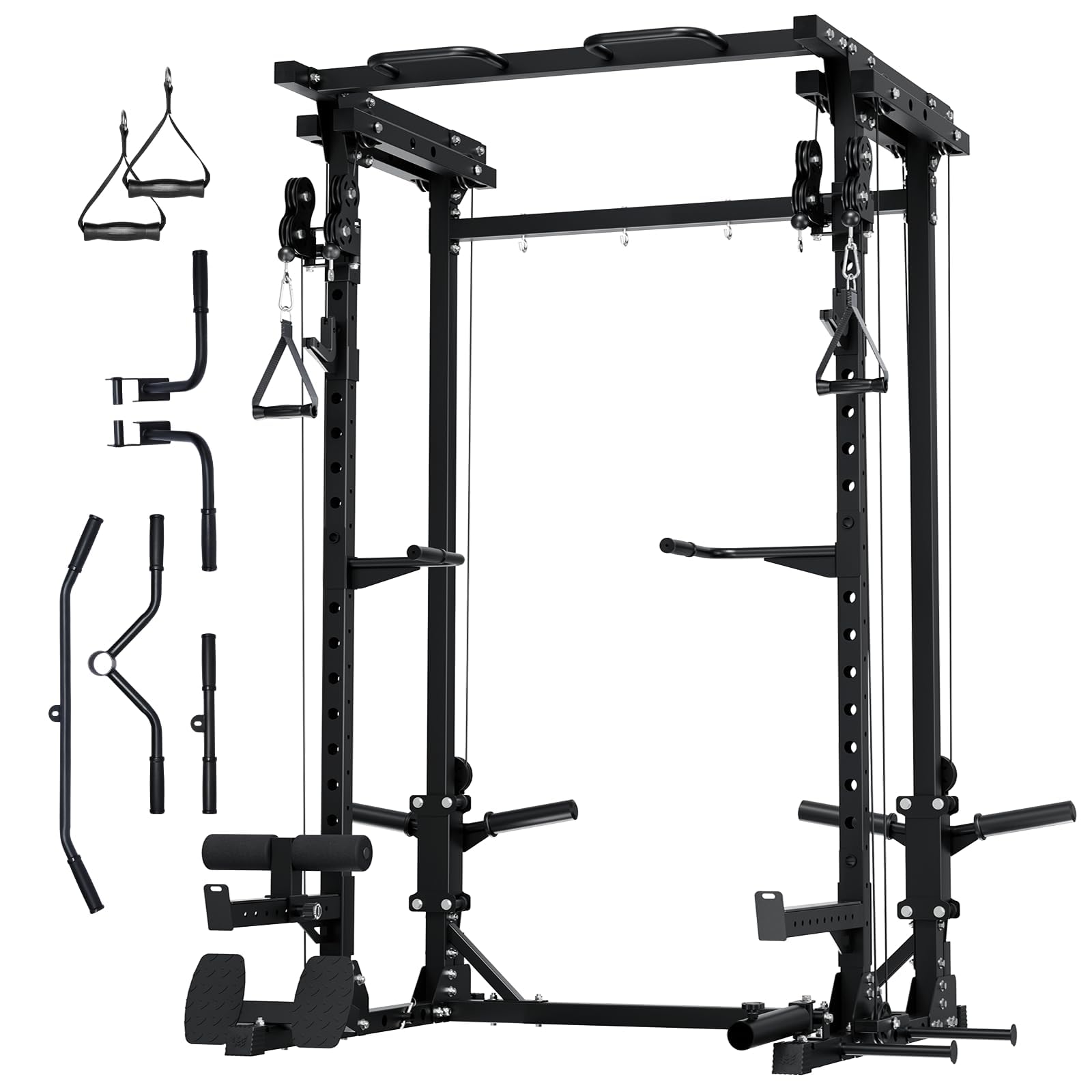
A 2500 lbs rack that out-loads every other cage here by a wide margin.
Start with the number, because it is the highest in this list: 2500 lbs of capacity built on 2×2-inch commercial-grade steel. The nearest competitor, the JELENS S11, is rated to 2000 lbs, and this one raises the ceiling further. The dual-pulley system lets you switch between a 2:1 ratio for smooth high-rep sets and a 1:1 ratio for heavy strength work, so the same cables suit both endurance and max-effort training. A linear bearing system keeps the bar path friction-free, and a spring system adds a safety layer. There are 19 precise height settings to dial in your stance.
For all that load capacity, it keeps a relatively compact footprint at 69.5″ W x 45.9″ D x 85″ H. The build includes a high pull-up bar, a T-bar, and a chest pull-up bar, which gives you plenty of upper-body variety without extra equipment. Built-in storage keeps the plates and bars off the floor, and the whole thing is made to let a couple of people train without a crowded mess.
The honest note is that the highest rating here comes at a premium, and the 85″ height plus the wide 69.5″ span means you need a roomy spot. If your working weights stay well under 2000 lbs, a lighter cage covers the same lifts in less space.
The headline spec: 2500 lbs of capacity, a switchable 2:1 / 1:1 pulley, and 19 height settings in one frame.
The honest limit: 85 inches tall and 69.5 inches wide means this rack wants a room, not a corner.
Pick it for: serious strength training where maximum load headroom and dual-ratio cables matter.
Look past it if: your space is tight or your training loads are well below the ceiling.
11. MAJOR FITNESS F22 Power Rack
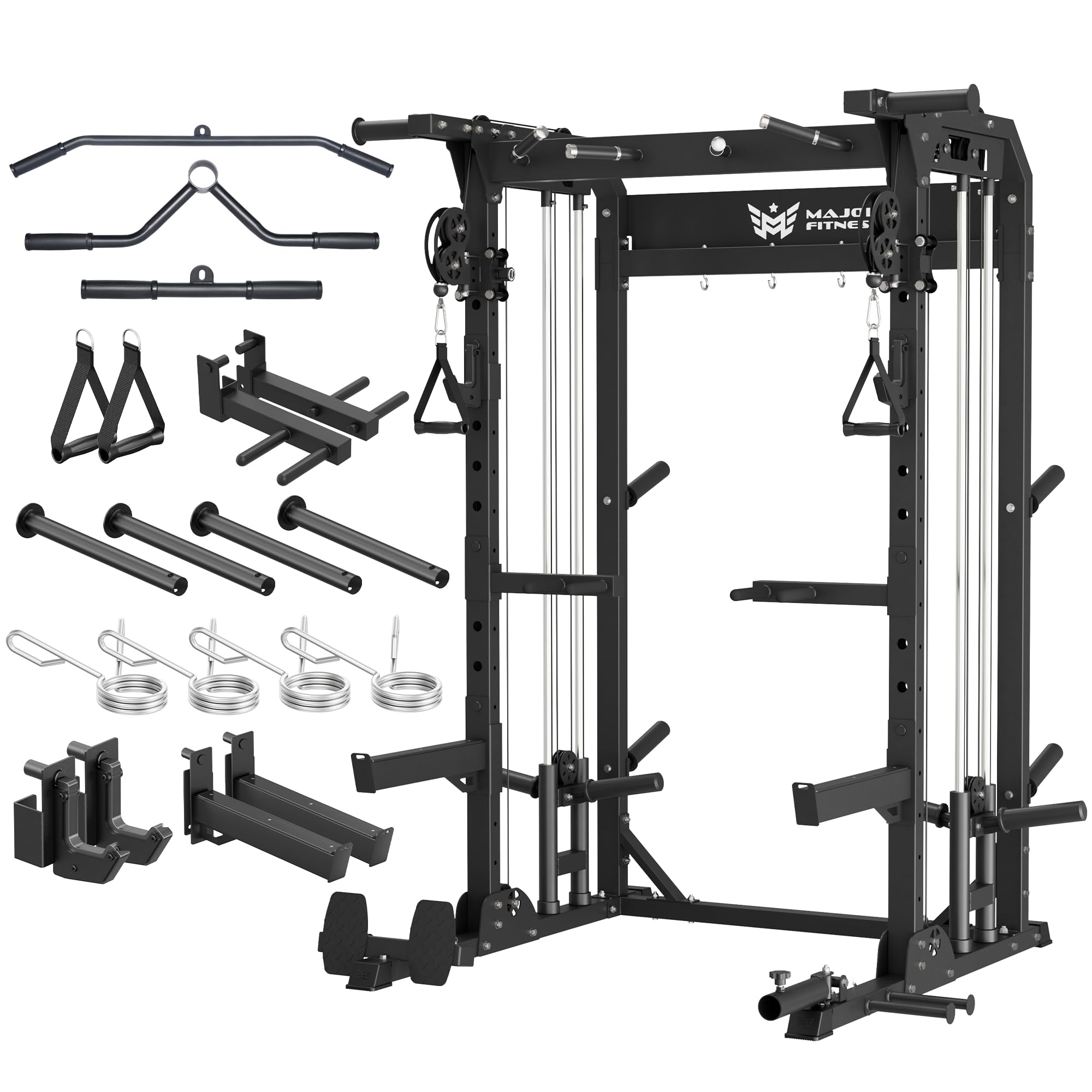
A three-in-one cage that lets two people train at the same time on separate cables.
This is the rack for a garage where more than one person trains. The independent dual-pulley system runs a 2:1 ratio for smoother cable travel, and two people can work at once without their cables tangling. That is a rare feature, and it is built on a frame of 2″x3″ commercial-grade 14-gauge steel — 0.08″ thick — rated for a 1600 lbs static capacity. The structural integrity is meant to keep the frame from warping or flexing under max-load squats and rack pulls. It weighs 243 pounds and combines a weight cage, squat rack, and dual-cable crossover in one compact footprint.
The dual-triangle base is designed to increase floor contact and cut the sway you feel during weighted pull-ups, and the maker says standard stability does not need floor bolting. The attachment set is thorough: J-hooks, safety arms, foot pedals, landmine, T-bar, dip bars, lat pulldown, cable bars, and band pegs. Integrated hooks keep all of it organized. The whole setup covers one-year parts coverage.
The honest concern is shipping damage. Some units arrive with badly bent components, so inspect the boxes before you assemble and contact the seller early if parts are damaged. Set against its 1600 lbs build and partner-friendly cables, it is still a strong buy for a shared home gym.
The partner advantage: independent dual cables let two lifters work side by side, backed by a 1600 lbs rating on 2″x3″ steel.
Check the boxes first: bent parts on arrival happen often enough to warrant an unboxing inspection.
Right for: households with two lifters who want cable crossovers and a shared cage without buying twice.
Consider a single-station rack if: you always train alone and would rather not pay for the partner feature.
Know the Specs
Weight Capacity
The rated capacity is the static load the rack is built to hold, given in pounds. It tells you how much weight the frame and safety bars can support when the bar is set down on them. Aim for a rack rated well above your heaviest working weight, because a missed rep drops with more force than a racked bar. The racks here start at 950 lbs and climb to 2500 lbs, so there is a fit for most home lifters.
Hole Spacing and Safety Arms
Hole spacing is the vertical distance between adjustment holes on the uprights — 1″ is common, and 1.5″ is tighter. A tighter spacing lets you set the safety arms closer to the bottom of your squat so a failed rep lands on the arms instead of on you. Arm length works with this: longer arms like the 16.7″ extension give the bar more room to be caught. Together, spacing and length decide how forgiving solo training really is.
Common Questions
How much weight capacity do I need in a squat rack?
Will a squat rack fit a 6ft barbell?
What is the difference between a half rack and a full cage?
Do I need to anchor my squat rack to the floor?
What does hole spacing mean on a power rack?
Can I do lat pulldowns on a squat rack?
How tall does a squat rack need to be for pull-ups?
Do squat racks need to be bolted down for bench press?
What is a 2:1 pulley ratio on a power cage?
How much floor space does a home squat rack take up?
The Bottom Line
For most home lifters, the weight lifting squat rack winner is the FLYBIRD SR1 because it pairs a 950 lbs rating and 16.7″ extended safety arms with a compact half-rack footprint that fits a spare room — the balance most people actually need for solo squats and bench work. If you want a full cage with storage and a pull-up bar for modest money, grab the BEKING All-in-ONE. And for heavy cable training with a lat pulldown and a leg hold-down, the Mikolo F4 2.0 is the one to reach for. Whichever way you go, buy capacity above your working weight and measure your ceiling before checkout — that pair of checks saves more home gyms than any brand name ever will.
How we choose
We do not accept paid placement. Every pick is matched to a real buyer and a real use-case; we do not hands-on test units.
Sources
Specifications: manufacturer listings and product documentation. Review insights: verified customer reviews, as of November 2026. Pricing: not shown on this page (it changes often); check the current price via the retailer link.
As an Amazon Associate, Tactical Gear Guy earns from qualifying purchases. This does not affect which products we feature.