Specs are compiled from manufacturer listings and verified buyer reviews and can change over time — please confirm the key details on the product page before buying.
If your trailer pushes your truck around on a windy highway, the fix is almost never a new truck — it is the hitch between them. A weight distribution and sway control hitch does two jobs at once. It spreads the trailer’s tongue weight (the downward load the trailer puts on the ball) back onto your truck’s front axle, so the truck sits level. It also resists the side-to-side wag that builds into a white-knuckle wiggle at speed. Buy the right one and a 30-foot camper tracks like it is on rails. Buy the wrong one and you get a pile of steel that is rated wrong for your trailer.
This guide is built by comparing the manufacturers’ published specifications and the patterns across verified customer reviews, so you get each pick’s real strengths and trade-offs instead of marketing spin.
The crowding here is between chain-style hitches that clamp the bars down and integrated friction designs that resist sway inside the head itself. Below you’ll find which one matches your tongue weight, your trailer frame, and how much bolting you’re willing to do in the driveway. This is my honest shortlist of the best weight distribution and sway control hitch options I’d trust with a family camper.
Top Picks


How To Choose The Best Weight Distribution and Sway Control Hitch
The two numbers most buyers get backwards are tongue weight and gross towing weight. Tongue weight is how much the loaded hitch of your trailer presses down on your ball — it is the number the spring bars are rated to hold. Gross trailer weight is everything rolling behind you, camper plus water plus gear. A hitch rated for 1,200 pounds of tongue weight can still be the wrong tool if your trailer frame is wider than its brackets will clamp.
Match the bars to your real tongue weight, not the brochure
Load your trailer the way you’ll actually travel, then weigh it. Bars sized far above your real tongue weight ride stiff and bounce; bars sized under it sag and let the tail wag. Chain-style round bars, like the ones on the Husky and Camco Eaz-Lift, are forgiving and simple to adjust with links. Trunnion bars on the CURT and Equalizer units sit in a different socket and load more evenly through their travel.
Friction sway control versus integrated sway control
The old approach is a separate sway bar that clamps a friction pad to the trailer frame — effective, but it adds steps and needs occasional loosening for backing. Integrated systems build the resistance into the hitch head, using either friction brackets or a spring-and-cam setup. They tow quieter and let you back up without pulling a pin.
Shank drop, rise, and trailer frame width
The shank is the vertical steel that slides into your receiver; the drop is how far the head hangs below it. Get this wrong and your trailer tongue rides nose-up or nose-down, which fights the whole hitch. Check your receiver height against your coupler height before ordering, and measure your trailer frame if the hitch uses clamp-on brackets — most clamp designs top out at a fixed frame width.
Side-by-Side Comparison
| Model | Best For | Max Tongue Weight | Max Towing | Sway Control | Amazon |
|---|---|---|---|---|---|
| Husky 30849 Round Bar★ Best Overall | Heavier campers on a budget | 1,200 lbs | 12,000 lbs | Included bar | Amazon |
| Camco Eaz-Lift Elite 48057Best Value | Half-ton trucks with mid-size trailers | 800 lbs | 10,000 lbs | Included bar | Amazon |
| Equalizer E2 10KSway Built In | Owners who want sway built in | — | 10,000 lbs | Integrated | Amazon |
| REESE 49912 Pro Round Bar | Wide trailer frames | — | 8,000 lbs | Included bar | Amazon |
| CURT 17601 TruTrack 2P | Simple bolt-on sway, no add-on bar | — | 10,000 lbs | Two-point | Amazon |
| Camco ReCurve R3 | Quiet towing and no grease | 1,200 lbs | 12,000 lbs | Adjustable single-bolt | Amazon |
| CURT 17500 TruTrack 4P | Maximum anti-sway confidence | — | 10,000 lbs | Four-point | Amazon |
| Andersen No-Sway | Fast hitching, no noise | — | 14,000 lbs GTWR | Built-in bar | Amazon |
| Blue Ox BXW1000 SwayPro | Rain and snow, quiet towing | 1,000 lbs | 10,000 lbs | Rotating latch | Amazon |
Detailed Reviews
1. Husky 30849 Weight Distribution Hitch
Our pick — 4.5+★ from 550+ verified ratings; the strongest balance of quality and price.
The 1,200-pound round-bar workhorse that levels a big camper without emptying the truck fund.
Here is the number that puts this one at the top: it is rated up to 1,200 pounds of tongue weight, the downward force the loaded hitch of your trailer presses onto the ball. That is the rating heavier campers need, and it clears the Camco Eaz-Lift Elite’s 800 pounds by a wide margin. Paired with the 12,000-pound gross trailer weight figure, this is the hitch that sits comfortably ahead of mid-size round-bar kits for a full-size camper.
Hooking up stays simple because the design is refreshingly mechanical. Spring bars (the steel arms that carry the load) bolt together with the ball mount and shank (the bar that slides into your receiver), the bars swap left or right, and the lift brackets let you hook up without wrestling a loaded tongue off the ground. You get 8 inches of total height adjustment, split as 5-5/8 inches of rise and 2-3/8 inches of drop, plus a 10-inch shank and a 12-3/4-inch ball-to-pin-hole span. That means setting your trailer level is a matter of picking the right holes once. The black polyester finish and alloy steel take the weather fine on a seasonal setup.
What wins people over is how it changes the whole tow. Owners routinely move up from a plain ball mount and describe a truck that no longer squats. One half-ton owner added the bars and had the truck towing a 6,500-pound trailer with the nose level where it belongs. The sway bar is the one step worth a little patience; a few find it fussy to set the first time, though most say the effort pays off within a mile. The 2-5/16-inch ball is included, and you’ll need your own sway control platform balls, since the head’s 1-1/4-inch hole takes a matching shank.
Where It Wins
- 1,200 lb tongue weight and 12,000 lb gross trailer weight ratings handle a full-size camper
- Bolt-together shank assembly with interchangeable spring bars
- 8 inches of total height adjustment for leveling across trucks
- Includes the 2-5/16-inch trailer ball and sway control bar
Where It Tests You
- 104 pounds of alloy steel — a two-person lift into the receiver
- Sway platform balls are not included
- The sway bar takes some fiddling to dial in the first time
Pick this for: heavier campers and full-size trucks that need a level ride without the premium-tier spend.
The honest caveat: at 104 pounds it is not a one-hand install, and the sway balls are extra.
2. Camco Eaz-Lift Elite 48057 Hitch
The kit that arrives half-assembled so your install is a bolt-check instead of a build project.
Installs that go wrong usually go wrong over torque specs. This Camco sidesteps the whole argument: the 2-5/16-inch hitch ball and the sway control ball come pre-installed and torqued to spec on the adjustable ball mount, and the U-bolts and chain package are already on the spring bars. You are checking bolts, not hunting for a torque wrench in the dark. The universal spring bars are interchangeable side to side, which matters when you lose track of which bar went where.
The ratings are honest and mid-weight. It handles a 1,000-pound maximum tow and 800 pounds of tongue weight. That 800 lb figure keeps the Camco Eaz-Lift Elite well under the Husky’s 1,200 lb bar rating, so size this one for mid-size travel trailers, not a toy hauler. At 88.5 pounds it stays manageable for one determined person, and that figure also edges under the Husky’s 104-pound heft in the same way.
Owners towing a 22-foot, 4,100-pound trailer with 525 pounds of tongue weight report the Suburban and trailer sitting level with no sway at highway speed. The recurring gripe is stability on the road: an occasional unit reportedly broke early into a trip, so check the hardware torque before your first long haul and re-check after a few hundred miles. The chain-style friction sway bar also wants to be loosened before you back into a tight site.
What Saves You Time
- Hitch ball and sway ball arrive pre-torqued to specification
- U-bolts and chain package pre-installed on the spring bars
- Interchangeable spring bars fit either side of the head
- 800 lb tongue and 1,000 lb max tow suit mid-size trailers
What To Watch
- A handful of buyers saw early hardware failure, so re-check torque after break-in
- Chain-style sway bar needs loosening before backing
- Not the pick for heavy campers near the 1,200 lb bar ceiling
Reach for this if: you want a half-ton truck and a mid-size camper leveled with minimal driveway work.
Look elsewhere if: you’re pulling a heavy toy hauler that needs bars past 800 lb of tongue weight.
3. EQUALIZER E2 94-00-1000 Hitch
Sway control that lives inside the hitch instead of clamped to the frame.
If bolting a separate sway bar to your trailer frame sounds like one more chore, this is the design that deletes it. The E2 folds weight distribution and sway control into one system, and the sway resistance comes from the hitch itself — no add-on bar to clamp, loosen, or forget. It’s rated for 10,000 pounds of pull force and offered in both round bar and trunnion styles, so you can match the bar shape to your comfort.
The build is alloy steel with a powder-coated finish, and the warranty is the headline: 10 years. That long a coverage window is a real vote of confidence in a wear part. The catch is some homework on the front end, because this model is a vehicle-specific fit rather than a universal bolt-on, so confirm your receiver and coupler before you commit.
Think of it as buying the integrated-design experience at a mid-range spend. You lose the simple link-by-link adjustability of the chain style, and setup takes a deliberate read of your vehicle’s fitment, but you gain a quieter tow and no extra hardware hanging off the frame.
Why it earns a look: the combination of a 10,000 lb pull rating, integrated sway, and the 10-year warranty is hard to match without stepping up to the four-point premium systems.
Who it doesn’t suit: if you want link-by-link tinkering or need to move one hitch between two different trucks, a vehicle-specific fit gets in the way.
Best fit for: a single dedicated tow rig where you want sway handled without add-on hardware.
Think twice if: you swap the hitch between vehicles — this one is built for a specific fit.
4. REESE 49912 Pro Hitch

Built for campers with wide frames and tight driveways, where the brackets have to clamp on without drilling.
Some trailers have frames too wide for most clamp-on kits. This REESE solves that with no-drill brackets that fit up to a 7-inch trailer frame, clamped on instead of welded. The kit arrives complete: a head with preinstalled 2-5/16-inch ball, tapered spring bars, an 8.5-inch-deep drop shank, control brackets, a lift-assist bar, and the hardware for an install that doesn’t require a torch.
It is rated for 8,000 pounds, which lands under the CURT 17601 TruTrack 2P’s 10,000-pound ceiling. That gap is the useful comparison here: if you are near or past the 8,000-pound mark gross, step up to the CURT or the Husky rather than pushing these bars. Under that ceiling, the tapered bars keep weight distributed over the axles through their travel.
Towing is where it earns its keep. Buyers report excellent sway control on a 24-foot trailer and stability in high winds, and the design lets you back up without pulling the bars. Setup is quick once you have the tools in hand — the printed manual is adequate, with the manufacturer’s setup video filling in the gaps. A word of warning from the carton side: the hitch is very heavy and can arrive with the packaging looking rough, so inspect everything before you start bolting.
The Case For It
- No-drill clamp brackets grip trailer frames up to 7 inches
- Complete kit with preinstalled 2-5/16-inch ball and 8.5-inch drop shank
- Tapered spring bars hold weight distribution across their travel
- Back up without removing the sway control
The Fine Print
- 8,000 lb rating is lower than the 10,000 lb CURT and Husky options
- Instructions are adequate but thin; the video helps
- Heavy unit — inspect the carton on delivery
Made for: campers with 7-inch frame rails and owners who dislike drilling.
Not your pick if: your loaded trailer runs past 8,000 pounds gross.
5. CURT 17601 TruTrack 2P Hitch

Friction brackets that resist sideways push, without the separate sway bar clamped to your frame.
The TruTrack 2P uses two points of friction to keep the trailer aligned — the brackets grip and resist lateral movement rather than relying on a friction pad bolted to your trailer frame. That means no add-on sway bar enters the picture, and the adjustable brackets provide fixed support in a way the chain-and-spring-bar designs don’t. It is rated for 10,000 pounds, forged spring bars, an adjustable 2-inch shank, and a 2-5/16-inch ball.
One feature deserves a callout: a head-tilt adjustment that simplifies setup and removes the washer-stacking guesswork some hitches require. It is a small thing that saves a frustrating afternoon, and it is one of the quieter reasons this hitch installs cleanly. The 94-pound alloy steel build is serious but liftable with a helper.
On the road, owners describe a big change on rough interstates — the trailer feels more stable and less prone to swaying at speed, and one F150 owner towing an 8,500-pound toy hauler called it an exact match. The one gap to expect is ball height: plan to spend a little time dialing in the tongue height so it sits correctly, because a hitch this rigid rewards an accurate setup.
The upgrade that matters: integrated two-point friction plus a washer-free head tilt makes this a strong step up from chain-only kits for drivers who want sway handled internally.
The honest trade: it still asks you to get the ball height right before the friction does its best work, and there’s no dual-cam spring system like the step-up TruTrack 4P offers.
Pick it when: you want friction-based sway control built into the head and a simpler setup.
Step up if: you want the cam-and-spring four-point system instead of friction alone.
6. Camco Eaz-Lift ReCurve R3 Hitch Kit
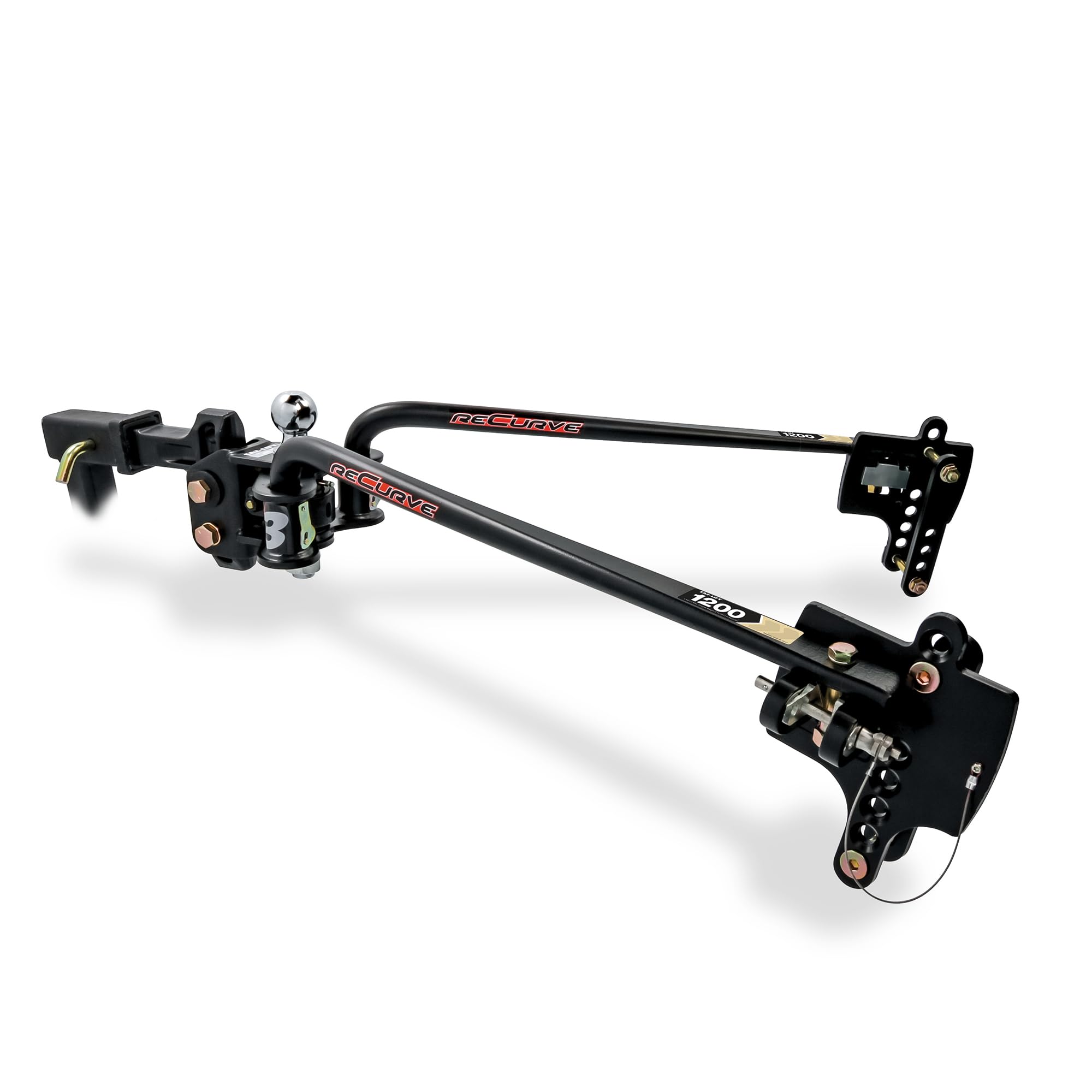
Top-loading bars and no-grease brackets — the quiet tow for people who hate the clunk.
The ReCurve R3 attacks the two things that wear on long tow days: the noise and the grease. Its top-loading spring bars drop into place without grease, and the design works to eliminate the clunking and creaking that traditional hitches make over expansion joints. The sway control adjusts with a quick bolt turn, and an on/off feature lets you turn it off to reverse or to navigate a tricky lot without the sway fighting you.
The numbers are top-tier: up to 1,200 pounds of tongue weight and 12,000 pounds of gross trailer weight, matching the Husky’s ceiling and well clear of the 800-pound bar rating on the Eaz-Lift Elite. The build uses high-carbon steel with a brake-pad style friction material, so the brackets and bars resist wear without constant greasing. You also get better ground clearance from the top-loading design and less physical effort on the hookup.
Owners find it stabilizes through bumps, crosswinds, and hard sway moments, and the single-bolt adjustment keeps the friction where you set it. The downsides are honest and minor: the bars carry real weight, and a few note small hardware gaps like a missing wrench, so check your kit contents. Occasionally chrome can lift off the ball over time. A 5-year limited warranty backs the assembly.
Why Towing Gets Quieter
- 1,200 lb tongue and 12,000 lb GTWR ratings for big campers
- No-grease top-loading bars save the greasy-hands routine
- Single-bolt sway adjustment with an on/off for reversing
- Better ground clearance with less hookup effort
Where It Costs You
- Bars carry real weight on and off the truck
- Check the box — a few kits arrived short a tool
- Premium spend over the Eaz-Lift Elite round bar
Choose it for: quiet, low-maintenance towing on a bigger camper without grease or extra sway hardware.
Weigh the bar weight if: you’re loading and unloading the setup solo every trip.
7. CURT 17500 TruTrack 4P Hitch
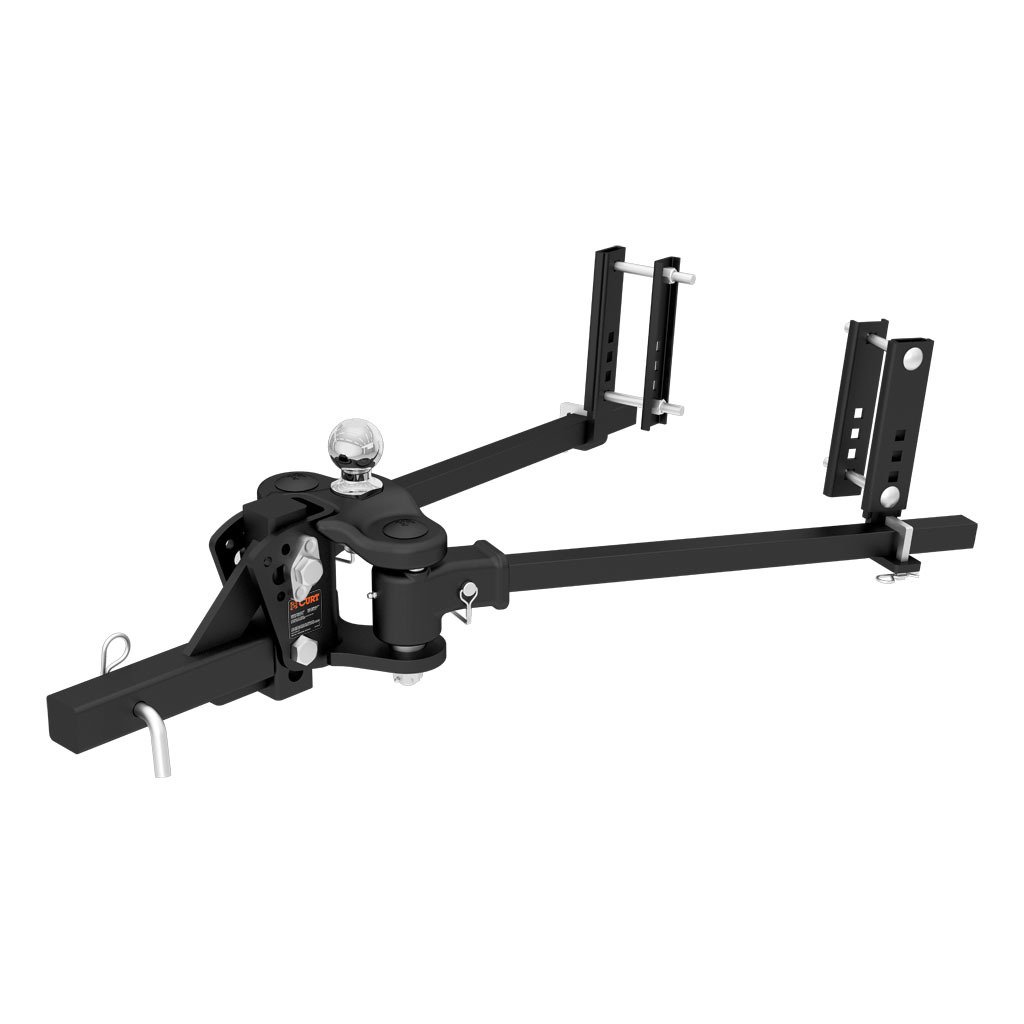
Four friction points and a cam-and-spring setup for the driver who wants sway handled from every angle.
Where the two-point TruTrack resists sway at two friction points, this one doubles down. The 4P works four points of sway control together, and its head uses a spring-and-cam system with hardened components in place of friction alone. The welded head with cast pieces and trunnion-style forged steel spring bars is the top of the CURT range, and it lands at a 10,000-pound rating with an adjustable 2-inch shank and a 2-5/16-inch ball.
The design detail that matters day to day is backing up. The adjustable brackets give fixed support rather than relying on a chain-and-spring-bar action, so you can reverse into a site without pulling a pin or loosening anything. The grease fittings sit where you can reach them, which keeps maintenance quick — one owner with a lifted truck before and a stock one now called the maintenance access easy.
Owners describe strong anti-sway and a ride without the porpoising bounce over rough pavement, and a 2011 F150 pulling a 27-foot trailer is the setup behind a lot of happy campers. The honest note is the weight: it is a heavy assembly, so plan for a two-hand lift and a spotter, especially if you are older or towing solo. Shipping occasionally shakes a part loose, though CURT reportedly ships replacements quickly.
Why drivers upgrade here: four points of sway control plus the cam-and-spring system give a firmer, more controlled tow than friction-only designs.
Be ready for: a genuinely heavy hitch and a setup that rewards a careful first install.
Right for: big trailers and long highway stretches where sway control confidence is worth the weight.
Skip if: light, frequent solo hitching is your routine and the two-point friction design already covers your trailer.
8. Andersen Hitches Weight Distribution Hitch
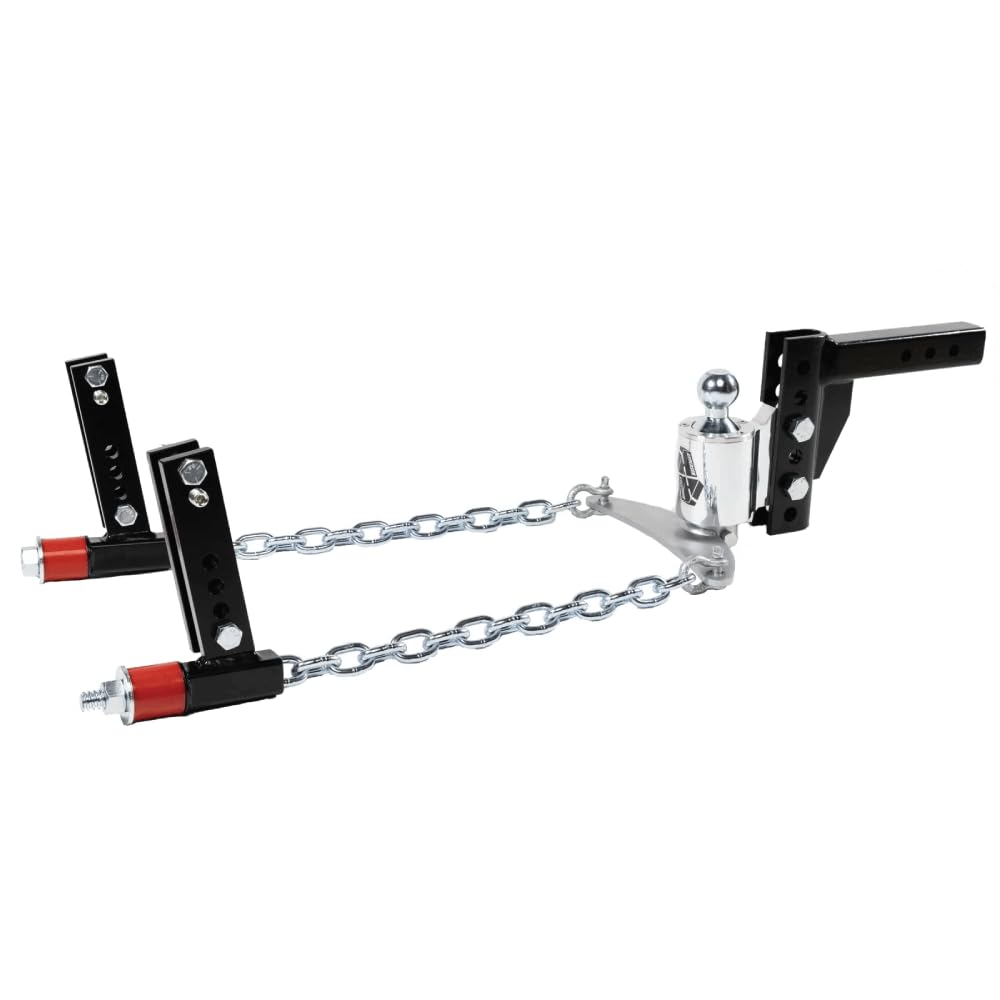
The hitch that hooks up in a fraction of the time and tows without a whisper of grinding.
Setup speed is this hitch’s whole personality. The Andersen distributes tongue weight across the vehicle-trailer combination to level the load, and it does so with a design owners describe as a fraction of the time to hitch and unhitch compared with bar-and-chain setups. It is rated to a 14,000-pound gross trailer weight, the highest ceiling on this list, and it is made in the USA.
The quiet ride is the other draw. Owners mention no squeaks or grinding, and one Airstream owner towing behind a 2019 truck called it the best hitch they had used. Stability holds up too: a 10,000-pound trailer with 1,300 pounds of tongue weight tows with great control, and a 31-foot camper rides level with reduced squat on a half-ton Suburban. The 2-inch shank with a 6-inch drop and 2-5/16-inch ball, plus brackets for 3 to 6-inch frames, covers a lot of trailer shapes.
The trade-off is that this is the pricey end of the list, and the design is different enough that you should read the setup instructions rather than assume your old habits transfer.
What Buyers Rave About
- 14,000 lb GTWR — the highest towing ceiling in this group
- Quiet operation with no grinding or squeaks
- Fast hitch and unhitch every trip
- Levels camper and reduces truck squat
What To Know
- Premium spend above the classic round-bar kits
- The design differs from bar systems — follow the setup steps
- Not the pick if you want link-by-link chain adjustment
The one for: frequent campers who want fast hookups and a near-silent tow.
Spend the difference if: you tow every weekend and dread the bar-and-chain routine.
9. Blue Ox BXW1000 SwayPro Hitch

Sway prevention that keeps working in rain and snow, with rotating latches and clamp-on brackets.
The SwayPro’s pitch is simple: noise-free sway prevention that never stops working, even in rain or snow. That matters if you tow in weather, because some friction designs lose effectiveness once they get wet. Here the resistance is built into the design rather than depending on a dry friction pad. It is rated for 1,000 pounds of tongue weight and 10,000 pounds gross towing weight, with a 7-hole, 9-inch receiver stinger on a standard 2-inch receiver.
Fit is the first thing to check. This model suits trailers with a coupler welded to the top of the frame, without cross-members on the tongue or blocking equipment — so measure before ordering. Setup is quick because the rotating latches sit on clamp-on brackets. At 68 pounds it is the lightest hitch in this group, which makes on-and-off far easier than the 100-plus-pound units.
On the road, customers note no sway and no noise, with one who had to back up through a tricky lot finding it a breeze to reverse with the hitch connected. A 30-foot, 8,000-pound trailer behind an F150 leaves the tow vehicle dropping evenly by less than half an inch — the precision you want. The adjustability at the chains is a small but welcome touch for dialing in your setup.
what separates it: weatherproof sway prevention that keeps working in rain and snow, plus the lightest 68-pound build on this list.
The catch: the SwayPro model fits only trailers with a coupler welded to the top of the frame and no blocking cross-members, so confirm your tongue before you buy.
Best for: all-weather tow conditions and drivers who want a lighter hitch to lift and clamp on.
Check first if: your trailer tongue has cross-members or a bottom-welded coupler — this model won’t fit.
Know the Specs
Tongue weight versus gross trailer weight
Tongue weight is the downward force your loaded trailer puts on the ball — the number the spring bars are rated to hold. Gross trailer weight is the total load rolling behind you, camper plus water plus gear. A hitch can be rated high on gross weight and still be wrong if the bars can’t hold your real tongue weight, so weigh the tongue loaded and match the bars to that.
Friction versus integrated sway control
Friction sway control uses a clamped pad or bracket that resists sideways movement; integrated control builds that resistance into the hitch head, sometimes with a spring-and-cam system. Friction is simple and can be tuned, but needs occasional loosening and can lose grip when wet. Integrated systems tow quieter and let you reverse without pulling a pin, at a higher entry cost.
Shank drop, rise, and height adjustment
The shank slides into your receiver and sets how high or low the hitch head sits. Too little drop and the trailer tongue rides nose-up, which fights the weight distribution. Total height adjustment, split into rise and drop, lets you level trailers with different coupler heights. Measure your receiver height against the coupler before ordering.
Trailer frame fit and bracket style
Clamp-on brackets grip the trailer frame without drilling, but each set has a maximum frame width — some models fit up to 7-inch frames, others only narrower ones. A few hitches are vehicle-specific, so confirm your receiver and coupler match. Getting the fit right means no drilling, no welding, and no bracket slipping once you’re on the road.
Common Questions
How do I know what tongue weight my trailer really has?
Can I back up with a weight distribution hitch attached?
What is the difference between a friction sway bar and integrated sway control?
Will the brackets fit my trailer frame?
Do I need to grease a weight distribution hitch?
How heavy are these hitches to lift on and off?
How do I set the shank drop so my trailer sits level?
Is a weight distribution hitch worth it for a half-ton truck?
Which sway control design works best in rain and snow?
Why might the hitch arrive with missing or damaged parts?
The Bottom Line
The safest call for most campers is the weight distribution and sway control hitch winner, the Husky 30849, because its 1,200-pound tongue and 12,000-pound gross ratings cover a real full-size camper without premium-tier money. If quiet towing and no grease matter most, the Camco ReCurve R3 delivers integrated sway with a 1,200-pound ceiling. And for fast hookups and near-silent tows, the Andersen No-Sway is the one to reach for — a fair nudge to check your real tongue weight first, then buy the bars sized for it.
How we choose
We do not accept paid placement. Every pick is matched to a real buyer and a real use-case; we do not hands-on test units.
Sources
Specifications: manufacturer listings and product documentation. Review insights: verified customer reviews, as of November 2026. Pricing: not shown on this page (it changes often); check the current price via the retailer link.
As an Amazon Associate, Tactical Gear Guy earns from qualifying purchases. This does not affect which products we feature.