Specs are compiled from manufacturer listings and verified buyer reviews and can change over time — please confirm the key details on the product page before buying.
Most weeds win because you pull the leaf and leave the root behind. A weed picker tool works differently: four metal claws close around the taproot and lever the whole plant out of the ground while you stay standing. The picks below range from a 60-inch long-handle set to a stainless-steel stand-up puller with a foot pedal, and every one of them is chosen to save your back first and kill the weed second.
This guide is built by comparing the manufacturers’ published specifications and the patterns across verified customer reviews, so you get each pick’s real strengths and trade-offs instead of marketing spin.
The best weed picker tool grips the taproot without making you kneel, and the Fiskars below — 4.0+ stars across 29,500+ ratings — is the one to start with.
Top Picks


How To Choose The Best Weed Picker Tool
Two weed picker tools with the same four-claw head can act very differently in your yard. What changes the result is how the claws close, how long the handle is, and whether a pedal pushes the tool into the soil.
Claw Design And Root Grip
A puller works by closing its claws around the weed’s taproot — the thick central root that keeps a dandelion coming back. Four serrated claws that pinch together will grip that root; two flimsy tines will slide off it. Look for stainless steel claws, since they keep their edge through wet soil and repeated use.
Claw length matters on deep-rooted weeds. A longer claw reaches further down the taproot, which means less chance the root snaps and regrows. If your lawn is mostly dandelion and thistle, favor a deeper claw over a wider one.
Handle Length And Your Back
A stand-up weeder keeps your hands high and your knees off the grass, which is the entire reason to buy one. A handle in the 39- to 52-inch range works for most adults standing upright; a 60-inch shaft helps taller gardeners or anyone who wants to weed without leaning far over.
Adjustable handles cost a little more but let two people share one tool. If you garden with a partner or want the tool to work for a shorter family member, an adjustable shaft that locks with screws rather than a twisting collar tends to stay tight during a pull.
Foot Pedal, Eject Mechanism, And Soil Type
A foot pedal lets you drive the claws into the ground with your body weight instead of your arms — worth having in firmer soil. Once the weed is out, an eject mechanism pushes it off the claws so you are not picking it loose by hand.
Almost every claw weeder performs best in damp, recently watered ground. In hard, dry, or clay-heavy soil, watering the patch first makes the claws bite cleanly. That timing is the single biggest factor in whether a puller feels easy or fights you.
Hoe And Rake Alternatives
Not every weeding job needs a claw. A push-pull hoe slices weeds just below the surface and covers a wide row fast; a two-in-one hoe and rake covers both jobs with one shaft. If your weeds are mostly small annuals in open soil, a hoe can be faster than a puller — but it will not lift a deep taproot cleanly.
Side-by-Side Comparison
| Model | Best For | Head Type | Handle Length | Weight | Amazon |
|---|---|---|---|---|---|
| Fiskars Deluxe Stand-Up Weed Puller★ Best Overall | Most yards, most soil | 4 stainless claws | 39.25 in | 2.5 lb | Amazon |
| 60″ Long Handle Weeding SetBest Value Set | Two-person households | Dual-sided rake and hoe | 60 in | 2.4 lb | Amazon |
| Triangle Garden HoeBest for Edging | Crooked rows and edging | Triangular carbon steel blade | Up to 57 in | 1.85 lb | Amazon |
| Allsetool Weed Puller with Eject | Fast repeat pulling | 4 metal claws and foot pedal | 43.7 in | 3.61 lb | Amazon |
| LAWFYMORI 60″ Weed Puller | One tool for two jobs | 2-in-1 hoe and 6-tine rake | 17–60 in | 0.84 kg | Amazon |
| COCONUT Stirrup Hoe | Early-season cultivating | Stirrup blade and cultivator | 62 in | — | Amazon |
| SOMOLUX 52″ Stand-Up Weeder | Full-metal build | 4 curved stainless claws | 52 in | 3.3 lb | Amazon |
| SOMOLUX 52″ Serrated Claw Weeder | Tough weed variety | 4 serrated 3″ claws | 52 in | — | Amazon |
| HAUSPROFI Stand-Up Puller with Bag | Cleanup in one kit | 4 stainless claws | 36–46 in | — | Amazon |
Detailed Reviews
1. Fiskars Deluxe Stand-Up Weed Puller Tool
Our pick — 4.0+★ from 29,500+ verified ratings; the strongest balance of quality and price.
The weeder that turned kneeling in the grass into a standing job for a whole generation of gardeners.
Four serrated stainless steel claws are the heart of this tool. You press them around a dandelion with the foot pedal, lean the aluminum handle back, and the claws clamp shut on the taproot and lever it free. The offset handle takes the twist out of your wrist, and a viewing window lets you line the claws up on the weed before you commit. A 39.25-inch shaft keeps you upright the entire time.
What wins people over is the build. The claws are stainless steel and the blades hold their edge through heavy, repeated use, which is why this one has become the default recommendation in the category. It comes with a lifetime warranty, and the whole thing weighs 2.5 pounds. It holds 4.0+ stars across 29,500+ ratings, the strongest review record in this lineup.
The honest catch is durability versus expectation: a share of long-term buyers report the claws eventually giving out, and some question whether the tool justifies its premium tier. Treat damp soil as a requirement rather than a suggestion — in dry, compacted, or clay-heavy ground, water the patch 30–60 minutes beforehand so the claws bite. The other thing to know is that a few buyers find replacing the head more hassle than expected, so store it dry.
Why it earns the top spot
- Four serrated stainless steel claws clamp onto the taproot for a clean pull
- Foot pedal drives the claws into firm soil without arm strain
- 39.25-inch aluminum handle keeps you standing upright
- Offset grip and viewing window make aiming easy on small weeds
Where it asks more of you
- Needs moist or recently watered ground to bite cleanly
- Some long-term owners mention the claws wearing out over seasons
- Heavier and pricier than a simple hoe
Buy this one if: you have a lawn full of dandelions and thistles and want one tool that grips the root without kneeling.
Look elsewhere if: your soil is hard-packed clay year-round — you will spend more time watering than weeding.
2. 60″ Weed Puller Tool
Two tools, two lengths, one set that keeps both the tall and the short gardener out of the dirt.
You get a 60-inch stand-up weeder and a 17-inch hand tool in the same box. The long pole adjusts from 16 inches to 60 inches, so one person weeds the whole lawn upright and someone else uses the short tool to dig into tight beds and narrow gaps. At 2.4 pounds, it is light enough to swing around for a full afternoon without tiring your arms.
Functionality is the reason this set holds its score, backed by a welded one-piece cast steel head that resists deformation and rust. The connection method is the smart part: the pole sections screw together and lock instead of relying on a twisting collar, so the shaft does not loosen mid-pull and force you to stop and re-tighten. It also serves as a dual-sided head — one side with sharp tines for roots, the other with a flat edge for leveling soil.
You trade some grip for safety and a dual-sided head. The tines (the pointed prongs) are sharp, so keep the tool away from children and pets. The dual-sided head does not clamp like a dedicated four-claw puller; it digs and pries instead of gripping. If your yard is all deep dandelions, a claw puller above will pull roots better. If you want one tool that weeds, loosens, and digs, this is the pick.
Family-friendly value: A two-tool set at the entry-level end of the range is the practical choice when more than one person weeds, and the adjustable 16″–60″ shaft covers a range of heights in one purchase.
What to expect: Sharp tines demand careful storage, and the hoe-and-rake head pries rather than clamps, so it excels at surface weeds and loose soil more than stubborn taproots.
Reach for this if: two people share the yard work, or you want a single tool that also loosens soil and digs planting holes.
Pass it over if: you need a dedicated claw that clamps a taproot — this head digs and levers instead.
3. Triangle Garden Hoe, Carbon Steel Push-Pull Weeding Tool
A triangular blade that slices weeds in tight corners where a claw puller cannot fit.
The triangular carbon steel head on this hoe lets you push or pull to cut weeds just below the surface, which makes it the tool for edging beds, working between pavers, and clearing a crooked row. The stainless steel handle adjusts up to 57 inches so you stay standing, and a padded cover at the end keeps your grip comfortable through a long session.
Its weight separates it from the claw pullers here: at 1.85 pounds versus the Allsetool puller at 3.61 pounds, it stays easy on the arms through a long weeding run. Customers note it works in both dry and wet soil, which helps when the ground is too hard for a clamp-style claw. The handle detaches for storage, and the head fixes on with screws so it will not slip off mid-task.
The honest gripes are the weight as some see it and the handle itself. A few find it slightly heavy for a hoe, and the handle durability is the recurring concern — treat it as a slicing and edging tool, not a pry bar, and it holds up. There is no claw to grip a dandelion root, so deep taproot weeds need the pullers above.
Light and precise: 1.85 pounds and a triangular edge make short work of edging and between-paver weeds, and the adjustable 57-inch handle saves the same bend you would feel with a short hoe.
The catch: No clamping claws, and the handle is the part to watch over a long season — keep the pull on the blade, not the shaft.
Best suited to: gardeners who edge beds, clean between pavers, or weed in soil too hard for a claw puller.
Not the tool for: deep taproot weeds like mature dandelions, which need a clamping claw puller.
4. Weed Puller Tool with 2 Weed Eject Feature
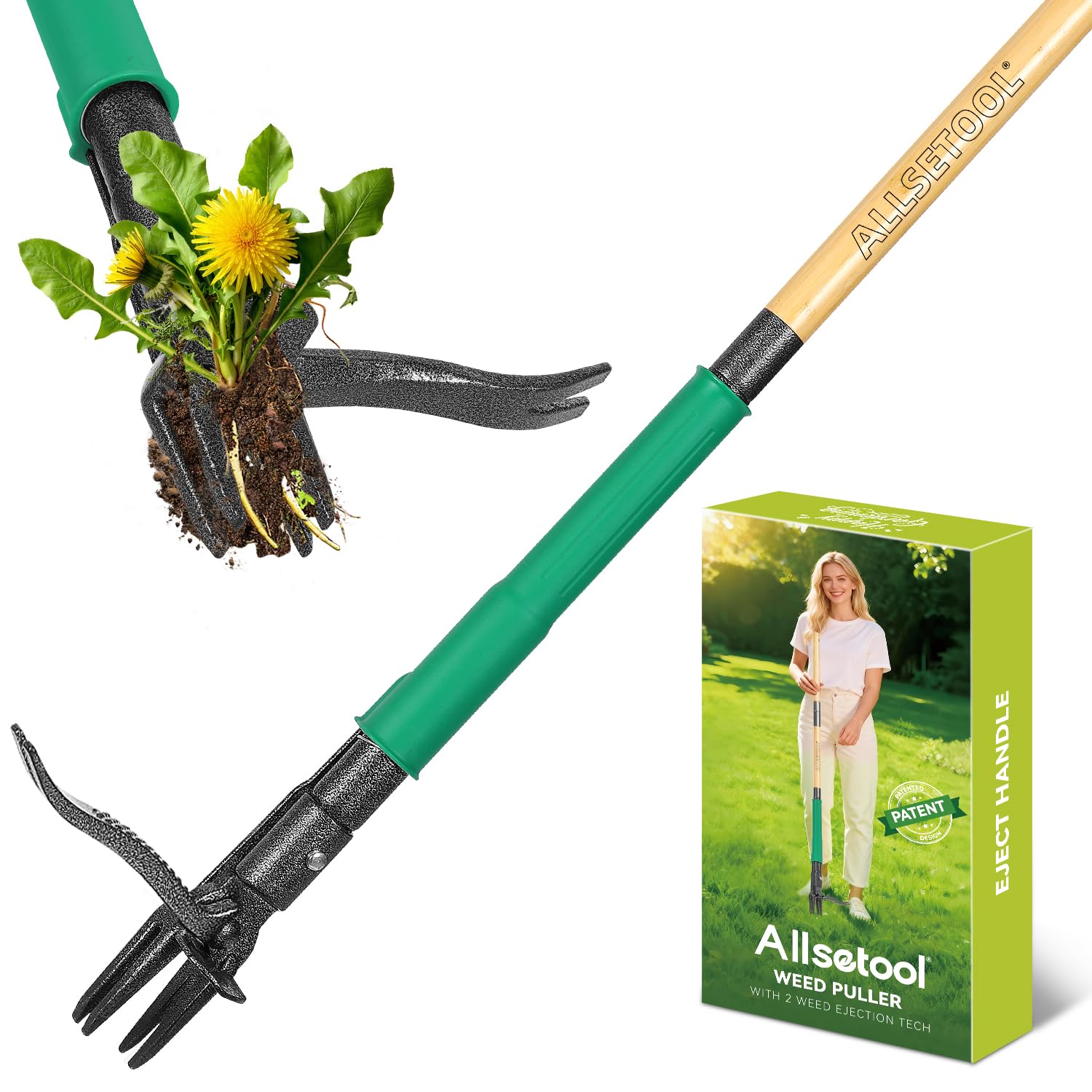
Two ways to dump the weed off the claws so you never touch it with your hands.
This is the puller for a fast rhythm across a big lawn. Four pointed metal claws drive into the soil, grip the root, and lever it out — then the eject system does the cleanup. You can slide the weed off with the eject handle or kick the eject pedal to push it out with your foot. No bending to yank a plant off the tines.
Reviewers point out the puller is effective on flat, spread-out weeds, and assembly takes only about 30 seconds — a genuine plus if you want to weed the same afternoon it arrives. The foot pedal is metal rather than plastic and has a non-slip textured surface, so it holds up when you step down hard in damp ground. The 43.7-inch shaft keeps you standing, and the real bamboo handle adds warmth to the grip compared with an all-metal pole.
The catch is weight and soil contact. At 3.61 pounds versus the Triangle Garden Hoe at 1.85 pounds, it is a two-handed tool, not a one-hand whip. And like every claw puller here, it wants damp ground after rain or watering. In dry, rocky, or uneven soil, the claws can slide instead of gripping, which is the fit issue to expect — this one shines on a level lawn, not a wild slope.
Where it pulls ahead
- Two eject options — handle slide or foot pedal — mean faster repeat pulls
- Metal non-slip foot pedal takes real body weight
- Ready to use in about 30 seconds of assembly
- Bamboo handle and 43.7-inch shaft keep you upright and comfortable
Things to weigh
- 3.61 pounds makes it heavier than the lighter hoes in this lineup
- Works best in damp ground after rain or watering
- Less consistent on rocky or uneven soil
Ideal for: clearing a flat lawn quickly, where the eject system saves your hands on every pull.
Think twice if: your yard is uneven or rocky, or you want a light one-handed tool.
5. Weed Puller Tool with Long Handle, 60″ Garden Weeding Tool
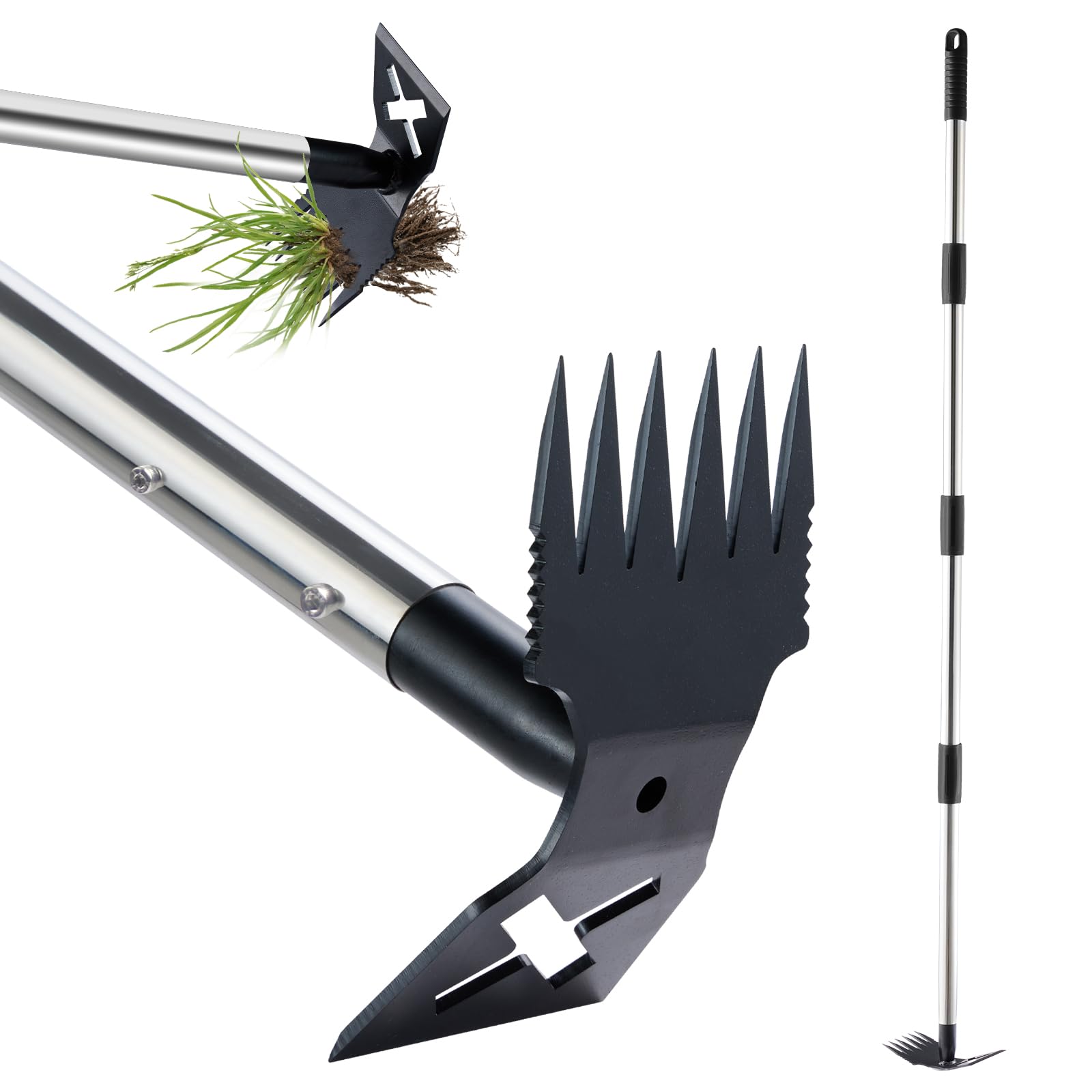
Four pole sections that build into 17, 31, 45, or 60 inches — one shaft for every gardener in the house.
The clue to this tool is in its adjustability: four detachable stainless steel poles let you set it at 17, 31, 45, or 60 inches to match your height and the job. The 2-in-1 cast steel head flips between a six-tine weed rake that goes deep for roots and a flat-edged hoe for clearing wide patches and leveling soil. At 0.84 kg it stays manageable however you configure it.
Effectiveness is the headline — this one is built for weeds with deep tap roots, and the long handle takes the bend out of your back. Adjustability is the feature buyers talk about most after that, and it earns its keep: shorten the shaft for close work in beds, extend it to 60 inches for the open lawn. The detachable poles also break down flat for storage, which matters when your shed is already full.
Honesty note: the sturdy feel is not universal. Some shoppers say durability issues, and the sharpness of the tines draws divided opinions — sharp enough to bite, or not sharp enough to suit some. Keep it to soil work and the poles intact, and it does its job. It is a rake-and-hoe head, so for gripping a single dandelion root, the four-claw pullers above still do that job more cleanly.
Configure to fit: The four-pole build covering 17″ to 60″ is the most flexible shaft here, and the six-tine rake side is designed to reach deep tap roots without bending.
The honest limit: Mixed feedback on long-term sturdiness and on how sharp the tines arrive, so store the poles dry and do not overload the joints.
Worth it for: households where several heights of gardener share the tool, or where storage space is tight.
Better to choose a claw puller if: your priority is clamping a single taproot out of hard ground.
6. Garden Hoe Hula Hoe

A stirrup blade and cultivator in one — the early-season tool for working around young plants.
The stirrup head on this hoe slices weeds just below the surface by cutting on both push and pull strokes, so you cover a row with both directions of movement. Flip the head and it becomes a cultivator for loosening soil. It is built for early-season work around seedlings, where a claw puller would tear up the young plants you want to keep.
Its reach separates it: the heavy-duty steel handle runs out to 62 inches versus the Fiskars at 39.25 inches, so you stay fully upright in long beds and vegetable rows. The double-edged blade cuts on either end to cut effort in soft to medium soil, and the rods screw together in minutes.
Two things temper it. Long-term durability gets mixed reviews, and a share of buyers find the value questionable for what is a fairly simple tool — so treat the joints with care and tighten them when you assemble. The blade is also designed for soft to medium soil, not hard clay. If your beds are established and full of taproot weeds, a claw puller wins; for loose, annual weeds between seedlings, this slices faster.
The long-reach slicer: A 62-inch steel handle and a stirrup blade that cuts on push and pull is the combo for covering vegetable rows fast and staying upright.
Mind the joints: Durability feedback is mixed, so screw the rods tight and avoid prying with the blade — it is a slicer, not a pick.
Most useful for: vegetable and flower beds in early season, where you need to cut weeds between young plants without disturbing roots.
Reconsider if: you need to lift established taproot weeds — this blade cuts tops, it does not clamp roots.
7. SOMOLUX 52” Weed Puller Tool

Built entirely from stainless steel and metal to solve the snapped-claw problem other pullers run into.
Four curved claws sit on a 52-inch stainless steel shaft built to survive heavy use without the claw or the pole breaking away. The method is a three-step rhythm: center the puller over the weed, step the pedal to drive the four claws into the soil, then lean the handle toward the pedal side to close the claw and lift the weed out. The curved claws are designed to work across soil types, with best results after rain or watering.
What wins people over is the solidity. Owners describe a heavy-duty build that will not come apart with heavy use, and that matters most for anyone weeding on a slope or in stubborn patches. Functionality and quality both drive its reputation, and the 52-inch handle makes it a stand-up tool from the first pull — no kneeling, no sore back. The maker backs it with a lifetime warranty.
The recurring gripe is durability over the long haul — a share of buyers report the tool not lasting as expected — and a few find the value questionable at its premium tier. Read that as a care note: these are tools that reward storing them dry and not abusing the joints. On a level lawn after rain, it grips and lifts; on a rocky slope, expect to reset the claws more often.
What earns it a premium place
- Whole body made from stainless steel and metal, with curved claws built for all soil types
- 52-inch handle means a full stand-up pull on every weed
- Simple three-step center, step, lean method that anyone can learn
- Backed by a lifetime warranty
Where the shine fades
- Durability is the recurring concern over several seasons
- A few find the value hard to justify at its premium tier
- Best performance still needs damp ground to bite cleanly
Go for it if: you want a stand-up puller built around a full-metal shaft and are ready to care for it properly.
Hold off if: you want a low-maintenance tool you can leave outside — this one rewards dry storage.
8. SOMOLUX 52” Weed Puller
Four serrated three-inch claws sized to grab the widest variety of weeds in one pull.
The claws are the story here: four 3-inch stainless steel claws with serrated teeth, designed to grip almost any type of weed — dandelions, crabgrass, chickweed, thistle. Serrated edges bite into the root rather than sliding off it, which is why this one handles a wider weed variety than the curved-claw puller next to it. The water-resistant stainless steel and 52-inch handle mean it stands up to wet ground and keeps you upright.
Assembly and use are where it earns its keep — owners mention it goes together easily and needs minimal force to pull, which helps if grip strength is a concern. Unlike a fixed-length puller, the long handle gives you a full stand-up pull without the bend. The maker backs it with a lifetime warranty, and the tool is designed to be used from a standing position the whole time.
Buyers split on weeding ability and value. Some say it handles larger weeds well and is worth the money; others find it ineffective on their particular weeds and question the value. That gap usually depends on soil and weed type: on small or shallow-rooted weeds the three-inch claw has less to grip. In damp ground with real taproots, it performs; on dry, shallow weeds, it may come up empty.
Grip and variety: Serrated 3-inch claws are designed for the broadest weed range in this lineup, and the 52-inch shaft keeps the pull standing.
The honest split: Results vary by weed type — strong on bigger taproots, weaker on small shallow weeds — so match it to what is actually in your lawn.
Right for: a lawn with a mix of weed types, especially larger taproot weeds you want out in one pull.
Not ideal for: a yard of small, shallow-rooted weeds, where the deep claw has less to grab.
9. HAUSPROFI Stand Up Weed Puller Tool
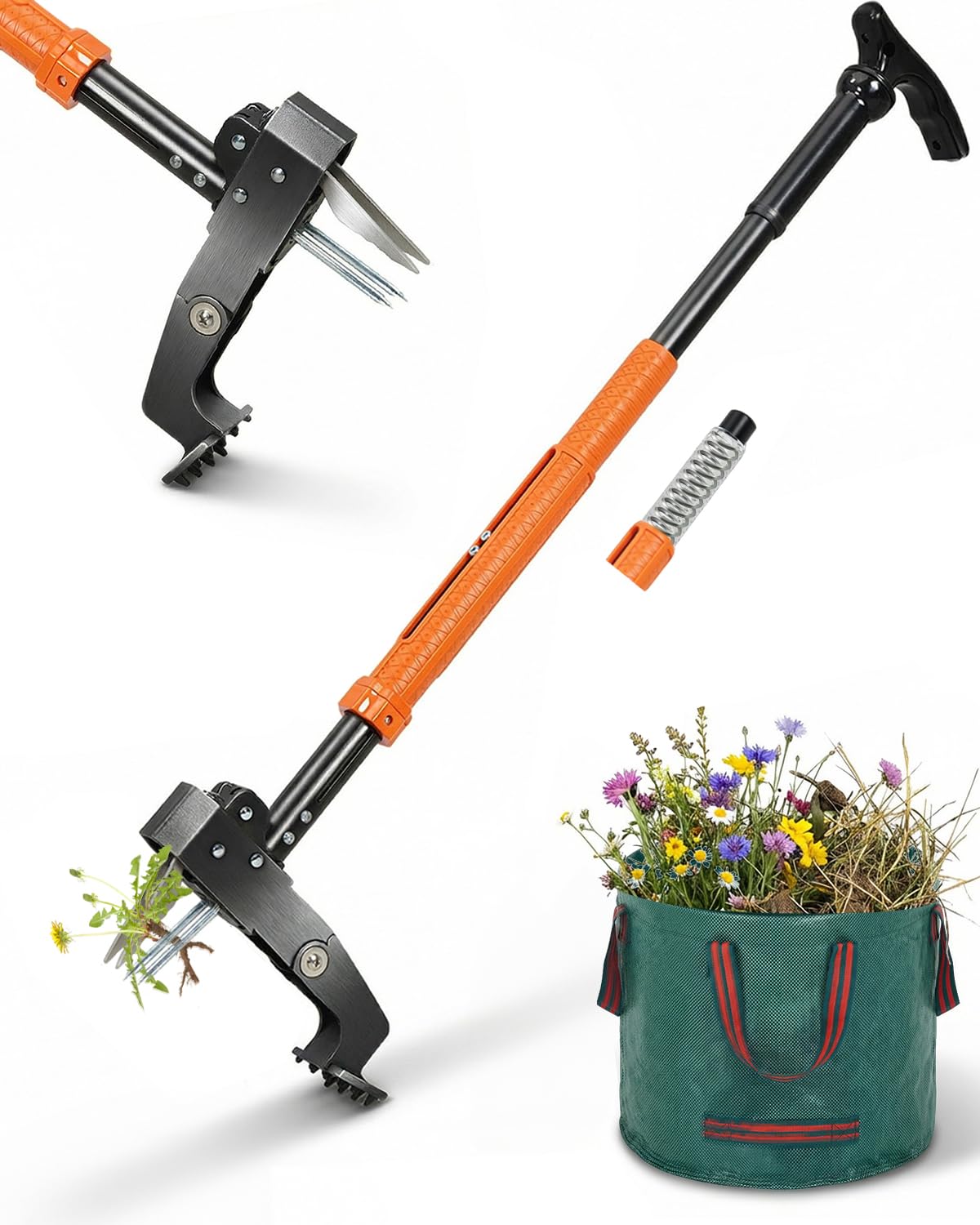
A spring-back eject and a 50-liter bag, so the weed goes straight from claw to sack.
This puller pairs four stainless steel claws with a quick-release eject: a light push on the handle sleeve throws the plant and soil out, and the head springs back for the next pull. You get two handle lengths, 36 inches and 46 inches, for different heights. The kit also throws in a 50-liter garden waste bag so you can collect pulled weeds and leaves as you go.
The deep-root removal relies on the four heavy-duty claws and a lever principle, so you push the pedal down, lean the handle, and lift the root out with minimal effort. The automatic rebound is the part that makes it feel different from a manual eject — the workflow keeps rolling without a second motion to reset. It is also built for transplanting seedlings, so it earns a place beyond just weeding.
Two honest cautions. Effectiveness and ease of use get mixed feedback: some find it works well, others do not. The instructions are a known weak spot, so plan to watch the maker’s install video rather than rely on the leaflet. If you get it set up right and use it in soft soil, the adjustability and the included bag make it a tidy all-in-one kit.
What makes it different
- Automatic rebound eject springs back for a continuous weeding rhythm
- Two handle lengths — 36″ and 46″ — to fit different users
- Comes with a 50-liter garden waste bag for cleanup
- Four stainless steel claws and a lever principle for deep roots
Where to stay wary
- Effectiveness and ease of use draw mixed reports
- Instructions are a weak point — rely on the video
- Best in soft soil; harder ground needs softening first
Choose it when: you want one kit that pulls, ejects, and bags the weeds, with handle lengths that adjust to your height.
Skip the fuss if: you dislike setup — the instructions are the weak link and you will want the install video first.
Know the Specs
Claw Type And Serration
Claws are the working end. Serrated claws have small teeth that bite into a root instead of sliding off it, while curved smooth claws close around the root and lever it out. Both work on taproots; serrated edges tend to grab a wider range of weed types. Stainless steel keeps its edge in wet soil better than plain steel, which matters across seasons.
Handle Length And Adjustability
A longer handle keeps you further from the soil and more upright. A 39- to 52-inch shaft suits most standing adults; a 60-inch shaft helps taller gardeners. Adjustable shafts trade a fixed build for flexibility — screw-locked sections stay tighter during a pull than twist collars, which can loosen when you lever the tool.
Eject Mechanisms
After a pull, the weed clings to the claws. A manual eject uses a handle or pedal to push it off; an automatic rebound springs the head back to ready on its own. Both save your hands from touching the plant; the rebound version keeps your pulling rhythm going without a reset motion.
Soil Condition
Claw pullers bite best in damp, recently watered ground. In hard, compacted, or clay-heavy soil, the claws can slide off the root or fail to penetrate. Watering the patch beforehand — as much as 30–60 minutes for tough ground — is the single biggest factor in a clean pull.
Common Questions
Will a claw weeder work in dry, hard clay soil?
What handle length should I pick for my height?
How long does a weed picker tool last?
Does a puller or a hoe work better for dandelions?
What is a foot pedal for on a weed puller?
Can I use a weed picker tool for planting or loosening soil?
Is a stand-up weeder really easier on your back?
Do I need to sharpen the claws?
What is the difference between the two SOMOLUX pullers?
The Bottom Line
For most lawns, start with the Fiskars Deluxe Stand-Up Weed Puller: four serrated stainless claws and a foot pedal clamp the taproot, and the 39.25-inch handle keeps you standing while it levers the root out of damp soil. If you want a two-tool set for a family, the 60″ Long Handle Weeding Set covers both short and tall gardeners. And for clearing a vegetable bed between seedlings, the COCONUT Stirrup Hoe with its 62-inch reach slices where a claw cannot follow.
Pick for your soil first and your height second: a claw puller in damp ground beats a longer handle in hard clay every time.
How we choose
We do not accept paid placement. Every pick is matched to a real buyer and a real use-case; we do not hands-on test units.
Sources
Specifications: manufacturer listings and product documentation. Review insights: verified customer reviews, as of November 2026. Pricing: not shown on this page (it changes often); check the current price via the retailer link.
As an Amazon Associate, Tactical Gear Guy earns from qualifying purchases. This does not affect which products we feature.