Specs are compiled from manufacturer listings and verified buyer reviews and can change over time — please confirm the key details on the product page before buying.
If your trimmer keeps snapping string on the same stubborn patch of brush, you already know the answer: you need a metal blade bolted to a machine with real torque behind it. Every pick below is a gas or cordless cutter that ships with — or accepts — a metal brush blade, so saplings, briars and overgrown fence lines stop being a wall you can’t get past. The big decision isn’t brand, it’s if you want to pull a starter cord or press a trigger, and how much weight you’re willing to swing.
This guide is built by comparing the manufacturers’ published specifications and the patterns across verified customer reviews, so you get each pick’s real strengths and trade-offs instead of marketing spin.
What separates a blade machine that eats brush from one that just stalls is engine size, blade diameter and how the power reaches the cutter head. Below you’ll find how each of these nine cutters handles that balance, plus the honest limits to expect before you order. This breakdown of every weed eater with metal blade keeps engine size, blade size and shaft design side by side.
Top Picks


How To Choose The Best Weed Eater with Metal Blade
Buying a blade cutter is really a question of matching three things: how thick the stuff is you want gone, how much arm you’re willing to give it, and whether mixing fuel at the pump annoys you. Get those three lined up and the spec sheet reads itself.
Engine size tells you what the blade can bite through
A bigger engine (measured in cc, or cubic centimeters of cylinder displacement) gives you torque — the twisting force that keeps the blade spinning when it hits something dense instead of bogging down. A 25cc-class engine will clear tall grass and light weeds with a blade attached. Pine saplings and heavy briars belong to the 40cc-and-up machines.
2-stroke versus 4-stroke, in plain terms
A 2-stroke engine needs oil mixed into the gasoline — a 50:1 ratio means roughly one part oil to fifty parts fuel. It’s lighter and revs harder. A 4-stroke runs on plain gasoline with a separate oil sump, so no mixing at the can, and it usually runs smoother. The trade-off is weight and a little less punch per cc.
Blade tooth count decides brush versus wood
A 3T blade (three teeth) is a rough brush hog — it slices weeds, vines and thin saplings fast. A 40T blade has finer teeth and makes cleaner cuts on woodier growth. An 80T circular-saw style blade is for the thickest stuff. If a listing includes several blades, that’s a machine built for more than one job.
Straight shaft, curved shaft, and where you can reach
A straight shaft runs the drive cable in a straight line to the head, which gives you longer reach under decks, fences and low shrubs. Curved shafts are lighter and easier on the arms but shorten your reach. For clearing fence lines and underbrush, the straight shaft is the one you want.
Side-by-Side Comparison
| Model | Best For | Power Source | Cutting Width | Weight | Amazon |
|---|---|---|---|---|---|
| Makita DUR369AZ★ Best Overall | Battery power with no cord pull | 36V cordless | 430mm (43cm) | 6.5 kg | Amazon |
| AMERISUN 26ccBudget Brush Cutter | Budget brush clearing | Gas 2-stroke | 16 inches | 18.7 pounds | Amazon |
| WILD BADGER POWER 26ccLightweight Wacker | Light arm-friendly yard work | Gas 2-stroke | 17 inches | 12 pounds | Amazon |
| WORKIT 52cc | Pro thick-brush jobs | Gas 2-stroke | 18 inches | 31.6 pounds | Amazon |
| NEO-TEC 26cc 4-in-1 | One tool for every yard task | Gas 2-stroke | 16 inches | 30 pounds | Amazon |
| PROYAMA 42.7cc | Balanced hard-use machine | Gas 2-stroke | 18 inches | 19 pounds | Amazon |
| Elegarden 51.7cc | Big engine plus saw blade kit | Gas 2-stroke | 16 inches | 16 pounds | Amazon |
| PROYAMA 40cc 4-Cycle | No fuel mixing required | Gas 4-stroke | 18 inches | 16 pounds | Amazon |
| Husqvarna 525RX | Pro-grade straight-shaft work | Gas 2-stroke | 17 inches | 11.2 pounds | Amazon |
Detailed Reviews
1. Makita DUR369AZ Brush Cutter
Our pick — 4.5+★ from 350+ verified ratings; the strongest balance of quality and price.
The blade cutter that skips the fuel can and the pull cord entirely, running on two 18V LXT packs.
If the whole idea of mixing oil into gasoline puts you off, this is the machine that ends that argument. It runs on two 18V batteries stacked together for 36V of power, spinning a brushless motor — “brushless” just means fewer wearing parts inside, so the motor runs cooler and lasts longer than the older brushed kind. It ships with a metal 2-tooth blade, a nylon cutting head and a plastic blade in the box, so you get the brush setup without buying extra.
You get a 430mm (43cm) cutting diameter, so a single pass clears a wide strip of brush. The spindle thread is M10 x 1.25 left — a left-hand thread, meaning it tightens the opposite way to a normal bolt — so any replacement metal blade or head you buy must match that thread and direction to seat properly. Automatic Torque Drive Technology (a system that boosts turning force when the blade hits resistance) keeps the head digging into dense growth instead of slowing down. Active Feedback Sensing Technology (it cuts the motor the moment the head jams) is what keeps a kickback from wrenching your wrists.
Being honest about the catch: battery average life is listed at 30 minutes, and no batteries or charger come in the box. Budget for genuine LXT packs, and know this model is not compatible with the smaller G-Series batteries. A 6.5 kg (about 14 lbs) frame with a harness included is a long-job machine, not a quick lap around the mailbox. Mosquito-whackers and heavy briar piles are where a blade cutter earns its keep, and a cordless one means no stalling-at-idle starts in the wet grass.
What earns it the top spot
- Brushless motor with 3 speed options and a reverse rotation switch
- Auto torque drive plus active feedback sensing for jam protection
- Electric brake and an electronic current limiter as overload protection
- Metal 2-tooth blade, nylon head and plastic blade all included
What to factor in before ordering
- Batteries and charger are not included — budget for two LXT packs
- Roughly 30 minutes of run time per listed battery average life
- Not compatible with G-Series batteries
Made for: anyone already on the LXT battery platform who wants blade power without fuel mixing, at roughly half the physical fuss of a stripped-down gas unit.
Check first: that you own or will buy two 18V LXT packs and a charger — nothing in the box turns the motor.
2. AMERISUN 26cc Gas Weed Eater
Three tools in one straight-shaft body, and a 10-inch blade for the stubborn stuff.
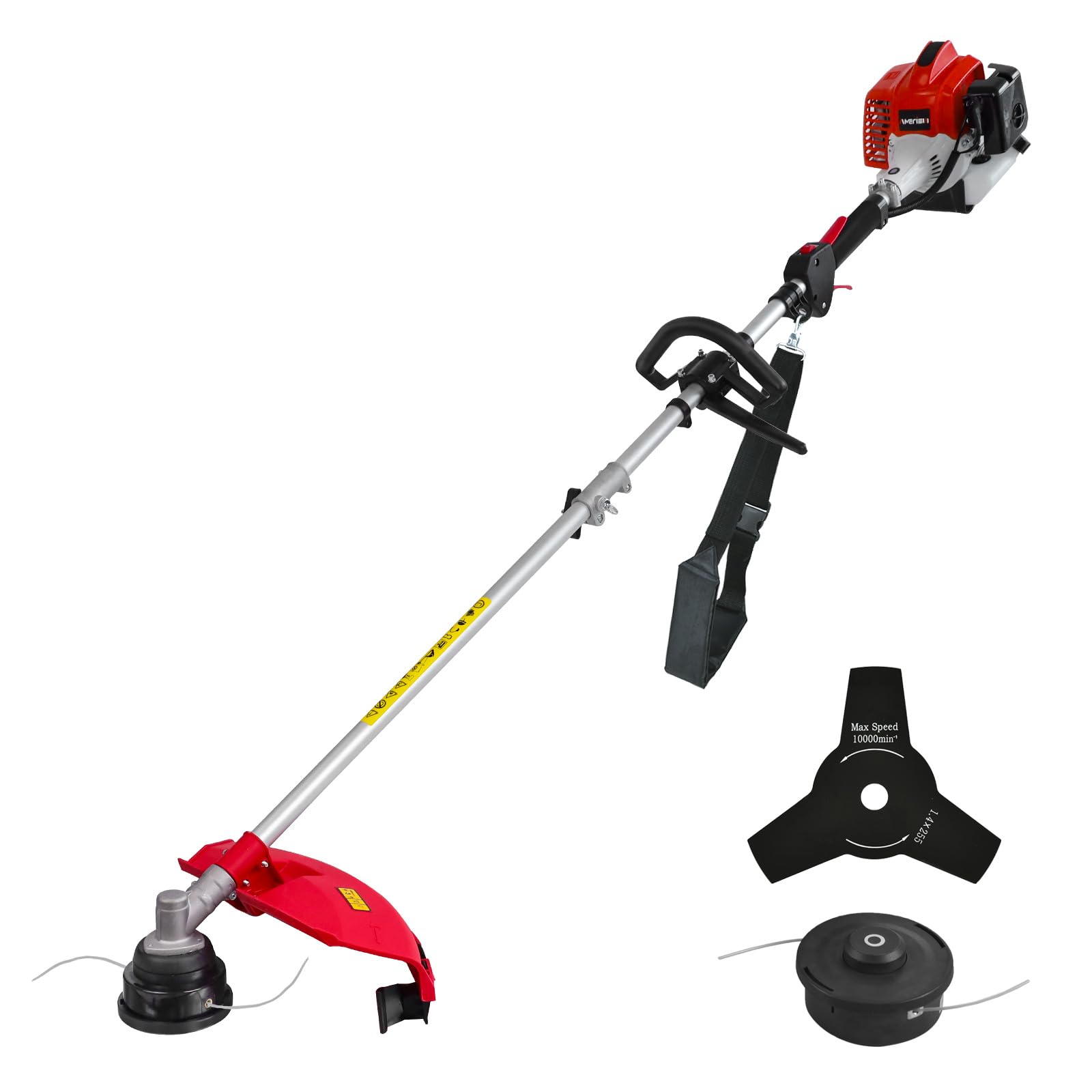
The number that matters here is the 10-inch metal blade sitting alongside a 16-inch string trimmer head. That’s a genuine step up from string-only machines: switch to the blade and you’re chewing through thick brush instead of whipping it into a fog of grass confetti. Its 25.4cc air-cooled 2-stroke engine runs on a 50:1 unleaded-and-lubricating-oil mix, which you measure once and pour — get the ratio wrong and you invite hard starting.
Reach is handled by a 59-inch main pipe section, and it’s adjustable, so you can dial the shaft into your height rather than stoop through the whole job. At 18.7 pounds it sits in the middle of the weight range, comfortably lighter than the WORKIT 52cc at 31.6 pounds but heftier than the WILD BADGER 12-pounder. The 16-inch cutting width sits below the PROYAMA 42.7cc’s 18-inch swath, though at this price that’s a reasonable trade.
Buyers report the 10-inch blade chews through thick brush instead of whipping it into grass confetti — it clears grass, weeds and light woody growth without bogging, and that value-for-dollar read is why it sits in the budget tier while still carrying a metal blade. Edging is a listed use case, so walkway clean-up is part of the plan rather than an afterthought. The honest trade-off is the 26cc engine (a small gas motor): heavier saplings and long stretches of thick vines will make you slow down and let the blade do the work rather than force it.
One tool, three jobs: the trimmer head, edging mode and 10-inch blade swap cover lawn care and brush clearing without hauling two machines around the property.
The honest ceiling: it’s a 26cc powerplant, so treat it as a residential-scale brush cutter that shines on grasses, weeds and light woody growth — not a commercial land-clearing rig.
Reach for this if: you want a metal blade in the kit without stretching to premium money, and your brush is grass, weeds and thin woody stalks.
Sounds like someone else: if you’re routinely dropping saplings over a couple of inches thick, step up to a bigger-displacement engine.
3. WILD BADGER POWER 26cc Gas Weed Wacker
Twelve pounds of two-stroke that swings all afternoon without wrecking your shoulders.
Weight is where this machine wins friends. It tips the scale at 12 pounds — that’s noticeably lighter than the WORKIT 52cc at 31.6 pounds, and it’s the sort of difference your forearms feel after the third tank. A 12-pound body plus the included shoulder strap and rubber handle makes long edging sessions bearable for people who don’t fancy a gym membership as a prerequisite.
Under the hood sits a 26cc 2-cycle full-crank engine. Full-crank means the crankshaft is supported at both ends rather than one, which translates to a more stable spin and less wobble over years of use. Two cutting attachments ship in the box: a 17-inch string-trimmer swath for grass and edging, and a 10-inch brush-cutter blade for thicker weeds and brush. That’s the metal blade you came for, without an extra purchase.
Starting is pitched as a five-pull affair, and tool-free air-filter access means routine maintenance doesn’t require rummaging for a screwdriver. The powerhead also accepts compatible Wild Badger Power attachments, so the platform can grow. On the honest side: the brush blade is a 10-inch piece, so it’s happiest on weeds and light brush — don’t expect it to fell hardwood saplings. And at 26cc, patience is part of the deal on heavy overgrowth. It’s the pick for the buyer who values a lighter swing and a 3-year limited warranty over raw brute force.
The real selling point: 12 pounds and a shoulder strap mean you can finish the fence line without swapping arms halfway through, and the 3-year limited warranty covers residential and commercial use.
Where it stops: the 10-inch brush blade and 26cc engine are built for weeds and light brush, so treat hardwood saplings as a job for a bigger machine.
Best first blade machine: homeowners who want a lighter two-stroke with a starter that behaves and a warranty behind it.
Look elsewhere if: your property is mostly saplings and heavy briar — you’ll want a bigger blade and more displacement.
4. WORKIT 52cc Gas Powered Weed Eater

Fifty-two cubes of two-stroke built for the overgrowth you’ve been avoiding.
Here’s the displacement figure that separates the men from the boys: 52cc. That’s 52cc against the 26cc engines on several picks here, and in the brush-clearing world displacement is the honest measure of how much the blade can chew before the engine bogs. The 18-inch precision string head handles routine lawn care, then the included 3T and 40T metal blades turn it into a heavy-brush machine for dense weeds, thick growth and small saplings.
The 18-inch cutting path matches the widest picks here on paper, but the 52cc engine behind it is where the difference lives — the same swath, more authority. A straight-shaft design gives you reach under bushes, decks and fences, and the durable metal gearing inside is built for daily heavy use. An adjustable shoulder strap spreads the load, which matters because this is a 31.6-pound machine — the heaviest on this list by a wide margin, well above the HUSQVARNA 525RX’s 11.2 pounds.
It runs on a 50:1 gas-oil mixture, and that ratio has to be right or the engine pays for it. The auto-feed head with 0.095″ line makes advancing string a tap rather than a fumble, and blade swaps are quick once you’ve done it a couple of times. The honest catch: at 31.6 pounds, this is a two-hands-and-take-a-break machine. If you have a bad shoulder or a big property, the weight will be the deciding factor, not the power. For commercial jobsites and genuinely overgrown acreage, the torque is worth the heft.
Why heavy-duty operators pick it
- 52cc commercial-grade 2-stroke for dense brush and saplings
- 3T and 40T metal blades plus an 18-inch auto-feed string head
- Straight shaft with metal gearing for under-fence reach
- Adjustable shoulder strap and smooth recoil starter
The trade-offs you’re accepting
- 31.6 pounds makes it the heaviest pick here by a wide margin
- Requires a 50:1 gas-oil mix — no shortcuts
- Real overkill for a small suburban lawn
Built for: large properties, farms and commercial jobsites where thick brush and small saplings are the daily reality.
Pass on it if: you have one small lawn and shoulders that prefer lighter tools — the 31.6-pound frame will be the sticking point, not the cutting power.
5. NEO-TEC 26cc Gas Weed Eater 4-in-1 Weed Wacker
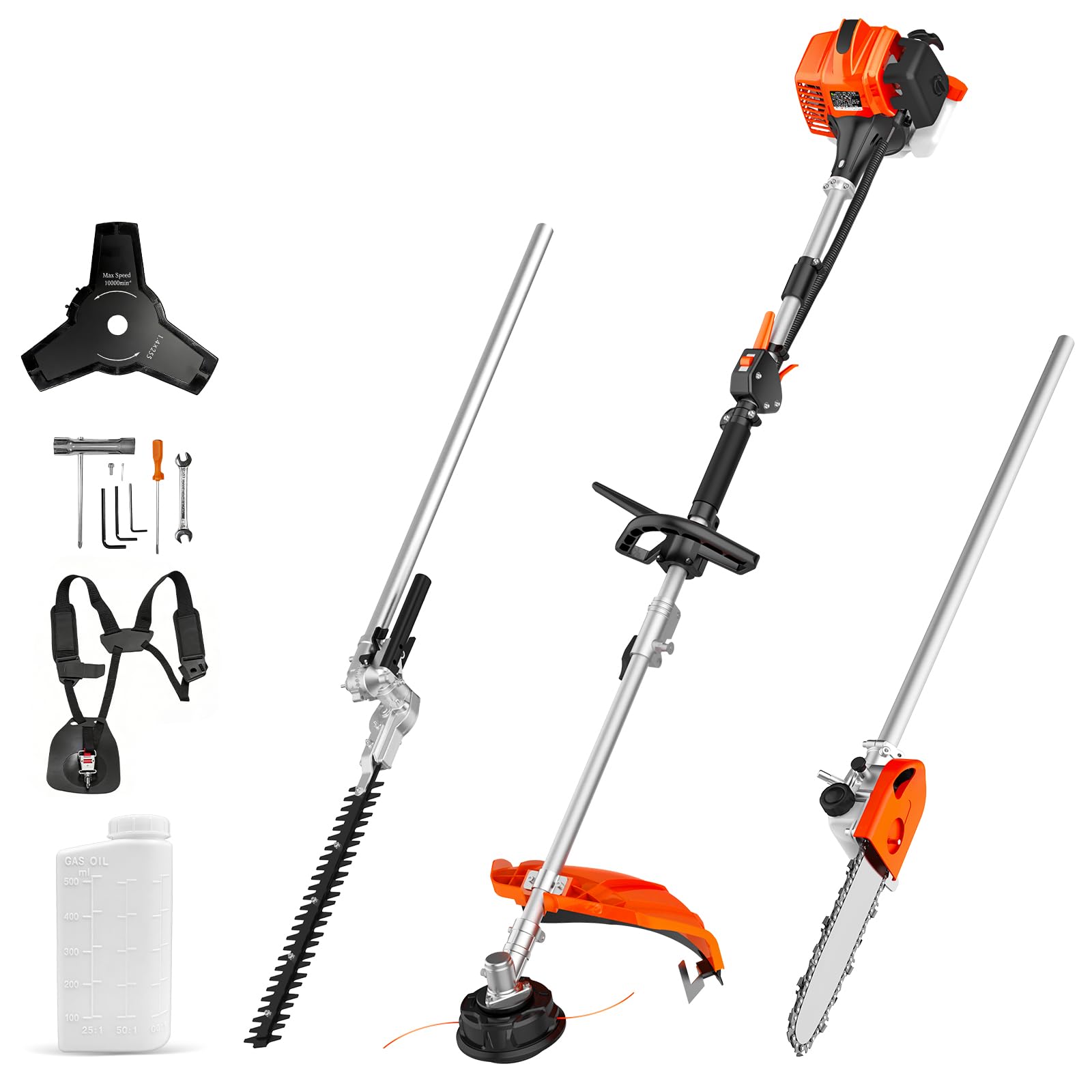
A trimmer, pole saw, hedge trimmer and brush blade sharing one 26cc engine.
One powerhead runs four attachments: a 16-inch string trimmer, a pole saw, a 16-inch hedge trimmer and a brush blade. That’s a full-season yard kit in a single box, which is why it suits someone who’d rather own one machine than four. The engine is a 26cc 2-cycle EPA unit (a small gas motor that meets EPA emissions rules), and it asks for a precise 25:1 fuel-oil ratio — a richer mix than the 50:1 engines elsewhere on this list, so read the ratio at the can before you pour.
Starting is handled by an advanced ignition pitched to catch within five pulls, even after the machine’s been sitting in the shed all winter. Comfort gets real attention: an ergonomic rubber grip and padded shoulder strap cut fatigue, and vibration-dampening keeps the whole shaft steady through long sessions. Cut capacity is the 16-inch swath, and the brush blade handles thick grass and dense brush — the lighter side of blade work rather than sapling felling.
Two practical things to weigh. First, at 30 pounds it’s close to the WORKIT on the scale, so the four-tool versatility comes with a heft penalty. Second, the listing warns that California policy restrictions mean oil products can’t be delivered there, so California buyers should check before ordering. The complete kit includes the trimmer head, pole saw, hedge trimmer, brush blade, shoulder strap, mixing bottle and tools — a well-rounded package if one engine for many jobs is what you want.
The all-season case: a pole saw and hedge trimmer alongside the brush blade covers high branches and hedges, not just ground-level brush, from a single 26cc powerhead.
Know before you buy: 30 pounds is real weight to swing, and California buyers can’t receive the oil products — verify delivery eligibility first.
One machine, four tasks: owners who want hedge and branch cleanup covered by the same tool that clears brush.
Think twice if: you’re in California or you want a machine built primarily for heavy saplings — 26cc and 30 pounds set the limits.
6. PROYAMA 42.7cc Gas Weed Eater

A 2HP two-stroke with three blade options and a straight shaft built for reach.
You get real cutting muscle from a 42.7cc 2-cycle engine (a gas motor with 42.7 cubic centimetres of displacement) that delivers 2HP and spins up to 10,000 rpm. That rpm figure is the cutting speed at the head, and it’s what lets the blades slice rather than mash. Three attachments ship in the kit — a 3T blade (3 teeth), a 40T blade (40 teeth) and a chain blade — so you can rough-cut weeds, tidy woodier growth, or reach for the chain blade on the thickest stuff without buying extra parts.
A straight shaft adds reach around fences, trees and sidewalks, and cordless gas operation means continuous power with no cord to drag. It weighs 19 pounds — heavier than the HUSQVARNA but lighter than the 30-pound-plus machines here — and a shoulder strap is included to spread that load.
What wins people over is the build: the 42.7cc motor holds 10,000 rpm through dense growth, and the solid construction is the thing that gets talked about most. The honest note is durability and starting — the engine has a reputation for wanting a proper warm-up and a clean fuel mix, and hard use will eventually show up in wear. Be disciplined about fuel and storage and it holds up. It’s a strong middle-of-the-road choice for someone who wants more blade options and more displacement than a basic 26cc unit.
Where the value sits: 42.7cc and 2HP at 10,000 rpm, with three metal blade types in the box and an 18-inch swath — a lot of cutting capability for the displacement class.
The honest caveat: it’s a 2-stroke that rewards careful fuel mixing and regular maintenance, and at 19 pounds it isn’t a featherweight for long sessions.
Strong middle ground: buyers who want 2HP and multiple blade types without jumping to the heaviest or priciest tier.
Not the first pick if: you want zero fuel mixing — the 4-stroke PROYAMA is the one for that.
7. Elegarden 51.7CC Gas Weed Wacker
An 80T saw blade in the box takes this past brush and into small trees.
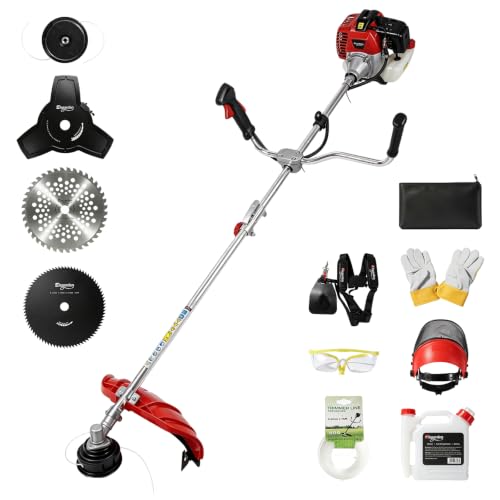
Most machines here stop at a 40T blade. This one goes further with an 80T circular saw blade included alongside the 3T weed blade and the 40T brush cutter blade — three tiers of cutting teeth for weeds, brush and small trees respectively. Behind those blades sits a 51.7CC full-crank 2-cycle engine delivering 2 HP and up to 10,000 RPM, feeding a 16-inch dual-line trimmer head for the everyday lawn work.
The weight is the surprise: 16 pounds from a 51.7CC engine, against the 31.6-pound WORKIT despite similar displacement, which makes a big-engine blade cutter genuinely swingable for longer stretches. The straight shaft carries an ergonomic U-handle, an adjustable shoulder strap and a balanced build to keep control through fatigue. A quick-release split shaft means it breaks down for transport and storage — handy if the machine lives in a trunk or a cramped shed.
The complete kit is unusually thorough: trimmer head, all three blades, shoulder strap, safety goggles, face shield, protective gloves and an installation tool kit. Two honest flags. First, the listing states this is not CARB certified and can’t be sold or shipped to California — check your state before ordering. Second, 16-inch swath is the narrowest on this list alongside the AMERISUN and NEO-TEC, so wide-open acreage will take more passes. The three-blade ladder is the reason to choose it.
The cutting ladder: 3T, 40T and 80T blades in one kit mean you can match tooth count to whatever you’re cutting, from vines to small trees.
The fine print: not CARB certified, so California buyers are out — and the 16-inch swath means more passes on big open areas.
Pick this one if: you want the most blade variety from the start and you’re outside California.
Skip the order if: you’re in California — the listing says it can’t ship there — or you need the widest possible swath.
8. PROYAMA 40cc Gas Weed Wacker
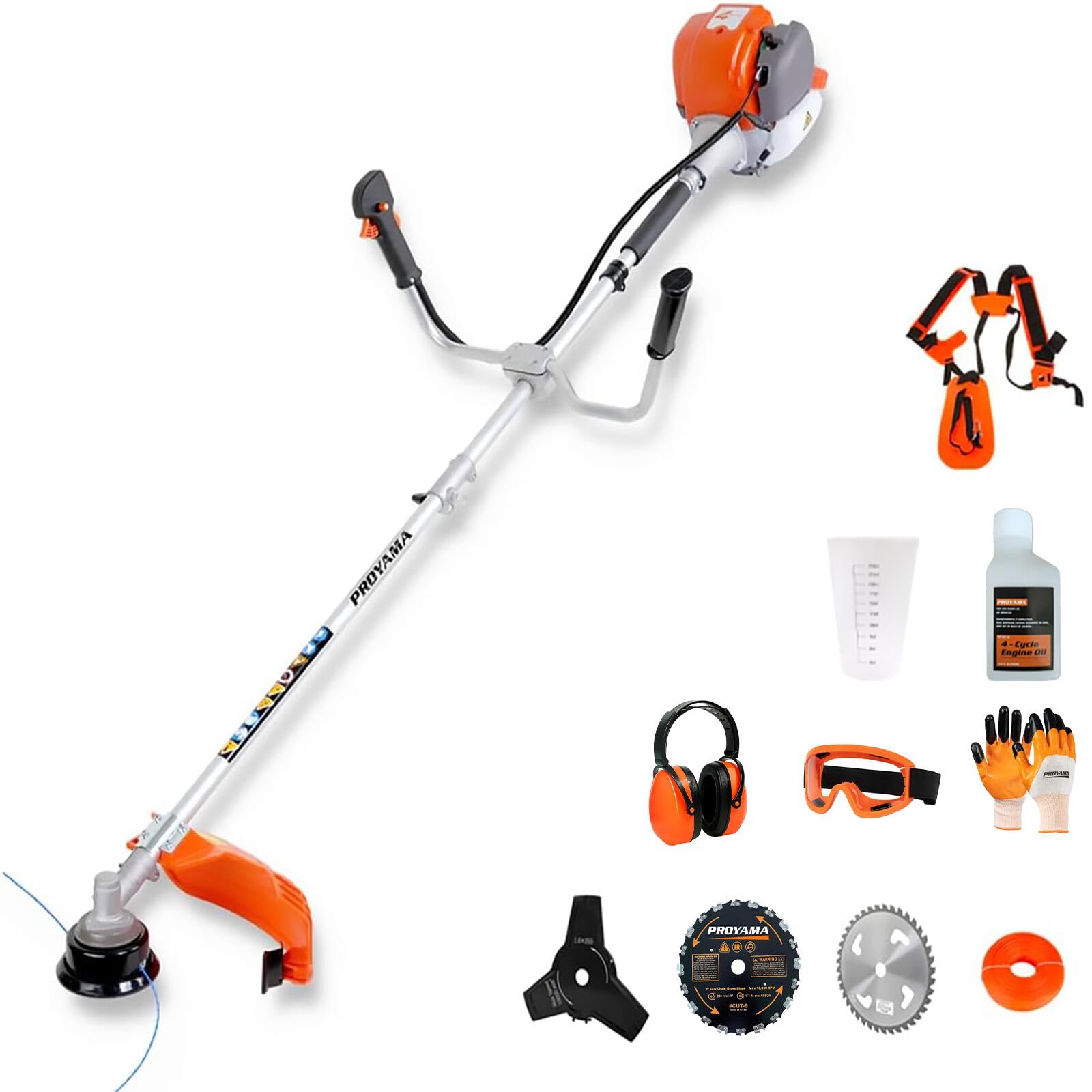
Plain gasoline, no mixing jug, and a 4-cycle engine that runs smooth all day.
If you’ve ever fumbled a fuel ratio and paid for it with a hard-starting engine, this is the answer: a 40cc 4-cycle engine that runs on regular gasoline with no oil mixed in. No measuring, no mixing bottle, no pre-mixed cans at the pump — just pour and go. The 4-stroke design also cuts vibration, which you feel in your hands after an hour of cutting, and the engine delivers 1.5HP of smooth, consistent power for trimming grass and handling brush.
The cutting setup is versatile: a string trimmer head for everyday grass and metal blades for tougher weeds, thick vegetation and brush clearing. The cutting width is 18 inches, the widest on this list, versus 16 inches on the AMERISUN, NEO-TEC and Elegarden. It weighs 16 pounds — lighter than the WORKIT by a wide margin and in the same range as the Elegarden — and a shoulder strap is included to help carry it.
What people talk about most is the engine character: the 40cc 4-cycle pulls steadily through large outdoor areas, and running on straight gas (no oil mixed in) buys you longer runs between fill-ups. Paying the extra genuinely gets you a different kind of ownership: no 50:1 mixing at the can, less vibration through the handles, and a plain-gas refill. The honest trade is that a 4-stroke of this size has a touch less raw punch per cc than a tuned 2-stroke, and it still rewards clean fuel and a proper warm-up. For blade work without a mixing jug, it’s the pick.
The no-mix advantage: regular gasoline only, so refueling is a pour-and-go job with no oil ratio to calculate and less vibration through the session.
What you give up: a 4-stroke at this size trades a little peak punch for smoothness, and at 16 pounds it’s a two-handed machine, not a wrist-flick trimmer.
Simplest ownership here: anyone who hates mixing oil into gas and wants blade capability with an 18-inch swath.
Pick the 2-stroke instead if: you’re chasing maximum raw power per cc on the heaviest brush.
9. Husqvarna 525RX Brush Cutter with T35 Tap n Go Trimmer Head
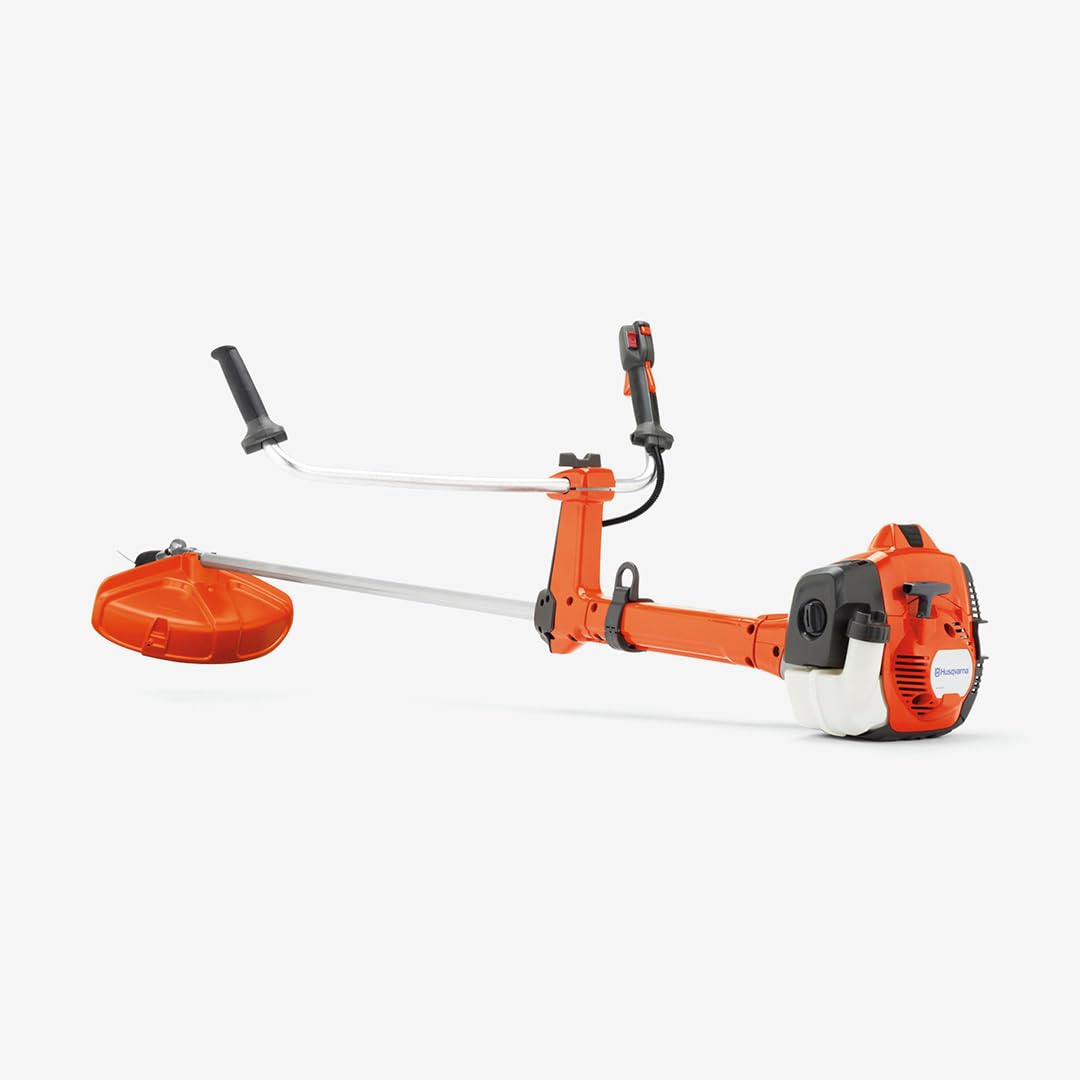
A professional 25.4cc straight-shaft cutter that weighs just 11.2 pounds.
Eleven point two pounds from a brush cutter is a serious claim, and it’s the number that sets this machine apart. That’s lighter than the WILD BADGER’s 12 pounds and well under the WORKIT’s 31.6 pounds, so a full day along a fence line doesn’t leave your arms hanging. The 25.4-cc X-TORQ engine is built around efficient combustion, which the maker says delivers strong power and torque — a smaller displacement tuned to make the most of it rather than a big block brute.
If you’re hunting a metal-blade machine, the versatile guard is the detail that matters: it works with either a grass blade or the trimmer head, so the same unit switches from string to blade without a separate guard. A straight shaft with an adjustable offset handle bar and high offset post gives comfortable handling and freedom of movement, and the heavy-duty T35 Tap n Go head advances line with a quick tap. The cutting width is 17 inches, so you cover a wide strip per pass.
What you’re paying for is the professional build and the low weight, not a huge displacement or an oversized blade kit. The honest trade-offs: at 25.4cc it won’t muscle through the heaviest overgrowth the way a 50cc-plus machine will, and the blade is a separate part — the guard is compatible but the machine arrives with the T35 trimmer head. For routine professional trimming and light brush clearing where you’ll add your own blade, the 11.2-pound frame and X-TORQ efficiency (a design that cuts fuel use and emissions) make it a joy to run.
Why pros gravitate here: 11.2 pounds and an adjustable offset handle bar make long trimming sessions far easier on the body, and the guard accepts a grass blade or the trimmer head.
The reality check: a 25.4cc engine and a separate blade purchase mean it suits pro-scale trimming and light brush, not a 50cc land-clearing assignment.
Go pro: landscapers and heavy DIYers who value a light, well-balanced straight-shaft cutter and already own or will buy a blade.
Not your machine if: you need the blade in the box on day one, or you’re clearing the heaviest overgrowth where displacement rules.
Know the Specs
Displacement (cc) and what it buys you
Displacement is the swept volume of the engine’s cylinder, measured in cubic centimeters. Bigger numbers mean more torque to keep a blade spinning when it bites into something dense. A 25 to 26cc engine handles grass, weeds and light brush with a blade attached. The 40cc-and-up machines take on saplings and heavy growth without bogging down. More displacement usually means more weight and more fuel burned, so match it to your actual growth, not the biggest number on the shelf.
Fuel-oil ratios on 2-stroke engines
A 2-stroke engine has no separate oil sump, so lubricant goes into the gasoline. A 50:1 ratio is roughly one part oil to fifty parts fuel; a 25:1 ratio is richer in oil. Getting the ratio wrong causes hard starts, excess smoke or engine wear. 4-stroke engines run on plain gas with a separate oil reservoir, so there’s no mixing — at the cost of a little extra weight and a slightly lower power-per-cc figure.
Blade tooth count: 3T, 40T and 80T
Tooth count sets what the blade is for. A 3T (three-tooth) brush blade is a coarse cutter for weeds, vines and thin saplings. A 40T blade has finer teeth for cleaner cuts on woodier growth. An 80T circular-saw style blade is for the thickest material. A machine that ships with more than one blade type can handle a wider range of jobs from a single powerhead.
Cutting swath and shaft type
Cutting width — the swath — is the diameter the blade or string sweeps. A wider swath covers more ground per pass but needs more power behind it. A straight shaft sends the drive in a straight line to the head for longer reach under fences and decks. A curved shaft is lighter but shortens reach. For brush clearing along fence lines and underbrush, a straight shaft with a wide swath on enough displacement is the combination to look for.
Common Questions
Can I put a metal blade on a string trimmer that came with only a string head?
What is the difference between a 2-stroke and a 4-stroke weed eater?
What fuel-oil ratio do these machines need?
Which blade should I use for thick brush versus small trees?
Is a gas or cordless electric brush cutter better for blade work?
Can I use these cutters on wet grass or in the rain?
How heavy are these metal-blade weed eaters to use for a long session?
Will a metal blade fit the same shaft as the string head?
Do these brush cutters ship to California?
The Bottom Line
For most people shopping for a weed eater with metal blade, the Makita DUR369AZ is the pick that balances real blade power with cordless convenience, provided you’re on the LXT battery platform or willing to buy in. Want to cut brush without mixing fuel? The PROYAMA 40cc 4-Cycle is the no-hassle choice. For the heaviest overgrowth where displacement rules, the WORKIT 52cc brings 52cc of two-stroke — just be ready for its 31.6 pounds. And if you want the most blade variety in one box, the Elegarden 51.7CC’s 80T saw blade takes you into small trees.
How we choose
We do not accept paid placement. Every pick is matched to a real buyer and a real use-case; we do not hands-on test units.
Sources
Specifications: manufacturer listings and product documentation. Review insights: verified customer reviews, as of November 2026. Pricing: not shown on this page (it changes often); check the current price via the retailer link.
As an Amazon Associate, Tactical Gear Guy earns from qualifying purchases. This does not affect which products we feature.