Specs are compiled from manufacturer listings and verified buyer reviews and can change over time — please confirm the key details on the product page before buying.
If your scorecard keeps stalling on the holes you reach in two shots, the fix is rarely a new driver — it is the short-game club in your bag that turns a scuffed chip into a two-footer. The wedge does the awkward work: getting you out of a bunker lip, stopping a ball on a green that runs away from you, and saving par when your approach leaks right. The problem is that this category is sold on grooves and marketing language, while the numbers that actually change your results are loft, bounce angle, and sole grind — three specs almost nobody explains before you click buy.
This guide is built by comparing the manufacturers’ published specifications and the patterns across verified customer reviews, so you get each pick’s real strengths and trade-offs instead of marketing spin.
Loft decides how high the ball flies, bounce angle (the leading edge’s tilt away from the turf) decides whether the club digs or skims, and grind (the sole’s shaped relief) decides which lies it suits. Below, that spec map drives a shortlist built for real greenside outcomes and for players who want to stop guessing which number they need. Every pick here earns its slot as one of the Best Wedges Golf Clubs for the shot you actually face most.
Top Picks
How To Choose The Best Wedges Golf Clubs
Start with the gap you are trying to fill, not with a brand. A wedge sits between your pitching wedge and your putter, and the number stamped on the sole tells you how steeply the ball launches. If you carry a 44-degree pitching wedge, a 52-degree gap wedge leaves a manageable step, while a 48-degree sits closer to a second pitching wedge. Buy the loft that closes a real distance gap in your bag and the rest of the decision gets much easier.
Loft first, then bounce
Loft sets trajectory; bounce angle sets the club’s relationship with the ground. Bounce is the angle of the sole’s leading edge measured against the turf, and a higher bounce number keeps the club from digging on soft sand or lush rough. A low bounce figure — TaylorMade’s Milled Grind carries a 10-degree bounce angle — suits firm turf and players who pick the ball cleanly. If you play a course with fluffy bunkers, lean toward more bounce; on hardpan, lean toward less.
Read the grind like a tread pattern
Grind is the shape cut into the sole, and it controls how much of the club touches the ground when you open the face. A full sole with trailing edge relief, like the TaylorMade Milled Grind’s design, keeps the club stable on square-faced shots. A three-tiered sole with extra width and added leading edge bounce, like Cleveland’s Smart Sole design, is built to resist digging from fairway, rough, or sand. Match the grind to how you actually swing, not to how you wish you swung.
Forgiveness level and head shape
Manufacturers publish a forgiveness level for a reason. Low-forgiveness blades reward a centered strike and punish everything else, while high-forgiveness cavity-back heads put more mass around the perimeter so a thin or toe-side contact still flies. If your handicap sits in double digits, a mid or high forgiveness wedge will save you more shots than a tour-shaped blade with a prettier profile.
Side-by-Side Comparison
| Model | Best For | Loft | Forgiveness | Head Type | Amazon |
|---|---|---|---|---|---|
| Cleveland RTX 6 Zipcore★ Best Overall | All-around short game | — | Mid | Wedge | Amazon |
| MAZEL Forged WedgeBudget Bunker Saver | Bunker escapes on a budget | 48 degrees | Mid | Forged | Amazon |
| Wilson HarmonizedSimplest Lob Option | Simple lob-wedge upgrade | 60 degrees | — | Blade | Amazon |
| Full Choice 7-Piece Set | Building a full wedge lineup | 56 degrees | — | Blade | Amazon |
| A11N SPORTS Forged Set | Mid-handicap three-club setup | 52/56/60 | — | Blade | Amazon |
| Yamato Forged Pro | Forged feel with a distinct finish | 52 degrees | — | Blade | Amazon |
| TaylorMade Milled Grind | Precision on square-faced shots | 60 | Low | Blade | Amazon |
| Cleveland Smart Sole Full-Face | Maximum forgiveness from any lie | — | High | Cavity back | Amazon |
| Callaway Opus | Grind matching for shot-makers | — | — | Grind | Amazon |
Detailed Reviews
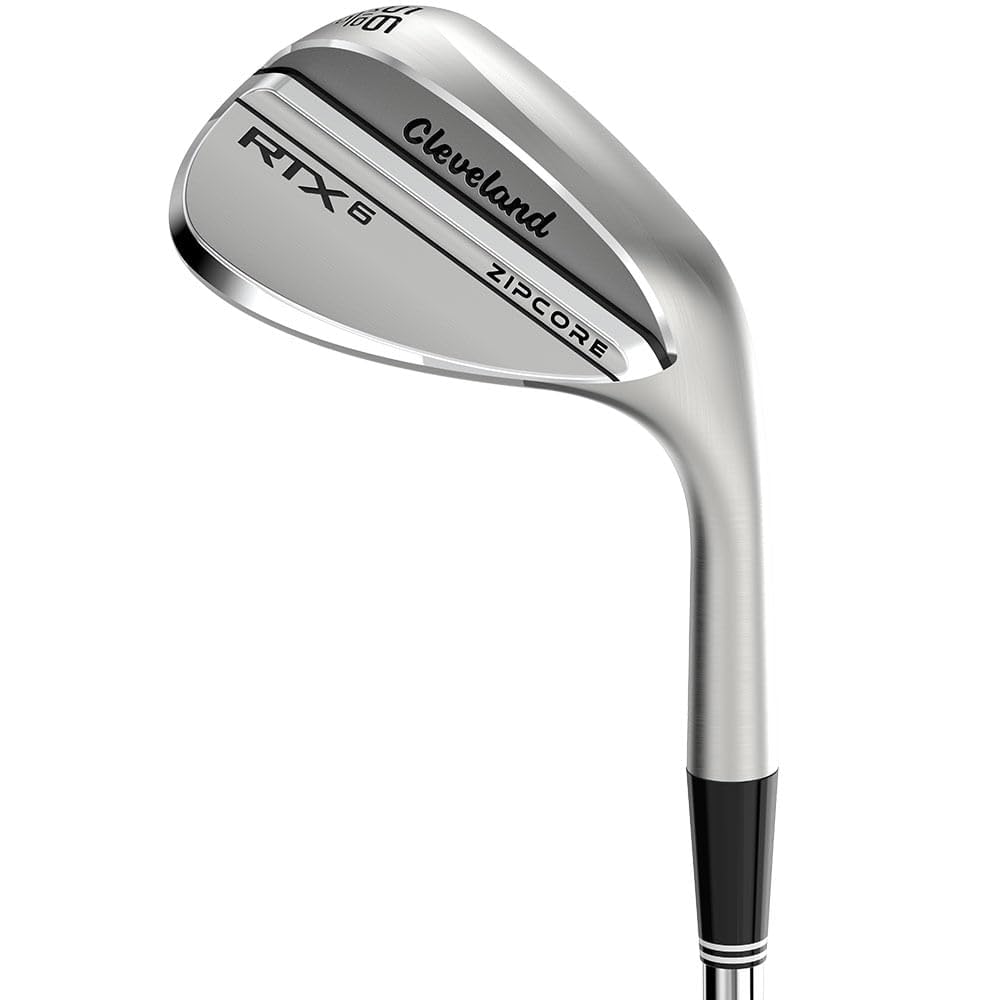
1. Cleveland Golf RTX 6 Zipcore Wedge
Our pick — 4.5+★ from 250+ verified ratings; the strongest balance of quality and price.
A laser-milled face and raised MOI make this the one wedge for chips, pitches, and bunker work.
The headline here is a face treatment Cleveland calls HydraZip, and it is worth knowing what that means in practice. It is a laser-milled line system that roughens the face to boost friction, so the ball grips instead of skidding off the grooves. That shows up most on the shot you dread: a little chip from thick rough where the ball would normally come out hot and run past the hole.
Then there is ZipCore, the low-density core set inside the head to push weight to a more useful spot. Cleveland states this generation carries up to 95% more of that ZipCore material and raises the moment of inertia by up to 20% — inertia here meaning resistance to twisting when you catch the ball off-center. The result buyers keep coming back to is consistency: these wedges make chipping and bunker shots more repeatable, and quality is what wins people over more than any other single trait in the feedback.
The UltiZip grooves are sharper, deeper, and more tightly spaced than earlier tour groove layouts, which lets Cleveland fit two extra grooves on the face for more edge contact against the ball. Set against the MAZEL forged wedge, the RTX 6 carries no loft number in its published spec but delivers far more face technology, while the MAZEL pins its card to a single 48-degree head. The catch is honest and simple: this is a mid-forgiveness design that still expects a decent strike, and the Tour Satin finish is a finish, not a shield against the bag chatter a forged-style head collects.
Where it pulls ahead
- Roughened, laser-milled face keeps spin alive from rough and wet grass
- Raised moment of inertia means off-center strikes finish closer to target
- Tightly spaced grooves put more bite on the ball at contact
Where it asks more
- Mid forgiveness level still rewards a centered strike over a sloppy one
- Matte face shows wear marks faster than a polished finish would
Settle here if: you want one wedge that handles chips, pitches, and bunker work without a specialty head for each.
Look elsewhere if: you want a wide, high-bounce sole doing the forgiveness work for you instead of your technique.
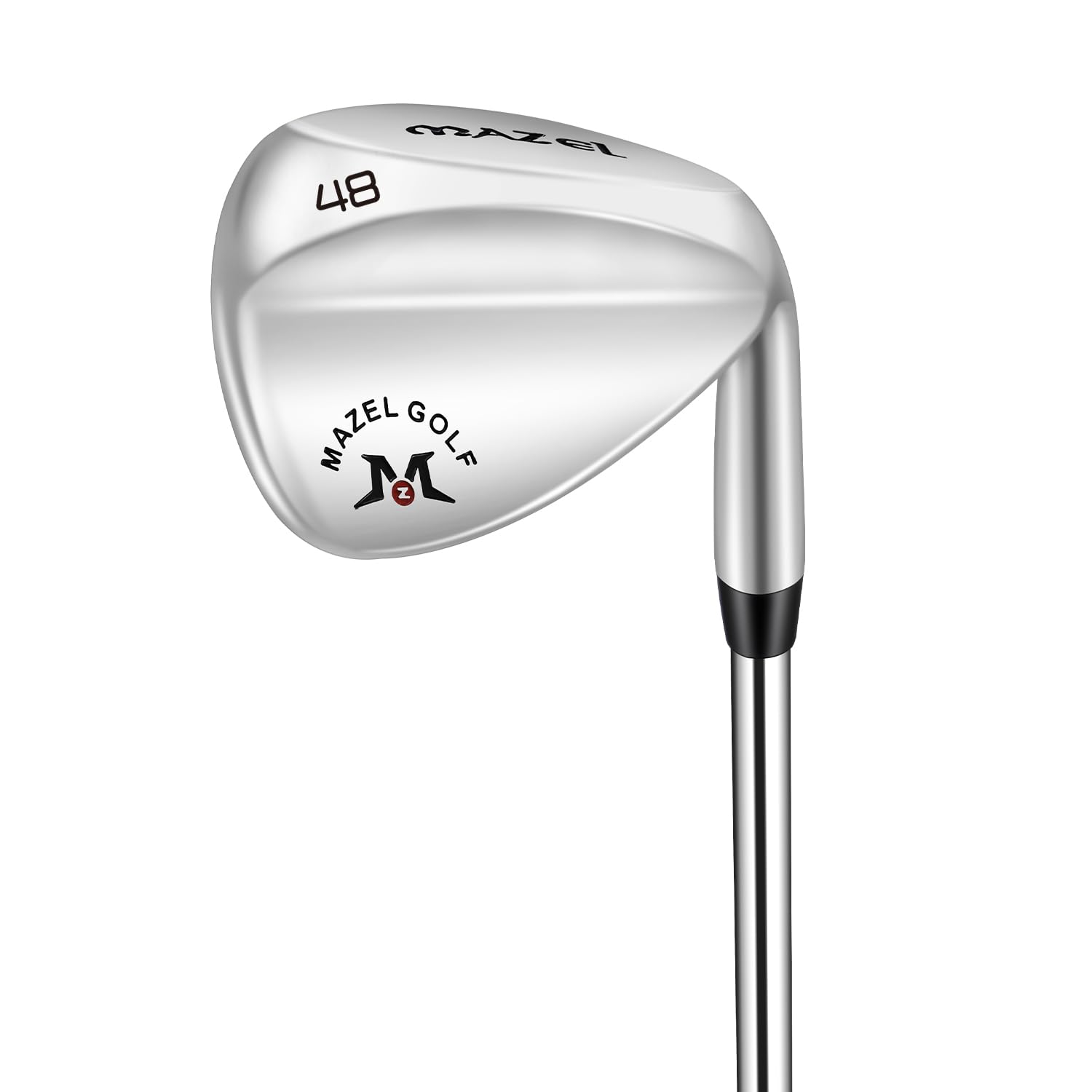
2. MAZEL Forged Golf Wedge
An extra-wide sole that cuts through sand without skipping or digging, at a value price.
MAZEL builds this head around one job — getting out of trouble around the green. The extra-wide sole is designed to cut through sand without skipping or digging, which is the difference between a clean escape and a second attempt from the same bunker. That 48-degree loft gives you a controlled, mid-trajectory flight, and it sits a full 25% below the Wilson Harmonized’s 60-degree option if you want an easier launch to manage.
The forged head arrives with a full CNC milled face and conforming grooves, so spin and control stay predictable from fairway, fringe, or rough. Buyers report better touch around the greens, and there is a clear theme in the feedback: this club is easy to hit 100-yard shots with. The grip is a standard synthetic rubber model, the lie angle is 63 degrees, and it is configured right-hand only — worth checking before you order.
Weigh the head before you buy: it comes in at 300 g. Some players find that reassuringly solid, while others find it on the heavy side. If you like a featherweight feel in your hands, that is the trade-off you are accepting. Otherwise, this is a genuine short-game tool at an entry-level tier rather than a toy wedge.
What the sole buys you: the wide base does the work on soft sand, so you can swing with less fear of the club burying itself.
The honest weigh-in: forged feel and milled grooves for a value-tier outlay, with heft that some hands will notice.
Reach for this if: bunker play is the weakest part of your short game and you want a sole that forgives a slightly steep swing.
Pass if: you prefer a light-headed wedge you can feel the clubhead position with on delicate flop shots.
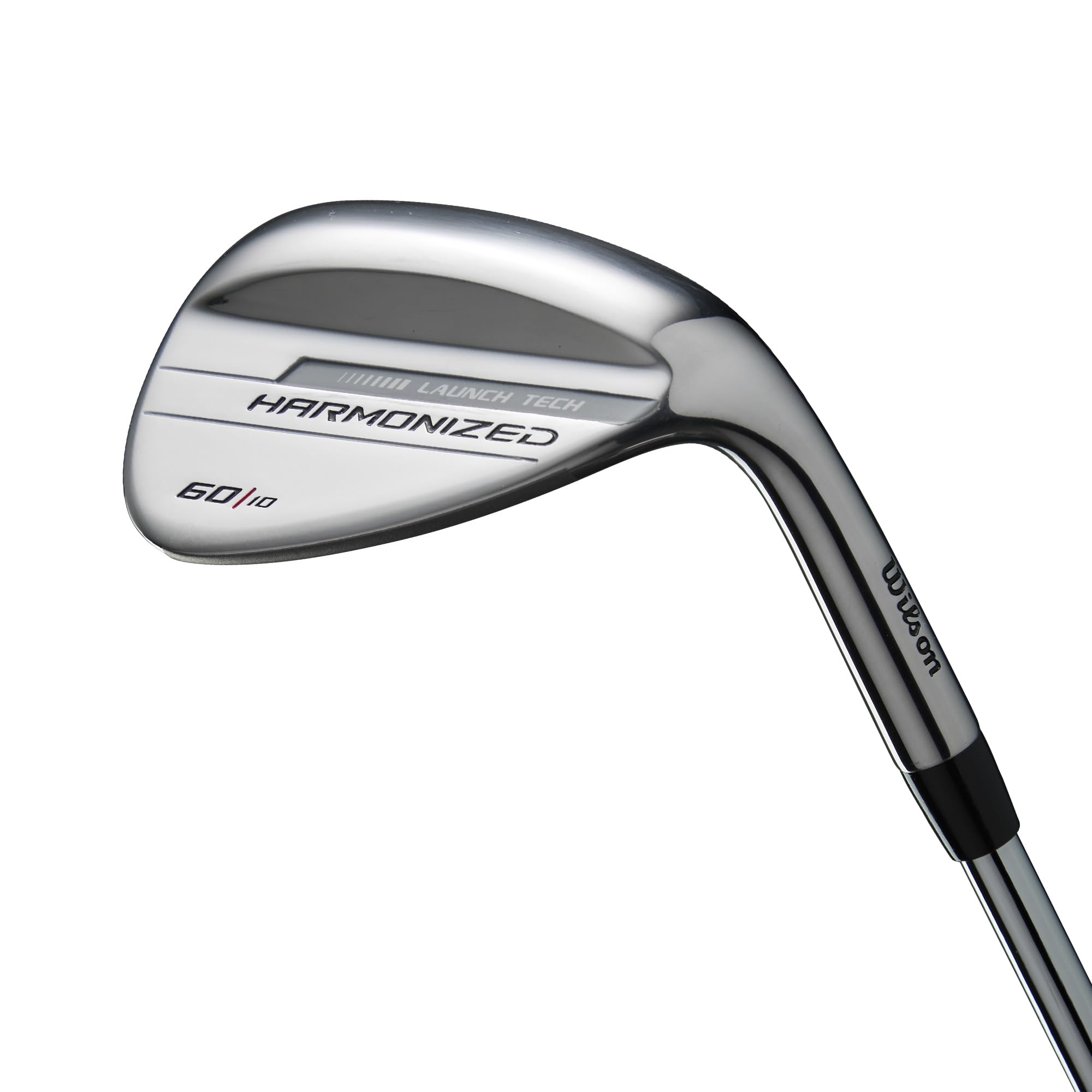
3. Wilson Harmonized Unisex Golf Wedge
A 60-degree blade that launches steep and lands soft for short-sided pins.
Sixty degrees of loft is the whole story here. That much angle launches the ball steeply and lands it soft, which is exactly what you want when the pin is tucked behind a bunker and you have almost no green to work with. The blade head keeps the profile tidy behind the ball, and the steel shaft gives the club a firm, direct response through the turf.
Wilson keeps the package deliberately plain: a regular flex, standard synthetic rubber grip, and a grey-and-black finish that will not distract you at address. It weighs 0.48 kg, which reads as a balanced, unremarkable feel in the hands — no drama, no surprise. Compare that to the MAZEL’s 48-degree head and this is the opposite end of the loft map: the MAZEL launches lower and rolls out, while this one flies higher and stops faster.
A lob wedge this steep is a specialty club, so the follow-up question is whether it earns bag space. It does if you regularly face short-sided pins or need to clear a hazard from just off the green. It is a less natural pick if you want a single do-everything wedge, because the high face makes full swings harder to control than a gap wedge would.
Why it earns a slot: pure 60-degree launch for the tightest greenside lies, with nothing extra to learn.
Where it narrows: it is a specialist, not a substitute for a gap or sand wedge in the bag.
It suits: the player who keeps losing strokes to short-sided pins and needs a controlled high floater.
Think twice if: you are filling your only wedge slot — a lower loft will serve you across more shots.
4. Full Choice Golf Wedge Set
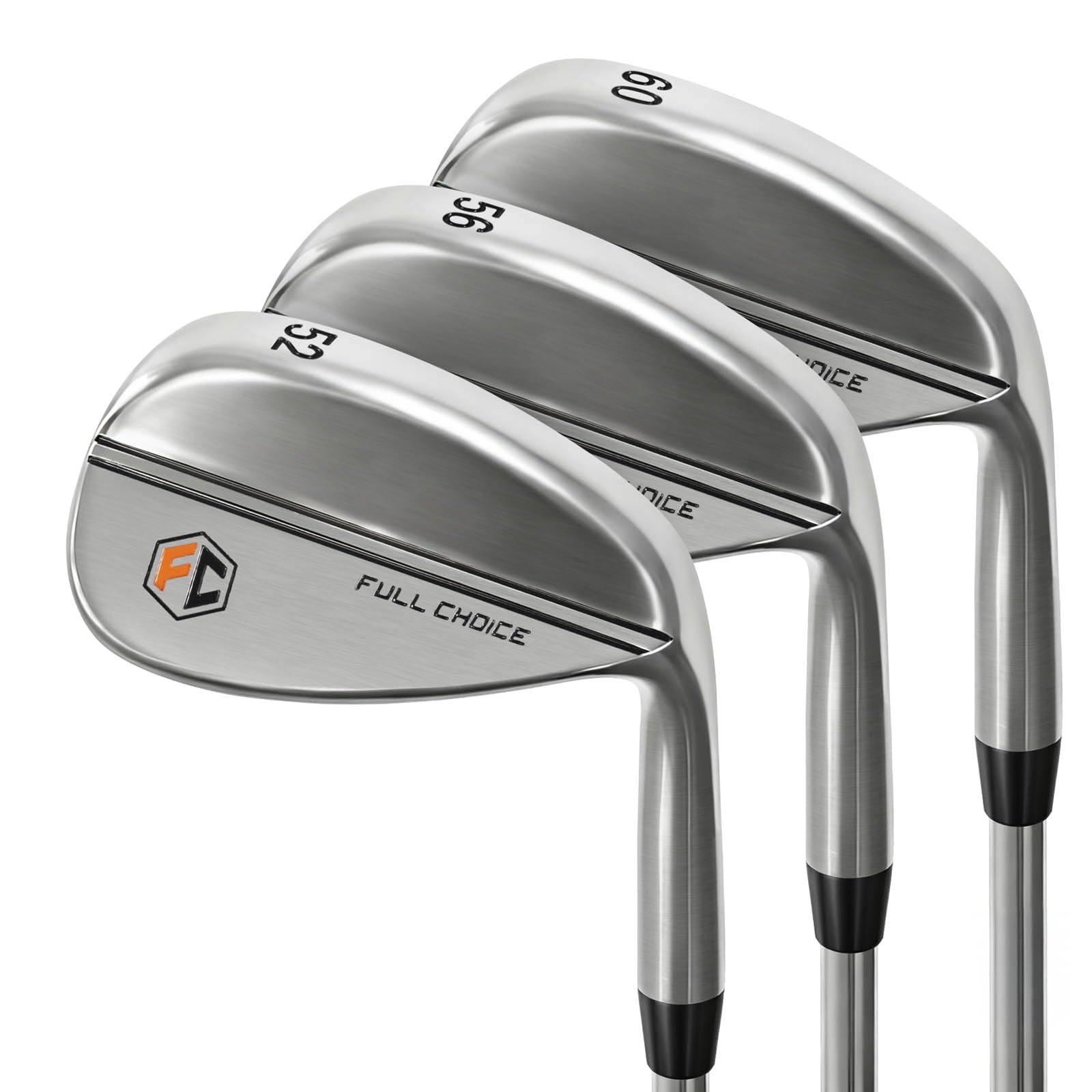
Lofts from 50 to 70 degrees in one box, so you can space your gaps on the range.
Most wedges force you to pick a number and live with it. This one hands you the whole ladder: 50, 52, 54, 56, 58, 60, and 70 degrees, with the multi-club set landing in a 52/56/60 configuration. If you are building a bag from nothing or replacing a mismatched mix of wedges, that range means you can space your lofts into even gaps instead of guessing.
The face is micro-milled to sharpen spin and control, and the alloy steel construction is meant to hold up to regular course use. The blade head shape keeps the look clean at address. In the feedback, quality is the trait praised most, with value for money running right behind it — and buyers describe it as a beginner set that makes good strikes easier to come by.
Here is the practical question a set like this raises: seven clubs is a lot of bag space, and most golfers settle on two or three lofts they actually trust. If you already know your gaps, buy the individual heads instead of the full run. If you do not, this set lets you experiment on the range until two or three numbers clearly earn their place.
What the loft spread delivers
- Every gap from 50 to 70 degrees covered in one purchase
- Micro-milled face sharpens spin on approach shots
- Easy entry point for a new player assembling a short game
What to plan for
- Seven wedges crowd a bag fast — you will likely bench several
- Blade heads reward clean contact over a wide, forgiving sole
Choose it when: you want to test lofts on the course before committing to a permanent wedge lineup.
Skip the set if: you already know your yardage gaps and only need one or two specific heads.
5. A11N SPORTS Forged Golf Wedge Set

52, 56, and 60 degrees in forged steel, with a published 10-to-19 handicap target.
Three lofts — 52, 56, and 60 degrees — cover approach shots, bunker work, and greenside flicks without carrying five wedges. That is the setup most coaches would hand a player. A11N publishes a recommended handicap level of 10 to 19 for this set, a rare and useful bit of honesty. It tells you the clubs are shaped for someone striking the ball decently but not perfectly.
The forged construction is what gives these their soft response, and a precision-milled face ensures the grooves are cut uniformly so spin stays predictable shot to shot. The bronze finish also happens to be the most striking cosmetic in this whole lineup, and appearance draws real praise from buyers who describe the clubs as looking and feeling great. Value for money lands nearly as high as quality in the feedback.
The fair caveat: durability draws more mixed comments than any other trait on this set, and a forged head is inherently softer metal than a cast one. Treat them as precision instruments rather than range rocks and they will hold up. Bear in mind that the 60-degree is still a specialist loft even inside the set — you will use the 52 far more often.
The case for the trio: forged feel, milled grooves, and a coherent gap structure for a mid-handicap bag.
The honest asterisk: softer forged metal asks for care, and the high-loft head is a once-a-round club, not a daily one.
Best matched to: the 10-to-19 handicap player who wants one purchase to organize their entire short game.
Not the one if: you need a single wedge and would rather spend that bag space on a hybrid.
6. Yamato Forged Pro Golf Wedge

Curved wave scoring lines for backspin, in a forged 52-degree gap wedge with a glare-cutting tarnish finish.
Yamato’s differentiator is a face full of “wave scoring lines” — a curved groove pattern the brand says generates heavy backspin for stopping power. The face also gets a blast treatment to raise friction, so the ball checks up rather than releasing past the hole. On a firm green where your sand wedge usually runs out, that bite is the shot-saving part.
The head is forged carbon steel, which is why the feedback keeps circling back to feel and feedback — the club tells you what it just did. The 52-degree loft is a classic gap wedge number, and the tarnish finish is a deliberate alternative to chrome that cuts glare at address. Value for money is what buyers highlight most, and the performance follows right behind, with players saying these swing as well as more expensive names.
Weigh this against the three-club A11N set: the Yamato gives you one more-lofted head with a more exotic finish for roughly similar money. That is the better call if you already own a lob wedge and only need a gap club. One honest note — durability draws mixed feedback here, so the tarnish finish may wear thinner at the sole over a season of regular play.
What makes it stand out
- Wave scoring lines aim for real stopping power on firm greens
- Forged carbon steel transmits clear feedback through your hands
- Tarnish finish cuts glare while looking different from every chrome wedge on the rack
Where to temper expectations
- Finish durability is the more debated trait among owners
- One head only — this does not cover your bunker and lob gaps
Pick it if: your gap wedge is the worn-out club and you want forged feel with a finish that is not chrome.
Move on if: you need a wide sole for bunker escapes or a full set to rebuild your short game.
7. TaylorMade Golf Milled Grind Wedge

A machine-milled full sole with 10 degrees of bounce, for square-faced players on firm turf.
The name is literal. TaylorMade mills the sole of this wedge by machine, and the point of that is tolerance — the company says the process holds consistency levels that are difficult for a human hand to repeat. Every club that leaves the line has the same sole geometry, so what you learn on the range carries onto the course.
Mass sits higher in the head, which raises the center of gravity for a controllable launch angle with high spin. That combination is what lets you attack a pin rather than just hold a green. The machine-milled face and grooves do the same job at the contact point, keeping spin consistent from any lie. The full sole design has a constant trailing edge relief, and the tour-proven 4-way camber is built for most swing types who play with the face square to the target.
Two figures shape who this is for: a 60-degree configuration and a 10-degree bounce angle, paired with a low forgiveness level. This is a club that tells the truth about your strike. Where the Cleveland Smart Sole is a high-forgiveness cavity back, this TaylorMade head asks for centered contact and gives back precise feedback when it gets it. Pair it with a lower-lofted club rather than treating it as your only wedge.
What precision milling changes: identical sole geometry club to club, so your short game translates rather than re-learns.
The refinement tax: low forgiveness and a 60-degree face leave little room for a mis-hit, especially from wet sand.
Right for: the confident ball-striker who plays a square-faced game and wants a lob wedge with predictable launch.
Wrong for: anyone who wants the club to rescue a thinned chip — this one reflects it back at you.
8. Cleveland Golf Smart Sole Full-Face Wedge

A high-forgiveness cavity back with an extra-wide three-tiered sole that resists digging from any lie.
Cleveland rates this head at high forgiveness, and the construction matches that badge. It is a cavity back, which puts weight around the perimeter rather than behind the balance, so contact out toward the toe still flies. The faces are Cleveland’s largest on any wedge the brand makes, with full-face grooves and improved moment of inertia — inertia meaning the head resists twisting when you miss the center.
The sole is where the real engineering sits. It is an extra-wide, three-tiered design with added leading edge bounce, meant to keep the club from digging whether the ball sits on fairway, rough, a tight lie, or sand. The face carries the same HydraZip blast-and-laser treatment and UltiZip full-face groove network the RTX 6 uses, so spin stays high in wet or dry grass. The grip is a Lamkin Crossline Connect Black at 0.6 inches, which is a genuine grip upgrade over the generic rubber on most value wedges.
The honest question is whether high forgiveness dulls your touch. It can — a wide sole limits how much you can open the face on a delicate flop. But if you have ever watched a chip dig straight into the turf, that trade is easy to accept. Set against the TaylorMade’s low forgiveness, this is the opposite philosophy: the club covers your misses instead of exposing them.
The forgiveness story: cavity-back mass and an extra-wide three-tiered sole keep thin and toe contacts in play from sand, rough, and tight lies alike.
What you give up: that same wide sole resists being opened up, so the open-faced flop is harder work.
Made for: the player whose short game leaks strokes on mishits and wants the club to absorb them.
Not made for: a shot-shaper who opens the face and manipulates the sole through every chip.
9. Callaway Golf Opus Wedge

Four grind options and a Tour-refined head shape — the wedge you match to your swing.
Callaway builds the Opus around a simple truth: your technique travels with you, so the sole has to fit how you swing. The lineup runs from narrow to wide across four shapes — the popular S grind, the forgiving W, the versatile C, and the Tour-favorite T grind. That is a real range of options rather than a single profile sold in several finishes, and it means you can pick the sole that suits your turf and attack angle.
The head shape carries a higher toe peak, a radius in the leading edge, and easier hosel transitions, which Callaway frames as its most Tour-tested, Tour-validated shape to date. Spin Gen face technology does the spin work at contact. A 10-degree bounce angle on this configuration keeps the leading edge from digging too sharply, and the steel regular shaft keeps the club’s response firm through the swing.
Now the trade-off to size properly: choosing between four grinds is a decision most players cannot make without knowing their swing, and picking wrong means fighting the sole all day. If you can identify your attack angle or get fitted, this wedge rewards the effort with real shot-making control. If you cannot, a single forgiving profile like the Cleveland Smart Sole is the lower-risk route to the same greenside results.
What the grind lineup gives you
- Four distinct sole shapes mean a match for narrow, wide, firm, or soft turf
- Refined leading edge and hosel transitions make the head sit cleanly behind the ball
- Spin Gen face technology delivers tour-level spin intent
Where it asks for knowledge
- Picking the wrong grind can cost you more shots than a single forgiving sole
- Best results usually follow a fitting, adding a step before purchase
Worth it when: you know your attack angle and want the one grind built around it.
Better deferred if: your priority is forgiveness on day one rather than a fitted short game.
Know the Specs
Loft and Your Distance Gaps
Loft is the angle of the clubface, and it sets both flight and distance. Higher loft like a 60-degree Wilson Harmonized sends the ball up steeply and lands it soft; lower loft like a 52-degree Yamato sends it on a flatter, longer flight. The goal is to space your wedges so they fill the gaps between your pitching wedge and your lob wedge, rather than overlapping with clubs you already own. If you buy a set, the numbers 50 through 70 give you the whole spectrum to test against real yardages.
Bounce Angle and Sole Grind
Bounce angle is the tilt of the sole’s leading edge away from the turf, and it controls how the club behaves when it meets the ground. More bounce keeps the club from digging on soft sand or thick rough. Less bounce lets the leading edge get under the ball on firm, tight lies. Grind is the shape cut into the sole — a three-tiered design like Cleveland’s builds in bounce for forgiveness, while a milled full sole like the TaylorMade’s adds trailing edge relief for stability on square-faced shots.
Grooves and Face Milling
Grooves channel water, grass, and debris away from the contact point so the face can grab the ball. Face milling — micro-milled, laser-milled, or CNC-milled — roughs the surface to boost friction. What that changes for you is stopping power: a ball struck with a sharp, clean face checks up instead of rolling past the hole. Most modern wedges use conforming grooves, and more tightly spaced grooves mean more edge contact against the ball at impact.
Forgiveness and Head Shape
Forgiveness describes how much help the head offers on a mishit, and head shape is where that help comes from. A blade head puts weight behind the balance, rewarding a centered strike and giving clear feedback on a bad one. A cavity back like the Cleveland Smart Sole moves weight to the perimeter so a thin or toe-side contact still travels toward the target. Mid-handicap players usually get more from higher forgiveness; confident ball-strikers often prefer a blade’s response.
Common Questions
What loft wedge should I add to my bag first?
What does bounce angle actually do on a wedge?
Is a forged wedge better than a cast wedge?
How many wedges should a mid handicapper carry?
Will full-face grooves help my short game?
Can beginners use a low-forgiveness blade wedge?
What does a milled face change compared to a standard wedge face?
Does a heavier wedge head help or hurt my chipping?
Do I need to replace my wedges when the grooves wear out?
What is the difference between an S grind, W grind, and C grind?
The Bottom Line
One wedge that covers chips, pitches, and bunker work — no specialty head for each shot — is the Cleveland RTX 6 Zipcore. The roughened HydraZip face and the tightened UltiZip grooves both do their job where it counts, and the raised inertia keeps off-center strikes closer to target. Want a bunker escape on a budget instead? The MAZEL Forged Wedge pairs a wide sole with a fine ball-flight claim and is the value play for sand trouble.
For players who would rather have the club do the forgiving, the Cleveland Smart Sole Full-Face is the other end of the dial — a cavity back with a three-tiered sole built to resist digging from any lie. And if you are rebuilding your short game from scratch, the A11N SPORTS Forged Set hands you a coherent three-club ladder at a mid-handicap target. Pick the loft that closes a real gap in your bag, pick the grind that matches your turf, and the rest of the short game follows.
How we choose
We do not accept paid placement. Every pick is matched to a real buyer and a real use-case; we do not hands-on test units.
Sources
Specifications: manufacturer listings and product documentation. Review insights: verified customer reviews, as of November 2026. Pricing: not shown on this page (it changes often); check the current price via the retailer link.
As an Amazon Associate, Tactical Gear Guy earns from qualifying purchases. This does not affect which products we feature.