Specs are compiled from manufacturer listings and verified buyer reviews and can change over time — please confirm the key details on the product page before buying.
If you only remember one thing: buy the camera whose weather rating matches your worst season, not your average one. A camera that shrugs off drizzle but fogs up after a two-day storm is money thrown away, so every pick below carries a real IP rating plus the power and connectivity spec that decides whether it stays online. The Ring Floodlight Cam 2K leads the group — 4.5+ stars across 600+ ratings — because it pairs Retinal 2K video with a motion-triggered floodlight and a siren you fire from the app.
This guide is built by comparing the manufacturers’ published specifications and the patterns across verified customer reviews, so you get each pick’s real strengths and trade-offs instead of marketing spin.
Weatherproofing is only half the battle — power source, night vision range, and whether storage needs a subscription decide how the camera behaves in month six. Here is how each of these holds up as a weatherproof security camera once the honeymoon phase ends and the storms roll in.
Top Picks


How To Choose The Best Weatherproof Security Camera
Most buyers walk into this category asking “how many megapixels?” and walk out with a camera that dies in a downpour or drops off Wi-Fi at the worst moment. The spec that keeps it alive outdoors is the ingress protection rating — the IP number that tells you how well the housing seals against dust and water.
Read the IP rating before anything else
An IP65 rating means the housing is dust-tight and survives water jets from any direction, which covers rain, sprinklers, and a hose-down. IP66 steps that up to powerful water jets. Anything below IP65 is not built for a permanent outdoor mount, whatever the listing photos suggest.
Watch for the caveat that comes with the number. One pick here states plainly that water and dust resistance is not permanent and can fade with normal wear, so the seal at the charging port matters as much as the badge.
Match the power source to your patience
A plug-in camera runs forever but needs an outlet within reach of its cable. A solar camera mounts anywhere but depends on how much direct sun that spot gets. A battery camera with a detachable solar panel is the compromise — you can angle the panel at the sun while the lens points where you actually need it.
Decide whether you will pay a monthly fee
Several cameras here record to a microSD card or a base station with no subscription at all, and one gives you 32GB of built-in local storage from the start. Others open up their smart alerts and video history only with a paid plan. If you want zero recurring cost, check that line first.
Side-by-Side Comparison
| Model | Best For | Weather Rating | Resolution | Power Source | Amazon |
|---|---|---|---|---|---|
| Ring Floodlight Cam 2K★ Best Overall | Front-door deterrence | — | Retinal 2K | Wired | Amazon |
| WYZE Cam Pan v3Budget Champion | Cheapest full-pan coverage | IP65 | 1080p | Adapter required | Amazon |
| Arlo Essential Pan Tilt Zoom 2KMost Versatile | Plug-in pan and tilt | Weather resistant | 2K | Plug-in | Amazon |
| eufyCam C37 | Off-grid solar mount | — | 2K | Detachable 3W solar | Amazon |
| VicoHome 2CG6 | Long solar runtime | IP65 | 2K | Solar + 5200mAh | Amazon |
| Tapo C545D | Dual-lens detail | IP66 | Dual 2K | DC powered | Amazon |
| REOLINK Argus PT Ultra | Sharpest 4K image | — | 4K 8MP | 3W solar | Amazon |
| aosu D1 Max 2-Cam Kit | Two-camera base system | — | 4K 8MP | Solar + 5200mAh | Amazon |
| aosu T2 Ultra | Whole-property build-out | — | 4K 8MP | Solar + 9200mAh | Amazon |
Detailed Reviews
1. Ring Floodlight Cam 2K
Our pick — 4.5+★ from 600+ verified ratings; the strongest balance of quality and price.
A camera that floods your driveway with light the second someone steps onto it.
For the front of a house, the job is not just recording — it is making a stranger turn around. Ring’s newest Floodlight Cam does that with a motion-triggered floodlight and a siren you set off from the Ring app with a single tap. The lens itself captures wide-angle Retinal 2K video, and the app pushes a mobile alert the moment motion is sensed.
What wins people over is the picture. Video quality is the single most-raved-about trait here by a wide margin, and the adjustable brightness lets you dial the floodlight up for a dark side yard or down so it does not blast the neighbour’s window. Two-way talk through the app means you can answer a delivery without opening the door. Zoom reaches up to 6x Enhanced Zoom, which is where the Ring beats the Arlo Essential 2K’s 12x zoom on nothing — the Arlo actually zooms further (12x to 6x) — but the Ring’s advantage is the light and siren combo the Arlo does not carry.
The honest catch is the subscription line. Live view, two-way talk, and basic motion alerts work without paying anything, but smart alerts and rewatching what you missed need a compatible Ring Protect Plan sold separately. Plan for that recurring cost or accept the plainer alerts. Sound quality is a smaller mixed note — the speaker does the job for a quick “can I help you,” not for long conversations.
Where it earns its place
- Retinal 2K wide-angle video with crisp detail on faces and plates
- Motion-activated floodlight doubles as a real deterrent, not just a light
- Built-in siren fires from the app in one tap
- DIY install guided in the app, or hand it to an installation expert
Before you mount it
- Smart alerts and video history sit behind a Ring Protect Plan
- Sound quality lands in mixed territory for longer chats
- Brightness controls leave some buyers wanting a finer range
Reach for this if: you want one camera at the front door that records, lights up the yard, and makes noise — all from one app.
Think twice if: a recurring subscription fee is off the table, because the smartest alerts need the Ring Protect Plan.
2. WYZE Cam Pan v3
One small camera that swivels 360 degrees and still costs less than a takeaway dinner.
If you want to cover a whole room or a wide driveway without buying three cameras, this is the value play. The Pan v3 sweeps a 360° pan and 180° tilt range on 1080p video, and you can set up to four custom waypoints so it patrols those spots on a schedule. On top of that it holds a microSD card up to 512GB — double the 256GB ceiling on the eufyCam C37 — so local recording runs a long time before you clear anything.
What the review pages reward is the overall build for the money, and picture quality runs a close second in the consensus. Color night vision genuinely works in low light, which matters for a dim driveway or a back garden after dusk. Setup through the app is quick, and the built-in siren plus AI motion tracking that follows pets and people give it real deterrent value.
The catch is reliability, which reads mixed across the long review history — plenty of units run for years, and a smaller share quit outright. Two practical points: it is not 5G compatible, and the IP65 outdoor rating only counts if you add the outdoor power adapter, which is not the standard indoor one. Add the outdoor adapter and accept the occasional dropout, and it delivers far more pan coverage than its price suggests.
The pan-scan payoff: four waypoints plus 360° pan and 180° tilt mean one mount can watch a whole yard, and the 512GB microSD support keeps local footage rolling without cloud fees.
What to buy alongside it: the outdoor power adapter — without it, the IP65 rating does not apply to your install.
Pick this one if: budget is the deciding factor and you can live with occasional flakiness in exchange for full pan coverage.
Spend up instead if: you need a camera that never drops — that is where the reliability-mixed history bites.
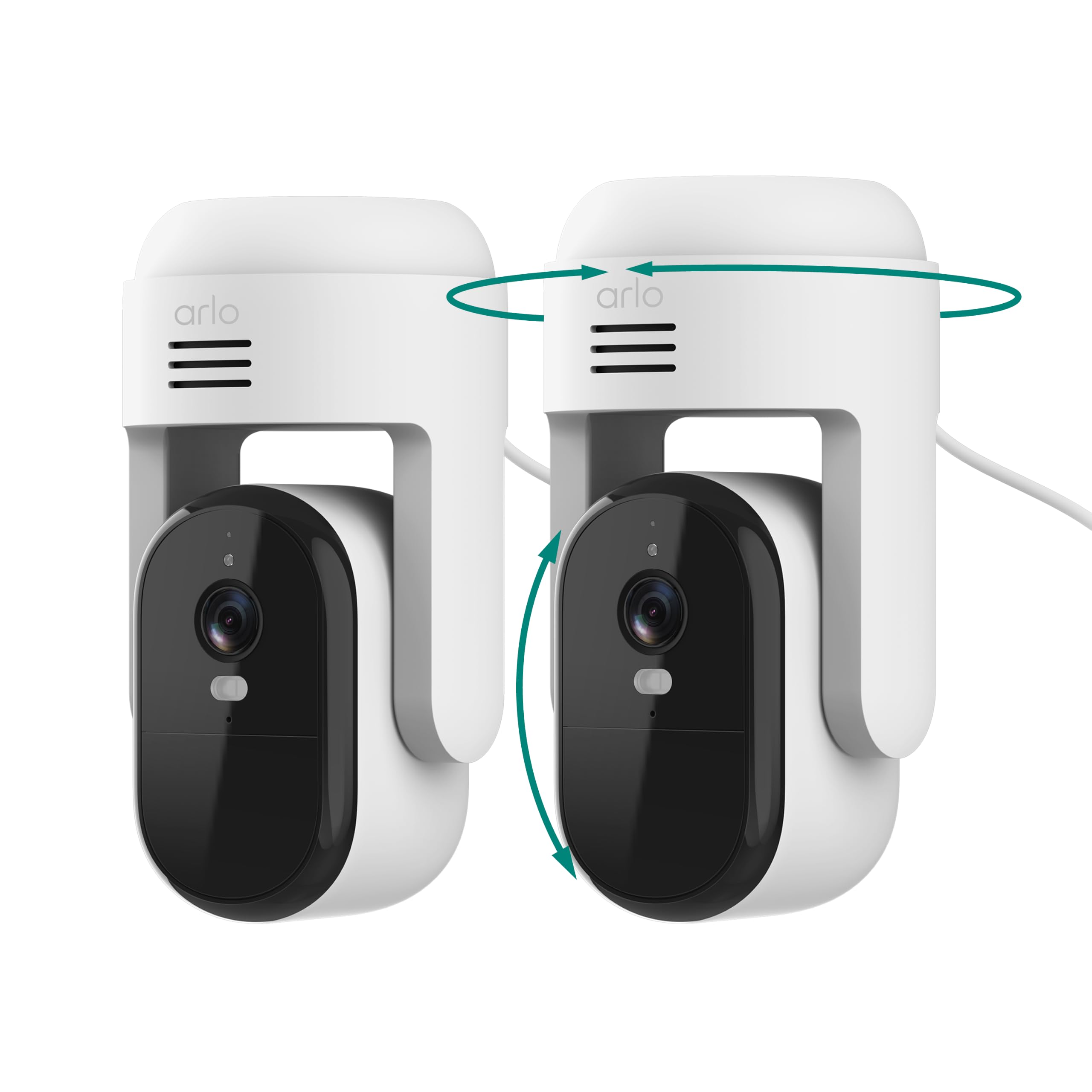
3. Arlo Essential Outdoor Pan Tilt Zoom
Two plug-in cameras that pan, tilt, and zoom 12x deep — no recharging, ever.
Here is the zoom fight the specs make for you: the Arlo Essential reaches 12x, and the Ring Floodlight Cam stops at 6x. That is the biggest reach in this group, and on a plug-in camera it means you can pull a licence plate or a face out of a wide 360° frame without moving the mount. Both cameras in this kit run 2K video with 360° pan and 180° tilt, so a single install patrols a whole stretch of yard.
Because these are plug-in, the batteries-never-die problem simply does not exist — each unit ships with a 16ft power cable and stays powered around the clock. Dual-band Wi-Fi (2.4GHz and 5GHz) grabs whichever signal is stronger in that spot. Video quality and motion tracking both land positive in the review consensus, and the pan-tilt sweep is praised for covering an entire area with zero blind spots. Color night vision plus an integrated spotlight keep the picture readable after dark, and Smart Detection flags people, vehicles, pets, and packages without a fee for basic alerts.
The recurring gripe is a reliability one: video recording can stall roughly every twelve hours on some units, which means you should glance at the app now and then rather than trust it blindly. Advanced features like 60-day video history and AI detection need the paid Arlo Secure plan after the trial ends.
Where it beats the pack: 12x zoom and a full 360° sweep on plug-in power edge out the Ring’s 6x reach — you get closer detail without hunting for an outlet recharge.
Matches well with: anyone mounting near a socket who wants maximum zoom reach and full pan coverage from one camera.
The trade-off to know: on some units recording pauses about every 12 hours, so check the app periodically.
4. eufy Security eufyCam C37
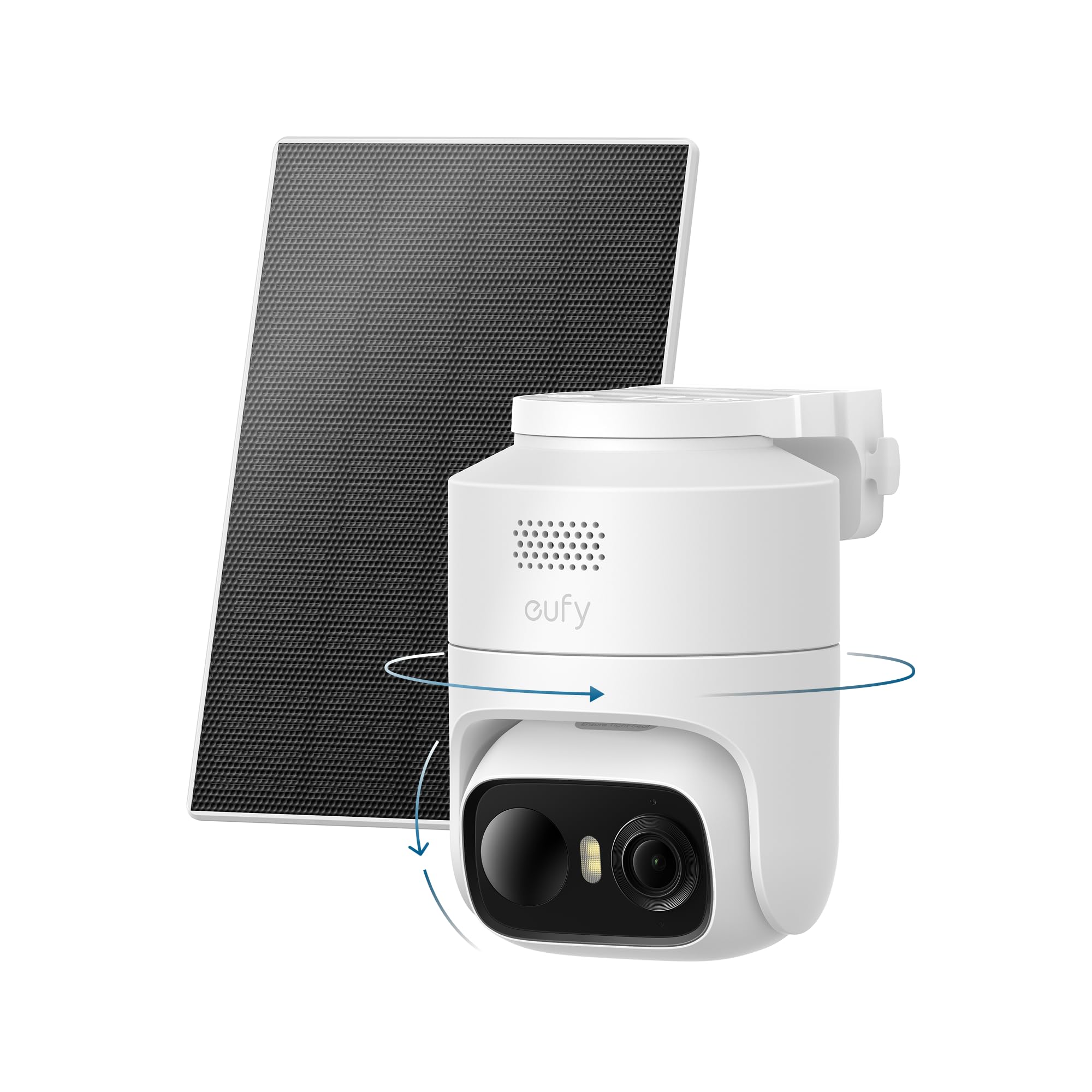
The solar panel detaches from the lens, so the sun and the view stop fighting each other.
Most solar cameras force a compromise: point the panel at the sun and the lens points wherever the mount allows. eufy solves it with detachable 3W solar panels you angle independently, so the camera stays aimed at your yard while the panel faces the light. That single design choice is why this is the pick for a spot with no outlet — a gate, a shed, the far fence line.
Video runs 2K with color night vision, and eufy claims 77% more pixels than standard 1080p — a real jump in how much detail lands on a face or a plate in the dark. Smart AI sorts people, vehicles, and pets, and a 360° pan-tilt sweep with auto-tracking keeps a moving subject centred. Frame rate is 15 frames per second. There is no cloud storage at all: you record to a microSD card up to 256GB or a HomeBase, and the maker pitches the lack of monthly fees as the draw.
Do your homework on compatibility before you buy. This camera connects over 2.4GHz Wi-Fi only, works with select HomeBase models (not HomeBase2), and is not compatible with HomeKit. If you already own eufy gear, check your base station version against the list. Match your HomeBase version and Wi-Fi band, and you have a solar camera with no subscription attached.
The independent-panel trick: a detachable 3W solar panel means you can chase sunlight and the best viewing angle at the same time — rare at this tier.
Check before ordering: 2.4GHz Wi-Fi only, no HomeKit, and a HomeBase version list you have to match.
Go for it when: the mount spot has sun but no socket, and you refuse to pay a monthly cloud fee.
Look elsewhere if: you run a HomeKit setup or an older HomeBase — compatibility stops you cold.
5. VicoHome 2CG6
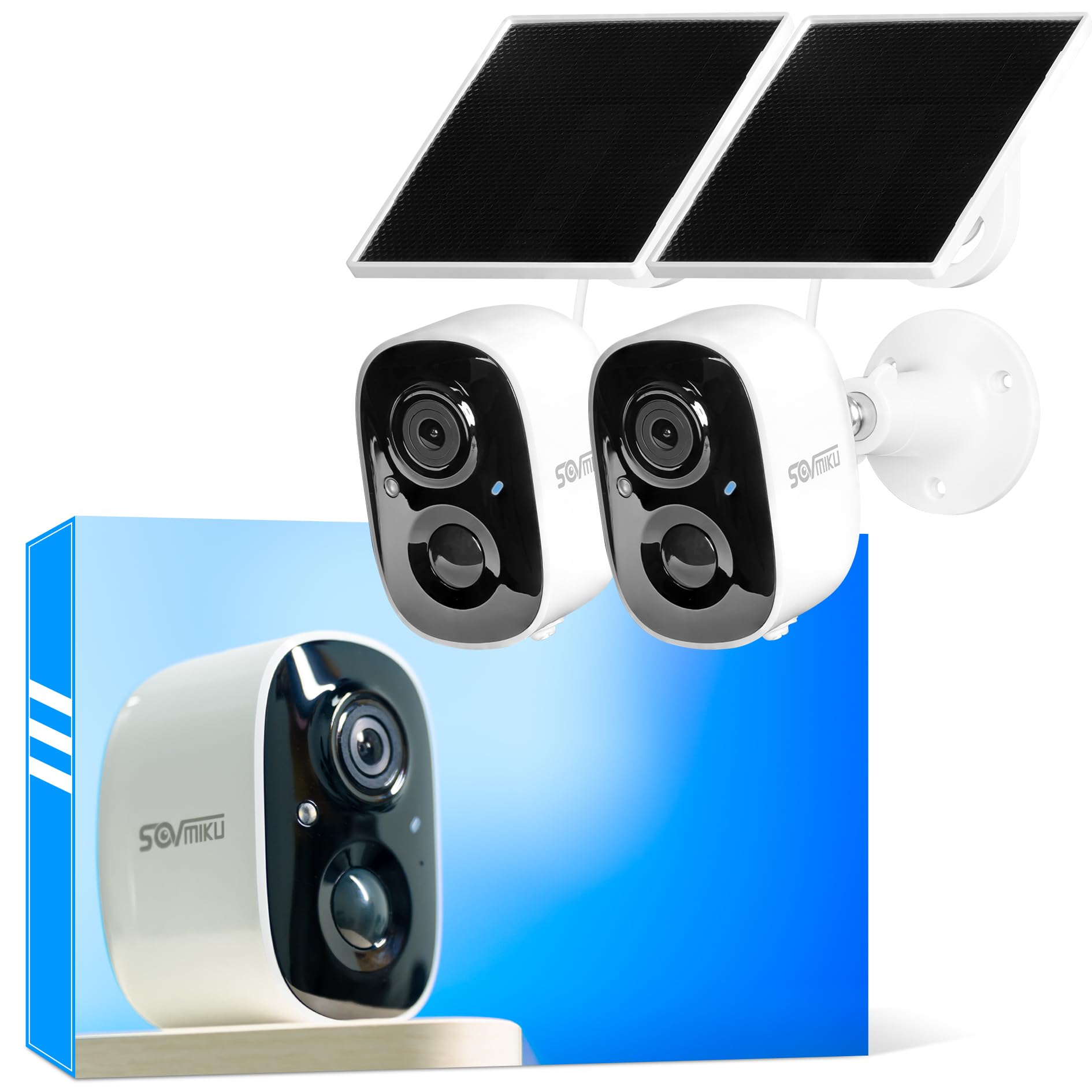
A solar camera built to go weeks without the charger touching it.
Runtime is the whole pitch here. A 5200mAh built-in battery plus monocrystalline solar panels rated for up to 23% energy conversion — the maker claims a full charge keeps the camera running two months or more. Owners back that up: the solar feature gets steady praise, and one buyer reports 59 days of running on solar energy alone. For a back fence with no wiring, that two-month solar runtime is the whole point.
The PIR sensor stays armed constantly, so a warm body — person or animal — trips it and wakes the camera in a fraction of a millisecond range before the spotlight and siren can fire. Video is 2K across a 110-degree field of view. The whole kit is IP65, tested to the IEC 60529 standard, and the charging port carries a silicone waterproof plug so you can install it in the open without worrying about water creeping in.
Two honest notes. IP65 resistance is not permanent — the maker says it can fade with normal wear, so keep that plug seated and clean. And the battery-life and connectivity aspects sit in mixed territory, meaning a share of owners find the real-world runtime or signal weaker than the headline. Set expectations around winter sun and thick walls before you mount it.
What it does best: a 5200mAh battery paired with up-to-23% solar conversion means long gaps between charges, and the always-on PIR sensor wakes the camera fast when something moves.
The realistic limit: the waterproof seal and battery runtime are not forever — treat both as wear items over the years.
Suits you if: a shed, gate, or tree at the edge of your property needs coverage with no cable run, and you want the sun to do the charging.
Plan around this: mixed reports on battery and signal mean you should test that spot’s Wi-Fi before committing the mount.
6. Tapo C545D

Two lenses on one mount: one takes in the whole yard, the other zooms in on the detail.
The Tapo carries the toughest water rating in this group at IP66 — a step past the IP65 cameras here, meaning the housing shrugs off powerful water jets, not just rain. For a coastal spot or a driveway that catches spray from a passing hose, that extra seal is worth having. Inside are two lenses: a 165° ultra-wide 2K lens for the big picture and a 6mm telephoto lens that pans and tilts through 360° and zooms up to 10.8x.
One-tap smart focus is the feature you will use every day — tap anywhere on the wide view and the telephoto lens locks onto that spot so distant details stay sharp without you fiddling. Free on-device AI detects people, pets, vehicles, line-crossing, and tampering to keep false alerts down with no monthly fee. Night vision reaches 99 ft. There is no subscription storage requirement either: record to a microSD card up to 512GB, a Tapo Hub, or optional cloud.
The power situation is the main thing to plan for. The C545D runs on the included DC adapter and connects over 2.4GHz Wi-Fi 6 or Ethernet, drawing a max of 11.5W — so you need an outlet near the mount, and it is not a battery or solar unit. Run the DC cable to a sheltered socket, and the dual-lens reach gives you the most flexible single-camera detail setup here.
The dual-lens gamble pays off
- IP66 rating outlasts the IP65 units in driving rain and spray
- 165° wide lens plus a 6mm telephoto covering 360° pan and tilts to 10.8x zoom
- 70-plus feet of night vision means the dark side yard stays readable
- Free on-device AI and 512GB microSD support keep alerts sharp and storage local
What you give up
- DC-powered only — no battery or solar option, so you need an outlet nearby
- Needs 2.4GHz Wi-Fi for wireless setup, not 5GHz
- Fewer reviews to draw on than the more established picks here
Made for: a buyer who wants both a wide sweep and a zoomed close-up from one housing, and has power at the mount.
Hold off if: there is no socket within reach — this camera does not run on battery or sun.
7. REOLINK Argus PT Ultra
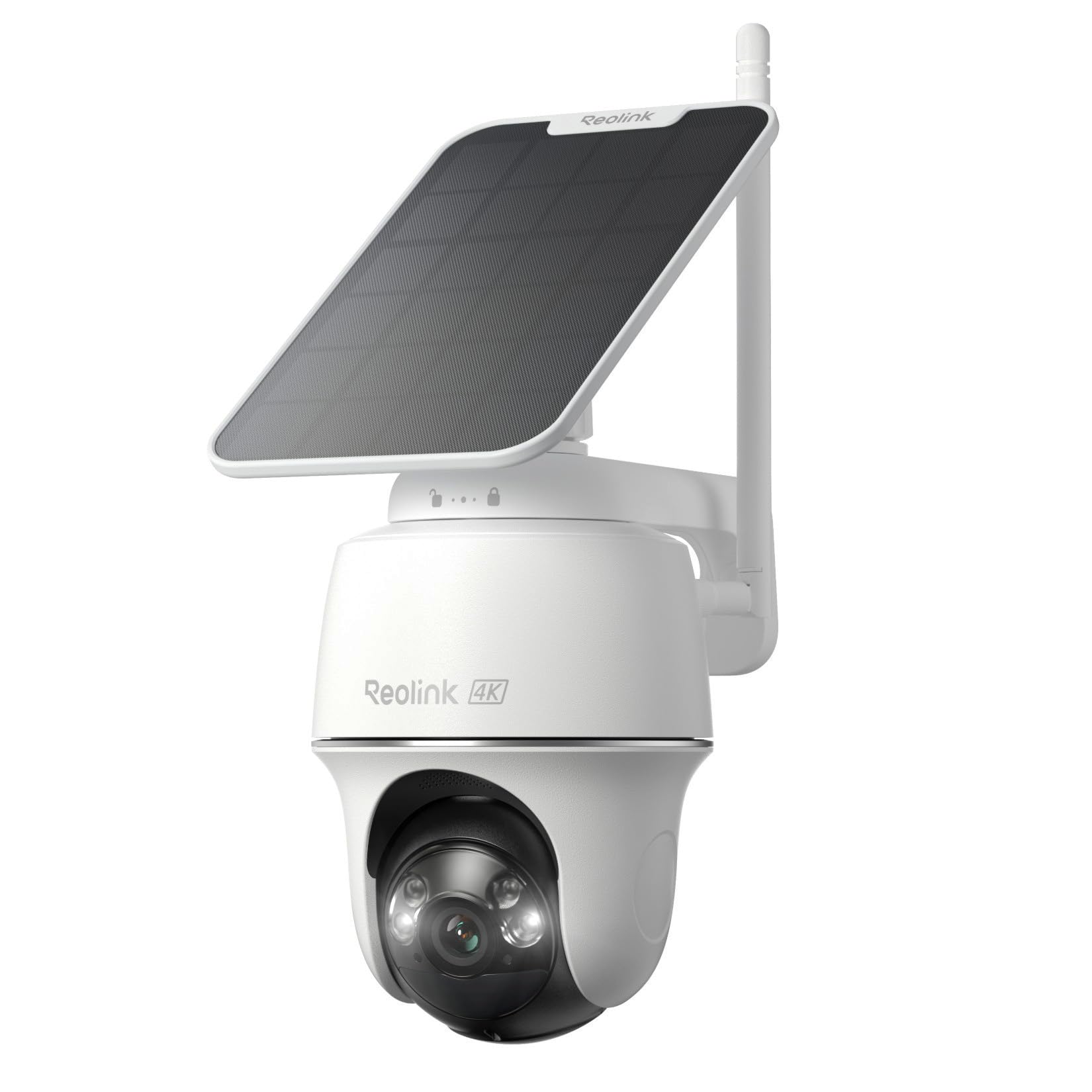
4K resolution on a solar mount that pans 355 degrees without a single wire.
Resolution is the reason to look here. The Argus PT Ultra jumps to 4K 8MP — double the 2K on the Arlo and the eufy above — with a built-in motion spotlight so color detail survives after dark. On a wide 355° pan and 140° tilt sweep, that extra pixel count means a face or a plate fills more of the frame when you zoom into the app later. It runs entirely wire-free on 2.4/5GHz Wi-Fi, kept charged by a 3W solar panel.
The consensus on picture quality is strong, and pan-and-tilt control gets consistent approval. Recording goes to a microSD card supported up to 512GB, and the free Reolink app gives remote control and two-way talk from anywhere. Smart detection with motion zones cuts down on nuisance alerts, and the spotlight and siren fire on trigger.
Connectivity is the real caveat, and it shows up across the review history — the camera can refuse to connect or drop its network link. On a stable connection, its 4K image is the sharpest of this 2K-heavy field.
The resolution lead: 4K 8MP out-resolves every 2K pick here, and the motion spotlight keeps color in the frame at night.
The signal risk: dropping or refusing to connect is common enough to plan a mounting spot with strong Wi-Fi.
Choose it for: pixel-heavy recording where you want to zoom into 4K footage after the fact.
Weigh this first: if your Wi-Fi is patchy at the mount point, connectivity drops will frustrate the very detail you bought it for.
8. aosu D1 Max 2-Cam Kit

Two 4K solar cameras and a base station that keeps footage off the cloud.
When you want both entry points covered from day one, this kit skips the “add a camera later” step. Two SolarCam D1 Max units pair with an aosuBase that stores recordings locally — 32GB built in, expandable up to 1TB — so nothing goes to a subscription cloud unless you want it to. Each camera shoots 4K 8MP with 6x digital zoom, and the maker says faces and plates read clearly from up to 33ft away.
The build-and-picture combo carries this one: quality and easy setup top the consensus, with motion tracking singled out for exactly detecting movement in a yard. On-device AI sorts people from vehicles to thin out junk alerts, and Smart Vehicle Guard watches parked cars. Cross-camera tracking ties clips from both cameras into one continuous timeline, so a person walking from driveway to door reads as a single event. The detached solar panels let you angle for sun while the lens stays aimed.
Two measurements are worth knowing before you buy. Each camera runs a 5200mAh battery on that solar charge, and reliability plus battery life and Wi-Fi connectivity all sit in mixed territory — meaning a slice of owners hit weaker real-world results than the base station’s stable-signal pitch suggests. The 32GB storage fills faster than you might guess once two 4K cameras are writing to it, so budget for a card or drive expansion.
The sell: two 4K solar cameras, a base station, and 32GB of local storage from the start — no subscription required to keep your footage.
Great for: a home with two spots to watch — front door plus driveway — who want local storage and a base that holds the signal.
Keep in mind: 32GB fills quickly with two 4K streams, so plan the 1TB expansion early.
9. aosu T2 Ultra
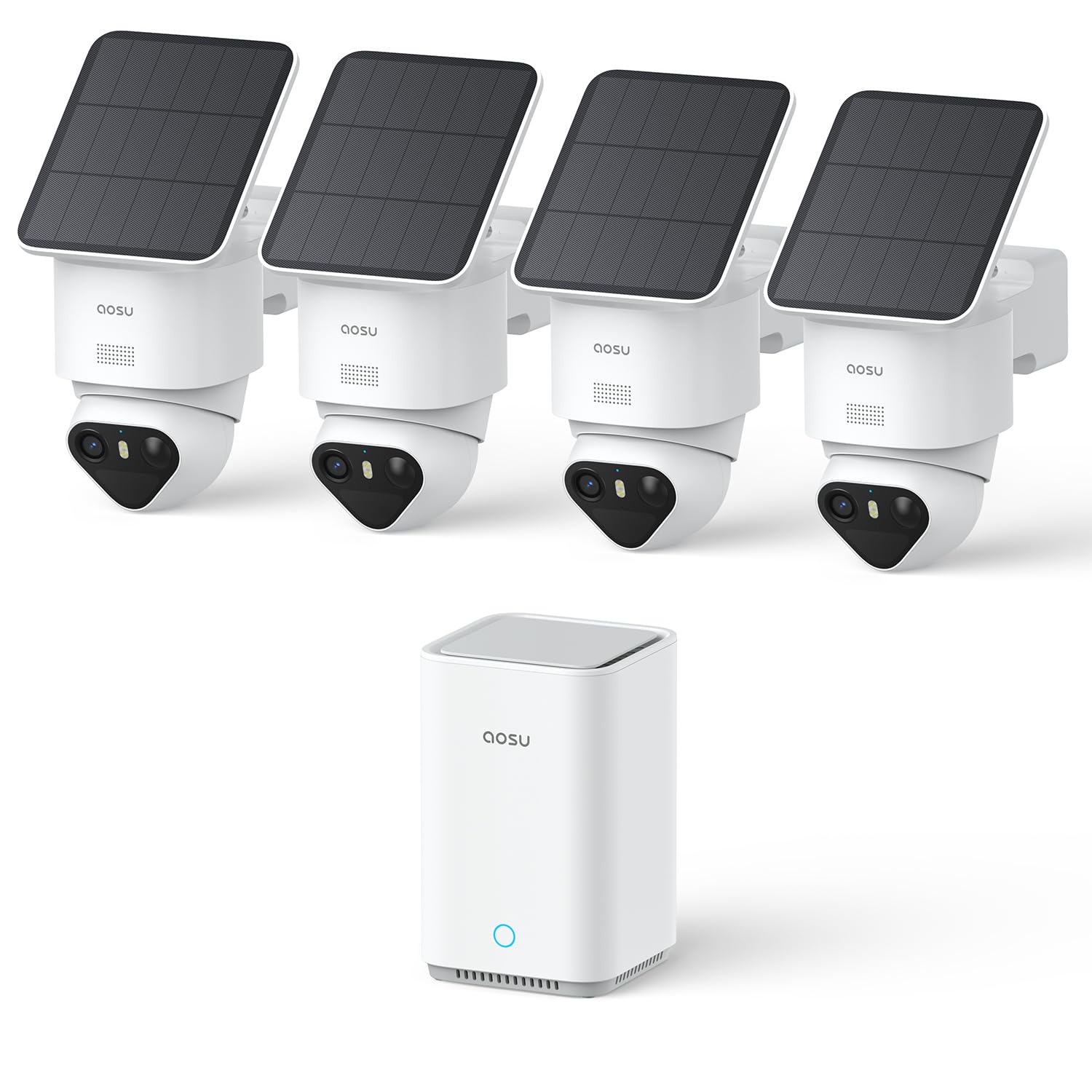
The biggest battery here, a 360° dome that tracks, and a base that grows to six cameras.
This is the build-out pick for someone who plans to cover a whole single-family property. Each camera pairs a 9200mAh battery — the largest of the group, well past the 5200mAh cells on the VicoHome and the D1 Max — with a detachable solar panel, so runtime is the least of your worries. Video is 4K TrueColor night vision, and the dome pans a full 360° with real-time auto tracking and no blind spots.
The aosuBase is the engine. It connects to your router by Ethernet and the cameras link to it wirelessly, which removes the “is my home Wi-Fi 2.4 or 5GHz?” headache entirely. It holds 32GB of encrypted local storage from the start, expands to 1TB, and supports up to six cameras so the system scales as you add spots. Triple AI detection sorts people from activity, and multi-camera tracking stitches clips from different angles into one event.
The honest trade-off is motion performance. Video quality, night vision, and even battery life land positive in the consensus, but motion detection is mixed — it catches movement, though tracking can lag. The cameras are sold here as a four-camera kit, so confirm the camera count you actually want before checkout. If whole-property coverage with a local base matters more than twitch-fast tracking, this is the most expandable system here.
Built to cover a full property
- 9200mAh battery per camera — the largest capacity in this lineup — plus detachable solar
- 360° dome with auto tracking and a base that scales to six cameras
- Ethernet-tethered base sidesteps 2.4/5GHz Wi-Fi confusion
- 32GB encrypted local storage, expandable to 1TB, no subscription
The honest trade-offs
- Motion tracking can lag behind the subject even when detection fires
- Connectivity gets mixed reports — the base helps, but signal still matters
- Sold as a multi-camera kit, so check the count you want up front
Right for: a large property where you want one base, expandable cameras, and no monthly cloud bill.
Only if: you can accept slower-than-perfect tracking in exchange for the biggest battery and a scalable system.
Know the Specs
IP ratings explained
The IP number is two digits: the first is dust protection, the second is water. An IP65 means the housing is dust-tight and survives water jets — enough for rain, sprinklers, and a hose. IP66 raises that to powerful water jets for tougher spray. The seal at the charging port matters as much as the badge, because water resistance is not permanent and fades with wear.
Power source: plug-in vs solar vs battery
A plug-in camera like the Arlo runs nonstop but needs a cable to an outlet. A solar camera mounts anywhere but depends on how much sun the spot gets, and a detachable panel lets you angle toward the sun independently of the lens. A battery-plus-solar combo frees you from wiring — the bigger the mAh, the longer the gap between charges.
Wire-free coverage and pan range
Pan and tilt numbers tell you how much of your yard a single mount can sweep. A 355° pan covers nearly a full circle, while the 165° wide lens on the Tapo trades sweep for breadth. More sweep and a wider field of view mean fewer cameras to cover one driveway or back garden.
Storage and subscriptions
Local storage — a microSD card or a base station — means no recurring fee and your footage stays under your control. Check the maximum card size, since it caps how many days of video you keep before overwriting. Cloud and smart alerts on some cameras need a paid plan, so confirm what runs free before you commit.
Common Questions
Is IP65 enough to leave a security camera outside all year?
Do I need to run a cable to a weatherproof security camera?
Will a solar security camera keep working through winter?
Can I record without paying a monthly cloud fee?
What is the difference between 2K and 4K on an outdoor camera?
How much zoom do I actually need on a weatherproof camera?
Will these cameras work with Alexa or Google Home?
Do these cameras need 2.4GHz or 5GHz Wi-Fi?
Can one weatherproof camera cover a whole yard?
What should I check before mounting a camera outdoors?
The Bottom Line
For most homes, the weatherproof security camera worth starting with is the Ring Floodlight Cam 2K, because it records, lights up the yard, and sounds a siren from one app — and its 4.5+ star standing across 600+ ratings backs that up. If you want the most zoom reach on plug-in power, grab the Arlo Essential 2K at 12x. And for a spot with sun but no socket, the eufyCam C37 with its detachable solar panel is the one to reach for.
How we choose
We do not accept paid placement. Every pick is matched to a real buyer and a real use-case; we do not hands-on test units.
Sources
Specifications: manufacturer listings and product documentation. Review insights: verified customer reviews, as of November 2026. Pricing: not shown on this page (it changes often); check the current price via the retailer link.
As an Amazon Associate, Tactical Gear Guy earns from qualifying purchases. This does not affect which products we feature.