Specs are compiled from manufacturer listings and verified buyer reviews and can change over time — please confirm the key details on the product page before buying.
Here is the short answer: the right wearable fall detector is the one that actually reaches a human when your parent is on the floor and cannot press anything. That means automatic fall tripping, live GPS location, and a live person or family contact on the other end — not a pretty watch that only counts steps. What follows is nine devices that genuinely detect falls on their own, sorted so you can see which work with a monitoring service, which alert family directly, and which cost nothing monthly.
This guide is built by comparing the manufacturers’ published specifications and the patterns across verified customer reviews, so you get each pick’s real strengths and trade-offs instead of marketing spin.
Below you will find which devices alert a professional center and which call your own family, so the choice becomes a coverage question rather than a gadget question. Think about it as choosing who receives the alarm and how fast they can move, then scan these wearable fall detection devices against that single answer.
Top Picks
How To Choose The Best Wearable Fall Detection Devices
A wearable fall detector answers one question: when a person goes down unexpectedly, who finds out and how soon? Everything below — monitoring plans, GPS, battery size, water ratings — exists to protect that answer. Get the alarm path right first, then worry about the rest.
Automatic tripping versus the SOS button
Every device here detects falls on its own, but the way it decides differs. Some sense a hard impact and connect you to a monitoring center without any button press at all. Others use a heart button held for three seconds as a manual backup on top of automatic detection. A device with both is safer, because a fall against carpet is softer than one against tile, and a person who is conscious may want to call for help quickly. If your parent lives alone, treat automatic detection as the headline feature and the button as the second line of defense.
Who picks up the alarm
There are three distinct paths. A professional monitoring center answers a cellular call and dispatches help — that is the model behind the 321 Alert Mini X3. A family-first system sends the alert straight to your phone and your own contacts, with no call center between you and the news. A 911-direct pendant skips everyone and connects to emergency dispatchers. Each path has a different monthly arrangement, so decide who you trust to answer before you compare any spec sheet.
Coverage and battery, in plain terms
An embedded SIM (a chip soldered inside the device, so there is no card to insert or lose) keeps the pendant on a cellular network coast to coast wherever signal reaches. GPS then pinpoints the wearer’s location so responders find the right door. Battery life runs from a single day on a health-monitoring watch up to seven days on a low-power tracker, and daily charging is far easier to forget than weekly. For a shower or a rainy walk, look for a water-resistance rating — IP67 is the common one, meaning it survives splashes and brief immersion.
The beginner mistake to avoid
Buyers often buy the cheapest pendant and only then discover it cannot reach anyone without a plan they did not budget for. Others buy a full health smartwatch for its heart-rate displays and find the fall alarm depends on a connection that drops. The wrong assumption is that “fall detection” means the same thing everywhere; in this category the plan and the alert contact matter more than the screen.
Side-by-Side Comparison
Every row below detects falls automatically. The three spec columns show, in the same order for each device, the alert path, the battery figure, and water protection — the numbers that decide whether it fits your situation.
| Model | Best For | Alert Path | Battery Life | Water Rating | Amazon |
|---|---|---|---|---|---|
| 321 Alert Mini X3★ Best Overall | Living alone with monitoring | 24/7 monitoring center | 3-5 days | Water resistant | Amazon |
| Seculife Alert PendantBest Geo-Fencing | Geo-fencing and location history | Direct to family contacts | Up to 6 days | IP67 | Amazon |
| Seculife Medical Alert SmartbandMost Like a Watch | Wrist-worn health tracking | Direct to family contacts | 1 day | IP67 | Amazon |
| Fall Detection Watch for Seniors | Medication reminders on the wrist | Direct to emergency contacts | 12 hours | IP67 | Amazon |
| Audar E2 Smartwatch | Remote vital monitoring | SMS, email, platform alerts | 7 days | IP67 | Amazon |
| Nomo Smart Care Essential Kit | Home coverage with range extenders | Care Circle via Wi-Fi hub | — | — | Amazon |
| Guardian Alert 911 Plus | No monthly fee, direct 911 | Direct to 911 dispatchers | — | Water resistant | Amazon |
| SureSafeGO | Fully mobile with GPS | Direct call from pendant | Up to 4 days | Shower-safe | Amazon |
Detailed Reviews
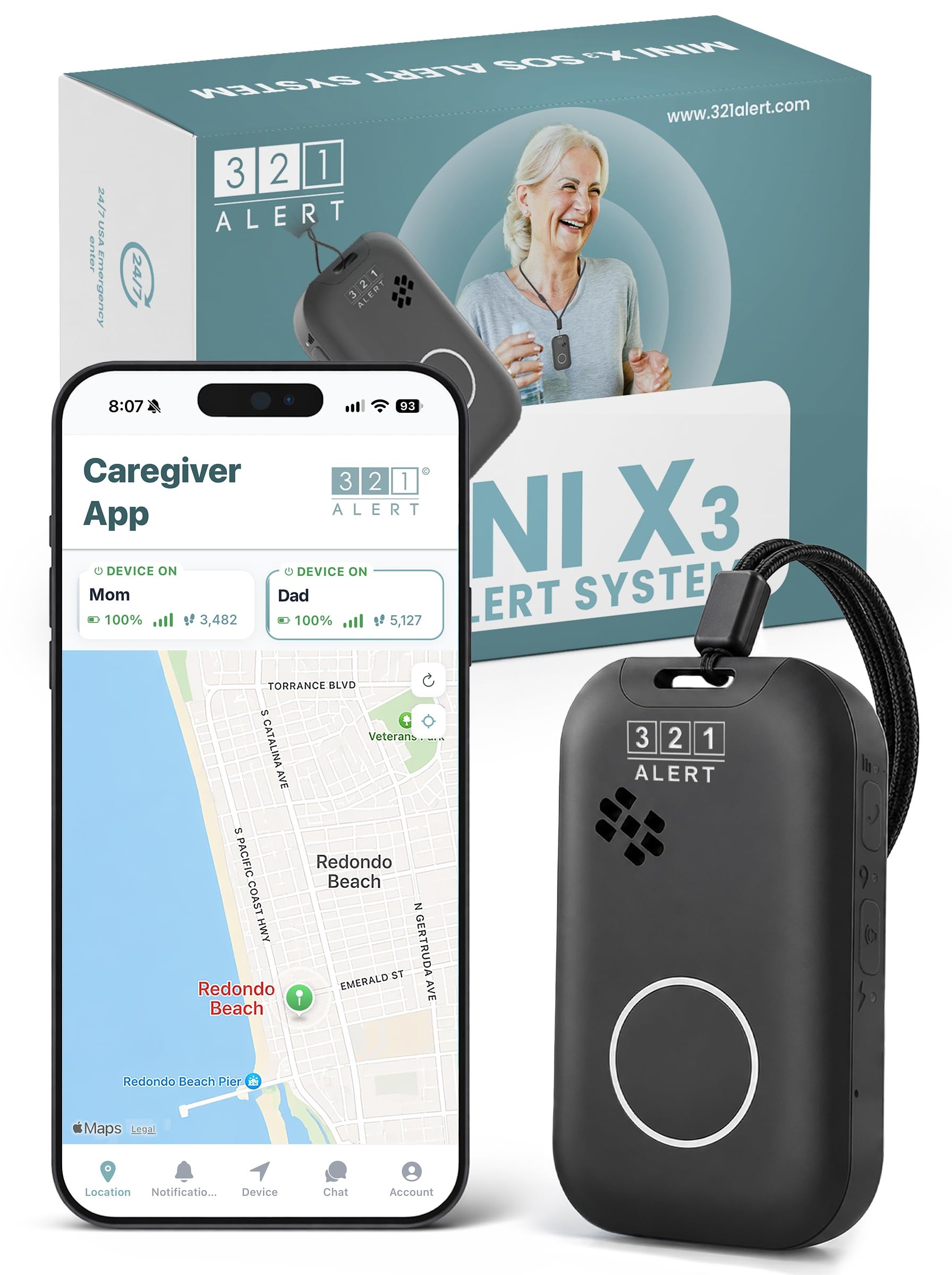
1. 321 Alert Medical Alert System Mini X3
Our pick — 4.5+★ from 70+ verified ratings; the strongest balance of quality and price.
The pendant that calls a real person before your parent can reach the button.
What makes the Mini X3 the pick for most families is the alarm path, not the plastic shell. A hard impact trips the fall sensor and connects straight to a 24/7 emergency response center — a live operator answers, even if the wearer never touches a button. That is the whole point of wearing one of these. The embedded SIM (a chip soldered inside so there is no card to install or lose) keeps the connection live coast to coast wherever cellular service reaches, and GPS and 4G LTE mark the location for responders.
Activation is a single phone call, and fall detection plus 24/7 monitoring go live immediately. You call to activate, and fall detection plus 24/7 monitoring go live right away. The device is a stand-alone cellular unit (it connects on its own mobile network) — no phone pairing, no home hub, nothing to plug in beyond the charging dock. Reviewers most often praise the one-call activation and the fact that the fall alert reliably reaches a live operator. The second big theme is how easy it is to get going, which matters when an adult child is setting it up for a parent in another state.
It is deliberately chunky and easy to grip — comfortable in a hand with arthritis, where slim medallions slip and frustrate. It clips to a belt or bag with the included clip, or hangs on the lanyard, and the dock has a built-in help button so the wearer can call for help from the bedside without wearing the pendant overnight. It is water-resistant for showers and rain, and the charge runs 3-5 days depending on use. Compared with the SureSafeGO further down, which lasts up to 4 days, the Mini X3 sits in the same working range — both need a charging routine, neither is a leave-it-and-forget device.
What works well here
- Automatic fall detection connects to a live monitoring center — a real operator answers, not a recording.
- Embedded SIM with no card to install, so activation is one phone call.
- GPS and 4G LTE locate the wearer precisely for responders.
- Chunky, grippable shape suits hands with arthritis better than slim pendants.
- Dock has a bedside help button, so the pendant can stay on the charger overnight.
Where it fits less neatly
- Requires a monthly monitoring plan to function — budget for it as part of the purchase.
- 3-5 days of battery means a fixed charging habit, not a weekly afterthought.
Go with it if: your parent lives alone and you want a professional center answering the fall alert, day or night.
Look elsewhere if: you want zero recurring cost — the Guardian Alert 911 Plus is built around that instead.
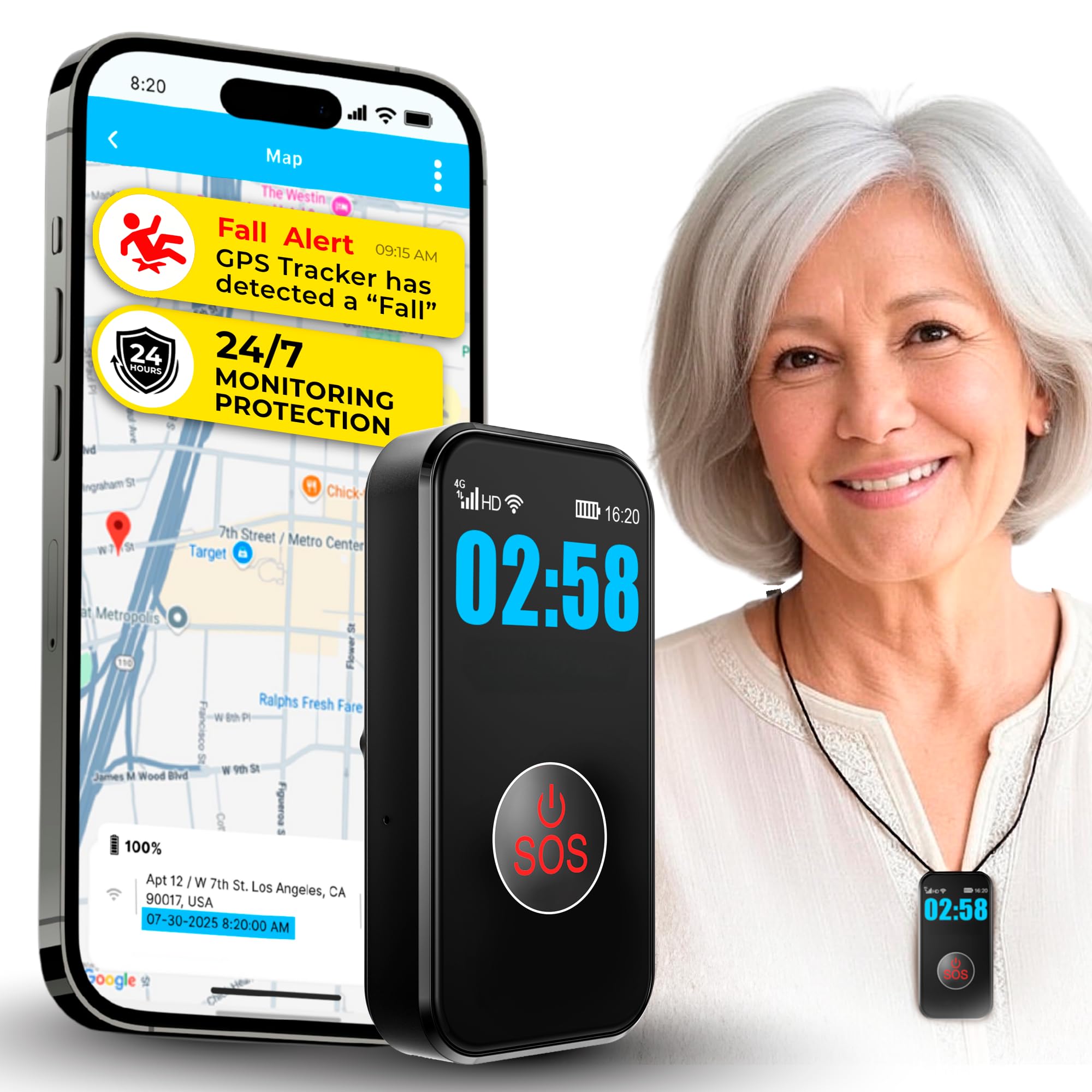
2. Seculife Medical Alert Pendant
Rings you the moment your parent wanders past a boundary you drew yourself.
The Seculife pendant lets you draw safe zones on a map and pings you when the wearer enters or leaves them — that is the feature no other pick here offers as clearly. It also keeps a full year of location history, so you can see where the day actually went. On top of that sits automatic fall detection that calls and sends an SOS to preselected contacts, plus hands-free two-way calling with a speakerphone.
The wearer side is built for simplicity. The pendant has a clear display showing time, battery, and signal strength — so the person can glance down and know it is charged and connected. The SOS button is large, and calls auto-answer hands-free when a contact dials in, so nobody has to fumble with a small screen. It is fully waterproof to IP67, meaning it survives showers, rain, and splashes and can stay on 24/7. Battery runs up to 6 days with tracking at 24-hour intervals, which is the longest figure in this group aside from the Audar E2’s 7 days.
Owners single out the geo-fence alerts and year of location history as the features they actually use. Families value knowing where everyone is without making a call. The catch is that this is a family-first device with a monthly plan; there is no professional call center between your parent and your own contacts, so your family is the response team. If your loved one needs a trained operator to dispatch an ambulance, the 321 Alert winner is the stronger path.
Standout spec: custom geo-fence zones plus a year of location history put this at the top for wandering-prone wearers.
The honest limit: it alerts your family directly, so your contacts become the primary responders rather than a monitoring center.
Made for: families tracking a parent with dementia or Alzheimer’s who needs safe-zone alerts and live location.
Not the pick if: you want a professional dispatch center taking the fall call — go with the top pick instead.
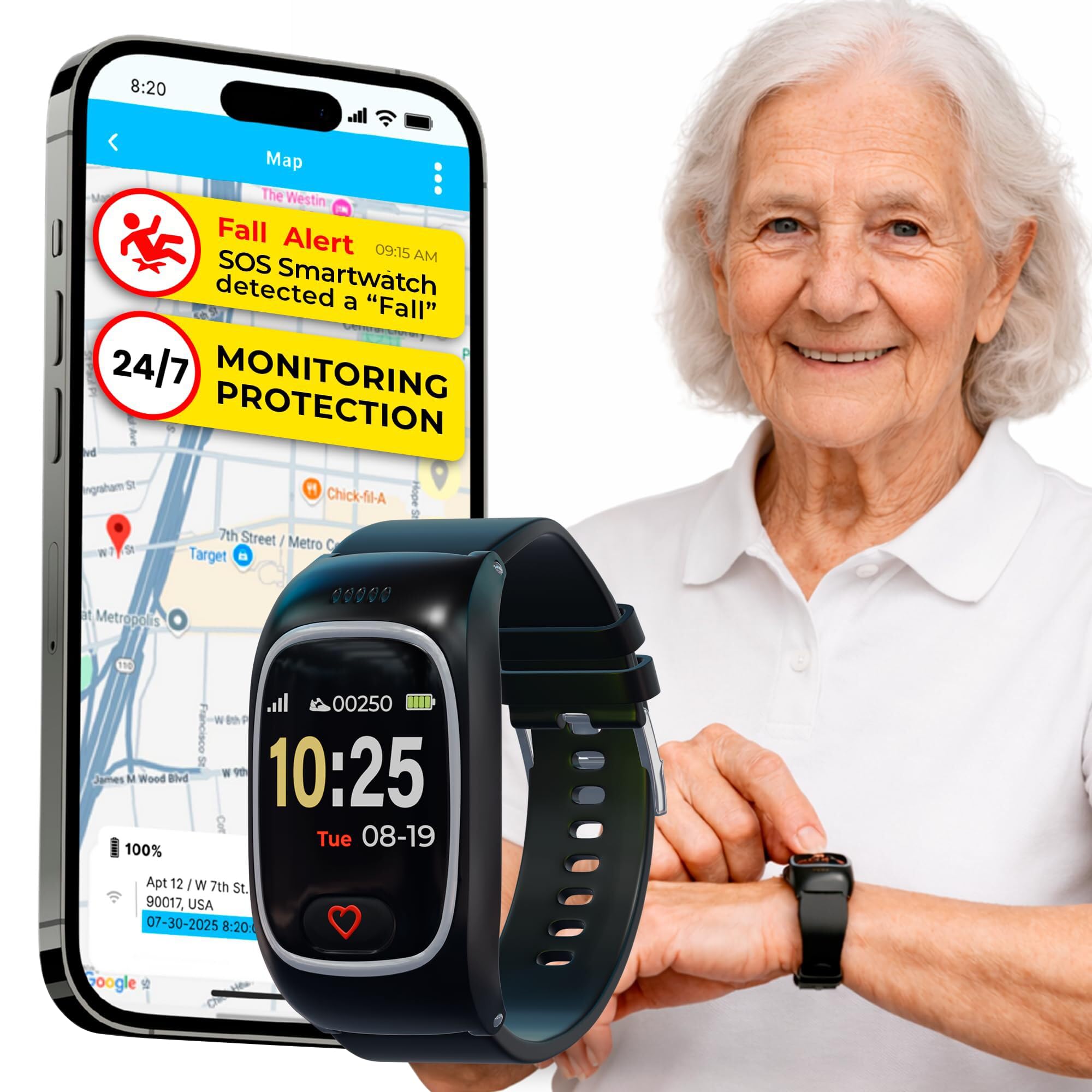
3. Seculife Medical Alert Smartband
Wrist-worn alert watch that answers calls by itself and watches heart rate on the side.
Some seniors refuse a pendant but will happily wear a watch, and that is exactly the buy this smartband is made for. It detects a fall or a three-second press of the heart button and automatically calls the pre-selected emergency contacts. Hands-free auto-answering means a pre-approved caller gets through without the wearer touching anything, which removes the single biggest hurdle for a person with limited dexterity. GPS tracking and geo-fencing work alongside a silicone band that stays comfortable through a full day.
Its strengths are the solid build and accurate GPS tracking, which owners say holds up indoors and out. The app on the caregiver side is simple to navigate. The recurring gripe is the pairing setup, which some find fiddly and others find smooth, so budget ten quiet minutes to get it connected before handing it over. Reliability is the other mixed note: it works well for plenty of wearers, but it is not a device to hand off without a test walk around the block first.
Battery is the real consideration. A single day of charge on a 680 milliamp-hour battery means this goes on the charger every night — close to the fall-detection watch below at 12 hours, and nowhere near the multi-day pendants in this group. The IP67 rating covers splashes and handwashing but not swimming. If a nightly routine is realistic for your parent, the watch form factor earns its place. If charging is the thing that gets forgotten, a pendant with a week of life is the safer call.
Why some families choose it
- Watch-style design gets worn by seniors who reject a necklace.
- Automatic fall calling plus hands-free auto-answer means no button fumbling.
- GPS and geo-fence tracking with a simple caregiver app.
What to weigh first
- Roughly one day of battery per charge on a 680 mAh cell.
- Paired-device setup and long-run reliability are hit and miss across owners.
Best for: a watch wearer who will happily charge nightly and wants auto-answer calls.
Skip if: charging discipline is unreliable — a multi-day pendant is the safer choice.
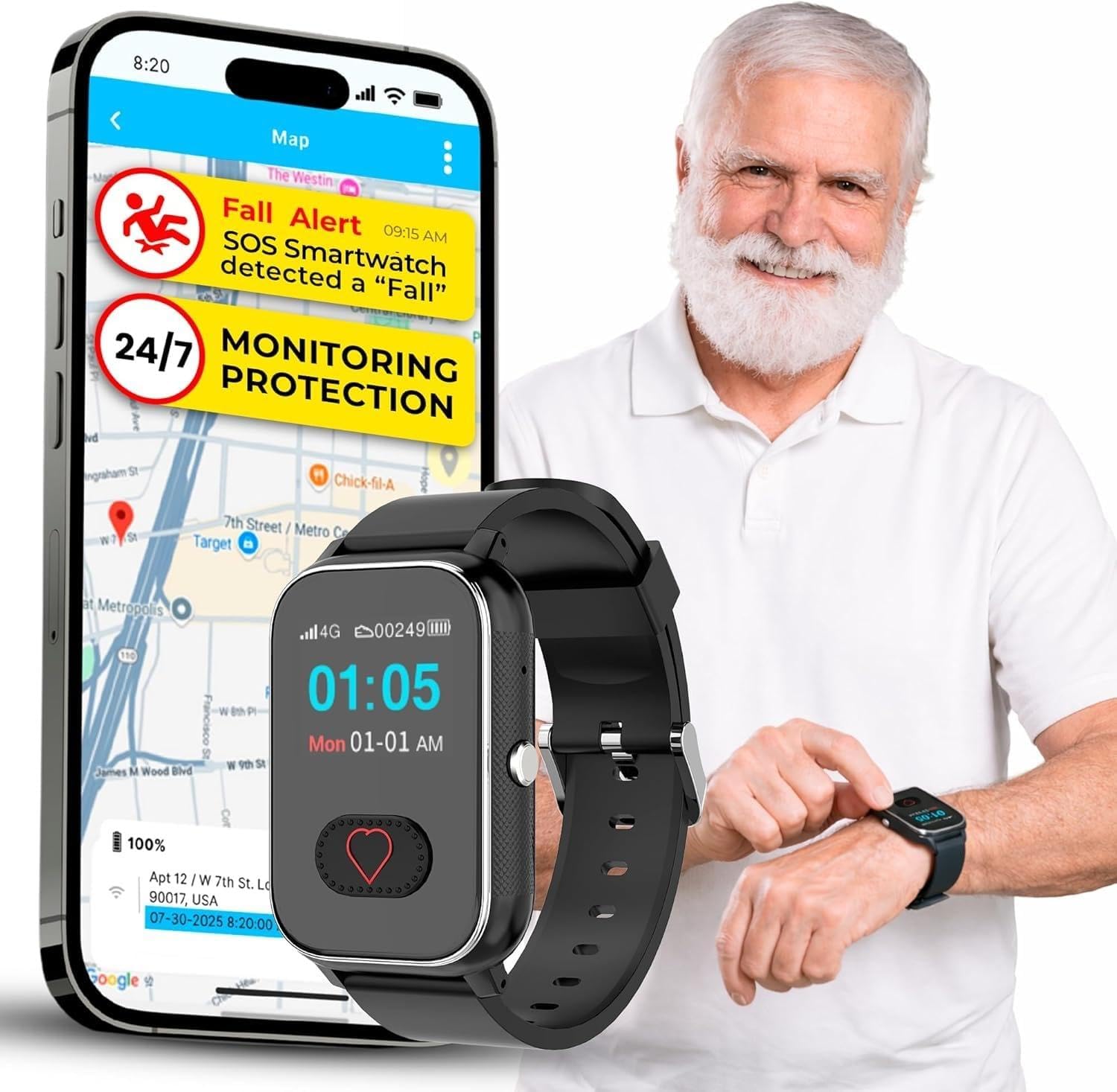
4. Fall Detection Watch for Seniors
The one that nudges your parent to take the pills and calls if they fall doing it.
Medication reminders are the differentiator here, and for a lot of older adults, a missed dose is a more common daily hazard than a fall. This watch lets you set daily medication and activity alerts, then layers fall detection on top: it senses hard falls and calls the emergency contacts automatically. There is also a large SOS button held for three seconds, a clear screen with big menus, and hands-free two-way calling through a built-in speakerphone that behaves like a simple phone.
The health readout is broad — heart rate, blood oxygen, distance walked, and a step counter — with a note from the maker that it is for general information use, not diagnosis. Treat those numbers as a rough daily glance rather than medical data. GPS tracking shows live location with up to a year of history in the app. Setup runs quick by most accounts, and the large-screen simplicity is the feature buyers notice most.
You will need to charge this one every night: the battery figure is 12 hours, the shortest in this guide. And the functionality is the mixed note — it works well for some wearers and not as expected for others, which is a fair reason to test it thoroughly in the first week rather than the first emergency. IP67 water resistance (a rating that means it survives being dunked in up to 1 metre of water for 30 minutes) covers rain and handwashing. At 3.0+ out of 5 across 30+ ratings, this is a smaller, more divided track record than the top picks, so it suits a specific buyer rather than everyone.
The draw: built-in medication reminders plus fall calling in a big-button watch is a rare combination at this tier.
The honest caveat: 12 hours of battery and split opinions on day-to-day function mean it needs a trial week before you trust it.
Pick it for: a parent who needs pill reminders and will reliably dock the watch each night.
Choose a pendant instead if: you want multi-day battery and a more consistent reliability record.
5. Audar E2 Senior Smartwatch

A remote-monitoring watch for the family that wants weekly vitals trends, not just a fall alarm.
If the fall alarm is the safety net, the Audar E2’s reason to exist is the trend chart behind it. Built-in sensors track heart rate, blood pressure, blood oxygen, and body temperature on intervals of 30 minutes, 1 hour, 2 hours, or 4 hours, or on demand. Those readings feed the Audar Health Platform, where daily, weekly, monthly, and yearly graphs sit ready for family to review. Weekly wellbeing reports can even be generated from the wearer’s data for continued monitoring. A blood pressure cuff is not included, and the maker recommends calibrating against one for the most reliable readings.
You can leave the charger at home for a week. It will hold a charge up to 7 days with hourly measurements, or up to 30 days of standby, which is the longest in this guide and beats the SureSafeGO at up to 4 days. It also runs a built-in SIM (a chip that connects to mobile networks on its own) that connects on low-cost IoT networks in 20+ countries with no roaming charges — no smartphone, app, Wi-Fi, or Bluetooth required, and connectivity is included for the first year. The slim, IP67-rated body (a rating that means it survives being dunked in up to 1 metre of water for 30 minutes) resists water, dust, and sweat, and the magnetic strap fits wrists from 135-238 mm.
The fall-detection and SOS side works well, with alerts reaching contacts by SMS, voice message, email, or the platform itself. The caution is the alarm behavior — several buyers report alerts not triggering on the watch and the device not calling 911, so set expectations that this contacts your family, not emergency services. Overall function and quality draw divided views, which is fair warning to test the alert chain before you depend on it. It is a monitoring tool first, an emergency alarm second — a distinction worth saying plainly.
What’s genuinely different
- Scheduled vitals tracking (heart rate, blood pressure, SpO₂, temperature) with long-range trend charts.
- Built-in SIM works in 20+ countries with no roaming charges and connectivity included for the first year.
- Up to 7 days of battery and 30 days of standby — the longest endurance here.
- IP67 body with a magnetic strap that fits wrists from 135-238 mm.
Where it falls short
- It does not call 911; alerts go to your contacts by message or platform only.
- Alarm triggering and overall function draw divided owner reports, so test it thoroughly.
Worth it for: families managing an ongoing health picture who want scheduled vitals plus fall alerts.
Not for: anyone counting on a direct 911 dispatch — this contacts family, not emergency services.
6. Nomo Smart Care Essential Kit
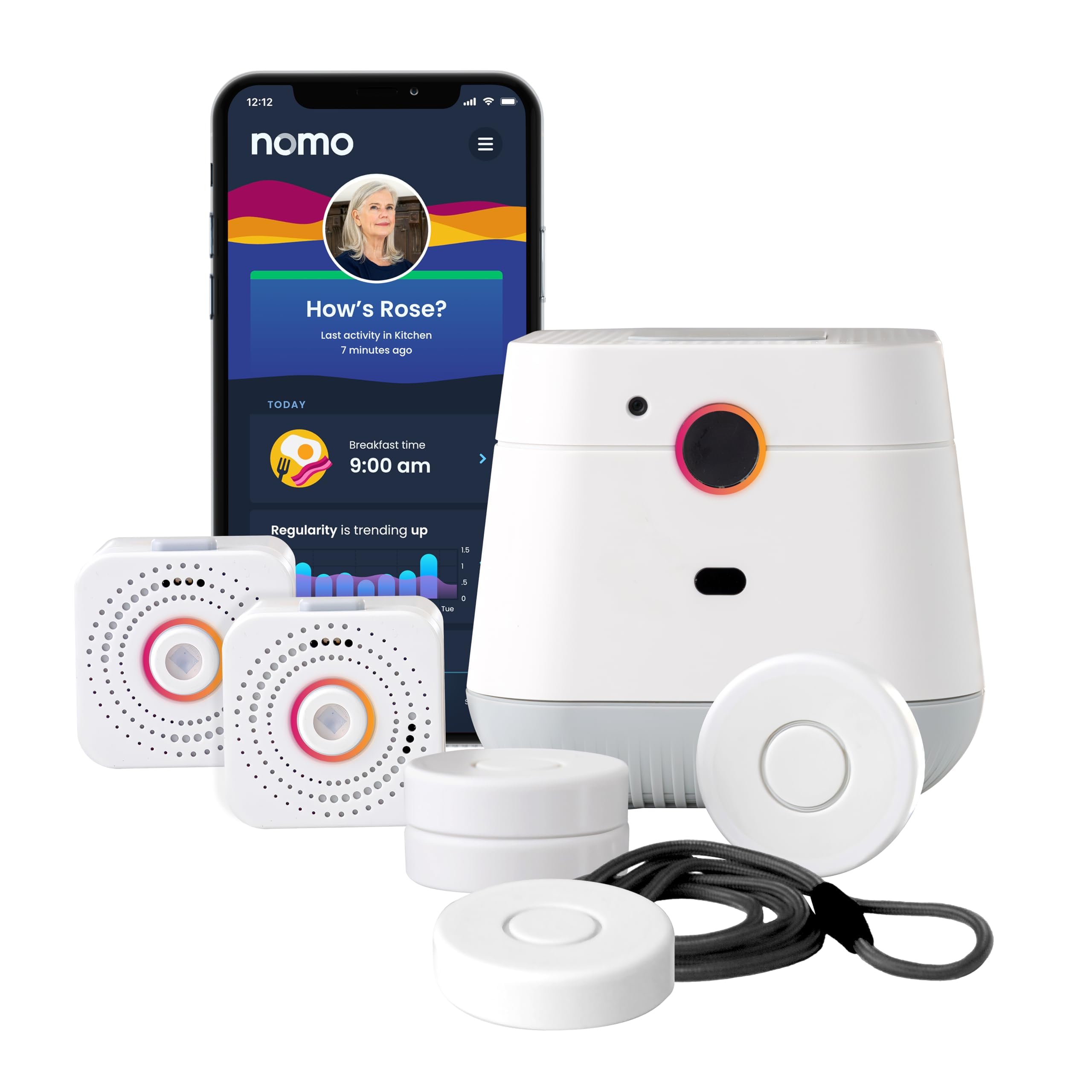
A whole-home kit rather than a single pendant — hub, two range extenders, and tags.
This is the odd one out in the best way. Instead of one wearable, the Nomo kit delivers a Smart Hub, two Satellite range extenders, and wearable Tags for fall detection and emergency alerts. The satellites spread coverage across a house so the signal reaches rooms a single pendant cannot. Everything runs over secure Wi-Fi with no landline required, and setup is plug-and-play: put the hub and satellites in wall outlets, place the tags, and you are live. There is no special wiring and no technician visit.
Two-way voice runs through the hub, so the wearer talks to someone directly in an emergency. Fall detection reads unusual movement patterns and fall events and pushes instant alerts to your Care Circle. The kit includes a 30-day trial of 24/7 monitoring with RapidSOS emergency services through the Nomo app; after the trial a monthly subscription applies, and you can cancel anytime. Movement tracking keeps a running picture of activity around the home.
Alerts reach you two ways at once: as both text messages and phone calls, which is a thoughtful touch when a caregiver might miss one channel. Owners mention the hub, satellites, and tags deliver the whole-home coverage the kit promises. The mixed note is value — some families find it worth the outlay, others feel the recurring subscription changes the math. It is also a home-anchored system, so a parent who walks to the shops needs a mobile pendant instead. If your parent is mostly indoors, the satellite coverage here is the widest in this group.
Why it earns a spot: hub plus two satellites plus wearable tags gives whole-home coverage that a single pendant cannot match.
The trade-off: it is an at-home system with a subscription after the trial, so anyone who roams far needs a mobile device instead.
Ideal for: a parent who stays mostly indoors and needs coverage across a large house.
Pass on it if: the wearer is out and about often — this one lives on your home Wi-Fi.
7. Guardian Alert 911 Plus
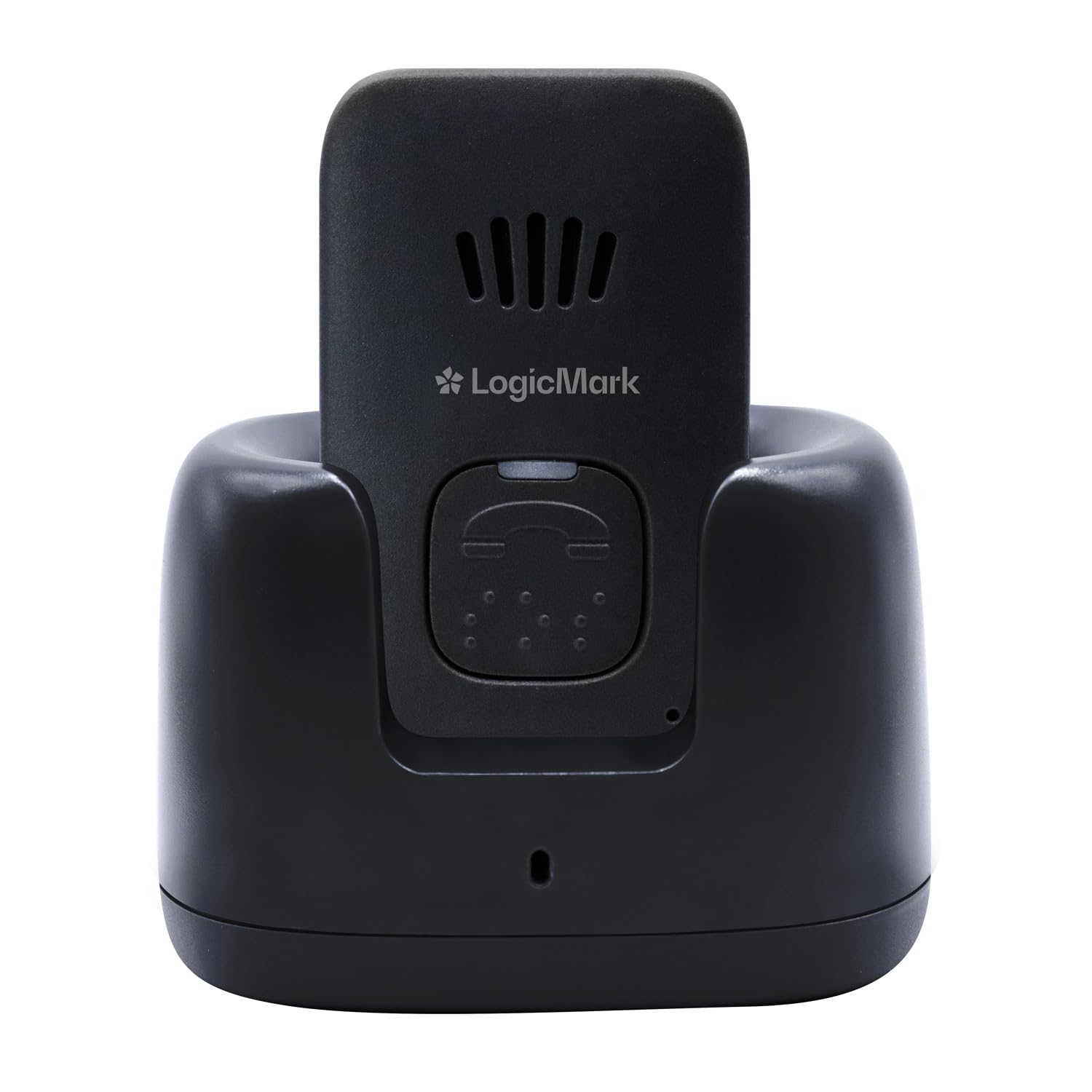
A two-way pendant that dials emergency dispatchers with no monthly bill attached.
The pitch here is simple: pay once, and never see a monitoring bill. The Guardian Alert 911 Plus carries no monthly fees, and it connects straight to 911 dispatchers without a landline or phone service. Fall detection uses proprietary tech to sense falls and sudden movements, alerting emergency services or your emergency contact even if nobody can press a button. Two-way voice lets the wearer talk directly with the dispatcher who sends help.
For households that refuse a subscription, this is the cleanest answer in the group. Seniors can wear the pendant or leave it on its tabletop mount for grab-and-go access in the room they use most. It is water-resistant enough for the shower and bath, so it can stay close in every room. The build comes in at 9.92 ounces with a Lithium-Ion battery, and it reads as a serious piece of kit rather than a gadget.
Owners most often praise the solid build of the pendant and its tabletop mount. Signal recognition is the mixed note — the device relies on cellular signal, and how well that reads varies by location. Before you rely on it, walk the house and confirm the signal is solid in the rooms your parent uses. This is also the direct-to-911 design, so there is no operator triage and no app — just you, the pendant, and emergency dispatchers. If your family wants a text alert to a phone, the family-first pendants above serve that better.
What you’re paying for: a one-time device with no monitoring bill and a direct line to 911 dispatchers.
What to check first: cellular signal strength in the rooms your parent uses, since the call depends on it.
Reach for this if: you have ruled out monthly fees and want a direct 911 path with fall detection.
Look at the top pick if: you want a live operator triaging the call and an app feeding your phone.
8. SureSafeGO Medical Alert System

The pendant for the parent who refuses to be kept indoors — no base unit required.
A neck pendant with no base unit, no indoor anchor, and a direct talk-through connection. The SureSafeGO is fully mobile — at home, in the garden, or out on the go — with GPS tracking that locates the wearer indoors and out. Fall detection catches most heavy falls and calls for help even without the SOS button being pressed. Talk directly through the pendant and skip the speaker-box-in-the-house setup entirely.
The endurance is the practical number: up to 4 days of battery, including shower wear. Connectivity runs on AT&T 4G with an included SIM card, at per month billed quarterly — one of the lower recurring plans in this group. The GPS locates the wearer for accurate assistance, and the pendant can dial up to three emergency numbers. Setup is straightforward by all accounts, and the core gets steady use.
Customers note the pendant keeps working in the shower and on the move, with GPS holding the location. Families also describe the build as good value for the monthly plan. The honest limit is the 4-day battery — less generous than the Seculife pendant at up to 6 days, so plan a charging rhythm rather than leaving it to chance. There is also no professional monitoring center doing the triage; the call goes where you program it. For a mobile senior who wants independence without a home hub, that trade is the deal.
The case for the SureSafeGO
- Fully mobile with GPS — works indoors, outdoors, and on the move.
- Direct talk-through pendant with no base unit to install.
- Fall detection dials help without the button, plus up to three emergency numbers.
- Up to 4 days of battery that survives shower wear.
Where it asks you to compromise
- No professional monitoring center — calls route to the contacts you program.
- 4 days of battery requires a set charging routine.
Built for: an active parent who wants a mobile pendant and no base unit at home.
Choose differently if: you want the longest battery or a monitoring center on the other end.
Know the Specs
Automatic fall detection
This is the sensor that fires the alarm when the wearer cannot. It reads a hard impact and strong movement, then connects to whoever is on the other end — a monitoring center, family contacts, or dispatchers — without a button press. A soft sink onto a padded chair can read differently from a hard fall onto a hard floor, which is why a manual SOS button stays useful as a backup. On watches, holding a heart button for a set few seconds is the usual manual path.
Monitoring plans and alert paths
The plan decides who answers. A professional center takes the cellular call and dispatches help. A family-first system texts and calls your own contacts through an app. A 911-direct pendant connects straight to emergency dispatchers. Each has a different recurring cost, and the plan is not optional on the center-based and family-first devices — it is the thing that makes the alarm meaningful. Read the monthly figure before the spec sheet.
GPS tracking and geo-fencing
GPS marks the wearer’s spot so responders find the right door. Geo-fencing lets you draw safe zones on a map and get an alert when the wearer crosses the boundary — useful for a parent with memory loss who may wander. Some devices keep a year of location history so you can review where the day went. Cellular connectivity, usually 4G LTE, is what carries that location out of the house and to your phone.
Battery life and water resistance
Battery runs from 12 hours on a full health watch up to 7 days on a low-power tracker. A shorter figure is not automatically worse — it usually means more sensors and a display — but it demands a nightly charging habit that a person with memory trouble may not keep. IP67 is the common water rating, meaning the device survives splashes and brief immersion, so it can stay on through a shower or a rainy walk. Water resistance without that exact rating still usually covers daily wear and light splashes.
Common Questions
Do these devices detect a fall automatically or only when the button is pressed?
Will a fall detection device work if my parent does not press the button?
Can I set up one of these without a monthly subscription?
Which is better for a parent with dementia, a pendant or a smartwatch?
How long does the battery last and how often do I charge it?
Can these be worn in the shower?
What happens if my parent is out of the house when they fall?
Will an emergency alert reach me directly or go through a call center?
Do I need a landline for any of these?
Can the Audar E2 call 911 on its own?
The Bottom Line
For most people shopping for the best wearable fall detection devices, the 321 Alert Mini X3 is the one to buy — its automatic fall detection routes straight to a live 24/7 monitoring center, its embedded SIM (a chip that connects to mobile networks on its own) removes a setup step, and its grippable shape works for arthritic hands. If zero monthly fees matter more than a live operator, the Guardian Alert 911 Plus dials 911 dispatchers directly with no landline. And if wandering is the worry, the Seculife Medical Alert Pendant draws the safe zones and keeps a year of location history.
One honest nudge before you commit: the top pick carries a shorter track record than the wider-field pendants in this list, but it holds the highest rating among the monitoring-center devices here at 4.5+ out of 5 across 70+ ratings. Confirm cellular coverage in the rooms your parent uses, test the alert chain in the first week, and choose the device by who answers the alarm — that single decision decides everything else.
How we choose
We do not accept paid placement. Every pick is matched to a real buyer and a real use-case; we do not hands-on test units.
Sources
Specifications: manufacturer listings and product documentation. Review insights: verified customer reviews, as of November 2026. Pricing: not shown on this page (it changes often); check the current price via the retailer link.
As an Amazon Associate, Tactical Gear Guy earns from qualifying purchases. This does not affect which products we feature.