Specs are compiled from manufacturer listings and verified buyer reviews and can change over time — please confirm the key details on the product page before buying.
Wet socks at 10 a.m. are the fastest way to ruin a shift. The boots that fix that are not always the ones with the biggest logo — they are the ones with a real waterproof barrier, a sole that grips wet concrete, and a toe cap that survives a dropped wrench. Below you get nine pairs that actually seal out water for men, sorted by what each one does best, so you can pick the right pair in one pass instead of buying twice.
This guide is built by comparing the manufacturers’ published specifications and the patterns across verified customer reviews, so you get each pick’s real strengths and trade-offs instead of marketing spin.
Waterproofing is the headline, but the toe type, the shank, and the break-in period decide whether a boot lasts a season or five years. Here is how the leading waterproof work boots for men actually compare once you cut through the spec sheets.
Top Picks


How To Choose The Best Waterproof Work Boots for Men
The biggest buying mistake is treating “waterproof” as a single feature. It is not. A rubber shell, a membrane-lined leather upper, and a full-grain leather with a gusseted tongue are three different ways to keep water out, and each one behaves differently across a shift. Knowing which type you are buying is the difference between dry feet and a boot that soaks through by lunch.
Know your waterproof construction
A rubber and neoprene shell like the TIDEWE keeps water out completely because there is no leather to soak — that makes it the pick for mud, standing water, and wash-down work. A leather boot with an internal membrane, like the Timberland PRO or the Carhartt, keeps rain and puddles out while still breathing a little, which suits mixed indoor and outdoor work. A leather boot with a gusseted tongue, like the Thorogood, relies on that tongue to stop water creeping in from the top. Each construction wins only in the wet conditions it was built for.
Steel toe, composite toe, or soft toe
If your site requires impact protection, a steel toe or composite toe is the difference between a stubbed foot and a broken one. Composite toe options are metal-detector friendly because there is no metal in the cap, which matters if you pass through security. Soft toe boots skip the reinforced cap entirely, so they are lighter and more flexible but offer no drop protection. Pick your toe type first and half the list drops away.
Read the sole construction, not the tread photo
A Goodyear welt stitches the upper to the sole so it can be repaired and tends to hold up through heavy abuse. Cement construction glues the sole on, which is more flexible and lighter but can let go over time. A shank — steel, fiberglass, or composite — sits inside the sole to support your arch and guard the underside from punctures. On rough ground or a site full of nails and debris, that underfoot layer is what separates a boot that lasts from one that fails.
Plan for break-in and true fit
Full-grain leather almost always needs a break-in window, while rubber boots typically do not. Some brands run true to size and others run slightly big, so measure your foot and check the size chart before you buy. Ordering a half size up “for thick socks” is the most common way buyers end up with a boot that never fits right.
Side-by-Side Comparison
| Model | Best For | Toe Type | Waterproof Method | Sole Construction | Amazon |
|---|---|---|---|---|---|
| Irish Setter Marshall 11″★ Best Overall | All-day all-round work | Soft Toe | UltraDry + waterproof full-grain leather | Goodyear Welt | Amazon |
| Wolverine Carlsbad 6″Top Performer | Lightweight site days | Not stated | Waterproof full-grain leather | Rubber lug outsole | Amazon |
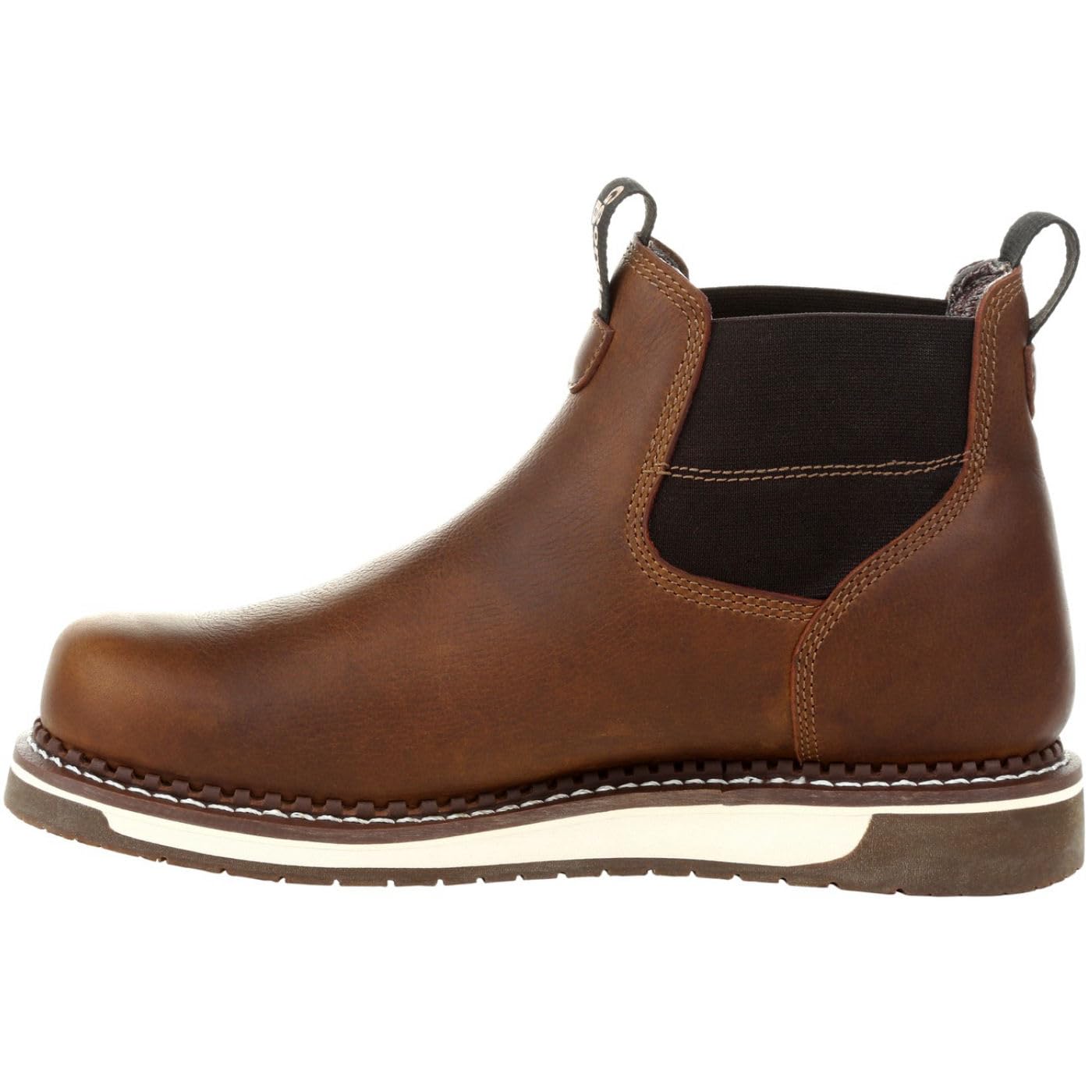
| Georgia Boot AMP LT WedgeMost Versatile | Slip-on barn and yard work | Not stated | Georgia Waterproof System | EVA midsole + fiberglass shank | Amazon |
| Carhartt CMW6220 6″ | Comfort on hard floors | Not stated | Storm Defender | Polyurethane outsole | Amazon |
| ARIAT Turbo 6″ | Metal-detector sites | Carbon (composite) | DRYShield breathable | Cushioning midsole | Amazon |
| Timberland PRO Titan EV 6″ | Sneaker-light protection | Composite | Internal waterproof membrane | Cement | Amazon |
| Ariat Rebar Lift 6″ | Wet-weather cushioning | Composite | Waterproof composite toe build | Not stated | Amazon |
| Thorogood 1957 Series 8″ | Heavy trades, long haul | Steel | Gusseted tongue + waterproof build | MaxWear 90 traction outsole | Amazon |
| TIDEWE Rubber Steel Toe | Mud, water, wash-down | Steel | 100% waterproof rubber + neoprene | Rubber with steel shank | Amazon |
Detailed Reviews
1. Irish Setter Marshall 11″ Mens Soft Toe Work Boot
Our pick — 4.5+★ from 400+ verified ratings; the strongest balance of quality and price.
The one that earns its keep on build quality you can see in the stitching.
What makes the Marshall 11″ the strongest all-rounder here is not a flashy feature — it is the build. The upper is full-grain, waterproof leather, and the boot sits on a Goodyear welt sole, the stitched construction method that holds the upper and sole together through years of abuse and can be repaired rather than thrown away. It is rated ASTM F2892-18 for EH (electrical hazard) protection and ASTM F3445-21 for slip resistance, so it covers you on wet floors and around live circuits.
The thing buyers rave about is the sheer quality — it is far and away the most-praised trait of this boot. Owners describe it as a boot that looks good enough to get compliments on the job site and tough enough to wear every single day. It is also a soft toe, so there is no steel cap to weigh your foot down, and the RPM technology outsole is rated heat resistant for hot surfaces.
Here is the honest catch: sizing is genuinely split. Enough owners find them running slightly big that you should measure your foot and check the size chart rather than guessing. The sole also starts stiff — it is a welted work boot, not a sneaker — so give it a break-in period before you judge the feel. With a 4.5+ star rating across 400+ owners, the consensus still lands firmly on the positive side.
What earns the top spot
- Goodyear welt construction means the sole can be repaired, not replaced — real longevity.
- Full-grain waterproof leather with UltraDry keeps water out while the boot still looks sharp.
- EH-rated and slip-resistant (ASTM F2892-18 and F3445-21) for wet floors and electrical zones.
- Heat-resistant RPM outsole handles hot surfaces on the job.
Where it demands patience
- Runs slightly big for some buyers — measure before ordering.
- The sole starts stiff and needs a break-in window.
- Soft toe offers no drop protection.
Top pick for: anyone who wants one boot for mixed indoor and outdoor work and expects it to last years, not months.
Think twice if: you need a safety toe or you want zero break-in time.
2. Wolverine Men’s Carlsbad Waterproof 6″ Work Boot
No break-in, no drama — the boot that feels broken in on day one.
At 3 pounds, the Carlsbad is one of the lighter leather boots on this list, and that lightness is the whole point. A lighter boot means less leg fatigue by the end of a long shift, and it is the easiest way to make a 6-inch work boot feel like something you actually want to wear. The upper is premium waterproof full-grain leather over a full-cushion EVA midsole (the cushioned underfoot layer that absorbs shock), and the rubber lug outsole is built to grip uneven ground.
What wins people over is the quality of the build, with comfort right behind it. The standout trait buyers describe is the lack of a break-in period — this boot feels good from the first wear, which is rare for full-grain leather. Buyers also point to a generously wide fit that holds up through all-day wear. A moisture-managing mesh lining runs inside to pull sweat away, and the molded EVA footbed adds another cushioning layer under your arch.
The honest trade-off is durability on the sole over the long haul, which is the one area with mixed feedback. The waterproofing is also leather-based rather than a rubber shell, so this is a rain-and-puddle boot, not a standing-water boot. For most buyers who want a comfortable, sharp-looking leather boot for site work and everyday wear, it delivers.
Why it climbs the list: a 3-pound leather boot that needs no break-in, with a premium waterproof full-grain leather upper and a rubber lug outsole that grips wet ground.
The honest limit: the outsole is the part with mixed durability feedback, and a leather upper will not shrug off standing water the way a rubber shell does.
Reach for this if: you want a light, great-looking leather boot that feels good immediately.
Look elsewhere if: you work in standing water or deep mud day after day.
3. Georgia Boot AMP LT Wedge Waterproof Chelsea Work Boot
Pull it on with one hand and walk into the barn without a lace in sight.
If you want a boot you can slip on without bending to tie laces, this is the one. The Chelsea design uses twin gore panels (stretchy side inserts) and nylon pull tabs, so it goes on fast and holds a good fit once it is on. The leather is a tried-and-true SPR leather that the maker describes as three times stronger and two and a half times more abrasion resistant than traditional leathers — that wear resistance matters when you brush against fencing, tools, and rough walls all day.
At 4.5 pounds packaged, it sits close to the Irish Setter’s 4.67 pounds, so this is a substantial boot rather than a featherweight. The removable AMP LT memory foam insole is a comfort-forward pick for long days on your feet, and the cushioning EVA midsole with a fiberglass shank (a stiff support piece inside the sole) adds stability under the arch. The Georgia Waterproof System keeps water out from the inside, and the Carbo-Tec rubber outsole is made for heat, chemical, and slip resistance — the maker outright names barnyard-type work as this boot’s ideal environment.
The main point to know before buying is fit: this boot gets mixed feedback on sizing, so measure carefully rather than assuming your usual size. Scuff resistance also shows up as a recurring note, so treat the SP leather kindly if you want it looking new. Owners who click with the fit tend to love it — the slip-on convenience and the cushioning insole are the draws.
The case for it: hands-free slip-on entry, a memory foam insole, and a fiberglass shank under a leather rated by the maker for high abrasion resistance.
The catch to plan for: fit is mixed, so check the size chart, and the leather shows scuffs more than a plain work finish would.
Best served for: barn, ranch, and yard work where you want a fast slip-on and cushioned support.
Not your pair if: you need a locked-in lace fit for heavy loads or want a scuff-proof finish.
4. Carhartt Footwear CMW6220 6-Inch Waterproof Work Boot
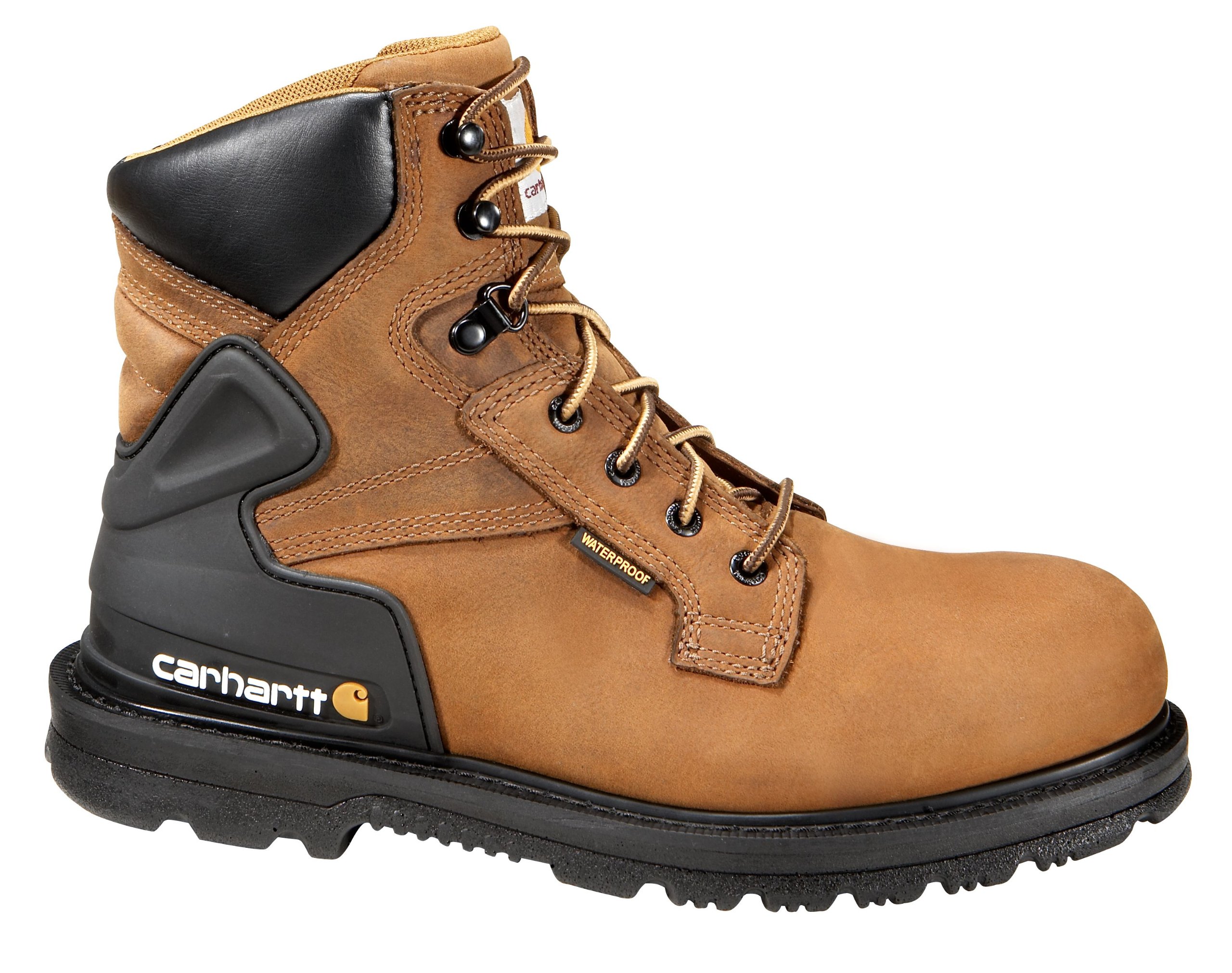
Comfort is the headline here — the rest is a fit question you need to answer first.
Carhartt built this one around comfort. The Cushion Comfort PU footbed (a padded, polyurethane underfoot layer) and the FastDry lining work together to keep your feet feeling fresh from clock-in to clock-out. The Storm Defender waterproof system handles rain and wet ground, and a TPU heel guard at the back adds ankle stability when the ground gets rough. The flexible polyurethane outsole gives you traction without a rigid slab under your foot.
What wins people over is outright comfort — the boot is praised for feeling great on hard surfaces, and the look gets its share of attention too. It is a straightforward heritage-style work boot that does its job without fussing around. The package weighs 4.5 pounds and comes in a compact 12 x 8 x 4-inch box, which tells you this is a trimmer 6-inch boot than the taller 11-inch Irish Setter — a real difference if you prefer a shorter cut.
Now the part that decides it for you: fit is divided. A meaningful share of owners find this boot runs narrow, so if your foot is wide, plan for that before you order. Long-term sole durability also comes up as a concern from a portion of buyers, so it is best treated as a comfort-first boot for moderate work rather than a sole you can lean on forever.
Why comfort seekers lean in
- Cushion Comfort PU footbed and FastDry lining keep feet dry and cushioned on long days.
- Storm Defender waterproofing handles rain and wet ground.
- TPU heel guard adds ankle stability.
- A recognizable, great-looking heritage work boot silhouette.
What you should weigh
- Runs narrow for a fair share of owners — wide feet should size carefully.
- Sole durability is a concern for some over the long term.
- No stated safety toe on this model.
Pick it for: comfort on concrete, warehouse floors, and mixed weather where a short boot fits your work.
Pass on it if: you have wide feet and cannot try it on, or you need a reinforced toe cap.
5. ARIAT Men’s Turbo 6” Waterproof Carbon Toe Work Boots

A reinforced toe you can wear through a metal detector without a beep.
For sites that scan employees, the Turbo’s non-metallic toe is the reason to shortlist it. It uses an ASTM F2413-rated composite safety toe that is electrical hazard-resistant — so you get impact protection over your toes without a metal cap that trips a detector. The upper is DRYShield waterproof breathable construction in full-grain leather, with an impermeable barrier underneath to hold water out. At 3.1 pounds it is one of the lighter boots in this group, which keeps fatigue down over a full shift.
Comfort and quality are what carry this boot. The removable Energy Max anti-fatigue insole is built for long hours on hard surfaces, and the ATS technology (an ergonomic support system inside the boot) steadies your foot on uneven ground. A cushioning midsole absorbs shock, and the oil- and slip-resisting outsole is rated to pass hot-contact tests at a stated 150°C/302°F — a genuine advantage if you step onto hot surfaces.
Two trade-offs to know: the padding gets mixed feedback, with the leather at the toe cap called thin by some, and break-in period divides buyers — some need time before the boot really settles. If you want barefoot-immediate comfort, plan a little patience. If a non-metal safety toe and light weight top your list, this is the pick.
Standout spec: a non-metallic ASTM F2413 composite toe plus electrical hazard resistance, in a 3.1-pound boot.
What to expect: a break-in window and a toe cap that some find thin on padding.
Made for: workers who pass through metal detectors, walk hot surfaces, and want a light safety toe.
Consider another pair if: you want zero break-in or heavy toe padding.
6. Timberland PRO Titan Ev Composite Safety Toe
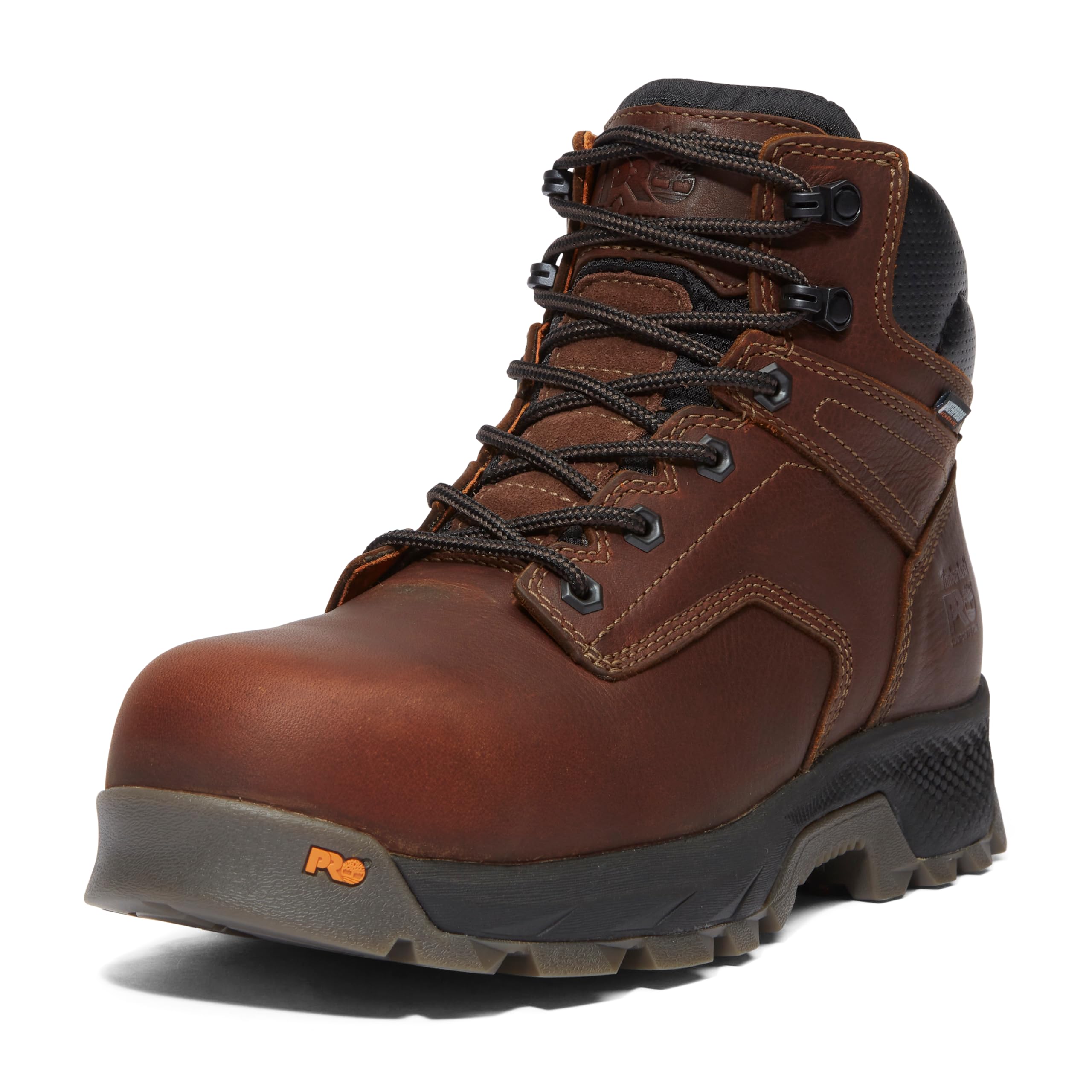
Sneaker feel on the inside, safety toe and waterproof armor on the outside.
Timberland PRO built the Titan EV around a lightweight Hover Spring foam midsole, and you can feel it — buyers describe this as a boot that feels like a sneaker on the foot. That lightweight cushioning is paired with a full-grain waterproof leather upper and an internal waterproof membrane, so the water protection sits inside the leather rather than relying on the surface alone. A composite safety toe gives you impact protection without the weight of steel.
Comfort and quality are what earn the praise here, and fit comes in strong too — owners describe a true-to-size fit with a roomy toe box that gives your toes room to spread. The Anti-Fatigue Technology footbed is built for all-day shock absorption and energy return, and the non-marking rubber convex outsole is heat-, oil-, slip-, and abrasion-resistant for grip indoors and out. The breathable, moisture-wicking lining is made of ReBOTL fabric containing at least 50% recycled plastic, a small detail worth knowing if that matters to you.
The one thing to keep in mind: slip resistance and long-term durability both draw mixed feedback, so this is a boot best suited to jobs where you are not constantly on slick, oily ground. Think of it as the comfort-first safety toe boot — great for a day that mixes walking, climbing, and standing.
Where it shines: a lightweight Hover Spring foam midsole, internal waterproof membrane, composite safety toe, and a roomy toe box in a true-to-size fit.
The trade-off: slip resistance and durability both come in mixed, so heavy oil-and-grease work may want a different sole.
Fits best for: workers who want safety toe protection and waterproofing without a heavy, clunky boot.
Choose differently if: your day is spent on oily, slick floors where slip grip is the deciding factor.
7. Ariat Men’s Rebar Lift 6″ Waterproof Composite Toe Work Boot
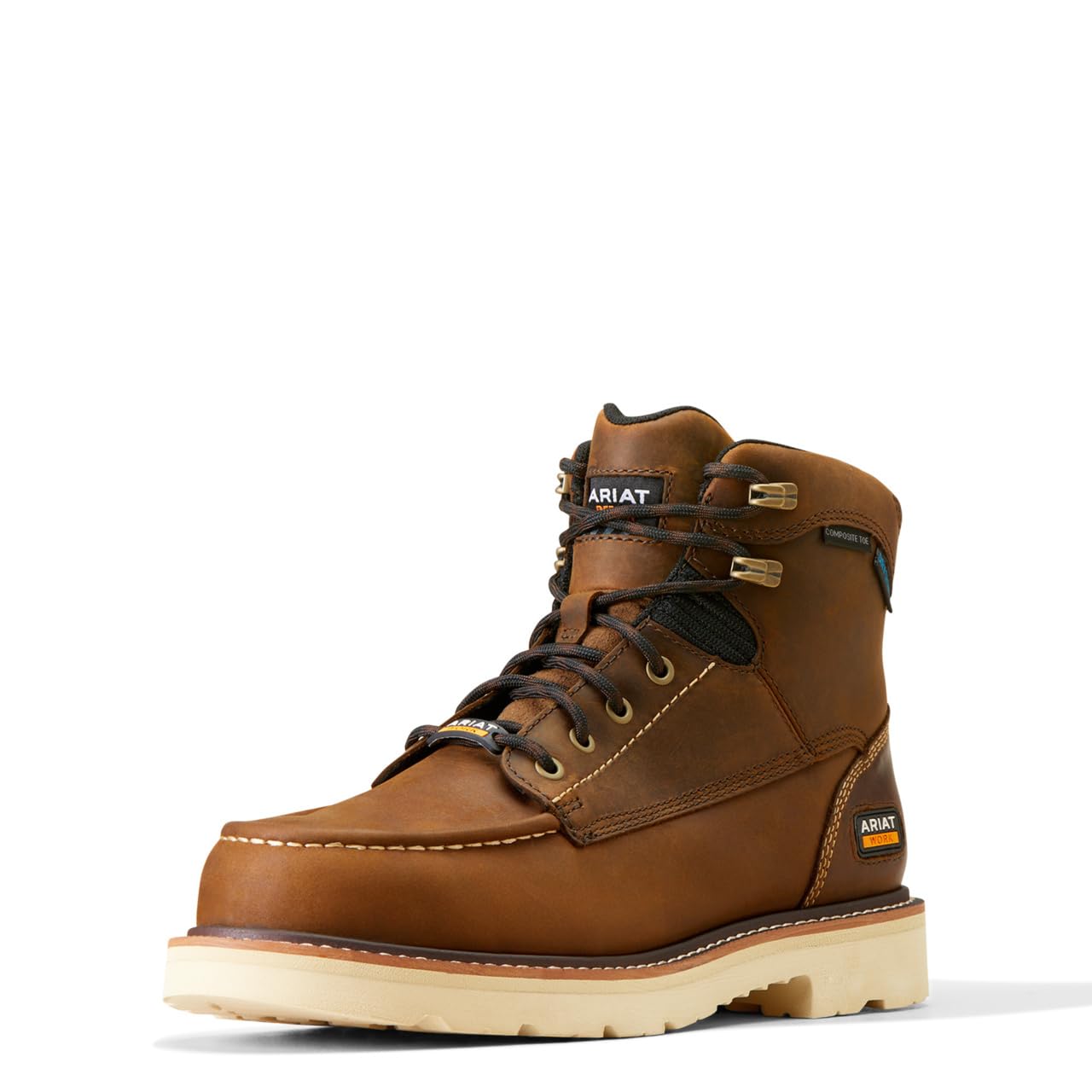
Comfort and support that show up on day one — durability is the thing to watch.
The Rebar Lift is built for long work days in outdoor conditions, and it leans into cushioning and stability. Quality and comfort are what carry it, with buyers also calling out the ankle support and the stretchy ankle panel that makes squatting and crouching easier. A composite toe gives you impact protection, and the waterproof build keeps wet weather out while you work outside.
What buyers like most is the overall quality of the boot, with comfort close behind, and the foot support earns genuine praise for a boot that stays steady through a long shift. It is a good-looking work boot too — the appearance gets its share of compliments. At 5.5 pounds packaged it is on the heavier side of the boots here, so if you cover a lot of ground daily, factor that into your choice.
Durability is the real consideration on this one. A portion of buyers describe the soles peeling apart and the boot coming apart after a couple of months, which is a heavier concern than you see on most boots in this group. If you want a waterproof composite toe boot for comfort-focused work and moderate use, it delivers; if you need a heavy-duty sole you can count on for years, weigh that risk carefully.
What carries it: a composite toe, a waterproof build, and comfort-plus-support that buyers feel right away.
The thing to weigh: durability is a concern here, with soles peeling and boots coming apart raised by a portion of owners.
Reasonable for: wet-weather work where cushioning and ankle support matter most and the load is moderate.
Look past it if: you need a sole that holds up through years of heavy-duty abuse.
8. Thorogood 1957 Series Steel Toe Work Boots

Full-grain moc-toe leather and a steel cap — built for the trades that don’t forgive.
Thorogood makes this one in the USA from USA and globally sourced components, and the craftsmanship shows in the leather. It is a premium full-grain saddle leather moc-toe boot in Trail Crazyhorse brown, with a special wax finish that gives it a vintage look. The gusseted tongue is the waterproof trick here — it stops water and liquids from creeping in from the top, while a moisture-wicking lining pulls sweat away from your foot. The steel toe meets ASTM F2413-18 safety toe standards, and the boot comes in a taller 8-inch shaft height for more ankle coverage.
What earns the respect here is quality plain and simple — it is the standout trait owners recognize — and comfort follows once the leather is broken in. The MaxWear 90 traction outsole is made with a heel and is built to flex better than other work boot outsoles, absorbing impacts and gripping loose gravel, wet surfaces, and oily floors. It meets ASTM F3445-21 slip-resistance standards, which is the safety-relevant proof for slick work.
Two things to know: leather this heavy needs a break-in period, so do not expect a soft fit on day one, and sole durability gets mixed feedback, with some reporting the soles ripping off. At 4.9 pounds it carries real heft. For heavy-trade work where a steel toe, real leather, and proper slip resistance are the priorities, it is a serious boot.
Arguments for the Thorogood
- Premium full-grain saddle leather with a waxed Trail Crazyhorse finish.
- Steel toe meets ASTM F2413-18; outsole meets ASTM F3445-21 slip resistance.
- Gusseted tongue keeps water and liquid from entering from the top.
- MaxWear 90 outsole flexes to absorb impact while gripping wet and oily ground.
What to brace for
- Heavy leather needs a real break-in period.
- Sole durability gets mixed feedback, with some reporting soles ripping off.
- At 4.9 pounds it carries substantial weight.
Worth it for: heavy-trade workers who want American-made full-grain leather, a steel toe, and certified slip resistance.
skip it if: you want an immediate soft fit or need the lightest boot on the list.
9. TIDEWE Rubber Work Boots Steel Toe
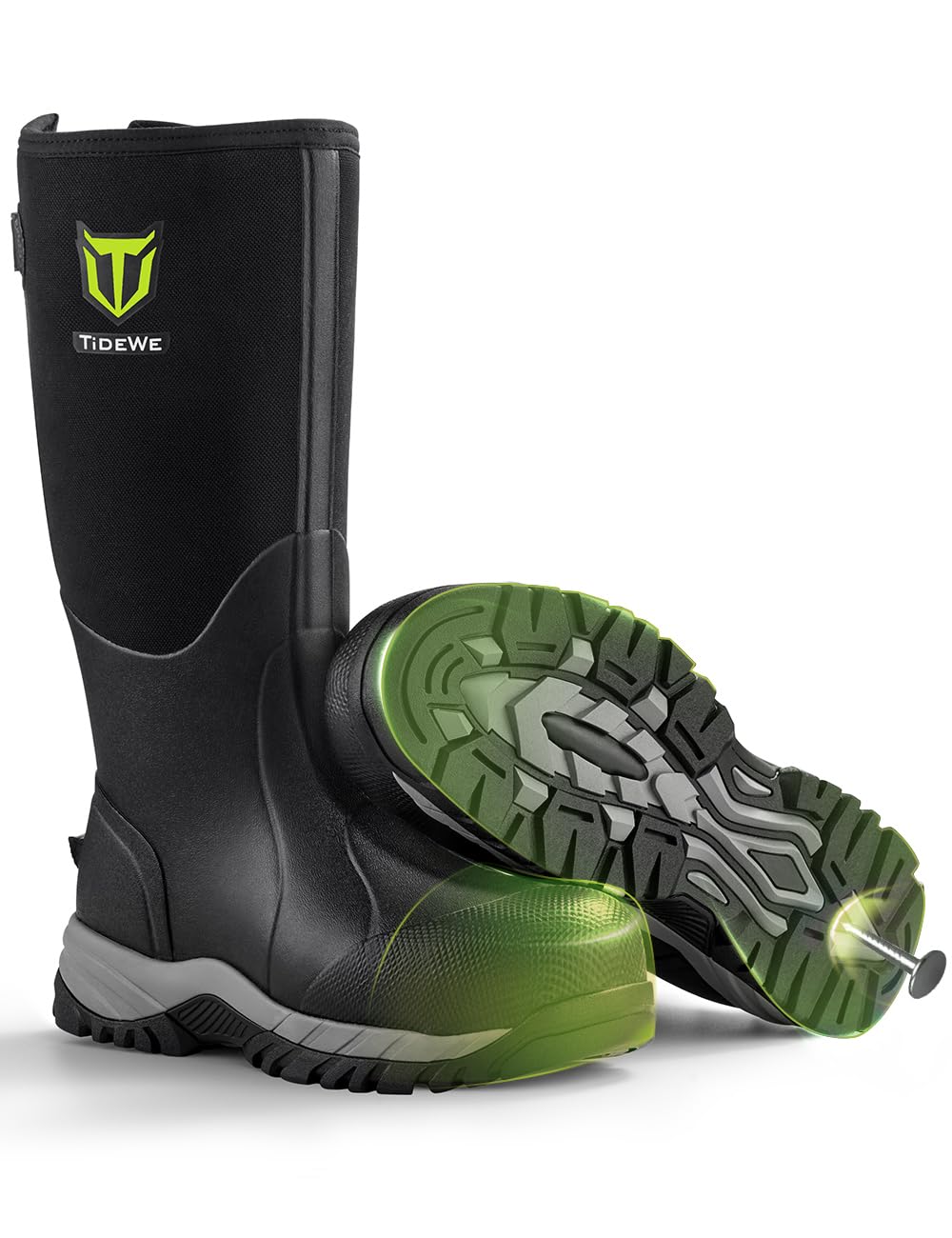
The pair you hose off after a shift in the mud — full rubber, full protection.
When your work means standing in water, no leather boot on this list matches a rubber shell for waterproofing. The TIDEWE is 100% waterproof rubber and neoprene, so there is no leather to soak through and no seam for water to find. A steel toe handles impacts from falling or rolling objects, a steel shank sits between the insole and outsole to protect the underside of your foot, and the boot is built with puncture resistance for secondary underfoot protection — the layer you want when there are nails or sharp debris around.
Comfort is a real strength for a rubber boot. There is a breathable inner lining for air circulation when it is warm, and 6mm neoprene added for warmth when the temperature drops. A pull-on loop and kick tab get it on and off fast, and the ergonomic arch shape up top helps it fit the way it should. The rubber sole has deep tread for gripping uneven workplace terrain. Buyers describe long shifts in mud and water without complaint, and the quality and comfort both earn strong praise.
The one caveat to size carefully on: the maker asks you to measure your foot and pick a size about 0.16 inches greater than your actual measurement, and gets mixed feedback on durability over time — some find the rubber splitting in the middle and losing waterproofing. For mud, water, wash-down, and farm work, though, nothing here keeps water out more completely.
The waterproofing edge: 100% waterproof rubber and neoprene means water has nowhere to soak in, and a steel toe plus steel shank add two layers of protection.
Plan for this: follow the size chart carefully, and know that durability over time is mixed, with some reporting the rubber splitting.
Your boot if: you work in mud, standing water, or wash-down jobs where leather simply cannot keep up.
Not the one if: you want a boot that stays intact for years of daily abuse or prefer a leather look.
Know the Specs
Waterproof membranes vs rubber shells
A waterproof membrane is a thin barrier built into a leather upper that stops water while still letting some moisture escape, which makes it the fit for mixed weather and long days that switch from indoors to outdoors. A rubber shell keeps water out completely because there is no porous upper to soak, which is why it belongs in mud and standing water. Match the construction to your job’s wetness and you avoid buying twice.
Toe protection: steel, composite, and soft
A steel toe guards your toes from falling or rolling objects. A composite toe does the same job without metal, so it clears a metal detector and is often lighter. A soft toe skips the reinforced cap — lighter and more flexible, but no drop protection. Settle the toe type first and the shortlist shrinks fast.
Goodyear welt vs cement construction
A Goodyear welt stitches the upper to the sole, which makes the boot repairable and lets it hold up through heavy abuse — a good long-haul choice. Cement construction glues the sole on, which gives a lighter, more flexible feel but can let go over time. Welt suits heavy abuse; cement suits lighter, more flexible wear.
Slip ratings you can actually check
A slip-resistance standard such as ASTM F3445-21 is your proof that the outsole was actually tested on slick surfaces, not just described as “slip-resistant.” A heat-resistance rating, such as passing hot-contact tests at a stated temperature, tells you the sole can take hot surfaces without melting. Check for the ASTM number, not the word “slip-resistant.”
Common Questions
How do I know if a work boot is truly waterproof and not just water-resistant?
Should I buy steel toe or composite toe for my job?
How long does a waterproof work boot take to break in?
My boots say true to size, but some buyers report they run big. Which do I trust?
Does a Goodyear welt sole actually last longer than a glued sole?
Are rubber work boots any good for cold weather?
Is a heat-resistant outsole worth paying extra for?
How important is slip resistance on a waterproof boot?
Can I wear a waterproof work boot all day on hard surfaces?
The Bottom Line
The best overall pick for most people is the Irish Setter Marshall 11″, because a Goodyear welted full-grain waterproof leather boot is the one that stays on your feet season after season — just measure before you order, since it can run slightly big. If a non-metal safety toe and light weight come first, the ARIAT Turbo gets you composite protection, electrical hazard resistance, and a heat-tested sole. And for mud and standing water where leather cannot compete, the TIDEWE Rubber Steel Toe is the pair to reach for — full rubber waterproofing plus a steel toe and shank underfoot.
How we choose
We do not accept paid placement. Every pick is matched to a real buyer and a real use-case; we do not hands-on test units.
Sources
Specifications: manufacturer listings and product documentation. Review insights: verified customer reviews, as of November 2026. Pricing: not shown on this page (it changes often); check the current price via the retailer link.
As an Amazon Associate, Tactical Gear Guy earns from qualifying purchases. This does not affect which products we feature.