Specs are compiled from manufacturer listings and verified buyer reviews and can change over time — please confirm the key details on the product page before buying.
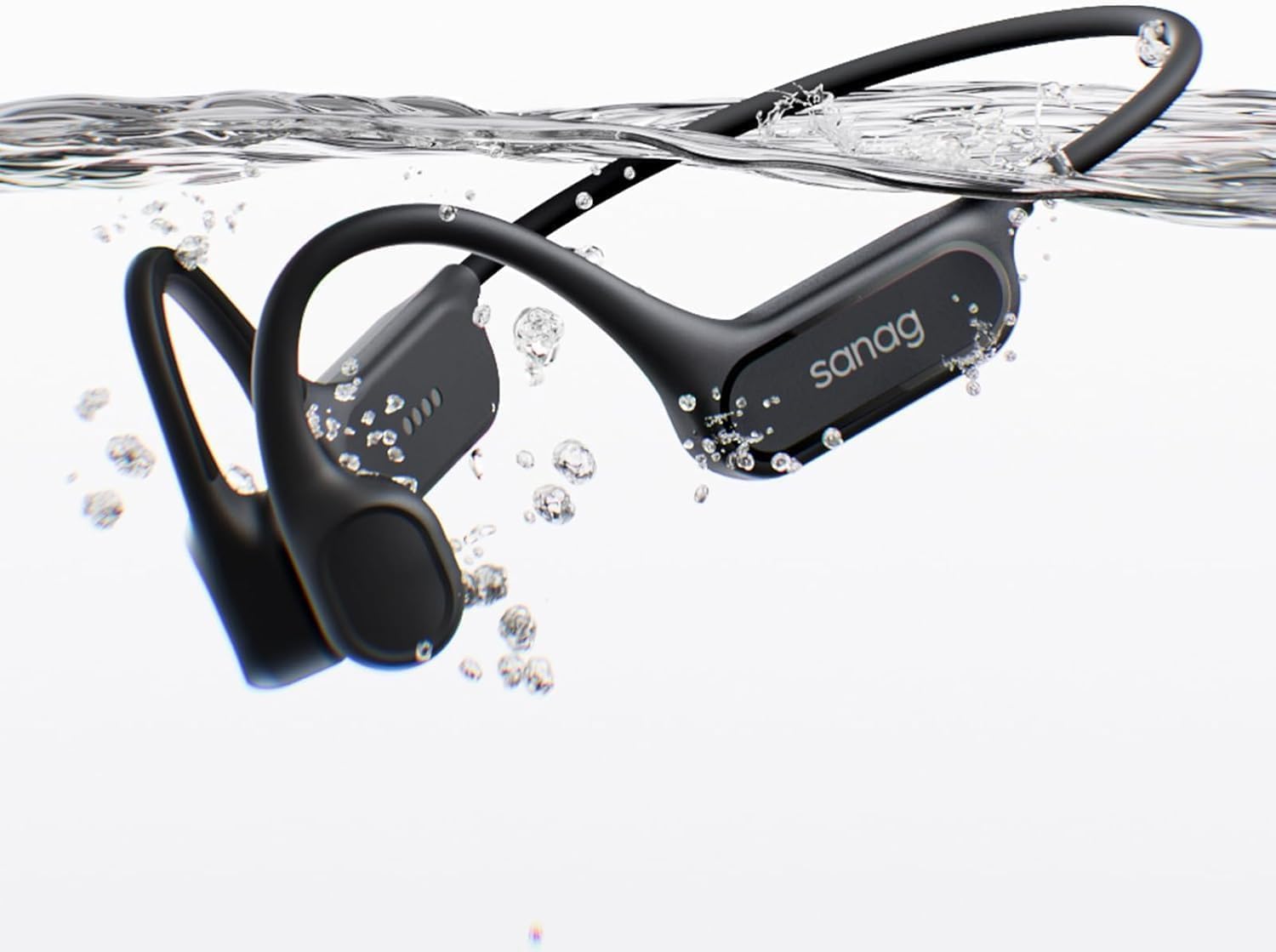
If you want music during laps without water pouring into your ear canals, the short answer is bone conduction headphones that sit on your cheekbones — and the one to beat is the Sanag Swimming Bone Conduction set, which runs 12 hours per charge and carries the IPX8 rating you need for pool work. Everything else on this list is a variation on that same idea, and the differences come down to battery, storage, and how they handle Bluetooth the moment you go under.
This guide is built by comparing the manufacturers’ published specifications and the patterns across verified customer reviews, so you get each pick’s real strengths and trade-offs instead of marketing spin.
One thing trips up nearly every first-time buyer: Bluetooth simply does not travel through water, so every one of these headsets has to play stored files from internal memory once your head goes under. That single fact reshapes the whole purchase, which is why storage capacity and battery hours carry more weight here than Bluetooth specs. The right pair of waterproof swimming earbuds is the one with enough internal storage for your whole playlist and an IPX8 seal that survives lap after lap.
Top Picks

How To Choose The Best Waterproof Swimming Earbuds
The buying decision for pool audio is narrower than it looks. You are not hunting for the best sound quality in the world — you are hunting for a set that survives full submersion and still has music on board when the phone signal dies at the water line. Get those two things right and the rest of the decision depends on fit and battery.
Water rating comes first, and sweat-proof is not enough
An IPX8 rating means the housing is sealed against continuous submersion, which is the bar you need for laps. IPX4 or IPX5 sets are splash and sweat resistant only, and they are not built for a head that goes under the surface. Several sets here also carry an IP68 rating, which adds dust protection to the same water standard. Check the depth figure too — some are rated to 2 meters, and that is the one to know before you dive in.
Internal storage decides whether you hear anything underwater
Since Bluetooth cannot pass through water, every swim session runs on the built-in MP3 player. Storage is quoted in gigabytes, and the sets here range from 8GB up to 32GB. A 32GB player holds thousands of songs, so you can load an entire training playlist and forget about syncing. An 8GB player is plenty for a few hundred tracks but fills faster if you like long podcasts. Match the storage to how much you want to carry without a phone.
Battery hours versus charge time
Playtime per charge runs from 6 hours to 12 hours across this group, and most sets recharge in about 2 hours. If you swim three or four times a week, a longer playtime means fewer charging sessions and less chance of a dead battery mid-lap. Note that MP3 playback tends to drain faster than Bluetooth on some models, so plan your charging around the mode you actually use in the water.
Fit under a swim cap and goggles
These are open-ear designs, so the band rests behind your head and the drivers sit against your cheekbones. That means they need to play nicely with caps, goggles, and glasses. A flexible titanium or memory-alloy band bends to your head shape and springs back, which helps it stay put through turns. Weight matters here — lighter frames sitting around 26g to 28g tend to disappear on long swims, while heavier builds can press after an hour.
Side-by-Side Comparison
| Model | Best For | Water Rating | Battery | Storage | Amazon |
|---|---|---|---|---|---|
| Sanag Swimming Bone Conduction★ Best Overall | All-around pool training | IPX8 | 12 hours | 32GB | Amazon |
| Roujune Swimming HeadphonesComfort Pick | Long-wear comfort | IP68 | 6 hours | 32GB | Amazon |
| PSIER Bone ConductionMulti-Device Pick | Switching between devices | IPX8 | — | 32GB | Amazon |
| MONODEAL Swimming Headphones | Bend-and-forget durability | IPX8 | — | 8GB | Amazon |
| ANSTEN Swimming Headphones | Big-driver audio on land | IPX8 | 8 hours | 8GB | Amazon |
| Tevese Bone Conduction 32G | Top-rated sound underwater | IPX8 | 10 hours | 32GB | Amazon |
| VLOP WaveBone Pro 2 | Bass and mid clarity | IP68/IPX8 | 8 hours | 32GB | Amazon |
| RR SPORTS IP68 Swimming | Full-immersion depth | IP68 | 7 hours | 32GB | Amazon |
| Rhyfell Fit 5 | Fast file transfers | IP68 | 10 hours | 32GB | Amazon |
Detailed Reviews
1. Sanag Swimming Bone Conduction Headphones
Our pick — 4.5+★ from 80+ verified ratings; the strongest balance of quality and price.
The one that outlasts everyone else in the water — 12 hours and a 32GB library on board.
The headline here is stamina. This Sanag runs up to 12 hours of continuous playback on a full charge, versus 6 hours from the Roujune set below — a difference that means a whole week of swim sessions between charging trips, not a scramble before every lesson. An IPX8 rating covers submersion up to 2 meters, so pool training, ocean swims, and lane work are all inside its comfort zone.
The 32GB of built-in memory is the other half of the story. You load your tracks once, switch to MP3 mode when you swim, and leave the phone in the locker. In between laps it doubles as a normal Bluetooth headset with version 6.0 pairing and a 33-foot range, and the open-ear design keeps water out of your ear canals entirely. The 2-hour charge time is modest considering the playtime you get back.
Where owners tend to live happily is the long-session comfort — no earbud pressing into the ear, no seal to break. The trade-off is honest and simple: bone conduction sound is thinner at the low end than a sealed in-ear pair, and Bluetooth mode cannot follow you under the surface. You are buying 12 hours of endurance and a 32GB phone-free pool session, and that is exactly what this delivers.
IPX8 sealed shell
- Up to 12 hours of playback — the longest here, versus 6 hours on the Roujune.
- IPX8 rating rated for submersion to 2 meters.
- 32GB of storage for phone-free MP3 swimming.
- Bluetooth 6.0 pairing with a 33-foot range on land.
bass stays thin
- Bone conduction bass is lighter than a sealed in-ear set.
- Bluetooth cuts out underwater, so MP3 mode is mandatory in the pool.
one headphone for everything: best for the swimmer who wants the longest gap between charges and a phone-free library already loaded.
skip open-water swims: you expect deep, thumping bass underwater — open-ear conduction trades that away for awareness.
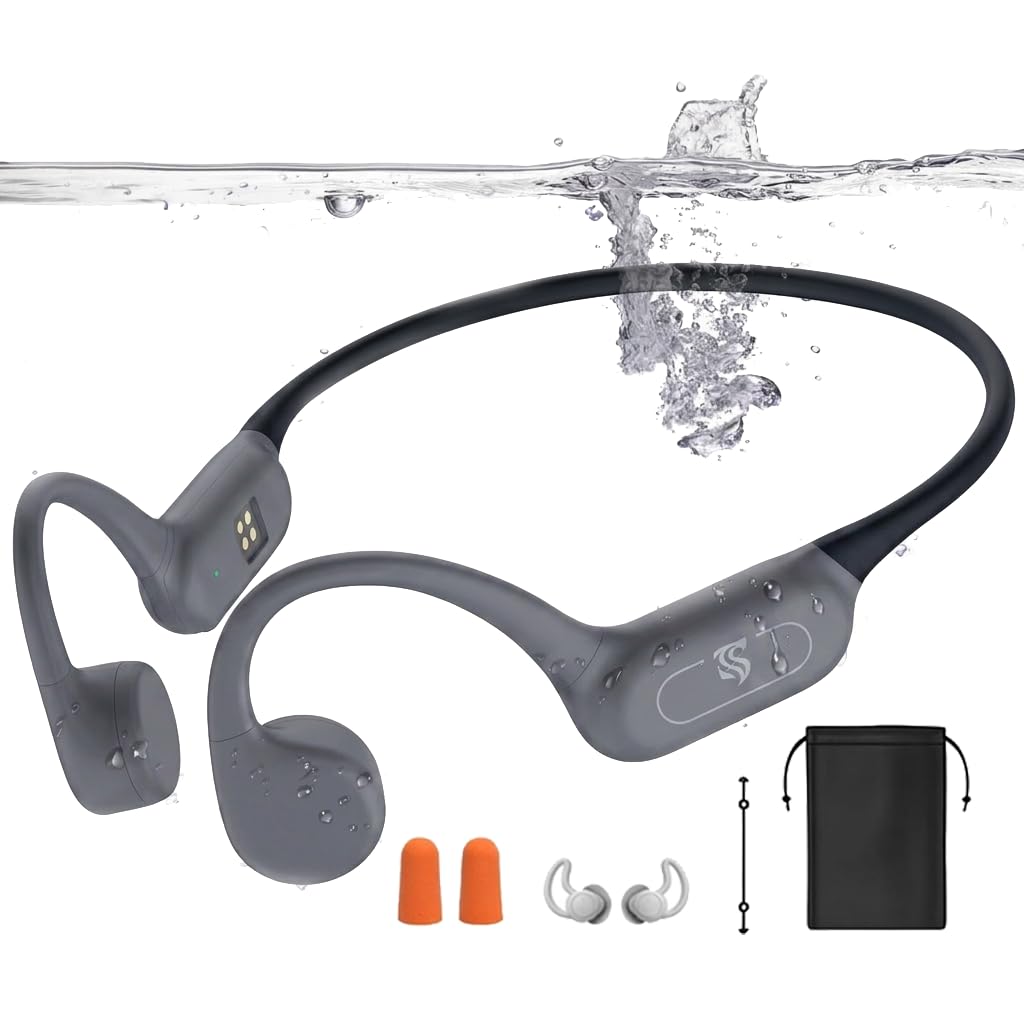
2. Roujune Swimming Headphones Bone Conduction
Feather-soft on the head, sealed to a certified standard, and built to vanish under a cap.
At 27g this set practically disappears once it is on. Soft liquid silicone meets a flexible titanium memory band that curves to your head shape and springs back, so it sits under a swim cap and goggles without a fight. That light weight is the difference between a frame you forget about at lap twenty and one you keep nudging into place.
The water protection is the certified kind — a TÜV-certified IP68 rating with an advanced sealing system, rated for submersion up to two meters for an hour. It carries 32GB of storage holding up to 8,000 songs, and the power button does the mode switching: a double-press jumps between Bluetooth and MP3, a triple-press flips between shuffle and straight order. Bluetooth 5.4 handles the above-water side with a 10-metre range and dual-device connection, so you can hop between laptop and phone.
Comfort is where the owners keep circling back, and the fit explains why. The catch to know before you buy is stamina — up to 6 hours per charge, versus the Sanag’s 12 hours. It is a fair trade if your sessions are shorter than that and you prize a lighter headband over marathon runtime, and Roujune backs it with a 2-year after-sales service.
cap-friendly fit: at 27g it weighs a hair more than the ANSTEN’s 26g — the real story is the titanium memory band hugging a swim cap line without pressure points. The IP68 seal handles two meters of depth for an hour.
short battery runs: 6 hours of playtime is the shorter end of this group, so heavy swimmers will charge it more often than the top pick.
cap wearers first: swimmers who do 45 minute lane sessions and want the band to feel like nothing.
long-session swimmers avoid: you train back-to-back days and refuse to charge between every swim — the 12-hour Sanag owns that need.
3. PSIER Bone Conduction Headphones
For the swimmer who keeps two devices in play and hates reconnecting every session.
This PSIER lives and dies by its switching speed. Bluetooth 6.0 gives it ultra-low transmission latency and lets you pair two or more devices at once, flipping between them without a re-pair dance. With 32GB of internal memory rated for up to 4,000 songs, the phone-free side is covered too — a double-click drops you into MP3 mode when you hit the water.
The IPX8 seal puts it on the same footing as the top pick for pool work, and the open-ear shape keeps your surroundings audible, which matters when you are sharing a lane. The 32GB capacity is the same headline number as the Sanag, though its smaller song count reflects a different file-size assumption, so judge it by gigabytes rather than the vague song estimate.
What a buyer should weigh honestly here is sound character. Bone conduction keeps your ears unblocked, so the audio is efficient and clear but not a sealed-room experience. If your priority is device juggling on deck between swims, this one is tuned for exactly that habit and the IPX8 rating is the safety net under it.
multi-gadget switchers: pair it to your phone and laptop and switch between them by double-click, no reconnection fuss.
single-phone users pass: you want every session tracked on your wrist mid-swim — the open-ear MP3 focus assumes you go phone-free underwater.
4. MONODEAL Swimming Headphones Bone Conduction

An alloy frame you can twist, bend, and stuff in a bag without it losing its shape.
Durability is the pitch with the MONODEAL. A high-quality alloy body bends freely and springs right back to its original shape, so it tolerates being folded into a swim bag and bounced around a locker room. The same alloy is corrosion-resistant, which is the sensible material choice for a device living in chlorinated water. It sits open-ear with an ergonomic curve that follows your head, no pressure during long wear.
The IPX8 rating covers water, sweat, rain, and dust, and the switch to MP3 mode is a double-click on the multifunction button — necessary, since Bluetooth cannot travel underwater. Bluetooth 5.4 handles the dry side with steady connection and low power draw. The honest limitation in the specs is storage: 8GB holds roughly 1500+ songs, which is a smaller library than the 32GB sets higher up this list and fills quickly if you carry long audio.
So the fit is clear. If you want a resilient, bend-friendly frame that shrugs off pool water and a compact playlist is all you need, this is a solid, no-drama choice. If you want to load thousands of tracks and forget about managing storage, a 32GB set serves you better.
rough handling ready: a corrosion-resistant alloy frame rated IPX8 that bends and recovers without cracking.
big playlists skip: 8GB is the constraint if you want thousands of songs on board — 32GB picks are the answer there.
5. ANSTEN Swimming Headphones Bone Conduction

A wide driver in a light frame, aiming for fuller audio through the cheekbones.
Most bone conduction sets hide a small driver. This ANSTEN fits a 13mm wideband driver to push full, clear 360° sound — versus the 10mm unit in the Sanag at the top. That extra surface area is aimed squarely at the thing bone conduction usually gives up: richness and body. It weighs 26g, slightly under the Roujune’s 27g, and the frame stays put through intense sport.
The IPX8 seal covers swimming, surfing, and diving, and the AI noise cancellation with a front microphone is a genuine help for calls on deck or at the gym. Directional transmission keeps audio from leaking out to the next lane. A 2-hour charge returns up to 8 hours of continuous playback, and there is 8GB of storage for phone-free swimming on MP3 mode.
The genuine caveat is connection behavior. Owner feedback on the Bluetooth side is split — solid for many, with dropouts showing up for others — so treat wireless pairing as the variable part and lean on MP3 mode in the water where Bluetooth would not work anyway. Comfort and fit are lighter concerns, but the frame can feel firm on some head shapes until you settle the seating.
driver detail claims: that 13mm unit is the biggest here, versus the Sanag’s 10mm, and it targets the low-end body open-ear audio usually lacks.
variable real output: Bluetooth stability is the thing to watch — many connect cleanly, but some hit dropouts, which is why preloaded MP3 swimming is the safer lane.
Worth it for the audio-first swimmer: if you want the fullest sound this category offers and MP3 is your in-water mode.
spec readers apply: you need rock-solid Bluetooth above water for calls and meetings all day — the wireless is the shakier half here.
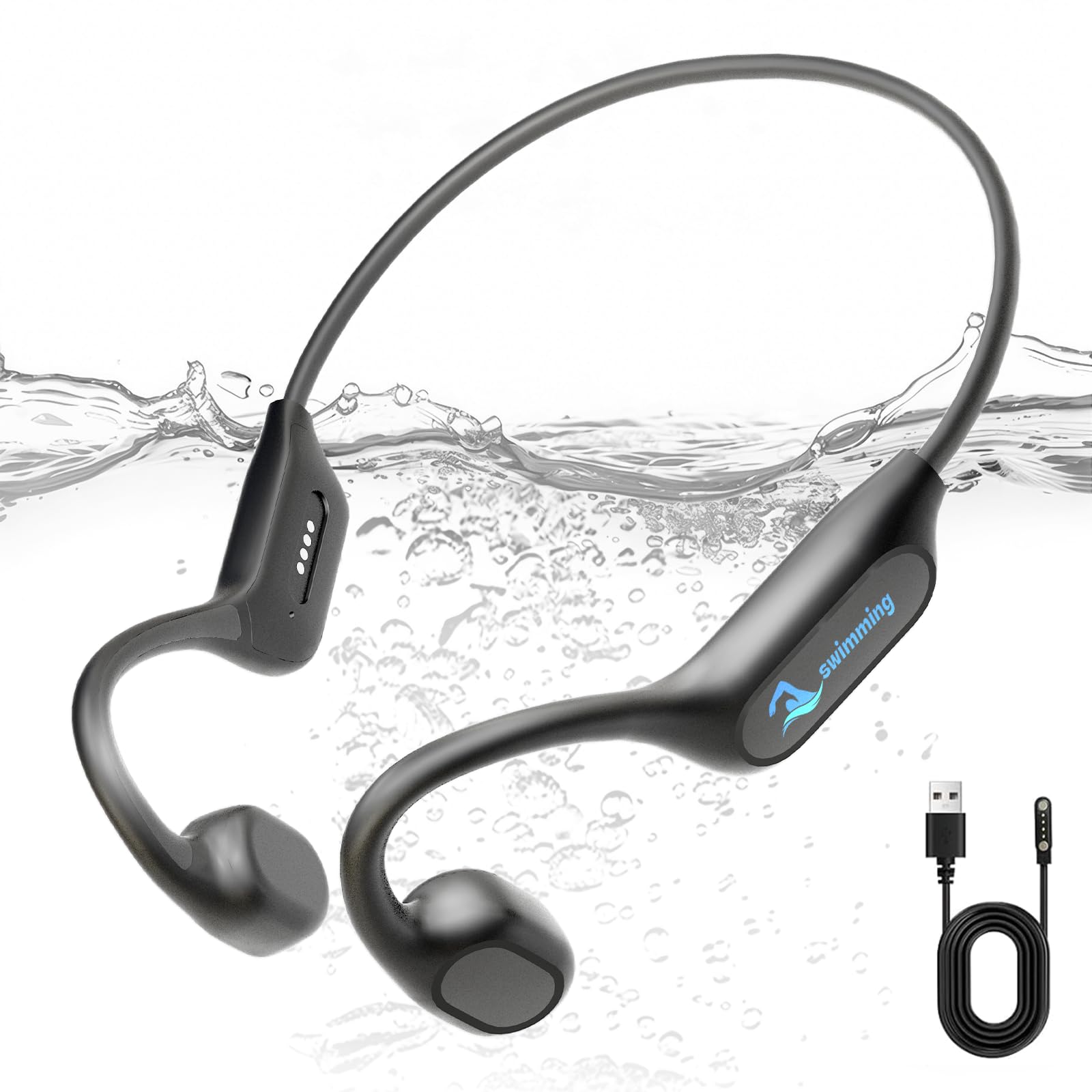
6. Tevese Swimming Headphones Bone Conduction
The highest-rated set in the group, pairing 10 hours of runtime with a 9,000-song library.
Of everything here, this is the one owners rate the highest — 4.5+ stars across 150+ ratings — and the specs back the enthusiasm. It carries the IPX8 rating for prolonged submersion and a 32GB internal player that holds 9,000+ songs, so the whole training catalogue travels with you. Ten hours of playback per charge puts it just below the Sanag’s 12-hour marathons while still covering a very long session day.
The open-ear shape keeps your ear canals completely free, which keeps your surroundings audible in open water or a shared pool. Bluetooth 6.0 handles the above-water half, and the switch to MP3 mode from a double-click is what makes underwater listening possible at all. It is compatible with swim caps and goggles, and the ergonomic frame is built to stay put through intense activity.
The one thing to go in knowing is that battery life is shorter than the top pick and the sound is bone-conduction, so it favors clarity and awareness over depth. That clarity-over-depth balance is what the 4.5+ star rating reflects, and if you want the best-loved set in the category, this is the one.
popular default pick: 4.5+ star backing with 10 hours and a 9,000-song 32GB player — hard to argue with for most pool swimmers.
feature hunters look on: you absolutely need the longest runtime available, in which case 12 hours beats it.
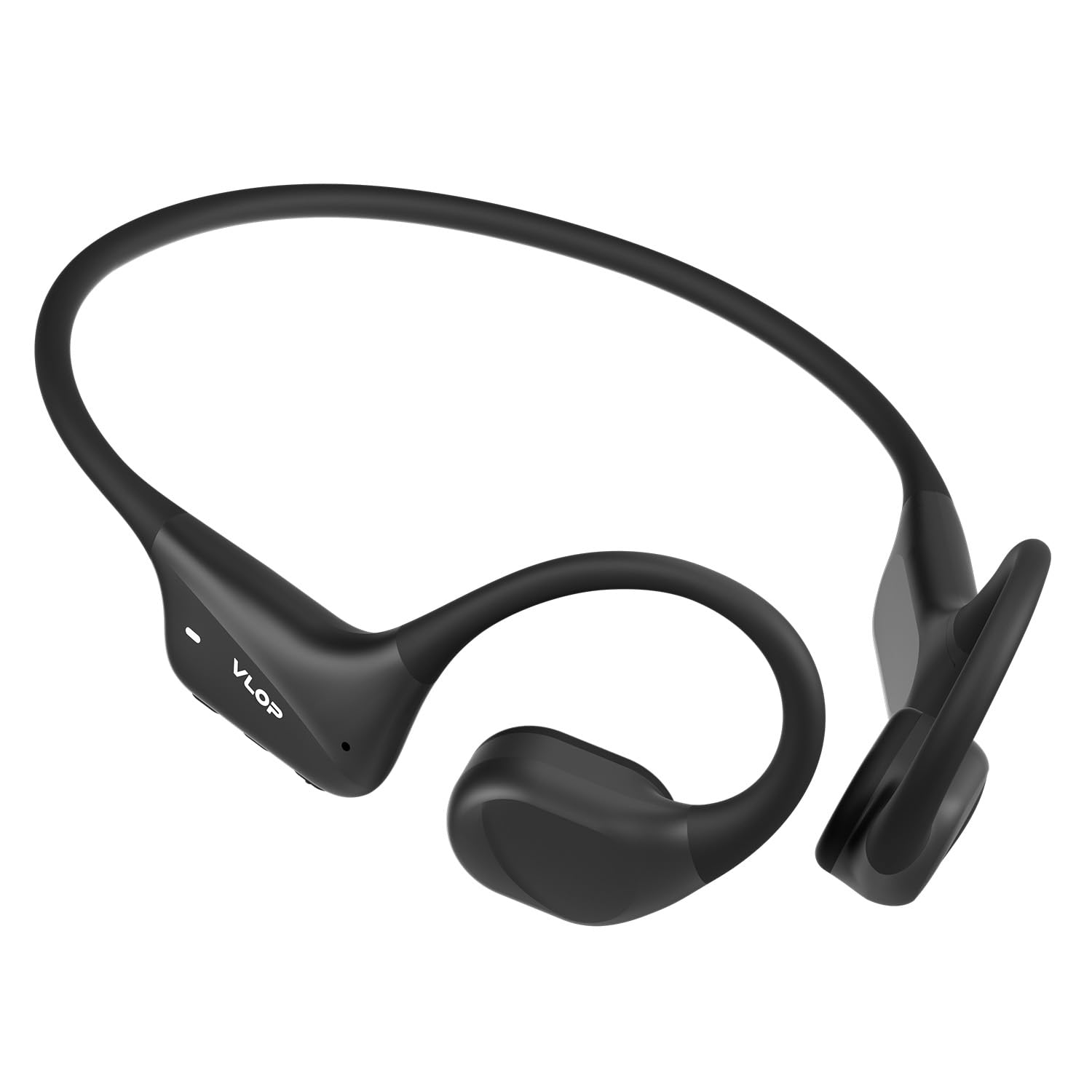
7. VLOP WaveBone Pro 2 Bone Conduction Headphones
A hybrid driver that bolts air conduction onto bone conduction to claw back the low end.
This is the most interesting driver design on the list. The dual-driver structure blends bone-conduction vibration with directional air conduction, aimed at clearer mids and stronger bass than a plain bone-conduction set delivers. In a category where bass is usually the sacrifice, a hybrid driver aimed at stronger low end is a real reason to look here.
The water side is covered by a sealed internal structure rated equivalent to IP68/IPX8 standards, and it supports standalone playback in water — a 32GB internal library covers the phone-free laps. Bluetooth 6.0 handles land use with a 10-metre range. The titanium memory frame adapts to most head shapes and stays put under goggles, helmets, or glasses.
Battery is where you should set expectations. Playtime is up to 8 hours, and the maker notes that MP3 playback draws more than Bluetooth — so charge fully before a swim and know a low battery can trigger an automatic mode switch. Overall it earns its badge on audio: the hybrid approach is the differentiator, and the owners back the build quality heavily.
hybrid sound tuning: combining bone and air conduction is the one design twist no other set here tries, and it targets bass specifically.
modest battery life: 8 hours is the ceiling and MP3 mode drains faster, so a full charge before each swim is the routine.
curious listeners try: if fuller bass from an open-ear set is worth prioritizing over raw battery hours.
purists stay away: the swimmer who wants a set-and-forget battery that ignores mode switching — charge discipline matters here.
8. RR SPORTS IP68 Waterproof Swimming Headphones
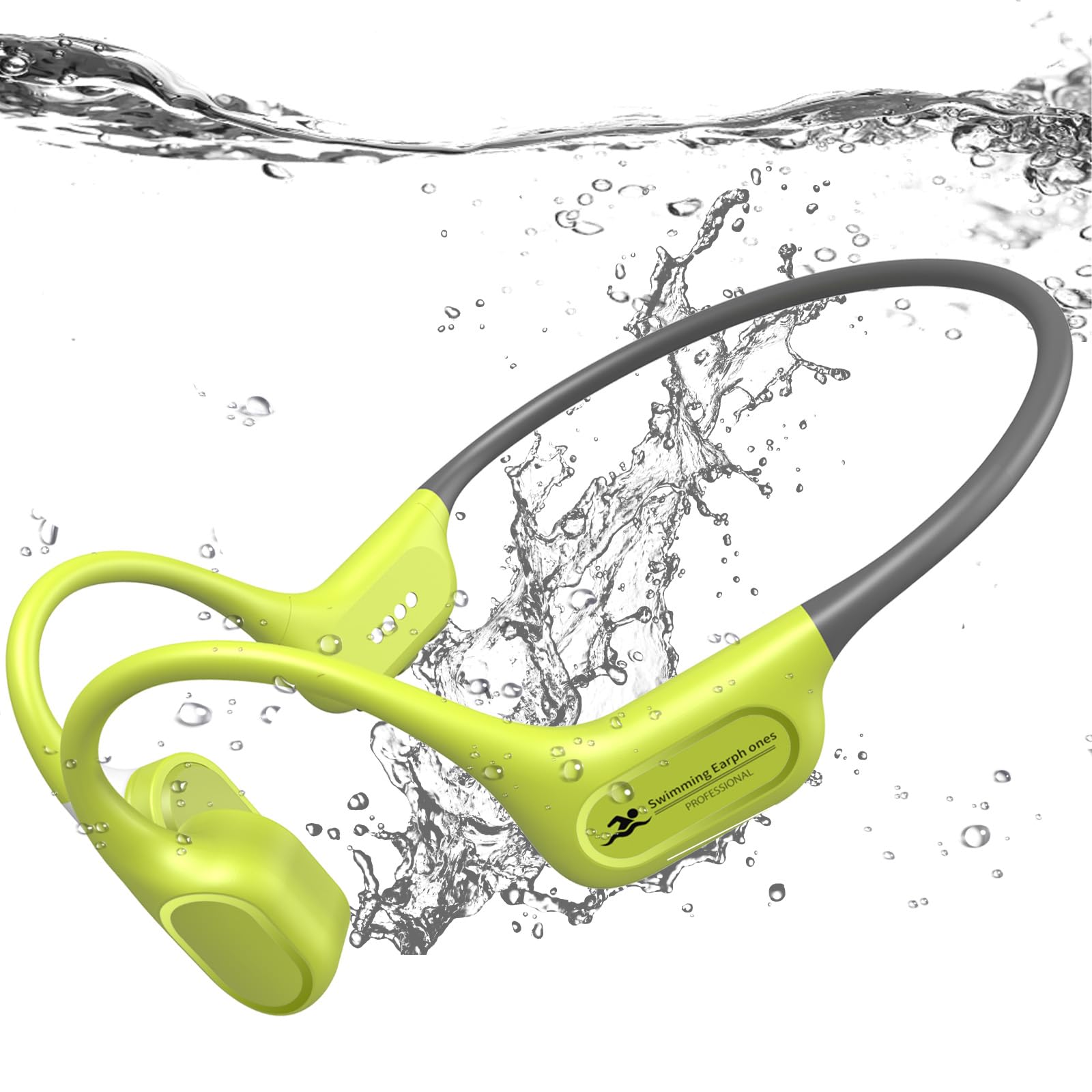
Sealed with a hydrophobic coating and rated to sit two meters under without complaint.
This RR SPORTS set is built around staying wet. The IP68 rating means it handles submersion in up to 2 meters of water, and the sealed design is reinforced by a nano-hydrophobic coating that keeps sweat, rain, and pool water off the internal components. It is the sort of construction that reassures anyone who actually trains underwater rather than just getting splashed.
On the audio side, 32GB of storage holds up to 7,000 songs and reads MP3, WMA, WAV, and FLAC — the widest format support here, so odd file types play without conversion. The included magnetic charging cable also doubles as the data transfer route from your computer. Bluetooth 6.0 handles the dry half with a 10-meter range and up to 7 hours of battery. Ultra-soft silicone keeps it comfortable for long wear.
The real question a buyer faces is runtime against the stiffest competition. Seven hours sits below the 10- and 12-hour sets, so if you swim most days you will charge more often. If your priority is genuine depth capability and flexible file formats, that shorter battery is a reasonable thing to live with.
depth and format fans: IP68 down to 2 meters with MP3, WMA, WAV, and FLAC support — ideal if your library is not all MP3.
forgetful chargers skip: 7 hours of runtime is the lower tier here, so plan on more frequent top-ups.
9. Rhyfell Fit 5 Bone Conduction Swimming Headphones
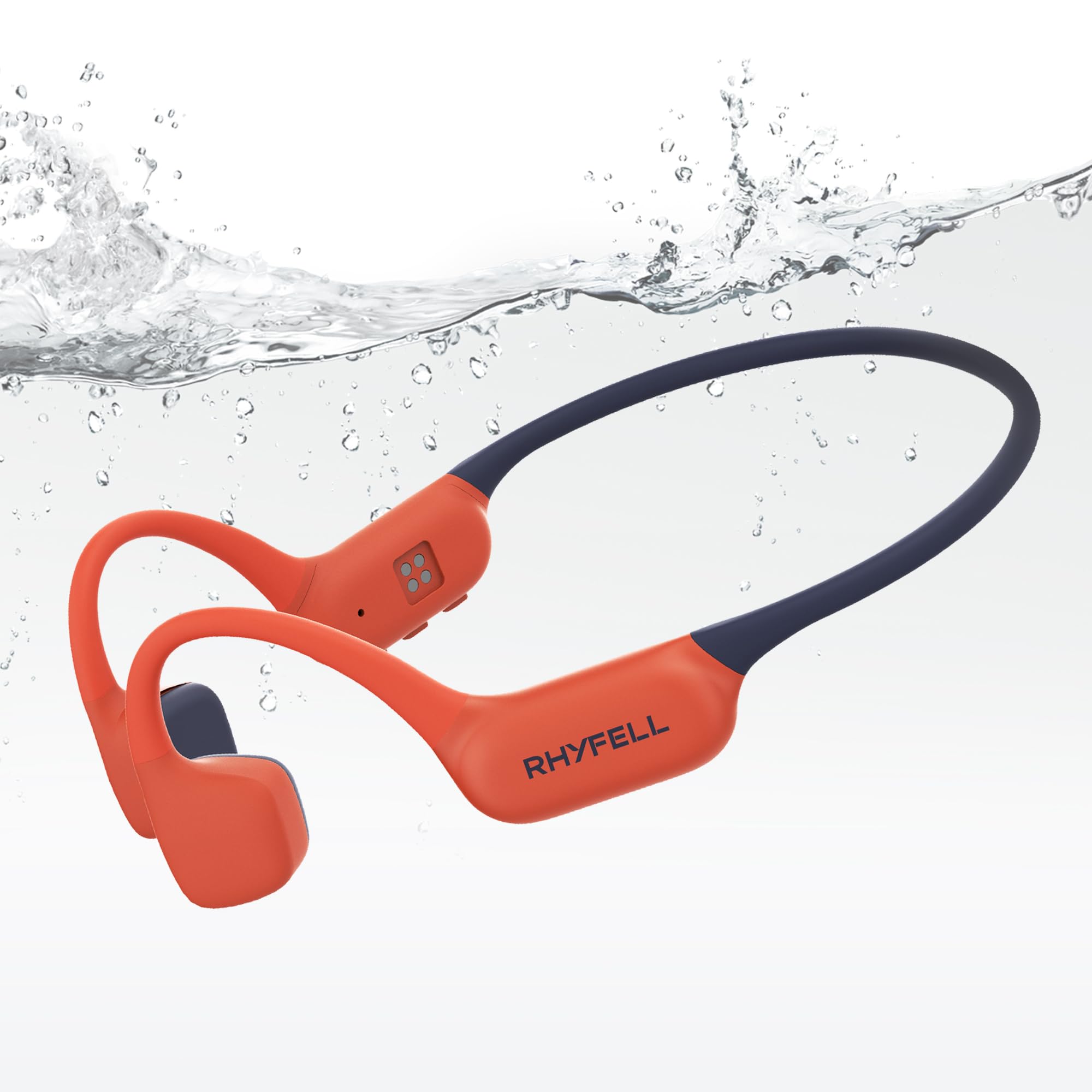
Built for people who hate waiting on a file transfer before their swim.
Getting music onto these is the fast part. The maker quotes a transmission speed of 18MB/s, which it describes as 18 times faster than previous generations, and with 32GB of storage you can move 8,000+ songs in minutes rather than babysitting a slow sync. A pro IP68 rating lets it submerge up to 2-5 meters, putting it in genuine dive territory, and MP3 mode makes the pool session phone-free.
Runtime is competitive at 10 hours per charge, and a 28g frame in liquid silicone is designed to stay on through high-intensity training and long wear. Bone conduction keeps your ears open, so you stay aware of the pool around you. Bluetooth 6.0 covers the above-water half with instant pairing.
The honest notes come from the water itself. Sound quality and battery feedback are mixed in owner reports — the open-ear design means you hear your surroundings, which is the point, but it also means the noise isolation is minimal. Treat this as an awareness tool with music attached, not a private concert, and the fast storage plus deep-water rating make it a strong pick for triathletes.
For the triathlete with a big library: 32GB at 18MB/s gets thousands of songs on board fast, and IP68 down to 2-5 meters covers open water.
storage-first swimmers: isolation is minimal by design, so do not expect to block the world out underwater.
Know the Specs
IPX8 vs IP68 waterproof ratings
The “IP” part stands for Ingress Protection, a standard measure of how well a device keeps out water and dust. The first digit after IP refers to solids and the second to liquids. An IPX8 rating means continuous submersion is survivable, with the X signaling the dust rating is not specified. An IP68 rating combines both: a 6 for dust, an 8 for water. In plain terms, both handle a swim, and IP68 is the better-rounded spec because it also seals against grit and dust.
Bone conduction and open-ear listening
Bone conduction sends sound as vibration through your cheekbones straight to your inner ear, bypassing the eardrum entirely. That means nothing sits inside your ear canal, so water stays out and you can still hear a whistle or a lane neighbor. The trade-off is bass depth — vibration-driven audio does not pressurize a sealed ear canal, so the low end is thinner than an in-ear set. For swimmers who need to hear a whistle or a lane neighbor, that open-ear awareness is a feature, not a flaw.
MP3 storage in gigabytes
Internal storage is what makes underwater playback possible, since Bluetooth signals cannot travel through water. Sizes on this list run from 8GB to 32GB. A 32GB player can hold thousands of songs, giving you room for full albums and long training sets. An 8GB player is fine for a few hundred tracks but demands more frequent file management. Judge by gigabytes, not the maker’s song estimate, since file size varies with audio quality.
Battery hours and mode drain
Playtime per charge runs from 6 to 12 hours here, and most sets recharge in about 2 hours. One thing many buyers miss: MP3 playback can draw more power than Bluetooth on some models, so the playtime you get underwater may be shorter than the number quoted. Charge fully before a swim, especially if you swim for a marathon set, and know that some sets switch modes automatically when the battery dips low.
Common Questions
Why does Bluetooth stop working when I go underwater?
What is the difference between IPX8 and IP68 for swimming?
How much internal storage do I need for swim sessions?
Will bone conduction headphones stay on under a swim cap?
Can I make calls with these while I swim?
How long does the battery last per charge for swimming headphones?
Do these leak sound to the swimmer next to me?
Is bone conduction sound quality worse than regular earbuds?
How do I get my music onto the headphones without a phone?
What depth can waterproof swimming headphones handle?
The Bottom Line
For most swimmers the answer is the Sanag Swimming Bone Conduction Headphones, because its 12-hour playtime and 32GB library mean you actually finish swim weeks without hunting for a charger. If you want the most-loved set in the category, the Tevese carries the highest rating here with 10 hours and a 9,000-song player. And if your sessions put a premium on the fullest bass an open-ear can manage, the hybrid-driver VLOP WaveBone Pro 2 is the one to reach for. Whatever you pick, charge it fully, load your MP3s, and leave the phone in the locker — that is what keeps the music playing underwater.
How we choose
We do not accept paid placement. Every pick is matched to a real buyer and a real use-case; we do not hands-on test units.
Sources
Specifications: manufacturer listings and product documentation. Review insights: verified customer reviews, as of November 2026. Pricing: not shown on this page (it changes often); check the current price via the retailer link.
As an Amazon Associate, Tactical Gear Guy earns from qualifying purchases. This does not affect which products we feature.