Specs are compiled from manufacturer listings and verified buyer reviews and can change over time — please confirm the key details on the product page before buying.
If your truck sits for weeks and fires up slow every spring, or your boat battery is flat by the time the season starts, a solar panel that keeps it topped off while you are away solves the problem.
This guide is built by comparing the manufacturers’ published specifications and the patterns across verified customer reviews, so you get each pick’s real strengths and trade-offs instead of marketing spin.
Below you will find nine panels that are all sealed for outdoor duty, sorted by what they actually keep alive — a lawn tractor, a camper, a deep-cycle bank. Every pick here is a genuine waterproof solar battery charger.
Top Picks

How To Choose The Best Waterproof Solar Battery Charger
Start with what you are keeping alive. A motorcycle battery under a cover needs far less panel than a pair of deep-cycle batteries on a boat trailer. Get that match wrong and you either drain nothing or cook the battery with too much current on a sunny afternoon.
Read the IP number, not the word “waterproof”
An IP rating is a two-digit seal score. The first digit covers dust and the second covers water, so IP68 means dust-tight and safe under water — the highest seal class in this lineup. IP67 handles rain, snow and splashes but is not meant for a dunking. IP65, like the POWOXI 15W, survives heavy rain and spray but not standing water. All three are fine for a windshield or a roof bracket; only the IP68 units are the ones you can leave out through a flood-prone winter.
MPPT vs PWM controllers
MPPT (Maximum Power Point Tracking) is a chip that actively hunts for the best voltage to pull from the panel as light shifts. PWM is the older, simpler method that just clamps voltage down. MPPT panels tend to hold up better on gray days, which is why so many of these kits advertise it. If your vehicle sits under trees or a carport half the day, prioritize MPPT.
Flexible ETFE vs rigid tempered glass
ETFE is a tough clear plastic film that bends, weighs little, and resists UV yellowing — good for a curved hood or a stowed panel. Tempered glass over an aluminum or ABS frame is heavier and stiffer, but it spreads heat and takes hail better. Decide by where the panel lives: a windshield wants flexible, a roof rack or a fence post wants rigid.
Know your battery chemistry before you buy
Flooded, gel, AGM, SLA and LiFePO4 all want slightly different charge voltages. Panels that list selectable modes — like the SUNER POWER’s 12V, 12V AGM and 12V Lithium settings — let you tune the charge to your battery. Panels that do not still work on most lead-acid types, but a lithium pack deserves a mode built for it.
Side-by-Side Comparison
| Model | Best For | Max Power | Water Rating | Weight | Amazon |
|---|---|---|---|---|---|
| SUNER POWER 30W 12V Maintainer Ultra★ Best Overall | Deep-cycle and RV banks | 30 watts | Waterproof | 4 pounds | Amazon |
| 12V 20W Smart MPPT Kit with MountBest Bang for Output | Aiming at the sun | 20 watts | IP68 | 2.5 pounds | Amazon |
| Callsun 20W Trickle Maintainer KitMost Proven | Lawn mowers and stored Jeeps | 20 watts | IP68 | 4 pounds | Amazon |
| ZZE 20W MPPT Kit | Budget 360° mounting | 20 watts | IP68 | — | Amazon |
| ECO-WORTHY 25W Kit | Off-grid lights and pumps | 25 watts | Waterproof | 2.34 kg | Amazon |
| SUNAPEX 20W Flexible Charger | Windshield and dash installs | 20 watts | IP67 | 1.06 kg | Amazon |
| POWOXI 15W MPPT Charger | Small batteries, tight spaces | 15 watts | IP65 | — | Amazon |
| Sun Energise 25W PRO | Harsh-weather mounting | 25 watts | IP65 | 2.53 kg | Amazon |
| POWOXI 50W Flexible ETFE | Maximum output, marine | 50 watts | IP67 | 450 g | Amazon |
Detailed Reviews
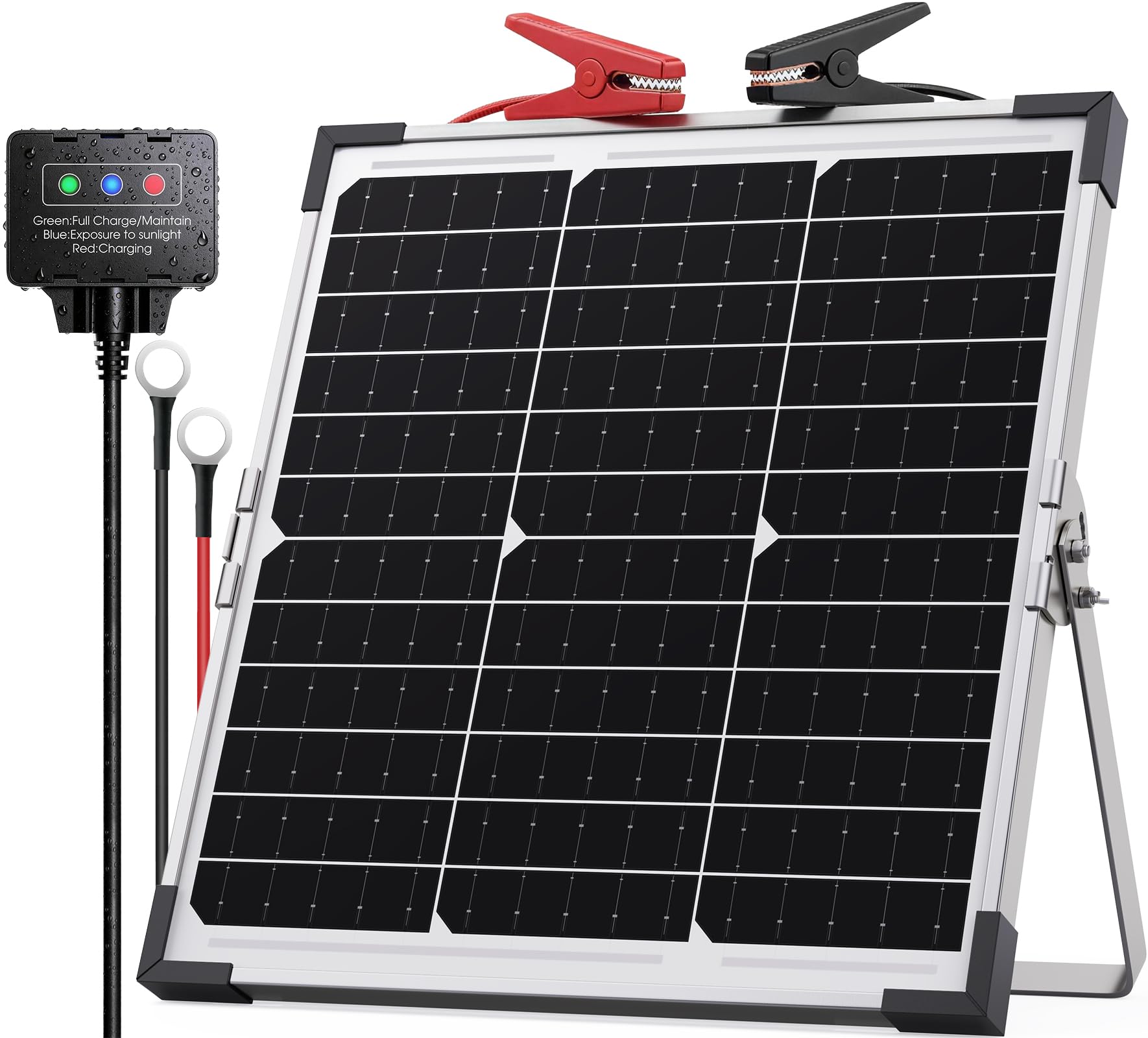
1. SUNER POWER 30W 12V Solar Panel
Our pick — 4.5+★ from 300+ verified ratings; the strongest balance of quality and price.
The most wattage on the list, and the one you reach for when the battery is a deep-cycle workhorse.
This is a 30-watt panel, and that number is the whole story. A 30W panel harvests more current per hour of sun than the 15W and 20W options here, which is why it suits a boat’s deep-cycle battery or a dual-battery truck rather than a tiny lawnmower cell. Buyers report a deep-cycle bank down to about 60% charged came back in a few hours of daylight.
The controller is the second reason it leads. SUNER POWER’s Ultra-Smart MPPT is rated at up to 99% tracking efficiency and 98% conversion efficiency. In plain terms, very little of the sun’s power gets lost between the glass and your battery terminals. It also offers three selectable modes — plain 12V, 12V AGM, and 12V Lithium — so a LiFePO4 pack gets a voltage curve built for it, not a compromise setting. The 25%-50%-75%-100% charge-level lights tell you where the battery sits without a voltmeter.
Physically, this is the heaviest pick in the round: 4 pounds and 18.9 by 15.3 inches, which is 2 pounds and roughly 7 inches wider than the IOTBIG 20W kit. That extra bulk buys you 10 more watts of panel. It survived rain and weather in the field, and the mount holes plus included suction cups cover a roof, a windshield, or a deck. For a serious bank that sits all winter, that trade is worth it.
Where it earns its keep
- 30 watts of solar is the highest output here, so a drained deep-cycle bank refills faster than the 20W kits
- Three charge modes (12V, 12V AGM, 12V Lithium) cover flooded, gel, AGM and LiFePO4 packs
- Pass-through charge-level lights at 25%, 50%, 75% and 100% show status at a glance
- Eight built-in protections mean reverse polarity and over-charge are handled automatically
The honest trade-off
- At 4 pounds and 18.9 inches wide, it is the bulkiest panel in this round — not a glovebox stow
- Deep-cycle and RV users are the balance; a motorcycle battery is overkill for this much panel
The verdict: If you keep a boat, an RV, or a work truck parked all season, this is the panel that keeps the big battery alive.
Think twice if: your battery is a small motorcycle or lawnmower cell — the higher wattage is more than you need.
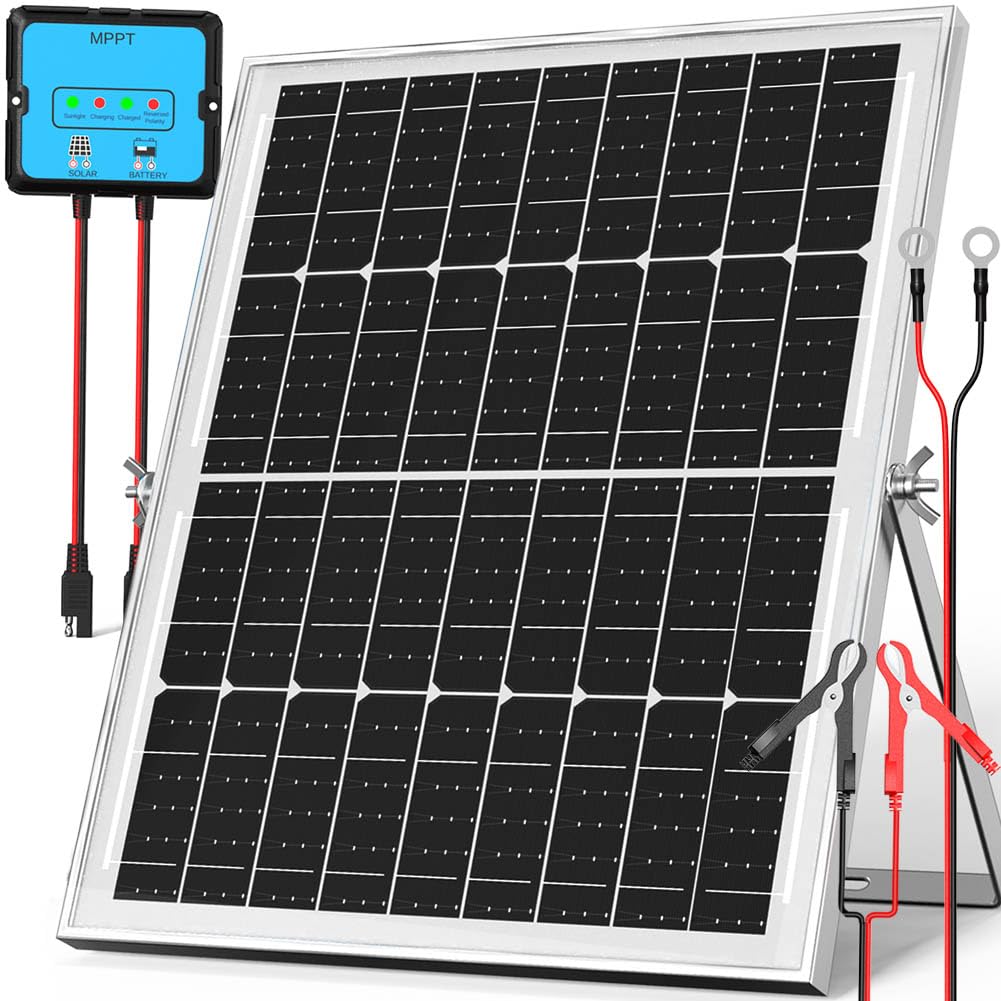
2. 12V 20W Smart MPPT Solar Battery Charger
A 20-watt panel under 3 pounds, sealed to IP68 and pointed at the sun from a 360° bracket.
This IOTBIG kit stands out because it is easy to mount and built to survive weather. It weighs 2.5 pounds and is 12 inches long — nearly 7 inches shorter and 2 pounds lighter than the SUNER POWER 30W, so it fits on a dash, bumper, or small roof rack with less fuss. It is IP68 (dust-tight and rated to survive being underwater), so a storm or a melted snowbank will not shut it down. The included rust-proof aluminum bracket tilts and rotates a full 360° so you can aim it at the sun instead of settling for whatever angle the hood provides.
Per the maker, its MPPT controller pulls 20% to 30% more charging current than standard PWM models. That is the difference between a panel that barely registers on a gray day and one that still nudges a battery upward. It also has eight protections — over-charge, over-discharge, reverse polarity, overcurrent, overvoltage, reverse current backflow, short circuit and overheating — plus a bright LED that warns you if the cables are reversed.
Once the battery hits full, the controller drops into float maintenance mode instead of shutting off, so the battery stays topped between drives. A 10-foot heavy-duty SAE cable means you have slack to reach a bumper terminal from a roof mount. A 3-year warranty backs it. This is the panel for a car or motorcycle that sits through snow, and you want to mount it where the sun actually lands.
what separates it: IP68 plus a 360° bracket is a rare pair — the seal handles winter, and the mount lets you chase daylight instead of accepting a fixed angle.
Where you take a hit: At 20 watts it charges slower than the 30W SUNER POWER, so a deeply drained deep-cycle bank takes longer to come back.
Reach for this if: you want a light panel you can aim at the sun and leave out through snow and rain.
Look elsewhere if: you need to refill a large deep-cycle bank quickly — the 30W panel above does that faster.
3. Callsun 20W 12V Solar Battery Charger Kit
The lawn-tractor and stored-Jeep specialist that keeps a battery topped through a whole winter.
Owners mention the same story again and again — a mower, a Jeep, a fuel-pump battery on a remote tank that sits unused for months and still fires up when needed. what separates it is a strip of low-iron tempered glass over A+ monocrystalline cells (a high-grade silicon cell type), sealed in IP68 and rated to keep pushing current from 14°F to 158°F. That temperature window is the real magic: a lot of panels fade once the mercury drops, and this one is built for the cold side.
The three-stage sequence (Bulk, Absorption, Maintenance) means the panel fills the battery quickly at first, then backs off to a gentle topping charge, which helps a battery last longer. Three status LEDs show the stage without a meter. And the kit is genuinely complete: panel, 360° adjustable mount, alligator clips, O-rings, and a full mounting hardware set.
The one thing to watch is the hardware. The alligator clips are the weak point — a pair of jaws have failed on first use for some buyers, so treat the clip ends carefully and consider swapping them for O-ring terminals where the battery has the posts. It is a minor fix for a panel that otherwise holds up on tractors and boats alike.
The case for it: IP68 sealing plus a 14°F to 158°F operating window makes this a genuine four-season maintainer, not a fair-weather panel.
One thing to plan for: the alligator clips are the failure point — O-ring terminals last longer if your battery has posts.
Who should pick this: the owner with a mower, a stored Jeep, or a trailer that sits idle for the cold months.
Who should keep looking: fans of clip-on connections — swap in terminals for a longer-lived setup.
4. ZZE 20W 12V Solar Panel Kit
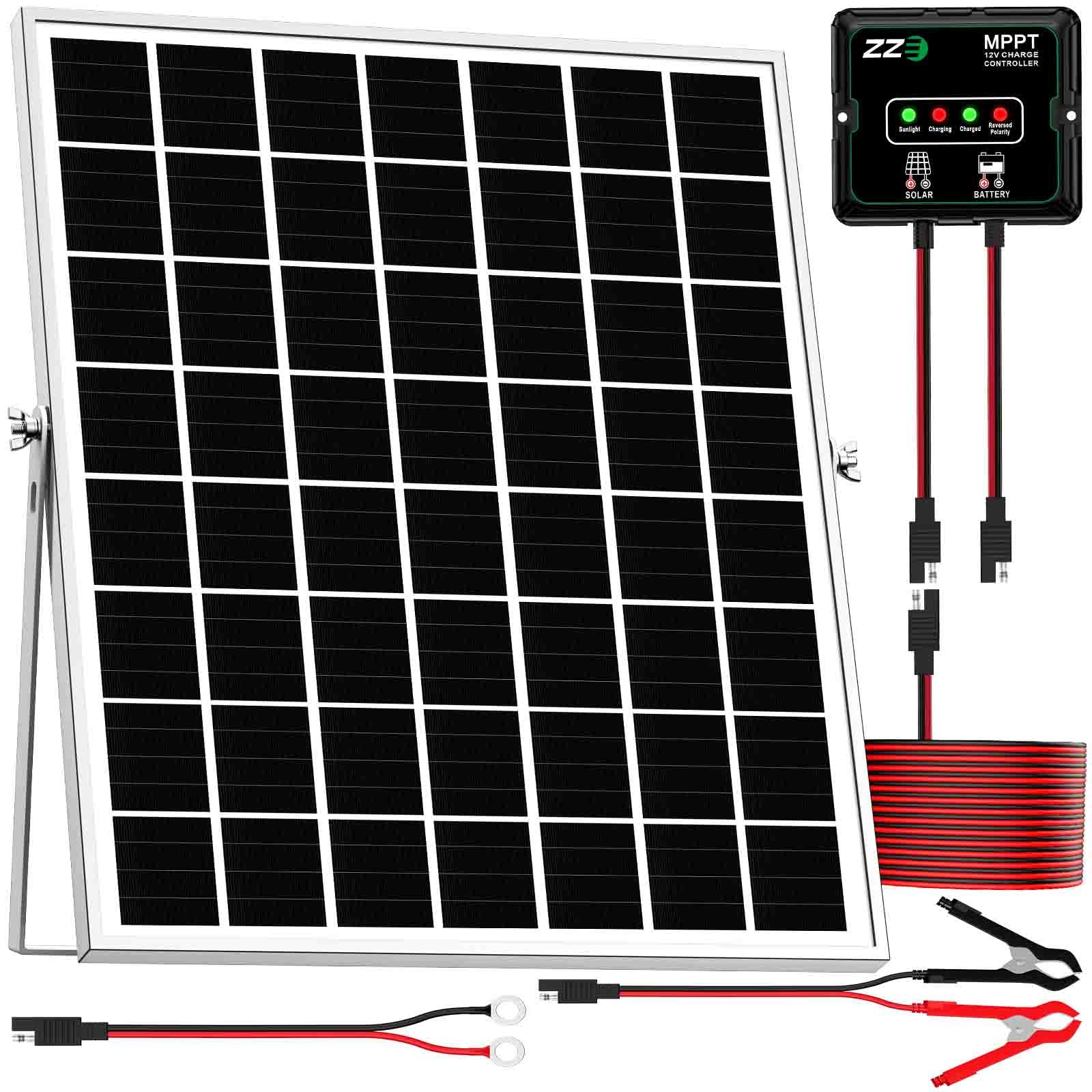
The budget 20-watt kit that still packs an MPPT controller, IP68 sealing, and a 360° bracket.
It is easy to write off a lower-tier panel, but this ZZE kit keeps the features buyers actually care about. The controller is MPPT (tracks the best voltage as light changes), the seal is IP68 (dust-tight and rated for submersion), and the mount swings a full 360° to angle the panel at the sun. Eight protections — over-charge, discharge, reverse polarity, over current, over voltage, backflow, short circuit and high temperature — mean a reversed clamp or a heavy rainstorm will not ruin the unit. The controller features distinct LED indicators, so you can see at a glance whether the battery is charging.
What makes it a value pick is what is always claimed and hard to verify: real-world output. The panel is a 20W monocrystalline unit, and a few owners note that the delivered output under direct sun falls short of the rated watts. That is common across panels this size — the 20W figure is the panel’s peak under ideal conditions, not what reaches your battery on a cloudy afternoon. So treat it as a solid maintainer for a parked car or boat and not a fast charger.
The plug-and-play connectors and extended cable lengths let you run the panel a good distance from the battery. For a vehicle you drive a few times a month, this gets the job done while staying easy on the wallet.
Value read: MPPT, IP68, and an adjustable bracket at the wallet-friendly end of the range — features that usually cost more.
The honest gap: some units deliver less than the 20W rated peak in full sun, so match it to a maintainer job, not a fast recharge.
Suits you if: you want the MPPT and IP68 features without paying premium-tier money.
Pass if: you expect full 20W at the terminals on a cloudy day — panels this size rarely deliver that.
5. ECO-WORTHY 25W 12V Solar Panel Kit
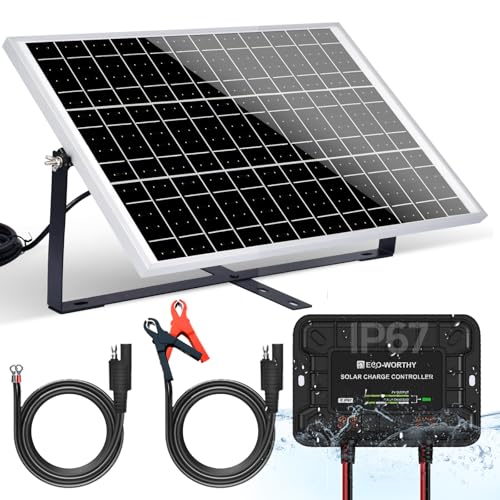
A 25-watt panel rated to push 100Wh a day, built for gates, pumps and fence chargers as much as batteries.
This kit sits one step above the common 20W panels. The 25-watt monocrystalline panel uses A+ cells rated up to 23% efficiency, and the maker states it can generate 100Wh of power daily — enough to keep a gate opener, a water pump, or a set of off-grid lights running as well as topping a 12V battery. That dual role is rare among maintainers: most only top the battery, while this one can also feed small devices directly.
The glass is low-iron tempered over an aluminum frame, built to take sandstorms, thunderstorms, hail and wind loads up to 2400 Pa and snow loads up to 5400 Pa. The controller is fully sealed for all-weather use, with zero power draw at night, plus temperature compensation and the usual over-voltage, over-discharge, overload and short-circuit protections. Indicator lights track charging status.
The honest weak spot is durability on some units — reports of a panel faulting and burning out its wiring connectors within a month exist alongside others that run for months without an issue. Treat the controller connections gently and mount it out of standing water. For a gate or a fence that sits far from an outlet, this is the panel that earns its keep.
Why it fits off-grid jobs
- 25W A+ mono cells generate up to 100Wh daily, enough to feed a gate opener or pump as well as charge
- Rated for 2400 Pa wind and 5400 Pa snow load, so hail and blizzards are within its spec
- Sealed controller draws zero power at night and adds temperature compensation
The catch to weigh
- Build quality is mixed — a few units faulted and burned their connectors within a month
- At 2.34 kg it is heavier than the flexible panels, so it wants a fixed mount
Pick it for: a remote gate, fence charger or water pump that needs daily power, not just a topped battery.
Second-guess it for: a dash or glovebox install — the weight and fixed mount want a permanent spot.
6. SUNAPEX 20W 12V Solar Car Battery Charger
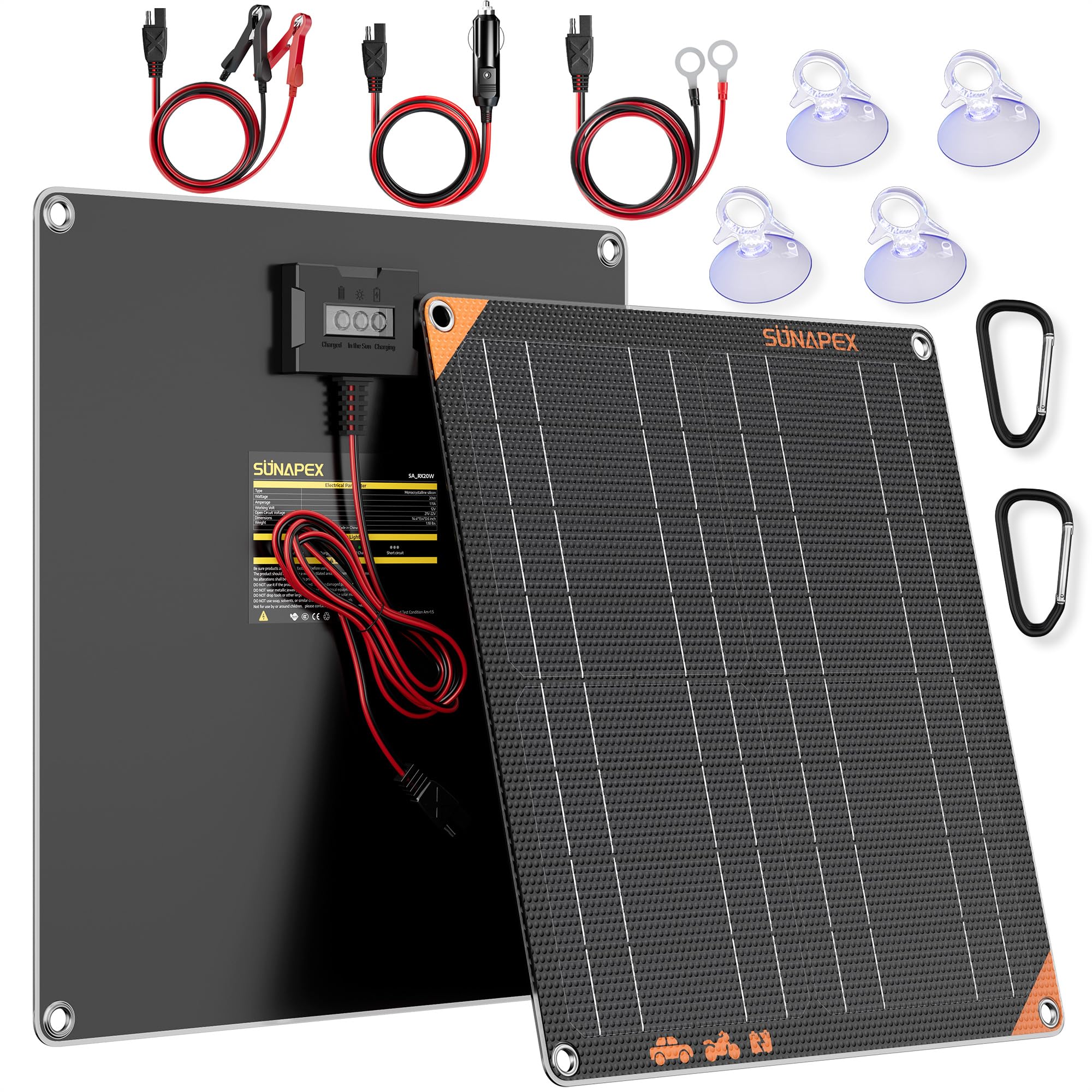
A flexible 20-watt sheet that sticks to a windshield and shrugs off rain at IP67.
The defining trait here is the material. This panel is built from ETFE, a flexible clear film over monocrystalline cells, and it weighs 1.06 kg. Because it bends, it adheres to a curved car front windshield or a dash rather than needing a rigid bracket. Suction cups and carabiners come in the box, so it hangs or sticks without tools. The IP67 seal means rain and snow are fine — just do not submerge it like the IP68 units.
The 20W cells are monocrystalline, which the maker notes deliver higher power than same-size polycrystalline panels and hold stable output in low light. A smart controller prevents overcharging, over-voltage and deep discharge, and the three LED lights (blue for sunlight, red for charging, green for full) remove the guesswork. It is compatible with sealed lead-acid, lithium, LiFePO4, GEL, AGM and flooded batteries, and the SAE connector matches most 12V accessories.
Durability is where you should set expectations. The flexible film is more exposed than a glass-and-frame panel, and a segment of customers note units failing within weeks. For a windshield that sees sun and rain, the trade is weight and flexibility for a shorter service life than a rigid kit. That is the honest cost of going flexible.
What owners like: the flexible ETFE film lets it cling to a windshield or dash, and the included suction cups and carabiners mean a tool-free install.
Where it asks patience: the exposed film wears faster than rigid glass, and some units stop working within weeks — plan for a shorter run than a frame-mounted panel.
For the flexible-first buyer: windshield or dash installs where a rigid panel will not sit and you want IP67 rain protection.
For the long-haul buyer: a rigid glass panel lasts longer when it will live in one outdoor spot for years.
7. POWOXI 15W 12V Solar Battery Charger Kit
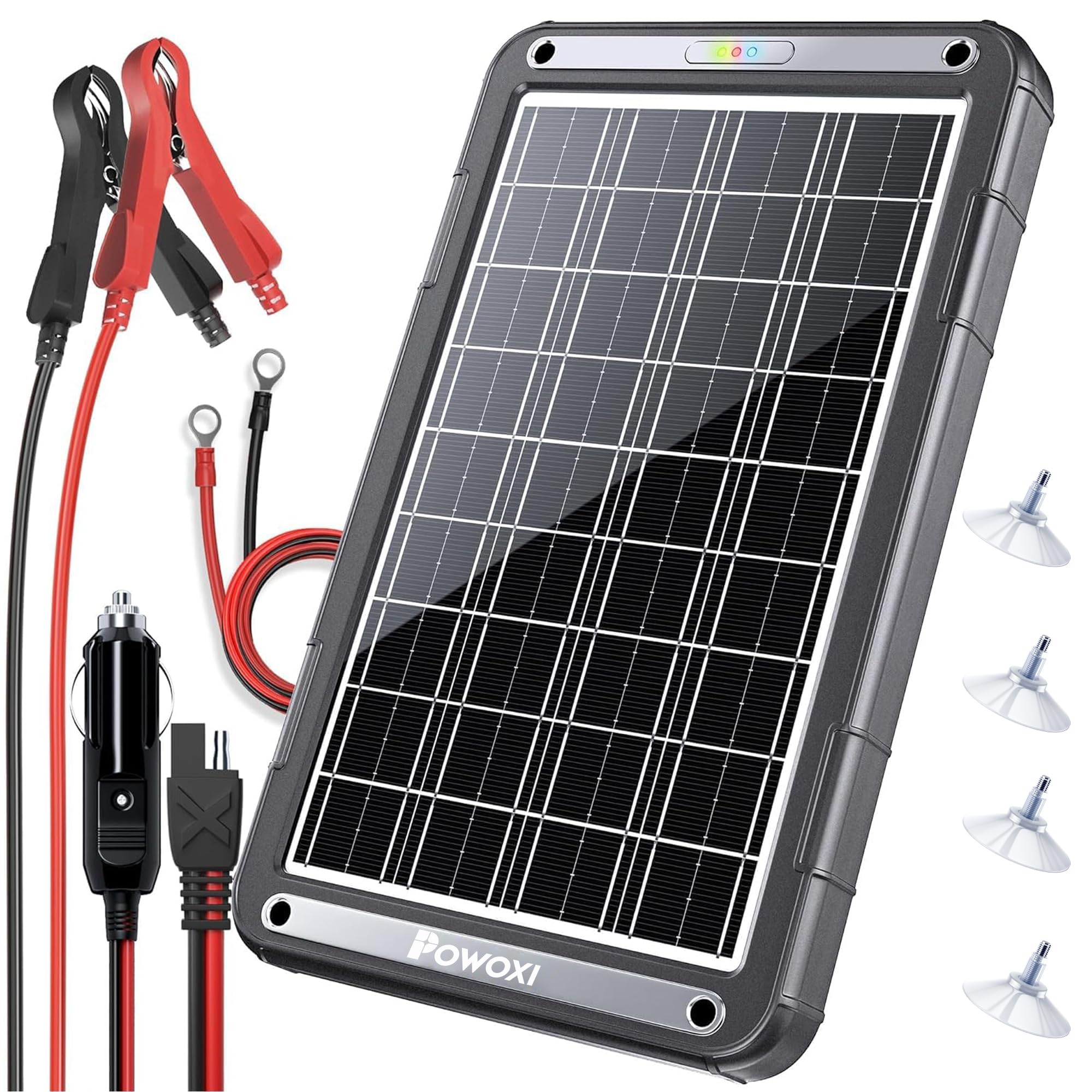
A small-format 15-watt MPPT panel that fights for output even on a gray afternoon.
MPPT on a 15-watt panel is unusual, and it is the feature that defines this POWOXI. Its MPPT controller is rated up to 99% conversion and adjusts power as sunlight changes, so it holds more output on cloudy days than a plain PWM panel. The three LEDs (blue for sunlight, red for charging, green for full) update in about two seconds, so you see the state change quickly rather than waiting.
For mounting, the PC+ABS frame is worth noting. It will not damage car paint the way an aluminum frame can, and the tempered glass over the cells takes heavy rain and cold down to -40 and heat up to 137°C at IP65. That IP65 means rain and spray are fine, but standing water is not — mount it where it drains.
The trade-off is the wattage. At 15W this is the smallest output in the round, so it suits a car or motorcycle battery that needs topping between drives, not a deeply drained bank. The MPPT helps, but 15 watts of panel is a maintainer, and you should plan around that.
Standout spec: a 15W panel with MPPT and a 2-second LED status refresh — small-panel efficiency without the PWM compromise.
The size limit: 15 watts is the floor of this lineup, so a heavily drained deep-cycle bank will take far longer to recover.
Right match: a car or motorcycle that needs gentle topping, especially if you want MPPT in a compact form.
Wrong match: a large deep-cycle battery that needs real amperage instead of a slow trickle.
8. Sun Energise 25W 12V Solar Panel PRO
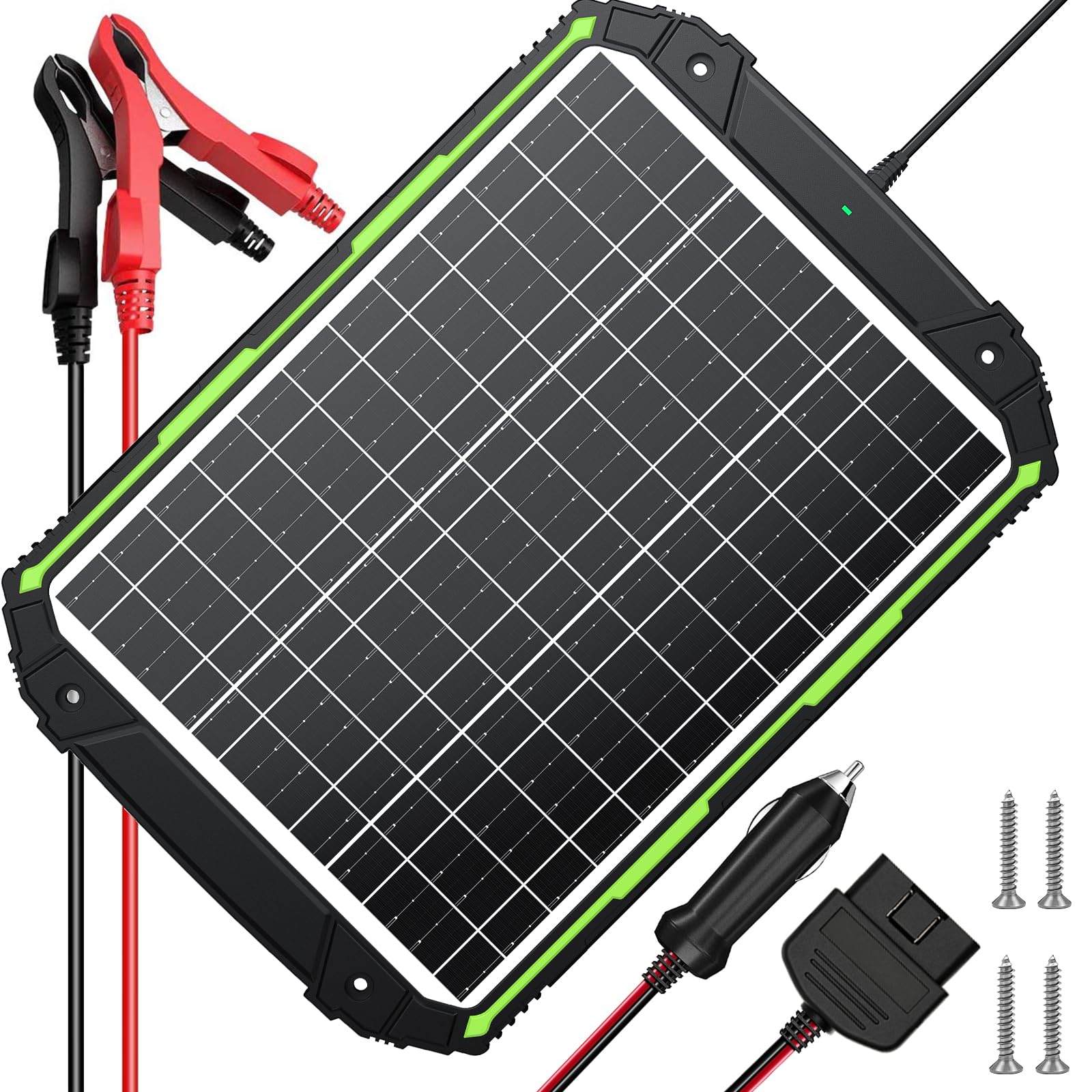
A 25-watt rigid panel built to sit outdoors through hail, sandstorms and snow load.
This is the rugged option. The tempered glass and corrosion-resistant ABS frame hold up against UV, hail and sandstorms, and the maker states wind pressure up to 2400 Pa (pascals, a pressure unit) and snow load up to 5400 Pa — the physical overload a panel sees under a heavy northern snowfall. The cells are A+ mono rated up to 21% to 30% efficiency, and the MPPT controller delivers up to 99% tracking efficiency and 98% conversion efficiency.
Charging is a three-stage Bulk, Absorption, Float sequence, and the controller cuts off fully charged batteries and resumes automatically when they drain. It handles gel, deep-cycle, SLA, flooded, AGM and LiFePO4. The 8-safety package covers over-charge, discharge, over-voltage, current, load, short circuit, reverse polarity and over-temperature. At 2.53 kg and 20.1 inches long, it is a permanent-mount panel, not a portable one.
Where this one asks for patience is in long-term reliability. The rugged frame holds up to weather, but the electronics do not always last — some units have stopped working within a month or two of being installed. So pour the value into the spec sheet (the sturdy frame, the MPPT, the 25W output) while knowing you are buying a heavier, weather-ready panel that may need service. That frame is the thing that lets it outlast the lightweight flexible sheets in snow.
Why it is a serious panel: 5400 Pa snow load and 2400 Pa wind pressure are figures that speak to real weather, not just a listing bullet.
The honest risk: electronic failures inside a month are on record for some units, so buy where you have a clear warranty path.
The fit: a permanent roof or rack mount on a rig that sits through snow, where a rigid frame earns its keep.
The misfit: a portable or glovebox role — at 2.53 kg and over 20 inches, it is not meant to travel.
9. POWOXI MPPT 50W 12V Solar Car Battery Charger
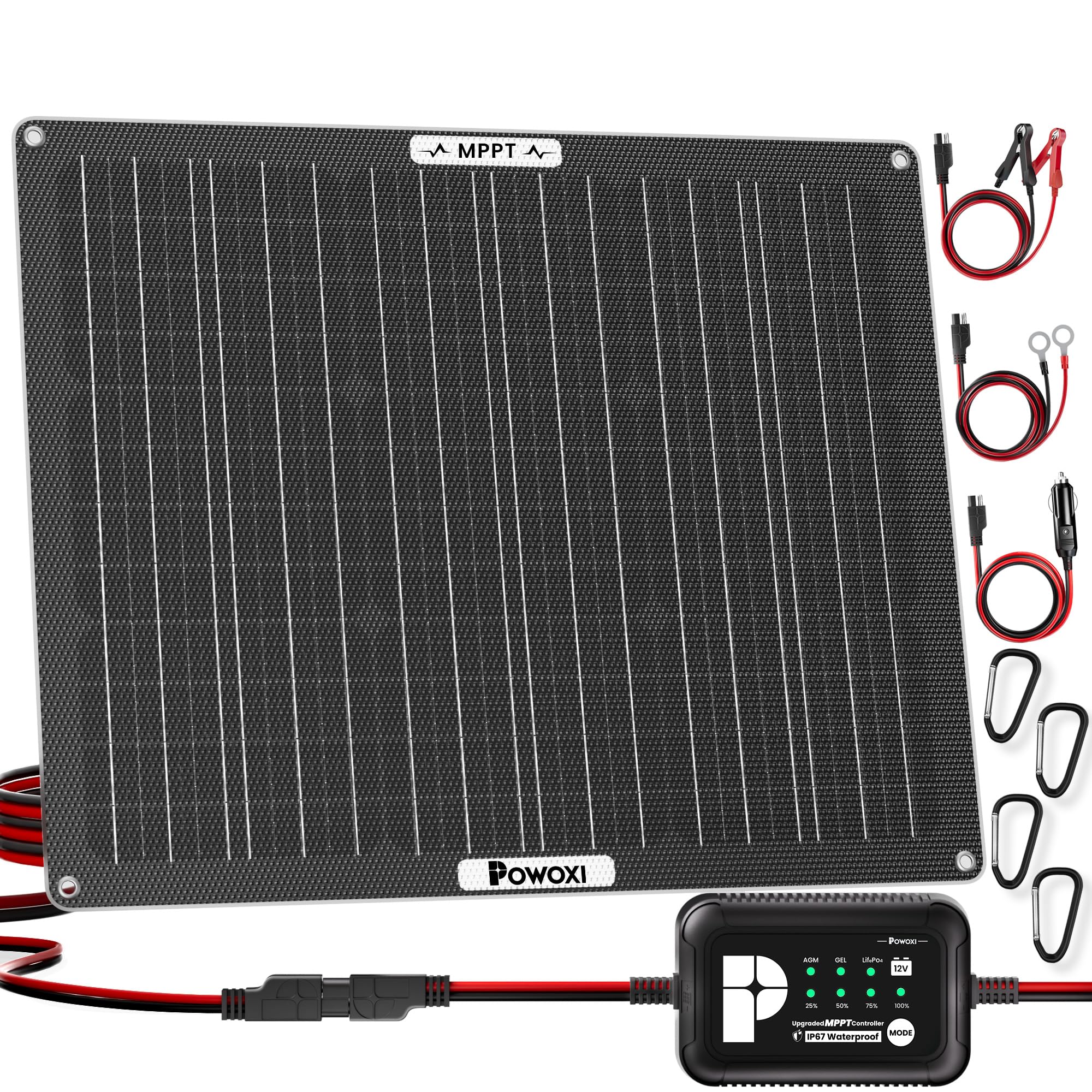
Fifty watts on a flexible ETFE sheet weighing 450 grams — the highest output and lowest weight here.
Two extremes sit in one product. This POWOXI is the most powerful panel in this round at 50 watts, and also the lightest at 450 grams. It achieves that by using a thin flexible ETFE sheet instead of glass, with the 2-in-1 MPPT controller built into the same sealed body. The controller adapts to the battery temperature across seasons and runs a three-stage Bulk, Absorption, Float charge, so it tunes the voltage to the battery’s actual state. An independent MPPT controller sealed to IP67 potted spec means the whole unit survives wet conditions without a separate box.
The ETFE film transmits up to 95% of light and resists UV embrittlement. The maker states its incremental-conductance algorithm improves charging efficiency by 36% over non-MPPT chargers. A 4-stage charge indicator shows 25%, 50%, 75% and 100%, with the next stage’s light flashing while charging. It works on 12V AGM, GEL, LiFePO4 and lithium batteries via a mode button.
Because it is flexible and light, it suits sail covers, curved roofs and tight marine spaces where a rigid panel would not fit. Its small mass also means it packs into a glovebox. If you want maximum output without maximum weight, this is the pick that gives you both at once.
Where it wins the sheet
- 50 watts is the highest output in this round, and it still weighs only 450 grams
- Fully sealed IP67 2-in-1 MPPT controller removes the separate-box clutter
- Selectable modes cover AGM, GEL, LiFePO4 and lithium with a 4-stage charge indicator
- ETFE film transmits up to 95% of light and resists UV embrittlement
Where the flexible trade shows
- Flexible film is more exposed than tempered glass, so a hard snag or heavy abrasion can harm it
- The lightweight sheet needs a secure mount or it flaps in wind on a highway
Jump on it if: you want the most output here in the lightest package — sail covers, curved roofs and glovebox stows all work.
Hold off if: the panel will live a rough, high-abrasion life where a tempered-glass panel is the safer build.
Know the Specs
IP ratings explained
The two digits in an IP number are a seal score. The first covers dust, the second water. IP68 is dust-tight and rated for submersion — the highest in this group — so it handles a flooded yard or heavy rain with no issue. IP67 survives rain, snow and splashes but is not built to be dunked, and IP65 takes heavy rain and spray but not standing water. Match the rating to where the panel lives, not to how tough it sounds.
MPPT vs PWM
MPPT (Maximum Power Point Tracking) is a chip that tracks the best voltage point as light shifts, so the panel keeps pulling useful current through clouds and shade. PWM simply clamps voltage down and is cheaper to build. MPPT panels hold up better on gray days, which is why many kits here advertise it. If your vehicle sits under trees, MPPT is worth the bit of extra cost.
Watts and what reaches the battery
The watt figure on the box is the panel’s peak output under ideal sun — not the number that lands at your terminals. A 20W panel under clouds delivers a fraction of that, which is why a maintainer tops a battery slowly and cannot refill a dead one fast. Match the wattage to the battery size — small cells need less, deep-cycle banks need more.
Flexible ETFE vs tempered glass
ETFE is a clear, flexible film that resists UV yellowing, bends to a curved surface and weighs less. Tempered glass over a frame is heavier but spreads heat and takes hail and abrasion better. Choose flexible for a windshield, a sail cover or a stow; choose glass for a roof rack or a permanent fence-post mount.
Common Questions
Can a waterproof solar maintainer keep a car battery charged while the car sits for months?
What is the difference between IP65, IP67 and IP68 on a solar panel?
Will a 20W solar maintainer fully recharge a dead battery?
Does an MPPT controller actually matter on a small solar panel?
Can I leave a flexible ETFE panel on my car windshield while driving?
Which battery types do these solar chargers support?
Do I need a separate charge controller with these kits?
How do I mount a solar panel so it gets the most sun?
Will these panels work in snow and cold temperatures?
Can a solar maintainer overcharge my battery if I leave it connected all season?
The Bottom Line
The safest bet for most rigs is the SUNER POWER 30W — it brings the most wattage here and its three charge modes cover everything from a flooded truck battery to a LiFePO4 pack. If you want a light panel you can aim at the sun through snow and rain, the IOTBIG 20W pairs IP68 sealing with a 360° bracket in a 2.5-pound package. And for a remote gate, fence charger or pump that needs daily power, the ECO-WORTHY 25W is the one built to feed devices, not just top a battery.
Whichever you pick, match the panel to the battery and the mount to the weather. Do that, and your battery will greet you with a full charge instead of a slow crank.
How we choose
We do not accept paid placement. Every pick is matched to a real buyer and a real use-case; we do not hands-on test units.
Sources
Specifications: manufacturer listings and product documentation. Review insights: verified customer reviews, as of November 2026. Pricing: not shown on this page (it changes often); check the current price via the retailer link.
As an Amazon Associate, Tactical Gear Guy earns from qualifying purchases. This does not affect which products we feature.