Specs are compiled from manufacturer listings and verified buyer reviews and can change over time — please confirm the key details on the product page before buying.
You want dry feet, and you want them without paying for a brand name stitched on the side. That is the whole job of a rubber rain boot. The problem is that plenty of boots look the part in the photos and then split a seam, slide on wet decking, or leave your socks damp after an hour in the garden. The nine pairs below are the ones worth your money, sorted by what each actually does best — slippery farm mud, cold morning hunts, a wet commute, or a long shift on your feet.
This guide is built by comparing the manufacturers’ published specifications and the patterns across verified customer reviews, so you get each pick’s real strengths and trade-offs instead of marketing spin.
One number on the spec sheet often decides whether a waterproof rubber rain boot keeps you dry for years or fails its first winter. Below are plain-English notes on shell thickness, shank support, and calf fit, plus a table you can scan in under a minute.
Top Picks
How To Choose The Best Waterproof Rubber Rain Boots
Start with where the boot is going, because a boot built for flooded pasture and a boot built for a wet sidewalk are not the same shoe. A hunting or farming pair leans on a thick insulation layer and an aggressive tread. A commuting pair leans on a slim silhouette and a shaft that slides under a trouser leg. Buying for the wrong job is the most common way people end up disappointed.
Wall thickness: neoprene and rubber
Cold-weather comfort depends on the neoprene (the soft, spongy layer inside the shell that traps warmth and adds cushioning). It is measured in millimeters, and that number is your best clue to warmth — a 6mm layer holds heat noticeably better than a thin 5mm one, at a small cost in flexibility. The outer rubber shell is what actually blocks water. A thick, smooth rubber wall keeps a puddle from creeping in at the seams, so look for a shell described as one continuous piece rather than panels stitched together.
Support and protection underfoot
A steel shank is a stiff strip of metal built into the sole under your arch. It stops the sole from folding in half when you stand on a shovel edge, and it spreads your weight so long hours on rough ground hurt less. If you will be digging, carrying, or walking hours in mud, a shanked sole earns its keep. A reinforced or hard toe cap does the same job up front — it shields your toes from falling tools and roots.
Traction that matches your ground
Deep lugs — the raised ridges on the bottom — bite into soft mud and wet grass. That same pattern wears down faster on hard concrete or gravel, which is why daily wear on abrasive surfaces shortens the life of an aggressively treaded boot. Match the tread to your most common surface, not to a once-a-year trip.
Fit, calf room, and getting them off
Rain boots run over thick socks, so a true-to-size fit often means snug. If you sit between sizes, sizing down is the safer call for boots described as running large. An adjustable back gusset with a cinch buckle expands for wide calves and bulky overalls, while pull tabs or a rear kick tab let you get the boot off without bending or reaching with muddy hands.
Side-by-Side Comparison
| Model | Best For | Shell / Lining | Underfoot Support | Shaft Height | Amazon |
|---|---|---|---|---|---|
| Trudave Rubber Boots for Women, Mid Calf★ Best Overall | All-round wet-weather work | Waterproof rubber, mid calf | Not listed | Mid calf | Amazon |
| HISEA Men’s Rain Boots with Steel ShankBuilt To Work | Long shifts on rough ground | 5mm neoprene, natural rubber shell | Integrated steel shank | Knee high | Amazon |
| Trudave Rubber Boots for Women with Steel ShankCold Mornings | Cold-weather comfort | 6mm neoprene, thickened rubber | Built-in steel shank | Mid calf | Amazon |
| Rubber Boots for Men, Waterproof Insulated Mid Calf | Ease of putting on | 6mm neoprene, rubber | Not listed | Mid calf | Amazon |
| WTW Womens Mid Calf Rain Boots | Gardening and everyday chores | 5.5mm neoprene and rubber | Not listed | Mid calf | Amazon |
| HISEA Men’s Ankle Neoprene Garden Shoes | Quick slip-on yard work | Reinforced rubber shell | Not listed | Ankle | Amazon |
| Hunter Women’s Original Chelsea Boot | Wet-weather city wear | Natural rubber, recycled polyester lining | Not listed | Ankle (Chelsea) | Amazon |
| Mens Steel Toe Rain Boots | A tough toe on a tight budget | PVC | Not listed | Not listed | Amazon |
Detailed Reviews
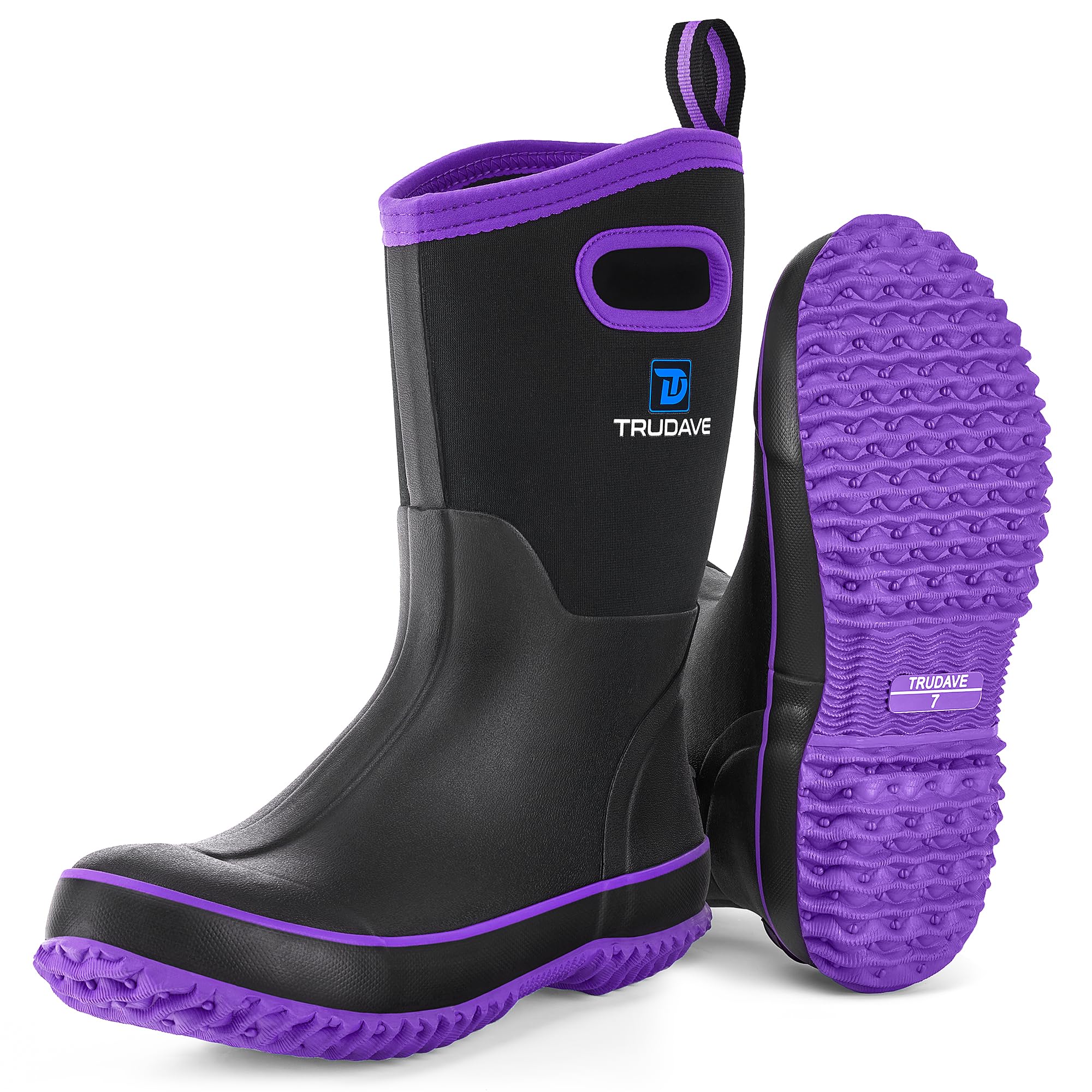
1. Trudave Rubber Boots for Women, Mid Calf Rain Boots
Our pick — 4.5+★ from 550+ verified ratings; the strongest balance of quality and price.
The pair that wins on build quality first and everything else second.
For the woman who needs one boot to handle wet grass, a muddy run to the chicken coop, and the walk back to the porch, this is the pick. The shell is a 100% waterproof rubber construction, so standing water stays on the outside where it belongs.
Quality is what carries this boot above the field, and it is not a close call. It is the most-discussed strength by a wide stretch, well ahead of fit and ease of use. Owners also put real weight behind the ease of getting them on and off, which is the day-to-day thing you notice most with a boot you wear twice a day. Warmth holds up in winter, and the water resistance holds through wet gardening sessions.
Sizing is the honest catch. Opinions split, and the pattern points toward these running a little big, so if you sit between two sizes the smaller one is the safer gamble. Everything else points to a sturdy insulated boot rather than a flimsy shell: the 16 x 12 x 4.6 inch packed footprint and the 3.5 pound weight. A 4.5+ star average across 550+ owners confirms the build holds up.
What earns the top spot
- Rubber shell rated 100% waterproof, so puddles stay outside
- Built-in pull handles make a fast, hands-free entry
- Keeps feet warm in winter without a separate liner
- Appearance holds up — owners call them genuinely nice-looking boots
Where it asks you to pay attention
- Sizing leans large; size down if you are between sizes
- At 3.5 pounds the pair is on the substantial side for a long walk
Made for: garden and farm work where a waterproof shell and warmth matter more than a featherweight feel.
Think twice if: you want a trim, city-ready silhouette — this one is built for the yard.
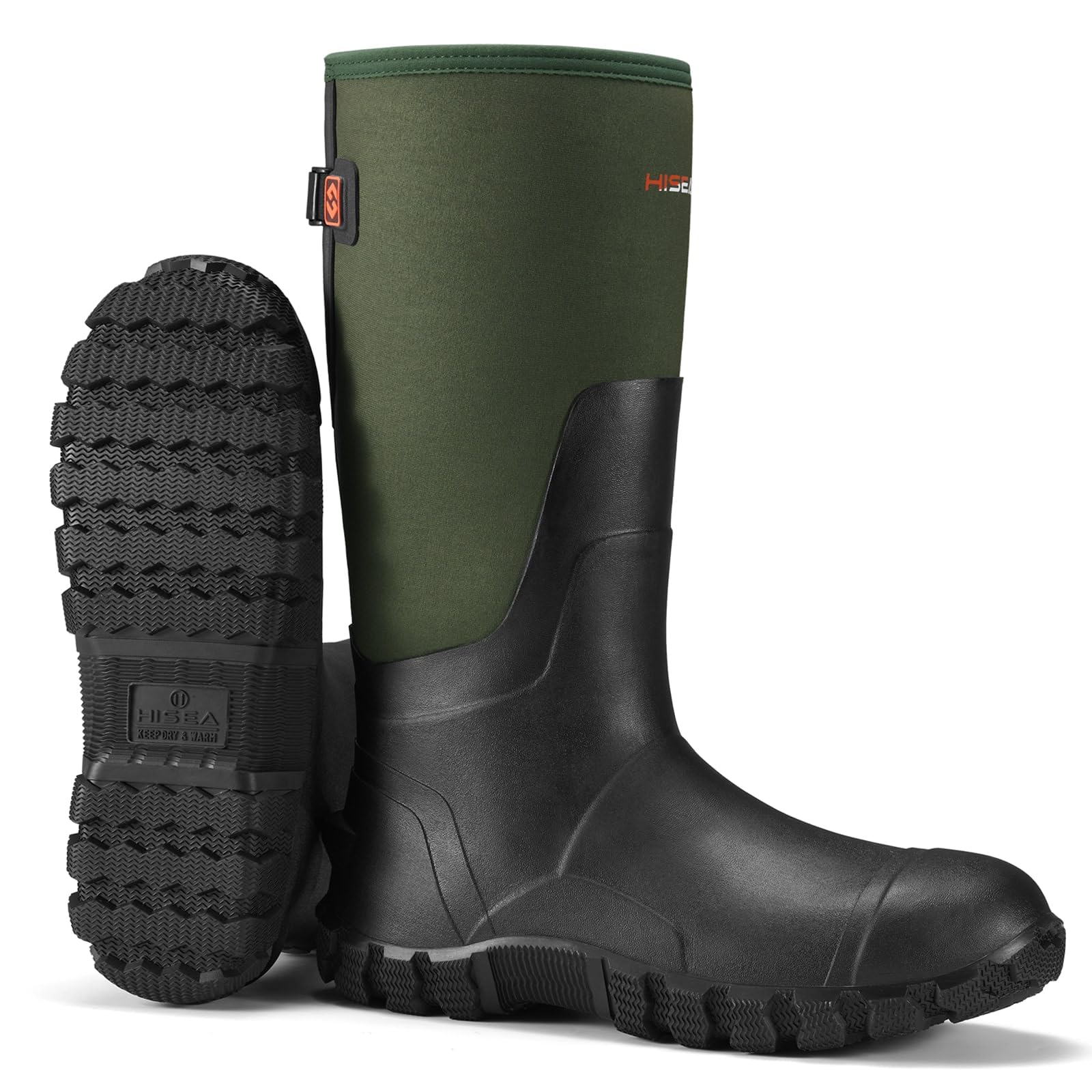
2. HISEA Men’s Rain Boots
A shank in the sole and buckles at the back — built like a tool, not a fashion boot.
This comparison tells you what the boot is for: HISEA pairs a 5mm neoprene lining with a smooth natural rubber shell, while the Trudave women’s steel-shank model goes thicker at 6mm. That extra millimeter of insulation on the Trudave favors raw cold, but the HISEA counters with a knee-high cut and a cinch system the mid-calf pair does not have. Its integrated steel shank runs through the midsole — the strip that keeps a shovel edge from folding your arch in half and spreads weight across the foot during a long dig.
The spec sheet rates it to 14°F (-10°C), and the breathable mesh lining vents sweat so your feet stay dry through a full shift. The expandable back gussets with cinch buckles open up for large calves and thick overalls. A rear kick tab means you step down and slide out without using your hands, which is exactly what you want when both gloves are caked in mud.
The trade-off is genuinely a fit issue, not a flaw: 5mm insulation is not built for heavy summer labor above 86°F (30°C), so this is a cool-weather worker. Deep lugs grip wet grass and soil but wear faster on concrete, and the maker’s own guidance is to alternate pairs if you log more than 8 hours a day on abrasive ground. Quality is the clear strength of the boot, and the two-pair rotation advice is the honest answer to the durability questions that come up.
What the spec sheet buys you: a steel shank for puncture resistance against nails and debris, a knee-high shaft, and adjustable gussets that fit a wide calf — a combination the mid-calf picks above cannot offer.
The follow-up question: is it right for summer? No — the maker flags it for use under hot-labor temperatures, so treat it as a cold-season workhorse.
Reach for this if: you dig, haul, or hunt in cold wet conditions and want arch support under a shovel.
Look elsewhere if: you need a light summer garden boot for hot afternoons.
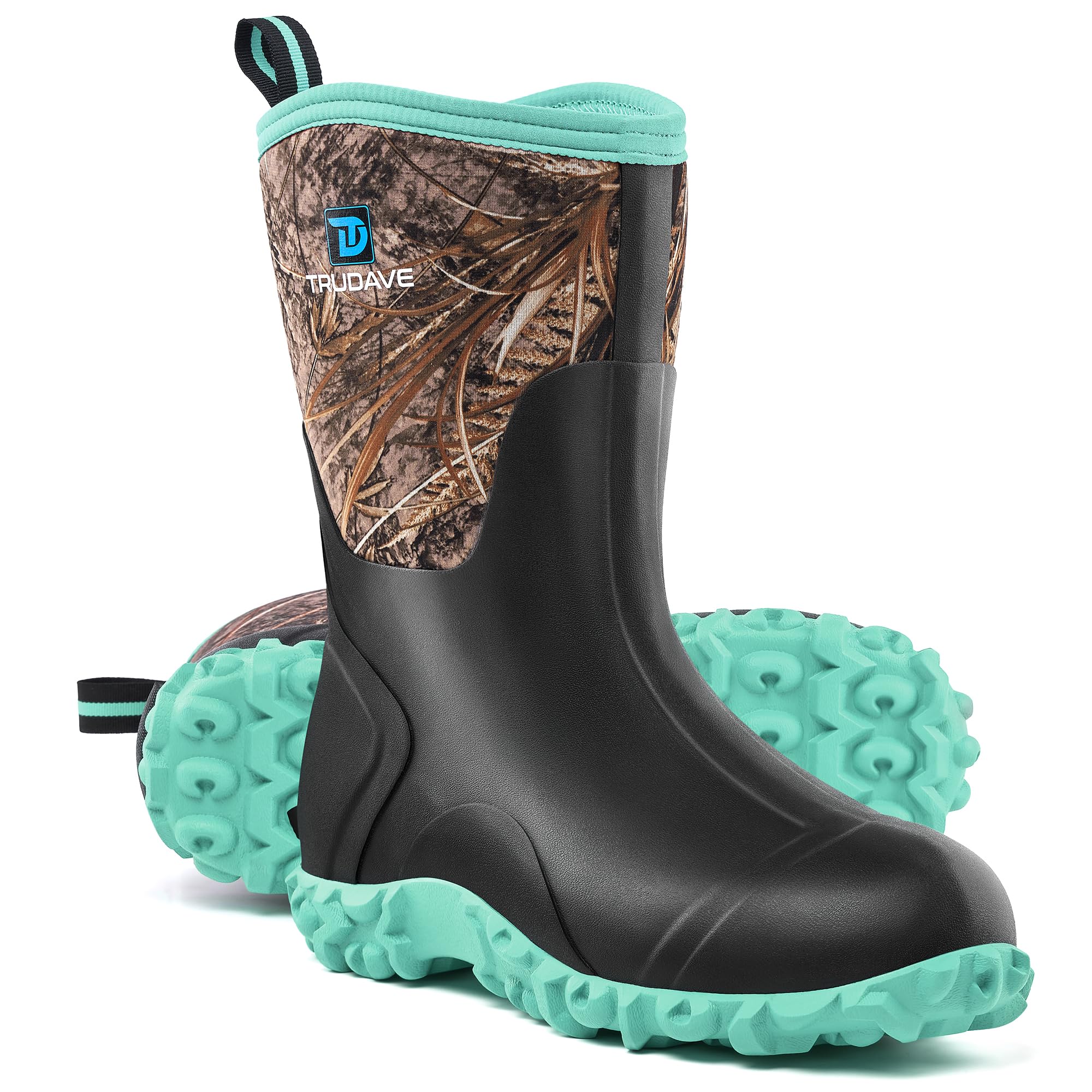
3. Trudave Rubber Boots for Women
Thicker neoprene than the HISEA up the list, and a shank to back it.
The 6mm neoprene here runs thicker than the HISEA’s 5mm lining, which matters when the ground is frozen and you are standing still waiting for a dog or a hose to fill. Soft, breathable neoprene under a thickened rubber shell keeps feet dry while you work, and a built-in steel shank with a deep tread handles the muddy path to the gate and the rough patch behind the shed. Reinforced protective toes and pull tabs round out the working details.
Comfort is where this boot separates itself — no foot pain after a long stretch on your feet, and a fit that accommodates both thin and thick socks without needing a separate size. Buyers report it holds up well over time and stays warm and dry through rain and snow. The shell cleans up easily, which for a 100% waterproof work boot is a real convenience rather than a footnote.
One sizing note carries through the line: Trudave builds strictly to US sizing, so measure rather than assume. If you want the boot that feels best on your feet rather than the one with the most aggressive tread, this is the strongest women’s option on this page for comfort — a 4.5+ star average across 950+ owners backs that up.
The case for the thicker lining
- 6mm neoprene insulates better than the 5mm HISEA above
- Steel shank plus deep tread for muddy, uneven ground
- Fits thin or thick socks without changing size
- No foot pain reported over long wear
Where you should plan around it
- Built to US sizing — measure before you order, do not guess
- Thicker shell adds bulk compared with a thin commuting boot
Made for: cold-weather fieldwork where your feet need warmth and arch support for hours.
Think twice if: you want a slim boot that disappears under a trouser leg.
4. Rubber Boots for Men
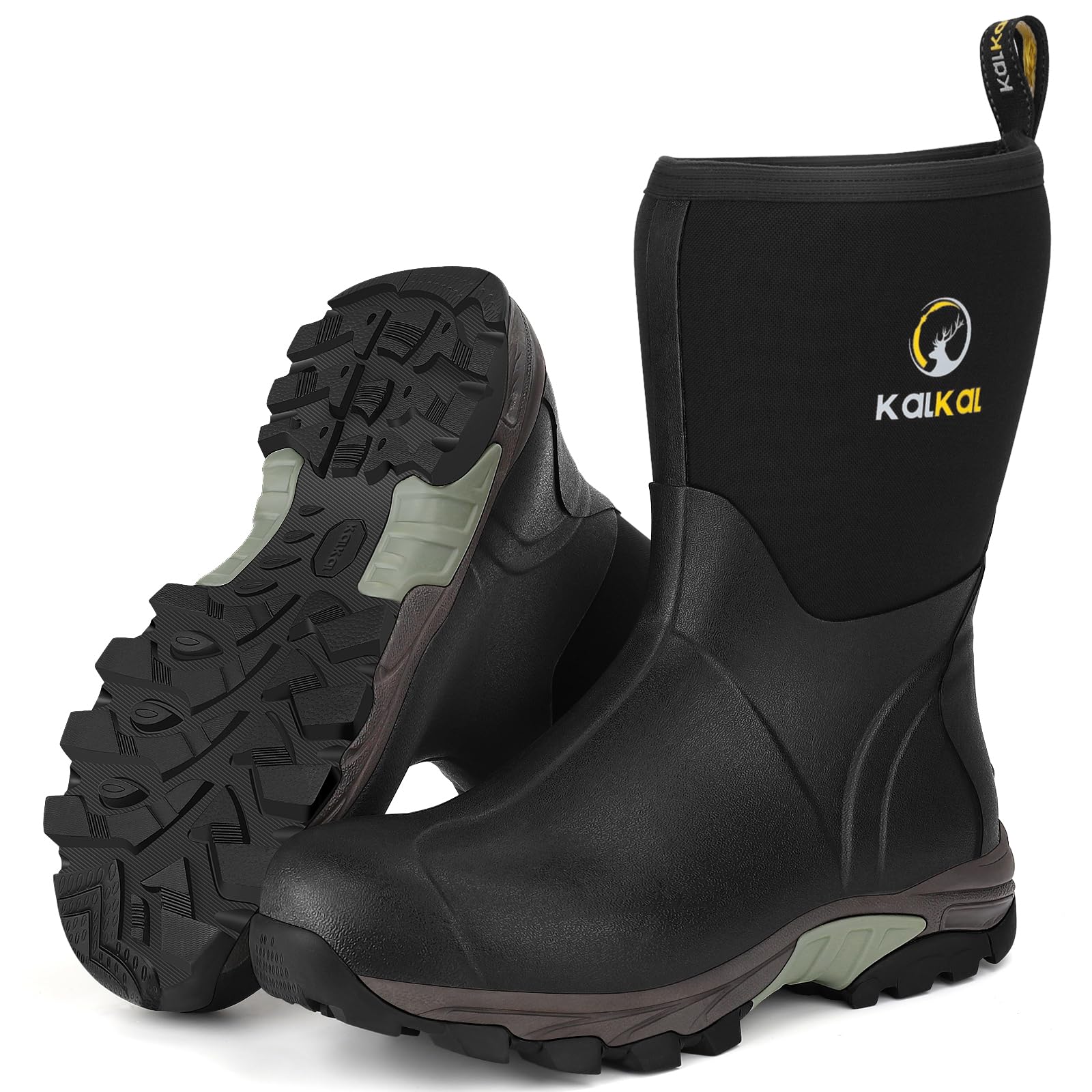
The boot you can step into without bending over — and that is the whole point.
Getting out the door fast is the point of this mid-calf boot: the design lets you pull them on and kick them off without stooping, so you are not wrestling a stiff rubber shaft onto your foot first thing in the morning. The 6mm neoprene insulation sits at the thicker end of this group, level with the Trudave women’s shank model and ahead of the 5mm boots above, so cold ground on an autumn hunt or a wet farming morning is handled.
Owners find them well-fitting, dry, and warm, and useful across cooler weather, rain, and snow. Quality is the clear driver of satisfaction, with comfort and fit right behind it, and that is roughly what you would expect from a boot that gets the entry and exit bit right. When a boot is this easy to get on, you actually wear it for the quick jobs instead of leaving it by the door.
The catch is underfoot durability — a portion of owners mention the soles coming apart after a month, and that is the one thing to weigh if you plan to live in them seven days a week. For seasonal gardening, hunting trips, and wet commutes this boot has no trouble at all. For daily abuse on hard ground, alternate with the shanked picks above.
What it does well
- 6mm neoprene insulates as well as the thickest women’s boot here
- Step in and out without stooping
- True, dry, warm fit across rain and snow
What to weigh up
- Soles reported separating for a small share of buyers after about a month
- No steel shank listed, so arch support is standard
Grab this if: a stiff shaft is the reason you avoid rain boots and you want warmth plus an easy entry.
Consider the HISEA instead if: your job means hours on hard gravel every day.
5. WTW Womens Mid Calf Rain Boots
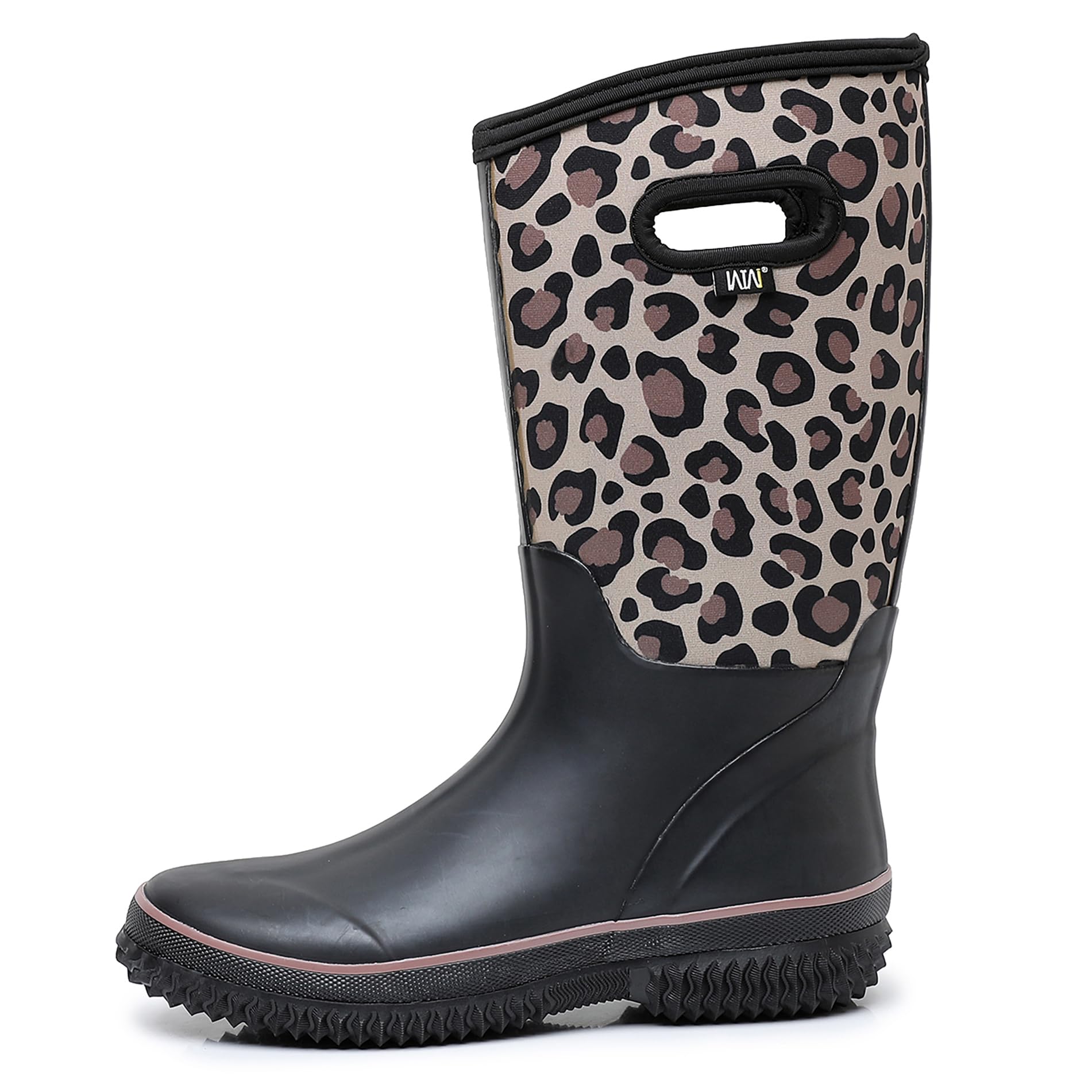
Soft material, modest price, built for chores rather than slogging through a swamp.
Take a 5.5mm neoprene and rubber outer, add a breathable mesh lining and a flexible anti-slip outsole, and you get a boot designed for working, farming, fishing, gardening, hunting, camping, and everyday chores across all seasons. It slots in right between the thicker 6mm Trudave and the 5mm HISEA, which makes it a sensible middle option if you want warmth without the heaviest shell.
Comfort and warmth drive the good will here — owners describe a soft interior that stays warm in snow, and the pull-on handle makes it quick to slip into. Style gets mentioned often enough to matter: this is a boot that does not look like a piece of farm equipment, which is why it gets worn for the school run and the grocery store as readily as the garden.
Two honest fit notes: the fit splits between those who find it comfortable on the calf and those who find it runs small, and water resistance has both believers and doubters among owners. For a boot at this modest tier that is not surprising — treat it as excellent for wet grass and chores, and look to the fully rubber-shelled picks above if you plan to stand in deep water.
What owners warm to: soft breathable neoprene and a look that passes in public — comfort and style both earn real praise, not just the waterproofing.
The honest limit: the fit runs small for part of the range and water resistance is uneven, so confirm your size and keep deep puddles off the plan.
Suited to: gardening, chores, and casual wet-weather wear where a soft, good-looking boot is the priority.
Not the pair for: standing water or a calf that needs extra room — size up and stick to the shallows.
6. HISEA Men’s Rubber Rain Boots

Cut at the ankle, so you can step in and out all afternoon without a fight.
Every other boot on this page climbs to mid calf or higher, which makes this ankle-height HISEA the odd one out — and that is exactly why some buyers pick it. It is the boot for the person who is in and out of the house a dozen times on a Saturday, potting plants, hosing a patio, or clearing wet leaves. A reinforced rubber shell plus a breathable mesh lining keeps the water out while letting air move, and reflective pull straps mean you can find and grab them in a dim garage.
Traction earns genuine credit: the outsole holds on wet grass and mud, which is the surface most likely to take you down in a garden. Owners also find the fit true to size, with enough room for thick socks, and the versatility shows in how many buyers wear them for both yard work and general gardening errands.
The one thing to go in with open eyes is long-term durability — a portion of feedback questions how long the shell holds up, so treat this as a chore boot for regular but not brutal use. If your work is full days in mud up past the ankle, the mid-calf and knee-high picks above are the better fit.
Why gardeners reach for it
- Ankle cut makes repeated on-and-off genuinely easy
- Traction holds firm on wet grass and mud
- True-to-size fit leaves room for thick socks
- Reflective pull straps help in a dim shed
Where it comes up short
- Ankle height will not keep out deep puddles
- Durability is the question mark among owners
Made for: quick garden work, patio clean-up, and the constant in-and-out of a wet weekend.
Look higher up the page if: you need deep-water protection past the ankle.
7. Hunter Women’s Original Chelsea Boot
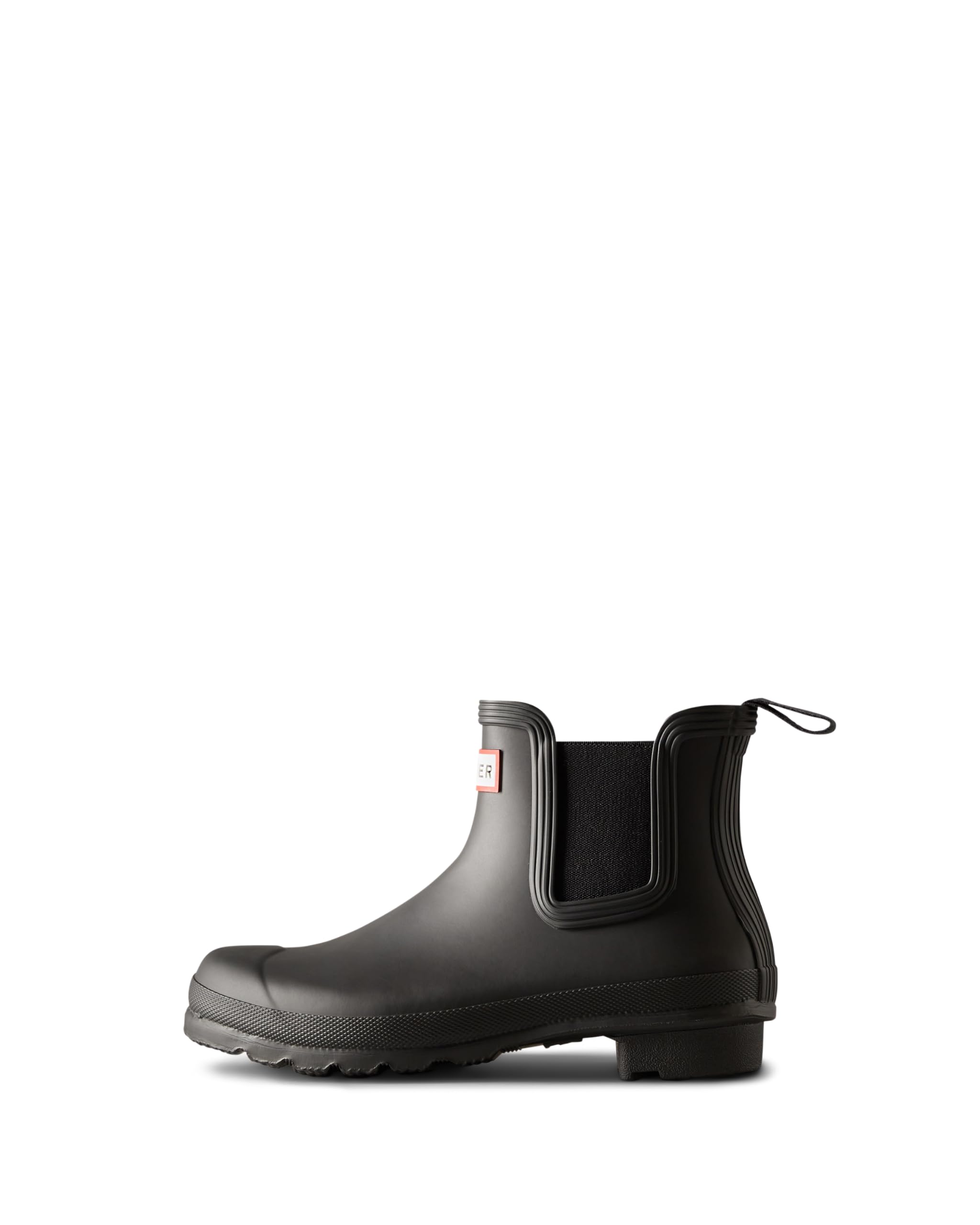
A rubber boot you can wear to the office and not feel like you took a wrong turn.
Handcrafted from natural rubber and vulcanised — a heat-and-pressure process that cures the rubber into a tough, watertight shell — this Chelsea is built for a wet city pavement rather than a muddy field. The elasticated gussets are the classic Chelsea detail that lets you pull it on without laces, and a nylon pull tab does the rest. The Original tread pattern and a lining made from 100% recycled polyester finish it off on a boot rated 100% waterproof.
Appearance is where this pair earns its place — it looks like a shoe, not a work boot, and owners say so plainly. It handles a rainy commute and a muddy path to the car without giving up the trim profile. At 3 pounds in the 16.5 x 12.2 x 8.5 inch packaging, it has enough heft to feel solid underfoot, though the ankle height keeps it light enough to drive in.
The real caveat is the foot opening, which runs narrow for part of the range — if your foot is broad or your calf sits on the larger side, this Chelsea will fight you at the ankle. Sizing otherwise lands where expected for those who fit the opening. It is the wardrobe boot of the group, not the field boot, and it knows exactly what it is for.
The standout: vulcanised natural rubber and a recycled polyester lining on a 100% waterproof Chelsea — a combination built to look presentable in town.
The catch to plan around: the foot opening is narrow, so a broad foot or a larger calf may not clear the entry.
Choose this if: you want a wet-weather boot that fits a city wardrobe and slides under a trouser leg.
Not your pair if: you need a wide entry or a knee-high shaft for deep mud.
8. Mens Steel Toe Rain Boots

The entry-level work boot — tough on paper, honest about its price point.
The material changes what this boot is: the shell here is PVC (a plastic-based rubber alternative) rather than a natural rubber or neoprene build, and the listing is transparent about that. On the plus side you get a 100% waterproof shell, a non-slip outsole, a protective steel toe, and a removable insole you can swap for your own. It also packs down to 3 x 2 x 1 inches at a pound — where the 3.5 pound Trudave women’s boot will fill a suitcase, this one disappears into a backpack.
Buyers find it good quality, comfortable, and well-fitting, with enough room to accommodate heavy socks — the fit and comfort both earn praise rather than just the price. It keeps feet dry through use, which for a boot built to a tight budget is the whole job. If you need a spare pair for the truck, the cabin, or a wet week of odd jobs and want a protective toe without stretching the budget, this is the sensible grab.
Durability is the mixed part — some owners expect them to last for years, some report tearing after a year or two. PVC does not flex the way natural rubber does, so treat this as a good-value boot for occasional hard use, not a lifelong work boot. The steel toe on this budget pair, by the way, is a protection the ankle-height HISEA above does not offer at all.
Worth knowing before you buy
- Steel toe protection at the most accessible tier here
- Removable insole you can swap for your own
- Non-slip outsole and a vapor-cheap waterproof shell
- Packs down small at 1 pound for a truck or cabin spare
The fair caveats
- PVC shell, not natural rubber — less flexible and less forgiving
- Feedback splits on long-term durability
Best for: a spare pair, a starter boot, or a protective steel toe on a tight budget.
Step up if: you wear a boot daily for years — the insulated rubber picks above will outlast it.
Know the Specs
Neoprene Thickness In Millimeters
Neoprene is the soft foam layer inside the shell that traps warmth. A 5mm layer holds heat well; a 6mm layer holds noticeably more. Thicker does not always mean better — a 5mm boot stays more flexible and handles summer work, while 6mm suits cold ground and long standing. Match it to the season you will actually wear the boot.
The Steel Shank Explained
A steel shank is a stiff metal strip embedded in the sole under your arch. It stops the sole folding when you press down on a shovel and spreads weight during long hours on uneven ground. It also adds puncture resistance against nails and debris under the arch. If you dig, haul, or walk rough terrain, a shank is a real advantage; for a quick garden chore it is not required.
PVC Versus Natural Rubber
Natural rubber is vulcanised — cured under heat and pressure — into a flexible, watertight shell that bends with your foot. PVC is a harder synthetic that stays stiffer. Both can be 100% waterproof, but rubber tends to flex and last longer under hard use, while PVC keeps the cost down. Check which material you are buying, because it decides how forgiving the boot feels over a long day.
Ankle, Mid Calf, Or Knee High
Shaft height decides how much water the boot sheds. An ankle boot handles wet grass and a hose; a mid-calf boot handles mud and shallow puddles; a knee-high shaft handles flooded ground and deep snow. Higher is not automatically better — a high shaft is heavier and harder to kick off, so pick the height for the deepest conditions you genuinely expect.
Adjustable Calf Gussets And Kick Tabs
A back gusset with a cinch buckle expands the shaft to fit a large calf or thick overalls and then seals in warmth. A rear kick tab lets you step out of the boot hands-free, which matters when your gloves are covered in mud. Pull-on handles and reflective straps serve the same goal — a boot you can put on and take off quickly without bending or reaching.
Why Deep Lugs Wear Faster
Deep lugs are the raised ridges on the outsole that bite into soft mud and wet grass. The same aggressive pattern grinds down faster on concrete, asphalt, and gravel. Manufacturers of heavily treaded work boots often suggest alternating pairs if you work long days on hard surfaces. If your day is mostly pavement, a less aggressive tread will last longer than one built for a swamp.
Common Questions
Are these boots actually waterproof or only water resistant?
Should I size up or down in rubber rain boots?
What does a steel shank actually do for my feet?
How thick should neoprene be for cold-weather hunting?
Can I wear insulated rain boots in summer?
What is the difference between a steel toe and a protective toe cap?
How should I clean and store rubber rain boots?
Will deep-lug boots wear out faster on pavement?
What is the difference between a Chelsea rain boot and a work boot?
Should I replace the insole in my rain boots?
The Bottom Line
For most buyers, the strongest all-round pick among these waterproof rubber rain boots is the Trudave Rubber Boots for Women, Mid Calf, because its 100% waterproof rubber build and built-in pull handles cover wet grass, garden mud, and cold mornings without a separate liner — just size down if you sit between sizes. If you want shank support for digging and long shifts, grab the HISEA Men’s Rain Boots with Steel Shank, built around a steel shank and adjustable calf gussets. And for a wet city commute that does not look like fieldwork, the Hunter Women’s Original Chelsea Boot is the one to reach for. Whatever your ground, favor the boot that matches your deepest water and your widest calf — that is the decision that keeps your feet dry all season.
How we choose
We do not accept paid placement. Every pick is matched to a real buyer and a real use-case; we do not hands-on test units.
Sources
Specifications: manufacturer listings and product documentation. Review insights: verified customer reviews, as of November 2026. Pricing: not shown on this page (it changes often); check the current price via the retailer link.
As an Amazon Associate, Tactical Gear Guy earns from qualifying purchases. This does not affect which products we feature.