Specs are compiled from manufacturer listings and verified buyer reviews and can change over time — please confirm the key details on the product page before buying.
Your socks stay dry in a muddy feed lot, a flooded duck blind, or a driveway full of slush — and you do not pay premium money for a boot that splits at the heel by spring. Every pick below had to pass that test.
This guide is built by comparing the manufacturers’ published specifications and the patterns across verified customer reviews, so you get each pick’s real strengths and trade-offs instead of marketing spin.
These are the waterproof rubber boots for men worth putting on before you step into the muck.
Top Picks


How To Choose The Best Waterproof Rubber Boots for Men
A rubber boot is a simple machine: a waterproof shell, some insulation, and a sole that has to hold up on ground that is trying to trip you.
Start with the waterproof shell, not the insulation
Every boot on this list is built from rubber or a rubber-and-neoprene blend, which is what makes it truly waterproof rather than merely water-resistant. A fabric or leather boot treated with a coating will soak through eventually. A rubber shell will not — the weak points become the seams and the toe flex point, which is why a reinforced toe cap and a one-piece molded foot matter. On a work boot, an integrated steel shank (a stiff plate between the insole and the outsole) also protects the bottom of your foot from nails and sharp debris.
Neoprene thickness tells you the temperature range
Neoprene is the foam layer inside the boot, and its thickness in millimeters sets how cold you can go. A 5mm boot is a general-purpose workhorse. A 6mm or 7mm boot is the cold-weather choice, and one pick here pairs 5mm neoprene with a stated comfort range down to 14°F (-10°C). The catch runs the other way too: thick neoprene is miserable in a hot summer workday, so a 5mm boot is a four-season boot and a 7mm boot is a cold-season boot.
Match the shaft height to your terrain
Shaft height is the distance from the sole up to the top of the boot opening. A knee-high boot protects your whole lower leg when you are wading through deep mud or flooded ground. An ankle-high deck boot is the pick for a wet boat deck or a slick dock where you need to feel the surface under you. Mid-calf sits between the two and is the most forgiving for wearing over pants.
Read the size chart before you click buy
Rubber boots do not flex like sneakers, so fit has to be right the first time. Some models here run larger on purpose so you can wear thick winter socks, and the makers explicitly recommend sizing down if you fall between sizes. Others suggest measuring your foot and picking a size about 0.16 inches longer than your actual measurement. Look for an adjustable rear gusset with a cinch buckle if you have large calves or wear overalls over your boots.
Side-by-Side Comparison
| Model | Best For | Shaft Height | Neoprene / Insulation | Standout Spec | Amazon |
|---|---|---|---|---|---|
| LaCrosse Burly Air Grip 18″★ Best Overall | Cold-weather hunting and land work | 18 in | Foam padding, scent-free rubber | Self-cleaning outsole | Amazon |
| Guide Gear Mid Camo BoggerBest Value | Muddy treks on a tight budget | Mid | 5mm neoprene top | Removable comfort insole | Amazon |
| HISEA Steel Shank Adjustable CalfBest for Cold Work | Long shifts in cold muck | Knee-high | 5mm neoprene | Steel shank + adjustable gusset | Amazon |
| BASSDASH Explorer-DG 6″ | Boat decks and wet docks | 6 in (ankle) | Rubber | Ankle-high profile | Amazon |
| Kalkal Mid Calf Insulated | All-round yard and farm wear | Mid-calf | 6mm neoprene | Hands-free pull-on | Amazon |
| Trudave Steel Shank 6mm | Mud and forest walking | Knee-high | 6mm neoprene | Reinforced hard-plastic toe | Amazon |
| Trudave Men’s Steel Shank 5mm | Four-season work and hunting | Knee-high | 5mm neoprene | Anti-slip outsole | Amazon |
| TIDEWE Puncture Resistant Steel Toe | Jobsite and heavy work | Ankle-high | 6mm neoprene | Steel toe + steel shank | Amazon |
| TIDEWE Rubber Hunting Boots | Late-season cold-weather hunting | — | 7mm neoprene, 800g insulation | 800g insulation | Amazon |
Detailed Reviews
1. LaCrosse Burly Air Grip 18″ Men’s Rain Boots
Our pick — 4.5+★ from 550+ verified ratings; the strongest balance of quality and price.
Eighteen inches of scent-free rubber that lets you wade a flooded ditch without a second thought.
The number that decides this one is the shaft height: 18 inches of waterproof rubber up your leg. That is a full 12 inches taller than the ankle-high BASSDASH deck boot on this list, and it is the difference between stepping over a flooded rut and wading straight through it. For a stand, a blind, or a field that holds water after rain, that coverage is the whole reason you buy a boot like this.
LaCrosse builds the shell in scent-free rubber with a neutral finish and adds foam padding for warmth and cushioning, so long sits do not leave your feet aching. Ankle-fit technology keeps the profile snug so it does not slop around while you walk in. The self-cleaning outsole sheds mud as you step, which keeps your tread biting instead of clogging with field clay.
What wins people over most is the build quality — it is the single most-praised thing about this boot, and it holds the highest rating of anything here. Traction comes next in the tally, and the grip on wet, slick ground is a consistent theme. The honest catch is sizing: a portion of buyers find the heel runs big, so try these with the socks you actually hunt in. Durability draws a split verdict, with a share of buyers saying they do not outlast cheaper boots, so treat the rubber with care and store them out of the sun.
Where It Earns Its Keep
- 18-inch waterproof rubber shaft covers the whole lower leg in deep water and mud
- Scent-free rubber shell and a neutral finish built for hunting scenarios
- Self-cleaning outsole clears mud as you walk so traction stays live
- Foam padding adds warmth and cushioning for long hours on your feet
Where It Asks For Patience
- Some buyers find the heel runs big — fit with your real hunting socks
- Durability feedback is split against less expensive boots
- Heavy on the foot compared with an ankle-high deck boot
Buy this if: you hunt, work land, or cross water deeper than your ankle and want the tallest waterproof coverage here.
Know first: the heel runs generous for some feet, so order with the socks you wear in the field.
2. Guide Gear Men’s Mid Camo Bogger Rubber Boots
Camo rubber with a 5mm neoprene collar — the mud boot that costs less than dinner for two.
You get a three-season mud boot, not a deep-winter boot, because the rubber foot is bonded to a 5mm neoprene top (a synthetic rubber foam that traps warmth). That is one millimeter thinner than the 6mm neoprene in the Trudave Steel Shank boot, and that millimeter matters at the margin. The warmth feedback confirms it — some buyers run warm in it on cold days, others say it is not warm enough. Crossing a muddy path, a wet field, or flooded bottom ground in mild weather, it does exactly what you need.
The camouflage blend is there to keep you concealed in the field, and the rubber foot shrugs off deep puddles and muck. A rear pull-on loop solves the one thing that gets old with rubber boots, which is wrestling them on with cold hands. The removable comfort insole lets you swap in your own arch support or pull it out to dry.
Fit earns the second-biggest share of praise after the overall quality, and there is a claim worth repeating plainly: these have been called more comfortable than muck boots that cost several times more. Water resistance gets specific mentions for keeping feet dry in mud. The thing to weigh is that durability opinions split, so clean the mud off and let them air dry in the shade rather than baking them by a heater.
The value math: a 5mm neoprene collar, camo upper, and rubber foot at an entry-level tier is the cheapest way into real mud-boot territory on this list.
Size it honestly: warmth is a mixed report and the neoprene is thinner than the Trudave 6mm, so this is a mild-weather mud boot rather than a deep-freeze one.
Worth it when: you want a wet-field and mud-path boot on the smallest budget and do not need deep-cold insulation.
Think twice if: you hunt or work in hard winter — the 5mm top and mixed warmth reports will leave you wanting more.
3. HISEA Men’s Rain Boots with Steel Shank and Adjustable Calf
A steel shank and a cinchable calf — built for the guy digging in cold mud all day.
Here is the spec that changes your day: an integrated steel shank midsole stiffens the boot under your arch and spreads pressure across the whole foot. Shovel work stops feeling like it is focused on your heel. The maker also states the shank delivers puncture resistance against nails and sharp debris, which is the kind of protection that matters when you are working a site or a barn floor rather than a hiking trail.
You stay warm down to a stated comfort range of 14°F (-10°C), thanks to 5mm insulating neoprene married to a smooth natural rubber shell. A breathable mesh lining wicks moisture so sweat does not leave you cold once you stop moving. The expandable back gussets (stretchy panels at the back) with cinch buckles adjust over large calves and thick overalls. A rear kick tab lets you step out hands-free at the end of the day with clean hands.
Build quality is the aspect buyers praise most, with fit close behind — the fit is widely called true to size, keeping feet warm and dry. The one honest caveat is the rubber: the maker itself flags that deep lug soles wear faster on hard asphalt and concrete, and recommends alternating pairs for 8+ hour days on abrasive ground. Durability reports are split, so the care routine is not optional if you want years rather than months.
What Makes It Work
- Steel shank under the arch cuts foot fatigue on long shovel or field days
- 5mm neoprene plus rubber shell with a stated range down to 14°F (-10°C)
- Adjustable back gusset and cinch buckle fit large calves and overalls
- Rear kick tab lets you pull them off without using your hands
What To Keep In Mind
- Deep lug soles wear quicker on asphalt and concrete than on soil
- Durability reports split — the maker’s shade-dry care advice matters
- 5mm insulation is stated as unsuitable for heavy labor above 86°F (30°C)
Reach for these: you spend cold days on your feet in mud and want arch support and a glove-easy fit.
Look elsewhere if: you work mostly on concrete or asphalt — the lug soles will wear faster on hard surfaces.
4. BASSDASH Explorer-DG Men’s 6” Waterproof Deck Boots

Six inches of rubber that treats a wet boat deck like dry pavement.
This is the shortest boot on the list at 6 inches — a full 12 inches below the LaCrosse Burly’s 18-inch shaft. That short shaft is deliberate. On a boat deck, a dock, or a slippery launch ramp you want a boot that stops at the ankle so your leg can move freely and you can feel the surface underfoot. A knee-high shaft would turn it into a wading boot.
Buyers report comfort and soft insoles again and again — this is the top comfort-praised boot in this group after its build quality, and it is an easy boot to stand in for a long day on the water. Owners mention the slip-on ease, which is what you want when your hands are busy with line, tackle, or a cooler. The design is noted as looking brighter in person than the listing photos suggest, so expect a little pop in the color.
Durability is where it asks for care — customers note splits, with a share saying the rubber gives out quickly. The maker’s own care guide is your best defense: clean with mild soap, condition the rubber to keep it flexible, and store it upright or hang it upside down so the rubber does not crack from sitting in a puddle of its own moisture.
The trade-off triangle: you are buying freedom of movement and slip-on convenience instead of shaft coverage — pick it for wet work above the ankle, not through it.
The care note: rubber conditioning and upright storage are not marketing fluff here; they are how you get a full season out of them.
Made for you: anglers, dock workers, and anyone who spends the day on wet, moving ground and wants easy on-off.
Not your boot if: you wade through shallow flooded fields — the 6-inch shaft will let water over the top.
5. Kalkal Rubber Boots for Men, Waterproof Insulated Mid Calf
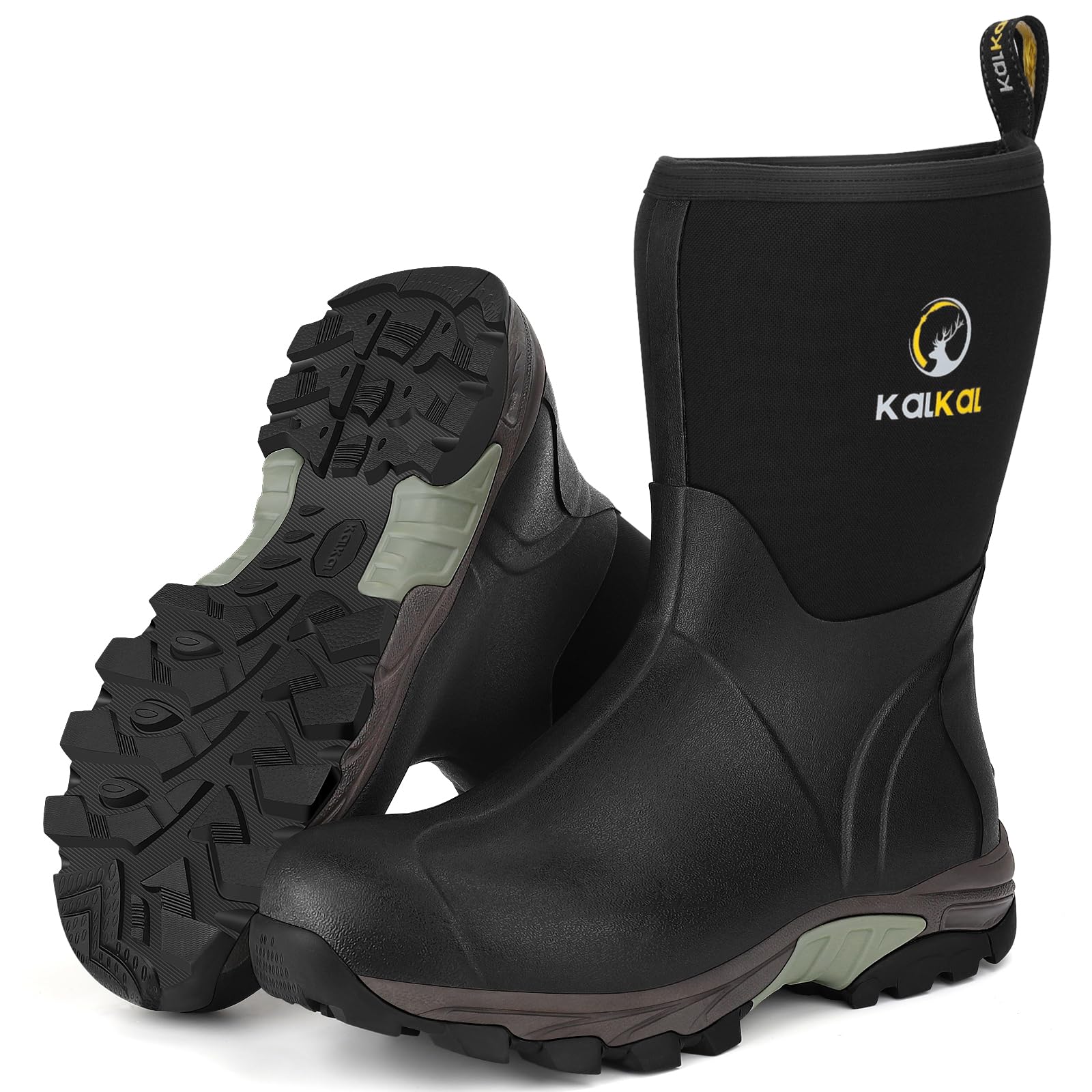
The mid-calf boot you can pull off without bending over or taking your gloves off.
Six millimeters of neoprene insulation is the headline here, matching the Trudave Steel Shank boot and sitting one millimeter above the Guide Gear Bogger. That puts it solidly in three-season territory, warm enough for a cold morning in a duck blind or a frosty feed lot, and it handles rain, mud, and snow as the buyers describe it. Mid-calf height is the practical middle ground — more coverage than an ankle boot, less bulk than a knee-high, and easy to wear over pants.
The feature that shows up in the reviews again and again is how easy these are to get on and off without bending over. That matters if you have a stiff back or spend a chore day stepping in and out of boots. Fit is well reported, keeping feet dry and warm, and the waterproofing holds up through wet weather.
The one thing to keep in mind is sole durability — a share of reviewers point out the soles separating after about a month of use. Note that is a minority report against a strong overall quality verdict, and the failure tends to point at heavy use. If you are in these boots eight hours a day on rough ground, treat them as a wear item and consider having a second pair in rotation.
The Strong Side
- 6mm neoprene insulation handles cold, rain, mud, and snow
- Pull-on design means no bending over to get them on or off
- Mid-calf height wears well over pants without knee-high bulk
- Fit and waterproofing both land positive with buyers
The Honest Caveat
- A share of shoppers say the soles separating after about a month
- Best treated as a wear item if you log long days on rough ground
Pick these up: you want cold-weather warmth and a boot you can kick off hands-free at the end of a long day.
Keep in mind: sole separation is reported in some cases, so rotate pairs if you wear them daily on hard, rough ground.
6. Trudave Rubber Boots 6mm Neoprene
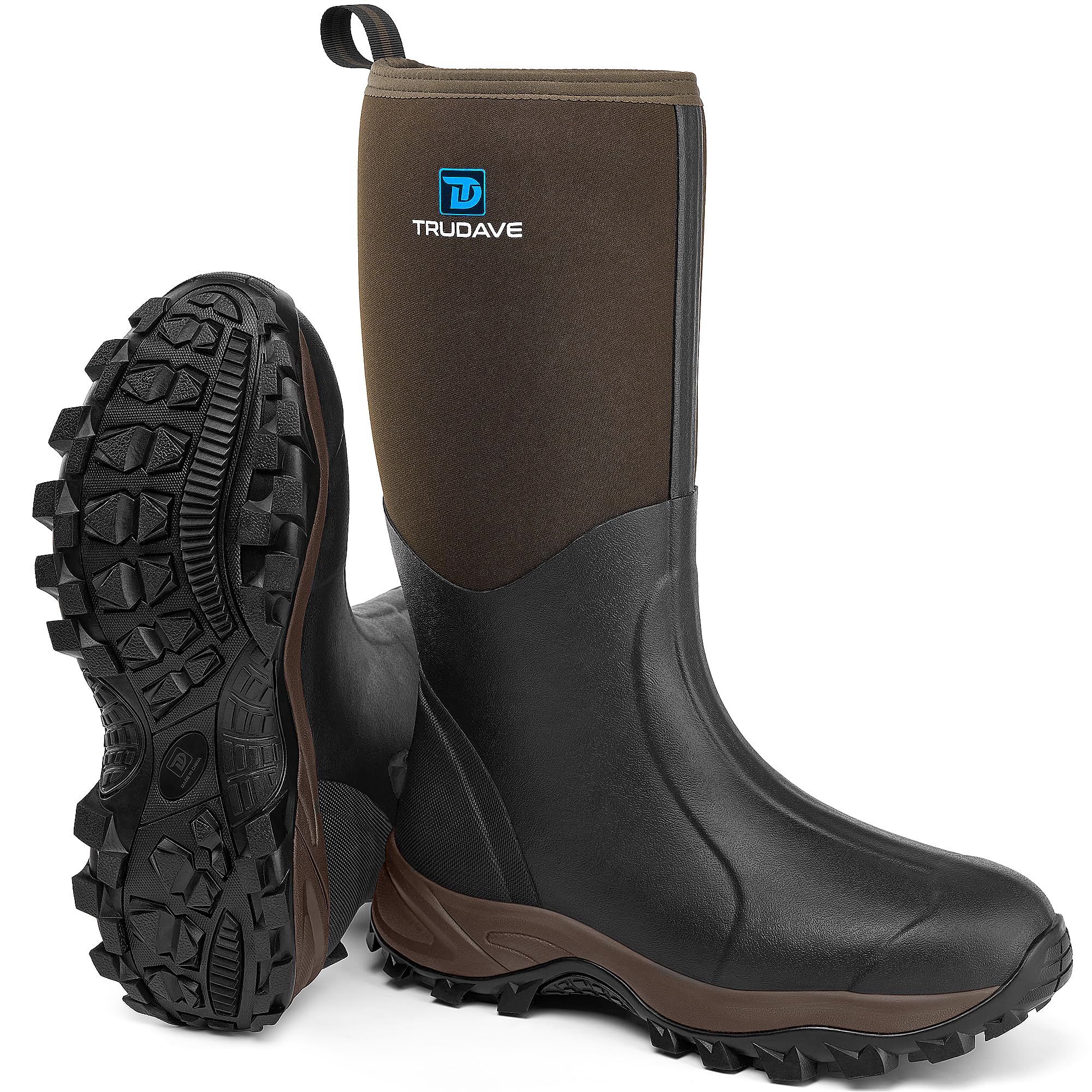
A hard-plastic toe cap and 6mm neoprene — protection that also shrugs off a frosty morning.
Trudave puts reinforced hard-plastic protection over the toe to guard against knocks and collisions, which is the detail you want when you are kicking through brambles, moving rocks, or working around machinery. The 6mm neoprene is a full millimeter thicker than the 5mm on the Guide Gear Bogger — a modest edge in warmth that shows up on a cold, wet morning.
Underfoot, a non-slip sole delivers the grip across mud, forest floor, gravel roads, rain, and snow, and the insoles add arch support for long days on your feet. The fit is built for real feet: buyers describe room for long toes and thick socks, and the wide calf opening makes it easy to pull the boot on over pants or multiple layers. A breathable mesh lining moves air through the boot and pushes sweat out, keeping your feet drier than a sealed-up rubber shell would.
Quality and comfort are the two things buyers praise most, and the traction in mud gets its own specific credit. Sizing is the split note — some find it true to size, others find it runs large, so measure your foot and check the size chart rather than trusting your sneaker size. The 100% waterproof CR Flex-Foam shell and pull straps for gloved hands round out a boot that is genuinely comfortable in the wet.
The standout detail: hard-plastic toe protection plus a steel shank and 6mm neoprene is a lot of armor for the money — the boot is built around not getting hurt.
The sizing note: reports swing both ways on fit, so the size chart is worth two minutes before you order.
Best for: work and hunting where your toes take hits and you want warmth without a knee-high boot.
Skip if: you need a true deep-winter boot — the 6mm neoprene is warm but the 7mm TIDEWE is the colder-weather pick.
7. Trudave Men’s Rubber Boots with Steel Shank, 5mm Neoprene

The five-millimeter Trudave that wants to be your one boot for flooded ground, snow, and mud.
Where the other Trudave runs 6mm of neoprene, this one dials back to 5mm — the same thickness as the Guide Gear Bogger and the HISEA. That makes it the more breathable, more year-round of the two Trudaves, aimed at flooded areas, snow, mud, and general wet work rather than a hard winters-only role. It is available in sizes 5 through 14, so it covers a wider range of feet than most here.
The parts are the same recipe that makes the Trudave name land well with buyers: an anti-slip outsole for steady footing, a hard-plastic reinforced toe guard, and pull tabs so you can get them on and off quickly. Buyers describe the warmth as keeping feet dry and insulated much the way a wet suit does, which is the neoprene doing its job. Waterproofing is a stated 100% and the traction gets specific praise for grip and slip resistance underfoot.
Value is the second-most-praised aspect here after overall quality, and that is the theme to weigh these against the pricier boots on this list. The caveat is durability — while some say they hold up well, others report a tear within a month, so a careful drying routine and honest use matter. The size feedback also splits, so check the chart.
Why It Fits
- 5mm neoprene works across flooded ground, snow, mud, and wet work
- Steel shank, anti-slip outsole, and reinforced toe in one boot
- Available in sizes 5 through 14 across a wide foot range
- Value is the second-biggest praise theme after quality
What To Watch
- Durability reports split, with some tears within a month
- Size feedback splits — check the chart before ordering
Take these when: you want a single four-season boot for wet work, hunting, and fishing without leaning into deep-winter insulation.
Weigh the trade: the split durability reports mean a care routine, not a fire-and-forget pair of boots.
8. TIDEWE Rubber Work Boots Steel Toe
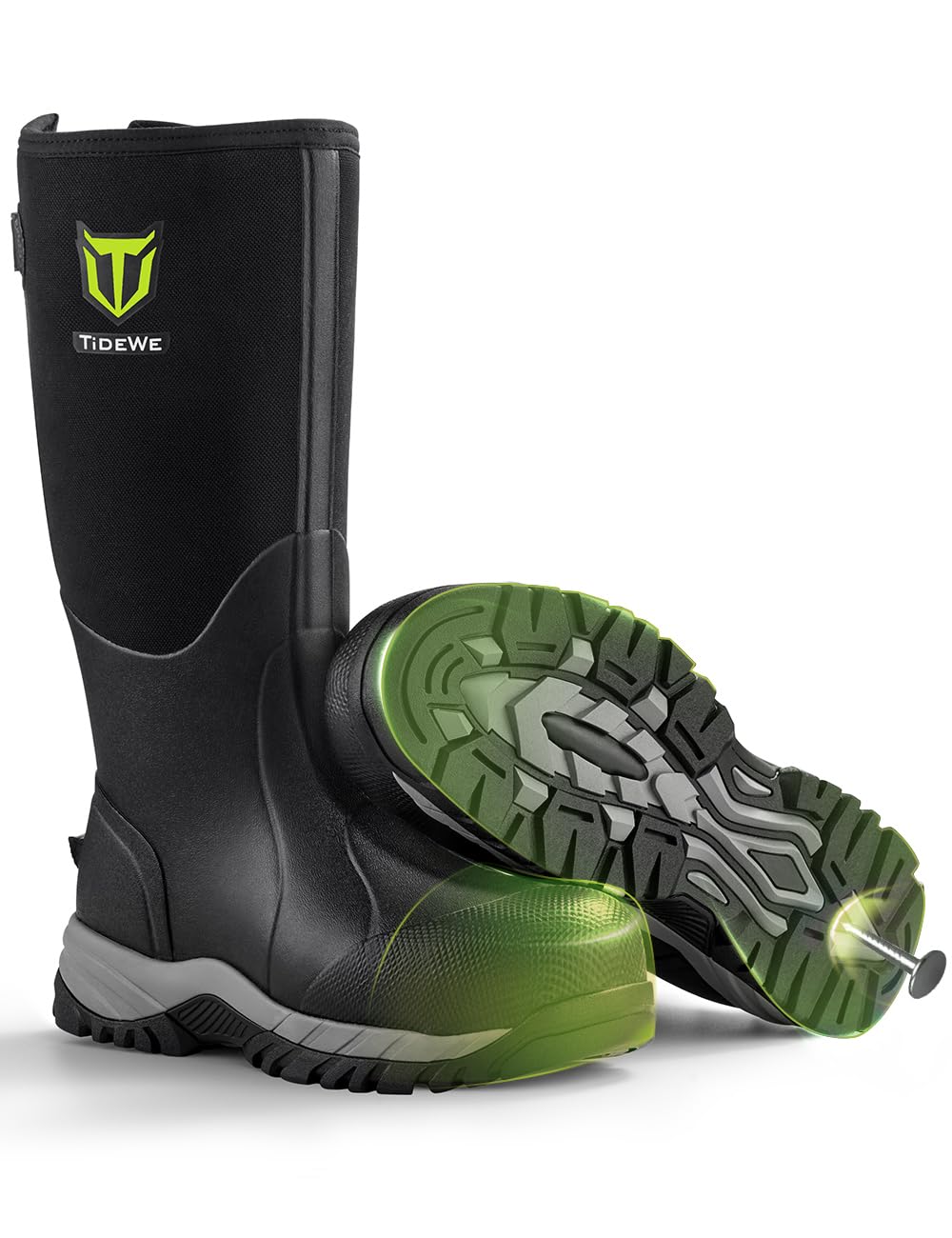
Steel toe, steel shank, puncture protection — this is the boot that goes where the work is heavy.
This is the only boot on the list that pairs a steel toe with a steel shank and puncture-resistant underfoot protection. The steel toe is rated to withstand impact from falling or rolling objects, and the shank sits between the insole and outsole to protect your foot and keep you comfortable through a full workday. If you work a construction site, a manufacturing plant, or a farm where something heavy can land on your foot, that combination is the reason to pick it over everything else here.
The shell is 100% waterproof rubber and neoprene, with a breathable inner lining that circulates air when it is warm. For cold days, 6mm neoprene adds warmth, and the ergonomic arch at the top of the boot keeps the fit comfortable. Pull-on and kick tabs get you out the door faster, and a 10-inch shaft circumference keeps the fit tidy around the leg. Deep tread on the rubber soles is built for workplace terrain.
Comfort and fit both land well with buyers, and the durability is proven enough for long days — the boots have carried people through 14-hour shifts in mud and water. The honest caveat is that a share of buyers report the rubber splitting at the middle and turning non-waterproof over time, so the breathable lining and drying between wears protect your investment.
The safety case: steel toe, steel shank, and puncture resistance in one boot is the most protective spec set here.
The care case: some report the rubber splitting over time, so dry these out between long wet shifts rather than leaving them soaked.
Choose it when: your day involves drop hazards and sharp debris and you need a boot that guards the foot as well as keeps it dry.
Think twice if: you only need ankle-deep puddle protection — the steel toe is weight worth carrying only if you need it.
9. TIDEWE Rubber Hunting Boots

Seven-millimeter neoprene and 800g of insulation — the warmest boot in this lineup.
If you hunt late season, the number to lock onto is 800g of insulation sitting on top of 7mm neoprene. That is the thickest neoprene of anything here — a full 2mm above the 5mm Guide Gear and HISEA boots — and the most insulation by far. The rubber and neoprene shell is built sturdy yet flexes when you walk, so your feet and legs move naturally instead of feeling locked into a stiff shaft. A thick cushioned footbed and generous toe room add to the comfort over long sits and stalks.
The colorway is Next Camo G2, and the boot is available in sizes 5 through 14. Buyers consistently report dry, warm feet in cold weather and durability that lasts a full hunting season. What the boot is designed for is the cold and the long wait — this is the one you lace up for a hard frost, not a summer scouting trip.
Two things split. Some buyers find them true to size and not too heavy, others report inaccurate sizing guidance and find them bulky — the 7mm neoprene and 800g insulation carry real bulk, so measure your foot and use the chart. Treat this as the cold-weather specialist it is rather than a summer work boot, and it will do its job well.
The Cold-Weather Edge
- 7mm neoprene plus 800g insulation is the warmest build on the list
- Rubber and neoprene flexes with you instead of restricting movement
- Available in sizes 5 through 14 in Next Camo G2
- Durability holds up through a full hunting season per buyer feedback
The Bulk Reality
- Sizing reports split, so measure before ordering
- Some find them bulky — the insulation thickness shows up in the fit
Made for the cold: late-season hunters who want the most insulation and neoprene warmth here.
Not for summer: the 800g insulation and 7mm neoprene are built for a hard frost, not a warm-weather workday.
Know the Specs
Neoprene Thickness (in millimeters)
Neoprene is the foam layer inside the boot that holds warmth, and its thickness in mm is the fastest way to read the temperature range. A 5mm boot is a four-season work boot. A 6mm or 7mm boot is built for the cold — the TIDEWE Hunting boot runs 7mm and tops the warmth order here. Thicker neoprene is also warmer than you want in a hot summer shift, so match the thickness to the season you actually work in.
Shaft Height (in inches)
Shaft height is how far up your leg the waterproof shell reaches. It ranges from a 6-inch ankle deck boot to an 18-inch knee-high field boot on this list, and that range is about 3x. Taller means more water protection when you wade through flooded ground. Shorter means more mobility and a boot that does not fight your leg on a moving boat deck. Pick based on how deep the wet usually gets.
Steel Shank and Steel Toe
A steel shank is a stiff plate set between the insole and outsole. It spreads pressure across your arch so long days on your feet hurt less, and it adds puncture resistance against nails and debris. A steel toe goes further, rated to take impact from falling or rolling objects. Both add weight. Choose them when the work is heavy, and leave them out when you only need to stay dry.
Insulation Weight (in grams)
Insulation weight, given in grams like the 800g on the TIDEWE hunting boot, tells you how much thermal fill the boot carries. It stacks on top of the neoprene, so the two numbers together set how cold you can go. A heavily insulated boot keeps feet warm on a frosty stand but runs hot the moment the weather turns mild.
Common Questions
How do I know which neoprene thickness to get?
Will these boots keep my feet dry in deep water?
Do rubber boots run true to size?
Is a steel toe boot worth it for everyday farm work?
How should I store rubber boots so they last?
Can I wear waterproof rubber boots in summer?
What is the difference between a deck boot and a hunting boot?
Do rubber work boots have arch support?
Why do rubber boots crack and how do I prevent it?
Are insulated rubber boots too warm for fall hunting?
The Bottom Line
For most buyers, the waterproof rubber boots for men winner is the LaCrosse Burly Air Grip 18″ because its 18-inch waterproof shaft covers the deepest muck and its build quality is the most-praised of any boot here. It carries the highest rating on the list at 4.5+, edging out the Guide Gear despite the Guide Gear’s larger review count. If cold-weather warmth and a steel shank are your priority, the HISEA pairs 5mm neoprene with a stated 14°F (-10°C) range. And if your day is on a wet boat deck, the BASSDASH Explorer-DG ankle boot is the one to reach for.
How we choose
We do not accept paid placement. Every pick is matched to a real buyer and a real use-case; we do not hands-on test units.
Sources
Specifications: manufacturer listings and product documentation. Review insights: verified customer reviews, as of November 2026. Pricing: not shown on this page (it changes often); check the current price via the retailer link.
As an Amazon Associate, Tactical Gear Guy earns from qualifying purchases. This does not affect which products we feature.