Specs are compiled from manufacturer listings and verified buyer reviews and can change over time — please confirm the key details on the product page before buying.
Steam from a shower or damp air on a porch can kill a cheap speaker in one season. The Polk Audio RC80i pair is the safest bet for most people. It is the crowd favorite here — 4.5+ stars across 2,300+ owners — with an 8-inch woofer and a rubber seal that keeps moisture out. Below, every pick is sorted by what it actually does well, so you can match one to your room and your amplifier.
This guide is built by comparing the manufacturers’ published specifications and the patterns across verified customer reviews, so you get each pick’s real strengths and trade-offs instead of marketing spin.
Wet rooms punish cheap speakers, so the details that matter are the surround material, the grille finish, and the cutout size you have to live with. Each entry below explains those specs in plain terms and tells you which room it suits, so you can choose a waterproof ceiling speaker for your bathroom or porch with confidence.
Top Picks


How To Choose The Best Waterproof Ceiling Speakers
Start with the room, not the spec sheet. A bathroom or laundry room throws constant moisture at a speaker, so you want a surround made from rubber or Santoprene — a flexible material that shrugs off heat, cold, and damp instead of drying out. A rust-resistant aluminum or stainless-steel grille matters just as much, because a steel grille in a steamy shower will show it within a year.
Measure the hole before you buy
Every in-ceiling speaker needs a circular cutout of a specific size, and the numbers differ. The OSD 6.5-inch models want a 7.95-inch cutout with 4.33 inches of clearance above the ceiling. The OSD 8-inch wants 9.06 inches. A smaller cutout is easier to fit into a tight joist bay, while a bigger one gives you more cone area and deeper bass. If you are replacing old speakers, measure the existing hole first — patching drywall is the expensive part.
One speaker or a stereo pair
A narrow bathroom or hallway may only have room for one speaker. That is where a dual voice coil design earns its place: it plays both the left and right channels through a single woofer, so you still get stereo sound from one hole in the ceiling. In a wider room — a covered deck or a kitchen — a matched pair gives you proper left-right spread and fuller sound.
Match power handling to your amplifier
Power handling tells you how many watts a speaker can absorb before it distorts, and sensitivity tells you how loud it gets per watt. A 90 dB sensitivity with 8-ohm impedance, like the OSD pairs, plays comfortably off most stereo amplifiers and AV receivers. Higher numbers here mean less strain on your amp, which matters in a multi-zone setup running several rooms at once.
Side-by-Side Comparison
| Model | Best For | Driver Size | Power Handling | Sold As | Amazon |
|---|---|---|---|---|---|
| Polk Audio RC80i★ Best Overall | Best overall for most wet rooms | 8 inches | — | Pair | Amazon |
| OSD Audio 6.5″ SingleSingle-Speaker Stereo | Single-speaker stereo for tight rooms | 6.5 inches | 150 W | Single | Amazon |
| STUDIOFINIX 6.5″ Bluetooth 4-Pack | Whole-home audio with built-in amp | 6.5 inches | 600 W | 4 speakers + amplifier | Amazon |
| Polk Audio MC80 | Fuller bass in large enclosed rooms | 8 inches | — | Single | Amazon |
Detailed Reviews
1. Polk Audio RC80i In Ceiling Speakers
Our pick — 4.5+★ from 2,000+ verified ratings; the strongest balance of quality and price.
An 8-inch woofer and a rubber seal that keeps the steam on the other side of the cone.
This pair earns the top spot because its 8-inch Dynamic Balance woofer moves more air than a 6.5-inch driver. That gives you more low-end weight — exactly what a bathroom or covered porch needs when music plays over a running shower. The 1-inch aimable tweeter (a small high-frequency driver you can point) lets you aim the highs where you stand, so vocals stay clear instead of getting lost.
A rubber seal blocks damp and also improves the audio response. That matters because a wet room is the whole reason you are shopping this category. The grilles are paintable, so they blend into your ceiling and disappear. Installation is a three-step job that most people can handle, and owners back that up — sound quality is what wins people over most, and the sheer volume of happy installs tells you the fit-and-forget approach works. The OSD 6.5-inch pair can be had with a smaller cutout, but for a pair that plays both a bathroom and a covered patio well, this is the one to start with.
The catch is worth knowing up front: at loud volumes, the grilles can work loose. Treat the covers gently on the first install and you avoid that. A few owners also found the grille screens tight to remove on day one — a paper clip or small nail handles it. Neither is a reason to pass, just a heads-up for the first afternoon.
What the RC80i gets right
- 8-inch Dynamic Balance woofer plus a 1-inch aimable tweeter fills a wet room with real low-end body.
- A rubber seal blocks moisture and tightens the audio response at the same time.
- Paintable grilles let the speakers vanish into your ceiling.
- Three-step install that suits a weekend DIY job.
Where it asks for care
- Grilles can loosen at high volume — seat them firmly.
- Grille screens come off tight the first time; a small tool helps.
- Moisture-resistant, not built for fully exposed outdoor use.
Go with this if: you want a proven pair for a bathroom, kitchen, or covered porch and value a fuller 8-inch sound.
Think twice if: your ceiling joists leave less than the depth an 8-inch driver needs, or you only need one speaker.
2. OSD Audio 6.5″ In Ceiling Speaker
One hole in the ceiling, both channels of sound — built for rooms too small for a pair.
This is the fix for a narrow bathroom, a closet, or a hallway where two speakers simply will not fit. Inside a single 6.5-inch woofer sits a dual voice coil, a design that plays the left and right channels through the one cone. Wire the left channel to one set of terminals and the right to the other, and you get stereo from a single cutout. Two 1-inch polycarbonate dome tweeters, one per channel, carry the highs, and the whole thing runs from 48Hz to 20kHz with 150 watts of power handling.
The moisture story is a Santoprene surround — a rubber-like material that resists heat, cold, and humidity without hardening or cracking — plus a rust-resistant aluminum grille. Check the fit before you order, because this one needs a 7.95-inch cutout and 4.33 inches of clearance above the ceiling. The paintable grille measures 9.06 inches across. Dog-ear clamps hold it in place with no brackets. Owners praise the build quality, and bathrooms, closets, and hallways are exactly the rooms where one speaker is the whole solution.
The honest trade-off: a single 6.5-inch driver in a narrow room will not give you the bass depth of an 8-inch pair, and the top end is a touch reserved compared with what a bigger two-speaker setup can deliver. For a bathroom or a small hallway, that is a fair swap for the space you save.
Why it fits the tight rooms: dual voice coil stereo, two dome tweeters, and 150 watts in a single 6.5-inch package.
The fit note: measure for a 7.95-inch cutout and 4.33 inches of overhead clearance before you commit.
Reach for this if: your powder room or hallway has room for only one speaker but you still want left and right sound.
Look elsewhere if: you have room for a pair and want deeper bass from your music.
3. OSD Audio 6.5″ In Ceiling Speakers
A full left-right pair with an aimable tweeter, sized to slip into a tighter joist bay.
Where the single-speaker OSD above solves a one-hole problem, this pair or of its 6.5-inch sibling. That 38Hz-to-20kHz range is the reason this pair sounds fuller in a larger space: a big covered patio soaks up bass, and a bigger driver gives it more to work with. A 1-inch pivoting polycarbonate dome tweeter handles the top end, and you can aim it toward the chairs on the deck so speech and vocals sit in the right place.
The weather build matches the smaller pair — Santoprene surround, rust-resistant aluminum grille, rated for bathrooms, laundry rooms, kitchens, and covered patios. Fit is the thing to plan: this one needs a 9.06-inch cutout, 4.13 inches of clearance above the ceiling, and a 10.24-inch paintable grille. Dog-ear clamps mean no brackets. Owners praise the sound first and the weather-ready build a close second. One 11-year AV pro reckoned these hold their own against pricier speakers; the honest caveat is that owner reports on long-term durability are mixed, so mount them under cover.
Where it leads on paper is that low-frequency reach — 38Hz against the 6.5-inch OSD’s 48Hz. Where it falls short is installation flexibility: the 9.06-inch cutout rules out tight joist bays that the smaller pair slips into. And a few dog-ear clamps have refused to grip, so check the hardware before you cut.
What you gain: 38Hz low-end extension and an 8-inch cone for a richer bassline on a large covered patio.
The install reality: a 9.06-inch cutout and 4.13 inches of overhead clearance — measure twice.
Pick this when: your covered deck or large bathroom can take a 9-inch hole and you want bass you can feel.
Choose the 6.5-inch pair instead if: your ceiling space is tight or the room is small.
4. 6.5 Inch Bluetooth Ceiling Speakers
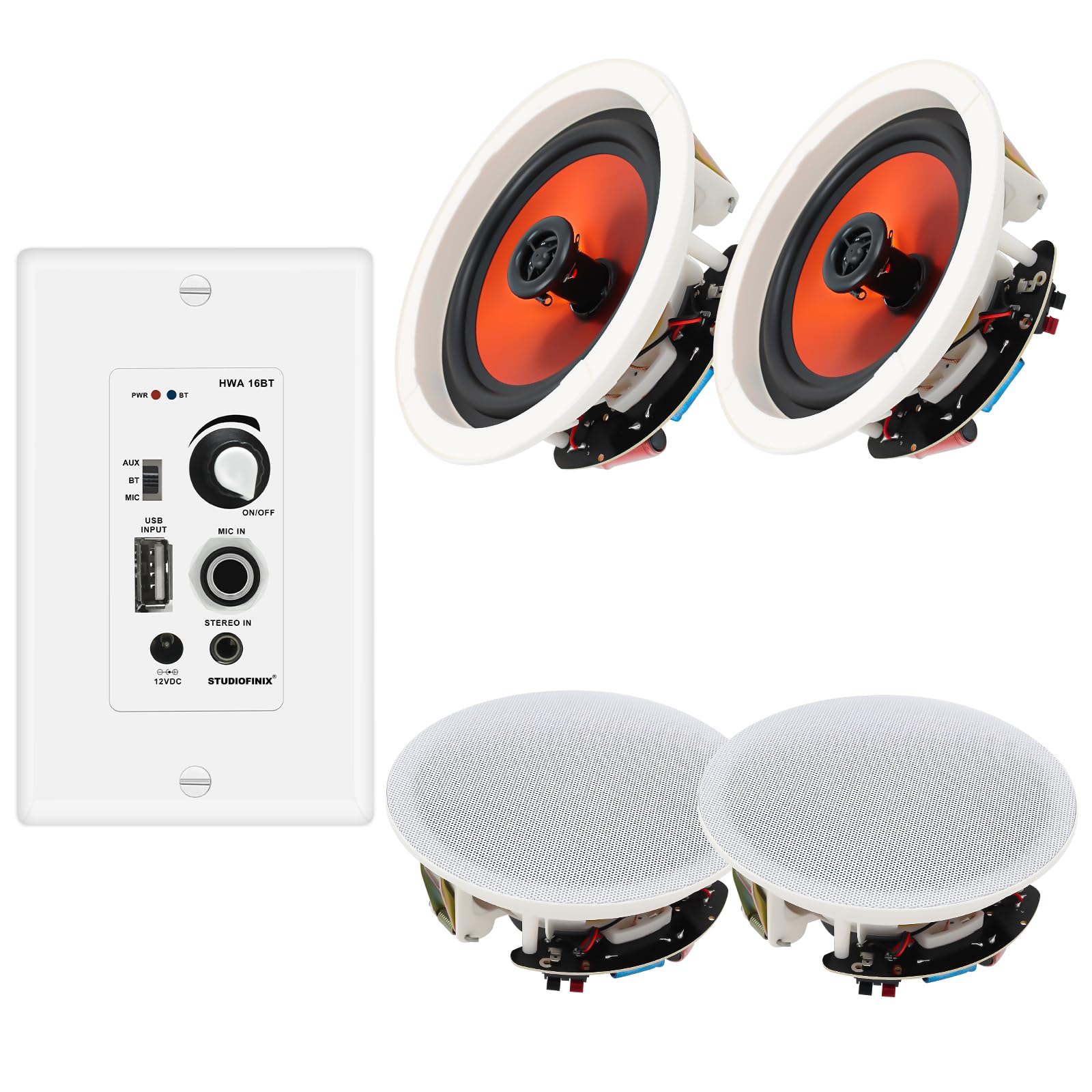
Four speakers and the amplifier in one box, no separate receiver required.
This is the one to look at if you do not already own an amplifier. The kit ships four 6.5-inch speakers with 1-inch silk dome tweeters, a four-channel wall amplifier, and the wiring to connect them. The amplifier streams over Bluetooth, reads USB flash media, and doubles as a charging port for your devices. There is a 3.5mm aux input for anything with a headphone jack, plus mic paging through the wall plate — a feature that makes sense in an office or a restaurant.
The 600 watts of power handling in the product name covers the whole four-speaker system, not a single driver, so treat it as the ceiling for the kit rather than a per-speaker number. Each speaker needs a 6.3-inch cutout, with a 3.15-inch mounting depth and a 7.5-inch overall diameter. That shallower 3.15-inch depth is a real advantage over the OSD 6.5-inch pair, which asks for 4.33 inches — so if your ceiling void is shallow, this drops in where those would not. Flush-mount trim keeps the wall and ceiling clean.
The trade-off is that you are buying into a self-contained system. The amplifier is fixed to that wall plate, and the speakers match its design, so it suits a whole-room build rather than adding to an existing stereo setup. There are no verified owner reviews on this listing yet, so the sound is a spec-sheet call rather than a settled reputation. For an office, basement, or a multi-room home install, though, one box doing the whole job is a tidy answer.
What makes this kit useful
- Four 6.5-inch speakers plus a Bluetooth wall amplifier in a single package.
- USB media playback and a 3.5mm aux input for phones and tablets.
- Microphone paging through the wall plate suits an office or shop.
- 3.15-inch mounting depth fits shallower ceilings than many rivals.
What to weigh up
- No verified owner reviews on the listing yet, so the sound is untested by feedback.
- System-locked to its own amplifier; no easy path to add on later.
Ideal for: an office or basement build where you want four speakers and the amplifier bundled together.
Not the right fit if: you already own an amplifier and only want speakers to hang off it.
5. Polk Audio RC6s In-Ceiling Speaker

The 8-inch step up from the MC60, for a bigger room that wants more body in the low end.
This is the MC60 with more cone: an 8-inch Dynamic Balance midrange instead of a 6.5-inch, and a 0.75-inch aim-ready swivel tweeter carrying the highs. The extra cone area means more air moved, which shows up as fuller sound in a larger enclosed room. It shares the moisture-resistant build of its smaller sibling, with rustproof stainless-steel hardware and butyl rubber surrounds for bathrooms, kitchens, sunrooms, and covered porches.
Install follows the same drop-in pattern: a one-cut fit with Perfect Fit templates, a precision flange, and rotating cams to seat it without vibration. Owners praise the sound here — that 8-inch driver cranks out more bass than many buyers expect from an in-ceiling speaker. Owners run it as part of surround and Atmos builds and report it handles plenty of power. The paintable grille blends into white ceilings and can be painted to match decor.
The comparison to keep in mind is this pick against the MC60: same tuning, more cone, more bass, and a bigger hole to cut. Against the RC80i pair, this is a single speaker, so two of them is your stereo path and the per-unit math changes. Neither is better in the abstract — one is a pair built for a wet bathroom run, the other a single that scales to a large room one speaker at a time.
Where it leans in: 8-inch Dynamic Balance driver, moisture-resistant internals, and bass that surprises in-ceiling owners.
What to note: sold as a single, so a stereo room needs two.
Pick it when: you have a large enclosed room and want fuller low end from a single speaker per spot.
Choose the MC60 instead if: your space is small or you want subtle background detail over bass.
Know the Specs
Power handling and sensitivity
Power handling is the wattage a speaker can absorb before it starts to distort — the OSD pairs list 150W, and the STUDIOFINIX system lists 600W for the whole four-speaker kit. Sensitivity, measured in dB, tells you how loud the speaker plays per watt; 90 dB and 8-ohm impedance means most stereo amplifiers and AV receivers can drive it comfortably. Higher sensitivity and lower impedance usually means less strain on your amp in a multi-zone setup.
Cutout diameter and mounting depth
These two numbers decide whether a speaker will physically fit. Cutout diameter is the size of the circular hole you cut; mounting depth is the clearance the speaker needs above the ceiling. The OSD 6.5-inch models want a 7.95-inch cutout and 4.33 inches of depth, the STUDIOFINIX 6.5-inch kit wants a 6.3-inch cutout and 3.15 inches of depth, and the OSD 8-inch wants 9.06 inches. Measure your joist bay and your overhead clearance before ordering.
Surround material and moisture
The surround is the flexible ring that connects the cone to the frame. A Santoprene or butyl rubber surround resists heat, cold, and humidity without hardening or cracking, while cheaper foam dries out. Pair that with a rust-resistant aluminum or stainless-steel grille and you have a speaker built for a bathroom or a covered porch. Rubber seals and moisture-resistant construction are the other markers to look for.
Dual voice coil stereo
A dual voice coil lets one speaker play both the left and right channels, so a tight bathroom or hallway gets stereo sound from a single cutout. You wire the left channel to one set of terminals and the right to the other, and the single woofer handles both. It needs four wires rather than two, so plan the run before you cut.
Common Questions
Are waterproof ceiling speakers really safe in a shower or sauna?
Do I need an amplifier for in-ceiling speakers?
What cutout size do I need for a 6.5-inch ceiling speaker?
Can one ceiling speaker play both left and right channels?
Is a 6.5-inch or 8-inch ceiling speaker better for a covered patio?
Can I paint the grilles to match my ceiling?
How many watts do I need to drive a ceiling speaker?
Do these speakers work outdoors on an uncovered deck?
Are these ceiling speakers hard to install yourself?
Do the built-in amplifier kits replace a separate receiver?
The Bottom Line
For most people shopping for waterproof ceiling speakers, the Polk Audio RC80i pair is the safest call — an 8-inch Dynamic Balance woofer, a moisture-blocking rubber seal, and a track record that runs deep across home audio installs. If you need stereo sound from one hole in a narrow bathroom or hallway, the OSD 6.5-inch single solves it with a dual voice coil and 150W of handling. And for a whole-home build where you want several rooms covered at once, the STUDIOFINIX four-speaker Bluetooth kit bundles four speakers and the amplifier, so there is no receiver to buy. That Polk pair is the strongest all-rounder for a wet room, and its 4.5+ star record across 2,300+ owners is why it takes the top spot.
How we choose
We do not accept paid placement. Every pick is matched to a real buyer and a real use-case; we do not hands-on test units.
Sources
Specifications: manufacturer listings and product documentation. Review insights: verified customer reviews, as of November 2026. Pricing: not shown on this page (it changes often); check the current price via the retailer link.
As an Amazon Associate, Tactical Gear Guy earns from qualifying purchases. This does not affect which products we feature.