Specs are compiled from manufacturer listings and verified buyer reviews and can change over time — please confirm the key details on the product page before buying.
If your arches ache by lunchtime and your socks are damp by ten, the fix is a waterproof boot with a footbed built to hold your arch up — not a flat slab of rubber. The four picks below all state waterproof construction and real arch support in their own specs, and each one suits a different kind of day: a shift on concrete, a wet trail, or a long walk through town in the rain. Read the trade-offs before you pick, because the gap between these boots is mostly about weight, toe protection, and who the footbed was shaped for.
This guide is built by comparing the manufacturers’ published specifications and the patterns across verified customer reviews, so you get each pick’s real strengths and trade-offs instead of marketing spin.
You will see which boot carries a composite safety toe, which one lets you swap in your own insoles, and where each pair falls short. The short version: match the boot to your surface and your arch first, then worry about the rest with these waterproof boots with arch support.
Top Picks

How To Choose The Best Waterproof Boots with Arch Support
Two things make or break this category, and neither is the brand name on the heel. The first is whether the boot actually keeps water out at the seam and the tongue, not just across the toe cap. The second is whether the footbed lifts the arch of your foot instead of letting it flatten under your body weight all day. Get those two right and the rest — toe style, shaft height, weight — becomes a matter of matching the boot to your job or your walk.
Waterproofing is a construction detail, not a spray
A waterproof membrane is a thin layer inside the boot that blocks liquid water while letting vapor escape. The Carhartt Ground Force names its Storm Defender membrane and a moisture wicking lining, and the ROCKROOSTER Walker uses a Hydroguard membrane with a Coolmax fabric. Both approaches tackle the same problem: wet feet from the outside plus sweat from the inside, which is what makes a boot feel clammy after four hours. A leather upper treated on its own is not the same promise — you want the membrane named in the spec sheet.
Arch support means a shaped footbed, not extra foam
Arch support comes from a footbed molded to follow the curve under your instep, sometimes paired with a firm heel counter that keeps your foot from rolling inward. The Skechers Arch Fit Tarver names podiatrist-certified Arch Fit support, and the Orthofeet Delta pairs its Ortho-Cushion system with a removable orthotic insole and extra depth. If you already wear custom orthotics, that removable insole is the detail that decides whether a boot is even an option for you.
Match the toe and the sole to where you stand
A composite safety toe shields your toes from dropped weight without the cold feel of steel, and an electrical hazard rating matters if your day involves live circuits. On the sole side, a slip-resistant outsole keeps you upright on wet concrete, while a rubber wedge sole spreads pressure more evenly for long standing hours. The Skechers pair lists a slip-resistant Goodyear Rubber outsole and electrical hazard protection; the ROCKROOSTER lists a rubber outsole over a steel shank. Neither is better in the abstract — one is built for grip on slick floors, the other for support over a long shift.
Weight and shaft height change how the day feels
A 6-inch shaft adds structure around your ankle, which helps on uneven ground but takes a little break-in. Weight is the quieter factor: the Skechers Tarver is listed at 3.1 pounds, while the Carhartt Ground Force is listed at 4.1 pounds. Over a twelve-hour day, that difference decides whether you notice the boot at hour ten. Lighter is not automatically better if you want ankle support, so weigh your surface against your stamina.
Side-by-Side Comparison
| Model | Best For | Weight | Toe Style | Arch Support System | Amazon |
|---|---|---|---|---|---|
| Skechers Men’s Arch Fit Tarver★ Best Overall | All-day shifts with a safety toe | 3.1 pounds | Composite safety toe | Podiatrist-certified Arch Fit | Amazon |
| Carhartt Ground Force 6-Inch | Wet jobsites and general walking | 4.1 pounds | Soft toe | Insite cushioned footbed with EVA midsole | Amazon |
| Orthofeet Delta Orthopedic | Custom orthotics and long standing hours | — | — | Built-in orthotic insole, removable | Amazon |
| ROCKROOSTER Walker | Long standing shifts on hard ground | — | Soft toe | RC930 insole with Poron XRD | Amazon |
Detailed Reviews
1. Skechers Men’s Arch Fit Tarver
Our pick — 4.0+★ from 250+ verified ratings; the strongest balance of quality and price.
The one boot here that pairs a certified arch footbed with a protective safety toe.
If your day mixes wet floors with the risk of something heavy landing on your foot, this is the obvious starting point. The Tarver carries a composite safety toe — a non-metal cap that shields your toes without the cold strike-through of steel — and a slip-resistant Goodyear Rubber outsole for slick concrete. The composite toe and slip-resistant outsole sit alongside podiatrist-certified Arch Fit support, a rare combination in this price band. Plenty of work boots bolt on a safety toe and leave the footbed flat; this one does not.
What wins people over is the leather-and-mesh build, with value a close second. The leather, synthetic and mesh upper keeps some airflow moving, and electrical hazard protection adds a layer of workplace safety for anyone near live circuits. It is also the lighter of the two boots with a published weight — 3.1 pounds, against the Carhartt Ground Force at 4.1 pounds — so the Tarver is the friendlier choice if you are on your feet and moving for a full shift rather than standing in one spot.
The honest catch is sizing and lining durability. The fit runs slightly big on the wide size, so try your usual size with the socks you actually work in rather than sizing up out of habit. Durability is the split verdict: the boot can hold up for a year of work, but the internal lining has been reported ripping after as little as two days on some pairs, and the review pages carry that mixed note alongside the praise. Treat the lining as the wear point to watch during the return window.
Where the Tarver earns its place
- Composite safety toe protects against dropped weight without steel’s cold feel
- Podiatrist-certified Arch Fit support sits alongside the composite toe cap
- Slip-resistant Goodyear Rubber outsole for wet, slick floors
- Electrical hazard protection for work near live circuits
- Listed at 3.1 pounds — the lighter published weight of the two boots that state one
What to keep an eye on
- Fit runs slightly big in the wide size
- Internal lining has been reported ripping early on some pairs
- Weight draws split opinions across the review pages
Reach for this if: you need arch support and toe protection in the same boot for wet, busy workdays.
Look elsewhere if: you want a soft toe and a roomier, more forgiving fit from the start.
2. Carhartt Ground Force 6-Inch Work Boots

A leather work boot that names its waterproof membrane and still leaves your toes free to flex.
Start with the membrane, because that is the whole point of this boot. The Ground Force uses Storm Defender waterproofing behind a leather upper, so rain and puddle splash stay on the outside while a moisture wicking lining moves sweat away from your foot on the inside. The 6-inch shaft adds structure around the ankle, and a reinforced heel area firms up stability during frequent steps — useful when you are carrying something across a wet yard rather than standing still.
The comfort layer is an EVA midsole paired with a cushioned Insite footbed that gives you arch support without a rigid shell under your foot. The soft toe construction keeps the front of the boot flexible, which is a real benefit if you crouch and kneel through the day and do not need a safety cap. It is the heavier of the two boots with a published weight — 4.1 pounds against the Skechers Tarver’s 3.1 pounds — and it is also the only waterproof boot here without any safety toe option, so pick it for wet comfort, not for impact protection.
Built for the damp job: the Storm Defender membrane and wicking lining handle both directions of moisture — outside rain and inside sweat — which is exactly the pairing that keeps feet from going clammy by mid-morning. The 6-inch height and reinforced heel are the stability details you notice on uneven, wet ground.
The trade-off in one line: there is no safety toe here, so if dropped objects are part of your day, the Skechers Tarver covers that base and this boot does not.
The right call for: wet outdoor and indoor tasks where flexible toes and dry feet beat impact protection.
The wrong call for: anyone who needs a capped toe on the job.
3. Orthofeet Delta Orthopedic Women Leather Hiking Boot

The women’s boot that makes room for the insoles you already trust.
Here is the detail that decides it for a lot of buyers: the insole comes out, and the boot has extra depth to take a custom orthotic in its place. If you have spent money on prescription inserts, a boot with a glued-in footbed is a dead end — the Orthofeet Delta is not. The Ortho-Cushion system combines a built-in orthotic insole, a shock-absorbing sole and a roomy, pressure-free fit, and some styles ship with fitting spacers and an Arch Booster for extra control over how much support sits under your arch.
Comfort and fit are what this boot is known for, and it is the most-reviewed pick on this list. Owners describe wearing them all day, and the arch support gets specific credit for how the heel and ankle feel after long hours. A wide base, firm heel counter and slip-resistant sole round out the stability story, which is the part that matters on wet, uneven ground. It is a leather hiking boot, so it also draws compliments for how it looks, which is a rare thing to say about footwear built around an orthopedic footbed.
Two honest notes. Sizing is the split point across the reviews, so measure your foot rather than assuming your usual number carries over. Water resistance is the second mixed signal — the boot is built for the trail, but this is the one pick here whose waterproofing does not appear by name in the spec sheet the way the Carhartt and ROCKROOSTER membranes do, so do not treat it as a wading boot.
Best for: women who wear custom or prescription orthotics and need a leather boot that accommodates them.
Think twice if: you need a boot rated for standing water rather than wet trails.
4. ROCKROOSTER Walker Waterproof Work Boots
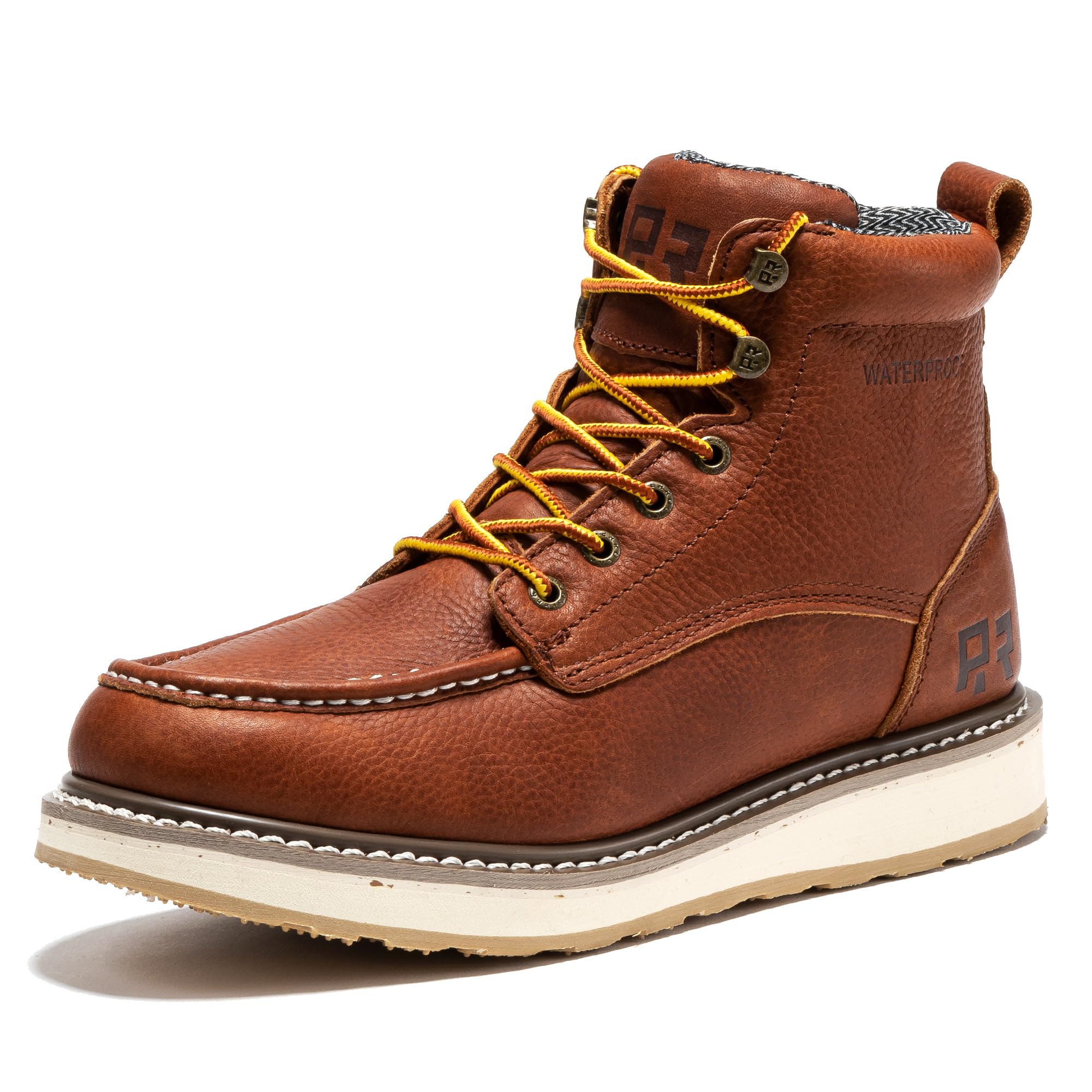
A wedge-sole work boot built for standing on hard ground all day, not walking trails.
The build sheet reads like a standing-shift specialist. A Hydroguard waterproof membrane sits behind oiled full-grain tumbled leather, with Coolmax fabric handling the inside moisture. The insole is an RC930 over Poron XRD — a cushioning material named for its energy absorption — set on a PU midsole and a rubber outsole with a steel shank underneath. A steel shank is the stiff spine that stops the sole from flexing under load, which is why the boot stays supportive when you are planted on concrete for hours.
Cushioned comfort and stitched-leather build quality are the two things this boot does best. The leather and stitching hold up as the standout details, and the memory foam insoles get called out for how they feel underfoot. It runs true to size, which takes the guesswork out of ordering, and it carries an ASTM F2892-18 EH rating — the electrical hazard standard for footwear — for anyone working around live circuits. The maker positions it for roofing, asphalt, air-conditioner repair, construction, electrical and courier work: jobs where you stand more than you stride.
Durability and looks are where opinions split. Some pairs hold up well over long use, while others have been reported starting to come apart, and the appearance draws mixed reactions. Neither issue is universal across the range, but if you want a boot you never have to think about, plan to check the seams during the return window. The Goodyear Welt construction is the reassuring counterpoint — it is a stitched build rather than a glued one, which is the more durable way to attach a sole.
What it is built for: long standing shifts on hard, flat ground. The wedge sole spreads your weight, the steel shank holds the arch of the sole rigid, and the Poron XRD under the heel absorbs the repeated impact of standing in one place.
The honest limit: it is the boot here with the most mixed record on long-term durability, so it rewards a buyer who inspects the seams early rather than the one who wants a decade of no-thought wear.
Pick this one when: your shift is spent standing on concrete and you want cushioning plus a rigid shank underfoot.
Skip the idea if: you want a hiking-style boot with a more flexible sole for varied terrain.
Know the Specs
Waterproof Membrane vs. Treated Leather
A membrane is an inner layer that stops liquid water from passing through while letting moisture vapor escape. When a spec sheet names a membrane — Storm Defender on the Carhartt or Hydroguard on the ROCKROOSTER — that is a stronger promise than a leather upper treated on its own, because the membrane does not wear off with scuffs. Pair it with a lining that moves sweat, and your feet stay dry from both directions.
Arch Support and Removable Insoles
Arch support comes from a footbed molded to follow the curve under your instep, often with a firm heel counter behind it. If you wear custom orthotics, the removable insole and extra depth on the Orthofeet Delta is the spec that matters most, because a glued-in footbed blocks the insert you already own. Otherwise, a contoured footbed like the Arch Fit or the Insite cushioning gives you shaped support from the start.
Composite Safety Toe and Electrical Hazard Ratings
A composite toe is a non-metal cap that shields your toes from dropped weight, and it stays warmer against the foot than steel. An electrical hazard rating, such as the ASTM F2892-18 EH marking on the ROCKROOSTER Walker, means the boot is built to reduce the risk of a circuit path through your body. Neither feature is on every boot here, so check the spec before you assume.
Wedge Sole, Shank and Traction
A wedge sole is one continuous rubber slab from heel to toe, which spreads your weight more evenly when you stand in one place. A steel shank is the stiff spine inside the sole that keeps the boot from flexing under load. A slip-resistant outsole is the pattern that keeps you upright on wet concrete. Match the sole to your surface — wedge and shank for standing, aggressive tread for varied wet ground.
Common Questions
Will custom orthotics fit inside the Orthofeet Delta boot?
Do these boots stay waterproof once the leather scuffs?
What is the difference between a composite safety toe and a soft toe?
How much does boot weight matter over a long shift?
Can I wear these boots if I am on my feet standing still all day?
Is a 6-inch shaft better than a shorter boot for wet ground?
What does an electrical hazard rating on a work boot mean?
How should I size a waterproof work boot with arch support?
How long should a waterproof work boot last?
Is a leather boot with arch support comfortable for hiking?
The Bottom Line
If you want one pair that covers the most ground, the Skechers Arch Fit Tarver is the pick — a composite safety toe, podiatrist-certified arch support and a slip-resistant outsole in the lighter of the two boots that publish a weight. It is the crowd favorite here, with 4.0+ stars across 200+ owners, and its price-to-features ratio is why it sits on top. Want the waterproof membrane plus a flexible soft toe for wet jobsite tasks? Reach for the Carhartt Ground Force. If you already wear prescription orthotics, the Orthofeet Delta is the only boot here with a removable insole and extra depth to take them. And if your shift is spent standing on concrete, the wedge sole and steel shank of the ROCKROOSTER Walker are built for exactly that.
How we choose
We do not accept paid placement. Every pick is matched to a real buyer and a real use-case; we do not hands-on test units.
Sources
Specifications: manufacturer listings and product documentation. Review insights: verified customer reviews, as of November 2026. Pricing: not shown on this page (it changes often); check the current price via the retailer link.
As an Amazon Associate, Tactical Gear Guy earns from qualifying purchases. This does not affect which products we feature.