Specs are compiled from manufacturer listings and verified buyer reviews and can change over time — please confirm the key details on the product page before buying.
Here is the hard part of buying a bivy sack: a bag that seals out rain also traps your own breath, and the sacks that breathe well can wet out under real weather. So the right pick is the one whose waterproofing, breathability and packed weight fit the way you actually sleep outdoors. Below you get nine waterproof bivy sacks sorted by what they genuinely do well, from emergency shells that live in a car trunk to lightweight covers you carry on a thru-hike.
This guide is built by comparing the manufacturers’ published specifications and the patterns across verified customer reviews, so you get each pick’s real strengths and trade-offs instead of marketing spin.
First you will learn which specifications decide whether a bivy keeps you dry or leaves you soaked, then every pick is reviewed with its honest trade-offs laid out. Read on for clear guidance on choosing the best waterproof bivy sack for your sleep system.
Top Picks


How To Choose The Best Waterproof Bivy Sack
A bivy sack is a thin outer shell that slides over your sleeping bag and closes around your head and feet. It blocks wind, rain and ground splash without adding the bulk or setup time of a tent. Keeping rain and wind off your bag is the job you are shopping for, and every decision below flows from how well a shell does it.
Decide between a full bivy sack and a cover
A full bivy is a standalone shelter you lie inside with your pad. A cover is a shell that wraps a sleeping bag, usually one from a modular military sleep system. Covers tend to be larger and roomier but assume you already own a bag. Full bivies pack smaller but give you less room to roll around inside.
Waterproofing and breathability work against each other
A waterproof shell keeps rain out, but your body still releases moisture all night. If that moisture cannot pass through the fabric, it collects on the inside as condensation and soaks your bag from within. Look for a fabric described as both waterproof and breathable, and treat pure waterproofing without venting as an emergency-only trait.
Match the dimensions to your body and your bag
A bivy that is too short bunches up at your feet and stretches the zipper. Check the listed width as well as the length, because a wider shell gives you room for a pad and lets you turn over without fighting the fabric. A mummy-shaped bivy trims weight but leaves less side room than a rectangular cover.
Weigh how you will get in and out
Entry matters more than most buyers expect. A U-shaped opening or a half-length center zip makes late-night bathroom trips far easier than a short drawstring neck. If you plan to sleep in the bivy nightly rather than only in emergencies, a side or center zip is worth the small weight penalty.
Pick the packed size for how you travel
An emergency bivy that folds into a tiny sack can live in a car kit or a daypack without being noticed. A larger, roomier cover takes more pack space but sleeps better over multiple nights. Decide whether the bivy is emergency backup or nightly shelter before you look at fabric or features.
Side-by-Side Comparison
| Model | Best For | Listed Length x Width | Listed Weight | Closure Type | Amazon |
|---|---|---|---|---|---|
| Bivy Sack XL Waterproof Survival Sleeping Bag★ Best Overall | Emergency kits and car trunks | 94.5″L x 49.2″W | 0.44 kg | Drawstring | Amazon |
| Ammo Can Man ACU Digital Bivy CoverMilitary Proven | Modular military sleep systems | 80″L x 30″W | 0.8 kg | Zipper | Amazon |
| Mil-Tec Trilaminate Sleeping Bag CoverRoomiest Cut | Room to move for taller sleepers | 88.58″L x 33.5″W | 1.33 kg | Zipper | Amazon |
| Litume Waterproof Sleeping Bag Cover | Mummy bags and stealth camping | 85″L x 33″W | Under 400 g | Zipper | Amazon |
| AKMAX Military Bivy Cover Sack | Fast bivouac setup | 86″L x 36″W | 2 pounds | Drawstring | Amazon |
| Sierra Designs Backcountry Bivy Bag | Backpacking with a Backcountry Bed | 80″L x 36″W | 16 ounces | Side-zip | Amazon |
| AquaQuest Pharaoh Bivy Sack | Tall sleepers wanting a full shell | 85″L x 36″W | 0.5 kg | Zipper | Amazon |
| Snugpak Bivvi Bag | Ultralight emergency backup | 90″L x 33″W | 11 ounces | Drawstring | Amazon |
| Snugpak Special Forces Bivvi Bag | Nightly use with zip entry | 90″L x 33″W | 12 ounces | Zipper | Amazon |
Detailed Reviews
1. Bivy Sack XL
Our pick — 4.5+★ from 450+ verified ratings; the strongest balance of quality and price.
An emergency shell roomy enough to move inside, small enough to vanish in a trunk
You get a lot of room inside a bag that still folds into its own little stuff sack. It measures 94.5 inches long and 49.2 inches wide, against 80 by 30 inches for the Ammo Can Man cover. In practice that means elbow room to turn over without the shell pulling tight across your shoulders. The listed footroom tops out at 84 inches, so even a tall sleeper fits without curling up.
That space comes wrapped in a thick PE shell (polyethylene, a tough plastic film) that resists tears and punctures, with reinforced seams. A hood closes over your head, and a Mylar inner face (a shiny reflective lining) is meant to bounce body heat back at you. The maker claims it reflects 90 percent of body heat and that the hood adds up to 10 percent more — treat those as the manufacturer’s own claims, not a lab result you can bank on. The pack also includes two sacks and an emergency whistle, which makes it a genuine kit rather than a single bag.
Where it earns its place: the quality holds up under handling, and buyers keep calling it essential gear that packs easily. The honest catch is warmth versus condensation — a shell this sealed tends to trap moisture, and a drawstring neck is slower to get in and out of than a side zip. It also leans on price perception more than most buyers expect, so weigh what you are getting per sack in the two-pack. If you want a shell that lives in a car kit or a bug-out bag and can handle real abuse, this is the one to grab.
What earns it top spot
- 94.5 by 49.2 inches of floor space — the most elbow room in this group
- Thick tear- and puncture-resistant PE shell with reinforced seams
- Hood plus Mylar lining aimed at holding body heat
- Two sacks and an emergency whistle in one kit
Where it gives ground
- Drawstring neck is slower than a zipper when you need to get in fast
- A sealed shell like this traps condensation across a long night
- The value question comes up more than on the plainer covers
Reach for this if: you want an emergency shell with real room, stored in a car kit or prepper bag and pressed into service when weather turns.
Look elsewhere if: you will be climbing in and out several times a night — a side zip like the Sierra Designs is kinder for that.
2. Ammo Can Man ACU Digital Bivy Cover
The factory-style cover that wraps a modular military sleep system in Gore-Tex
This is a bivy cover in the literal sense — it is built to slide around a patrol or intermediate cold-weather bag as part of a modular sleep system. The outer layer is Gore-Tex, listed as 100 percent water- and wind-proof, which is the fabric reputation that gives this piece its following. At 80 inches long and 30 inches wide it is snugger than the Mil-Tec cover, so it is best paired with the bag it was designed to enclose rather than a thick rectangular one.
The two-way nylon zipper runs both directions so you can vent from the top or the bottom, and the sliders are non-locking so they self-repair if they snag or jam. That venting is the workaround for a fully sealed shell — you crack the top for airflow instead of relying on the fabric alone. It is non-flammable and machine washable, so campfire smoke and trail grit wash out instead of soaking in.
Buyers report it arrives in excellent condition from the start, and owners mention the value gets a lot of praise for what is essentially surplus-pattern kit. The one split in opinion is durability — the shell itself holds up, but a few customers note rips in the bag area over time. A summer bikepacking trip is the kind of use it clearly handles. This one suits you if you already run a modular sleep system and want the shell that system was built around. If you like to sprawl, look elsewhere for a roomy standalone.
Where it shines: a genuine Gore-Tex water- and wind-proof outer on an 80-by-30-inch body, with a self-repairing two-way zip you can vent from either end.
The right owner: a modular-sleep-system user who wants the exact cover pattern the bag was specced for.
The wrong owner: a side-sleeper who wants extra width — 30 inches is on the narrow side here.
3. Mil-Tec Trilaminate Durable Waterproof Sleeping Bag Cover
A generous trilaminate cover built to swallow a full sleeping bag — and be sat on
What sets this Mil-Tec apart is a three-layer laminate fabric with a listed 5.0mm water column, which is the spec that tells you how much moisture the shell will hold back before it wets through. The cut is deliberately generous — 88.58 inches long and 33.5 inches wide, with a recommended height up to 89 inches. That is roomier than the Ammo Can Man cover and it means a bigger bag still slides in without a fight.
Entry is through a two-way zipper on the side, so you can open a section instead of the whole thing. A wide snap-fastener storm flap backs up the zip, and the head area closes with an elastic band plus hook-and-loop to hold it snug. It is designed to also work as a standalone bivy sack, which is more flexibility than a dedicated cover gives you.
The catch worth knowing is weight. At 1.33 kg (about 2.9 lbs) this is a heavy piece of kit to carry on foot, far above the lighter AquaQuest and Snugpak sacks in this list. It is fine strapped to a pack or packed by vehicle, but less fun on a long approach. Breathability is the other split, with cold and condensation complaints cutting against the waterproof praise. Buyers do consistently describe it as well made and genuinely waterproof, and they praise the durability for not puncturing easily. It suits hunters and campers who value room and toughness over an ounce-counting pack weight.
The build story: a heavy-duty trilaminate shell with a 5.0mm water column, storm flap and two-way side zip, sized to fit a full bag and big enough for a 89-inch sleeper.
Fits your trip if: you carry gear by pack or vehicle and want a tough, roomy cover that shrugs off hard ground.
Weigh it against the alternative: at 1.33 kg it is the heaviest sack here — a long backpacking approach favors a lighter shell.
4. Litume Waterproof Sleeping Bag Cover, Bivy Sack for Camping

A mummy-cut shell with a headline waterproof rating and a featherweight packed size
The number that makes this Litume worth a look is water resistance of up to 12,000mmH2O, tested to the JIS L1092B standard — the highest waterproof figure stated on any sack here. For you that means the shell is rated to hold back serious rain, not just a light drizzle. It is shaped specifically for mummy-style sleeping bags, with a spacious footbox and a hood that cinches down with an elastic drawcord for full head coverage.
Weight is the other draw. The maker lists it as folding down to 17.5 by 8.5 cm and weighing under 400g, small enough to disappear into a daypack pocket. The inner fabric is 40D nylon ripstop and the outer is 40D nylon with a waterproof breathable coating; seams are fully sealed and the zipper gets its own cover. A semi-open YKK zipper on the side runs smoothly and gives you a wide entry.
One honest trade-off: the fabric is OEKO-TEX certified and meant to be hand-washed to keep the waterproof coating intact — machine washing is not recommended, so it wants a little care. This is a newer listing with a smaller pool of feedback, so there is less of a track record to lean on than the established covers. If you run a mummy bag and want a light, stealthy shell with a serious water rating, this lines up well.
Specs that earn their keep
- Up to 12,000mmH2O water resistance, JIS L1092B rated
- Under 400g and folds to 17.5 x 8.5 cm
- Mummy shape with spacious footbox and cinching hood drawcord
- Fully sealed seams and a covered YKK side zip
Keep in mind
- Hand-wash only to protect the waterproof coating
- Fewer reviews so far than the long-running covers
- Mummy cut leaves less side room than a rectangular cover
Made for you if: you sleep in a mummy bag and want a light shell rated to 12,000mmH2O that all but disappears in your pack.
Not for you if: you want spill-over room for a wide rectangular bag and a pad.
5. AKMAX Military Bivy Cover Sack Waterproof Sleeping Bag Shell

A no-setup military-style shell that goes on in seconds
If speed matters — weather turned on you fast and you just need a shell around your bag — the AKMAX is the one that asks the least of you. It is a minimalist bivy cover with no setup time, based on the U.S. Army modular sleep system pattern. It envelopes your bag and pad inside a waterproof-breathable shell made from three laminated nylon fabrics, windproof and breathable in the same layer.
It weighs in at 2 pounds and comes with a compression sack and straps, so it stays compact when you are on the move. The 86-by-36-inch footprint gives you a bit more width than the Ammo Can Man cover, which helps when you are stuffing a pad in too. The stated max height is 6 feet, so taller sleepers should size carefully.
The construction is where it earns its word of mouth — buyers describe it as well put together and note it makes bivouac setup easy. The drawstring neck is the trade-off: it seals fast but is less convenient than a zip for getting in and out repeatedly. For a shell you deploy in a hurry, that is a reasonable swap. Good pick for a modular-system fan who wants minimal fuss.
Bottom line: a 2-pound three-layer nylon cover with a compression sack, 86 by 36 inches of footprint, and a built-to-be-fast drawstring closure.
Pick it when: you want a military-pattern cover that deploys with zero setup and packs down with its own straps.
Hold off if: you are over 6 feet tall, since the listed max height caps there, or you want zip entry.
6. Sierra Designs Backcountry Bivy Bag

A backpacking bivy with a big open door and a window for clear nights
Ease of entry is where the Sierra Designs pulls ahead of the drawstring sacks. A large U-shaped opening makes climbing in and out far simpler, and it pairs with a side zip, so you are not wrestling a neck hole at 2 a.m. A mesh window panel gives you ventilation when the weather is kind, which is the practical answer to a sealed bivy’s condensation problem.
The top fabric is waterproof and breathable and the body is 20D nylon ripstop, weighing 16 ounces and sized 80 by 36 inches to fit the brand’s Backcountry Bed and sleeping pad. A guy line loop lets you raise the peak for more breathing room at your face. It is built to be light first and roomy second — less floor area than the Mil-Tec cover, but far lighter to carry.
Owners like that a full sleep pad fits inside, and the stuff size is genuinely small enough to pack with a bag. Insects stay out, which a tent-less sleeper will value. The honest caveat is water resistance — in proper sustained rain the shell offers less protection than a fully seam-sealed cover, and condensation builds on cold nights. Treat it as a fair-weather-to-showers bivy and it rewards you. The pick for backpackers who want a light, easy-to-enter shell over a Backcountry Bed.
Why backpackers like it: a U-shaped door plus side zip for painless entry, a mesh window for airflow, and a 16-ounce body that stuffs down small.
Best match: a backpacker or bikepacker running the Backcountry Bed who wants quick entry and a vent window on good nights.
Wrong fit: a storm-bound mountaineer who needs a fully sealed shell against sustained rain.
7. AquaQuest Pharaoh Bivy Sack
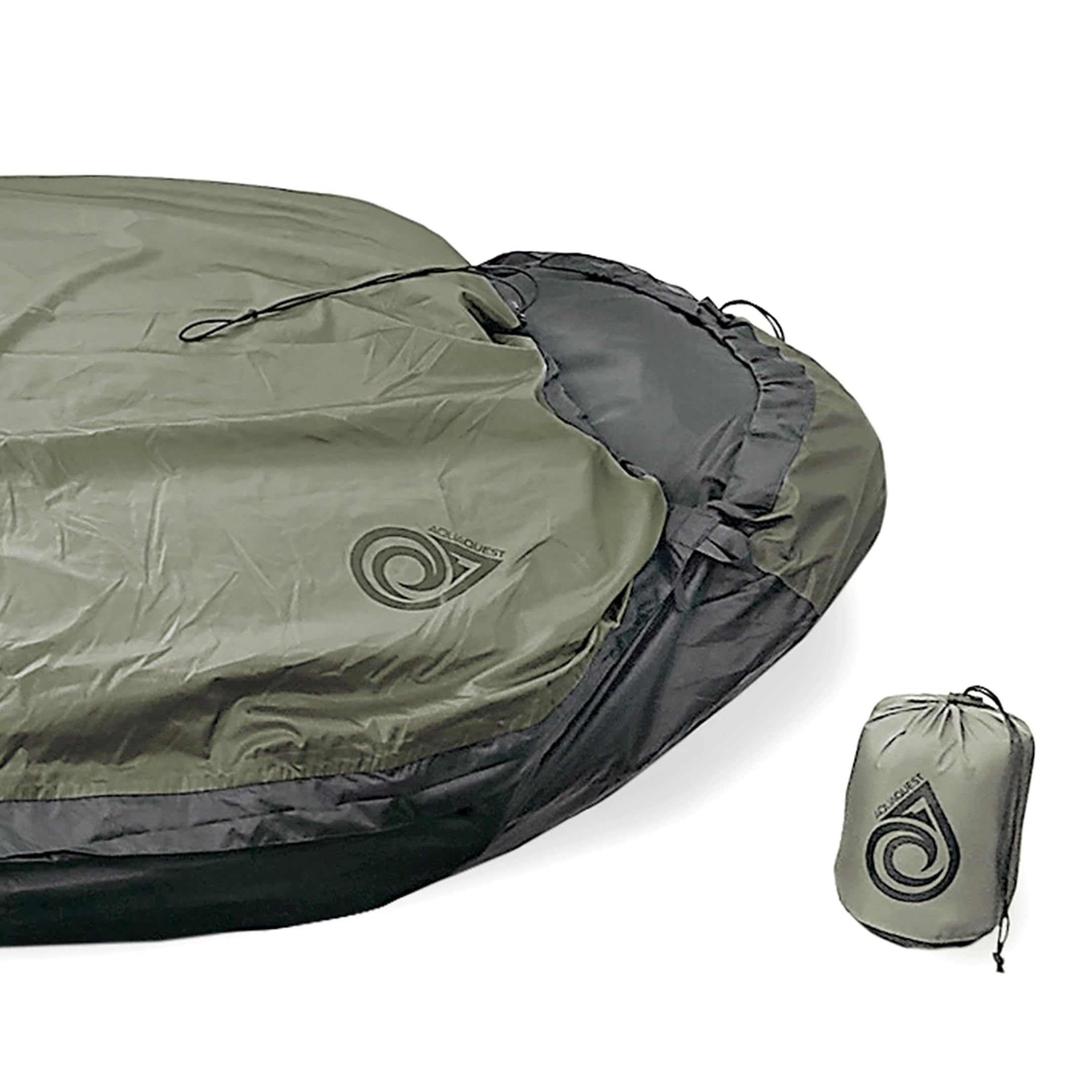
A tall-sleeper shell with a stated waterproof rating and dual zips both sides
Two numbers make the Pharaoh stand out: a waterproof rating of 10,000 mm and a moisture vapor transmission rating of 10,000 gr/m2/day. The first tells you it is rated to shed heavy rain; the second tells you the fabric is built to let your sweat vapor pass out, so it fights condensation rather than adding to it. Those figures come straight from the maker’s spec, and they put it among the more weather-rated sacks here.
You get a tougher fabric than the 20D and 40D shells in this group: the body is 70D nylon (a thicker, denser weave). Yet it weighs only 1.1 lbs and packs into a built-in cylindrical stuff sack measuring 9 inches long by 5 inches in diameter. Fit is a big part of the appeal: it is sized for users up to 6’6″, with dual YKK zippers (a trusted zipper brand) on both sides so you can open it from either shoulder. That makes late-night exits far easier than a drawstring neck.
Reviewers point out it keeps them dry in rain, and that is what people come back to — the waterproofing is what gets praised most, followed by build quality. It gives you the option to sleep out under the stars with no tent and stay put when drizzle moves in. The thing to know is that it is a shell alone with no insulation, so you still need a bag beneath it in the cold. Buy it if you are tall and want a rated, breathable bivy with zip access on both sides.
The case for it
- 10,000 mm waterproof and 10,000 gr/m2/day breathability ratings
- Fits users up to 6’6″ with dual YKK side zippers
- 70D nylon body, 1.1 lbs, built-in 9-by-5-inch stuff sack
What to weigh
- A shell only — no warmth on its own, you need a sleeping bag
- Dual zips mean more seams to keep sealed and cared for
Choose it for: tall campers who want a rated waterproof-breathable bivy they can enter from either side.
Don’t choose it for: insulation — this is a shell, so bring a bag for the cold.
8. Snugpak Bivvi Bag

The emergency shell so light you will forget it is in the pack
At 11 ounces with a stuff size of 5 by 4 inches, this Snugpak is the lightest full bivy in this lineup, and that tiny packed footprint is the whole pitch for an emergency layer. It is made of Paratex Dry fabric, described as completely waterproof and windproof, and the same shell is designed to wick moisture so the inside does not turn into a puddle overnight. The 90-by-33-inch body fits right over a sleeping bag as a protective outer layer.
Where it earns its keep is the role it plays: keep yourself warm and dry in sudden weather, then pack it away again. It is the sort of item that rides in a daypack or a summit bag and only comes out when the forecast turns. The windproof shell traps warm air inside, which is a real advantage when you get caught out without a tent.
The trade-offs are real and worth knowing. Getting in and out is awkward because the entry is a simple neck with a drawstring, and the thin fabric calls for care — a snag on rock can find it. Water resistance is fair in rain, though condensation can collect inside on cold nights. As a lightweight backup that vanishes into a pack, it delivers; as a nightly shelter, look up the Special Forces version below.
The honest read: an 11-ounce waterproof-windproof shell that packs to 5 by 4 inches and fits over a bag — brilliant backup, minimal shelter for sleep-filled nights.
Worth it for: hikers who want a barely-there emergency shell for daypack or summit bag.
Not the one for: nightly sleeping in bad weather, where the awkward entry and thin fabric frustrate.
9. Snugpak Special Forces Bivvi Bag

A zip-front Paratex shell for sleeping out night after night
The Special Forces takes the light Paratex Dry shell of the plain Snugpak and adds the upgrade that matters for real use: a half-length center zip. That turns getting in and out from a nightly hassle into a quick open-and-slide, which is the difference between a bag you sleep in and one you tolerate.
Sized at 90 by 33 inches, it fits over a sleeping bag as a protective layer. The Paratex Dry fabric is the same family the maker uses to keep the elements out while letting the inside breathe, so it suits a full night under the stars rather than just an emergency bivvy.
This is the version people actually sleep in — owners praise its quality and lightness, and it is a favorite of light-infantry types who need a shell that carries light and keeps a bag dry. The honest note is value: as the priciest sack on this list, the price-to-feature question comes up more than on the others, and durcomfort over seasons is a known point of care. If you will sleep in a bivy many nights and want zip entry with a near-featherweight pack weight, this is the one to reach for.
What makes it a nightly keeper
- Half-length center zip for easy entry every night
- Paratex Dry waterproof, windproof, moisture-wicking shell
- 12 ounces packed to 6 by 4 inches, sized 90 by 33 inches
The fine print
- The priciest sack here, so value gets questioned more
- Long-term durability over many seasons needs care
Pick it if: you sleep out often and want zip-front ease with a 12-ounce Paratex shell.
Think again if: budget is the deciding factor — the plainer covers do the same core job for less.
Know the Specs
Waterproof Rating
The waterproof rating, often stated in millimeters (like 10,000 mm) or in millimeters of water column (like 5.0mm), tells you how much water pressure the fabric can hold back before moisture pushes through. Higher numbers mean better protection in sustained rain. It is the first spec to check if you expect real weather rather than a passing shower.
Breathability Rating
Breathability is measured in moisture vapor transmission, stated in grams per square meter per day (like 10,000 gr/m2/day). It tells you how much sweat vapor the shell can pass out of the bag. A shell with a strong waterproof number but weak breathability traps condensation, so look for both figures stated together.
Packed Weight and Size
Weight in ounces or kilograms and packed size in inches or centimeters decide whether a bivy rides unnoticed in a pack or takes up real space. An emergency shell can pack tiny; a roomier cover weighs more. Match the packed figure to how you travel — car kit, daypack or thru-hike — rather than chasing the lowest number.
Closure Type
Closure is the way you get in — a drawstring neck, a side zip, a U-shaped opening or a half-length center zip. A zip is easier for nightly use; a drawstring is fast to seal when weather hits. Pick a zip if you will climb in and out nightly; pick a drawstring if you only seal it once in a storm.
Common Questions
Is a waterproof bivy sack as good as a tent?
Why does my bivy get condensation inside?
Will a bivy sack fit over my sleeping pad?
What is the difference between a bivy sack and a bivy cover?
How tall a person can a bivy sack fit?
Can I machine-wash a waterproof bivy sack?
Do I still need a sleeping bag inside a waterproof bivy?
How much does a waterproof bivy sack weigh?
Is a bivy warmer than a tent?
The Bottom Line
For most people the Best Waterproof Bivy Sack winner is the Ironstripe Bivy Sack XL. It pairs the most room in the group — 94.5 by 49.2 inches — with a tear-resistant, reinforced shell and a two-pack kit that suits an emergency bag or a car trunk. If you want a roomy, heavy-duty cover you can sit on and stretch out, reach for the Mil-Tec Trilaminate cover with its 5.0mm water column (a measure of how much water pressure the fabric holds back). And for tall hikers who want a rated, breathable shell with zip entry on both sides, the AquaQuest Pharaoh is the one to grab.
How we choose
We do not accept paid placement. Every pick is matched to a real buyer and a real use-case; we do not hands-on test units.
Sources
Specifications: manufacturer listings and product documentation. Review insights: verified customer reviews, as of November 2026. Pricing: not shown on this page (it changes often); check the current price via the retailer link.
As an Amazon Associate, Tactical Gear Guy earns from qualifying purchases. This does not affect which products we feature.