Specs are compiled from manufacturer listings and verified buyer reviews and can change over time — please confirm the key details on the product page before buying.
If you want the short answer, buy the box built specifically for the job you are powering, not the cheapest shell you can find. A waterproof battery box is a sealed enclosure that keeps rain, spray and road grit off your 12V battery while giving you ports or cable exits to actually use the power. A gasketed lid and the correct group size are what keep your battery dry and your terminals clean season after season.
This guide is built by comparing the manufacturers’ published specifications and the patterns across verified customer reviews, so you get each pick’s real strengths and trade-offs instead of marketing spin.
Match the box to your battery group size, check how the lid seals, and count the ports you truly need before you buy. That is the whole game with a waterproof battery box.
Top Picks


How To Choose The Best Waterproof Battery Box
The wrong box fails in two quiet ways: water sneaks past a lid that only looks sealed, or the battery will not drop in because the group size was never checked. Both problems are avoidable if you check three things before you commit — what battery you are protecting, how the water stays out, and what you need to plug in.
Start with your battery, not the box
Battery group size is a standard footprint number, and it decides whether your battery fits at all. A Group 24 battery is the smaller common size, Group 27 sits in the middle, and Group 31 is the big one. Check your battery’s label, then check the box’s listed maximum battery dimensions — not just its outside dimensions. Terminals, cable lugs, and the bend radius of thick wires all eat into that space, so leave room. A good box spec will tell you the max battery size it accepts, like 13.0″ L × 7.5″ W × 10.0″ H on one of the stainless picks here.
How the seal actually works
A “waterproof” label on a listing is a claim; the lid overlap, rubber cable rings and raised floor are the proof. Look for a lid that overlaps the body rather than sitting flat on top, rubber rings around every cable exit hole, and a concave or raised bottom that keeps the battery off standing water. On ported boxes, rubber covers over the USB and lighter sockets matter as much as the lid — those are the openings that face the weather when you are actually plugged in.
Ports, fuses, and switches
If the box is just a shell, you wire your own leads. If it is a power center, count the ports before you buy: a cigarette lighter socket, USB-A and USB-C charging ports, Anderson connectors, and terminal posts are the usual set. Check what protection those ports carry. A replaceable blade fuse on high-current ports and a resettable circuit breaker on the lighter socket are the safety parts that stop one bad connection from frying your electronics. A master on/off switch earns its keep too — it stops the slow drain that kills a battery left sitting in the shed.
Side-by-Side Comparison
| Model | Best For | Battery Fit | Amperage | Build Material | Amazon |
|---|---|---|---|---|---|
| Yak-Power YP-BBK Power Pack★ Best Overall | Kayak electronics | Up to three 7AH or two 12AH | 15 A | Waterproof compact housing | Amazon |
| Briidea Battery BoxBudget Gate Pick | Gate openers and deer feeders | One or two 12V 7AH lead-acid | — | Sheet metal | Amazon |
| Stealth Cam 12V BatteryTrail Cam Favorite | Trail cameras in cold weather | 12V lead-acid (no batteries included) | 12 A | Weatherproof plastic | Amazon |
| HOSOCASE Hard Case for Dewalt 20V | Tool battery storage and transport | 12V/20V/60V batteries, 9 compartments | — | Polypropylene | Amazon |
| DR.PREPARE Trolling Motor Smart Box | Marine, RV and solar power center | Group 24/27/31, up to 77 lbs | — | Plastic | Amazon |
| Peastorm Steel Battery Box (Group 27) | Trailer and boat relocation | Group 27 | — | Steel with black coating | Amazon |
| Sidasu Stainless Steel Box | Long-term marine mounting | Group 24/27, max 13.0″ × 7.5″ × 10.0″ | — | Stainless steel | Amazon |
| Peastorm Lockable Adjustable Box | Mixed battery sizes | Group 24/27/30/31 (adjustable baffle) | — | Stainless steel | Amazon |
| CINVEI Steel Battery Box Kit | Gate opener kit with batteries | Two 12V 7AH lead-acid (included) | 7 A | Sheet metal | Amazon |
Detailed Reviews
1. Yak-Power YP-BBK Power Pack Battery Box
Our pick — 4.5+★ from 100+ verified ratings; the strongest balance of quality and price.
The one box here that turns a bare kayak hull into a working 12V power station.
The Yak-Power YP-BBK is the only pick on this list that arrives ready to power gear instead of just hold a battery. It runs at 15 amps, and that number matters — the Stealth Cam kit on this list is rated 12 amps, so the Yak-Power carries a higher ceiling for whatever you plug in. Its sealed housing can swallow up to three 7AH batteries or two 12AH batteries and still stow small enough to slide into many kayak hatches.
You get a working power center on the front face, not just a plastic shell. An integrated power port lets you plug in a fish finder or other 12V accessory, a master power switch stops you draining the battery bank all day, and a dual external USB charging port keeps a phone and an action camera topped up while you fish. It also ships with a home battery charger that maintains the bank, so you leave the dock with a full charge instead of a guess.
Buyers report it is easy to actually use in the yak — performance is what wins people over most, called out far more than anything else in the reviews, with the fish finder power and the money-to-value read close behind. One connection detail is worth memorizing: the box uses Yak-Power’s own snug-fitting SAE connectors (a push-together plug style), and they only work reliably when fully pushed home. That is the trade-off — a purpose-built connector system you must seat properly every time, not a generic plug you can force. It is the crowd favorite here at 4.5+ stars across 100+ ratings.
Why kayak anglers keep it in the boat
- Built-in power port, master switch and dual USB on one sealed face
- 15 A rating beats the 12 A trail camera kit on this list
- Holds three 7AH or two 12AH batteries and still fits many hatches
- Home charger included so the bank is topped off before launch
Before you clip it in
- SAE connectors must be fully pressed together or you lose the connection
- Batteries are not included, so budget for them separately
- It is a kayak-tuned system, not a drop-in shell for any battery
Worth it for: kayakers and small-boat anglers running a fish finder plus phone and camera off one battery bank.
Look past it for: plain trailer storage where you just need a lid over a Group 27 battery.
2. Briidea Battery Box
A metal shell built to shrug off snow, rain and wind at a gate post.
Briidea takes the steel route here, and that is the whole pitch. The shell is sheet metal rather than plastic, so it stands up to the weather and to knocks from a mower or a swinging gate arm far better than a thin plastic tub. Inside it holds one or two 12V 7AH lead-acid batteries, with a sealed tray that keeps acid leaks away from the control board underneath.
The box is aimed squarely at the outdoor gate world: vehicular swing gates, door openers and deer feeders, and it is listed as compatible with the Ghost Control line. It fits the Ghost Control ABBT door openers directly, and as long as your batteries are charged, it keeps the opener running through a long stretch of use. Setup is straightforward — drop the battery in, connect the leads, mount the lid, and it is working.
The honest catch is the one the listing puts in capital letters: no batteries are included. You buy the metal box and add the cells, which adds up. Weighing in at 1.81 kg, it is a small, tidy, no-frills enclosure that does one job cleanly.
What you are paying for: a metal lid, an acid-contained tray and a fit for common opener hardware. Nothing digital, nothing to go wrong in the rain.
The trade-off: plan to buy the batteries separately, and treat this as a gate or feeder box rather than a power-station with ports.
Buy this if: you have a gate opener or feeder that needs a battery kept dry and out of the weather.
Set it aside if: you want built-in USB or lighter sockets — this one is storage plus protection, full stop.
3. Stealth Cam 12V Battery
A complete trail-cam power kit, cable and all, that laughs at a hard frost.
This Stealth Cam kit is built around one job: keeping a trail camera alive through cold deer season. It runs at 12 amps and comes as a full kit — a weatherproof box with a watertight seal, an AC charger, a hanging strap, and a 10ft stainless steel mesh-covered cable for reaching a camera mounted away from the box. The mesh covering matters; it adds a layer of chew-and-scrape resistance that a bare wire does not have, so a squirrel or a branch is less likely to end your season early.
The sealed lid is the star. Owners talk about the quality of the build more than any other single thing, with performance right behind — and the cold-weather performance comes up specifically. It is commonly matched to Spypoint cell cameras, and it takes the sting out of feeding a camera a fresh set of alkalines every few weeks. Portability in the field is another point in its favor, with the whole kit light enough at 10.24 ounces to toss in a pack.
The catch is twofold and worth knowing up front: the connector can come tight enough to fight you, so seat it firmly but gently. And battery life feedback is genuinely split — some stretches run long, some fall short, which usually points to the camera’s own settings and the cold as much as the box. The strap is for hanging the box, not swinging it by the cable.
The verdict from the field: the value read is strong here — a charger, cable and box together beat buying alkalines over and over.
Where it stumbles: a tight connector and mixed battery-life reports mean set your expectations around a kit, not a guarantee.
Reach for this if: you run a trail camera in cold country and want one box, one charger and one cable that arrive together.
Skip the bundle if: you already own a charger and cable and just want the bare shell.
4. Hard Case for Dewalt 20V Battery
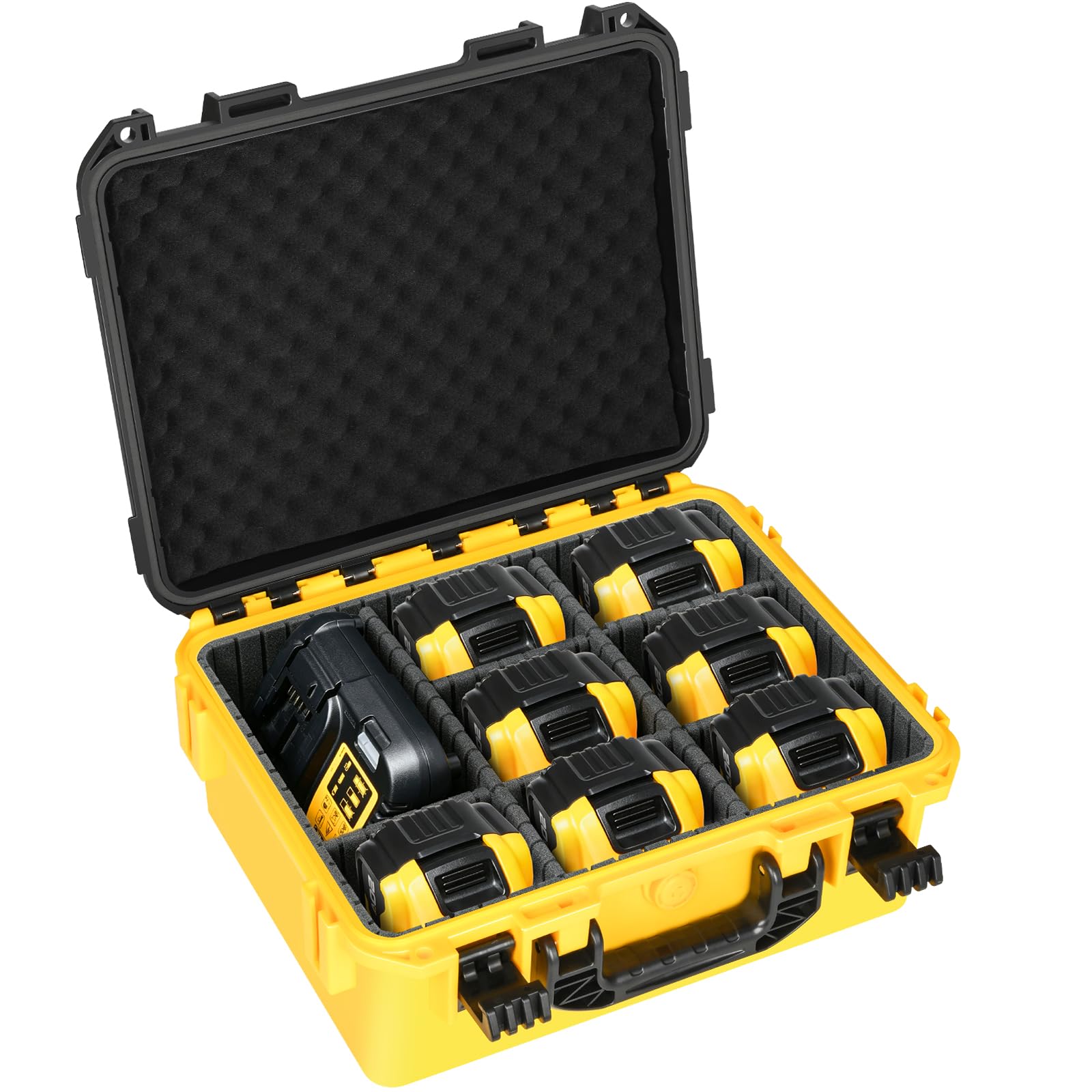
A hard-shell organizer that keeps a whole drawer of tool batteries from rolling around.
This is not a 12V marine box, and it does not pretend to be. It is a polypropylene hard case rated waterproof, built to carry and protect 12V/20V/60V tool batteries, a charger and accessories. Nine compartments sit inside, and the dividers adjust so you can widen a slot for a charger brick or squeeze down for smaller batteries. The outside dimensions run 11.42″ L x 6.8″ W x 13.98″H, so it lives in a truck bed or shelf without hogging everything else.
Buyers keep coming back to the sheer quality of the shell, with the battery capacity it holds and the value it delivers next in line. Owners talk about keeping every battery in one place instead of scattering them, and the adjustable compartments and portability get named too — it is as good for hauling to a job site as it is for shelf storage. Protection from the outside world rounds out the praise, which is what a hard case is for in the first place.
The one thing to internalize before you buy: this is case only. No battery comes with it, whatever the listing title advertises about capacity — you are buying the organizer, not the power.
The organizing win: nine adjustable slots turn a messy battery pile into a sorted, transportable kit.
Know before you order: it holds tool batteries, not a single deep-cycle 12V, and the case is empty on arrival.
Pick it for: organizing and carrying a mixed herd of tool batteries between home and job site.
Pass if: your goal is waterproofing one big marine or trolling battery in the elements.
5. DR.PREPARE Trolling Motor Smart Battery Box
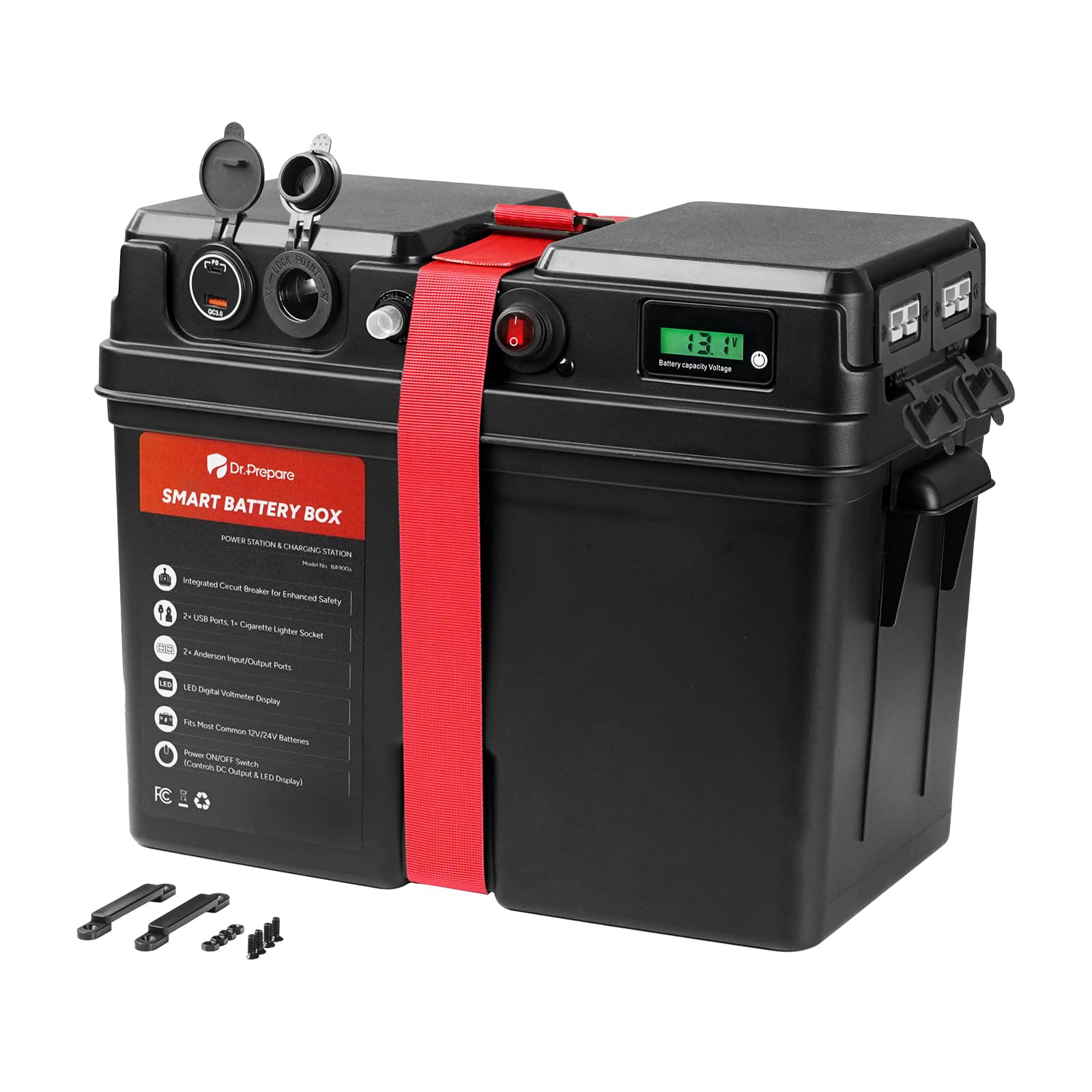
The only marine box here that turns a deep-cycle battery into a full power center.
DR.PREPARE packs more into one shell than any other pick. The box fits Group 24, 27 and 31 batteries with a maximum carrying capacity of 77 lbs (35 kg), and it handles both 12V and 24V deep-cycle systems. Around that battery it builds a whole front panel: a 12V/24V cigarette lighter socket, USB-C PD, USB-A QC 3.0, dual Anderson input/output ports, and high-current terminal connectors. You drop your battery in and it becomes a portable power center for a trolling motor, an RV or a solar setup.
The safety engineering is where the value lives. Each Anderson port gets a 30A replaceable blade fuse, and a 10A resettable circuit breaker guards the USB ports and lighter socket. An on/off switch kills the standby drain when you are not using it, and an LED screen shows live battery voltage and flags a low battery before you are stranded. The shell is also built to shield the battery from water, dirt, oil, gasoline and UV rays, with rubber port covers keeping dust and spray out of the sockets.
Reviewers keep landing on quality first, with functionality next. The honest note is stability — the power switch not staying put comes up, so a firm hand on that switch helps. Two reminders from the maker matter: never connect a solar panel straight to the Anderson port (a two-pin DC connector) without a charge controller (a device that stops a panel overcharging the battery), and never lift the box by its securing strap — use the dual side handles, because the box weighs 4 pounds empty and a 77 lbs battery is no joke.
What the panel gets you
- USB-C PD, USB-A QC 3.0, cigarette socket and dual Anderson ports in one unit
- 30A blade fuses on Anderson ports and a 10A breaker on the USB/lighter side
- LED voltage readout plus a low-voltage alert
- Handles 77 lbs and the 12V/24V split for trolling and solar setups
The housekeeping it demands
- The power switch can work loose, so check it stays seated
- Never wire solar straight to Anderson — a charge controller is required
- Lifting by the strap can fail; use the handles
This is your box if: you want one marine enclosure that charges phones, runs a trolling motor and reads voltage off a screen.
Think twice if: you prefer a plain lid-and-latch shell with no electronics to manage.
6. Trailer RV Marine Battery Box Group 27
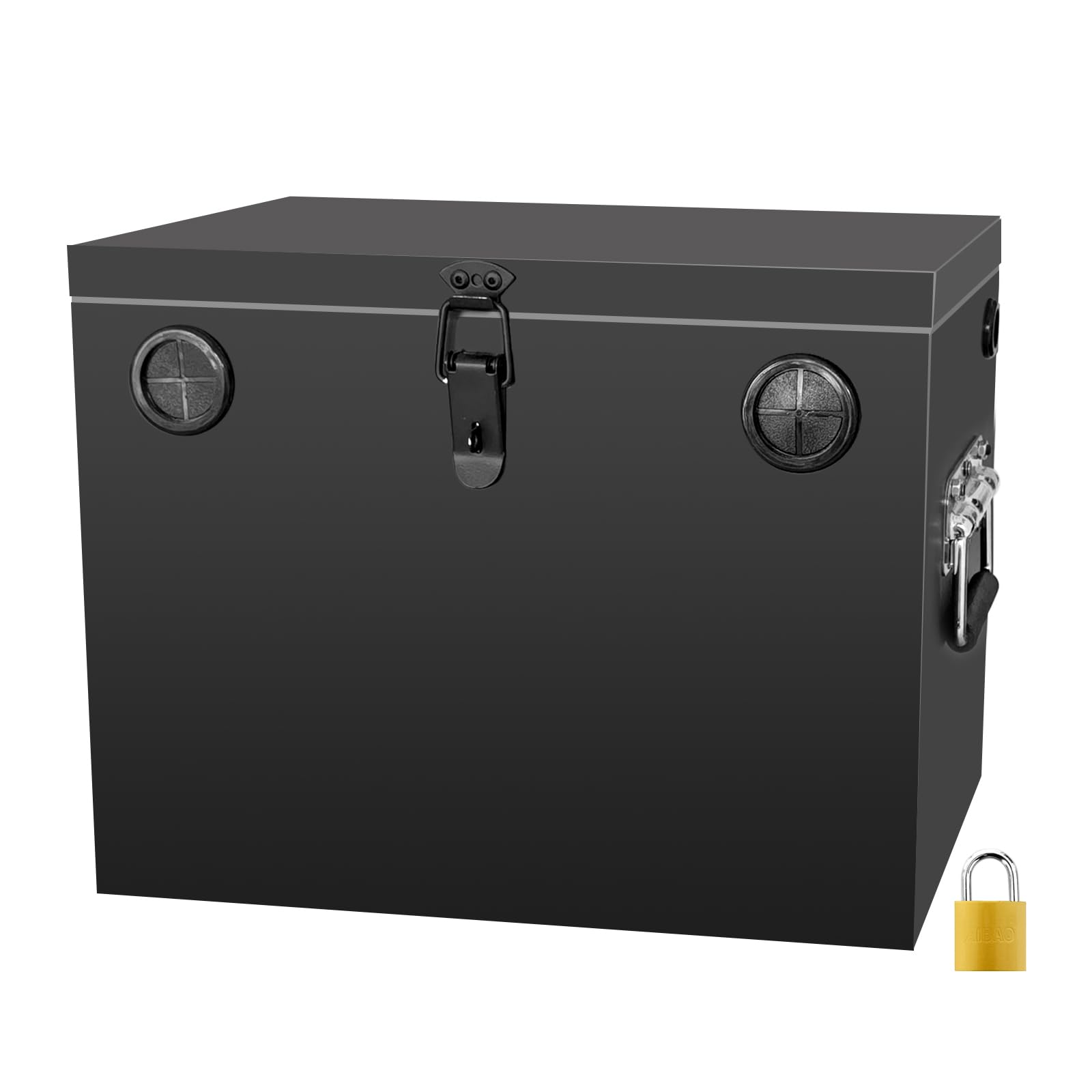
A locked steel shell for Group 27 batteries that has to live outside all year.
Peastorm builds this one out of quality steel with a black spray coating, and the coating is doing real work — it is what stands up to sun, rain and the occasional rock kicked up by a trailer while keeping the box fireproof. It is sized for the Group 27 battery (a common 12V size), with a max capacity of 13.78″ L x 7.8″ W x 11″ H inside and external dimensions of 14 L x 8 W x 11.25 H. Measure your battery’s length, width and height before you order; a steel box has no give.
The design details are what lift it above a plain tub. Handles sit on both sides for carrying, the upper cover locks with a lock included, and the reserved cable holes are lined with rubber rings so wires pass through without chafing or letting water in. Fixing holes at the bottom come with screws, so the box bolts down to a trailer or boat deck instead of sliding. Construction and fit are what the reviews focus on, with the fit for a larger battery getting specific mention.
The thing to check is the one the maker repeats: some oversized batteries simply will not fit, so measure first. At 4.79 kg it is a solid, weighty box — that heft is the point when it is bolted to a moving trailer.
Built to stay put: steel body, lockable lid, rubber-lined cable holes and bottom screws turn it into a permanent fixture.
Measure twice: it is Group 27 only — a Group 31 cell will not drop in.
Good fit for: trailer and RV owners bolting a Group 27 battery down outdoors and wanting it locked.
Mismatch if: you have a larger Group 31 battery or want an adjustable interior.
7. Stainless Steel Battery Box Group 27

Stainless steel and a concave floor — the marine box that fights rust and puddles at once.
Sidasu goes premium on the material: high-quality stainless steel with a black anti-rust paint coating, which is exactly the spec that matters on a saltwater dock. The box fits a single 12V battery and takes most Group 24 and Group 27 cells, with a max recommended battery size of 13.0″ L × 7.5″ W × 10.0″ H. It is waterproof, sunproof and fireproof per the maker, and the lift-off lid locks.
Two design touches stand out. The top cover is shaped to shed water rather than let it pool and seep, and the bottom is concave so the box sits improve off the ground — away from standing water soaking into the base. Handrails on the sides make it easy to lift, a rubber ring stops unwanted conductivity, and detachable non-slip feet keep it steady on a deck.
Sturdiness is what owners key on most, with the size right behind. The caveat is the same one that plagues every steel Group 24/27 box: oversized batteries with bulky terminals and cable bends may not clear that 13.0″ × 7.5″ × 10.0″ ceiling. Give your terminals and wire room before you commit. Weighing 4.24 kg, it feels like a serious piece of marine gear the moment you lift it.
The stainless argument: anti-rust coated steel, a water-shedding lid and a raised floor add up to long-term marine mounting.
Clearance warning: terminals and thick cable bends eat into the recommended interior size — check before you buy.
Best matched to: boat and trailer owners who want stainless steel, a lockable lid and a floor that stays out of puddles.
Not the one if: you need to squeeze in a Group 31 or a battery with fat top posts.
8. Lockable Car/RV/Marine Battery Box Group 24-31

The stainless box with an adjustable baffle, so one shell covers four battery sizes.
Here is the box to reach for when you are not sure which battery you will end up with. Peastorm builds it from stainless steel with a waterproof, sunscreen and fireproof finish, and it fits Group 24, 27, 30 and 31 batteries — the widest spread on this list. The trick is an adjustable baffle inside, a movable wall that slides to grip a smaller battery or opens up for a big one. Max capacity runs 14″ L x 7.8″ W x 10″ H inside, with external dimensions of 14.2 L x 9.1 W x 10.6 H.
The hardware matches the other steel pick: handles on both sides, a lockable top cover with a lock in the box, rubber rings protecting the reserved cable holes, and bottom fixing holes with screws to bolt it down. It carries an appearance patent, and the lift-off lid plus latch closure keeps the cover seated on the road.
The catch is straightforward: the adjustable baffle covers the group-size spread, not every battery shape. Even with the widest range here, you still measure before you buy — a tall post setup can defeat a box that fits the footprint. At 10 pounds it is the heaviest of the stainless shells, which is a good sign for something meant to hold a battery still at highway speed.
Why the baffle matters: one box spans Group 24 through 31, so a battery upgrade later does not mean a new enclosure.
Still measure: footprint flexibility does not fix a battery that is too tall with its posts and lugs.
Buy it when: you want stainless steel plus the freedom to swap between Group 24 and Group 31 batteries.
Elsewhere if: you want a fixed-size box that grips one battery group exactly.
9. Upgraded Steel Battery Box with 2 Batteries Kit

The only gate box here that shows up with both batteries already in the kit.
CINVEI sells this as a full gate-opener package, and that completeness is the draw. You get the metal waterproof box with a sliding lid, a wiring harness with a 4′ cable, two 12V 7AH lead-acid batteries, screws, locks and labels — nothing else to buy to get a swing gate moving. It runs at 7 amps and supports 12/24V through series and parallel wiring, so it matches 12/24V gate openers including the Mule and ABBT-style setups. Two mounting styles are built in: hanging or direct mounting.
The batteries are UL recognized, and the metal shell is waterproof to keep the elements off them. On the things buyers actually notice, the compatibility with gate openers and the easy-to-install power cable are the clear wins — the wiring harness is long enough at 4 feet to reach the control box without a fuss.
The real caution is the batteries themselves. Battery life is the honest weak spot here — the reports cluster around cells that quit well short of a year, and the general quality read is genuinely mixed. Treat the included batteries as a starter set and plan to replace them with a better pair when they give out; the box and harness are the lasting part.
The convenience play: box, harness, batteries, locks and labels arrive together and work with 12/24V gate openers out of one package.
The honest weak spot: included batteries do not last long for many buyers — budget for better replacements and keep the steel box.
Right choice for: someone fitting a 12/24V gate opener who wants every part in one box and can swap batteries later.
Not ideal if: you already have good batteries and just need a waterproof enclosure for them.
Know the Specs
Battery group size and interior clearance
Group size is the standard footprint number stamped on a battery — Group 24, 27, 30 and 31 are the common ones for marine and gate work. The number in the box name does not guarantee a fit because the interior is tighter than the outside; terminals, cable lugs and wire bends all claim space. Always compare your battery’s dimensions plus a little breathing room against the box’s listed maximum battery size, not its external dimensions.
Amperage and voltage ratings
Amperage (amps, written A) is how much current a box’s wiring and connectors are built to carry. A box rated at 15 A can pass more current than one rated at 12 A, which gives you more headroom for accessories like a fish finder or trolling motor. Voltage tells you what battery system the box serves — 12V for most single-battery setups, and 12/24V boxes that can be wired in series or parallel for larger gate and marine systems.
Sealing and weatherproofing details
A waterproof claim is backed by design, so check the lid overlap, cable-hole rubber rings and raised floor. An overlapping, water-shedding lid keeps rain from pooling; rubber rings around cable holes stop water creeping down a wire; a raised or concave floor keeps the battery off standing water. On boxes with USB, lighter or Anderson ports, rubber port covers are the last line of defense once you plug something in.
Fuses, breakers and switches
A replaceable blade fuse is a small sacrificial link that blows to protect the wiring from a current spike; a resettable circuit breaker trips the same way but can be reset by hand. Both protect expensive accessories. A master on/off switch stops the small standby drain a box pulls even when nothing is plugged in, which is what quietly kills a battery between trips.
Common Questions
Will a Group 31 battery fit in a box listed as Group 27?
How does a waterproof battery box actually keep water out?
Do I need a steel or a stainless steel box?
Can I connect a solar panel straight to a battery box’s Anderson port?
What is the difference between a 12V and a 24V battery box setup?
Are batteries included with these boxes?
How do I stop a stored battery draining between trips?
Can one of these boxes run a trolling motor?
Will a tool battery case keep my tool batteries dry outdoors?
What should I check first if my gate opener eats batteries?
The Bottom Line
The strongest all-round buy in this list is the Yak-Power YP-BBK Power Pack because it is the only pick that arrives as a working 12V power center — a 15 A box with an integrated power port, master switch and dual USB, sealed to keep a kayak hatch dry. If you want a stainless shell that adapts as your battery changes, the Peastorm adjustable stainless box spans Group 24 through 31. And for a gate opener with every part in one box, the CINVEI kit gets you running today — just treat its included batteries as a starter set. Match the box to your battery’s group size, seal every cable exit, and your 12V power will be there season after season.
How we choose
We do not accept paid placement. Every pick is matched to a real buyer and a real use-case; we do not hands-on test units.
Sources
Specifications: manufacturer listings and product documentation. Review insights: verified customer reviews, as of November 2026. Pricing: not shown on this page (it changes often); check the current price via the retailer link.
As an Amazon Associate, Tactical Gear Guy earns from qualifying purchases. This does not affect which products we feature.