Specs are compiled from manufacturer listings and verified buyer reviews and can change over time — please confirm the key details on the product page before buying.
What separates a dry bag that works from one that soaks your sleeping bag is not the brand logo — it is the seal, the material, and whether you roll the top correctly. Buy the Earth Pak if you want the one most paddlers settle on. Buy the Osprey if small and light matters more than volume. Buy the Malo’o if you are hauling expedition loads. Everything else in this list fills a specific gap in between, and each pick below tells you exactly where it lands.
This guide is built by comparing the manufacturers’ published specifications and the patterns across verified customer reviews, so you get each pick’s real strengths and trade-offs instead of marketing spin.
A roll-top sack only works when the closure is rolled tight and clipped, so the picks here are ranked on seal type, fabric weight, and real capacity. This list of the best waterproof bag for kayaking covers every budget and load size.
Top Picks


How To Choose The Best Waterproof Bag for Kayaking
Your gear gets wet from three directions on a kayak: spray over the bow, water sloshing in the cockpit, and the bag going overboard at the worst moment. A dry bag only solves all three if the closure seals properly and the fabric holds up to being stuffed, dragged, and dropped. Here is what actually matters before you pick one.
The Closure Is the Whole Ballgame
A roll-top closure (you fold the top edge down several times, then clip the buckle) is the standard for kayaking because it creates a mechanical seal with no zipper teeth to fail. The trick is rolling it enough. Most makers call for three tight rolls before you clip, and a bag that is only rolled once will let water in through the folds. A buckle with a safety clip, like the one on the COR Surf, adds a second lock so the seal does not pop when the bag gets bumped in the hull.
Submersion Rating vs Splash Rating
An IPX rating tells you how much water the bag is built to shrug off. IPX8 means it is rated for continuous immersion, which is what you want if the bag might go under. IPX6 handles heavy spray and waves but is not built for being held underwater. IPX5 covers splashes and rain only. Match the rating to your worst-case scenario, not your average day.
Fabric Weight and What It Survives
Fabric weight is measured in denier (D), which is a measure of thread thickness — higher numbers mean a thicker, tougher weave. A 500D PVC bag like the Earth Pak or the Malo’o is built to take abrasion from rocks, sand, and the floor of a kayak. A 70D nylon bag like the AquaQuest Rogue is much lighter and packs smaller, but it is a thinner fabric that demands more care around sharp edges.
Capacity: Liters Lie a Little
Listed capacity in liters is measured with the bag fully open and uncompressed. Once you roll the top down three times, you lose a chunk of that space. A 20L bag holds a day’s clothes, a towel, and a phone pouch comfortably. A 6L sack is really a phone-and-keys bag. Be honest about your load before you buy, because an overstuffed bag will not roll shut properly and that defeats the entire seal.
Side-by-Side Comparison
| Model | Best For | Capacity | Closure | Material | Amazon |
|---|---|---|---|---|---|
| Earth Pak Waterproof Dry Bag★ Best Overall | All-around kayak days | 20 liters | Roll top, buckle | 500D PVC | Amazon |
| Osprey Ultralight Dry SackFeatherweight Pick | Minimalist day trips | 6 liters | Roll top | Nylon | Amazon |
| COR Surf Floating Dry BagFloating Value | Overboard recovery | 10 liters | Roll top, safety buckle | 500D PVC | Amazon |
| Lamicall Dry Bag Backpack | Camera and gear hauling | 40 liters | Roll top, buckle | 500D PVC | Amazon |
| AquaQuest Rogue Dry Bag | Packing inside a pack | 20 liters | Roll top | 70D nylon | Amazon |
| Pelican Exodry Dry Bag | Visibility on the water | 20 liters | Roll top | — | Amazon |
| CRESSI Ocelot Dry Bag | Dive and paddle days | 20 liters | Roll top, buckle | PVC-coated polyester/nylon | Amazon |
| MIER Roll Top Dry Backpack | Commute-to-water crossover | 30 liters | Roll top | TPU | Amazon |
| Malo’o Waterproof Dry Duffel | Expedition loads | 100 liters | Roll top | 500D PVC | Amazon |
Detailed Reviews
1. Earth Pak Waterproof Dry Bag
Our pick — 4.5+★ from 33,000+ verified ratings; the strongest balance of quality and price.
The one bag that covers a whole kayak day and throws in a floating phone case.
Start with the numbers, because they are why this sits at the top. You get 20 liters of space, a 1.1-pound bag, and abrasion-resistant 500D PVC — thick, tough fabric measured by thread weight (denier), where 500D is built to shrug off rocks, sand, and the floor of a kayak. The roll-top closure clips shut with a buckle, which is the seal type that holds up on moving water. It was named one of the top dry bags of 2024 by The New York Times Wirecutter, and it carries a five-year warranty.
The included IPX8 phone case is the detail that earns its keep on a kayak. IPX8 means it is rated for continuous immersion, so you can shoot photos through the dual clear windows without pulling your phone out into the spray. That case fits phones up to 6.5 inches. If you would rather carry the bag on your back, the 30L, 40L and 55L versions add backpack-style straps with a sternum strap, and the 55L also gets a heavy-duty waist belt for extra support.
What wins people over is the build quality — the biggest praise category by far, with functionality and water resistance right behind it. Buyers report it kept gear dry through five hours of river time with no leaks. One owner summed up the everyday use: “works great for paddle boarding.” It is also roomy enough for a change of clothes and a towel without fighting the roll-top shut. The honest catch is that the shoulder strap setup depends on which size you pick — the 10L and 20L get a 24 to 42 inch adjustable shoulder strap, while the backpack straps only appear from 30L up. Check the size chart before you assume you are getting backpack straps.
What earns it the top spot
- Abrasion-resistant 500D PVC in a 1.1-pound bag
- IPX8 phone case included, fits phones up to 6.5 inches
- Six sizes from 5L to 55L, so you can match your exact load
- Five-year warranty and a third-party Wirecutter pick
Where it needs a check
- Backpack straps only on the 30L and larger versions
- The 55L waist belt is extra hardware you may not need for a short paddle
Reach for this if: you want one bag that covers a full kayak day, keeps your phone dry and shootable, and comes with a warranty that outlasts most trips.
Look at the size chart first: the backpack straps only show up on the 30L and larger bags, so a 20L buyer gets a shoulder strap instead.
2. Osprey Ultralight Waterproof Dry Sack
At 1.12 ounces, this sack weighs less than a deck of cards and disappears into a daypack.
The defining figure here is 1.12 ounces — about the weight of a few sheets of paper folded up. That is the whole point of this bag. It is a 6-liter sack in nylon with waterproof-coated fabric and seams, and a rectangular shape (11.4H x 7.1W x 5.5D inches) that packs flatter against a kayak bulkhead than a round-bottom bag. For scale, the Lamicall below holds 40 liters to this bag’s 6 — a 6.7x gap. This is not the bag you take for a weekend; it is the bag you take when you already have a pack and need one dry pocket for a phone, keys, and a layer.
What it does well is what a kayaker actually needs from a small sack: it disappears into the hull without adding bulk. The roll-top closure and coated seams meet IPX5, which is a splash-and-rain rating, not a submersible one — so keep it clipped inside the boat rather than trailing it off the stern. There is a D-ring for drying it out or clipping it to your rigging.
What wins people over is the workmanship, followed by how versatile it is for organizing day-hike gear. The lightweight build and moisture resistance get consistent praise. Durability is a mixed bag — plenty of owners find it sturdy, but a thin nylon sack rewards careful packing around sharp-edged gear. The honest limit: this is a splash-rated bag. If your kayak trips involve the bag going fully under, size up to something IPX6 or IPX8.
Who this fits: the paddler who already carries a pack and wants a near-weightless dry pocket for a phone, keys, and a layer — the kind of buyer who counts ounces.
The trade-off to know: IPX5 covers splashes and rain only, so this is a stow-it-inside-the-hull bag, not a tow-it-behind-you bag.
Suit the gram-counters: a 1.12-ounce nylon sack with a D-ring for clipping and drying, best used as an inner dry layer inside a pack.
Not your bag if: you need a submersible hull bag or anything approaching weekend volume.
3. COR Surf Floating Waterproof Dry Bag
A bag that floats when sealed, so an overboard drop is a retrieval, not a loss.
Here is the feature that matters most on choppy water: this bag floats when properly sealed. Go over, and you can spot and fish it back out instead of watching your keys sink. The 10-liter version is the one in the table, made from 500D PVC (a thick, abrasion-resistant fabric) with a roll-top closure. Roll it three times, clip it shut, and the seal holds.
The buckle has a built-in safety clip and a push-button design to keep the seal from popping when the bag gets bumped or tossed around the cockpit. That matters because a seal that opens mid-paddle is worse than no seal at all. Every bag comes with a removable, adjustable shoulder strap (24 to 42 inches), and reinforced D-rings and double-stitched seams handle heavier loads. Sizes run 3L, 5L, 10L, and 15L, with 3-packs and 4-packs available if you want to split gear across several bags.
What people like most is the overall build, with the sizing a close second — the 5L size gets singled out for holding personal and valuable items. The honest caveat here is water resistance: most owners find it keeps gear dry on the boat, but a few report leaks, so seal discipline is everything. Roll it tight three times every trip. This is a strong pick for a day bag on a lake or calm river, and a fair one for whitewater where the bag might get dragged.
The floating angle: a sealed roll-top traps air, so this bag stays on the surface if it goes over — the practical insurance a kayaker wants for a phone and keys.
The catch worth knowing: water resistance draws some mixed notes, so treat the three-roll seal as non-negotiable rather than optional.
Ideal for the day-tripper: a floating 500D PVC bag with a safety-lock buckle, built for calm rivers, lakes, and beach launches.
Think twice for: whitewater where the bag could get roughed up, since water resistance is the one area owners flag.
4. Lamicall Dry Bag Waterproof Backpack
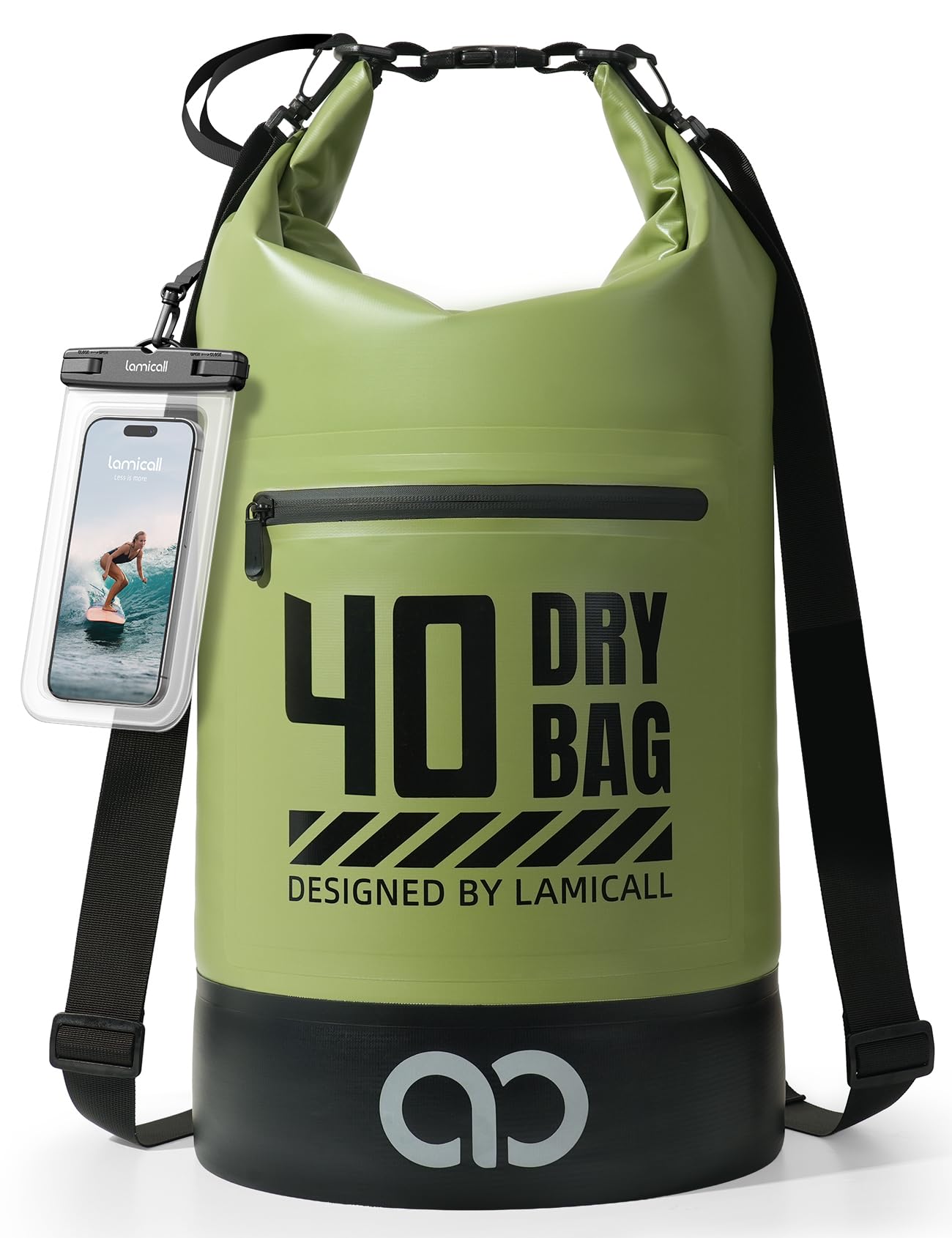
The 40-liter backpack that swallows a camera kit and still straps to your back.
Capacity is the headline: 40 liters, the largest volume among the roll-top bags here short of the Malo’o duffel. That is enough for a camera body plus multiple lenses, a change of clothes, and a lunch in one bag. It is built from high-density 500D PVC with airtight welded seams, and the main compartment traps air when sealed so the bag floats if you drop it overboard. It carries an IPX6 rating, which means it is built to handle heavy rain and sea waves — not continuous submersion, so keep the top rolled shut and clipped.
The 40L gets two fully adjustable, detachable shoulder straps for backpack-style carry, which is a real difference from the single-strap sacks once you are hauling a heavy load over rocks. It also includes an IPX8 phone pouch that fits smartphones up to 7 inches — a second layer of protection for a device that would otherwise ride loose in the hull. The seal is a three-step roll-top: flatten the stiffener, roll the top tightly three to four times, and click the buckle, which doubles as a carry handle. There is a front splashproof zip pocket for keys and sunscreen, but note that pocket is only splash-resistant, so electronics still belong in the main chamber.
The bag earns its reputation on build quality, with water resistance the runner-up in owner praise. Owners mention it kept water out across five hours of river time with no leaks. Size is a frequent point too — one owner fits multiple lenses alongside a camera body in the 30-liter version. The catches: the thick 500D fabric is heavier than an ultralight nylon sack, and the front pocket is splash-resistant, not waterproof, so it is a keys-and-ID compartment rather than a safe for electronics.
Why paddlers pick it
- 40 liters of high-density 500D PVC with welded seams
- IPX6 rating for heavy rain and sea waves
- Floats if sealed — the main compartment traps air
- IPX8 phone pouch fits phones up to 7 inches
Where it asks more of you
- Thick fabric adds weight a nylon sack avoids
- Front pocket is splash-resistant, not waterproof
Built for the gear-heavy paddler: a 40-liter backpack-form bag for cameras, clothes, and a day’s worth of kit.
Not for the ounce-counting minimalist: the 500D PVC build is heavier than a thin nylon sack, and the front pocket is only splash-resistant.
5. AquaQuest Rogue Dry Bag 20L

A lightweight 20-liter sack built to line your existing pack and keep it dry from inside.
This one is aimed at a different job. It is a 20-liter bag made from 70D nylon — a thinner, lighter fabric than the 500D PVC bags above, and at 0.16 kilograms it folds up small enough to line an existing backpack without adding meaningful weight. The fabric is waterproof-coated inside and out, with heat-taped seams and a rolldown closure. Two D-rings on each bag let you tie it down, strap it, or lash it to a deck line.
The plastic move here is burying it in the bottom of your kayak and trusting it to protect everything else. It comes in five volumes — 10, 20, 30, 60 and 100 liters — with a wider opening and body than most dry bag profiles, so it fits chunks of gear more easily. The lifetime warranty covers the bag, which is a longer promise than most of the hard-sided PVC bags here. Wash it inside and out with a quick rinse after every trip.
The bag gets high marks for quality, with how well it keeps gear dry and its light weight close behind. Storage capacity draws steady praise too. Durability is the split verdict: many owners find it sturdy, while a few report the thin nylon ripping early, often on the first day. The honest read is that 70D nylon is a pack-liner fabric, not a fabric to drag across rocks — treat it that way and it will last, especially with the lifetime warranty behind it.
The smarter use: drop it inside an existing backpack to waterproof what is already there, and the 20-liter size covers a day’s gear while folding away when empty.
What to respect: 70D nylon rewards care — the fabric is light, and a few customers note early rips, so keep it off sharp edges and rocks.
Perfect for the pack-liner: a 20-liter, 70D nylon sack with heat-taped seams and a lifetime warranty, built to live inside your existing bag.
Not your rough-and-tumble pick: the thin nylon is not meant for dragging over rocks, so go 500D PVC if that is your day.
6. Pelican Waterproof Dry Bag 10L/20L/30L – Reflective – Exodry

A reflective roll-top bag that makes your gear easier to spot on a busy launch or a dark hull.
The reflective finish is the reason to pick this one. On the water and at a crowded launch, that finish makes the bag easier to spot — and easier to find if it slips under a seat. It comes in 10L, 20L and 30L versions with a roll-top closure, plus two padded backpack straps so you can carry the load hands-free instead of slinging a single strap over one shoulder.
Build-wise it uses rugged, flexible waterproof material with integrated loops and buckles so you can attach essentials and keep them accessible. There is a water-resistant front pocket for small items, and the bag is designed to take a knock without failing. It is built to handle kayaking, fishing, and hiking, so it crosses over from the water to the trail without complaint.
The consistent note from owners is that not a drop of water gets inside — the water resistance is the most-discussed strength, and it lives up to the job across kayaking, fishing, and hiking trips. The space fits a change of clothes, a towel, a phone, and a wallet with room to spare. The honest caveat is the front pocket: it is water-resistant rather than waterproof, so keep essentials in the main sealed chamber and let the pocket handle items that can take a splash.
The pick’s real edge: reflective material plus padded backpack straps make this the bag to grab for a busy launch, a leaky cockpit, or a low-light paddle.
Keep the pocket in mind: the front pocket is water-resistant, not waterproof — the main sealed compartment is where electronics belong.
Grab it for visibility: a reflective 10L/20L/30L roll-top bag with padded backpack straps for hands-free carry.
Skip the front pocket: it is water-resistant only, so anything precious goes in the main chamber.
7. CRESSI Ocelot Dry Bag 20 L

A tarpaulin 20-liter carried as a backpack, built for the diver who also paddles.
Premium tarpaulin is the fabric here, and it is the kind of heavy, water-resistant material that takes knocks and scraps without complaint. The 20-liter version gets two shoulder straps for backpack-style carry, so you can hike to the put-in and paddle out without changing bags. If you want a crossbody, the 10-liter version uses a single strap instead. The roll-down top with a plastic clip fastener creates the water-resistant barrier that shields your gear from splashes, spray, and sudden rain.
The front zip pocket is a smart touch for a kayaker: it gives fast access to smaller essentials that otherwise sink to the bottom of a dry bag. Reinforced webbing loops and D-rings let you lash extra gear like fins or wet bags to the outside, which matters if you are moving between dive and paddle. It comes in 10, 20, and 30 liter sizes, and it carries a two-year limited warranty.
The material is PVC-coated polyester and nylon woven into a tarpaulin, so it holds up to salt and sand better than a thin nylon sack. This is the pick for the paddler who also dives or fishes, where gear has to survive more than spray. The trade-off is the heavy fabric: it is tougher than a lightweight sack, and it will feel heavier on your back than an ultralight option on a long hike-in.
Why divers like it: the tarpaulin build and D-ring lashing points let it carry fins and wet bags outside the sealed chamber, so the interior stays dry.
The weight to expect: tarpaulin is a heavier fabric than nylon, so it is the right bag for a short carry to the water, not a long backcountry hump.
Great for the diver-paddler: a 20-liter tarpaulin bag with backpack straps, a front zip pocket, and D-rings for extra gear.
Not for the ultralight hiker: the tarpaulin fabric is heavier than a thin nylon sack on a long carry-in.
8. MIER Roll Top Waterproof Backpack
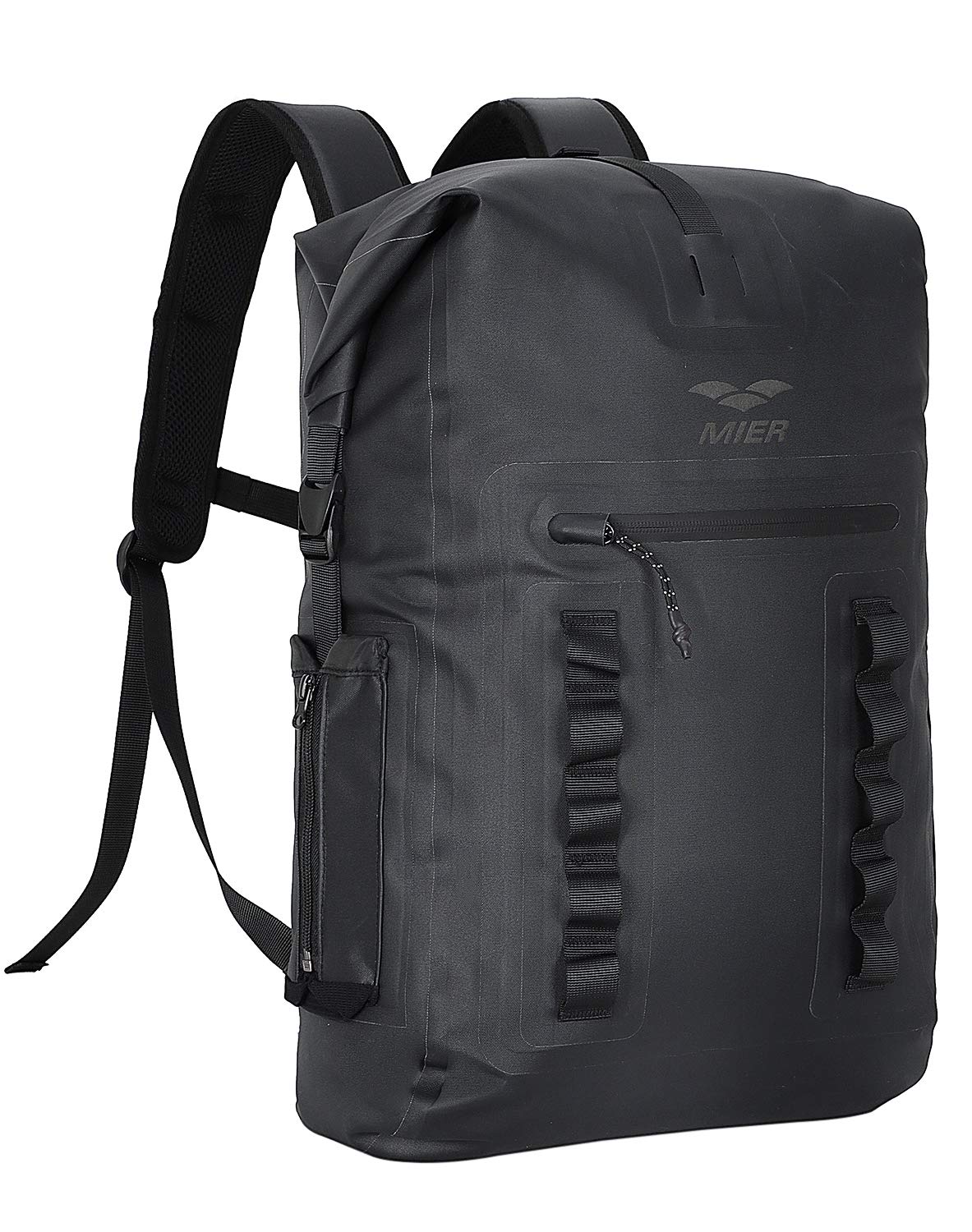
The bag that goes from a wet commute to the water without looking out of place.
This is the crossover pick — a 30-liter TPU dry backpack (TPU is a flexible, waterproof plastic sheet material) that works as a daily carry and a kayak bag. The main compartment is 100% waterproof, and the roll top keeps it sealed. It comes in multiple colorways, including Blue, Dark Gray, and Army Green/Black. The real reason to consider it is the everyday versatility: it holds a laptop, iPad, lunch, mask, bike lock, and a notebook, and doubles as a kayak bag on the weekend.
The one line to remember is the front pocket caveat, printed right in the product details: the front pocket is only splash-proof, so do not put important items there. Everything valuable belongs in the main compartment, which is the 100% waterproof one. Used that way, it works for kayaking, rafting, surfing, and boating, and keeps items dry in wet weather.
The bag gets high marks for quality, with how well it keeps things dry and how far the value stretches both close behind. Buyers like the look and the size. Durability and water resistance both land as mixed notes — plenty of happy owners, with some caveats, so treat the roll-top seal as the line between dry gear and wet gear. This is not a bag for whitewater submersion; it is a bag for the person who paddles on weekends and wants one bag that handles the commute Monday to Friday.
Who this is for: the weekday commuter and weekend paddler who wants one 30-liter TPU backpack for both jobs.
The one rule to follow: the front pocket is splash-proof only — everything that matters goes in the 100% waterproof main compartment.
Ideal for the crossover user: a 30-liter TPU backpack that holds work gear and kayak gear in the same bag.
Not for whitewater: water resistance and durability land as mixed notes, so treat the sealed main chamber as the only dry zone.
9. Malo’o Waterproof Dry Duffel 100L
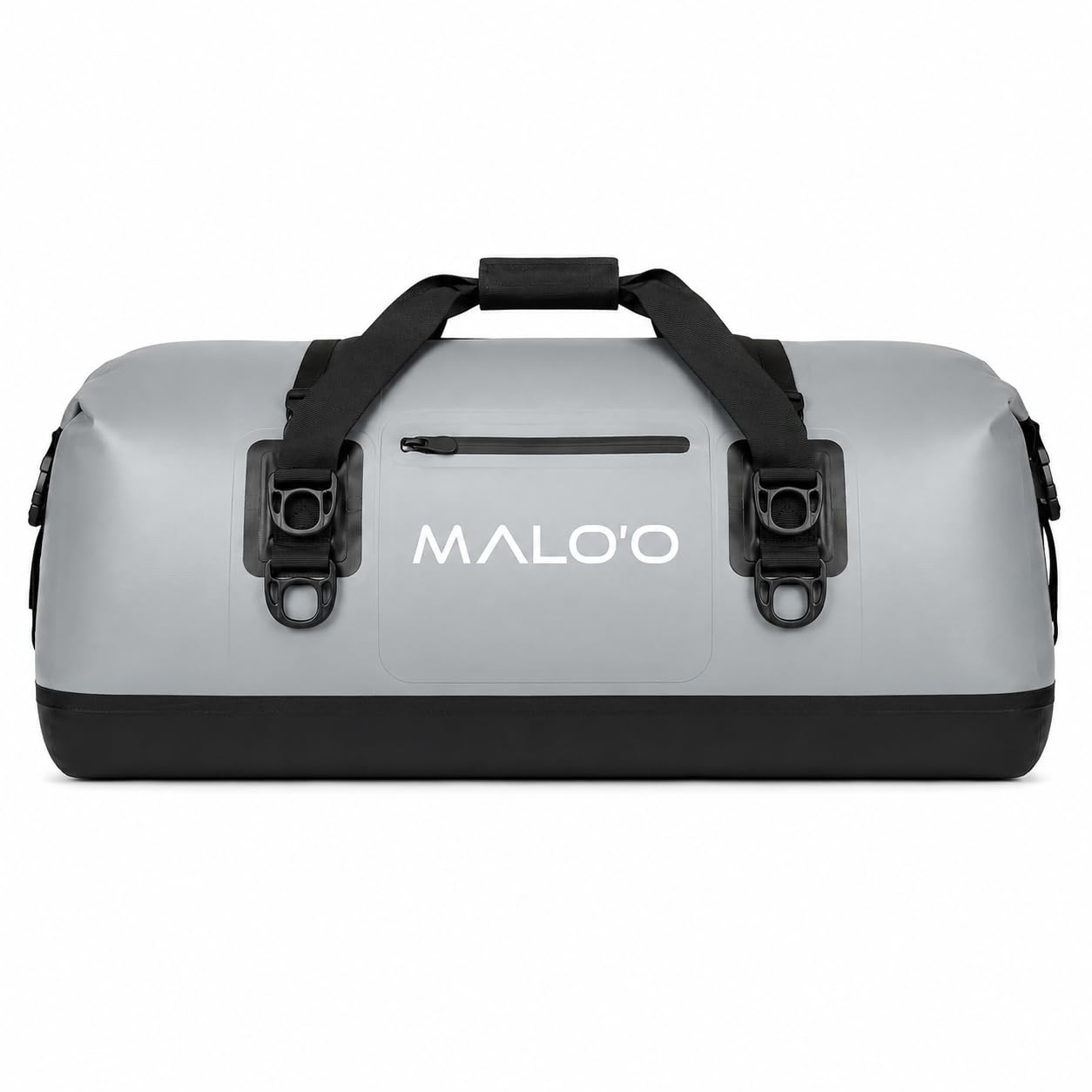
A 100-liter duffel that swallows an entire expedition’s gear in one sealed load.
The number that defines this bag is 100 liters — enough to fit 3 blankets, 4 camp pillows, sheets, and a 6-person tent in one place. It is built from heavy-duty 500D PVC with high-frequency welded seams, and DryCore construction that carries an IPX6 rating, which covers heavy rain, waves, and spray. The roll-top closure opens wide for packing and seals tight. It comes in 40L for daily trips, 60L for weekends, and the 100L for full expeditions, so the same build scales to your load.
Carrying a load this size needs real hardware: dual handles, a padded shoulder strap, interior and exterior zip pockets, and Molle loops for attachments. Webbing loops are the grid of straps on the outside where you clip extra gear. The duffel arrives in six colors — black, gray, blue, orange, green, and yellow — so you can pick a bright tone for visibility on the water. At 4.9 pounds the bag itself carries some weight, which is fair for a 100-liter duffel.
Owners single out the durability — one bag survived a trip down the Deschutes river — and the 100-liter capacity, with one owner packing 3 blankets, 4 camp pillows, sheets, and a 6-person tent inside. Where owners flag a caution is water resistance and the closure: some say it keeps gear dry in rain, others report clothes getting soaked. The lesson is to roll the top tight every time. Pack it correctly and the welded seams and IPX6 build do the job; leave the roll loose and it will let you down.
What makes it the expedition bag
- 100 liters of 500D PVC with high-frequency welded seams
- IPX6 DryCore construction for heavy rain, waves, and spray
- Molle loops, padded shoulder strap, and interior/exterior zip pockets
- 40L, 60L, and 100L sizes scale to any trip
What to watch
- Closure draws mixed notes — roll the top tight every time
- At 4.9 pounds, the empty bag is heavy before you pack it
Built for the big haul: a 100-liter, IPX6 duffel that takes an entire camp in one sealed load.
Not for a solo day bag: this is a 4.9-pound duffel meant for expeditions, so bring a smaller sack for a two-hour paddle.
Know the Specs
What the IPX Rating Means
The IPX number tells you how much water a bag is built to handle. IPX5 is splash and rain only, so it is a bag to keep inside a pack or clipped in the hull. IPX6 handles heavy rain and waves but not being held underwater. IPX8 is rated for continuous immersion, which is what you want if the bag could go under. Match the rating to your worst day, not your best.
Why Denier Matters
Denier (D) measures thread thickness — higher numbers mean a tougher, thicker fabric. A 500D PVC bag like the Earth Pak or the Malo’o is built for abrasion against rocks and kayak floors. A 70D nylon bag like the AquaQuest Rogue is much lighter and packs smaller, but it demands more care around sharp edges. Pick the fabric to match where the bag will live, not just how much it will hold.
Clip Buckle vs Plain Roll-Top
Every bag here uses a roll-top closure, but the buckle is where they differ. A plain roll-top has a single buckle; a safety-lock buckle like the one on the COR Surf adds a built-in clip and push-button so the seal will not pop if the bag is bumped. On a kayak, where the bag gets tossed around the cockpit, that extra lock is the difference between a seal that holds and one that opens.
Floating vs Sinking
A sealed roll-top traps air in the main compartment, so the bag stays on the surface if it goes over. That is the difference between a retrieval and a loss — a floating bag is easier to spot and fish back out. Not every bag here claims it floats; check the product details if overboard recovery matters for your launch.
Common Questions
How many times should I roll a dry bag top before clipping it?
Is IPX6 good enough for a kayak dry bag?
How much gear does a 20-liter dry bag actually hold?
Will a waterproof phone case fit my phone inside the bag?
Does a kayak dry bag actually float if it goes overboard?
What is the difference between 500D PVC and 70D nylon dry bags?
Can I use a dry bag backpack as my main kayak bag?
How do I clean and dry a waterproof dry bag after saltwater use?
Is a 100-liter dry duffel too big for a kayak?
Will a roll-top bag keep my gear dry in whitewater?
The Bottom Line
For most kayakers, the waterproof bag for kayaking winner is the Earth Pak Dry Bag because it pairs 20 liters of abrasion-resistant 500D PVC with an IPX8 phone case and a five-year warranty, and it holds the highest score in the lineup — the crowd favorite at 4.5+ stars across 33,000+ owners. If you need to haul a camera andclothes across a full day, grab the Lamicall Dry Bag Backpack with its 40 liters and IPX6 build. And for an expedition-sized load, the Malo’o Dry Duffel is the one to reach for, with 100 liters and welded seams behind it.
One honest nudge before you close this page: the Earth Pak carries the most owner weight of any bag here, and its five-year warranty is the kind of promise that most roll-top sacks do not make. If a full kayak day with a dry phone matters to you, that is the bag to start with.
How we choose
We do not accept paid placement. Every pick is matched to a real buyer and a real use-case; we do not hands-on test units.
Sources
Specifications: manufacturer listings and product documentation. Review insights: verified customer reviews, as of November 2026. Pricing: not shown on this page (it changes often); check the current price via the retailer link.
As an Amazon Associate, Tactical Gear Guy earns from qualifying purchases. This does not affect which products we feature.