Specs are compiled from manufacturer listings and verified buyer reviews and can change over time — please confirm the key details on the product page before buying.
A monitor that pings your phone while the basement fills is not the answer you want. You want one that closes the valve. That is the real decision here, and it splits these six units down the middle. Some only report numbers, like a dashboard. The best ones shut the water off on their own, and the sharpest of them can catch a leak as small as 0.01 gallons per minute (GPM — a trickle far below a running tap). Below, the six picks are sorted by how much real protection they give you.
This guide is built by comparing the manufacturers’ published specifications and the patterns across verified customer reviews, so you get each pick’s real strengths and trade-offs instead of marketing spin.
Install style matters as much as the sensor inside, because some of these need a plumber and some you fit yourself in minutes. Here is how each one earns its spot as a water usage monitor for your home.
Top Picks
How To Choose The Best Water Usage Monitor
One question decides your purchase: do you want a device that measures water, or one that physically closes the valve when something goes wrong? Those are two different buys, and mixing them up is the most common mistake in this category.
Detection: ultrasonic vs a moving turbine
Ultrasonic sensing reads flow with sound waves and no moving parts inside the pipe. That means it can register a change as slight as a dripping toilet flapper, and nothing wears out from spinning water. Turbine-style units use a small wheel that the water pushes around. That works for big flows, but it tends to miss the slow, hidden leaks that quietly run up a bill.
Reporting vs shutting off
A pure monitor sends a phone alert and leaves you to run downstairs and turn the valve by hand. An auto shut-off valve does that for you, whether you are at work or on vacation. If your reason for buying is burst-pipe panic, buy the valve. If you mainly want to spot waste and trim your bill, a sensor-and-app monitor is enough.
Pipe fit and installation style
Inline valves are sized to nominal pipe diameter — the pipe’s labelled size rather than its exact measured width. 3/4-inch and 1-inch are the common household options, and these valves sit right in the main line, so professional installation is often the sane call. Clamp-on monitors strap over your existing water meter with no plumbing cut at all. That is the route for renters or anyone who does not want to touch pipework.
Side-by-Side Comparison
| Model | Best For | Detection Method | Auto Shut-Off | Pipe / Mount | Amazon |
|---|---|---|---|---|---|
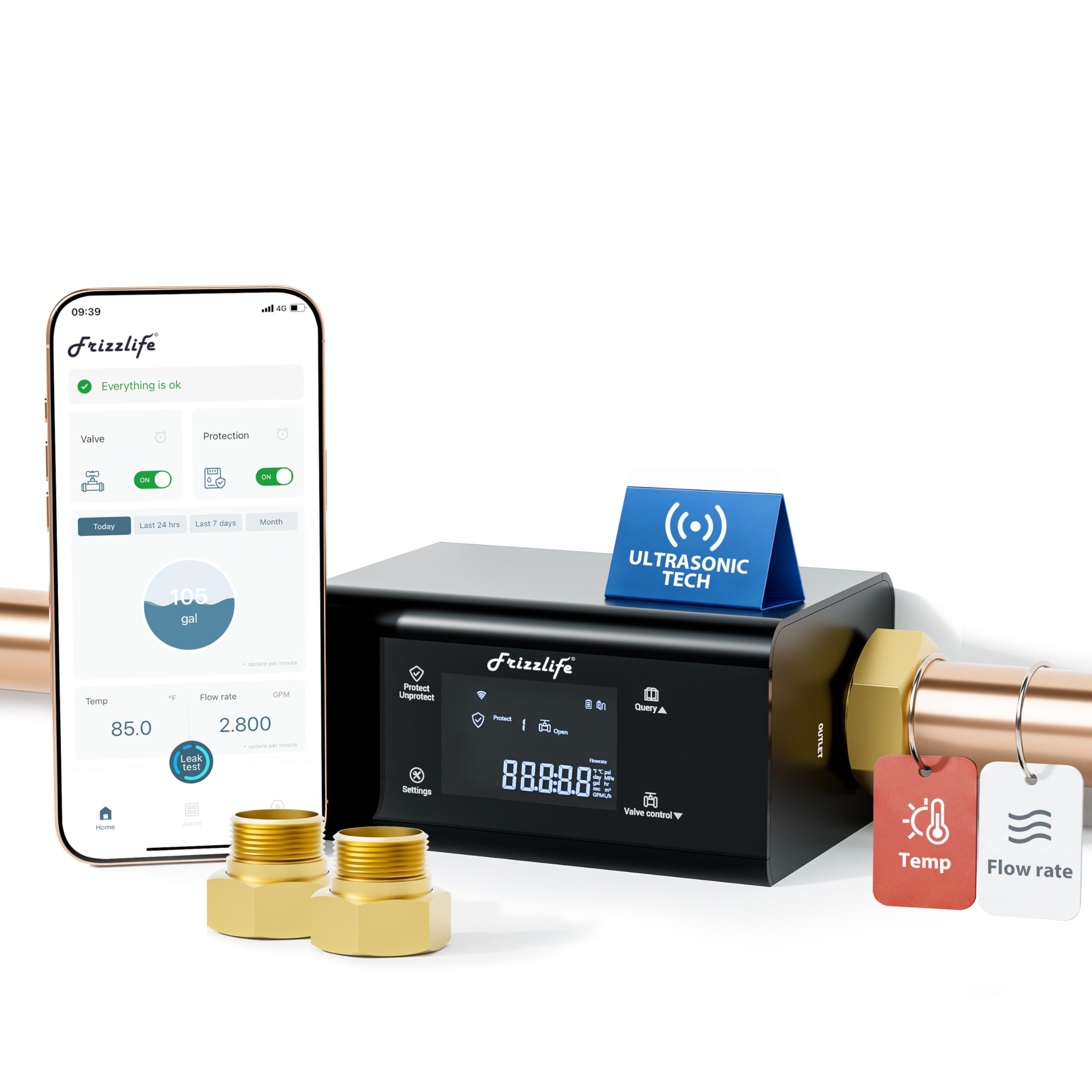
| Frizzlife LP365★ Best Overall | Whole-house protection | Ultrasonic, 0.01 GPM | Yes | 3/4″ and 1″ | Amazon |
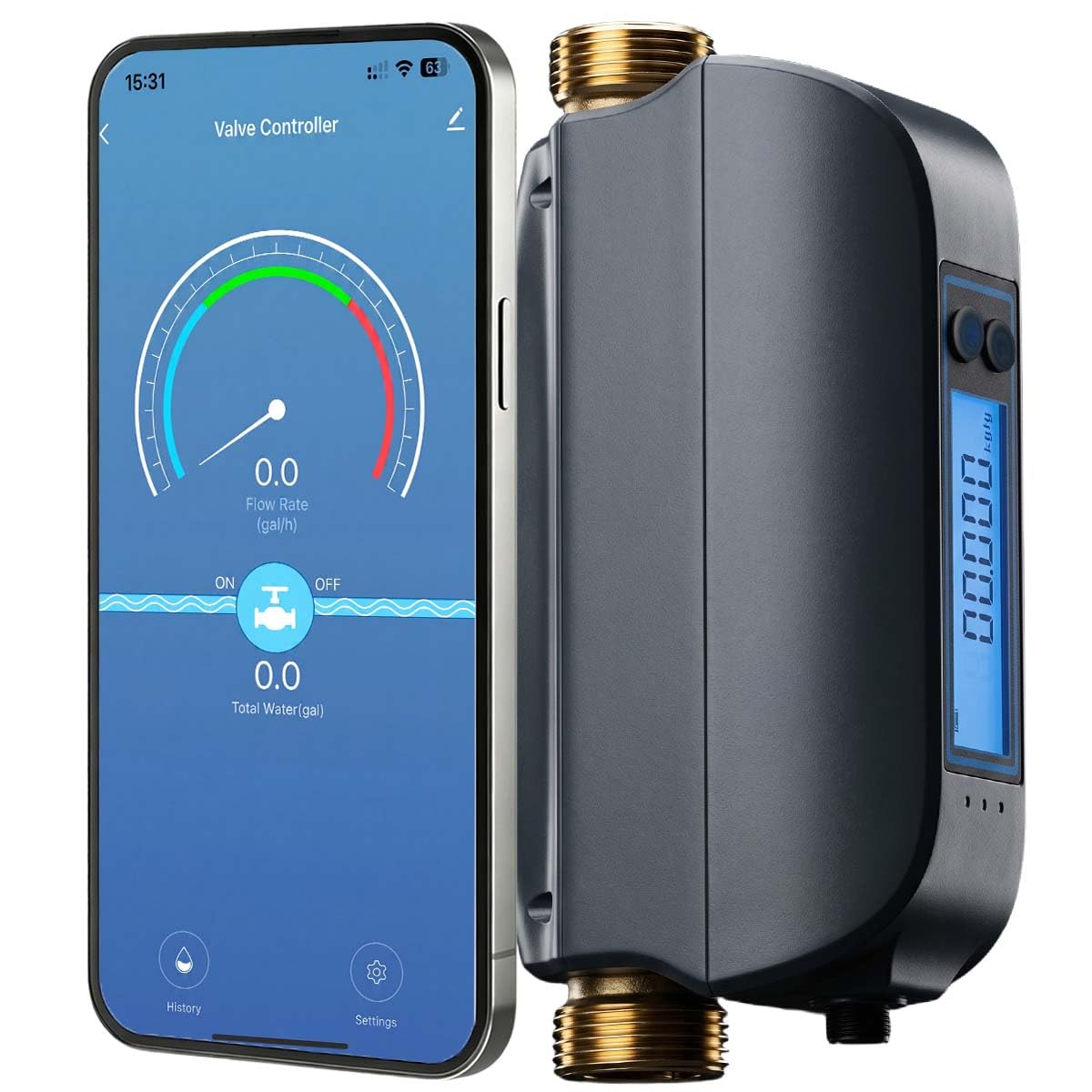
| GreenVation Water Flow MeterBest Value | Remote valve control | W-Type ultrasonic, 0.1 gal | Yes (app or button) | 3/4″ | Amazon |
| YoLink FlowSmart Kit | Long-range, low-power monitoring | Ultrasonic, 0.5″ meter | Conditional modes | 0.5″ | Amazon |
| YoLink FlowSmart All-in-One | User-set auto shut-off | Ultrasonic, 0.75″ meter | Yes (user-set limits) | 0.75″ | Amazon |
| Flume F2X | No-plumbing DIY install | Clamp-over meter sensor | No | Fits over 95% of meters | Amazon |
| Frizzlife LPG365 | Dual detection with sensors | Ultrasonic + 3 LoRa sensors | Yes | 3/4″ and 1″ | Amazon |
Detailed Reviews
1. Frizzlife LP365 Smart Water Monitor
Our pick — 4.0+★ from 350+ verified ratings; the strongest balance of quality and price.
The one that closes the valve for you, down to a 0.01 GPM trickle.
This pick earns its top spot on one number: 0.01 GPM ultrasonic resolution. It reads a trickle that fine, so a leaking flapper or a half-open faucet shows up as an abnormal pattern instead of blending into normal use. When it flags a risk, it sends SMS, phone-call, and app alerts and closes the valve on its own.
It also fits where space is tight. It measures 5.7″L x 4.3″W x 3.1″H and weighs 3.9 pounds, so it tucks against the pipe instead of demanding a shelf of clear wall. It fits both 3/4-inch and 1-inch pipe and ships with the NPT adapters, plug, plumbing tape, and a 6.6-foot power cable in the box. It carries NSF/ANSI 61 & 372 certification, the standard for parts that touch drinking water, and a lithium-ion battery backup keeps it protecting during an outage.
Owners rank it a crowd favourite by a clear margin — 4.0+ stars across 390+ reviews — and build quality is what wins people over, backed by how steadily it runs day to day. The app splits opinion: the layout is easy to navigate, but a minority find the WiFi pairing fiddly at first. Once it is joined to your network, it runs in the background. Buyers report it can pay for itself in under 30 days once it catches a real leak.
Where the LP365 pulls ahead
- 0.01 GPM ultrasonic sensing finds dripping-level leaks a spinning turbine would skip.
- Automatic valve shut-off plus three alert channels means action happens without you.
- Fits 3/4-inch and 1-inch pipe with adapters included in the box.
- Battery backup keeps it working through a power cut.
What to weigh before buying
- Inline fitting on the main line usually calls for a professional plumber.
- WiFi pairing is the weak link; some setups take a second attempt.
Best for: homeowners who want the water shut off automatically while they are away.
Look elsewhere if: you rent and cannot cut into the main supply line.
2. Water Flow Meter 0.1gal/min with Smart Valve, 3/4″
The budget entry that still gets you a valve you can close from the office.
Remote valve control for the least money on this list is what buys this unit its slot. It reads flow down to 0.1 gal, pushes threshold alarms from the Smart Life or Tuya app straight to your phone, and lets you shut the valve while you are at work or on vacation. For a renter, or a first-time buyer testing home leak protection, that is a sensible starting point.
It is 3 pounds and stands at 4.1″L x 3.5″W x 8″H. That is a taller footprint than the Frizzlife LP365 above at 3.9 pounds and 5.7″L x 4.3″W x 3.1″H, so plan for more clearance near the valve. Connection is 2.4GHz WiFi only, which is common for smart-home gear but worth knowing before you try to join it to a 5GHz band. The maker is upfront that install is somewhat complex and points you to the video and manual first — read that before you start wrenching.
The manual power button earns its keep in a blackout. During an outage the backup battery holds the unit alive, but app control drops away and you open or close the valve by pressing the button by hand. That same button makes it friendly for a parent or grandparent who does not want to fumble with a phone. Owners mention the casing quality and the remote shut-off as the draw, and at 4.5+ stars they are clearly happy with the purchase.
Cost-to-capability math: remote shut-off and 0.1 gal alarm thresholds for a fraction of what the whole-house valves ask — the trade-off is that install is fiddlier and the app is 2.4GHz only.
The caveat to size: it measures coarser than the 0.01 GPM ultrasonic units, so tiny drips may not trip an alarm the way a fine-resolution sensor would.
Reach for this if: you want app-based valve control on a tight budget and can handle a fiddly installation.
Step up instead if: you need micro-leak sensitivity or 5GHz WiFi at home.
3. YoLink FlowSmart Kit: 0.5″ Water Meter + Monitor + Hub

Ten years on a battery, and it still reaches the far side of the property.
The FlowSmart meter runs on cells rated to last up to 10 years, and that battery life is why it made this list. That longevity comes from the LoRa radio inside — a low-power signal built for whole-home coverage. It reaches up to 2034 feet, so a meter tucked in a basement corner still talks to the included hub without a WiFi dead-zone fight.
Reporting is where it shines if you like to see the numbers. YoLink’s app logs hourly, daily, weekly, and monthly consumption data and lets you export the reports, so you can trace exactly where a spike came from. You pick constant or conditional leak detection modes and bypass a preset schedule when life interrupts the routine. Alexa and Google Assistant pair through the hub, and the kit also works with Home Assistant.
The honest catch: this is a meter-and-hub package, not the sort of valve that shuts water off on its own, so pair it with leak sensors for that job. The other thing to plan for is the 0.5-inch meter size. Check it against your line before ordering, because it is not the common 3/4-inch household diameter. What owners rave about is how cleanly the whole thing installs and how precisely it tracks usage, and its 4.5+ star standing reflects that.
The ten-year pitch: once fitted, the battery is the last thing on your mind — a real contrast to units you recharge or re-cell regularly.
What it will not do: it monitors and alerts, but it does not close a main valve itself.
Ideal for: data-driven owners who want exportable consumption history and never want to chase a battery.
Check first: your pipe diameter matches the 0.5-inch meter, and that you are fine adding sensors for shut-off.
4. YoLink FlowSmart All-in-One Kit: 0.75″ Water Meter + Hub
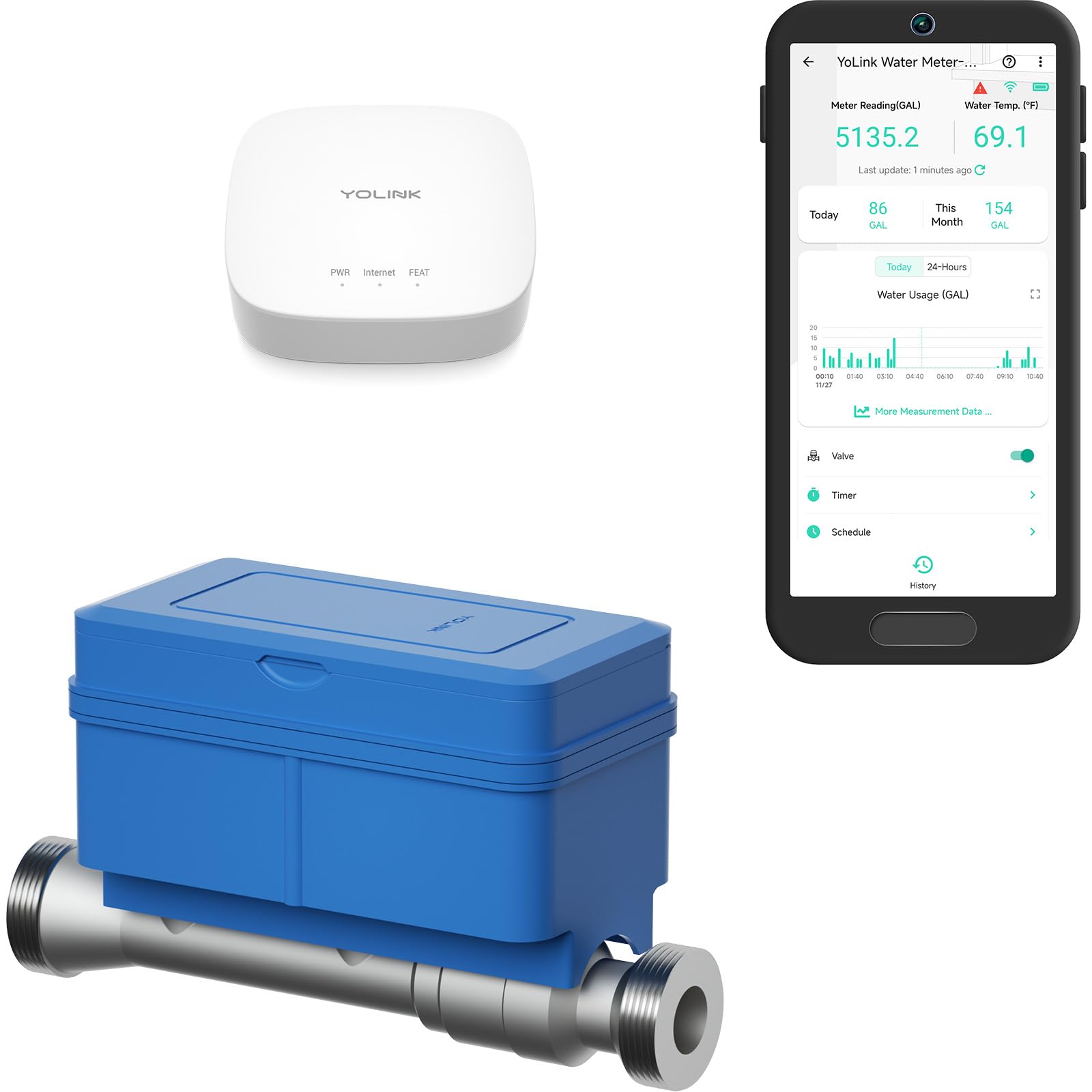
Ultrasonic metering and a motorized valve in one NSF-certified body.
The shut-off is built into the meter here, not bolted on later. This all-in-one body combines an ultrasonic water meter with a motorized shutoff valve for potable water, sized in nominal pipe size with a 0.75-inch option here. You set a maximum volume and a maximum continuous run time per water-use instance in the YoLink app, and the valve closes when either limit is crossed. No guesswork and no learning your habits — you draw the lines.
What makes it dependable when things go sideways is the offline behavior. Device-to-device rules let critical shutoff actions carry on without an internet connection, which is exactly when you need them most. The LoRa radio reaches up to 2034 feet for whole-home or building coverage, and the battery system is engineered for 10+ years of operation. Hook it up by Ethernet or 2.4GHz WiFi through the included hub, and it plays nicely with Alexa, IFTTT, and Home Assistant.
Reviewers repeatedly note that it catches the slow leaks a toilet or dripping fixture hides, which shows up as savings on the bill. Setup is described as straightforward with clear instructions. Just understand going in that this is an inline body on your main line, so factor in a plumber, and that you configure the shutoff limits yourself rather than expecting it to auto-learn what is normal.
Why this earns its place
- Ultrasonic meter plus motorized valve in one NSF-certified unit.
- User-set volume and continuous-run limits trigger the shutoff automatically.
- Device-to-device rules keep critical shutoff working offline.
- LoRa radio reaches up to 2034 feet and battery is built for 10+ years.
Before you commit
- It does not learn your usage — you must set the abnormal thresholds yourself.
- Inline main-line install is a plumber job.
Pick this one: for automated shut-off you control on your own terms, backed by long-range LoRa and a decade-plus battery design.
Think twice if: you would rather the system figure out “abnormal” on its own.
5. Flume F2X Smart Home Water Monitor and Leak Detector
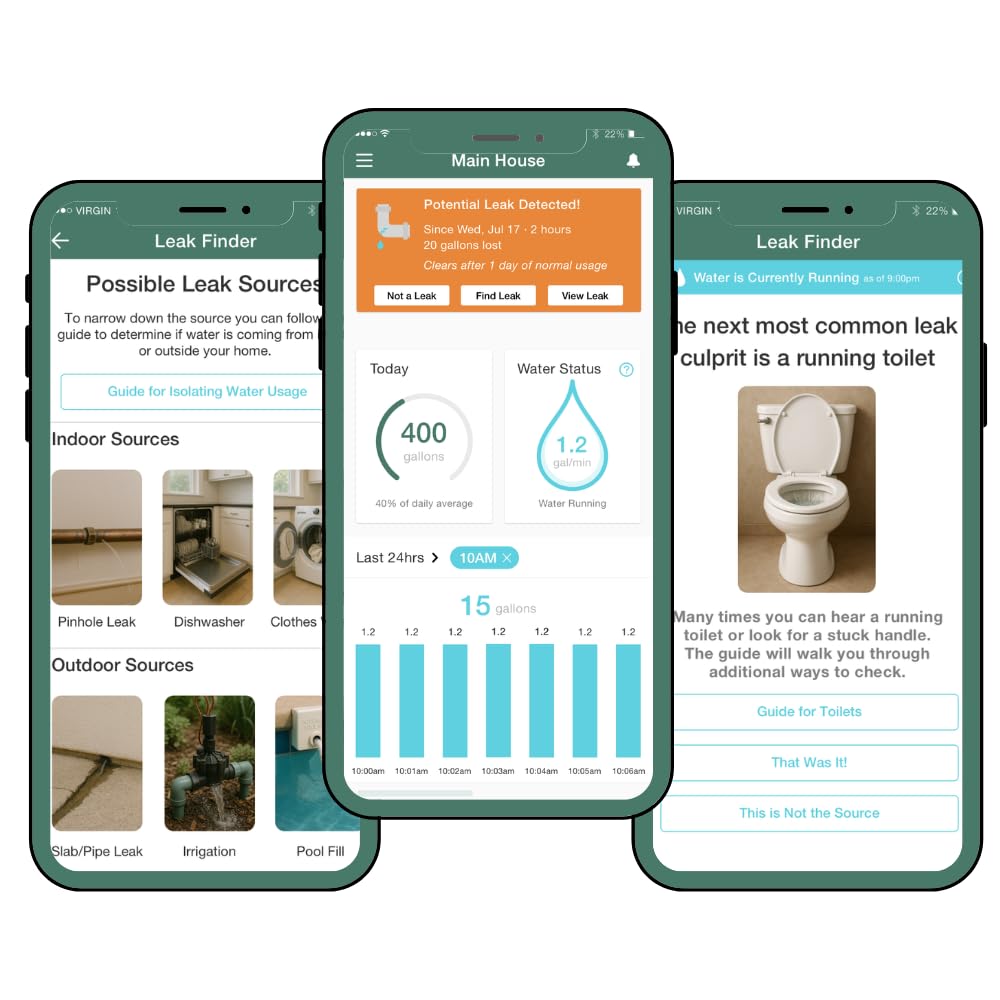
Strap it over the meter and start monitoring — no plumber, no pipe cut.
No pipe cut, no tools, no plumber: the F2X clamps over your existing water meter and installs in minutes, with the app walking you through it step by step. It fits over 95% of home meters, so most people skip the plumber entirely. It reaches up to 1500 feet via its upgraded WiFi chip, which is a real step up from the flakier pairing you can hit on inline units.
Tracking here is genuinely detailed: you see when, where, and how much water is being used, down to your sprinklers and irrigation. That last part separates it from a main-line-only valve — outdoor waste gets caught too, and smart alerts flag leaks indoors and out, including a small trickle. It takes standard AA battery packs with no proprietary cells to hunt down. A parylene coating — the sort used in medical and underwater gear — plus reinforced electronics mean it holds up to weather and yard conditions.
Here is the trade-off to weigh: this monitors and alerts, it does not physically close a valve for you. So if your fear is the pipe bursting, add a shut-off valve separately. Reviewers land on a reliable, easy-to-live-with monitor that reports usage in real detail and catches leaks you would otherwise miss.
Install day is the win: no plumbing, no special tools, and it clamps over the meter in the time it takes to make coffee.
The honest limit: you get alerts, not an automatic shutoff — pair it with a valve if full protection is the goal.
Choose this if: you want detailed usage data and outdoor leak alerts with zero plumbing work.
Not for you if: a hands-off automatic shutoff is non-negotiable.
6. Frizzlife LPG365 Smart Water Auto Shutoff Valve
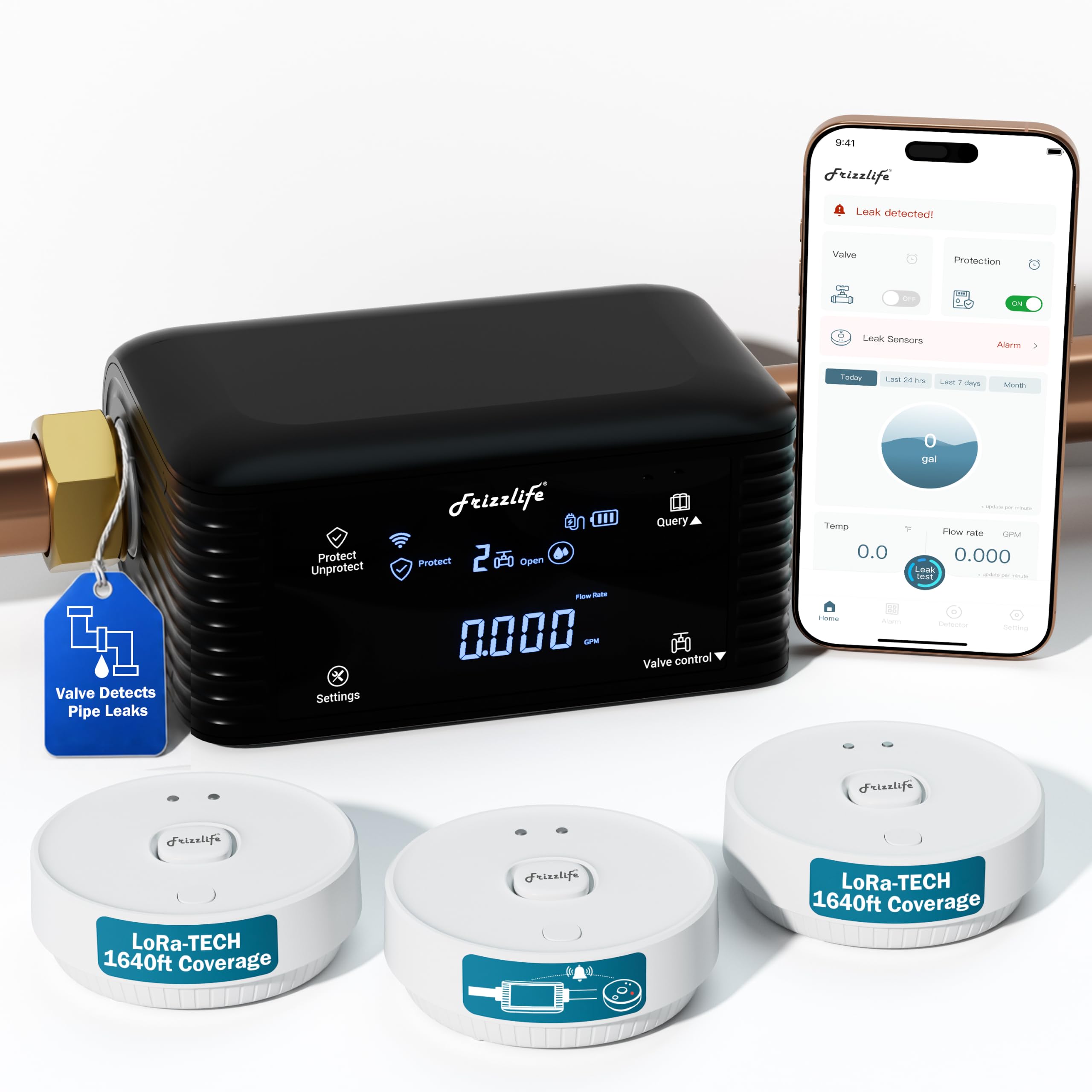
Two layers of protection: the pipe flow sensor and three point-leak sensors.
Three wireless leak sensors in the box is what separates this from every other inline valve here. The LPG365 pairs ultrasonic flow monitoring down to 0.01 GPM with sensors that sit right where trouble starts — laundry room, water heater, under-sink cabinet. When a sensor feels water, it signals the main valve to shut off. One valve can pair with up to 50 LR80 sensors, so you can ring the whole house if you want.
The LoRa link between sensors and valve reaches about 1/3 mile, which keeps the signal solid across a large home and cuts down on missed shutoffs from weak connections. The sensors themselves work without internet or power, so a blackout does not blind the system. The Frizzlife app handles flow rate, temperature, and remote valve control, runs on both 2.4GHz and 5GHz WiFi, and fires app, SMS, and phone-call alerts. It is NSF/ANSI 61 & 372 certified, and it fits both 1-inch and 3/4-inch pipe with the adapters included.
Reviewers repeatedly credit it with stopping a potential flood, including in crawl spaces and overnight when nobody is watching. It is also notably less expensive than the big-name valve it invites comparison to, which is where the value angle comes in. The one honest note is that professional installation is recommended for the main valve, so budget for a plumber on top of the hardware.
What you get in the box
- Inline ultrasonic valve plus three wireless leak sensors for dual detection.
- LoRa sensor range of about 1/3 mile keeps signals stable in large homes.
- Sensors keep working without internet or power.
- Dual-band 2.4GHz and 5GHz WiFi in the app.
Plan around this
- Main valve install is best left to a plumber.
- One-year manufacturer warranty only.
The coverage play: for large or leak-prone homes where you want both pipe-level and point-level detection.
Skip if: a single main-line shutoff already covers your concerns and you do not want extra sensors to place.
Know the Specs
0.01 GPM vs 0.1 gal detection resolution
The GPM figure (gallons per minute) tells you how small a flow the sensor can register in one minute. 0.01 GPM is a fine trickle-level reading, which is how a hidden drip gets caught. The 0.1 gal figure is a volume-per-detection measure, coarser and better suited to spotting larger events and usage totals. Finer resolution means smaller leaks surface, but it can also mean more false alarms if the unit is not well tuned.
Ultrasonic sensing
Ultrasonic units measure flow with sound waves and no moving parts inside the pipe, so there is nothing to wear out and slow drips register cleanly. The trade-off is that the measurement tube can be physically smaller than the pipe it threads onto, which is why installers note the sizing. A turbine sensor that spins is fine for big flows but tends to miss the quiet ones.
Auto shut-off vs alert-only
An auto shut-off valve closes the main line when a limit or a sensor triggers it, protecting the house whether you are home or not. An alert-only monitor reports to your phone and leaves the valve to you. The difference matters most during a burst pipe, when minutes count and you may be miles away.
Pipe size and mounting
Inline valves are sized by nominal pipe diameter (the pipe’s labelled size) — 3/4-inch and 1-inch cover most homes, with 0.5-inch and 0.75-inch meters on some units. Match this to your actual line before buying. Clamp-on units instead mount over the existing meter, no plumbing needed, which suits renters and anyone unwilling to cut the main.
Common Questions
Do I need a plumber to install a water usage monitor?
Will a water usage monitor detect a slow toilet leak?
What happens to my monitor during a power outage?
Is a monitor that reports usage enough, or do I need the shut-off version?
Which pipe sizes do these units fit?
Can these work with Alexa or Google Assistant?
Do I need 2.4GHz or 5GHz WiFi for the app to work?
How often do I have to change the batteries?
Will a leak sensor work if the internet is down?
Can I monitor irrigation and sprinklers too?
The Bottom Line
For most homes the water usage monitor to beat is the Frizzlife LP365. It pairs 0.01 GPM ultrasonic sensing with automatic valve shut-off and battery backup in a compact body that fits 3/4-inch and 1-inch pipe. If shutting the valve on your own terms is what you want, the YoLink FlowSmart All-in-One lets you set the limits and keeps working offline. And if you cannot touch the plumbing at all, the Flume F2X clamps over your meter in minutes and catches outdoor leaks too. Whichever way you go, a unit that pairs fine sensing with an actual shut-off is the one that earns its keep when a pipe bursts.
How we choose
We do not accept paid placement. Every pick is matched to a real buyer and a real use-case; we do not hands-on test units.
Sources
Specifications: manufacturer listings and product documentation. Review insights: verified customer reviews, as of November 2026. Pricing: not shown on this page (it changes often); check the current price via the retailer link.
As an Amazon Associate, Tactical Gear Guy earns from qualifying purchases. This does not affect which products we feature.