Specs are compiled from manufacturer listings and verified buyer reviews and can change over time — please confirm the key details on the product page before buying.
A trough that runs dry by noon and a trough that overflows all night are the same problem wearing two hats: the float valve is either worn out, undersized, or fighting water pressure it was never built for. Four specs decide the fix: flow rate in gallons per minute, inlet size and thread type, body material, and the wear points — O-rings, threads, and seals — that fail first.
This guide is built by comparing the manufacturers’ published specifications and the patterns across verified customer reviews, so you get each pick’s real strengths and trade-offs instead of marketing spin.
The short version: bronze bodies win on longevity, stainless handles freezing weather, and high-flow nylon units earn their keep on big cattle troughs. Below you’ll find flow rates, inlet sizes, and pressure ratings laid out side by side so you can match a valve to your tank and your supply line for the water trough float valve you actually need.
Top Picks

How To Choose The Best Water Trough Float Valve
Start with the pipe you already have. A valve with the wrong inlet size means an adapter, and every adapter is one more threaded joint that can weep. Match the inlet to your supply line and half the installation headaches disappear before you open the box.
Match the flow rate to how many animals drink
A single horse or a handful of goats can live happily on a slow refill. A row of cattle drinking at once will drain a trough faster than a low-flow valve can top it back up. Look at the published flow figure — gallons per hour or gallons per minute — and ask whether it keeps pace with peak drinking, not average drinking.
Pick a body material for your climate
Bronze and stainless steel shrug off sun, hard water, and the occasional knock from a nose. Plastic and glass-filled nylon resist corrosion but can crack in a hard freeze. If your winters drop below freezing, an all-metal body is the safer bet.
Check the pressure rating against your line
Every valve has a maximum operating pressure, and a household or farm line that runs higher than that rating puts constant strain on the seal. A valve rated for 125 psi or 150 psi gives you headroom. Low-pressure lines matter too — some valves need a minimum push to close cleanly.
Decide between a lever-and-ball design and a self-contained one
The classic float valve uses a lever arm and a ball that rides the water level. A self-contained valve hides the mechanism inside the body, which keeps it clear of livestock and debris. The trade-off is that self-contained units can be fussier to service when something wears out.
Side-by-Side Comparison
| Model | Best For | Inlet Size | Body Material | Flow / Pressure | Amazon |
|---|---|---|---|---|---|
| Mueller Industries 109-814★ Best Overall | All-around bronze reliability | 3/4 inch | Bronze | 125 psi rated | Amazon |
| Jobe Megaflow 82026Best for Big Herds | Big cattle troughs | 3/4 inch NPT | GF Nylon | Up to 90 GPM | Amazon |
| JUXILPP 304 Stainless Valve (2-pack)Freeze-Safe Pick | Freezing climates and spares | 1/2″ with 3/4″ adapter | 304 Stainless Steel | 10-150 psi | Amazon |
| Herdmate Stock Tank Float Valve | Budget multi-animal setups | 3/4 inch | Plastic | 245 gallons/hour | Amazon |
| Little Giant Trough-O-Matic | Simple hose-fed tanks | 3/4 inch garden hose | Polystyrene | 245 GPH, 20-50 psi | Amazon |
| B & K 109-813 | Half-inch bronze budget build | 1/2 inch | Bronze | 125 psi rated | Amazon |
| Shawmin 3/4″ Stainless with 6″ Float | Adjustable shut-off control | 3/4 inch NPT | 304 Stainless Steel | — | Amazon |
| Hudson V-S-G Automatic Float Valve | Fountains and ponds | 1/2 inch FNPT | ABS Plastic | 300-2,400 GPH, 140 psi | Amazon |
| Rojo J-RJV0075HF | Low-pressure gravity lines | 3/4 inch NPT | Non-corrosive (nylon) | 20L/Min, 75 psi | Amazon |
Detailed Reviews
1. Mueller Industries 109-814 Float Valves, 3/4-Inch
Our pick — 4.5+★ from 350+ verified ratings; the strongest balance of quality and price.
The bronze-bodied workhorse that keeps a 250-gallon tank topped off without drama.
The Mueller 109-814 earns the top spot because it is the one valve here that is both genuinely simple and genuinely tough. The body is solid bronze with a stainless steel pivot bolt assembly — a small metal pin that is the part most valves wear out first — and the whole thing carries a 125 psi pressure rating. Translation: it holds up to farm-line pressure without the seal straining every time you open the tap.
Its 3/4-inch threaded inlet fits standard supply pipe, and the dual inlet thread lets you connect either pipe or a locknut on the same valve. The machined flange presses flat against the tank wall, which is what stops the wobble that slowly loosens a poorly seated valve. What wins people over most, though, is simply that it works — steady supply to a filling tank, month after month, without you checking on it. Bronze also means it will not crack in a cold snap the way plastic bodies can.
The honest catch is the seal. Some buyers report the O-ring seals wearing within a year, and a few find water weeping from the output. That is a wear part, not a design flaw — but it means you should treat this as a valve you service occasionally, not one you install and forget for a decade. Compare it to the stock-tank unit above and the Mueller is 10.4 ounces of metal versus a plastic body, which is exactly why it feels more substantial in the hand and holds its seat longer under pressure.
Where the bronze pays off
- Solid bronze body with stainless steel pivot bolt resist corrosion and wear
- 125 psi rating gives real headroom on farm supply lines
- Machined flange seats flat against the tank wall
What to budget for
- O-ring seals are the wear point — plan to replace them over time
- No manufacturer warranty listed
Best for: anyone with a standard 3/4-inch supply who wants a bronze valve they can trust long-term.
Worth noting: the seal is a service part, so keep a spare O-ring on the shelf.
2. Jobe Megaflow 82026 3/4″ High Flow Float Valve
Built to refill a cattle trough at 90 gallons a minute while sitting out of harm’s way underwater.
If your trough serves a herd, flow rate is the number that decides everything, and this Jobe moves up to 90 gallons per minute — far beyond what a standard float valve can deliver. That speed is why it belongs at the top of the list for working farms: the trough refills fast enough that the next drinker in line does not find it empty.
The design is smarter than a lever-and-ball too. Instead of an arm riding on the surface where livestock can knock it, the Jobe mounts below the waterline, protected from hooves, debris, and sun. A nylon cord links an internal float to a small pilot valve, which triggers the main diaphragm valve when the level drops. The body is glass-filled nylon — a reinforced plastic that resists corrosion — and it survives cold, with the review pages noting it has come through multiple winters without issue.
Two things to know before you buy. First, the underwater mount means you will be reaching into the trough to service it, so factor that into your install. Second, while many owners mention no leaking at all, some do hit persistent leakage — a reminder that diaphragm valves depend on a clean, debris-free water supply. Keep your line filtered and it behaves. At 1.1 pounds it is a substantial piece of hardware, and it comes with a stated two-year manufacturer warranty on defects.
The flow advantage: 90 gallons per minute is the standout figure here — the kind of throughput a single animal’s trough never needs but a herd depends on. The GF nylon construction and quarter-turn cleaning design round out a valve built for daily farm duty.
The honest trade-off: the underwater mount keeps it safe from livestock but makes servicing a reach-in job, and a few owners hit leaks when debris gets into the diaphragm.
Reach for this if: you run cattle or multiple stock troughs and need real refill speed.
Look elsewhere if: you want a valve you can swap without kneeling in the water.
3. JUXILPP Automatic Water Level Control Float Valve (2-Pack)
Two all-stainless valves that laugh off a hard freeze and run on water pressure alone.
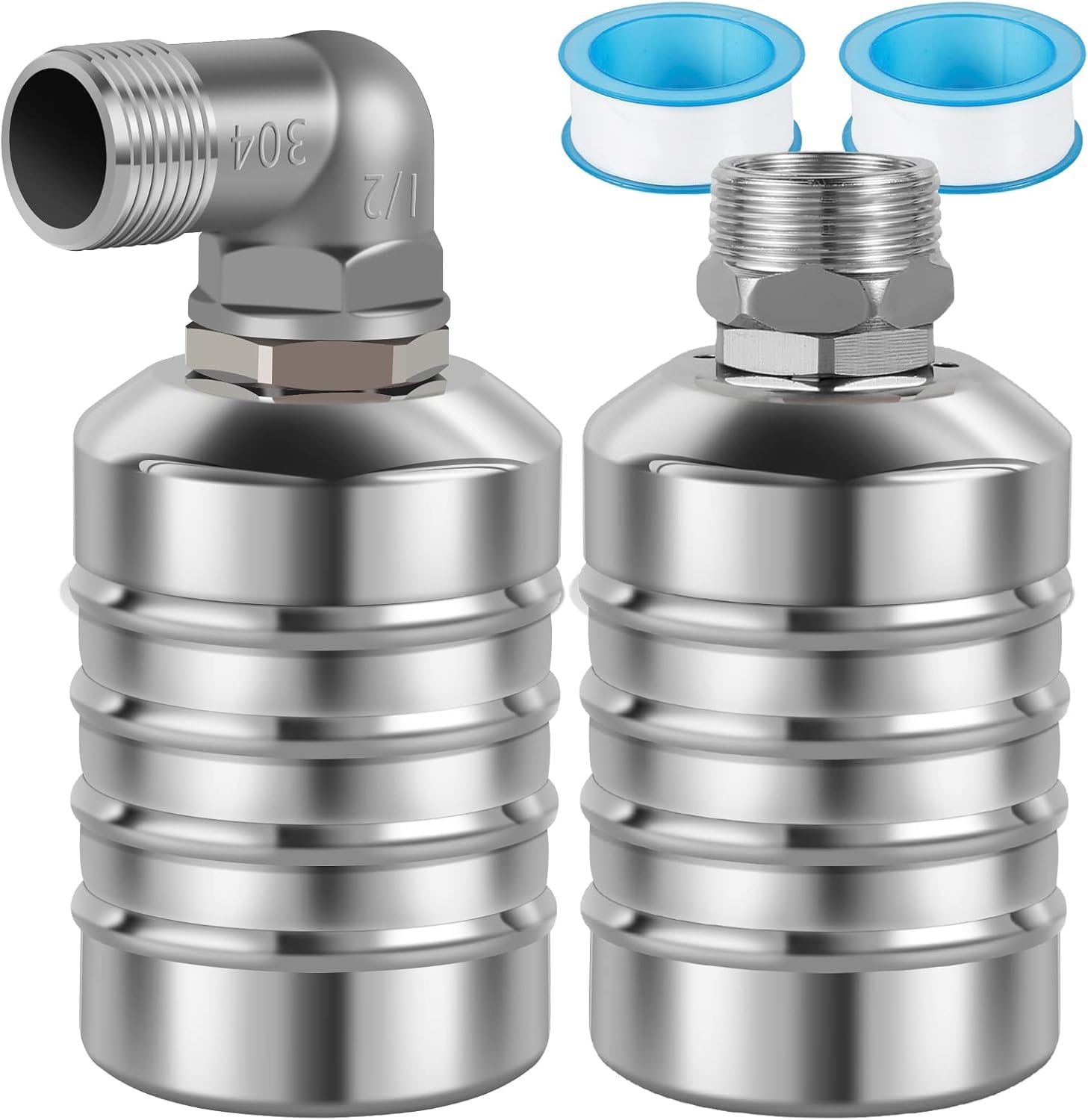
Here is the thing about plastic valves in cold country: they can crack when the water inside them freezes, and then you are out a valve and possibly a flooded barn. The JUXILPP solves that with a full 304 stainless steel body — an all-metal housing that the maker states will not crack in freezing temperatures the way plastic will. You get two valves in the pack, which means a spare on the shelf for the day the first one needs swapping.
It runs entirely on water pressure, no wiring or batteries, and handles a range from 10 to 150 psi. The 1/2″ NPT thread is standard plumbing, and the box includes a 3/4″ adapter plus a 90-degree elbow so you can mount it on the side or the top of a tank. The temperature range covers 32°F to 212°F. The internal float ball rises with the water and shuts the flow when full — when the level drops, it opens again. Simple and mechanical, with nothing electronic to fail.
The trade-off is scale. This is a modest valve suited to chicken coops, horse waterers, and backyard ponds — not a high-volume cattle main. Its flow suits a steady refill rather than a fast one. But for a homestead that wants bronze-grade cold resistance without bronze-weight price, the stainless body and the spare in the box make this a clean buy.
Why the stainless matters up north
- 304 stainless steel body holds up to freezing temps where plastic cracks
- Two valves in the pack — one installed, one spare
- No electricity needed; runs on 10-150 psi water pressure
Where it stops short
- Designed for steady refill, not high-volume cattle troughs
- You will need the included elbow and adapter to fit different threads
Ideal for: cold-climate coop and horse owners who want a metal valve with a backup in the box.
Skip if: you need to keep a large cattle trough full at speed.
4. Shawmin 3/4″ Stainless Steel Float Valve with 6″ Float Ball
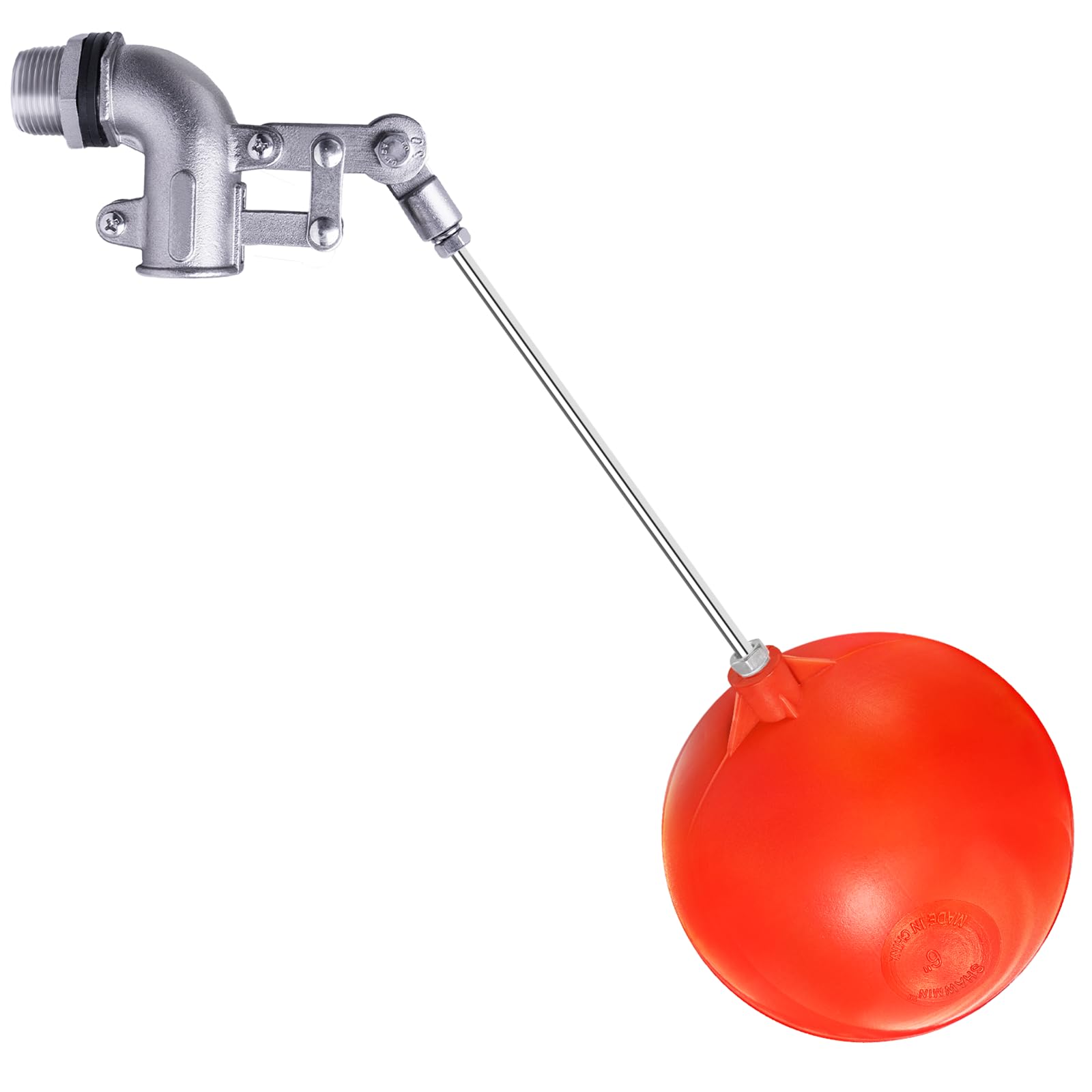
A big 6-inch float ball on an adjustable rod, so you set the water height you actually want.
Most float valves give you a fixed shut-off level, and you live with it. The Shawmin differentiates itself with a 6-inch float ball on an adjustable rod — a wide float that gives strong buoyancy and lets you dial in exactly where the water stops rising. On a tank with a specific fill line, or a trough you do not want spilling over the rim, that adjustability is the whole reason to pick it.
The body is heavy-duty 304 stainless steel, which resists rust and corrosion in wet, outdoor conditions. It fits standard 3/4-inch NPT threaded pipe, so it drops onto common supply fittings, and the 90-degree elbow has a sealing plug that cuts down on splash and waste. The manufacturer lists it as needing no maintenance, and the review pages back up the core promise — it shuts the water off once the tank is full, which is the one job a person mostly cares about.
The catch worth flagging: at 11.24 x 6 x 15 inches overall, the big float assembly takes up real space in the tank. On a small bucket or tight barrel it may crowd the water or bump the sides. It is a valve for a proper stock tank or storage tank, not a coffee-can-sized waterer. For the size class, though, the stainless build and adjustable shut-off are a strong pairing.
The adjustability edge: a 6-inch float ball on an adjustable rod gives you precise control over shut-off height — something fixed-level valves simply do not offer. Stainless construction and standard 3/4″ NPT threading keep installation straightforward.
Space to consider: the float assembly is physically large, so it wants a real tank rather than a cramped container.
Who it beats: any fixed-level valve when you need a specific fill height on a full-size tank.
Who it does not suit: small barrels where the big float ball crowds the water.
5. Little Giant Trough-O-Matic Stock Water Tank

The one you screw straight onto a garden hose — no plumbing required.
Not everyone wants to sweat pipe fittings. The Little Giant Trough-O-Matic accepts a standard 3/4-inch garden hose directly, so you can run a hose to your stock tank, screw this on, and have automatic water control in a few minutes. It is the easiest install on this list, and that alone makes it a popular first float valve for hobby farmers and backyard coops.
Once mounted to the tank wall, it flows up to 245 gallons per hour and works between 20 and 50 psi. The housing is high-grade polystyrene — a rigid plastic that holds its shape — and the float mechanism does its job reliably, keeping animal water levels consistent whether you run a chicken coop or a few horses. It ships with expansion brackets so it adapts to different tank walls, and installation is genuinely straightforward.
Be honest about the limits. The polystyrene housing (a hard plastic body) does not like a hard freeze, and some owners find it does not last as long as a metal valve. Leaks are the other recurring note. Treat it as a value-priced unit for a hose-fed setup in a mild climate, and it delivers — but if your winters bite or your tank is a serious cattle operation, the bronze and stainless picks above will outlive it.
The appeal
- Standard 3/4-inch garden hose connection — no plumbing needed
- 245 gallons per hour with 20-50 psi operating range
- Straightforward tank-wall installation with expansion brackets
The limits
- Polystyrene housing is vulnerable to freezing and long-term wear
- Leakage is a recurring complaint over time
Good starting point for: hose-fed coop and hobby-tank setups in mild weather.
Not for: freezing climates or heavy stock operations that need a metal body.
6. Rojo J-RJV0075HF High-Flow Low-Pressure Float Valve

Made for gravity lines and low pressure where ordinary valves refuse to close.
Gravity-fed systems are their own beast. A standard valve that needs a strong push to seal will never fully shut on a low-pressure line, and you end up with a slow, endless trickle. The Rojo addresses that head-on: it is rated to handle low pressures down to a 75 psi working maximum (psi is pounds per square inch, the push behind the water) and flows up to 20 liters per minute through a 3/4-inch NPT inlet (NPT is the standard tapered pipe thread), which makes it a solid match for cisterns, rain barrels, and gravity setups.
Its 4.9-inch-wide float with a fully adjustable float angle and a 3-inch extension arm means you can mount it side, bottom, or top, above or below the water level, and aim the float where it needs to ride. There is a built-in check valve and a switch to lock the valve off when you want to drain or work on the tank. The body screws apart by hand for cleaning, and flow stops when it is unscrewed — a nice safety touch.
The construction is non-corrosive material with a stated 12.8-ounce weight, and it tops off underground storage tanks reliably. The one thing to confirm before ordering is your flow demand — 20 liters per minute suits household-scale refilling, not a fast-fill cattle trough. For a pond, cistern, or fountain on low pressure, it is the valve that finally seals.
Where it shines: the low-pressure functionality and adjustable 4.9-inch float make it a flexible fit for cisterns and ponds, and the built-in check valve plus off-switch add control most valves lack.
Confirm first: 20 liters per minute is a modest flow — fine for topping off storage, slow for high-demand troughs.
Pick this for: gravity lines, rain barrels, and low-pressure tanks that need a valve that actually shuts.
Think twice if: you need high gallons-per-minute refills on a busy trough.
7. B & K 109-813 Tank Float Valve, 1/2 in Inlet, Bronze

The little bronze sibling to the top pick — half-inch inlet, same stubborn reliability.
If your supply line is 1/2 inch rather than 3/4, this B & K valve is the bronze answer, and it shares the family traits of the top pick: a bronze finish, high-tensile serrated arms (the ridged arms that grip the float), and a locknut included with the male inlet. It pairs a male inlet with a male outlet, so check your fittings match before ordering. At 9.12 ounces it is a touch lighter than its 3/4-inch sibling but carries the same 125 psi maximum operating pressure.
Reliability is what people talk about with this valve — it does its job steadily, whether that is filling a water trough or holding level on a sap pan. The bronze body resists corrosion, and the straightforward build means fewer moving parts to foul. For a modest 1/2-inch line feeding a single trough or a few buckets, it is a dependable, no-nonsense choice.
The recurring wear point is the O-ring seals, which some owners find give out within a year, and a handful report water escaping from the output. As with any bronze float valve, keep a spare seal on hand and you will get years, not months, out of it. It is note this is a smaller-bore valve than the 3/4-inch Mueller — adequate for gentle refill, not for volume.
What holds up
- Bronze finish with 125 psi rating suits standard supply lines
- Male inlet and outlet with locknut included
- Proven steady reliability in troughs and pans
What to watch
- O-ring seals are the wear point over time
- 1/2-inch bore is a gentle-refill valve, not a high-volume one
Best fit: a 1/2-inch line feeding one trough, where bronze longevity matters most.
Reconsider if: you need fast refill volume — this is a smaller-bore valve.
8. Hudson V-S-G Automatic Water Float Valve, 1/2″

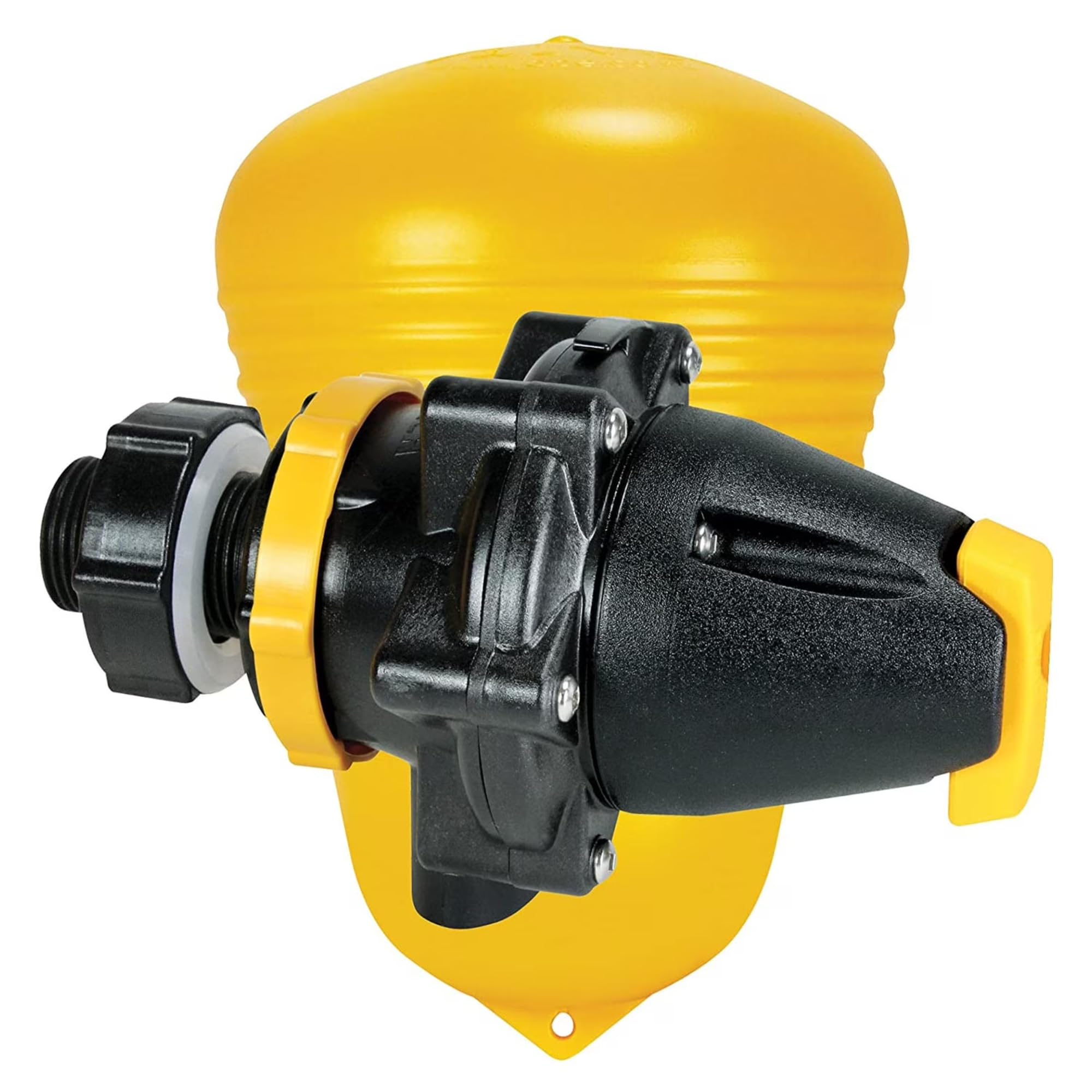
No lever, no ball, no exposed parts — just a compact body that seals itself with water pressure.
The Hudson Valve takes a completely different approach to float control. There is no lever arm, no float ball, and no exterior moving parts — the mechanism closes with water pressure on its own. That means nothing sticking out for a horse to bump or a goat to chew, and it tucks into tight spaces where a big ball-and-arm valve will not fit. It measures just 2.5 inches in diameter by 5.5 inches tall.
The flow range is the headline: 300 to 2,400 gallons per hour, far wider than the fixed-rate valves here. The 1/2-inch FNPT connection handles a 140 psi maximum, and the ABS plastic body is described as freeze-resistant, anti-siphon, and rustproof. It installs directly onto existing plumbing or with a mounting bracket and garden hose, and setups range from ponds and fountains to livestock tanks and evaporative coolers.
Durability is the question mark. Some customers note it works flawlessly and lasts a long time, while others find theirs fails quickly — an inconsistency worth knowing before you commit. For a fountain or pond auto-fill, its compact, debris-shy design is a genuine advantage.
The design win: removing the lever and float ball makes it compact, tamper-resistant, and splash-free, while the 300-2,400 GPH range covers everything from a fountain to a sizeable tank.
The variable: durability reports split between long service and early failure, so it is best matched to less punishing setups.
Suits: ponds, fountains, and tight spaces where a compact self-contained valve beats a lever-and-ball.
Hesitate if: you want the long-term track record of a bronze or stainless unit.
9. Herdmate Stock Tank Float Valve
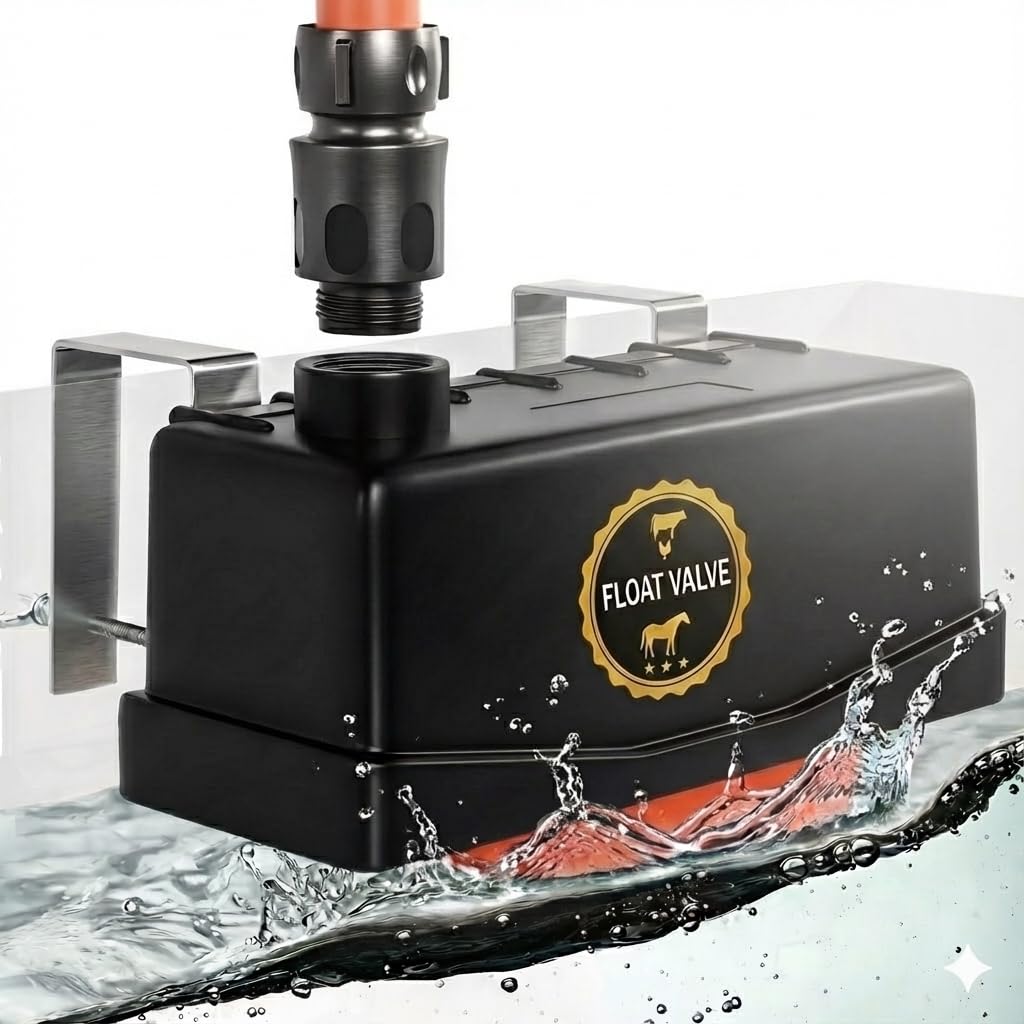
A budget plastic valve that arrives ready to mount, adapter and tape included.
For a simple livestock setup, the Herdmate gets you automatic water control for the least money on this list. The box includes the 3/4″ float valve, a 3/4″ valve-to-hose connector, Teflon tape, and an O-ring, so you are not hunting for fittings before you start. The built-in high-flow design delivers around 245 gallons per hour to keep large troughs topped up, and the plastic body resists rust and corrosion.
Installation is the easy part — hang it on the tank, tighten the brackets and screws, and walk away. It works across cattle, goats, chickens, and horse waterers, and doubles for pond and fountain auto-fill. The all-in-one box and the broad animal compatibility are exactly what make a low-cost valve appealing for a first setup.
The trade-off is upfront: quality and durability are the weak spots. If you want to try automatic watering cheaply or need a spare for a mild-weather coop, it does the job. For anything that has to survive a decade of farm duty, the bronze and stainless picks above are the safer money.
Why it earns a spot
- Complete kit with connector, Teflon tape, and O-ring included
- 245 gallons per hour for sizeable troughs
- Broad animal compatibility from chickens to cattle
The reality check
- Durability is the weak point — some units fail quickly
- Plastic body is a shorter-term choice than bronze or stainless
Best for: a cheap entry into automatic watering or a mild-weather spare.
Step up if: you need a valve to survive years of hard farm use.
Know the Specs
Flow Rate (Gallons Per Hour or Minute)
This tells you how fast a valve refills a tank. A valve rated in gallons per hour suits steady top-offs, while one rated in gallons per minute — like the Jobe at 90 GPM — fills a big trough fast. Size the flow to how many animals drink at once, not to how often you check the tank.
Inlet Size and Thread Type
The inlet is where water enters, and its size (1/2 inch or 3/4 inch) plus thread type must match your supply line. A 1/2-inch valve is a gentle refill; 3/4 inch moves more water. NPT threading is standard pipe, while a garden-hose fitting skips plumbing entirely.
Body Material
Bronze and stainless steel resist corrosion and hard water, and both outlast plastic in a hard freeze. Plastic and glass-filled nylon resist rust but can crack in a hard freeze. Choose bronze or stainless for freezing winters and daily stock duty, plastic or nylon for mild weather and light use.
Maximum Operating Pressure
Every valve has a ceiling — 125 psi, 140 psi, 150 psi — and running your line above it strains the seal. A higher rating gives headroom. Low-pressure lines need a valve that seals at low push, which is why gravity-fed setups want a low-pressure design.
Common Questions
Will a 3/4-inch float valve fit my existing 1/2-inch supply line?
How do I stop a float valve from leaking at the threads?
What flow rate do I need for a cattle trough versus a chicken coop?
Can a plastic float valve survive freezing temperatures?
What is the difference between a high-flow and a low-pressure float valve?
How often do the seals or O-rings need replacing?
Can I mount a float valve on the side of the tank instead of the top?
Is bronze better than stainless steel for a livestock trough valve?
Why does my trough keep overflowing after I install a float valve?
Can a float valve run off a gravity-fed rainwater tank with no pump?
The Bottom Line
For most buyers, the strongest water trough float valve is the Mueller 109-814 — a bronze body, a 125 psi rating, and a machined flange that seats flat, all in a valve simple enough to trust for years with the occasional seal swap. If you run a real herd and need refill speed, the Jobe Megaflow pours up to 90 gallons a minute, and its underwater mount keeps it clear of livestock. And if freezing nights are your worry, the JUXILPP stainless two-pack gives you an all-metal body and a spare in the box. Match the body material to your climate and the flow rate to your peak demand, and the valve stops being a chore.
How we choose
We do not accept paid placement. Every pick is matched to a real buyer and a real use-case; we do not hands-on test units.
Sources
Specifications: manufacturer listings and product documentation. Review insights: verified customer reviews, as of November 2026. Pricing: not shown on this page (it changes often); check the current price via the retailer link.
As an Amazon Associate, Tactical Gear Guy earns from qualifying purchases. This does not affect which products we feature.