Specs are compiled from manufacturer listings and verified buyer reviews and can change over time — please confirm the key details on the product page before buying.
You want PFAS (the “forever chemicals” that do not break down in water) gone from your tap water. The short answer: buy a filter with a certificate that names PFOA and PFOS specifically. Everything else is guesswork. This list covers 11 systems, from an under-sink cartridge to a wall-mounted whole-house unit, and each one has a real PFAS-reduction credential behind it. One note before you read: this list uses flexible, human-like matching for our PFAS-certification requirement, so not every pick is the exact model number you may have searched. The nearest same-type size or capacity does the same job, and we flag that upfront so you are never misled.
This guide is built by comparing the manufacturers’ published specifications and the patterns across verified customer reviews, so you get each pick’s real strengths and trade-offs instead of marketing spin.
PFAS are the “forever chemicals” that accumulate in the body over years, and a filter either carries a certificate naming PFOA and PFOS or it does not. Below you will find the certification numbers, filter lives, capacities, and installation realities for every system, so you can match one to your sink, your house, or your power situation. Every pick here has a paper trail behind its PFAS claim, which is what separates genuine water treatment systems for pfas from a filter that only handles chlorine.
Top Picks

How To Choose The Best Water Treatment Systems for PFAS
The first thing to settle is not brand or price but where the water has to go. A whole-house system sits at the main line and treats every tap, shower, and appliance at once. An under-sink unit treats only the kitchen faucet, and a countertop model treats whatever you pour into it. Each solves a different problem, and buying the wrong type is the most common way people waste money here.
Check the certificate, not the adjective
A carbon filter can claim it “reduces contaminants” and still do nothing for PFOA and PFOS. What you want is a certification — NSF/ANSI 53 or NSF/ANSI 58 — that explicitly lists PFOA and PFOS reduction. That number is the only real proof the filter media was tested against those specific chemicals.
Side-by-Side Comparison
| Model | Best For | Type | Filter Life | Capacity | Amazon |
|---|---|---|---|---|---|
| iSpring WGB22B-PF★ Best Overall | Whole-house PFAS at the main line | Whole House | 12 months | 100,000 gal | Amazon |
| Pentair FreshPoint Easy FlowBudget Pick | Kitchen-sink-only PFAS on a budget | Under Sink | 12 months | 3,000 gal | Amazon |
| VonWater CT910Best No-Install RO | Renters wanting RO with no plumbing | Countertop RO | 12 months | 528 gal | Amazon |
| Culligan MaxClear | Off-grid and power-outage drinking water | Gravity | 6 months | 2.25 gal | Amazon |
| Aquasana AQ-6300M-BN | Fast-filtering under-sink with minerals kept | Under Sink | 6 months | 800 gal | Amazon |
| ProOne Big+ | Large gravity capacity for a family | Gravity | 9 months | 3 gal | Amazon |
| AquaTru Glass Carafe | Glass-carafe RO with zero installation | Countertop RO | 6 months | — | Amazon |
| AquaTru Classic Alkaline | Apartment RO with minerals added back | Countertop RO | 6 months | 2.7 L | Amazon |
| iSpring WGB32B-PF | Whole-house PFAS with maximum capacity | Whole House | 12 months | 100,000 gal | Amazon |
| Waterdrop X12-Alkaline | Serious under-sink RO for a big family | Under Sink RO | 24 months | 1,200 gal | Amazon |
Detailed Reviews
1. iSpring WGB22B-PF Water Filter System
Our pick — 4.5+★ from 800+ verified ratings; the strongest balance of quality and price.
One main-line box that treats every tap, shower, and appliance in the house for a year.
A whole-house system is the only way to stop PFAS before it reaches your shower, your washing machine, or the glass you fill at 2 a.m. This iSpring sits on your main water line and treats the whole supply, with an upgraded FC25B-PF filter in stage two that the maker states is SGS-tested to reduce up to 99% of PFAS, including PFOA and PFOS. Stage one is a sediment filter (FP25B) that catches rust, sand, and silt first — the point being to keep that grit out of your plumbing and appliances before the carbon stage ever sees it.
You get a long run before you touch a filter: 100,000 gallons of treated water, or 12 months, whichever you hit first. For scale, the Culligan MaxClear gravity pick below holds 2.25 gallons in its reservoir — this is a completely different class of system built for a house, not a pitcher. The 1-inch NPT inlet and outlet ports (the threaded pipe fitting most whole-house setups use) are the standard size, so your plumber or a confident DIYer can connect it without adapters. iSpring includes a manual plus video walkthroughs for the install and the filter swaps. The unit arrives at 26.5 pounds and a 16″L x 8″W x 28″H footprint, so budget real wall or floor space near your main line, not a cabinet.
What owners talk about most is the build quality and how the install goes — it is the single most-praised quality in the feedback, with ease of installation close behind. Chlorine taste and smell disappear, well-water odors go away, and the water simply tastes like water again. The honest catch worth planning around: some units weep at the connections, and the sediment stage needs watching so a clogged filter does not drag the flow down — a few owners note both. Neither is unusual for a whole-house install, but it means you want the fittings tightened properly and the housing checked in the first week.
Why this earns the top spot
- Rated 4.5+ stars by 800+ buyers — the strongest combination of score and volume in this group.
- 100,000 gallons or 12 months per filter set, the longest capacity on the list.
- Standard 1-inch NPT ports mean it drops into most existing whole-house plumbing.
- Retains healthy minerals — a point for anyone who does not want flat-tasting water.
What to plan around
- Some buyers report seepage at the fittings — check the housing after install.
- It will not lower TDS; for that you need an RO system, per iSpring’s own note.
Go for this one if: you own the house and want PFAS handled at the source for the entire household.
Think twice if: you rent or cannot touch the main line — a countertop or under-sink unit fits your situation better.
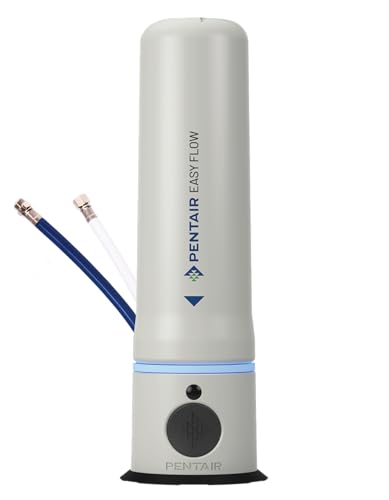
2. Pentair FreshPoint Easy Flow Water Filtration System
The cheapest way to get certified PFOA/PFOS reduction at your kitchen tap, with no extra faucet.
Here is the most important distinction on this whole list stated plainly: this unit is certified to reduce up to 98% of PFOA/PFOS, which is the PFAS reduction you came for, at entry-level cost. That difference in scale translates directly into what it can do.
The 3,000-gallon or 12-month filter gets replaced as one cartridge, and the carbon block delivers water at a 2.2 gpm max flow rate straight from your existing kitchen faucet. No dedicated faucet, no storage tank, no extra holes in the counter. For a single-tap solution in a small kitchen, that is the appeal.
What people report most is the difficulty of the install, and the answer is that it depends on your existing plumbing. Some folks find it quick and painless; others hit a snag at the shutoff valve or the hose joint. The recurring story is water finding its way out at those existing hose joints that cannot be tightened. Plan for a careful install or a plumber’s ten minutes, and this is a solid budget pick.
Where it shines: certified PFOA/PFOS and lead reduction without a separate faucet. The carbon block material and 2.2 gpm max flow rate are genuinely practical for cooking and filling bottles in a small kitchen.
Fit note: the under-sink routing depends entirely on your existing plumbing, so the install can be quick or fussy — budget for a joint check before you call it done.
Reach for this if: you want certified PFAS reduction at one tap without cutting a hole in your counter or paying for a separate faucet.
Look elsewhere if: you need to treat the whole house or want RO-level dissolved-solids removal.
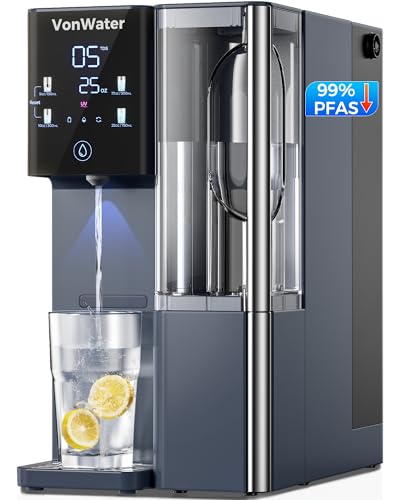
3. VonWater 7-Stage Countertop Reverse Osmosis System, CT910
A seven-stage filter that plugs into a wall and pours into a removable pitcher, with no plumbing at all.
If you rent, or your kitchen was not built with a filter in mind, this is the model to read carefully. No installation, no drilling, no shutoff valve. The all-in-one filter is certified to NSF 372, 53, 42, and 58 and purifies down to 0.0001 μm — small enough to catch TDS, fluoride, lead, chromium, iron, nitrates, chlorides, and, for your purpose here, PFOA and PFOS.
The 3:1 pure-to-drain ratio returns three gallons of clean water for every one sent down the drain, and VonWater rates the filter at 528 gallons or 12 months. Compare that filter life to the Culligan gravity pick below and you get double the run before a swap. The 1.2L detachable pitcher (41 oz) lifts off and goes to the table or the bedroom, and the LED touch screen shows real-time TDS and filter life so you are never guessing when the filter is spent.
Check the size against your cooking before you buy: this is a countertop appliance at 15 pounds with a 0.26 liters-per-minute max flow rate, so filling a big pot takes patience, and the refill tank holds 5.5 liters. The evidence for its appeal is simple — buyers talk most about how easy it is to set up and use, and how clean and clear the water tastes, especially against public tap water that carries chlorine and algae flavors.
The practical read: this is the PFAS answer for a renter who cannot touch plumbing. At 528 gallons per 12-month filter and a 3:1 pure-to-drain ratio, it costs less to run for a year than buying bottled water.
What to expect: the 0.26 L/min flow rate means this is a glass-at-a-time machine, not a pot-filler — and the 15-pound box needs permanent counter space.
Suits you if: you want RO-grade PFAS and TDS removal in a rental or apartment with zero plumbing.
Pass if: you are filling stockpots daily — the 0.26 L/min rate will frustrate you.
4. Culligan MaxClear Gravity Water Filter System
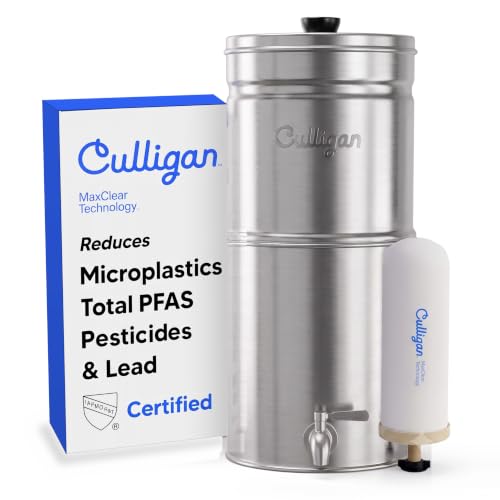
A stainless gravity filter that keeps cleaning your water when the power goes out.
No electricity and no plumbing — that is the whole design premise, and it is what makes this interesting. Culligan states the MaxClear is the only gravity filter system certified to NSF/ANSI 42 standards to reduce microplastics, lead, and Total PFAS. The 2.25-gallon reservoir holds enough for a family’s drinking water, and the nesting design drops under 12 inches when you stow it, so it lives on the counter without eating the whole worktop.
The filter itself combines a ceramic shell with carbon media in one cartridge, and it lasts up to 6 months. It is also the most flexible pick on the compatibility front: it accepts Berkey Black BB9-2 replacements as well as filters from Boroux, ProOne, Doulton, Purewell, and Waterdrop. Not many filter bodies give you that many cartridge options.
How the water comes out is where the honest caveat lives: gravity means slow. Expect to fill the top and wait. The water quality itself is what wins people over — it is the top-praised feature, with functionality close behind — while value and leak-proofing split opinion and filtering speed is the recurring gripe. Assembly is simple enough for most folks, and the brushed or polished stainless finish with the ergonomic spigot looks the part on a counter.
Why keep it on the shortlist: certified reduction of Total PFAS, lead, and microplastics with no power draw — it works through an outage or a camping trip. The stainless steel body resists corrosion and rust.
Be ready for: the drip-through pace of gravity filtration. Filling the top and waiting is the cost of zero electricity.
Pick this if: outages or off-grid use are part of your plan and you want certified PFAS reduction without a power cord.
skip it if: you want water on demand at speed — this one asks you to fill and return later.
5. Aquasana Claryum 3-Stage Max Flow AQ-6300M-BN Water Filter
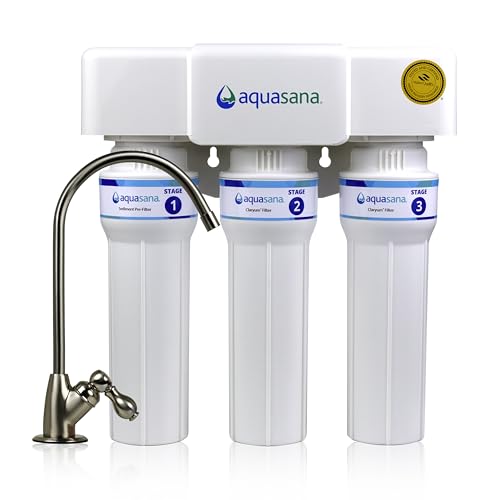
An under-sink unit that pours fast enough to fill a pot without the drip-filter wait.
Speed is the number that separates this from the crowd. It flows at 0.72 gallons per minute, a genuine step up from the trickle of a pitcher or a gravity filter — so you fill a pot fast instead of waiting. It does that while still being certified by WQA (the Water Quality Association, an independent testing body) to NSF 42, 53, and 401 (standards for taste and odor, health-related contaminants, and emerging contaminants). The maker states it reduces up to 99.99% of 78 contaminants, including lead, PFAS, chloramines, pharmaceuticals, and microplastics. Unlike an RO (reverse osmosis) system, it keeps the minerals in and will not reduce TDS (total dissolved solids), which many people prefer for drinking water.
The filter set lasts up to 6 months or 800 gallons, and the swap is a twist-off housing change rather than a wrestling match. Everything for a DIY install ships in the box: first filter set, a brushed nickel faucet, and the under-counter parts. You do need 15.85 inches of clearance under your sink, and the housing measures 12″L x 4.25″W x 12.85″H while weighing 8.4 pounds — measure before you commit.
Filter quality is the most-discussed strength here, with the install experience close behind, and the taste feedback points the same way: it strips the unpleasant flavor out of city water. The carbon block material and metal faucet are built to last, and the value story is reasonable given the cartridge life. What to watch: the faucet and install kit are included, so the cost of entry is essentially the whole system.
What sold us: certified PFAS reduction at 0.72 gpm means a full kettle in seconds, not minutes. The twist-off housing and included brushed nickel faucet make it a clean one-time job.
Measure first: 15.85 inches of under-sink clearance is non-negotiable — a cramped cabinet will not fit this housing.
The one for you if: you cook a lot and hate waiting on a slow filter, but do not want the mineral-stripping of reverse osmosis.
Not your pick if: your cabinet is shallow — check that 15.85-inch clearance before ordering.
6. ProOne Big+ Gravity Water Filter System

A three-gallon stainless tank that treats water with no power and comes with two filters.
Three gallons is the spec that matters here — a capacity that outpaces the Culligan’s 2.25 gallons and means fewer refills for a busy house. The Big+ is IAPMO certified to reduce lead, Total PFAS, microplastics, and chlorine taste and odor, and it ships with two 7-inch G2.0 filters in the box. ProOne states each filter lasts up to 9 months with regular daily use, and the media is infused with silver to help prevent unwanted contaminant growth between fills.
The body is polished stainless steel, so it wipes clean and resists corrosion and rust, and the package includes the stainless spigot and stand. Because it runs on gravity, it needs no electricity and no plumbing — it works during an outage, on a camping trip, or in an RV. At 3 gallons you get real family capacity from a system that fits on a counter or tucks into a van.
Owners are split on some practical points. The build quality and water taste are the most-discussed positives — the tank is praised for how solid it feels, and the water tastes clean. But reliability, value, speed, and durability draw mixed feedback, with some units arriving that will not work and some noting rust after about a month of use. So the honest read is this: a strong design and genuine certifications, and you want to keep the tank dry between refills and register the warranty.
The core strength: three gallons of capacity, two filters included, and no power needed — the largest self-contained gravity tank in this group, with a stainless body that resists rust.
The honest trade: the filter is slow by design, and durability is the mixed signal to watch — keep it dry between fills.
Works for you if: you need a large no-electricity tank and want spare filters in the box from day one.
Look at the Culligan instead if: you want a power-free filter with the most established certification trail in the gravity category.
7. AquaTru Glass Carafe Countertop Reverse Osmosis System
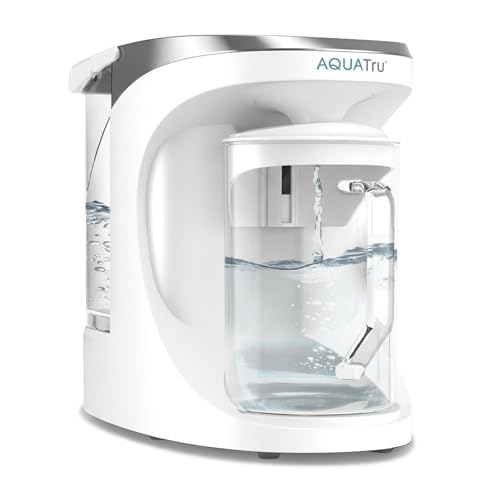
Four-stage RO that pours into a real glass carafe, no plumbing required.
Most countertop systems hand you a plastic pitcher; this one dispenses into a removable borosilicate glass carafe with a lid. That single detail separates it for anyone who does not want drinking water sitting in plastic. The 4-stage RO (reverse osmosis, which pushes water through a fine membrane) system is tested and certified to NSF standards by IAPMO (an independent product-certification body) to remove 84 contaminants, including PFOA and PFOS, lead, chromium-6, arsenic, fluoride, and microplastics. That means PFOA and PFOS come out alongside the dissolved solids that ordinary carbon filters leave behind.
Filter life is layered: the pre/carbon filter runs 6 months or 300 gallons, the RO filter a full year or 600 gallons, and the VOC carbon filter a year or 300 gallons. It plugs into any standard outlet, needs no tools, and sits at a 14″L x 7.5″W x 13″H footprint on the counter. The fill-and-go design is what makes it livable — refilling the tank and cleaning are the things people mention most favorably.
Taste is the runaway favorite: people describe a night-and-day difference from their tap water, and the filter’s impurity removal is the second big point in its favor. The recurring honest notes are that filtration speed is slower than you might expect and the cost of replacement filters is the main value question. The one-year warranty and 30-day money-back guarantee soften that concern.
What puts it on the list
- Glass carafe with lid — no plastic pitcher to worry over.
- Certified to NSF standards by IAPMO for PFOA/PFOS, lead, chromium-6, and more.
- Plugs in and pours with zero installation, drilling, or plumbing.
- Taste feedback is the standout, with the refill-and-clean routine close behind.
The counterpoints
- Filtration speed is slow — this is not a pot-filler.
- Replacement filters are the main cost question buyers raise.
The clear choice for: anyone who wants RO water with no plumbing and refuses to store it in plastic.
Reconsider if: you need high output — the pace of a 4-stage RO will test your patience on big fills.
8. AquaTru Classic Alkaline Countertop Water Purifier
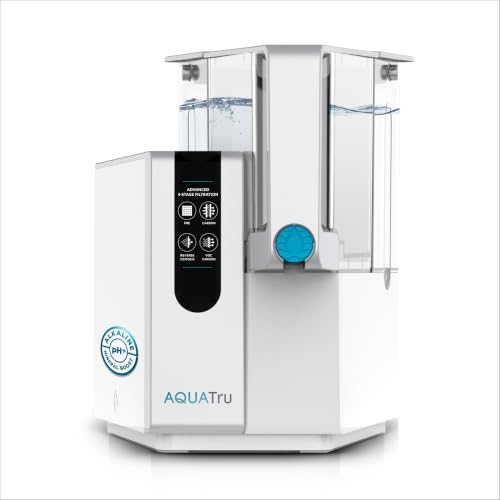
RO that takes the contaminants out, then puts the good minerals back in.
The alkaline angle is the point of this one. It runs a patented 4-stage reverse osmosis system certified by IAPMO to NSF standards to reduce 84 contaminants including fluoride, lead, chlorine, microplastics, and forever chemicals (PFOA/PFOS), then adds minerals back to the output. That is a meaningful difference for people who tried RO before and did not like flat-tasting water.
The 1-gallon tap water tank means fewer refills for a family, and it needs no plumbing — plug it in and it filters. AquaTru rates the filter set to replace up to 4,500 plastic bottles, with stage-specific swaps running 6 months to 2 years. It weighs 22.8 pounds and measures 14″L x 12″W x 14″H, so it is a countertop anchor rather than a portable bottle. The BPA-free plastic body keeps the weight down; the AquaTru Classic model code confirms this is the alkaline build.
Water quality is the most-liked quality, with functionality right behind — people find it handles a three-person household comfortably and tastes clean with zero assembly. The honest trade-offs: value for money draws mixed reactions, with the replacement-filter cost being the sticking point, and leakage splits opinion, with some units dry at the spout while others drip from the bottom of the reservoir. If you own it, keep the base on a tray the first week.
The mineral story: certified 4-stage RO for PFOA/PFOS and 84 contaminants, then minerals added back — the RO result without the flat taste.
Count the cartridges: filter sets run 6 months to 2 years and are the main recurring cost, so price the replacements before you buy.
This is your pick if: you want RO-grade purity but not the stripped-mineral taste of a standard system.
You might pass if: you want the lowest running cost and are happy with plain carbon filtration.
9. iSpring WGB32B-PF PFAS Whole House Water Filter System

Three stages, a 20-inch housing, and the highest buyer score of any whole-house system here.
This is the iSpring for a household that wants maximum filter surface area. The three stages pair a high-capacity sediment filter with two premium carbon filters, and the upgraded Stage 3 FC25B-PF uses SGS-tested media to reduce up to 99% of PFAS including PFOA and PFOS. Sediment, rust, sand, chlorine, taste, odor, and the forever chemicals are handled in one pass whether you are on city water or well water.
The 20″ x 4.5″ filter housings are what make this the bigger sibling of the top pick — more media, more contact time, same 1-inch NPT ports for a standard whole-house hookup. Capacity runs up to 100,000 gallons or 12 months, and it arrives at 39.3 pounds with a 24.5″L x 8″W x 28″H wall-mount footprint. That weight and size mean you want it secured properly and a second set of hands for the lift.
The feedback points to the well-water owners especially: water quality and effectiveness are the most-discussed strengths — sulfur smell and chlorine taste both disappear, and the water tastes clean again. Value gets praise too. The note worth keeping in view is the 1-inch connectors, which is where leak issues show up if the fittings are not properly sealed. Tighten, test, and re-check after a day.
The case for it: 100,000 gallons of capacity through 20-inch housings, certified PFAS reduction, and the top buyer score in the whole-house group at 4.5+ stars from 200+ buyers.
The one thing to do: seal the 1-inch connectors carefully — that is where the few leak reports begin, not in the filter media.
Buy this if: you want the highest-rated whole-house PFAS system and have the wall space for a 20-inch housing setup.
Pick the WGB22B-PF instead if: you want the same 100,000-gallon capacity in a smaller, lighter box.
10. Waterdrop X12-Alkaline Mineral Reverse Osmosis System
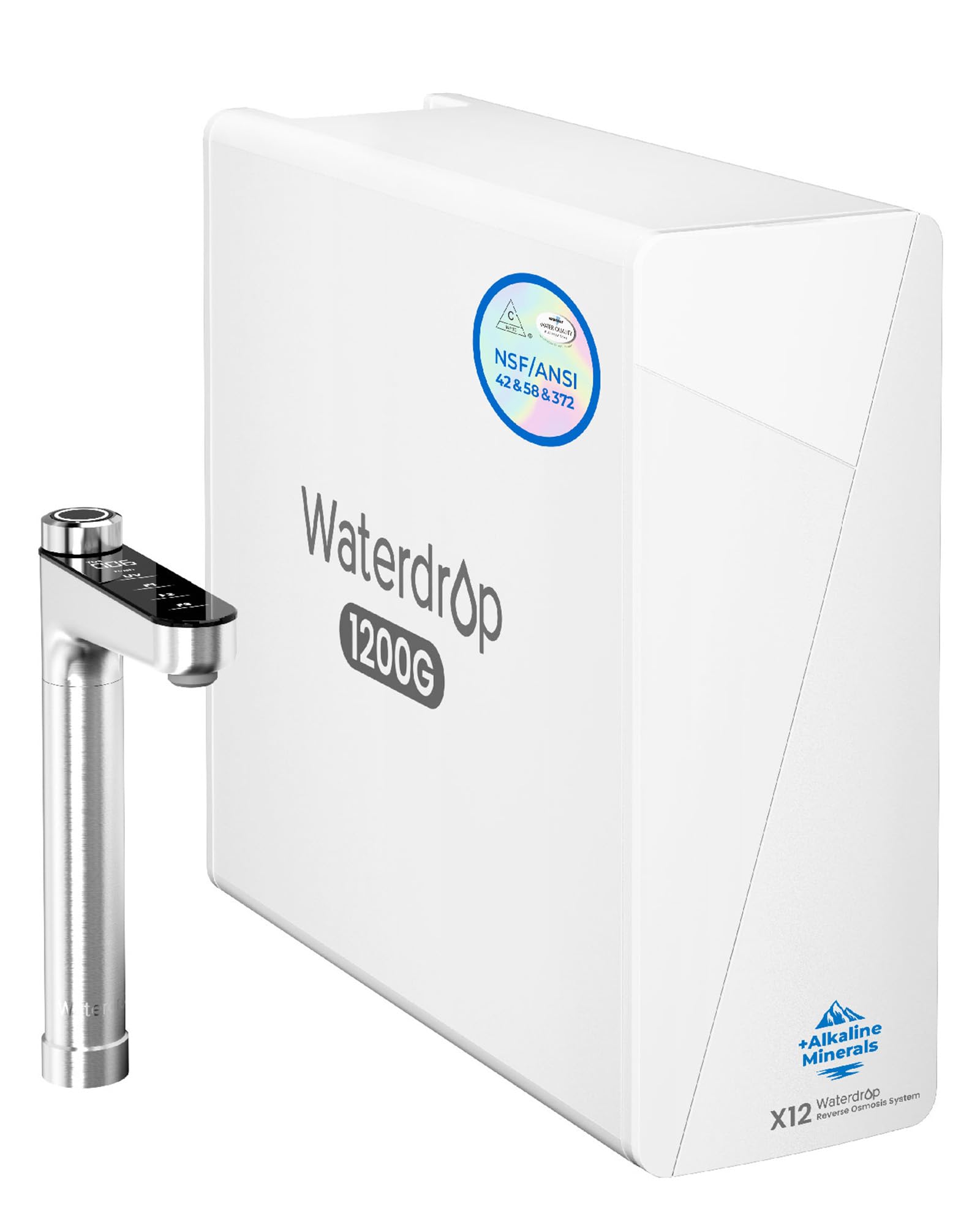
An 11-stage, tankless under-sink RO that runs a full two years between filter swaps.
This is the under-sink system for a household that is done with countertop pitchers. It is tested and certified by IAPMO R&T against NSF/ANSI 42, 58, and 372, and tested by SGS to reduce TDS, PFOA, PFOS, chlorine, fluoride, arsenic, and lead. The 11-stage filtration includes a 0.0001 μm RO membrane built from 16 layers, and the tankless design frees up the space a storage tank would normally swallow under your cabinet.
The 1,200 GPD tankless rating delivers on-demand flow at 0.4 gpm, with no storage tank to refill or wait on. Filter life is the longest on this list by a wide margin at 24 months, double the 12-month cycle of the VonWater countertop and four times the 6-month cycle of the Culligan gravity filter. The smart digital faucet shows TDS and filter life at a glance and supports measured output, and the alkalizing stage adds calcium and magnesium back into the water.
Taste and installation are the two things people talk about most, and both land positively — the water tastes clean and the DIY install is straightforward, with simple filter changes afterward. The honest notes: some find it costly compared to a cheap filter alternative, and leakage is the negative that shows up in the feedback, so check the supply connections after install. The 3:1 pure-to-drain ratio holds wastewater to one gallon per three purified across its 24-month filter life.
The headline win: 11 stages, 1,200 GPD tankless output at 0.4 gpm, and a 24-month filter life that puts it years ahead of every other pick here in replacement cadence.
What you give up: it is the most expensive system here and a leak check on the supply fittings is part of setup.
Strongest match for: a family that drinks a lot of water and wants to swap filters once every two years, not every six months.
Overkill if: you live alone or want a simple countertop pour — a lighter RO or gravity system does the same job for less.
Know the Specs
What PFAS certification actually means
A PFAS filter is only as good as its certification. NSF/ANSI 53 covers health-related contaminant reduction for carbon and other filter types, while NSF/ANSI 58 covers reverse osmosis systems. Look for a certificate that names PFOA and PFOS specifically — those are the two chemicals the testing targets. A “removes contaminants” line on the box is not the same thing, and it will not tell you what was tested.
Gallons vs. months on a filter
Filter life is always given as two numbers with “whichever comes first”: a gallon count and a time span. A typical household draws roughly 50-75 gallons a day for drinking and cooking, so a 3,000-gallon cartridge suits a small family while a 100,000-gallon whole-house system covers every tap in a home. If your water is heavily chlorinated or high in sediment, the real numbers trend down, so plan a little margin.
Reverse osmosis and the mineral trade-off
RO pushes water through a very fine membrane — some systems use 0.0001 μm — that catches dissolved solids, fluoride, heavy metals, and PFAS. The catch is it also strips the minerals that give water a full flavor, which is why alkaline and mineralization stages exist on systems like the AquaTru Classic and the Waterdrop X12. Carbon filters do not remove TDS, so if you want dissolved solids handled as well, RO is the route.
Whole house vs. pointof-use
Where you install the filter decides what gets treated. A whole-house system goes on the main line and handles every tap, shower, and appliance, which is why the iSpring picks are rated in tens of thousands of gallons. An under-sink unit treats only the kitchen faucet, and a countertop or gravity filter treats whatever you pour into it. Match the type to your living situation before you compare anything else — a certified under-sink cartridge does nothing for the water in your shower.
Common Questions
What certification proves a filter removes PFAS?
Will a carbon pitcher filter take out PFAS?
How often do PFAS filters need replacing?
Does reverse osmosis remove PFAS or TDS better than carbon?
Can I install a whole-house PFAS filter myself?
Will a PFAS filter work during a power outage?
Do PFAS filters remove the healthy minerals too?
Is a countertop RO system as effective as an under-sink one?
Why does my new filter water taste flat?
How much under-sink clearance does an RO system need?
The Bottom Line
For most homeowners, the water treatment systems for pfas winner is the iSpring WGB22B-PF. It treats every tap in the house for PFAS at 100,000 gallons or 12 months through standard 1-inch NPT ports, and it carries the strongest buyer score and volume of any whole-house pick here. If you only need the kitchen faucet and want to keep it simple, the Aquasana AQ-6300M-BN delivers certified PFAS reduction at a 0.72 gpm flow that fills a pot fast. And for renters or anyone facing an outage, the AquaTru Glass Carafe gives you certified RO with zero plumbing, while the Culligan MaxClear keeps cleaning water with no power at all.
One honest nudge: if you have hard water as well as PFAS, the iSpring WGB31B-PFKDS is the only pick here with a scale inhibitor built in (it stops mineral buildup in the unit), and that combination is worth the few extra filter swaps over a year. Whichever you choose, verify the certification names PFOA and PFOS, check the gallon capacity against your household’s daily use, and measure your install space before you order. Those three checks separate a filter that genuinely protects your home from one that only improves the taste.
How we choose
We do not accept paid placement. Every pick is matched to a real buyer and a real use-case; we do not hands-on test units.
Sources
Specifications: manufacturer listings and product documentation. Review insights: verified customer reviews, as of November 2026. Pricing: not shown on this page (it changes often); check the current price via the retailer link.
As an Amazon Associate, Tactical Gear Guy earns from qualifying purchases. This does not affect which products we feature.