Specs are compiled from manufacturer listings and verified buyer reviews and can change over time — please confirm the key details on the product page before buying.
Hard shower water tells on itself fast: hair that squeaks and tangles, a scalp that itches by evening, and a shower head crusted white in weeks. A water softener for an apartment shower fixes that at the source, and the best one for most renters is the SR SUN RISE — the crowd favorite at 4.0+ stars across 9,000+ owners, with a detachable handheld head and a five-year limited warranty. The four picks below all mount at your shower arm with no plumbing work, so nothing gets drilled and nothing gets left behind when you move out.
This guide is built by comparing the manufacturers’ published specifications and the patterns across verified customer reviews, so you get each pick’s real strengths and trade-offs instead of marketing spin.
These units swap in at the shower arm with a standard thread, so you get softer-feeling water without touching your building’s plumbing, and here are the picks worth your shelf space in a water softener for apartment shower.
Top Picks
How To Choose The Best Water Softener for Apartment Shower
Start with the rental constraint, because it decides everything else. A real water softener uses salt and a resin tank and needs plumbing work most leases forbid. What you can screw onto your shower arm is a filtered shower head or an inline filter cartridge, and its job is to trap chlorine, rust, sand and sediment before they hit your skin. Once you accept that trade, three numbers settle the choice: flow rate, filter life, and thread size.
Check the flow rate before anything else
Flow rate is measured in GPM, or gallons per minute — the volume of water the head pushes out each minute. A head rated 1.75 GPM or 1.8 GPM moves a steady stream without draining your building’s pressure. Third-floor walk-ups and older buildings tend to run weak, so a head that claims pressure boosting earns its keep there. If the listing lets you pull a flow restrictor to open the spray wider, you get more volume but you also spend your filter faster.
Match the filter media to your actual water problem
KDF is a copper-and-zinc filtration medium that grabs chlorine and some heavy metals. Maifan stone and calcium sulfite cartridges work on similar impurities and often pair with vitamin C, which neutralizes chlorine. If your complaint is a chlorine smell and dull hair, any of these helps. If your complaint is genuinely hard, chalky water leaving scale on the glass, know that a shower cartridge reduces the symptoms rather than softening the whole supply — no salt-free shower head can do that job.
Count the replacement cartridges and the install parts
Cartridge life usually runs about three to six months depending on your water and how long you stand in there. Four replacements a year is a normal rhythm, so check that spares are easy to find and cheap enough to keep buying. Then read the box contents. Thread seal tape, spare washers and a wrench in the box are the difference between a tool-free swap and a leak you spend an evening chasing. Universal G1/2 thread is the standard to look for, since it fits the shower arm already in your wall.
Side-by-Side Comparison
| Model | Best For | Flow Rate | Spray Modes | Weight | Amazon |
|---|---|---|---|---|---|
| SR SUN RISE Filtered Shower Head with Handheld★ Best Overall | Most apartment showers | 1.75 GPM | 9 | 1.8 lb | Amazon |
| Halo Filters 20-Stage Filtered Shower Head | Chlorine-heavy city water | 1.8 GPM | 1 | — | Amazon |
| JDO High Pressure Filtered Shower Head | Small bathrooms, quick filter swaps | — | 5 | 1.34 lb | Amazon |
| Sonaki Inline 6 Stage Vitamin C Filter | Keeping your existing shower head | — | — | 1.7 lb | Amazon |
Detailed Reviews
1. SR SUN RISE Filtered Shower Head
Our pick — 4.0+★ from 9,000+ verified ratings; the strongest balance of quality and price.
Nine spray settings and a 71-inch hose on a head that never needs a plumber.
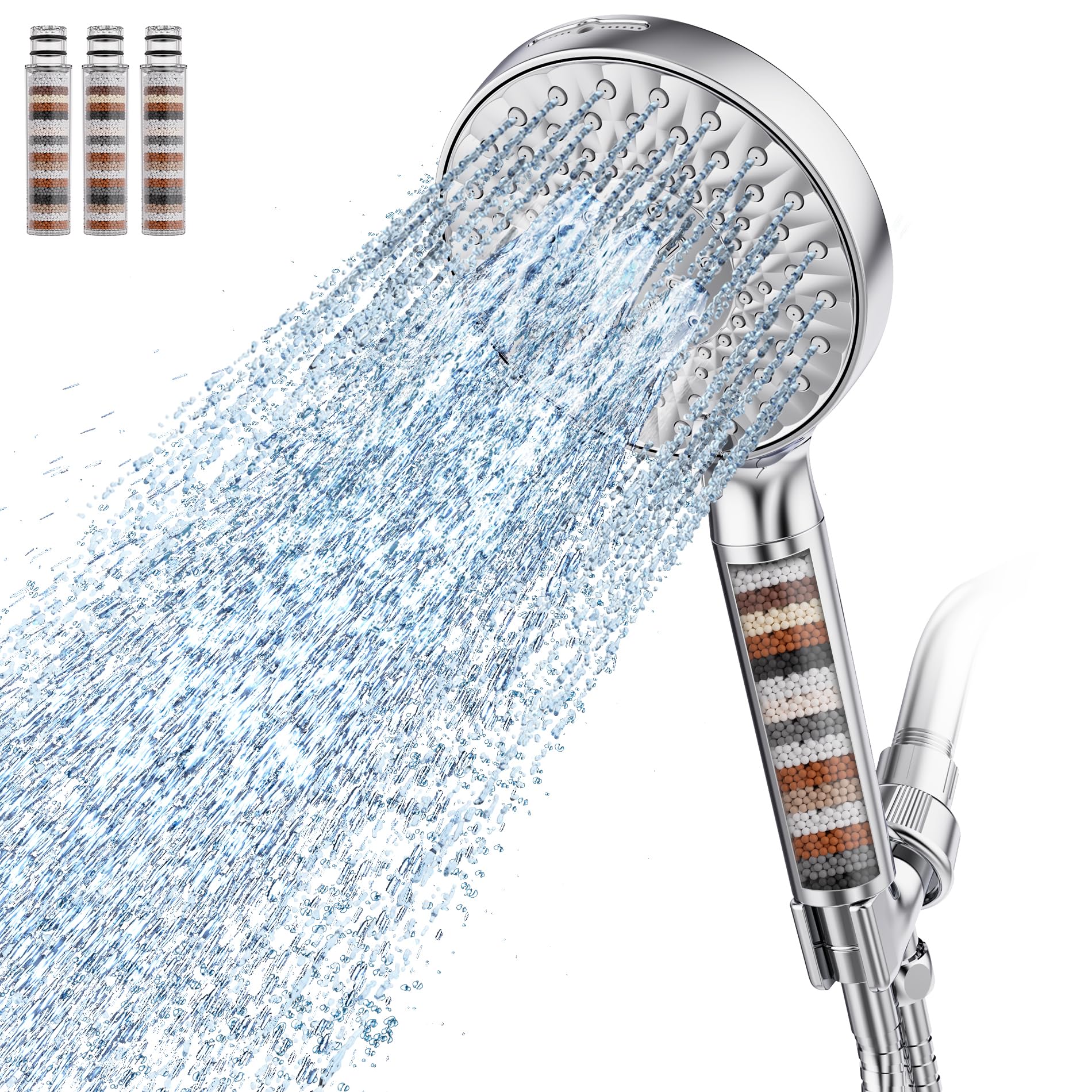
If your apartment shower is a fixed wall head you cannot reach, this replaces it with a handheld on a generous reach. The water runs at 1.75 GPM (gallons per minute — how much water comes out each minute), which keeps pressure steady without asking more of your building’s plumbing than it has to give. Better still, the whole swap takes about 3 minutes with no tools, using the universal G1/2 thread that matches a standard shower arm.
Filtration here is multi-stage, with KDF, maifanstone and vitamin C media stacked inside the head to pull down chlorine and some impurities. What wins people over is the build — 1,500+ buyers have weighed in on quality and it is the aspect that comes up most, though water pressure trails just behind at 870 mentions. Nine settings is a real spread too: Full Rain, Rain, Powerful Rain, Mist+Massage, Massage, Mist, Rain+Massage, Wide Fan and Pause, plus a Power Wash you flip to for rinsing tubs, tiles and pets.
The catch is the hose. Buyers report the hose cracking within four months of use, and durability sits as the one negative thread in an otherwise warm response. Replacement cartridges go every 3 to 6 months, sooner if your water is heavy on chlorine, so budget for spares. The manufacturer backs eligible defects for 5 years, which softens the hose worry considerably. Weigh it against the Halo Filters at 1.8 GPM and you trade a hair of flow for a handheld, a far longer hose and twice the spray choice.
What earns its keep
- 9 spray modes including a dedicated Power Wash flip for cleaning
- 3-minute tool-free install on any standard shower arm
- 71-inch kink-resistant stainless hose reaches the far corner of a tub
- Flow rate of 1.75 GPM holds pressure on weak apartment supply
- Five-year limited warranty on eligible parts
Where it asks patience
- The hose has cracked for some owners inside four months
- Cartridges need replacing every 3 to 6 months
- Soft silicone nozzles need occasional wiping to stay clear
Go for it: renters who want a handheld, multiple spray styles and a warranty behind the head.
Think twice: if you would rather not think about hose wear at all — an all-in-one head sidesteps a hose entirely.
2. Halo Filters 20-Stage Filtered Shower Head

Twenty filtration stages and a single fixed spray for people who want zero fiddling.
Chlorine is the target here, and the spec sheet is unusually blunt about it: a 20-stage cartridge built with KDF55 and calcium sulfite, claimed to remove up to 98% of chlorine and heavy metals. That is the maker’s number, not a lab test you and I ran, but it points at the right buyer — someone in a city building where the water smells like a swimming pool. The 1.8 GPM flow rate is the marginally higher figure next to the SR SUN RISE’s 1.75 GPM, so pressure is not the sacrifice.
This is a set-and-leave unit. One spray setting, one jet, no selector to learn, and a compact 5.27-inch face that fits a shower stall with no overhang. It is also the lightest thing to mount of the head-style picks. The filtration cartridge lasts up to 3 months, which works out to about four replacements a year, and the unit carries NSF-42 certification — an independent standard for water-treatment claims. Buyers describe less flaking and dryness on their face after switching.
Be honest about the trade: no handheld, no spray variety, and nowhere near the review history of the SR SUN RISE above.
The honest read: if chlorine smell and dull hair are your whole complaint, this is the most filtration-forward head on the list, and its NSF-42 certification gives you a verifiable standard rather than a promise.
Where it gives ground: one fixed spray means shaving legs and rinsing shampoo feel identical, so anyone who likes a massage setting should look elsewhere in this lineup.
Reach for this if: you want maximum filter stages and you never change spray settings anyway.
Look elsewhere if: you want a handheld head or a selection of spray patterns.
3. JDO High Pressure Filtered Shower Head, 5 Modes
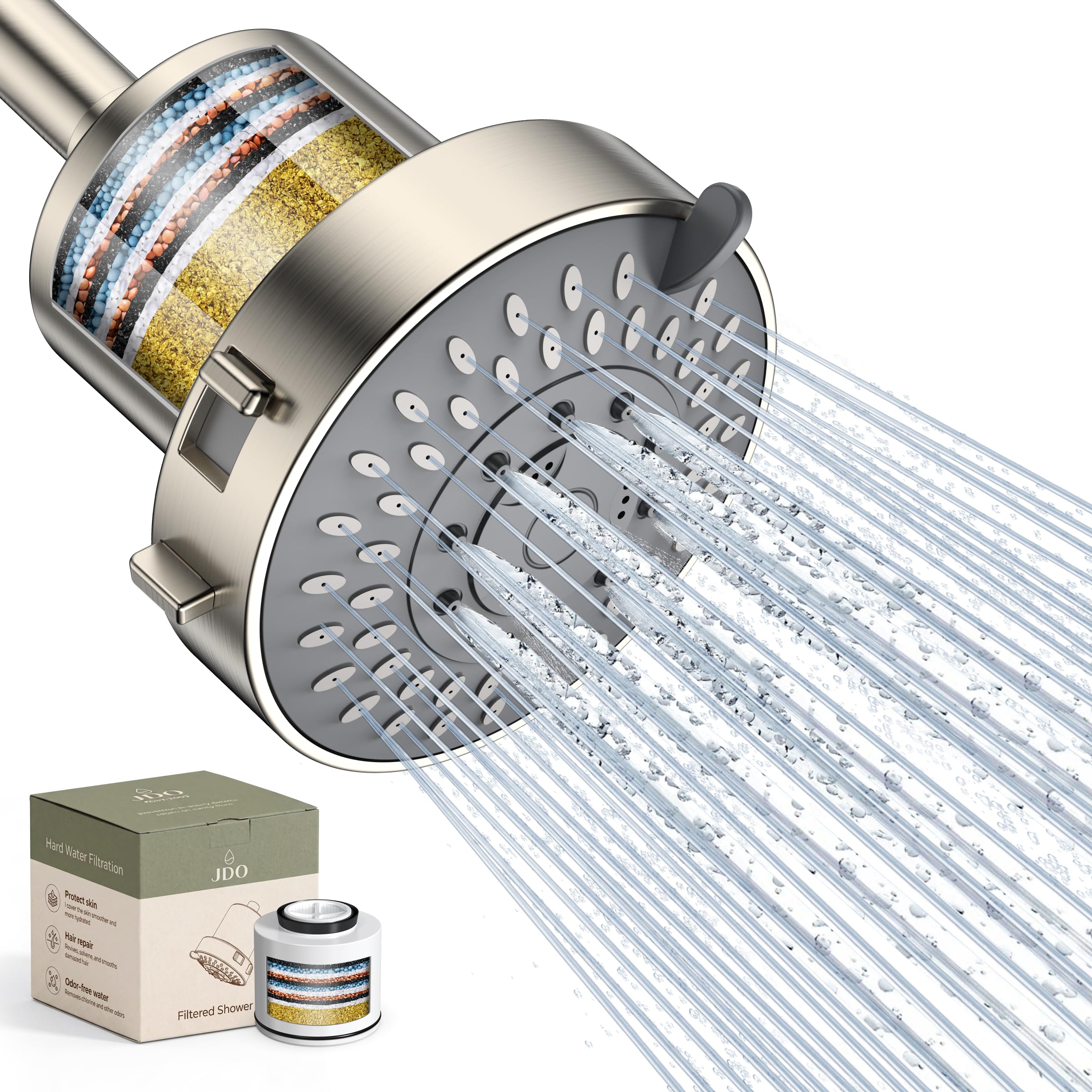
The filter lives inside a 4-inch head, so nothing crowds your shower arm.
Small bathrooms have a specific problem: an inline filter hanging off the shower arm eats the space behind the head and makes a tight stall feel tighter. JDO’s answer is to build the cartridge into the shower head body itself, keeping the 4-inch footprint clean. At 1.34 pounds it is the lightest head here, and the solid brass ball joint rotates a full 360° so you can angle the spray where you actually want it.
Filter swaps are the second clever bit. Squeeze the side tabs, slide the cartridge out, and you are done in seconds without unscrewing the head from the arm. You get 5 spray modes on a side selector — Rain & Massage, Rain & Mist, Massage, Rain and Mist — so there is a fuller rinse for shampoo days and a soft mist for a quick evening cool-down. The box includes spare washers, thread tape and a wrench, and it fits standard G1/2 shower arms. Cartridges want changing roughly every 3 months.
Now the part you need to hear. Water leakage is the loudest problem in the feedback, with water dripping where it should not, and low water pressure shows up as the other repeated gripe. That is a fit-and-tighten issue more often than a bad head, and the included tape and wrench exist precisely for it — but if your building’s pressure is already marginal, this is the pick to be cautious about. Functionality and value are the two things buyers do single out positively, and the honest framing is that most units work as intended while a few need careful reseating during install.
Space-saving verdict: the built-in cartridge and 4-inch face make this the tidiest option for a narrow stall, and the tool-free filter release is genuinely convenient at 3-month intervals.
The pressure question: with leakage and weak spray as the recurring notes, this suits a building with decent water pressure and a careful install, not a top-floor unit already starved of flow.
Best matched to: a compact bathroom where a bulky inline filter would crowd the shower arm.
Skip if: your water pressure is already weak — the low-spray complaints point at exactly that setup.
4. Sonaki Inline 6 Stage Vitamin C Shower Filter

An inline cartridge that filters your water without touching the shower head you already like.
Some renters do not want a new shower head at all — they want their existing one to stop wrecking their hair. This attaches at one end to the shower arm and at the other to your current head, and the listing states it does not change the height or position of that head. That is a specific, useful promise for anyone who has already found the right spray angle and does not want to lose it. The body is brass and durable resin in a chrome finish, with a see-through housing so you can eyeball the cartridge.
Filtration is the pitch: a 6-stage vitamin C and dual biotic setup, claimed to pull out up to 99.9% of chlorine and chloramines along with rust, impurities and heavy metals. Vitamin C neutralizing chlorine is a real, established use of the compound — it is why the media shows up in so many shower cartridges. Filter quality is the thing buyers praise most, with 56 mentions, and filter performance follows at 35. You get 4 vitamin C cartridges rated up to 5000 liters each plus one PureMax filter rated up to 20000 liters, so the spare situation is unusually generous.
Two honest notes. Among the most-discussed points is value for money, and it comes back mixed rather than glowing, so weigh the long-term cartridge math before you commit. Durability is also mixed — it lasts a good while for many, while some units give out within months. What is not in doubt is the install: 3 steps, a wrench in the box, and it performs well at pulling chlorine and rust from the water. If you have a shower head you love, this is how you keep it and still get filtered water.
Pick this for: keeping your own shower head exactly where it is while filtering what comes through it.
Weigh first: a mixed value picture and occasional early failures mean you should go in expecting to replace cartridges on schedule.
Know the Specs
Flow Rate in GPM
GPM stands for gallons per minute — how much water the head delivers in sixty seconds. A higher number means a fuller spray, a lower number means the head sips from your building’s supply. In an apartment, the practical question is whether your pressure can feed the head at all. A head rated 1.75 or 1.8 GPM is built for ordinary supply, and pressure-boosting nozzles help push a stronger stream from weaker water. Watch for a head that lets you pull the flow restrictor: you get more volume, but you also work the filter cartridge harder.
Filter Media and Cartridge Life
KDF is a copper-and-zinc blend that captures chlorine and some heavy metals. Calcium sulfite and maifanstone cartridges tackle similar impurities, and vitamin C neutralizes chlorine directly. None of these soften water in the salt-and-resin sense — they reduce the chlorine, rust, sand and sediment that leave hair rough and skin tight. Cartridge life runs about every 3 to 6 months, depending on water quality and how long you shower. A heavier household or visibly cloudy water means swapping sooner, so check that replacements are easy to find before you buy.
Common Questions
Will a shower filter actually soften hard water in an apartment?
Does a filtered shower head fit a standard apartment shower arm?
How often do I need to replace the filter cartridge?
Will a shower filter lower my water pressure?
Is vitamin C better than KDF for removing chlorine?
Can I use a filtered shower head as a renter without drilling?
Does a handheld shower head work in a small apartment tub?
What is the difference between an inline filter and a filtered shower head?
Do I need thread seal tape to install one of these?
Can a shower filter help with chlorine smell in city water?
The Bottom Line
For most renters, the water softener for apartment shower to buy is the SR SUN RISE, because it pairs a handheld head and 71-inch hose with 9 spray modes, a 3-minute tool-free install and a five-year limited warranty. If your complaint is specifically a chlorine smell and you want the most filtration stages, the Halo Filters brings a 20-stage KDF55 cartridge and NSF-42 certification. And if you already love your shower head and just want cleaner water through it, the Sonaki inline filter keeps it exactly where it is. Any of the three will beat another winter of chalky, chlorine-heavy showers — pick the one that fits your bathroom and your patience for cartridge swaps.
How we choose
We do not accept paid placement. Every pick is matched to a real buyer and a real use-case; we do not hands-on test units.
Sources
Specifications: manufacturer listings and product documentation. Review insights: verified customer reviews, as of November 2026. Pricing: not shown on this page (it changes often); check the current price via the retailer link.
As an Amazon Associate, Tactical Gear Guy earns from qualifying purchases. This does not affect which products we feature.