Specs are compiled from manufacturer listings and verified buyer reviews and can change over time — please confirm the key details on the product page before buying.
If you shoot outdoors, rain is the moment you either keep the camera out or shove it in the bag — and a cover is what decides which. The short answer: a well-fitted cover keeps water off your lens and body so you can keep shooting, while a sloppy one fogs your viewfinder and gets in the way of your buttons. This guide breaks down the real trade-offs of each pick so you can match a cover to the camera you actually carry.
This guide is built by comparing the manufacturers’ published specifications and the patterns across verified customer reviews, so you get each pick’s real strengths and trade-offs instead of marketing spin.
Below you’ll find the fitted nylon sleeves, the hard aluminum security-camera shields, and everything in between, sized to what each one actually fits. Every pick here is a water resistant camera cover that does a specific job well — the trick is buying the one that matches your lens, your body, and how you shoot.
Top Picks


How To Choose The Best Water Resistant Camera Cover
Most buyers get this wrong the same way: they buy a cover sized to their camera body, then discover the lens hood is what actually pokes out into the rain. Size for your longest lens first, then work backward to the body. That one decision prevents most of the frustration people describe after their first wet shoot.
Fit the cover to the lens, not the body
A cover that only wraps the camera back leaves your expensive glass exposed. Look for a model that cinches at both the front (around the lens) and the rear (around the viewfinder). Nylon sleeves with drawstrings let you tighten around a short lens or a long telephoto. The trade-off is real: a sleeve generous enough for a big telephoto feels baggy on a compact body.
Know if you want a soft sleeve or a hard shield
A soft nylon sleeve suits a handheld DSLR or mirrorless camera you’re actively shooting with. A hard aluminum shield is meant for a fixed outdoor security camera mounted to a wall or post, blocking sun and rain from above rather than covering a whole rig. Don’t buy a security-camera shield for your travel camera, or a sleeve for your porch cam — they solve different problems.
Watch the viewing window and the fog
A clear window over your LCD screen (the rear display) lets you change settings without peeling the cover back. But clear plastic fogs in humidity and cold, and that fog is among the most frequent gripes across these covers. An anti-fog treated window is the upgrade to look for if you shoot in drizzle or at the coast.
Side-by-Side Comparison
| Model | Best For | Type | Stated Size | Material | Amazon |
|---|---|---|---|---|---|
| Think Tank Emergency Camera Rain Cover (Small)★ Best Overall | DSLR/mirrorless with 24-70mm lens | Soft rain sleeve | 12.2″ long, 3.1 to 5.5″ diameter | Nylon | Amazon |
| Sun Rain Shade Camera Cover Shield (Uogw)Best for Security Cams | Outdoor security cameras | Hard shield | 10.63 x 5.51 x 0.79 inches | Aluminum | Amazon |
| Movo CRC17 Storm Raincover (Small)Budget Saver | Budget DSLR protection | Soft rain sleeve | 17 x 14.5 | Nylon | Amazon |
| K&F CONCEPT Camera Rain Cover | Anti-fog window and easy access | Soft rain sleeve | — | Polyester | Amazon |
| Universal Security Camera Cover Sun Rain Shield (WEILAILIFE) | Dome and bullet cameras | Hard shield | 10.63 x 5.51 x 2 inches | Aluminum | Amazon |
| NEEWER Camera Rain Cover (Small, PB003) | Compact DSLR/mirrorless, 70-200mm | Soft rain sleeve | 20″ x 20″ | Nylon | Amazon |
| NEEWER Camera Rain Cover (Medium Camo, PB021) | Wildlife and long-lens shooting | Soft rain sleeve | 23.6″ x 23.6″ | Nylon | Amazon |
| Peak Design Shell (Medium) | Hike and travel with a snug fit | Stretch sleeve | 10 x 7 x 2.7 inches | Nylon | Amazon |
Detailed Reviews
1. Think Tank Emergency Camera Rain Cover Small
Our pick — 4.5+★ from 500+ verified ratings; the strongest balance of quality and price.
A seam-sealed sleeve that keeps a long lens dry in sideways rain.
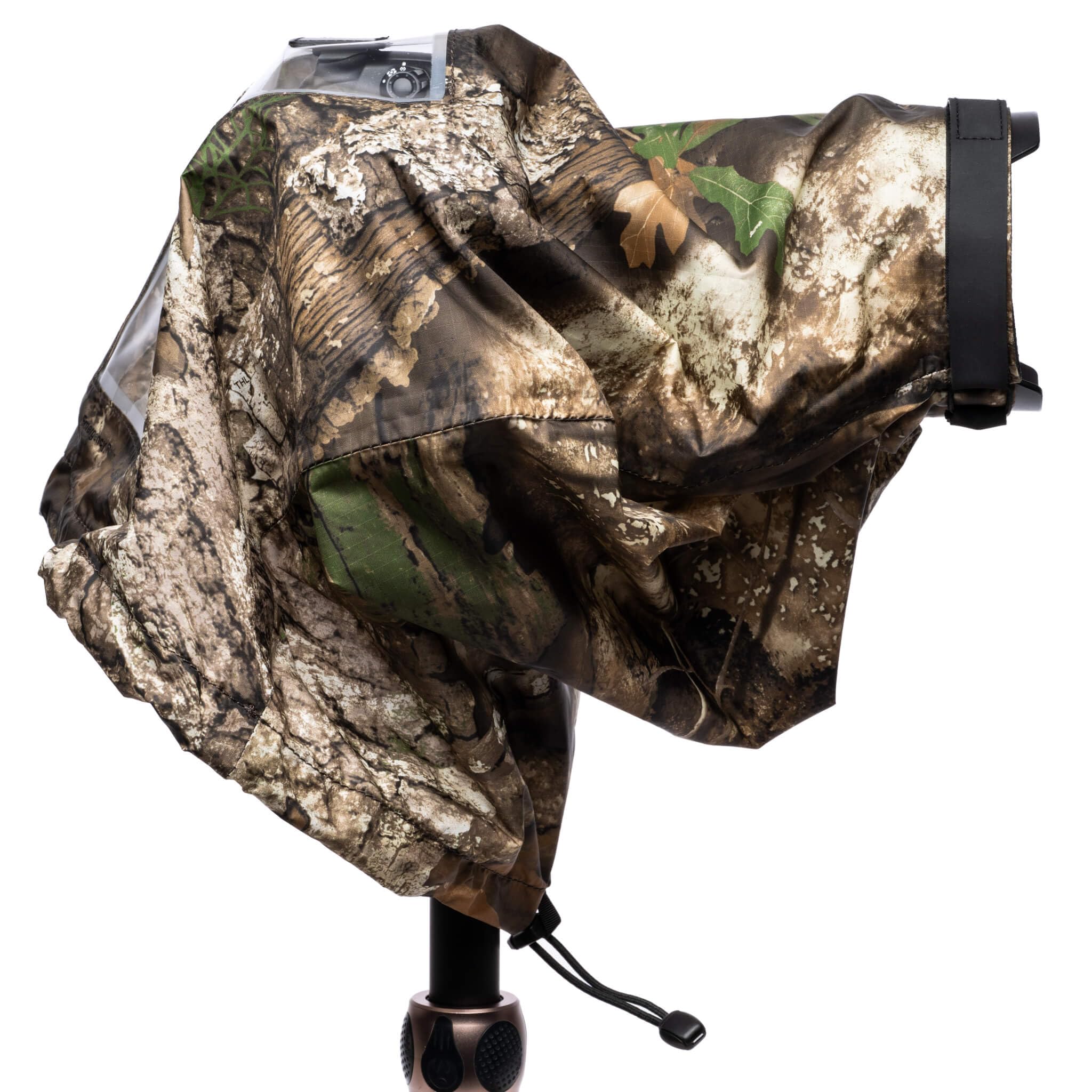
The spec that matters here is the seam sealing — the stitched seams are taped so water can’t wick through the stitching in a downpour or a dusty trail. It runs 12.2 inches long with a 3.1 to 5.5 inch diameter, which wraps a DSLR or mirrorless body with a 24-70mm lens mounted. That length also clears a modest lens hood, so the front glass stays out of the weather.
The Realtree APX camouflage pattern is the detail that sells it for field shooters — a lens sticking out of a bright sleeve spooks wildlife, while this one blends into brush and tree lines. An oversize clear window sits over the LCD so you can adjust settings without peeling the cover off. When you’re done it compresses into the included carrying pouch and disappears into your bag.
The thing owners praise most is straightforward build quality — this reads as heavy material rather than a flimsy poncho, and it goes on quickly. Buyers report it surviving monsoon workshops and an Alaska trip in 20+ mph wind and pouring rain, and some run it on a 5D Mk IV with a 100-400mm lens. Fit is where opinions split: order by your lens diameter, not your body size, because a gripped body with an extender pushes the medium range. A second one for a long-telephoto sports rig is a common repeat purchase.
Pack it for a serious shoot, not as a spare.
Where it wins
- Seam-sealed nylon holds up to dust and heavy rain
- 12.2″ length with 3.1 to 5.5″ diameter fits a body plus 24-70mm
- Realtree APX camo keeps wildlife from spooking
- Compresses into an included pouch for the camera bag
What to weigh
- Costs more than the entry sleeves in this list
- Diameter range is tight — check your lens barrel before ordering
Pick this if: you shoot a DSLR or mirrorless with a 24-70mm in real weather and want a cover that seals at the seams.
Size up if: you run a grip, an extender, or a long telephoto — the diameter range leaves little slack.
2. Sun Rain Shade Camera Cover Shield (Uogw, Aluminum, White)
A rust-resistant aluminum roof that keeps an outdoor security cam dry and out of the sun.
This is a different tool from the sleeves here: it’s a hard shield that mounts over a fixed outdoor camera, not a bag you slip over a handheld rig. The rust-resistant aluminum shell blocks rain, sunshine, dust, sand and snow from above — so your lens and housing stay dry and the sun doesn’t cook the camera. It fits a long list of models, from Blink XT, XT2, XT3 and XT4 to Arlo, Ring, Wyze Cam v4, Nest and SimpliSafe.
What wins people over is the sun protection as much as the rain cover. The sun stops hitting the lens directly, so you get rid of the flare and sunspots that wash out daytime footage. The underside is painted black so the shield itself doesn’t bounce glare back into the lens. Owners mention it holding up in serious weather, with one owner seeing it take 45 mph winds without issues.
The aluminum is a sturdy gauge rather than a thin sheet, which matters on a post in open ground. Night vision stays clear in most setups, though a cover this close to a lens can throw infrared glare at night if it sits too tight against the camera. Mounting weighs 0.37 kg, so it’s a light addition to a pole or wall bracket.
Straight read: if you’re protecting a wall-mounted security camera from sun and rain, this aluminum roof is a simple upgrade. If you’re a photographer looking for a cover for a handheld DSLR, this is the wrong product — go to the sleeves above.
The one caution: leave a little breathing room between the shield and the lens, since a tight fit can cause infrared glare at night.
Made for: porch, driveway and yard cameras you want shielded from above.
Not for: a DSLR or mirrorless you carry by hand — this is a fixed-mount roof.
3. Movo CRC17 Storm Raincover Protector (Small, 17 x 14.5)
The lightest, cheapest way to keep a DSLR dry through a steady drizzle.
At 0.09 kg, this is the lightest sleeve in this lineup — it weighs a fraction of the 0.37 kg Uogw shield, which matters if it lives in your bag for the one day it rains. The 17 x 14.5 inch nylon body covers a DSLR and lens, and a Velcro fastener at the bottom fits any tripod mount while letting you focus manually with a hand inside the cover. Front and rear cinching bands pull it tight in seconds.
It keeps your camera shooting in the wet, and that water resistance has earned it a following among travel shooters — Customers note it kept a camera dry on a zodiac boat tour of a glacier lagoon and through five straight days of rain. For the money, it’s a sensible starter cover, and the tripod-friendly Velcro bottom is the reason tripod shooters single it out over the plastic-bag alternative.
Two things to know before you order. The first is size: this small runs generous, and the fit is what people debate most — perfect on a Canon 5D with a 70-200, too big for a compact setup. The second is control access — working camera buttons through the nylon can feel like a headache during a fast football game. Neither is a dealbreaker for steady, deliberate shooting.
Strong points
- Lightest sleeve here at 0.09 kg
- Velcro bottom fits any tripod mount
- Front and rear cinch bands set up fast
Trade-offs
- Small runs roomy — fit is hit-or-miss by body
- Buttons are fiddly to reach through the fabric
Go for it when: you want a lightweight backup sleeve for a DSLR and tripod without spending much.
Check first: measure your body and lens against the 17 x 14.5 size, since this one skews large.
4. K&F CONCEPT Camera Rain Cover for Nikon Canon Sony
An anti-fog window that stays clear when the humidity turns your screen to milk.
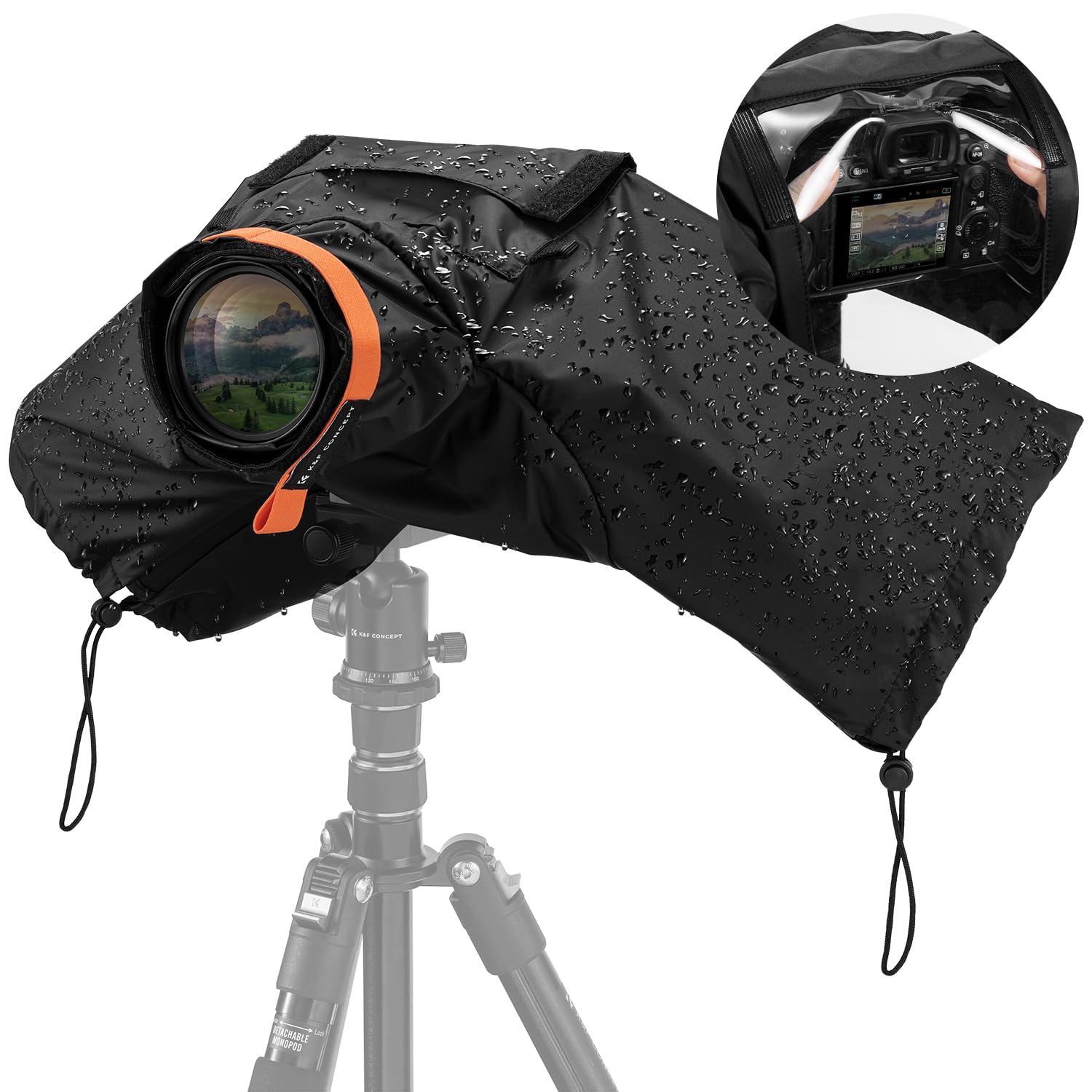
The standout here is the viewing window: a high-definition TPU panel (the clear flexible plastic over your screen) with a built-in dual-layer anti-fog barrier. That’s the fix for the one gripe you hear across nearly every clear-window sleeve — fog building up so you can’t read the LCD. It also has a scratch and oil-resistant coating and an anti-static finish, so it stays clean and clear instead of greasy.
The rest is built for real handling. The smooth polyester surface sheds water instead of soaking it, and a waterproof zipper gives you access to the camera controls without pulling the cover off. Hook-and-loop straps, elastic bands and a textured grip leather hold the lens steady, which stops the sleeve sliding off when you tilt for a low shot. A webbing loop on the back lets you sling it over your shoulder and keep your hands free while you walk.
Quality is what people praise most — it comes across as better than expected for the money, and it packs down into a camera bag without fuss. Reviewers point out a Canon R6 II with a 100-500 lens staying dry in steady rain and holding up in rainforest conditions. The fit is roomy, which suits large lenses but can feel oversized on a small body — verify your setup before you buy.
My take: the anti-fog window is a genuine upgrade, not marketing spin — it’s the difference between seeing your settings and guessing at them in damp weather.
Worth knowing: the roomy cut is a plus for big glass and a minus for compact kits, so it’s a fit question rather than a flaw.
Best fit for: anyone shooting in humid, drizzly or coastal conditions who wants a readable screen.
Look elsewhere if: you shoot a compact body and want a snug, form-hugging sleeve.
5. Universal Security Camera Cover Sun Rain Shield (WEILAILIFE)
A larger hard roof for dome and bullet cams on a post or wall.
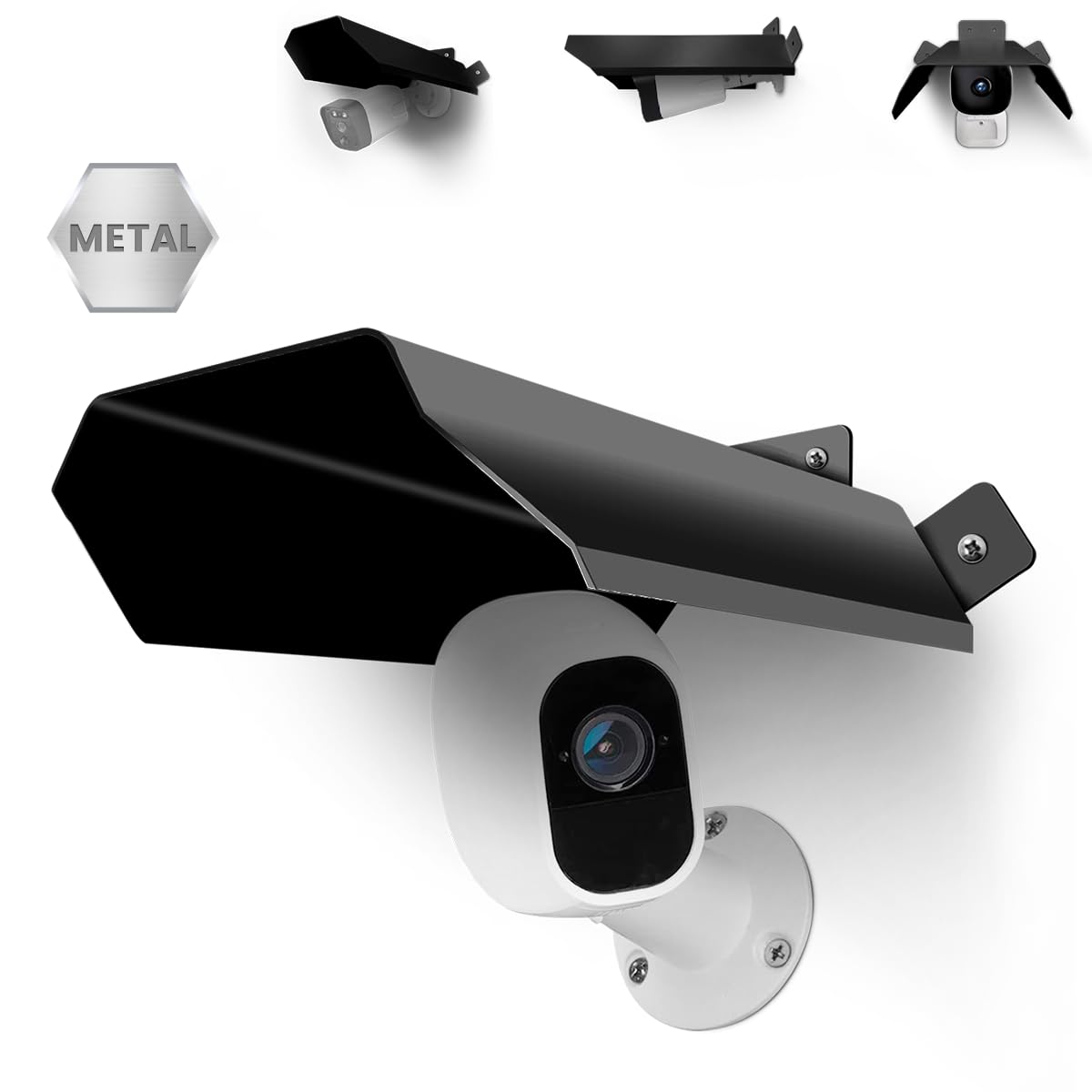
This is the bigger sibling to a security-cam shield: a metal cover measuring 10.63 x 5.51 x 2 inches, so it sits slightly deeper than the slimmer Uogw shield and gives more overhead clearance. It fits dome and bullet cameras plus a range of brands including Nest, Ring, Arlo and bullet cams, and its compatible device size maximum is 10 inches. The black aluminum build blocks rain, sun and snow and won’t rust.
Where the extra size helps is wind — the deeper roof works as a backup rain shield and cuts the spray that sideways gusts throw at the lens. The metal is a solid gauge rather than a thin sheet, and the black inside kills the glare that would otherwise bounce into the camera. Installation works on poles and trees as well as walls, and it fits cleanly around a camera back so the lens stays covered.
The catch is the same one that comes with most fixed shields: on a small camera or a cramped spot, the extra size can feel bulky and wide. A few owners found it larger than they wanted for a tight mounting area, so measure your camera and the space around it before you commit. Mounting holes are small, and a few found them fiddly, so have a good screwdriver handy.
Why it earns a spot
- 10.63 x 5.51 x 2 inch roof gives deeper overhead cover
- Black aluminum inside keeps glare off the lens
- Fits dome and bullet cams plus Nest, Ring, Arlo and more
Be aware
- Bulkier footprint can crowd a tight mounting spot
- Mounting holes are small and fiddly to work with
The right call for: a dome or bullet camera that faces open weather and needs a solid roof.
Measure first if: your camera sits in a narrow spot — the extra depth wants clearance.
6. NEEWER Camera Rain Cover (Small, Rugged Nylon, PB003)

Two hand sleeves mean you operate the camera without lifting the cover off.
The feature that sets this sleeve apart is the pair of sleeves for your hands — you reach inside and work the camera buttons from under the cover, so the rig stays sealed while you shoot. The nylon measures 20″ x 20″ (500 x 500mm) and suits a compact DSLR or mirrorless with a 70-200mm lens or smaller, with room to mount it on a tripod. An oversized clear window lets you see the LCD and viewfinder, and it folds down into the included bag for storage.
This is a good step up from the trash-bag approach, and Owners note the 20-inch coverage swallows a 300mm lens with room to spare, and even a 400-800mm Sony telephoto fits. The drawstrings cinch the openings tight, and if the lens sleeve runs long you can fold it back and secure it. The strap holes let you run a camera strap through so you can shoot handheld without the cover sliding off.
Small camera bodies are where it struggles — the same roomy cut that makes it great for big glass can feel awkward and hard to control on a small camera, and the clear window does fog up over time. It’s light at around 5oz / 140g but packs bulky on the camera. Best suited to shooters with a mid-to-large lens.
What I’d flag: the hand sleeves are the reason to buy it — you keep your buttons and your focus ring without breaking the seal.
Honest limit: on a small mirrorless body it runs big, and the viewing window fogs in cold, wet weather.
For you if: you shoot a mid-size DSLR or mirrorless with a 70-200 or longer lens and want hand access.
Skip if: you have a tiny body — the roomy cut makes the controls awkward.
7. NEEWER Camera Rain Cover (Medium, Camo, PB021)

Camo nylon sized for a telephoto, so wildlife never spots the sleeve.
Blending in is the point on this one: a dual-sided camo nylon that helps wildlife shooters disappear into the surroundings, with a reversible design so you can flip it and react fast when the weather turns or a subject moves. It’s the medium at 23.6″ x 23.6″ (600 x 600mm), big enough to fold around differently sized rigs and built for a DSLR or mirrorless with a lens up to 200mm. Touch fasteners cinch it tight, and an enlarged opening lets you reach the controls without pulling the cover off.
It shields your camera or telephoto lens from water, rain, moisture, dust and dirt, and the nylon holds up to long sessions in wet outdoor conditions. At 4.6oz / 130g it’s light enough to fold and carry all day — good for photography on the move, and it doubles over a telescope or Barlow lens if you’re digging in for a long watch.
Because it’s the medium, it’s the middle of the NEEWER range — the small PB003 covers up to a 70-200 with hand sleeves, while this one goes larger with the camo. The trade-off is that a 23.6-inch square sleeve folds down big and wants a large camera to justify it. Pair it with your longest lens and it earns its place in the pack.
Who it suits: a wildlife or landscape shooter with a long lens who wants camo and a fast flip when clouds roll in.
Trade-off to weigh: sized up for big glass, so it’s overkill on a compact kit and bulky to stow.
Reach for it when: you’re stalking wildlife with a long telephoto and want the cover to disappear into the scenery.
Look at the small NEEWER instead: if you shoot a compact body and want hand sleeves over camo.
8. Peak Design Shell Camera Rain Cover (Medium)

A stretchy shell that hugs the body and cinches to whatever lens you have on.
Instead of a loose bag, the Shell uses 4-way stretch fabric with a waterproof membrane (a layer that blocks water while letting the fabric flex) — the fabric pulls tight around your camera and lens so there’s no flapping nylon to snag or let water pool. That snug fit is what makes it a fast cover for hiking and travel: it cinches to shield the camera in hand, on a tripod, or stowed in your pack, and it pairs with a Peak Design Capture Clip or strap. At 10 x 7 x 2.7 inches in the medium, it’s a compact shell rather than a roomy sleeve.
The build is what owners praise most — the material reads as quality and the rain and snow protection holds up. Shoppers say the small fits a Sony A7 II even with a 24-240mm lens, and travelers use it on a Fuji X-T2 for everyday protection from rain, dust and scratches in a bag. Some owners run it over an Olympus with a long zoom on trips where rain is likely.
The real story here is fit and handling. The stretch fabric is snug to the point that getting it on and off over a lens hood takes real effort, and the sizing swings — some bodies swim in the medium while others are a perfect match. That’s a fit-and-fitment question, not a defect, but it means ordering the size that matches your actual lens. Dedicated shooters who learn the technique love it; those who expect a loose poncho will fight it.
Why photographers want it
- 4-way stretch with a waterproof membrane hugs the rig
- Cinchable for use in hand, on a tripod or in a pack
- Works with Peak Design Capture Clip and straps
What buyers hit
- Snug fit makes it hard to put on over a lens hood
- Sizing swings between bodies — measure your lens first
Go for it if: you hike or travel and want a compact, stretch-fit shell that stays tight to the camera.
Think twice if: you want a throw-on-and-shoot cover with room to spare — this one demands a wrestling match.
Know the Specs
Sleeve vs. Hard Shield
A soft nylon sleeve wraps a handheld DSLR or mirrorless camera you carry and shoot. A hard aluminum shield mounts over a fixed outdoor security camera and blocks weather from above. They solve different jobs, so match the type to the camera you’re protecting first.
Size and Diameter
Sizing is the number that decides whether a cover works. A sleeve is usually listed by length plus diameter, or by a flat square in inches, and it needs to clear your longest lens — not just the camera body. A shield lists its roof dimensions and the maximum compatible camera size.
Common Questions
Will a camera rain cover fit over a lens hood?
Can I use a security camera shield on my DSLR?
Why do clear viewing windows fog up?
How do I pick a size between small and medium?
Is a lightweight nylon sleeve as protective as a heavier one?
Can I still change settings with the cover on?
Will a cover work on a tripod?
Do these covers protect against salt spray and dust?
The Bottom Line
For most shooters, the water resistant camera cover winner is the Think Tank Emergency Camera Rain Cover because its seam-sealed nylon and Realtree camo handle real downpours without giving up access to your screen. If you shoot in humidity and need a clear, fog-free window, grab the K&F CONCEPT Camera Rain Cover. And for a fixed outdoor security camera, the Uogw Sun Rain Shade Shield is the one to reach for — a sturdy aluminum roof that keeps the lens dry and out of the glare.
How we choose
We do not accept paid placement. Every pick is matched to a real buyer and a real use-case; we do not hands-on test units.
Sources
Specifications: manufacturer listings and product documentation. Review insights: verified customer reviews, as of November 2026. Pricing: not shown on this page (it changes often); check the current price via the retailer link.
As an Amazon Associate, Tactical Gear Guy earns from qualifying purchases. This does not affect which products we feature.