Specs are compiled from manufacturer listings and verified buyer reviews and can change over time — please confirm the key details on the product page before buying.
You want a pitcher whose filter is certified to reduce PFAS (forever chemicals) by name. The Culligan ZeroWater 23-Cup Dispenser is the strongest all-round pick here. Certification is the one line that matters most — a pitcher that only claims chlorine and taste reduction does not qualify, no matter how good the water seems. One honest note: this list uses flexible, human-like matching for that certification requirement, so not every pick is the exact size or model you typed into the search bar. The nearest same-type pitcher serves the same job, and each entry says exactly what its filter is certified for.
This guide is built by comparing the manufacturers’ published specifications and the patterns across verified customer reviews, so you get each pick’s real strengths and trade-offs instead of marketing spin.
You will see capacities, filter lives in gallons, and what each filter is actually certified to reduce — all pulled from the listings themselves. The quick comparison table then lets you scan all eight side by side before you commit to the best water pitcher that filters out forever chemicals.
Top Picks

How To Choose The Best Water Pitcher That Filters Out Forever Chemicals
Start with the certificate, not the star rating. A filter that is certified to reduce PFOA and PFOS has been tested against a published standard, and that paperwork is what separates a real answer from a nice-tasting placebo.
The certification is the whole ballgame
Look for the filter’s certification body and standard printed on the listing or box. Culligan’s ZeroWater filters in this list are certified by IAPMO to reduce Total PFAS. Waterdrop’s filter is certified against NSF/ANSI 42, 53 and 372. Epic’s Pure XP filter is NSF certified to NSF/ANSI 42 and NSF/ANSI/CAN 372, plus independently tested to NSF/ANSI 53 and 401 with added PFAS testing. If a listing never names a standard, treat the PFAS claim as unproven.
How long the filter really lasts
A two-month filter life means you are swapping cartridges often. A 60-gallon or 100-gallon filter stretches that out considerably, and the difference shows up in how much of your year you spend reordering. Match the filter life to how much water your household actually drinks.
Capacity and fridge fit
A 7-cup or 8-cup pitcher suits one or two people and slides into most fridge doors. A 10-cup pitcher is the family size, and a 23-cup dispenser is for a countertop and a refilling counter rhythm. Measure your fridge shelf before you fall in love with a bigger vessel.
Does it lower TDS?
TDS stands for total dissolved solids — the metals, minerals and salts floating in your water. ZeroWater’s five-stage ion exchange design works to pull those out. Waterdrop’s PT-09W glass pitcher openly says it does not lower TDS. Neither approach is “wrong,” but pick one knowingly so you are not surprised by the reading on your meter.
Side-by-Side Comparison
| Model | Best For | Capacity | Filter Life | PFAS Certification | Amazon |
|---|---|---|---|---|---|
| Culligan ZeroWater 23-Cup Dispenser★ Best Overall | Countertop family use | 184 fluid ounces | 2 months | IAPMO — Total PFAS | Amazon |
| OWIARA 10-Cup Carbon PitcherCompact Pick | Tight countertop spaces | 3.2 liters | 2 months | Listing names PFAS/PFOA | Amazon |
| ZeroWater 10-Cup PitcherTop Performer | Everyday fridge pitcher | 10 cups | Not stated | IAPMO — PFOA/PFOS | Amazon |
| ZeroWater ZD-010rp | Blue-and-white fridge pitcher | 10 cups | Not stated | NSF — PFOA/PFOS | Amazon |
| LifeStraw Home Essential | Microplastics and bacteria too | 7 cups | 2 months | Reduces PFAS (per listing) | Amazon |
| LARQ 8-Cup Pitcher | Keeping healthy minerals | 1.9 liters | 60 gallons | NSF/ANSI 42, 53, 401 tested | Amazon |
| Waterdrop PT-09W Glass Pitcher | Plastic-averse kitchens | 10 cups | 100 gallons | NSF/ANSI 42, 53, 372 | Amazon |
| Epic Pure XP | Fluoride plus PFAS | 10 cups | 100 gallons | NSF/ANSI 42, 372 plus 53/401 testing | Amazon |
Detailed Reviews
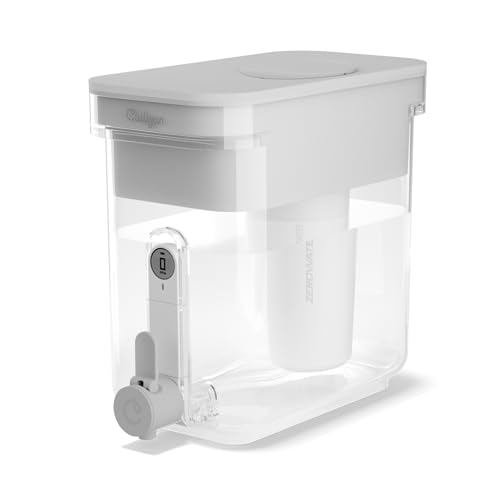
1. Culligan ZeroWater 23-Cup Dispenser
Our pick — 4.0+★ from 350+ verified ratings; the strongest balance of quality and price.
A 184-ounce countertop dispenser with the certificate most pitchers here cannot show.
This is the one for a family that fills up at the counter instead of the fridge door. It holds 184 fluid ounces — about 23 cups — so you are not refilling it three times while dinner cooks. It is IAPMO certified to reduce Total PFAS along with lead, mercury, fluoride and chlorine, and that certification is the reason it takes the top slot.
The five-stage filtration is rated to remove 99.9% of dissolved solids, the lowest TDS reading of any pitcher here. A TDS meter (the small tester that reads dissolved solids) ships in the box, and it tells you when to swap the filter: replace it when the meter reads above 6 or the amber light turns on. Filter life runs about two months. The dispenser measures 11.8″L x 6″W x 10.5″H, so it lives on a counter rather than a fridge shelf.
Weigh the setup honestly. It weighs 2.2 kg and holds a lot of water, so it stays put rather than moving to the table. Slow flow is the recurring gripe — this style of filtration drips through rather than gushing, so fill a glass and walk away. The value conversation is mixed too: it is not cheap to run, and the filter itself is the expense that keeps coming back. Build the cartridge cost into your year before you buy a dispenser this size.
What earns it the top slot
- IAPMO certified to reduce Total PFAS, not just chlorine
- 184 fluid ounces keeps a family pouring without constant refills
- TDS meter takes the guesswork out of filter changes
- Slim 6-inch width fits narrow counter gaps
Where it asks patience
- Filtration is slow — this drips, it does not rush
- Two-month filter life means recurring cartridge cost
- 2.2 kg empty, so it is a stay-on-the-counter item
Buy this if: you want proven forever-chemical reduction and a vessel big enough to serve a household from the counter.
Think again if: you need water fast — the slow drip-through will test your patience on a thirsty morning.
2. OWIARA 10-Cup Pitcher
The cheapest way into a carbon pitcher that names PFAS and PFOA on its own listing.
Counter space is the whole story with this one. It measures 10.21″L x 4.12″W x 10.8″H — narrow enough to tuck where a bulkier pitcher will not go. At 3.2 liters it is a standard 10-cup body, and the carbon-and-ACF filter (activated carbon fiber, the material that grabs contaminants as water passes through) is listed as reducing PFAS, PFOA, fluoride, chlorine and lead.
The fill design is genuinely different from most pitchers here. You pour into a non-opening water injection top, so the lid never comes off to refill and dust stays out. The body is BPA free to NSF standard, and the package includes a replacement filter. Filter life is about two months, or somewhere between 150L and 500L of water depending on your source.
Be clear-eyed about where this sits in the list. The rating is the lowest of the eight, and the filter performance and taste both draw split opinions — some get clean results, others less so. The PFAS claim appears on the listing but is not tied to a named certification body like IAPMO or NSF/ANSI. If certification paperwork is why you are shopping, spend a little more and step up to the ZeroWater or Waterdrop picks.
The narrow-space case: a 4.12-inch width and a no-lid-lift fill are real conveniences in a small kitchen, and the two-month filter change is easy to remember.
The certification gap: this filter names PFAS and PFOA but does not cite IAPMO or an NSF/ANSI standard, so treat it as an entry-level carbon pitcher rather than a certified forever-chemical solution.
Reach for this if: counter width is tight and you want a low-cost carbon pitcher with a lid-free refill.
Look elsewhere if: you need a named certification body behind the PFAS claim before you buy.
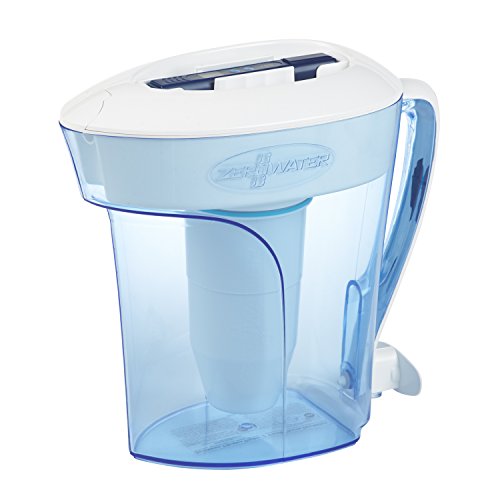
3. ZeroWater 10-Cup Pitcher Water Filter Removes PFOA/PFAS
The crowd favorite of the whole group — 4.0+ stars across 49,000+ owners — and the one most buyers end up with.
This is the pitcher people actually put in their fridge. The five-stage ion exchange filter works on total dissolved solids — the metals, minerals, salts and ions dissolved in water — and the listing claims it removes virtually all of them. It is IAPMO certified to reduce PFOA and PFOS along with lead, chromium and mercury, and the body is BPA free.
A TDS meter comes in the box, so you can check dissolved solids before you pour and know when the cartridge is spent. ZeroWater puts the savings at up to 110 single-use plastic bottles per filter, or up to 660 bottles a year. It measures 11.63″L x 5.93″W x 11″H and weighs 16 ounces, so it handles easily for its size.
What wins people over is the quality of the water — it is the most-praised trait by a wide margin, and clarity is the theme. The split verdict lands on taste and function: the purest-tasting style of filtration is not the sweetest-tasting style to every palate, and a few TDS testers arrive dead. Filter life and leakage come up as the recurring gripes, so treat the cartridge schedule and the seal with respect. Still, the scale of the owner base here tells you most people are happy.
The purity pitch: a five-stage ion exchange filter certified by IAPMO for PFOA/PFOS, with a TDS meter to verify it is working.
The honest trade-off: the stripped-down water tastes flat to some drinkers, and cartridges run out on a schedule you have to keep up with.
Head-to-head: the same 10 cups and the same look as the ZD-010rp below, but the ZD-010rp carries NSF certification where this one carries IAPMO — same job, different paperwork.
Most people land here: a certified 10-cup fridge pitcher with a TDS meter and a huge owner base behind it.
Know before you commit: budget for regular cartridges, and expect the ultra-pure taste to divide the family.
4. ZeroWater ZD-010rp 10-Cup 5-Stage Pitcher, Blue and White
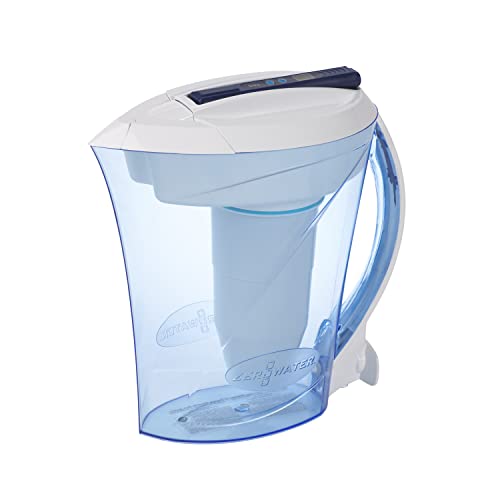
The colorway that tells you at a glance whether the family remembered to refill.
Weigh it in your hand and you get the point: 3 pounds for a 10-cup pitcher. That is the same footprint as the ZeroWater above, in blue and white, with the Ready-Pour design. The five-stage filter removes 99 percent of total dissolved solids, and this pour-through model is NSF certified to reduce lead, chromium and PFOA/PFOS. All materials are BPA free.
The package gives you the pitcher, one ion exchange filter and a free TDS meter. The eco math is up to 150 single-use plastic bottles saved per filter, or up to 2100 a year. It measures 11.63″L x 5.93″W x 11″H, so it sits on a fridge shelf with room to spare.
The strengths show up in daily use: quality, easy handling and filtration are what people talk about most, and the water tastes clean. Function pulls a mixed verdict, with the occasional dead TDS tester the main snag. Size and value draw some grumbling — this is a 10-cup body, not a dispenser, so a big household refills it often. Treat the cartridge cost as part of the deal and you will not be surprised.
Why the colorway sells it
- NSF certified for lead, chromium and PFOA/PFOS
- Ready-Pour design with a free TDS meter in the box
- 3 pounds for a 10-cup pitcher — easy to lift and load
What to expect after a month
- 10-cup body refills often for a full household
- The odd TDS tester arrives not powering on
- Filter changes come around quickly
Pick it when: you want NSF-certified PFAS and lead reduction in a fridge-friendly 10-cup pitcher people will actually lift.
Pass if: your household drinks more than 10 cups between refills.
5. LifeStraw Home Essential 7-Cup
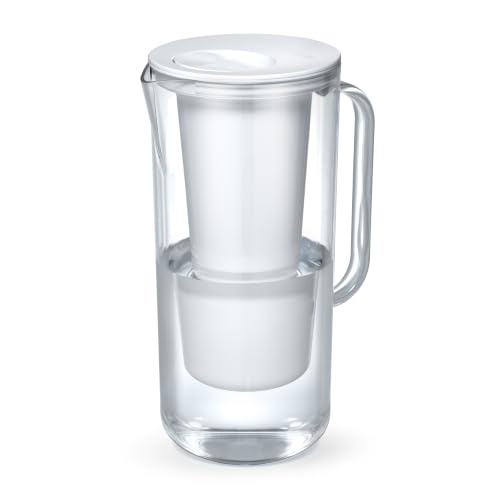
The petite 7-cup pitcher that goes after microplastics and bacteria in the same pass.
At 1.4 pounds and 7.2″L x 5.2″W x 11.3″H, this is the easiest pitcher here to carry and slide into a fridge door. The 7-cup body means fewer refills if you live alone. The filter goes further than most: it is listed as removing microplastics, bacteria and parasites alongside PFAS, lead, mercury, chlorine, herbicides, pesticides and VOCs. That breadth is the reason it earns a spot despite the smaller size.
Weigh it against the ZeroWater above and the difference is real: this one is 1.4 pounds where the ZeroWater sits at 3.5 pounds. The filter life runs about two months, so cartridge changes are on a short cycle. The body is designed with an ergonomic handle, an easy-fill lid and a Danish-inspired shape, and it fits standard fridge doors and shelves.
What buyers notice is the water quality — the tap crud is gone, and the taste is noticeably cleaner than a basic charcoal pitcher. The 7-cup capacity is the honest limit: a couple will empty it fast, and a family will be refilling constantly. The value question splits opinions, so think of it as paying for the wider filter rather than the volume.
Where it stands out: microplastics, bacteria and parasites alongside PFAS and lead reduction, in a 1.4-pound body that fits a fridge door.
The limit you will hit: 7 cups does not stretch far, and the two-month filter cycle comes around quickly.
For solo drinkers and couples: the lightest, most portable pitcher here, with the widest contaminant list.
Not for a family: the 7-cup reservoir empties too fast to keep a whole household supplied.
6. LARQ 8-Cup Pitcher
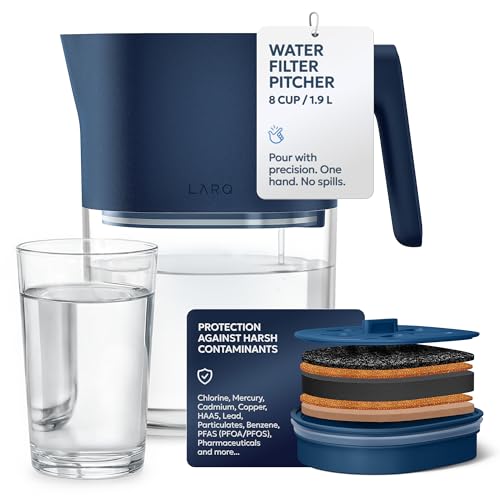
For drinkers who want the chemicals gone but the minerals left in the glass.
This one uses a plant-based Nano Zero filter, tested against NSF/ANSI 42, 53 and 401 (independent standards for contaminant reduction). It takes out lead, PFAS, chlorine, mercury, cadmium, copper, HAA5 and pharmaceuticals — but deliberately keeps the minerals that make water taste good. If you have tried a zero-TDS pitcher and found the water flat, this is the answer.
It holds 1.9 liters, roughly 8 cups, and fits a fridge shelf or countertop with a secure lid that presses open in seconds. The filter runs 60 gallons, about three months, and the maker puts that at over 450 single-use bottles replaced. Parts are dishwasher-safe and it needs no batteries. Flush the first 2–3 fills to clear harmless carbon dust before you drink.
What people like is the combination of good quality water and a sleek look that earns a place on the counter, not just in the fridge. The filter performance gets a split verdict — some find it works great, others have doubts about how much it really catches. That is the trade-off: this filter is not trying to strip everything the way the ZeroWater picks do, so if you want a TDS reading of zero, look elsewhere.
Why it earns the premium slot: NSF/ANSI 42, 53 and 401 testing, a 60-gallon filter, and a filter that leaves the healthy minerals in the glass.
The honest catch: this is a selective filter, not a total-strip design — if zero TDS is your goal, the ZeroWater picks above do that job instead.
Choose this: you want permanent-chemical reduction without the flat taste of fully stripped water.
Skip it: you are set on a zero-TDS reading from a meter.
7. Waterdrop 10-Cup Large Glass Water Filter Pitcher, PT-09W

A glass pitcher with a five-stage filter certified to NSF/ANSI 42, 53 and 372 — and a 100-gallon filter to go with it.
If the plastic body is what has been nagging you, this solves it in glass. The high-quality glass body is non-toxic, sustainable and easy to clean, built with a sturdy plastic inner liner for durability. The filter inside is certified against NSF/ANSI 42 for chlorine, taste and odor, NSF/ANSI 53 for mercury, and NSF/ANSI 372 for lead-free materials, and it is third-party lab tested to reduce PFOA and PFOS as well.
Filter life is the standout: up to 100 gallons or two months, whichever comes first, and it fills at 8.5 oz per minute — an 8 oz cup in under a minute. That flow speed beats the slow drip of the countertop dispenser up at the top. It holds 10 cups. Weigh the material in the hand, though: glass is heavier than the plastic ZeroWater, and the listing gives it a weight of 1.69 kg, so it stays on the counter rather than under the tap one-handed.
The water taste and the material are what people praise most, along with how easy it is to clean. The value judgment splits — some see a great product for the money, others find it overpriced. The other thing to know is that this system does not lower TDS, so if a zero reading on a meter is your goal, choose the ZeroWater instead. Do not put this one in the dishwasher; hand washing is the care instruction.
What the glass buys you
- NSF/ANSI 42, 53 and 372 certified filter, plus lab-tested PFOA/PFOS reduction
- 100-gallon filter life and an 8.5 oz/min flow — a cup in under a minute
- Non-toxic glass body with a sturdy plastic inner liner
The catches worth knowing
- Glass weight means counter duty, not one-handed pouring
- Does not lower TDS — this is a taste-and-chemical filter, not a stripper
- Hand wash only, no dishwasher
Best if: you want PFAS-certified filtration in a glass body and care about avoiding plastic in your water.
Not ideal if: a low TDS reading is your benchmark — this filter leaves minerals in place by design.
8. Epic Pure XP 10 Cup

The one that takes on fluoride as well as forever chemicals, with a lid timer to remind you to swap.
Fluoride is the differentiator here. The Pure XP filter reduces PFAS, lead, fluoride, chlorine, microplastics, pharmaceuticals, bacteria, viruses and parasites, and the brand publishes its full lab results. The filter is NSF certified to NSF/ANSI 42 and NSF/ANSI/CAN 372, independently tested to NSF/ANSI 53 and 401, and adds PFAS testing to the latest NSF/ANSI/CAN 53 criteria. Filters are assembled in Florida, USA.
The CoreXchange design pairs nano-fiber outer media with a carbon fiber block built for gravity flow. When it is time to change, you swap only the inner cartridge and reuse the housing, which the brand puts at up to 75% less filter plastic waste. Each filter lasts 100 gallons, about 3 to 4 months, and replaces over 1,000 single-use 12 oz bottles.
The 10-cup Tritan body is BPA and BPS free and fits a fridge shelf. A filter timer lives in the lid, so no guessing on change day. Set expectations on the lid: it draws mixed feedback, with some loving the design and others finding it poor, and there are reports of water running out from the top and dripping onto the floor. For best results, let all the water filter into the bottom reservoir before pouring, and keep a hand on the lid while you pour.
Why it stands apart: fluoride reduction alongside PFAS and lead, 100 gallons per filter, and a lid timer that tracks the change date for you.
The recurring gripe: the lid is the weak point — hold it while you pour and give the reservoir time to fill before tipping.
The pick for you: you specifically want fluoride plus forever-chemical reduction from a filter with published lab results.
Think twice if: a loose lid on a wet pitcher will bother you — that is the known weak spot.
Know the Specs
PFAS certification versus a claim
“Certified to reduce PFOA/PFOS” means an independent body tested the filter against a published standard. Culligan’s ZeroWater filters carry IAPMO certification for Total PFAS and PFOA/PFOS. Waterdrop and Epic both cite NSF/ANSI standards. A listing that names PFAS without naming a certification body is asking you to take it on faith, so weigh that before you buy.
Filter life in gallons and months
Filter life is stated two ways here: months for the ZeroWater and LifeStraw pitchers (about two months), and gallons for LARQ (60 gallons), Waterdrop (100 gallons) and Epic (100 gallons). Gallons tell you how much water you get; months tell you how often you reorder. Both come down to how much your household drinks, and neither replaces reading the change indicator on the pitcher.
What a TDS meter does — and does not do
TDS stands for total dissolved solids. A TDS meter is a small tester that reads how much is dissolved in your water, and it tells you when a filter has stopped working — ZeroWater says to change the filter when the meter reads above 6 or the amber light turns on. A low reading is not the same as PFAS removal, though. A filter can lower TDS and still leave specific chemicals, so judge the certificate not the number.
Capacity versus fridge fit
Capacity and footprint pull in opposite directions. The 7-cup LifeStraw measures 7.2″L x 5.2″W x 11.3″H, the 10-cup ZeroWater measures 11.63″L x 5.93″W x 11″H, and the 23-cup Culligan dispenser measures 11.8″L x 6″W x 10.5″H but is built to sit on a counter. Match the body to where it will live before you fall for the bigger capacity.
Common Questions
Does a water pitcher really remove forever chemicals like PFAS and PFOA?
How often do I have to change the filter in these pitchers?
Will a PFAS filter pitcher fit in my refrigerator door?
What does a TDS meter tell me about my water?
Is glass better than plastic for drinking water?
Do I need a pitcher that lowers TDS?
Which is better, a filter pitcher or a countertop dispenser?
Can these pitchers filter out fluoride as well?
Do I have to flush a new filter before drinking?
How many plastic bottles does a filter pitcher replace?
The Bottom Line
For most households, the water pitcher that filters out forever chemicals winner is the Culligan ZeroWater 23-Cup Dispenser, because it carries IAPMO certification for Total PFAS and holds enough water (184 fluid ounces) to serve a family from the counter. If a fridge pitcher suits you better and you want huge confidence in the pick, grab the ZeroWater 10-Cup Pitcher, which is IAPMO certified for PFOA/PFOS and carries the biggest owner base of the group. And if fluoride is your specific worry, the Epic Pure XP is the one that names it alongside PFAS and lead.
The Waterdrop PT-09W’s 100-gallon filter and 8.5 oz/min flow make it the least fussy of the certified picks for daily pouring, so if a glass body fits your kitchen, it is the second-best all-rounder here.
How we choose
We do not accept paid placement. Every pick is matched to a real buyer and a real use-case; we do not hands-on test units.
Sources
Specifications: manufacturer listings and product documentation. Review insights: verified customer reviews, as of November 2026. Pricing: not shown on this page (it changes often); check the current price via the retailer link.
As an Amazon Associate, Tactical Gear Guy earns from qualifying purchases. This does not affect which products we feature.