Specs are compiled from manufacturer listings and verified buyer reviews and can change over time — please confirm the key details on the product page before buying.
You stick a finger in the soil, it feels dry on top, you water, and a week later the leaves yellow anyway. A water moisture sensor fixes that by reading the actual moisture down at root level instead of at the surface. The catch is that these meters fall into two very different camps: the cheap push-in probes that need no batteries and no phone, and the smart wireless pucks that talk to an app. Buying the wrong camp for your garden is the mistake that wastes the most money here.
This guide is built by comparing the manufacturers’ published specifications and the patterns across verified customer reviews, so you get each pick’s real strengths and trade-offs instead of marketing spin.
Below you will find nine meters sorted by what they actually do in the dirt, from leave-in pens for houseplants to Wi-Fi units that ping your phone. Every entry is a working water moisture sensor pick, and each one suits a different kind of grower.
Top Picks


How To Choose The Best Water Moisture Sensor
Start with one question: do you want a number on a screen, or do you want the meter to tell someone else? A standalone meter reads out locally and asks nothing of your home network. A smart sensor streams data to an app, but almost every one of those needs a separate hub or gateway to do it. Decide that first and you skip half the confusion.
Standalone meter or connected sensor
A standalone unit like the Ecowitt WH0291 gives you a reading on its own LCD and needs no hub at all. A connected sensor such as the Ecowitt WH51L will not send anything until it pairs with an Ecowitt Wi-Fi gateway, which is sold separately. If you have no gateway and no plan to buy one, a connected sensor is the wrong purchase no matter how good its probe is.
How deep the probe reaches
Surface moisture tells you very little about what the roots are drinking. A short push-in probe reads near the top of the pot. A wired probe on a 1m/3.28ft PVC cable, as on the WH51L, lets you bury the tip deeper and leave the body above ground. For raised beds and deep planters, that reach matters more than any app feature.
Capacitive versus resistance sensing
A capacitive sensor measures moisture without passing current through the soil, so soil salinity and pH affect it less. That is the design several of these meters use, and it tends to hold calibration longer in treated or fertilized soil. Simple resistance probes still work fine for a houseplant on a shelf, but they are the ones to watch in salty beds.
Batteries, refills, and upkeep
Some meters run on no battery at all — the SUStee pen works on a refillable color-changing core, and the Gain Express probe is fully self-powered. Others take AA or AAA cells you supply yourself. Check what is included before you order, because a “battery not included” note on a smart sensor means a dead unit on arrival until you supply power.
Side-by-Side Comparison
These three columns are the ones that change your buying decision: how you read the data, how deep it reaches, and what power or protection it carries.
| Model | Best For | Reading Method | Probe Reach | Power / Protection | Amazon |
|---|---|---|---|---|---|
| Ecowitt WH51L★ Best Overall | Deep beds, app monitoring | LCD + Ecowitt app via gateway | 1m/3.28ft PVC wire probe | IP68 waterproof lever | Amazon |
| AC Infinity Soil Sensor ProbeBest for Controllers | AC Infinity AI controller owners | AC Infinity app via AI Controller | 6.7-inch sensing distance | IP67-rated, detachable stem | Amazon |
| SUStee Aquameter (Set of 4)Best for Houseplants | Houseplant owners who forget to water | Color-change indicator stick | Leave-in pen, root level | No battery required | Amazon |
| RAINPOINT Smart Kit | Push alerts on your phone | LCD + RainPoint Home App | Leave-in stake sensor | Battery not included | Amazon |
| THIRDREALITY Gen2 3Pack | Home Assistant and Zigbee setups | Zigbee hub into smart home app | Stake mount sensor | Alkaline battery | Amazon |
| Haozee Intelligent 3 Pack | Soil moisture plus soil temperature | Zigbee gateway or Zigbee2MQTT | 6.1-inch sensor body | 2 x AAA alkaline | Amazon |
| Ecowitt WH0291 | Standalone LCD reading, indoor/outdoor | Digital LCD with flower pot icon | Waterproof sensor probe | 2 AA batteries, not included | Amazon |
| Ambient Weather WH31SM | WS-2000 and WS-5000 station owners | Wireless 915 MHz to station console | 6-inch sensor body | 1 x AA battery, not included | Amazon |
| Gain Express ZD-06 | Deep pH plus moisture checks | Analog dial, dual pH/moisture | 295mm electrode | No batteries required | Amazon |
Detailed Reviews
1. ECOWITT WH51L Soil Moisture Sensor
Our pick — 4.5+★ from 100+ verified ratings; the strongest balance of quality and price.
The wired probe that reads moisture where the roots actually sit, not where your finger reaches.
You get readings you can trust because of how it’s built: a 1m/3.28ft PVC wire probe lets you set the sensor body well above the soil while the tip sits deep. That means it measures the moisture that matters, not the dry crust on top. The IP68 waterproof lever rating means the probe end is sealed against dust and liquid—so it survives a rainy bed instead of quitting after a wet season. It also shows real-time data on its own LCD, so you can glance at the reading without opening a phone.
Here’s the catch that trips buyers up: the WH51L sends nothing to your phone until it pairs with an Ecowitt Wi-Fi gateway, sold separately, such as the GW1100, GW2000 or GW1200. One gateway handles up to 8 channels, and you can rename each channel in the app so the tomato bed and the fern pot stay straight. Pairing with a compatible console instead lets you read data on the display and push it to the internet, but some consoles act only as a gateway and will not show the moisture figure on screen—check the model list before you commit. Also place the body at least 20cm above the soil surface, because sitting it too close weakens the radio signal and can cost you transmissions.
Calibration is how you make it accurate for your soil: the sensor converts the electrical signal in wetter or drier soil into a higher or lower AD value (a raw number the sensor reads). The manual walks you through setting your own 0%AD and 100%AD points so one soil type does not skew another. At 4.2 ounces it hangs on the wire without dragging. The WH51L and the older WH51 share the same 8 soil channels, so if you already run Ecowitt gear, plan which sensor owns which channel.
What earned it top spot
- 1m/3.28ft PVC wire probe reaches deep soil moisture a short push-in meter cannot touch
- IP68-rated probe end is sealed against liquid and dirt for outdoor beds
- LCD shows live readings; the app view opens up once a gateway is paired
- Custom 0%AD and 100%AD calibration lets you tune it per soil type
The honest catch
- No phone data without a separately sold Ecowitt gateway — buy one or the smart side stays dark
- Body must sit at least 20cm above the soil, which takes a little planning on a low pot
Made for: growers with raised beds or deep planters who already run or plan to run an Ecowitt gateway and want root-level numbers.
Think twice if: you want a single self-contained meter — the wired probe is a strength only once a gateway gives it a voice.
2. AC Infinity Soil Sensor Probe
A sensor that hands watering decisions to your AC Infinity controller — if you own one.
This one does a single job and does it in a specific ecosystem. Plugged into an AC Infinity AI Controller, it lets that controller switch water devices on and off with advance controls, and send alerts through the AC Infinity app. The detachable stem is the useful part for growers: you can push the sensing end deeper into a fabric pot or grow bed and still keep the body where you can reach it. It is IP67-rated, meaning it is sealed against liquids and dirt, and the probe is built to be gentle on roots in potting mixes and soil beds. At 6.4 ounces it has real heft, and its 6.7-inch sensing distance puts it deeper than a surface meter.
Two limits shape who should buy it. It is designed for AC Infinity AI Controllers, so it is not a standalone meter and will not feed another brand’s hub. And only one soil sensor can be used with an AI controller at a time — to add more probes you need the sensor splitters, sold separately. One tent and one controller needs no splitter; four beds reporting at once means buying splitters for each extra probe. Its 3.5+ rating reflects that split personality: the design is smart, but the experience depends heavily on which controller firmware and app version you are running.
Where it earns its place: inside an AC Infinity setup, it turns your soil into a trigger—the controller can water on a moisture threshold rather than a fixed clock, which is exactly what a grow tent wants.
Where it stops: as a standalone moisture meter it is the wrong tool. If you do not own an AC Infinity AI Controller, look at the Ecowitt WH0291 instead.
Worth it for: AC Infinity AI Controller owners who want watering tied to real soil moisture instead of a timer.
Not the pick for: anyone without that controller, or a multi-bed grower who has not priced in the splitters.
3. SUStee Aquameter Set of 4
Four leave-in pens that turn soil moisture into a color you can read at a glance.
Houseplant owners forget to check soil for days at a time, and the SUStee answers that with a stick you plant once and never pull out. It is a leave-in sensor pen, so it stays in the soil for continuous monitoring instead of being yanked out after each measure — no muddy fingers, no torn roots. Each pen has a water indicator that changes color: white says the plant needs a drink, blue says it has been watered. It senses at root level, which is deeper than a fingertip push. At 0.39″W x 7.09″H it sits flush in a standard pot.
You get four refillable sticks in the set, and each replacement core lasts approximately 6-9 months before you swap it. The size fits pots of 3.5, 4, 5 and 6, so this set covers a small indoor collection in one buy. It needs no battery, which means it cannot die mid-vacation, and it was developed with Tokyo University of Agriculture to refine the stick design. It reads most reliably in moisture-retentive potting mixes, not fast-draining blends.
The color indicator is the thing to understand before you rely on it. Some owners find the stick sometimes turns blue when the soil is actually dry, so treat the color as a prompt to look closer rather than an absolute yes/no. If your plant is in a very free-draining mix, lean on the physical check as well. Still, for a beginner who wants to stop overwatering a windowsill pothos, the leave-in approach is a genuinely useful habit-changer.
Reach for this if: you keep a handful of houseplants in 3.5 to 6-inch pots and want a no-battery, no-phone reminder sitting right in the dirt.
Look elsewhere if: you need a numeric reading or grow in fast-draining mixes where color cues get less reliable.
4. RAINPOINT Smart Digital Wireless Plant Moisture Meter
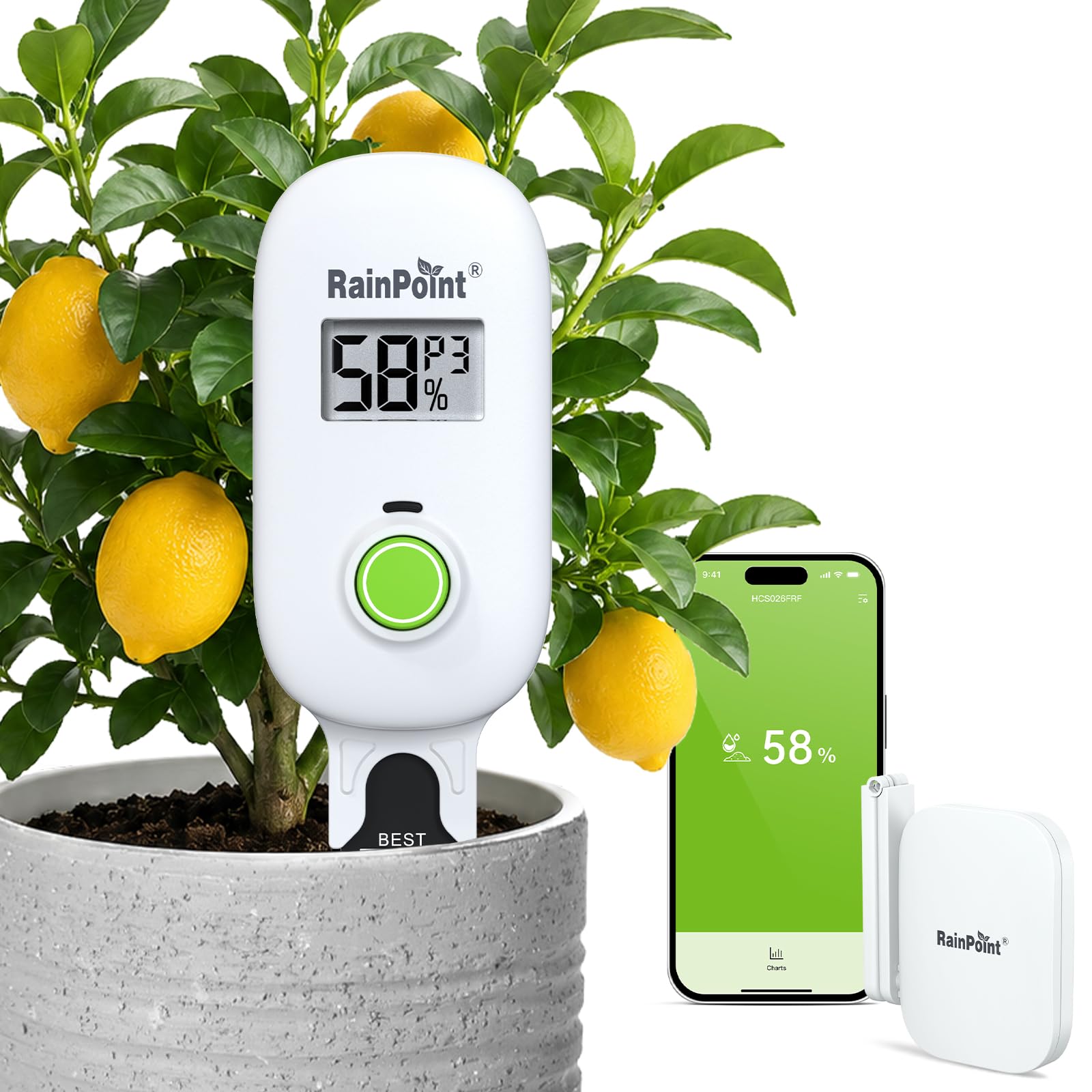
The meter that texts you before the plant wilts, with the hub included in the box.
Most smart sensors make you buy the gateway separately. This kit ships with the Mini WiFi Hub Gen2 in the box, along with pH test strips and a Phillips screwdriver, so you can go from unboxing to phone alerts without a second order. The sensor samples moisture continuously and refreshes the reading every minute, which is quick enough to catch a plant drying out between waterings. You set a low and a high threshold per plant, and the app pushes a notification or email when the soil crosses either line — a family member can be added to receive the same alerts. Without the hub, the large display still shows a current moisture snapshot at the pot.
Accuracy is what makes it credible, and the sensor uses capacitive reading with a soil-type selector to trim errors caused by different mixes. The 2.4 GHz hub is the only band it accepts, so a 5 GHz-only router needs its 2.4 GHz channel enabled. Paired with the hub, the meter can join other RainPoint smart devices, up to 39 in total, to build an automatic watering system around the same app.
The honest trade-off is connectivity. Battery is not included, so supply one before setup or the sensor stays silent. When the signal is solid, the threshold-alert system is the closest thing here to a plant that asks for water on its own.
The reason to pick it: a threshold alert is more useful than a raw number—the meter watches for the moment your soil gets too dry or too wet and tells you, instead of making you check a graph.
What to plan for: a strong 2.4 GHz signal where the plants live, and a battery in hand at setup, because the sensor will not report without both.
Pick this if: you travel or forget to water and want a phone notification when soil moisture drifts out of range, with the hub already included.
Pass if: your plants sit in a Wi-Fi dead zone or you would rather read a value directly than manage an app.
5. THIRDREALITY Smart Soil Moisture Sensor Gen2 3Pack

Three Zigbee moisture sensors for people who already run a smart home hub.
If your home already speaks Zigbee (a low-power smart-home wireless standard), this pack multiplies it. You get three stake-mount sensors that join a Zigbee 3.0 network—Echo (4th Gen), Echo Plus, Echo Studio, Eero 6, Home Assistant over ZHA or Z2M, Hubitat, SmartThings Aeotec, Homey, Homey Bridge or Homey Pro all work as the hub side. That list is why this pick appeals to the tinkerer: the readings land wherever you already automate your lights and plugs, and you can build a watering schedule off the moisture value. An enhanced antenna design is meant to hold a stable signal even on a balcony or in a garden corner, and the Gen2 build is tuned for stronger, more consistent transmission.
The sensing side uses capacitive monitoring, which is less swayed by soil salinity and pH than a plain resistance probe and holds up longer across different soil types. It is built for farms, greenhouses, nurseries, gardens and potted plants alike. Each unit runs on alkaline batteries, and the package carries a 1-year manufacturer warranty.
The caution is reliability over time. Some users report sensors that stop working within a couple of months, and readings that do not match what they expected, which is a real consideration when you are buying three at once. A dense Zigbee mesh with a repeater nearby reduces the drop-outs these sensors report. Home Assistant and Hubitat users gain the most from the multi-sensor flexibility, so keep the 1-year warranty in mind and mount each stake where Zigbee signal is strong.
Best matched to: Home Assistant, Hubitat or SmartThings users who want three sensors feeding one automation dashboard.
Weigh before buying: the drop-out reports — if you have a thin Zigbee mesh, add a repeater or start with one pack.
6. Intelligent Soil Moisture Sensor 3 Pack

Three sensors that report soil moisture and soil temperature into your Zigbee dashboard.
What people like here is the sensor quality, and the feature set explains why it matters. Beyond moisture, this meter also reads ambient temperature, so you get two numbers from one probe instead of one. The temperature accuracy is 0.5 degrees Celsius, tight enough to show meaningful swings in a greenhouse or a cold frame. It is built from PC and ABS materials with high impact resistance, heat resistance and cold resistance — the kind of shell that shrugs off a knock against a planter edge. At 0.98″W x 6.1″H it stakes into a pot or bed without dominating the soil.
The one rule you must accept is Zigbee. This tester needs a Zigbee gateway, or Zigbee2MQTT running in Home Assistant, or it will not read data at all. It pairs into greenhouses, gardens and lawns, and it can be combined with a smart watering timer so moisture levels trigger watering rather than a clock. Before use, keep the sensor surface clean and push in so at least two-thirds of the probe is submerged for an accurate reading.
Where it needs a fair warning: the moisture measurement is inconsistent for some users, and a few report units that stop transmitting within a couple of weeks. That is a bigger deal at three sensors than one, so if you buy, lean on the multi-pack value and keep the gateway close. It runs on 2 x AAA alkaline batteries you supply.
The draw is the dual reading: soil moisture plus a temperature figure accurate to 0.5 degrees Celsius gives greenhouse growers one less device to buy and mount.
The honest limit: a Zigbee gateway is mandatory, and the moisture side can be inconsistent — treat this as a monitoring aid, not a precision instrument.
Fits you if: you already run a Zigbee2MQTT or gateway setup and want moisture and soil temperature from the same stake.
Skip the trigger if: you have no Zigbee gateway, because without one this sensor reads nothing.
7. ECOWITT WH0291 Soil Moisture Tester

A self-contained LCD meter that gives you the reading in 72 seconds, no hub in sight.
If you refuse to build a gateway, this is the Ecowitt for you. The WH0291 measures soil moisture content and settles on a reading within 72 seconds, then shows it on a digital LCD with a flower pot icon so the number is easy to read at a glance. It needs no Wi-Fi and no app — the display console talks to the waterproof sensor and that is the whole system. The waterproof probe reaches into indoor and outdoor pots, lawns and garden beds, and there is a 12/24-hour time display on the console so it doubles as a small clock.
Functionality and ease of use are what carry it, and the calibration is the tool serious growers want. The custom mode gives you 0%AD and 100%AD points to set manually, so you can match the low and high moisture values to your specific soil type instead of accepting a factory default. It runs on 2 AA batteries, not included — one for the display console and one for the sensor. Compare that to the WH51L’s wired reach and IP68 probe: the WH51L goes deeper, but this one gives you a screen without a gateway, which for most windowsill and patio growers is the simpler buy.
The accuracy story is mixed. Many owners trust the readings, but some find them less reliable across different soils—which is exactly what the custom calibration exists to fix. Durability draws the occasional knock too, so treat the probe with reasonable care. Once you set its 0%AD and 100%AD points for your soil, it is the most dependable hub-free meter here.
Why it stands out
- No hub, no app — a complete meter with its own LCD console
- 72-second readings with a clear flower pot icon
- 0%AD and 100%AD custom calibration for different soil types
- Waterproof sensor works indoors and outdoors
Where it asks more of you
- 2 AA batteries not included — one for each half of the set
- Accuracy across soil types needs the custom calibration dialed in
Choose this for: a standalone meter you can read on its own screen, indoors or out, without a gateway or subscription.
Not ideal if: you want remote phone alerts — this one keeps you at the pot to read it.
8. Ambient Weather WH31SM Soil Moisture Sensor

The soil channel your WS-2000 or WS-5000 weather station is missing.
This sensor exists for one crowd: people who already own an Ambient Weather WS-2000 or WS-5000 console. Add it and your station gains a soil moisture channel alongside the temperature and wind data. It supports up to 8 channels, so one console can cover several beds. The wireless link runs on 915 MHz with a range up to 300 feet, or 100 feet in most conditions, refreshing every 71 seconds — quick enough to follow a garden through a hot afternoon. The sensor itself measures 6 x 3.5 x 1 inches and runs on 1 x AA battery, not included.
Its best moment is as a station add-on. Functionality is the reason owners keep it — the readings slot straight into the console you already check every morning. It uses a ceramic sensing element and is rated for outdoor use down to a 14 °F lower temperature limit, which covers cold-weather gardens.
Accuracy is the variable to know about. Some owners find the readings reasonably accurate, while others see them swing by more than 30% and consider the money poorly spent. That spread is the honest story with this unit — it is a convenience channel for an existing station, not a precision probe. If you want accuracy you can calibrate against, the Ecowitt WH0291 has the manual 0%AD and 100%AD controls; this one trusts factory calibration.
Built for: WS-2000 and WS-5000 owners adding soil data to a console they already rely on.
Stay away from this one if: you do not own that station — on its own it does not report anywhere.
9. Gain Express Soil PH Meter

A long self-powered probe that reads pH and moisture deep in a bed, with no battery to forget.
The 295mm electrode is the whole point of this tool. It is long and slender enough to push deep into garden soil, where shallow probes only sample the top crust, and it reads both pH and moisture from that depth. It is self-powered — no batteries required — so it cannot let you down with a dead cell. The waterproof metal probe and durable build suit it to vineyards, orchards, field production and lawn work as well as home planters. At 5.6 ounces it is light enough to carry around a yard all morning.
Build quality is what owners notice most, and the 295mm reach is why they trust it for a real garden. The operating window runs from 5 to 50 °C, or 41 to 122 °F, so it works in cold spring soil and hot summer beds alike. The maker recommends calibrating periodically to keep readings accurate, which is a reasonable habit for any analog probe.
The caveat on analog probes like this is consistency. Some owners see precise readings, others find it only works part of the time and need a second check before trusting a number. Long probes also bend if you force them into packed clay, so push slowly. No wireless unit on this list reads pH at all, let alone at 295mm depth without a battery.
Why the long reach earns it a slot: a 295mm electrode samples soil far below the surface, so you are reading the moisture and pH your deep-rooted shrubs and trees actually see.
Worth it for: gardeners and small growers who want pH and moisture from deep soil with no batteries and no app.
Think twice if: you want a reading you can trust every time without repeat checks — analog probes can vary.
Know the Specs
IP Rating
The IP number tells you how well the sensor is sealed against dust and water. The first digit covers solids and the second covers liquids, so higher is better for a probe that lives outside. A rating like IP68 means the unit is built to handle dust and liquid immersion in the probe area, while IP67 covers sealed protection against liquids and dirt without full immersion. If a probe is rated lower, keep it out of standing water and dry it after use.
Probe Reach and Wire Length
This is how deep your meter reads. A short push-in pen measures near the surface, where soil dries fastest and roots may never reach. A longer electrode or a wired probe, like the WH51L’s 1m/3.28ft PVC wire, lets the sensing tip sit deeper while the body stays above ground. For raised beds, deep planters and shrubs, deeper reach means your reading reflects what the roots actually get.
Gateways and Hubs
A wireless soil sensor is a radio, not a phone. It sends data to a hub or gateway, which then passes it to an app. Ecowitt sensors need an Ecowitt gateway such as the GW1100 or GW2000; Zigbee sensors need a Zigbee 3.0 hub such as Echo, Home Assistant, Hubitat or Homey; RainPoint uses its own 2.4 GHz hub. If the gateway is missing or on the wrong band, the sensor reads nothing where you want to see it.
Capacitive vs Resistance Sensing
The sensing method decides how long a meter stays accurate. A capacitive sensor reads moisture without forcing current through the soil, so soil salinity and pH sway it less over time. A resistance-style probe passes current through the soil and can drift as minerals build up. For treated or fertilized beds, capacitive is the design to look for.
Common Questions
Will the Ecowitt WH51L work without a gateway?
How deep should a soil moisture sensor sit?
Can I use more than one soil sensor on one system?
Do these meters need batteries?
Is a capacitive sensor better than a resistance probe?
Can a soil moisture sensor survive winter outdoors?
Why does my sensor sometimes read dry when the soil feels wet?
Which soil moisture sensor works with Home Assistant?
Does a pH meter also read moisture?
How often should I calibrate a soil moisture meter?
The Bottom Line
The strongest pick for most growers is the Ecowitt WH51L, because its 1m/3.28ft PVC wire probe reads soil moisture where the roots live and its IP68 probe end is built for real outdoor beds. If you want a meter you can read without a hub, grab the Ecowitt WH0291 and its 72-second LCD readout. And for forgetful houseplant owners, the SUStee Aquameter set of four leave-in pens turns watering into a color check you can do on the way past. Before you order, confirm the sensor speaks the same hub or gateway protocol as the gear you already run.
How we choose
We do not accept paid placement. Every pick is matched to a real buyer and a real use-case; we do not hands-on test units.
Sources
Specifications: manufacturer listings and product documentation. Review insights: verified customer reviews, as of November 2026. Pricing: not shown on this page (it changes often); check the current price via the retailer link.
As an Amazon Associate, Tactical Gear Guy earns from qualifying purchases. This does not affect which products we feature.