Specs are compiled from manufacturer listings and verified buyer reviews and can change over time — please confirm the key details on the product page before buying.
A water level switch is the small part that decides whether your pump wakes up or your basement gets wet. The right one cycles your sump pump on and off automatically, so you never stand over a pit with a flashlight at midnight. The wrong one sticks open, floods the basin, or quits within weeks. Below are the nine switches worth your money, sorted by what they actually do well.
This guide is built by comparing the manufacturers’ published specifications and the patterns across verified customer reviews, so you get each pick’s real strengths and trade-offs instead of marketing spin.
You will see how vertical floats, tethered floats, and electronic sensors differ, and which one suits a narrow pit, a deep cistern, or a sewage basin. Every pick here has one job: keep the water moving and the floor dry, and this water level switch breakdown shows you which one to trust.
Top Picks


How To Choose The Best Water Level Switch
Start with your pump, not the switch. A water level switch only has to do two things: close the circuit when the water rises and open it when the water drops. Everything else is about matching it to your basin, your pump’s draw, and how much tinkering you want to avoid.
Match the amp rating to your pump
The amp rating is the maximum pump current the switch can safely carry. A switch rated at 10 Amps at 120VAC handles a smaller pump than one rated at 16 Amps. If your pump pulls more current than the switch allows, the contacts burn out early. Check your pump’s label before you buy anything.
Vertical float, tether float, or electronic sensor
A vertical float rides up and down a fixed rod, so it needs clear space above and below. A tethered float swings on a cord, which lets you adjust the on and off levels by changing the tether length. An electronic sensor has no moving parts at all, so there is nothing to stick or foul, but it depends on its own circuitry staying healthy.
Cord length and pumping range
Cord length is the reach between the switch and your outlet. A 10-foot cord fits most basement sump pits. Pumping range is how far the water level must rise and fall to trigger a cycle, and a wider range means fewer, longer pump runs. For a deep tank or a sewage basin, a longer cord or a wider range saves you from mounting gymnastics.
Waterproofing and temperature
An IP68 rating means the switch is built to operate while submerged. That matters in a sewage basin or a flooded pit where the switch sits underwater for long stretches. Temperature ratings also count. A switch rated to 140°F tolerates hot discharge water, while one with no rating listed is a gamble in a hot basin.
Side-by-Side Comparison
| Model | Best For | Type | Current Rating | Cord Length | Amazon |
|---|---|---|---|---|---|
| PumpSpy 10-Foot Vertical Float Switch★ Best Overall | Hands-off sump automation | Vertical float | 10 Amps @ 120VAC | 10 ft | Amazon |
| MARSTEK Float Switch with 10ft CableBudget Tether Pick | Budget tether for tanks and ponds | Tethered float | 16 Amp maximum | 10 ft | Amazon |
| YoLink Water Level Sensor YS7904FSmart Alert Pick | Remote alerts and smart control | Smart float sensor | — | Cordless (LoRa) | Amazon |
| Water Boss Float Switch with Honeywell Microswitch | Bilge pumps and water tanks | Tethered float | 13 Amps / 0.5 HP | 10 ft | Amazon |
| FLUENTPOWER Vertical Float Switch FSK-16 | Tight pits with limited space | Vertical float | — | 10 ft | Amazon |
| PumpSpy 10ft Piggyback Tethered Float Switch | Sump and sewage replacements | Tethered float | 10 Amps @ 120VAC | 10 ft | Amazon |
| SJE-Rhombus PUMPMASTER 10PMDWOP | Septic and effluent pump-down | Pump-down float | 0.5 HP | 10 ft | Amazon |
| Little Giant RFSN-9 | Wide-range sump and pond control | Tethered float | 13 Amps | 15 ft | Amazon |
| HydroCheck HC6000v2 | Alarm-equipped electronic control | Electronic Hi-Lo sensor | 1 HP | — | Amazon |
Detailed Reviews
1. PumpSpy Vertical Replacement Float Switch
Our pick — 4.5+★ from 350+ verified ratings; the strongest balance of quality and price.
The vertical float that turns a sump pump into a hands-free system and keeps it that way.
If you want to set the float once and walk away, this is the one to buy. PumpSpy rates the VS-100 for up to one million cycles, which counts every time the float rises to the upper switch point and drops back to the lower one. A gold-plated electrical contact surface resists pitting and wear, and the advanced material helps stop buildup from sticking the float in place.
Installation is genuinely plug-and-play. The switch arrives fully assembled with a 10-foot power cord, a piggyback plug, a mounting bracket, and a stainless steel hose clamp, so it mounts straight onto the pump discharge pipe. It is a universal replacement for sump, sewage, and effluent setups, and it runs normally open at 10 Amps at 120VAC. That 10-Amp ceiling is modest compared to the 13 Amps on the Water Boss below, so check your pump’s draw first.
The setup wins on two counts that matter over years, not weeks. First, you get a real range of adjustment on the shaft, so you can dial in exactly where the pump kicks on and where it shuts off. Second, the switch stays put rather than drifting. It is designed to sit steady instead of floating all over the tank. The crowd backs it too: 4.5+ stars across 350+ owners is the highest score on this list, and the only honest caveat is that its 10-Amp rating is lower than the 16-Amp MARSTEK’s.
What earns it the top spot
- Rated for up to one (1) million on/off cycles, so it is built for the long haul
- Arrives fully assembled with cord, piggyback plug, bracket, and hose clamp
- Gold-plated contacts resist pitting and wear
- Locking adjustment on the shaft controls exactly where it turns on and off
Where it asks you to check first
- 10 Amps at 120VAC is the lowest ceiling among the float picks here
- Vertical design needs clear space above and below the float rod
Go with this if: you run a standard sump pump and want a vertical float that clamps to the discharge pipe in minutes and then disappears from your life.
Double-check first: your pump’s current draw, because the 10-Amp limit rules out heavier pumps that the 13-Amp and 16-Amp switches here handle.
2. MARSTEK Float Switch with 10ft Cable — 16 Amp, IP68
The affordable tether that takes heavier pumps and handles a fully flooded basin.
For a budget pick, the headline number here is a surprise. This switch carries a 16 Amp maximum pump run current, which is higher than the 10 Amps you get from either PumpSpy model and higher than the 13 Amps on the Water Boss. If you are running a beefier sump or sewage pump, that extra headroom is why this one earns its place. It pairs that with an IP68 waterproof rating, meaning it is built to operate fully submerged.
The cable is a UL-certified SJEOW type with a maximum service temperature of 140°F, and it is the part that actually sits in the water. Installation is the simplest kind: plug into the piggyback plug, tie it in place with the included nylon ties, and slide the float to adjust where it triggers. There is no complex circuit board to fail. A generous 10-foot cable covers basements, large water tanks, sewage systems, pools, and ponds.
Now the honest side. Reliability is the most-discussed topic in this listing, and it is mixed, not glowing. Some buyers report a switched that failed inside two months, and a smaller group saw trouble within a week. This is a mechanical tether, so treat the routine of checking it as part of ownership. For a light-duty tank, pond, or backup pump, it is a smart budget buy. For a critical primary sump in a finished basement, spend up on a switch with a longer track record than this tether’s.
Value read: The quality and the value are what buyers call out positively, and a 16-Amp rating at this tier is the real draw.
The honest math: The reliability record is a coin flip, so match this tether to low-stakes water control rather than your only line of defense.
Reach for it if: you need a high-amp, fully waterproof tether for a tank, pond, or utility pump and want to spend as little as possible.
Look elsewhere if: this is the sole switch guarding a finished basement, where a longer-proven model is the safer call.
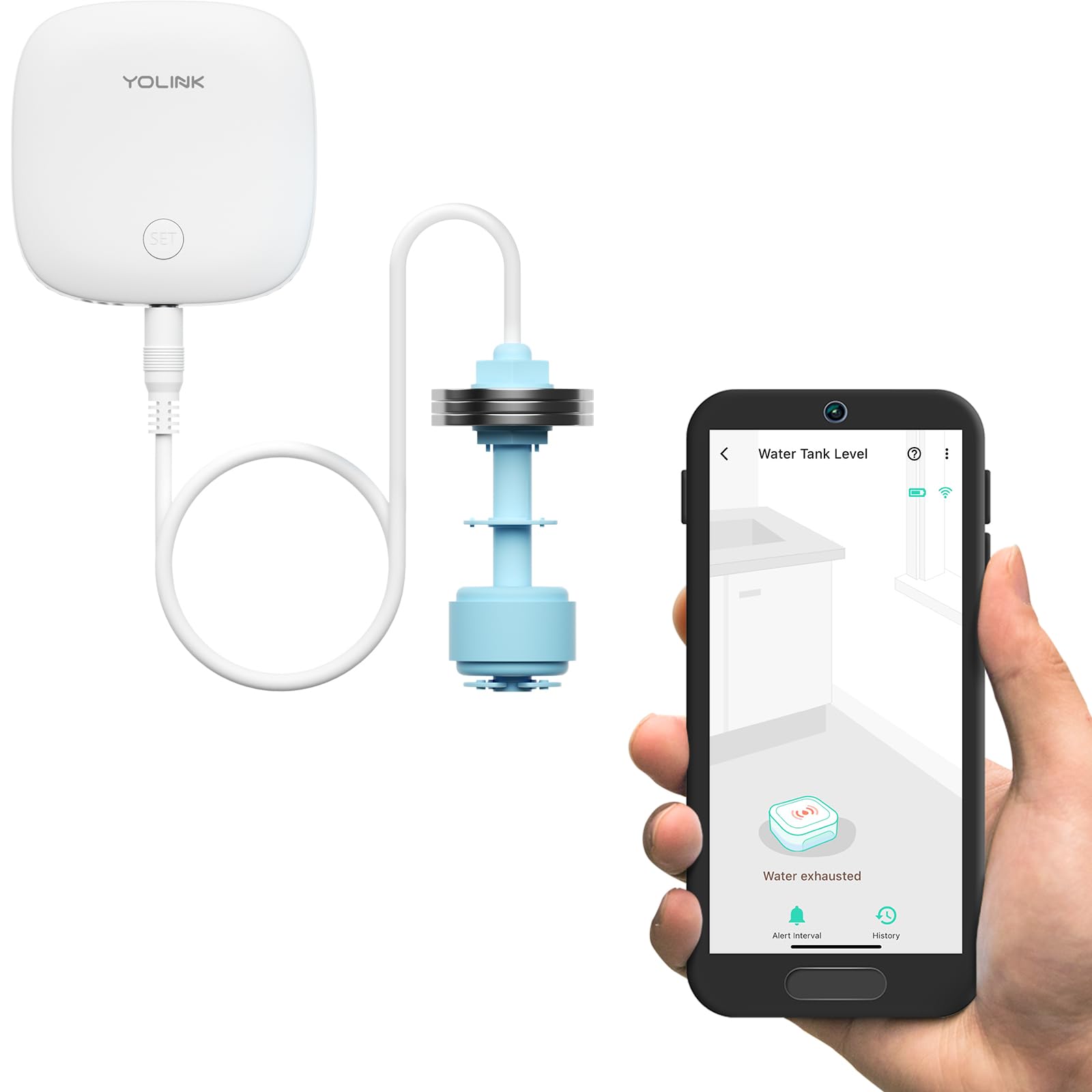
3. YoLink Water Level Sensor with Float Switch, 105 dB, YS7904F
Not just a switch — a cordless water sentry that pages your phone when the level rises.
This is the odd one out, and that is the point. Instead of a wired float that turns a pump on, the YoLink is a battery-powered sensor that hangs by a pendant mount into a tank, cistern, pan, or toilet and tells you what is happening. It fires a built-in 105 dB sounder for a local alarm, and it pushes notifications to your phone through the app, plus email, SMS, and speaker messages.
The wireless side is where it beats a cable. It uses LoRa, a long-range low-power radio, with a listed maximum range of 1,320 feet and up to 2,034 feet open-air, so you can drop a sensor where WiFi will not reach. No trenching, no conduit, no electrician. It works with Alexa, IFTTT, and Home Assistant, and it can trigger a YoLink Siren, Switch, Plug, or Relay to shut water off or turn a pump on automatically.
Two things to know before you buy. The first is that a YoLink hub is required and is not included, so this only runs if you already own or plan to buy one. The second is size: at 2.44 inches long and 0.8 inches high it is a compact unit that fits where a full float body will not. The mounting suits sump alarms, AC condensate pans, runaway toilets, fish tanks, ponds, rainwater drums, and cisterns. Owners lean on it most for spotting leaks around dishwashers and water heaters.
Where it shines: remote notification turns a silent overflow into an alert on your phone, even when you are not home to hear the alarm.
The catch: without a YoLink hub this device does nothing, so factor that into your plan before ordering.
Best for: the owner who wants to be told about a high level rather than rely on a mechanical float, especially in a far-flung tank or pan.
Not for you if: you want a switch that physically turns your pump on and off, since this sensor reports and alerts rather than directly switching the load.
4. Water Boss Float Switch with Honeywell Microswitch

A Honeywell microswitch built for repeatability, wrapped in a non-corrosive IP68 casing.
The number that sells this switch is inside the housing. A genuine Honeywell microswitch gives it high-precision, accurate repeatability and extended life, so the on and off points stay consistent rather than drifting. It is rated up to 13 Amps or a half-horsepower pump, and it carries CE and IEC approvals. Compared with the 10-Amp PumpSpy vertical float above, that 13-Amp ceiling gives you more room for a heavier pump.
The casing is rugged polypropylene, non-corrosive, and IP68 rated, so it tolerates full submersion in a bilge or tank. Temperature resistance runs from 32°F to 140°F, which covers a typical sump basin and even hot discharge water. The 10-foot PVC-jacketed adjustable tether lets you set the pumping range to suit a ground-water bilge pump, a water tank, or a sump pit. A 5-year warranty against manufacturer defects backs the whole thing.
This is the most-lauded switch in its own review set, and function and build quality are the two things buyers praise most. There is a mixed note on durability and on the switch action itself, so it is not magic. At 3.25 inches long, 1.5 inches wide, and 6.5 inches high, its body is the largest here, which matters if your pit is tight. Give it room to swing on its tether and it delivers precise, repeatable control.
Why owners stick with it
- Honeywell microswitch delivers accurate, repeatable on/off points
- 13 Amps or 1/2 HP capacity with CE and IEC approvals
- IP68 non-corrosive polypropylene casing handles full submersion
- 5-year warranty against manufacturer defects
Fit notes to weigh
- Largest body on this list at 6.5 inches tall, so tight pits need a check
- Durability feedback is mixed, so inspect the tether now and then
Choose this for: bilge pumps, water tanks, and sumps where repeatable, precise switching and a real 5-year warranty matter.
Think twice if: your basin is cramped, because the tall body needs swing room on its tether.
5. FLUENTPOWER Vertical Sump Pump Float Switch, FSK-16

Built for the cramped 12-inch pit where a swinging tether has no room to breathe.
Vertical float switches earn their keep in tight basins, and this FLUENTPOWER is the one buyers reach for when space is the problem. It works well in a narrow 12-inch diameter pit, where a tether would slap the walls and hang up. The float travels along its rod in a straight line, so as long as you keep the path clear of pipes and the pump body, it triggers cleanly. Reliability is the trait buyers praise most here, and fit follows close behind.
Everything you need to mount it ships in the box: a piggyback plug, two mounting brackets for the pump or pipe, a stainless steel hose clamp, and four screws. The 10-foot cord gives you reach to the outlet while the pump runs on its own cable. It is a control accessory, not a pump or a high-water alarm, so it is strictly the on/off brain for a compatible pump.
The one rule is to match it up before you buy. Check your pump, outlet, and switch voltage, the plug type, and the permitted motor load, because this model lists no amp rating in its specs and you cannot assume one. Clear space around the full travel path is non-negotiable — verify the basin layout rather than hoping any pit will fit. Do that and it does its quiet job in a way that suits small pits perfectly.
The tight-space answer: straight-line float travel plus two brackets make it the natural pick for compact basins other switches cannot fit.
Verify before ordering: it carries no published amp rating, so confirm your pump’s current draw against it first.
Pick it when: your sump pit is small and a tethered float keeps hanging up on the sides.
Pass it by if: you need a published amp rating to size against a big pump, because this spec sheet leaves that blank.
6. PumpSpy 10ft Piggyback Tethered Float Switch, TS-100

The swinging tether sibling of the top pick, made for sump, sewage, and effluent pumps alike.
Where the vertical VS-100 rides a rod, this TS-100 swings on a tether, and that changes everything about how it fits. A tether hangs down and rises with the water, so the tether length sets your on and off levels and you can adjust them by sliding the cable grip. Gold-plated electrical connections resist pitting and wear, and it runs normally open at 10 Amps at 120VAC. If your pump draws near that ceiling, the 16-Amp MARSTEK above gives more headroom.
Installation is a two-step job. Clamp the bracket to the pump discharge line, then plug the pump’s cord into the piggyback plug and connect that to any 120V outlet. The kit includes a hose clamp, a mounting clamp, and a mounting screw, and the 10-foot cord reaches the outlet with slack to spare. It is a universal replacement for sump, sewage, or effluent systems. The units are also assembled in Kalamazoo, Michigan.
Function is what buyers value here, with quality and installation close behind. The caution is on durability, which is mixed rather than flawless, and on the float and switch action, which also draws mixed notes. Treat it as a solid mid-tier tether that will serve for years when it is matched to a pump within its 10-Amp rating. Push it beyond that and you shorten its life.
The case for it: the same gold-plated contact build as the vertical top pick, in a tether shape that adapts to uneven basins.
Keep in mind: durability reports are mixed and the 10-Amp limit is real, so pair it with a modest pump.
Works well for: sump, sewage, and effluent setups where you want adjustable on/off levels from a swinging tether.
Better served elsewhere: if your pump draws more than 10 Amps, the higher-rated MARSTEK is the fit.
7. SJE-Rhombus PUMPMASTER Pump Switch, 10PMDWOP

A purpose-built pump-down switch for crankcase and septic effluent duty.
This is not a general-purpose float. The PUMPMASTER is a pump-down switch, which means it is wired to empty a tank rather than fill one, and it is intended for crankcase pumps and septic effluent pumps. It is rated for a half-horsepower pump and comes with a 10-foot cord without a plug (p/n 1002713). That no-plug setup means you wire it in, so it suits an existing install where the connection is planned for.
For septic work, one detail matters more than most: it passed the NSF Standard 61 protocol through an approved laboratory of the Water Quality Association. That is a recognized benchmark for components in contact with drinking-water-adjacent systems, and it is the kind of thing you want on a septic or effluent part. The grey plastic housing is compact and mounts above ground.
The review picture here is short and positive. Owners mention it works great and fits their needs perfectly, and function and fit are the two things they call out. There is not much volume of feedback, so treat this as a specialist buy from a known name in pump controls rather than a mass-market pick. If your job is a septic or effluent pump-down, this is built exactly for that task.
Why it exists: pump-down logic plus NSF Standard 61 testing make it the right tool for septic and effluent systems.
The niche catch: no plug on the 10-foot cord means you supply the connection, so plan for a little wiring.
Fit for: septic effluent and crankcase pump-down jobs where a specialist, NSF-tested switch is the point.
Overkill if: you just need a plug-in replacement for a standard basement sump, where a piggyback model is simpler.
8. Little Giant RFSN-9 Tethered Float Switch

A 7-to-36-inch pumping range and a 15-foot cord that reaches the far corner of a deep basin.
The spec that sets this Little Giant apart is its adjustable pumping range, from 7 inches up to 36 inches of water movement. That is a wide window, so you can let the water build before the pump fires and let it drop further before it quits — which means fewer, longer pump cycles. It handles sump, sewage, effluent, pond, and utility pump duty, and it is rated for a half-horsepower pump at 13 Amps maximum pump run current and 85 Amps maximum pump start current.
The 15-foot cord with piggyback plug is the longest here, so you can mount it well away from the outlet. It is UR and CSA listed in the USA and made in the USA, and it tolerates liquid up to 140°F. There is one firm condition: use it only with pumps that have integral thermal overload protection. Skip that and the switch’s maximums mean nothing.
What wins owners over is plain function. Reliability shows up in the years, with reports of one unit still running after 4 years, and quality and value get steady praise. The recurring gripe is the case — some report cracking, so handle it with care when you mount it and do not overtighten the clamp. Set against the PumpSpy tethers, this one buys you far more range and cord.
What the extra reach buys you
- 7 to 36 inch adjustable pumping range for fewer, longer cycles
- 15-foot cord, the longest in this lineup
- 13-Amp run and 85-Amp start current for bigger pumps
- UR and CSA listed, made in the USA
What to mind
- Only for pumps with integral thermal overload protection
- Casing can crack if handled roughly, so mount it gently
Made for: deep basins and ponds where you want a wide pumping window and a long cord run.
Only if: your pump includes integral thermal overload protection, which this switch requires.
9. HydroCheck HC6000v2 Sump Pump Float Switch

A float switch with no float to stick — dual electronic sensors and alarms instead.
The HC6000v2 throws out the mechanical float entirely. It uses a Hi-Lo dual-sensor design with no moving parts, so there is nothing to foul, stick, or wear out the way a float can. The Hi-Lo setup also tune pump cycles to reduce wear, and the whole thing is tested for over 1 million cycles. It is rated for a 1 HP pump with a maximum lifting height of 20 feet, the biggest pump capacity on this list.
Two features separate it from every mechanical switch here. First, it has built-in alarms that fire when the water runs high or the pump malfunctions, so you get an alert instead of a flooded floor. Second, the maintenance-free design means no cleaning and no moving parts to babysit. It fits where a standard switch came out, replacing it without drama, and it is electronic rather than a swinging or rising float.
Customers note the setup is clear and easy, and they value the adjustability for dialing in exact on and off levels. The electronic design with no moving parts is the selling point they appreciate most. Value gets mixed reviews — some consider it well worth the cost and others do not. This is the premium option at the top of the range, so the question is if you want alarm protection and zero moving parts. For a finished basement where a silent overflow is your worst-case, its built-in high-water and malfunction alarms make it the most protective switch here.
The differentiator: built-in high-water and malfunction alarms turn a quiet failure into a warning you can act on.
Weigh the cost: value is contested among owners, so buy it for the alarms and the no-moving-parts design, not as a bargain.
Worth it for: finished basements and critical pits where built-in alarms and a zero-moving-parts sensor justify the premium.
Skip the splurge if: you only need basic on/off cycling and a mechanical float will do, since value is the contested point here.
Know the Specs
Amp rating (pump current capacity)
The amp rating is the maximum pump current a switch can carry without its contacts overheating. A 10-Amp switch suits a lighter pump; a 16-Amp switch takes a heavier one. Match this number to the label on your pump, because a switch carrying more current than it is rated for wears out early. The switches here range from 10 Amps up to a half-horsepower rating and, at the top, a 1 HP electronic unit.
IP rating and submersion
IP68 means a device is built to keep working while fully underwater. In a sewage basin or a flooded pit, the switch can sit submerged for long stretches, so this rating separates a part built for that from one that merely splashes. Look for IP68 on any switch that will spend time below the waterline, and pair it with the temperature limit so hot discharge water does not shorten its life.
Common Questions
What is the difference between a vertical float and a tethered float switch?
Will a 10-amp float switch work with my sump pump?
Do I need a hub for the YoLink water level sensor to work?
Can an electronic float switch replace a mechanical one in the same pit?
How much cord length do I need for a basement sump pit?
What does the pumping range on a tether switch mean?
Is a float switch safe to use in a septic or sewage basin?
Why does my float switch keep turning the pump on and off too often?
What water temperature can these switches handle?
Can a water level switch turn on more than just a pump?
The Bottom Line
For most people buying a water level switch, the winner is the PumpSpy 10-Foot Vertical Float Switch — it arrives fully assembled, mounts in minutes on the discharge pipe, and is rated for up to a million cycles, which is why it holds the highest score here. If you want more current headroom for a heavier pump, grab the MARSTEK 16-Amp tether. And for a finished basement where a silent overflow is the real fear, the alarm-equipped HydroCheck HC6000v2 is the one to reach for.
How we choose
We do not accept paid placement. Every pick is matched to a real buyer and a real use-case; we do not hands-on test units.
Sources
Specifications: manufacturer listings and product documentation. Review insights: verified customer reviews, as of November 2026. Pricing: not shown on this page (it changes often); check the current price via the retailer link.
As an Amazon Associate, Tactical Gear Guy earns from qualifying purchases. This does not affect which products we feature.