Specs are compiled from manufacturer listings and verified buyer reviews and can change over time — please confirm the key details on the product page before buying.
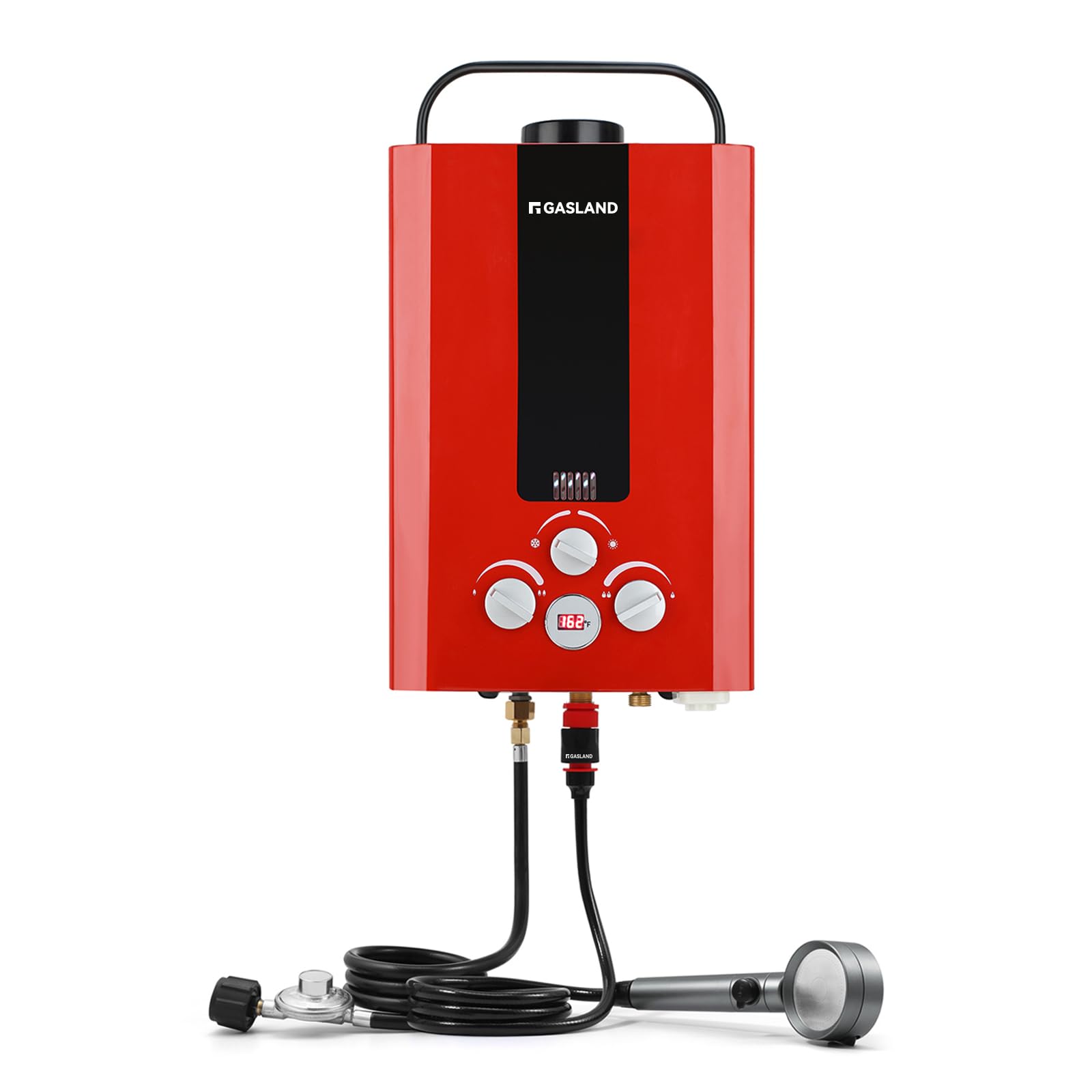
You want a hot shower at a campsite with no hookup, no generator, and no tank of pre-warmed water sloshing in the truck. The answer is a propane tankless heater, which fires the burner only as water flows through the coil. The GASLAND BE158R is the pick here for most people — 4.0+ stars across 500+ ratings — because it pushes 41,000 BTU of heat and starts on just 3.6 PSI of water pressure.
This guide is built by comparing the manufacturers’ published specifications and the patterns across verified customer reviews, so you get each pick’s real strengths and trade-offs instead of marketing spin.
Here is what actually separates these four units: flow rate in gallons per minute, heat output in BTU, and how low a water pressure they will fire on. Everything below is sorted around those three numbers, so you can match a heater to your pump, your propane tank, and your shower head. Read on for a straight breakdown of the water heater for camping options worth your pack space.
Top Picks
How To Choose The Best Water Heater for Camping
A camping water heater is not a miniature version of the tank in your basement. It has no storage tank at all. Cold water runs through a burner-heated coil and comes out hot on the other side, which is why these units are called tankless or on-demand.
That design means three specs decide your shower: flow rate in GPM, heat output in BTU, and minimum start pressure in PSI. Get those three right and the rest is hose fittings and D-cell batteries.
Start with flow rate, not heat
Flow rate is how many gallons per minute (GPM) the unit pushes through. A standard outdoor shower head wants somewhere around 1.3 to 1.6 GPM to feel like a real shower.
The four picks here run from 1.32 GPM up to 1.58 GPM. That 0.26 GPM gap is small on paper, but at the shower head it shows up as a thinner stream while you rinse.
Then check the heat output in BTU
BTU stands for British thermal unit — it is a measure of how much heat the burner throws. More BTU means the unit can raise the water temperature further at a given flow rate.
All four units here sit between 34,000 and 41,000 BTU. That range delivers a warm outdoor shower, not a scalding one, so plan your expectations around it.
Match the low-pressure start to your water source
The low-pressure start spec is the minimum water pressure the unit needs before the burner will ignite. Buyers overlook this spec most often, and it decides whether your pump or gravity feed can light the burner at all.
If you are feeding from a gravity bag or a small 12V pump, a heater rated down to 2.5 to 3.6 PSI will fire. A unit rated above your supply pressure will not ignite, no matter how you turn the knob.
Plan for propane and batteries
Every heater on this list runs on a standard 20 lb liquid propane tank. The ignition on each is powered by two D-cell batteries, so pack spares and keep them dry.
These are outdoor appliances. They are splash-resistant at best, and the makers all say the same thing: keep them out of prolonged rain and drain them before winter storage.
Side-by-Side Comparison
| Model | Best For | Flow Rate | Heat Output | Max Water Temp | Amazon |
|---|---|---|---|---|---|
| GASLAND BE158R★ Best Overall | All-round off-grid showers | 1.58 gpm | 41,000 BTU | 175 °F | Amazon |
| OEVANT 5L Portable Propane | Budget-friendly first setup | 1.32 gpm | 34,000 BTU | 109.4 °F | Amazon |
| RUINOPAR 6L Tankless | High-pressure hookups | 1.58 gpm | 12.3 KW | 167 °F | Amazon |
| CAMPLUX BW158B | Quick heat at the campsite | 1.58 gpm | 41,000 BTU | 167 °F | Amazon |
Detailed Reviews
1. GASLAND BE158R Tankless Water Heater
Our pick — 4.0+★ from 550+ verified ratings; the strongest balance of quality and price.
The heaviest hitter of the four, with 41,000 BTU and the highest temperature ceiling on the list.
That 41,000 BTU output is the reason this one takes the top spot. It beats the OEVANT by 7,000 BTU, and it carries the highest maximum temperature here at 175 °F — meaning the burner has more room to push heat into the water before it gives up.
What wins people over is how reliably it fires up and keeps running. It needs only 3.6 PSI to start, so a modest 12V pump or a gravity-fed barrel gets it going. Setup and day-to-day use draw steady praise too, and owners run these for camp showers, pet washing, and winter animal watering.
The honest catch is temperature predictability at the tap. The unit is rated to 175 °F, yet a chunk of owner feedback lands around the water never climbing past 101 degrees on their setup. Cold inlet water, flow rate, and propane pressure all pull that number down, so expect to tune the water flow valve to find your hot spot rather than just cranking the dial.
What earns it the top ranking
- 41,000 BTU and 175 °F max temperature — the strongest heat spec in this group
- Starts on just 3.6 PSI of water pressure, so small pumps and gravity feeds work
- CSA certified with over-heating, dry-combustion, flame-failure, and anti-freezing protection
- Comes with a 5-foot on/off switch shower head, gas regulator, hose, and mounting hardware
- Bright LED display shows the temperature readout so you are not guessing
Where it asks for patience
- Actual shower temperature can come in well below the 175 °F ceiling depending on inlet water and flow
- Fittings and connections are the weak point — check every joint before you trust it
- No prolonged rain exposure; splash-proof only, so it needs shelter and dry storage
Go with this if: you want the most heat and the highest temperature ceiling of the four and you are willing to dial in the flow.
Think twice if: you expect a fixed, set-and-forget shower temperature — you will be adjusting the valve.
2. 5L Portable Propane Water Heater
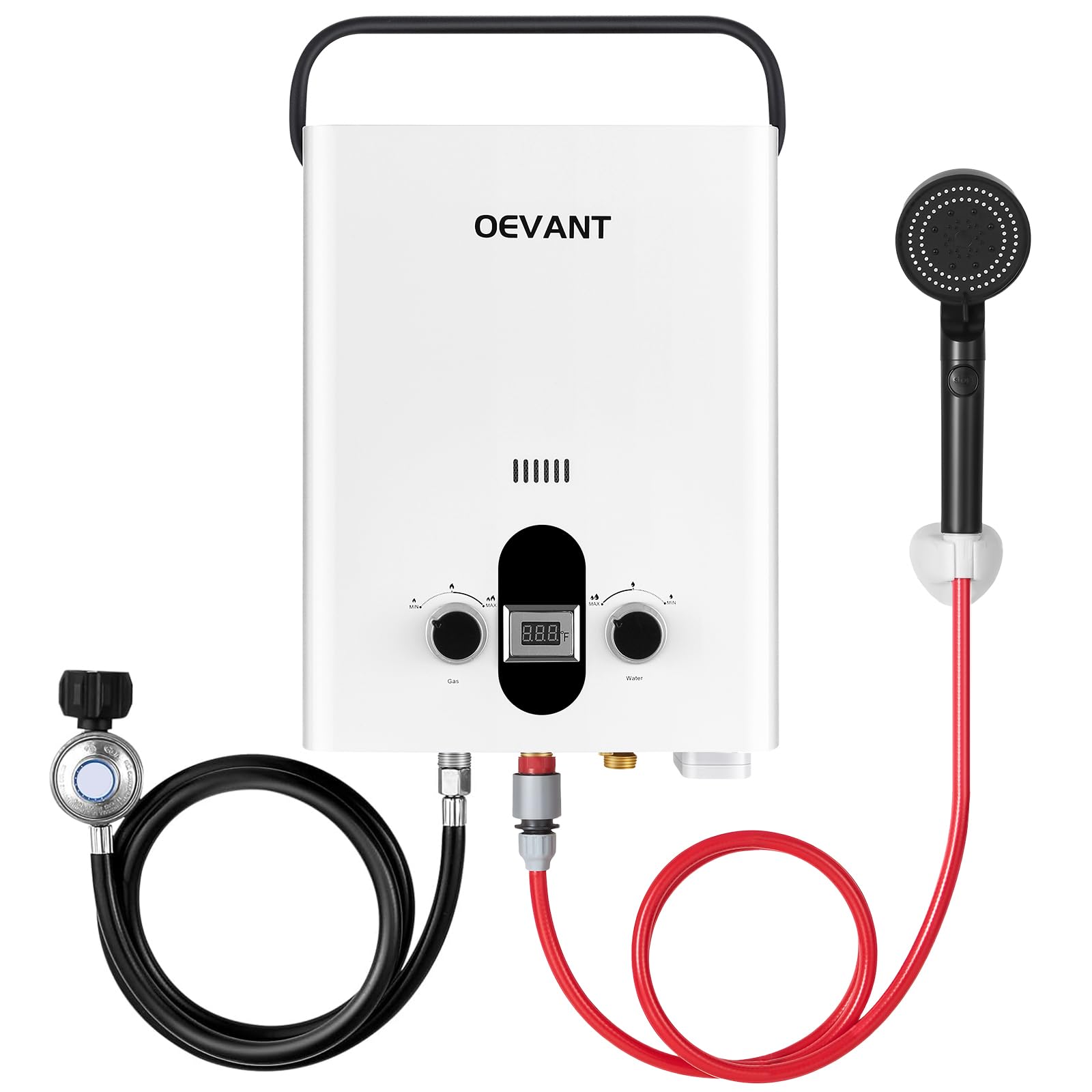
The lightest, most packable option here — a 10 lb metal body with a built-in carry handle.
Shedding weight is the entire pitch. At 10 pounds this is the lightest heater on the list, and the carry handle makes it something you can actually walk from the truck to the creek without a second trip. It is the entry-level pick of the four.
On output it gives up ground honestly. Its 34,000 BTU trails the GASLAND’s 41,000 BTU, and its 1.32 GPM is the lowest flow rate in this group — 1.58 GPM on the top pick versus 1.32 GPM here. The trade is a smaller, slower stream at the shower head, but what the heating side does, it does well.
Performance is the theme that comes up again and again in owner feedback, with the heater earning its keep as a straightforward hot-water source for RV rinses and campsite showers. The notable gripe is the hoses — a few setups report leaking at the connections, and the red shower hose can swell. Swap in a better hose early and you dodge most of that.
Packability win: 10 pounds with a carry handle and a compact 11.8″W x 14.6″H footprint means it stows in a truck bed or RV bay without eating the whole space.
Run it dry-stored: the housing handles drizzle but not a soaking, so a dry bag or a sheltered spot under the awning is part of the kit.
Reach for this if: you are building your first off-grid shower setup and want the lightest unit that still makes hot water on demand.
Look elsewhere if: you want the strongest stream — the 1.32 GPM flow is the slowest of the four.
3. Portable Water Heater Propane Tankless 6L

Built for the campsite with a real water main behind it — 145 PSI of pressure tolerance.
If you have ever run a hose off a pressurized RV spigot or a cabin line, this is the number that matters. Its 145 PSI maximum pressure rating tops the GASLAND’s 110 PSI, so it is the one you plumb into a feed with some push behind it rather than a trickle.
The spec sheet is otherwise solid: 1.58 GPM, a 167 °F max temperature, a six-protection list that includes overheat, anti-freeze, flame-out, anti-dry, high-pressure, and low-flow cutoffs, and it needs only 2.5 PSI to start — the lowest ignition threshold here. It also carries the longest warranty in the group at 24 months. Setting it up and operating it is the thing owners agree on most, and the stainless steel body holds up to a season of hauling.
The honest part: at the higher flow rates the heat output can run inconsistent, and some setups have trouble holding a steady temperature on the dial. Treat this as a heater that wants a consistent inlet pressure and a reasonable flow — not one to max out on both fronts at once.
Trading on pressure and warranty
- 145 PSI max pressure — the highest pressure tolerance of the four
- Starts on 2.5 PSI, the lowest ignition threshold in this group
- Two-year warranty — the longest coverage offered here
- Six protection systems including anti-freezing and flame-out shutoff
- Stainless steel body with a handle and rear mounting bracket for hanging
What to expect on the dial
- Temperature control can drift at higher flow rates, so you will be fine-tuning
- Internal leaks show up in some units over time — inspect the housing and fittings regularly
- Do not apply Teflon tape between the regulator and gas inlet — the maker specifically warns against it
Best matched to: RV hookups, cabin lines, or any feed with a real pump behind it and a buyer who values a two-year warranty.
The caveat: expect to dial the flow down to hold a steady temperature at the shower head.
4. CAMPLUX BW158B Portable Tankless Water Heater

The one that pours hot water fast — heating speed is the trait buyers talk up most here.
Speed is the story with this CAMPLUX. It matches the GASLAND’s 41,000 BTU and its 1.58 GPM flow rate, so on raw output it is a peer of the top pick. Where it leads is how quickly hot water reaches the head — owners note plenty of hot water and a short wait to get it, which is the difference between a pleasant rinse and a cold one when you are standing on gravel.
Setup is the other draw. Connect a water supply and a 20 lb propane tank and you are running, and the 3.0 PSI minimum pressure start means it fires on a small pump or gravity feed. The ECO and Full knob plus the LED display keeps the temperature adjustment simple, and at 13 lb with a foldable handle it hangs or carries without much fuss.
Here is the trade-off to weigh. Owner feedback on reliability and temperature control is split — the unit runs extremely well for many, but a share report it quitting after a handful of uses, and the shower head hose is the part that tends to go first. Wrap or swap the hose and check your regulator, and you sidestep the most common failure.
Heat where it counts: 41,000 BTU and 1.58 GPM are the same headline numbers as the GASLAND, so the stream and the burner are the equal of the top pick — the difference is a knobby, immediate heat-up that owners like.
The hose is the soft spot: plan to inspect or replace the shower head hose, since that is the failure point that comes up repeatedly.
Pick this one when: fast hot water and simple operation are what you want for camp showers and outdoor use.
Consider the alternative if: you want the strongest temperature-security spec — the GASLAND holds a 175 °F ceiling to this unit’s 167 °F.
Know the Specs
Flow rate (GPM)
Flow rate is how many gallons per minute the heater pushes through, and it sets the size of your shower stream. The picks here run from 1.32 GPM to 1.58 GPM. Higher flow feels more like a home shower; lower flow gives the burner more time to heat each gallon, which can mean warmer water at the head.
Heat output (BTU)
BTU measures how much heat the burner produces. A 41,000 BTU unit has more heating muscle than a 34,000 BTU one, so it can raise the water temperature further at the same flow. If your inlet water is very cold, the higher-BTU unit gives you more headroom before the shower turns lukewarm.
Low-pressure start (PSI)
PSI is pounds per square inch, a measure of water pressure. The low-pressure start is the minimum pressure needed to trigger the burner. A heater rated down to 2.5 to 3.6 PSI will run off a small 12V pump or gravity feed; one that needs more will not fire until you give it a stronger supply.
Maximum temperature
This is the hottest the unit is rated to send water out. The four here top out between 109.4 °F and 175 °F. That is a ceiling, not a guarantee — your actual shower temperature depends on the temperature of the water going in, how fast you run it, and how strong your propane supply is.
Common Questions
Can a tankless camping water heater run off a 12V pump or a gravity bag?
How long will a 20 lb propane tank last on a camping water heater?
Do these heaters need electricity?
What is a realistic shower temperature from a 34,000 BTU unit versus a 41,000 BTU unit?
Can I leave a propane water heater out in the rain?
How do I winterize a camping water heater?
Is the water safe to drink from a tankless propane heater?
Should I use Teflon tape on the gas connection?
How much does a portable camping water heater weigh and can I carry it alone?
Will a camping water heater leak after a while?
The Bottom Line
For most campers, the winner is the GASLAND BE158R — 41,000 BTU, a 175 °F max temperature, and a 3.6 PSI startup that lets it run off a small pump or gravity feed, all with the CSA certification and six safety protections that make it the most complete package here.
If you want the lightest unit to haul and a lower entry point, the OEVANT 5L is the one that saves your shoulders, and the RUINOPAR 6L is the one for a pressurized RV or cabin line, with the highest 145 PSI rating and the longest two-year warranty.
The CAMPLUX BW158B is the pick when fast hot water matters more than a higher temperature ceiling. Whatever you choose, drain the unit before winter and inspect the hose before every trip.
How we choose
We do not accept paid placement. Every pick is matched to a real buyer and a real use-case; we do not hands-on test units.
Sources
Specifications: manufacturer listings and product documentation. Review insights: verified customer reviews, as of November 2026. Pricing: not shown on this page (it changes often); check the current price via the retailer link.
As an Amazon Associate, Tactical Gear Guy earns from qualifying purchases. This does not affect which products we feature.