Specs are compiled from manufacturer listings and verified buyer reviews and can change over time — please confirm the key details on the product page before buying.
If you are tired of running the tap for half a minute before warm water reaches your hands, the fix is a point-of-use unit that sits right under the sink and holds heat at the ready. For a bathroom that means one correct decision: match the unit to how many fixtures you feed and to the wiring you already have. The shortlist below covers tank-style heaters that store a small reserve and tankless models that heat water as it flows, so you can pick the one that fits your wall, your outlet, and your patience level.
This guide is built by comparing the manufacturers’ published specifications and the patterns across verified customer reviews, so you get each pick’s real strengths and trade-offs instead of marketing spin.
The pieces that matter are simple: stored gallons, flow rate, and whether the unit plugs in or needs hardwiring. This breakdown of the water heater for bathroom keeps every number tied to the spec sheet so you can compare like for like.
Top Picks

How To Choose The Best Water Heater for Bathroom
Start with the faucet, not the box. A bathroom sink draws a small, short burst of water, so a heater sized for a sink behaves very differently from one built to feed a shower. Get that match right and the rest of the decision falls into place quickly.
Tank or tankless under the sink
A mini-tank holds a stored reserve — the Bosch ES2.5 keeps 2.5 gallons ready and the VEVOR matches it at 2.5 gallons — so hot water is available the instant you turn the handle. A tankless unit like the CAMPLUX 6kW heats on demand and never runs a reserve dry, but its output depends on the incoming water temperature and the flow you pull.
Check the electrical requirement first
This is where most bathroom installs stall. Plug-in models such as the ThermoMate ES150B and the Bosch ES2.5 run on a standard 120V outlet and a cord, which suits a DIY swap. The 6kW tankless units need 240V hardwiring with a dedicated breaker, so confirm your panel and wire gauge before you fall for a sleek wall unit.
Match flow rate to the fixture
Flow rate, measured in gallons per minute (gpm), tells you how much hot water the unit can deliver at a given temperature rise. A sink sips water; a shower gulps it. If you only feed a vanity faucet, a lower-gpm unit is plenty, but a shower needs far more — the Electrolux 8kW is explicitly built for sinks and vanities, not showers.
Factor in recovery and standby
A tank reheats after you drain it, so recovery time sets how long you wait between uses. The VEVOR lists 8 to 15 minutes to reach temperature; the Bosch touts a fast recovery rate that supplies up to two sinks. Tankless units skip the wait entirely but throttle output when the incoming water is cold.
Side-by-Side Comparison
| Model | Best For | Type | Capacity / Flow | Power | Amazon |
|---|---|---|---|---|---|
| CAMPLUX 6kW Tankless★ Best Overall | Instant sink hot water, hardwired | Tankless | 1.07 gal / 1.5 gpm | 6 kW, 240V | Amazon |
| VEVOR 2.5 Gallon Mini-TankBest Storage Reserve | Stored reserve for two sinks | Mini-tank | 2.5 gal / 2.2 gpm | 1440W | Amazon |
| ThermoMate ES150B 1.3 GallonBest Plug-In Install | Plug-in DIY under-sink swap | Mini-tank | 1.3 gal | 1440W, 120V | Amazon |
| ThermoMate 6kW Tankless | Sink washing, hardwired | Tankless | 1 gal / 1.07 gpm | 6000W, 240V | Amazon |
| Electrolux 1.5 Gallon Tank | No-fuss plug-in install | Mini-tank | 1.5 gal | 1440W, 120V | Amazon |
| 14kW Tankless (SIVUATEK) | Kitchen plus bath, two points | Tankless | 3.3 gpm | 14 kW, 240V | Amazon |
| Electrolux 8kW Tankless | Single vanity faucet | Tankless | 1.97 gpm | 8000W, 240V | Amazon |
| GE 2.5 Gallon Mini-Tank | Booster for long pipe runs | Mini-tank | 2.5 gal | 120V, 140°F max | Amazon |
| Bosch Tronic 3000 T ES2.5 | Whole-sink reserve, proven design | Mini-tank | 2.5 gal | 1440W, 120V | Amazon |
Detailed Reviews
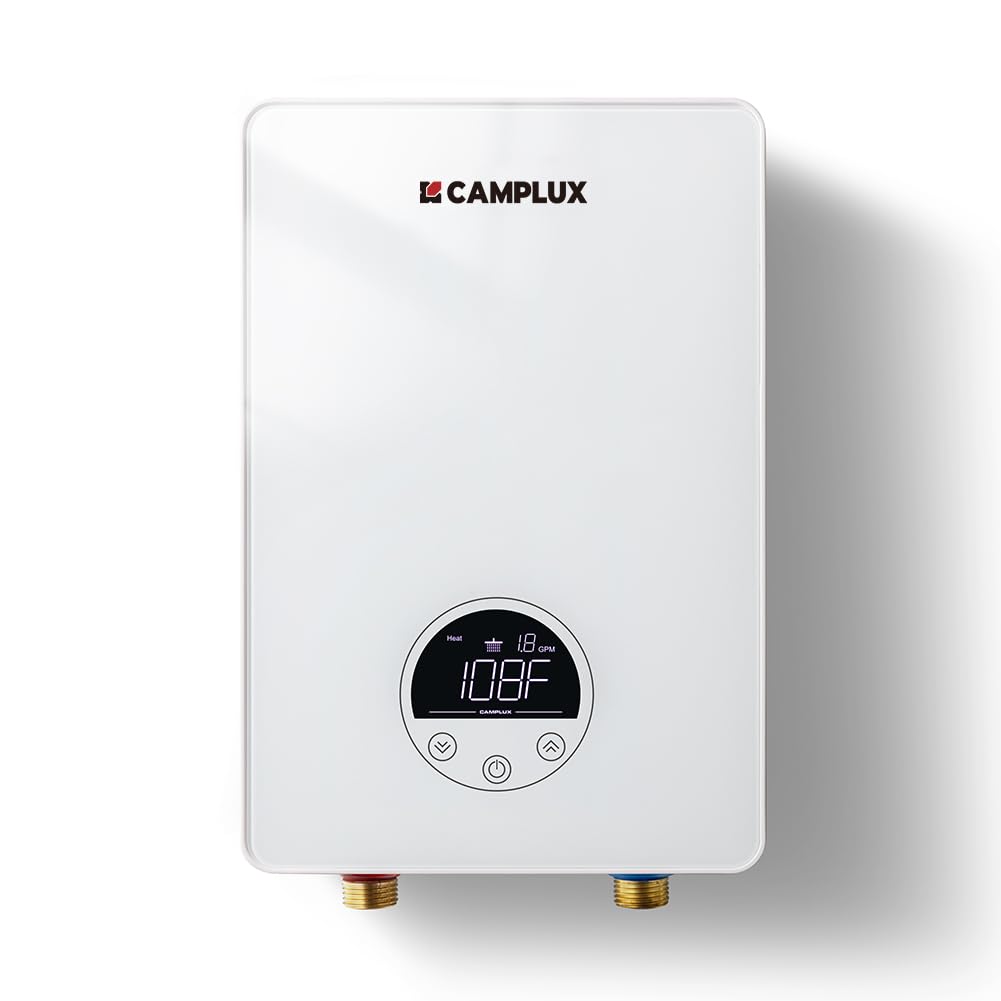
1. CAMPLUX Tankless Water Heater Electric 6kW at 240 Volts
Our pick — 4.0+★ from 650+ verified ratings; the strongest balance of quality and price.
The wall-mounted heater that ends the sink wait without ever running a tank dry.
This is the crowd favorite of the list — 4.0+ stars across 690+ owners — and the reason is heating performance. The 6kW element pours hot water on demand, so the tap delivers warm water in seconds instead of making you stand there with a hand under the faucet. Nothing is stored, so there is no reserve to drain and no recovery pause between uses.
At 3.9 pounds it is the featherweight of the group, and the comparison proves it. The VEVOR mini-tank weighs 17.6 pounds — a 4.5x gap — so the CAMPLUX mounts on a wall without any bracing drama. Its footprint is 10.95″ x 7.4″ x 2.52″, which means it tucks into the empty space beside a vanity cabinet rather than eating a shelf. For a small bathroom, that is the whole appeal in one line.
The catch is the wiring, and it is a real one. This unit runs ONLY hardwired at 240V with a 30A circuit breaker, 10AWG wire, and 1/2″NPT water connections. If your bathroom only has a 120V outlet behind the sink, this is not a plug-and-play swap. Owners also flag occasional leakage and durability concerns alongside the praise, so it pays to install the fittings carefully and check the connections.
Where it shines
- Heats on demand with no stored reserve to run cold mid-use.
- 3.9 pounds makes wall-mounting simple and unobtrusive.
- Self-modulating power trims energy use to the water you actually draw.
- Auto-shutoff and a cast aluminum element handle hard-water scaling.
What to weigh first
- Requires 240V hardwiring with a 30A breaker and 10AWG wire.
- Output tops out at 131°F, so very hot settings are off the table.
- A scattering of leakage and durability notes suggest careful installation.
Reach for this if: you have 240V power near the sink and want endless hot water with no tank to drain.
Look elsewhere if: your only power is a standard 120V outlet — a plug-in mini-tank suits you better.
2. VEVOR 2.5 Gallon Electric Mini-Tank Water Heater 1440 W
A stored 2.5 gallons that serves two sinks without a hardwired circuit in sight.
The number that defines this pick is 2.5 gallons — more than double the 1 gallon the ThermoMate 6kW tankless carries. That reserve sits ready under the shelf, so you get hot water the moment you turn the handle without waiting for an element to fire. It also flows at 2.2 gpm, versus the ThermoMate 6kW at 1.07 gpm, so it can feed two sinks at once rather than dribbling through one.
What wins people over is performance — 25 owners single it out — with instant hot water close behind. The 310S stainless steel tank resists corrosion, and a built-in temperature pressure safety valve releases excess pressure to guard against scalding and leaks. You can mount it vertically or horizontally, on a shelf, wall, or floor, which gives real flexibility in a tight bathroom.
Heating time is the honest trade-off. The spec book claims 8 to 15 minutes to reach temperature, but reactions split between fast and slow depending on the draw, and the maximum 145°F means it will not compete with a full-size tank for scalding-hot output. At 17.6 pounds it also needs solid mounting, unlike the 3.9-pound CAMPLUX above.
The honest read: a great fit if you want stored hot water for two bathroom sinks and can give it a few minutes to recover. The 2.5-gallon capacity and 2.2 gpm flow beat the tankless options for simultaneous use.
The trade-off: it takes minutes to heat a fresh tank and tops out at 145°F, so it is a reserve, not an endless supply.
Best matched to: a two-sink bathroom or a space where you can mount a tank on a shelf or wall.
Think twice if: you expect instant heat with zero warm-up — a tankless unit delivers that, this one does not.
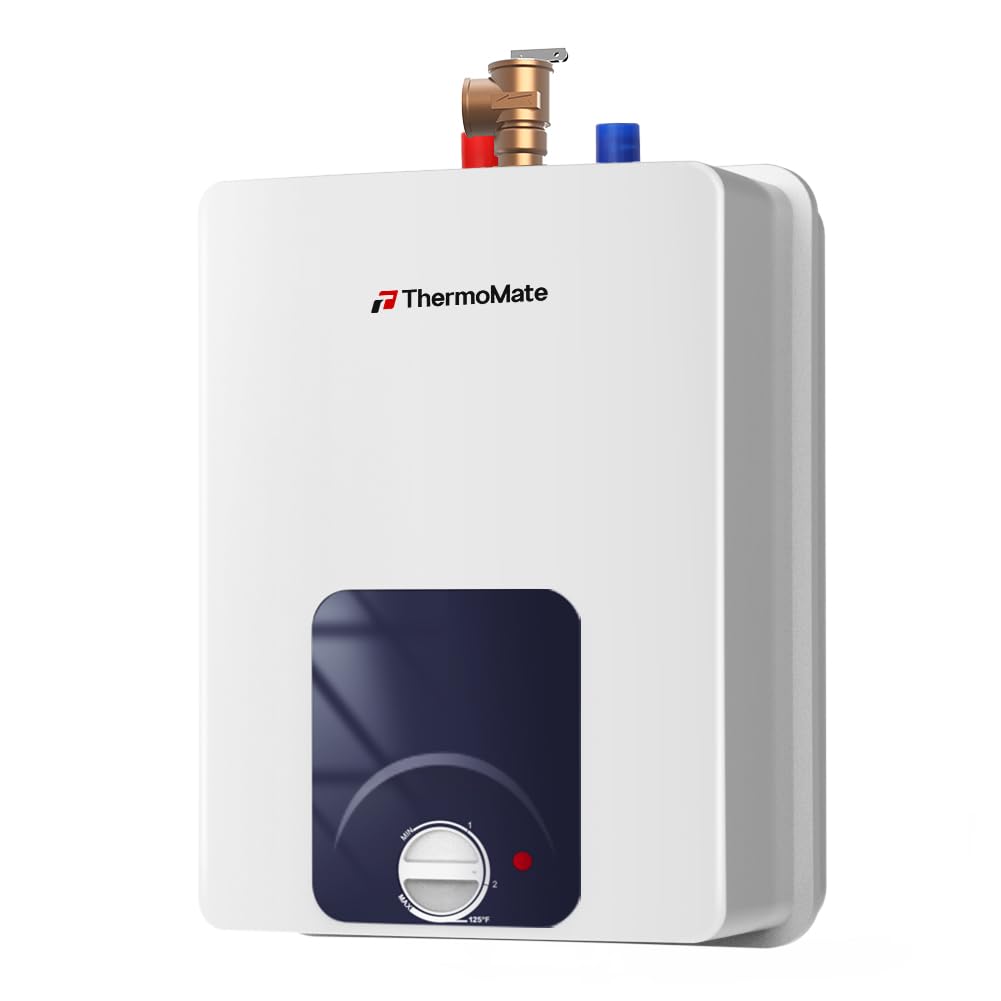
3. ThermoMate ES150B Water Heater
Corded, UL listed, and small enough to hide in a cabinet — a DIY-friendly swap.
For anyone who wants hot water at the sink without touching the breaker panel, this is the smartest starting point. It plugs into a standard 120V outlet with a cord, taps into the water line with a 1/2″ NPT connector, and mounts on a shelf, wall, or floor. The 1.3-gallon tank holds a small reserve at 1440 watts, and the knob adjusts temperature between 68°F and 140°F.
Functionality is the quality buyers notice most — 41 mentions — and installation draws 31, which tracks with a unit this straightforward to fit. The Incoloy 800 stainless steel heating element resists corrosion better than copper under high temperature and pressure, and the porcelain-lined tank holds heat with foam insulation. Its footprint of 11.4″W x 11.4″D x 18.3″H including the valve fits under most bathroom cabinets.
Temperature control is where expectations need managing. The 1.3 gallons will not heat perfectly evenly edge to edge, and some buyers call it a bargain while others feel shorted.
Why it earns its spot: the corded 120V design removes the single biggest barrier to adding under-sink hot water, and the UL listing with a CSA T&P relief valve adds a layer of safety confidence.
Worth knowing: the value question splits both ways, so match it to a modest sink and you will be happy.
Pick this for: a renter or DIYer adding instant hot water to one bathroom faucet on existing wiring.
Pass if: you need to run a shower or fill a tub — 1.3 gallons is a sink-sized reserve, not a bathing supply.
4. ThermoMate 6kW Tankless Water Heater

6000 watts in a cabinet-sized frame, tuned for one sink and nothing else.
This is the most powerful unit in the under-sink tankless class — 6000 watts — compared with the VEVOR mini-tank’s 1440 watts, a 4.2x gap. That power means it heats water as it passes through, with no stored reserve and no waiting. It is built for point-of-use spots: under or over a sink faucet, a hair salon basin, a bar counter, or a hotel reception.
The design keeps scale and trouble out of the water path. The cast aluminum heating element sits separated from the water line, which cuts down on mineral buildup, and the SUS 304 stainless steel tube resists corrosion. A touch panel and digital display let you set temperature in 1° increments, and the self-modulating circuit draws energy only when water flows.
Here is the honest limit: it requires 6kW at 240V, hardwired, with a 30A breaker and 10AWG minimum wire. It also caps at 131°F. The reviews praise it for running flawlessly — buyers report it has operated without issues for over two weeks — so the performance story is solid, but the install is not for a beginner with a screwdriver alone.
Suits you if: you are hardwiring a dedicated sink heater and want steady temperature with 1° control.
Not for you if: your bathroom power is 120V only — this one needs 240V and a 30A breaker.
5. Electrolux 1.5 Gallon Water Heater

A brand-name tank that plugs into a wall outlet and starts working in minutes.
The easiest install on the list. A 3.6 ft cord drops into a standard 120V outlet, no gas line and no high-voltage work required, so it is genuinely DIY-friendly. The 1.5-gallon tank at 1440 watts holds a small reserve, and it measures just 10.1 x 12.3 inch, so it slides under most sinks or into a tight cabinet.
Installation is what draws attention — 6 mentions — matched with performance and quality at the same count. Buyers repeatedly point to hot water arriving within 5 seconds of opening the tap. It carries a 6-year tank warranty and a 2-year electrical components warranty, and built-in protections include overheat shutdown, leak detection, and a pressure release valve.
The 1.5 gallons is a share-size reserve, not a storage tank. It reaches a steady temperature for a sink but will not feed a long shower, and a 1440-watt element is deliberate — enough for quick handwashing and dish rinsing, nothing more. That sizing is the fit question, not a flaw.
Editor’s take: the warranty plus the corded install make this the low-drama choice for a bathroom vanity. You trade a modest tank for a setup you can finish in an afternoon.
The one catch: with 1.5 gallons, this is a sink-and-handwash unit — expect to wait if you try to fill anything larger.
Go with this if: you want a reputable plug-in heater under one bathroom sink with a warranty behind it.
Skip if: you plan to run a shower off it — the reserve is built for faucets, not bathing.
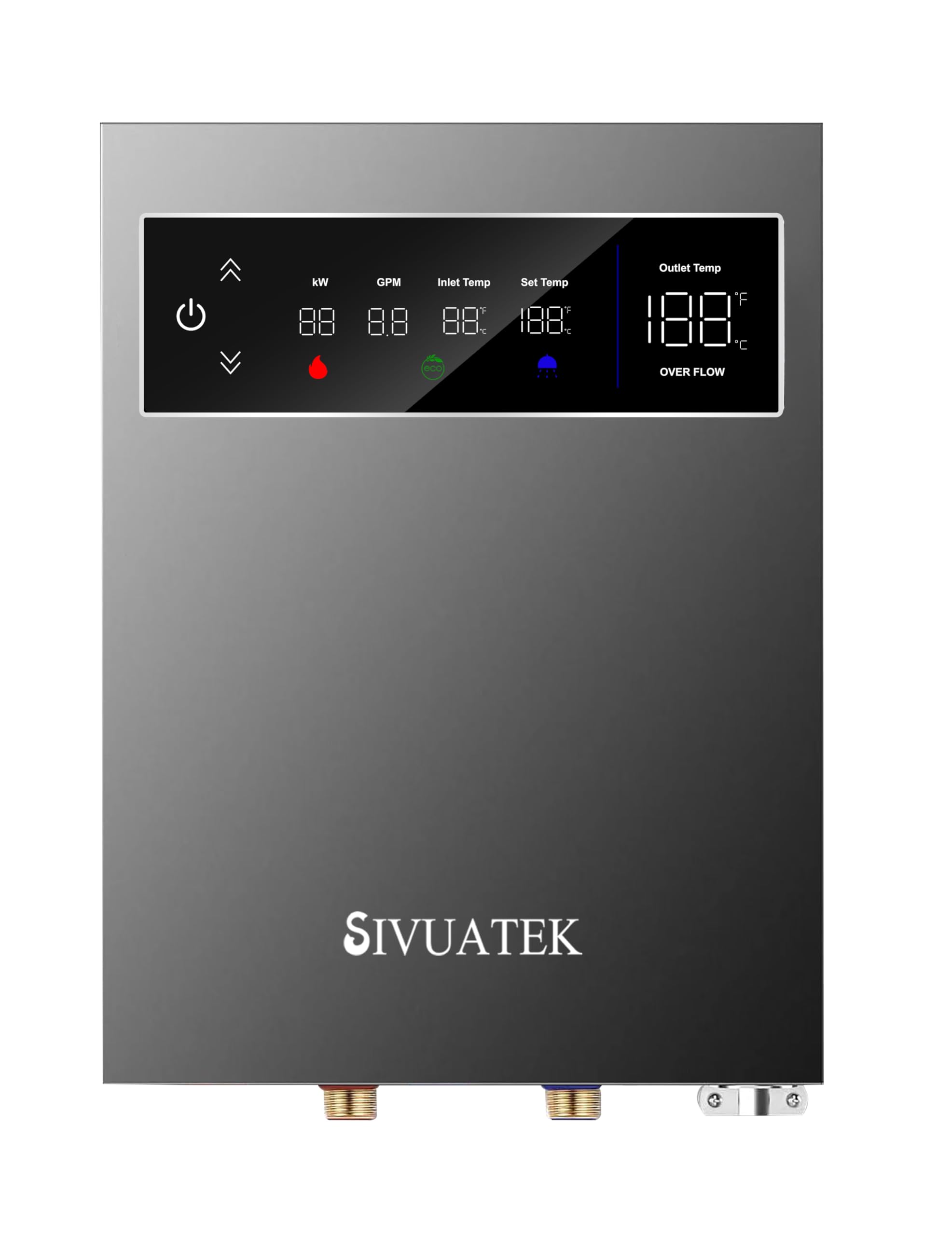
6. 14kW Tankless Water Heater
The one unit here powerful enough to feed a bathroom and a kitchen at once.
Most under-sink heaters are sink-only. This 14kW tankless is the exception — its 3.3 gpm flow rate lets it serve up to two simultaneous points, like a bathroom sink and a kitchen tap, without either running cold. That is a far bigger draw than the 1.07 gpm the CAMPLUX 6kW delivers, and it is the difference between one faucet and two.
The install is demanding, so plan for it. It needs 240V hardwiring through a single 60-amp circuit breaker, and the housing does not need disassembling for wiring, which speeds the job. The LED panel sets temperature from 86°F to 131°F in 1°F increments and holds it steady even when water pressure shifts. Safety covers leakage protection, overheating protection, and auto shut-off.
Temperature control is the one thing that splits reactions — most report steady output, some see fluctuation between cold and hot. That is typical of tankless units responding to flow changes, so pair it with a steady faucet and it behaves. Performance draws the bulk of the praise, and one owner notes it paid for itself in short order.
The upside
- 3.3 gpm can run two points at once — sink and shower or sink and kitchen.
- LED display with 1°F precision from 86°F to 131°F.
- Zero idle power use and no standby tank losses.
- Water-electricity separation slows scale buildup for a longer life.
The checks
- Needs 240V hardwiring on a 60-amp circuit — a serious electrical job.
- Some users see cold-to-hot fluctuation tied to flow changes.
- At 6.85 kg it is heavier to wall-mount than a small mini-tank.
Ideal for: a bathroom-plus-kitchen setup where two fixtures need hot water at the same time.
Hold off if: you cannot dedicate a 60-amp breaker to it — the smaller 6kW units fit a 30A panel.
7. Electrolux 8kW Tankless Water Heater
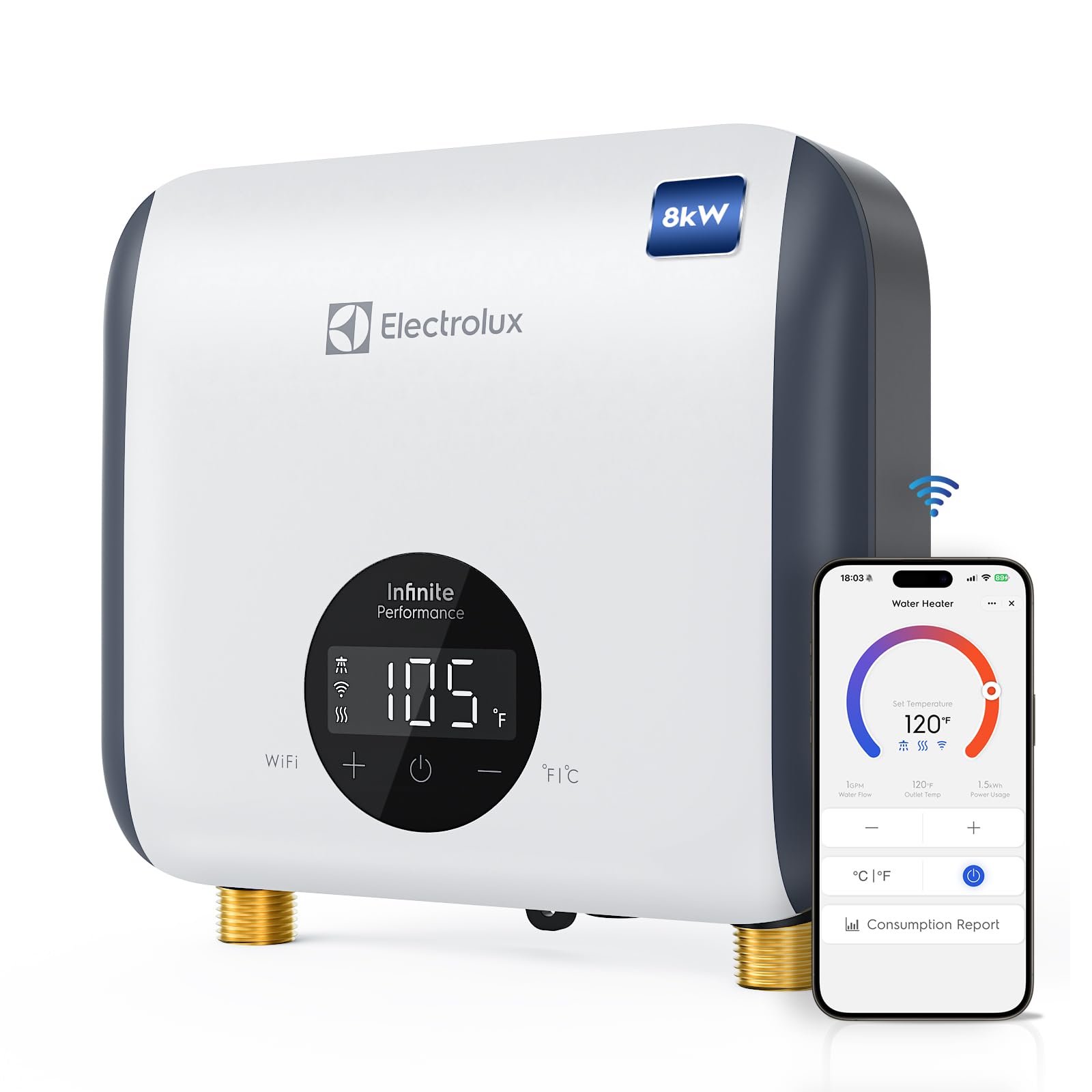
A 6.9″ x 8.1″ x 2.5″ box that heats a vanity faucet on just one breaker.
For a single bathroom vanity, this is the cleanest answer on the list. It delivers 1.97 gpm at a 77°F temperature rise from its 8kW element, which is enough for handwashing and dish rinsing without preheating a tank. The body is tiny — 6.9″ x 8.1″ x 2.5″ — and the company says it takes up 90% less space than a traditional water heater.
The wiring is deliberately modest for a tankless unit: one dedicated 40A circuit and 1/2″ NPT connections, which makes it friendlier than the 60-amp 14kW above. Six safety protections cover IPX4 water resistance, anti-scald tech, dry-fire prevention, a flame-retardant shell, low-flow protection, and voltage protection. An anti-scale design keeps mineral buildup and maintenance low.
Be clear on the limits before you buy. This model is not built for showers — it is tune for sinks and vanities, and its 130°F maximum temperature reflects that. If you want shower-capable output, the 14kW unit is the right tool. For a bathroom faucet, this compact panel gets the job done with minimal fuss.
Made for: a single vanity faucet where cabinet space is at a premium and a 40A breaker is available.
Not the pick if: you are trying to heat a shower — this model is specified for sinks and vanities only.
8. GE Appliances 2.5 Gallon Mini Tank Water Heater, GE02P08BAW

A brand-name tank that doubles as a booster for long pipe runs.
The neat trick here is flexibility. You can run it as a standalone under-sink heater, or put it inline with your main water heater to boost a slow-to-arrive fixture or a washing machine. That 2.5-gallon reserve at 140°F maximum temperature matches the VEVOR’s capacity but comes with the familiarity of a GE badge and a stainless steel element that resists rust.
Installation is where it earns its keep — it uses standard 1/2-in NPT connections and mounts on a wall or floor, so a swap takes minutes with existing plumbing. Functionality and installation each draw a handful of mentions and both read positive. The knob lets you set water temperature and power at a turn, which keeps operation simple for anyone who does not want a digital panel.
The fit question is the size. At 2.5 gallons it holds a usable reserve for a bathroom sink or a laundry hookup, but it is a booster, not a primary supply. If you need endless shower water, this is not the unit — it is the one that makes an existing heater feel faster at the far faucet.
The value angle: a well-known brand, a rust-resistant element, and dual-mount flexibility at a mid-range point. It is the sensible option when you want backup hot water without a full replumb.
Set expectations: 2.5 gallons is a reserve for one fixture, so treat it as a booster rather than a whole-bathroom source.
Works best for: boosting a far bathroom sink or laundry tap that waits too long for hot water.
Not for: replacing a full-size water heater — the 2.5 gallons is a supplement, not a main tank.
9. BOSCH Tronic 3000 T Water Heater

The mini-tank with the longest track record and the deepest owner base on this list.
When a single product racked up that many ratings, the patterns are clear. This Bosch holds 2.5 gallons in a glass-lined tank at 98% thermal efficiency, plugs into a 120V outlet on a 36-37″ cord, and can feed up to two sinks. It runs at 1440 watts and 12 amps, so it fits standard household wiring without a new circuit.
Quality and functionality are the two traits owners lean on hardest, and the design backs that up. The glass-lined tank resists corrosion, and the fast recovery rate cuts the wait between draws at the sink. It mounts on a shelf, wall, or floor with a bracket included, and the 13.75″ W x 13.75″ H x 10.75″ D body slots under a standard cabinet.
Two honest notes. Durability and value draw mixed reactions even on a model this well-known, and leakage appears among the complaints — so choose a mounting spot where a drip would be visible and keep an eye on the fittings. It is also the priciest pick here, a premium call for a proven name.
Why it stands out: 98% thermal efficiency plus a glass-lined tank make it the most efficient storage unit on the list, and the 6-year unit warranty reinforces the long-life promise.
An honest caveat: the track record is strong, but a small number of owners mention leaks — so install where you can inspect it.
Choose this if: you want a proven 2.5-gallon reserve for two sinks from a name you trust to last.
Think again if: budget drives the decision — the smaller plug-in tanks deliver sink hot water for far less.
Know the Specs
Capacity and Flow Rate
Capacity, in gallons, is how much hot water a tank stores; the Bosch ES2.5 keeps 2.5 gallons, while the Electrolux 8kW tankless stores none. Flow rate, in gallons per minute (gpm), is how much the unit delivers on demand — the 14kW model pushes 3.3 gpm while the CAMPLUX 6kW delivers 1.5 gpm. A sink needs only a trickle; two fixtures at once need far more.
Wattage and Circuit Requirements
Higher wattage heats water faster. The 1440W mini-tanks suit a 120V outlet, while the 6kW tankless units need 240V hardwiring on a 30A breaker. Match the unit’s wattage to the power you already have — a plug-in 120V model is a straightforward swap, but a 240V unit is a job for an electrician if the circuit is not already there.
Temperature Rise and Maximum
Temperature rise is how much the unit can warm the incoming water at a set flow. The Electrolux 8kW delivers 1.97 gpm at a 77°F rise, while the CAMPLUX 6kW manages 1.0 gpm at a 50°F rise. Maximum temperature caps the output — most sit near 131°F, and the VEVOR mini-tank reaches 145°F — so check the ceiling before you expect near-boiling tap water.
Recovery Time and Efficiency
Recovery is how long a tank takes to reheat after you drain it; the VEVOR lists 8 to 15 minutes. Efficiency tells you how much heat is retained — the Bosch reaches 98% thermal efficiency, and tankless units claim up to 99.8% because they never store water. Stored tanks stay warm through insulation; tankless models heat only when the tap opens.
Common Questions
Can I install a bathroom water heater under the sink myself?
Will a tankless unit work on a 120V wall outlet?
How many gallons do I need for a bathroom sink only?
Is a 6kW tankless unit enough for a shower?
What is the difference between a mini-tank and a tankless heater?
How long does a bathroom water heater take to heat up?
Can a mini-tank work as a booster for a larger heater?
Do these units prevent scale buildup from hard water?
Where can I mount a bathroom water heater?
The Bottom Line
For most bathrooms, the winner is the CAMPLUX 6kW Tankless Water Heater because it delivers hot water on demand in a compact 3.9-pound frame and never runs a tank dry — provided you have 240V hardwiring and a 30A breaker. If you want a stored reserve that feeds two sinks without a breaker job, the VEVOR 2.5 Gallon Mini-Tank holds 2.5 gallons at a 2.2 gpm flow. And for a no-fuss plug-in swap under a single vanity, the Electrolux 1.5 Gallon installs on a standard outlet and starts working in minutes. Whichever fits your wiring and your fixture count, pick the one that matches the job rather than the biggest spec sheet.
How we choose
We do not accept paid placement. Every pick is matched to a real buyer and a real use-case; we do not hands-on test units.
Sources
Specifications: manufacturer listings and product documentation. Review insights: verified customer reviews, as of November 2026. Pricing: not shown on this page (it changes often); check the current price via the retailer link.
As an Amazon Associate, Tactical Gear Guy earns from qualifying purchases. This does not affect which products we feature.