Specs are compiled from manufacturer listings and verified buyer reviews and can change over time — please confirm the key details on the product page before buying.
The hard part of testing hard water is not the chemistry, it is the reading. Most cheap strips ask you to match a beige patch against a tan chart under bathroom light, and then guess the number in between. This list fixes that problem. Below are seven testers that actually tell you what your water is doing, from a dip-and-read strip for quick checks to a drop-count kit that professionals trust.
This guide is built by comparing the manufacturers’ published specifications and the patterns across verified customer reviews, so you get each pick’s real strengths and trade-offs instead of marketing spin.
You will see how detection levels differ, why some kits use drops instead of paper, and which tester suits a pool versus a well. Every pick here translates a color or a drop count into a hardness number you can act on, which is the whole point of a water hardness tester in the first place.
Top Picks
How To Choose The Best Water Hardness Tester
Hard water is just water carrying dissolved calcium and magnesium. The tester’s only job is to tell you how much is in there. Almost every kit on this list does that, so the real question is how precisely you need to know, and whether the reading is easy to trust when you are standing over a sink at 7 a.m. Start with what you are testing, then move to how fine the readings need to be.
Match the kit to your water source first
A pool kit measures hardness in a different range than a drinking water strip, and some kits are explicitly pool-only. Check the recommended use on the label before you buy. A tester built for drinking water is the safer pick if you plan to check a faucet, a well, or a refrigerator dispenser. A pool-specific kit is fine if the pool is all you care about.
Decide between strips and drop-count kits
A test strip is a paper strip you dip and compare against a printed color chart. It is fast and needs no skill. A drop-count kit (also called titration) has you add drops of a solution until the water changes color, and you count the drops. Drop kits read finer, but they take a little more care. If you want a rough number in under a minute, strips win. If you are setting up a softener, drops win.
Look at the detection levels, not just the range
A wide range like 0–1000 ppm sounds impressive until you see that it only has eight fixed steps. Wide range with coarse steps means a reading that lands between two patches gets called either one. Narrow, even steps give you a better picture of where your water actually sits. Read the detection levels closely on any strip you are considering.
Side-by-Side Comparison
| Model | Best For | Test Method | Detection Range | Tests Included | Amazon |
|---|---|---|---|---|---|
| Industrial Test Systems WaterWorks 481108★ Best Overall | Fast everyday checks | Dip-and-read strip | 0, 40, 80, 120, 180, 250, 425, 1000 ppm | 50 strips | Amazon |
| Total Water Hardness Test Strips, 0-500 ppm, 100-PackBest Value | Softener setup checks | Dip-and-read strip | 0–500 ppm | 100 strips | Amazon |
| Pentair R151276 1200 | Pool owners | Drop-count kit | — | 1 kit | Amazon |
| 20-in-1 Drinking Water Test Kit with App | Whole-home water checks | Strip plus phone app | Hardness plus 19 other parameters | 10 strips | Amazon |
| AQUAX Total Water Hardness Test | Pools, spas, aquariums | Drop-and-see titration | German hardness units, convertible to GPG | 100 drops | Amazon |
| Culligan Essential Water Lab Test Kit | Family water screening | Strip plus digital TDS meter | Hardness plus 10+ contaminants | 1 kit | Amazon |
| Hach Total Hardness Test Kit, Model 5-EP | Precise, repeatable readings | Drop-count titration | Drop count per test | 1 kit with carry case | Amazon |
Detailed Reviews
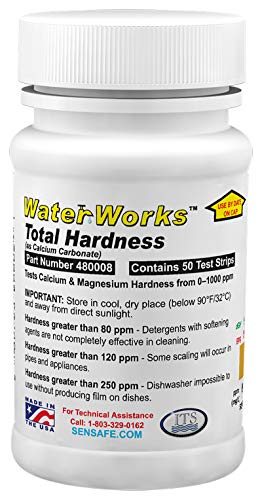
1. WaterWorks 481108 Total Hardness Test Strip
Our pick — 4.5+★ from 650+ verified ratings; the strongest balance of quality and price.
The strip that gives you a hardness number in the time it takes to rinse a glass.
Most people testing their water want a number fast and a reason to trust it. This kit delivers both. The dip-and-read procedure takes a three-second test, and the bottle carries a color chart printed right on the label. The detection levels run 0, 40, 80, 120, 180, 250, 425, and 1000 ppm, so you can tell soft water from moderately hard from someone who clearly needs a softener.
What wins people over is the build quality of the strips themselves. The maker batch-tests every strip against calibrated reference standards and rejects anything outside spec. In plain terms, that means the strip you pull out of the bottle behaves like the one before it. Owners consistently describe results landing in under two minutes, which is about the time it takes to fill a glass and check it.
The catch is the color reading, and it is worth naming honestly. Some owners find the patch color does not line up cleanly with the chart, especially in the middle of the range. If your water sits near 120 or 180 ppm, treat the reading as a bracket rather than a precise figure. Its 650+ ratings at 4.5+ stars make it the most-reviewed strip on this list. If you are commissioning a softener or chasing a warranty number, step up to a drop-count kit like the Hach below. For a fast read before and after a filter change, this is the one.
Where it earns its keep
- Three-second dip-and-read test, so you are done before the kettle boils
- Eight fixed detection levels from 0 to 1000 ppm give you a usable bracket
- Color chart printed on the bottle label — nothing to lose or misplace
- Batch-tested against calibrated reference standards for repeatable results
Where it holds you back
- Middle-range color matching is the most-discussed frustration
- Eight steps means a value between two patches gets rounded
- Only 50 tests per bottle, so heavy monitoring uses it up
Reach for this if: you want a quick hardness number for a faucet, a filter check, or a softener sanity test.
Step up instead if: you need a precise, defensible reading — a drop-count kit does that better.
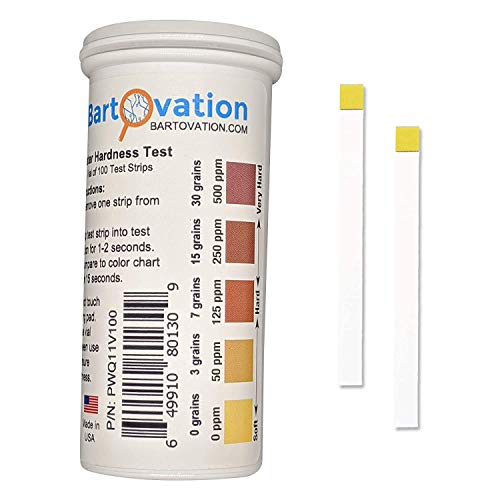
2. Total Water Hardness Test Strips, 0-500 ppm, 100-Pack
Two hundred tests’ worth of paperwork for the price of one softener service call.
The number that defines this pack is simple: 100 strips in the bottle. That is the widest count on the list — the Industrial Test Systems bottle above holds 50, so you get twice the testing runs here for less outlay. If you check hardness weekly to confirm a softener is still pulling its weight, this is the pack that will not have you reordering in a month. The 0–500 ppm range covers the hard-water band most homes actually fall into.
It is built for the softener crowd in particular. The listing is clear that the point is confirming your softener is working as efficiently as expected, or was set up correctly in the first place. The bottle uses a moisture-wicking material that pulls dampness away from the strips, which is the difference between a strip that reads true at the bottom of the bottle and one that has gone limp and unreliable. Standard American-made manufacturing is a small bonus on top.
Accuracy is the thing that earns this pack its keep, and it is what comes up most in owner feedback. The main gripe runs the same direction as the best overall: the color on the strip does not always line up neatly with the values printed on the bottle. Treat the reading as a band, not a decimal. Its 90+ ratings at 4.0+ stars are fewer than the top pick’s, but buyers report the same color-matching gripe. If you want the maximum number of tests from a single bottle and a strip that survives storage, this is the pack.
The count advantage: 100 strips against 50 in the top pick makes this the better stock-up for anyone checking water routinely rather than once.
The reading caveat: color matching is fuzzy, so read it in good light and use the chart on the bottle, not a screenshot.
The fit is clear: softener owners who test often and want a big bottle that lasts.
The trade-off: finer color matching than this is not available on a paper strip.
3. Pentair R151276 1200 Total Water Hardness Test Kit

A pool-hardness kit with one clear boundary: it is not built for your drinking glass.
Read the label first here. This kit is for swimming pool water and the maker states plainly that it is not for testing drinking water. If you are checking a faucet or a well, this is the wrong tool and you should look at the Droplytix or Culligan kits instead. If your concern is scale in the pool, calcium deposits on the tile, or whether the water chemistry is drifting, this is a kit built for exactly that.
You can slip this kit in a pocket and forget it is there. At 1.6 ounces it is the lightest item on this list by a wide margin — the AQUAX drop kit below weighs 5.3 ounces, so it is about 3.7 ounces lighter to carry to the pool deck. Owners consistently report it is easy to use and well built. It does one job without fuss.
Where this kit divides people is in how accurate it lands. A fair share of owner feedback says it works fine and reads accurately enough for normal pool care, while some find it short of precise. Two things follow from that. Know your pool’s target hardness before you test, so you have a benchmark to compare against. And if you want a second opinion on a borderline reading, a professional pool test at a shop is a reasonable cross-check. Its 150+ ratings at 4.0+ stars are the most middling score here, matching the split over its precision.
What it nails: a dedicated pool kit at 1.6 ounces that tells you whether your pool water is scale-prone.
What it rules out: drinking water testing — the maker excludes it, so do not use it on your tap.
The split: feedback on precision is genuinely mixed, so treat a borderline reading as a prompt to retest rather than a verdict.
Right for: pool owners who want a small, pool-only hardness kit they can toss in the equipment bag.
Wrong for: anyone who needs to also check tap or well water — get a drinking-water kit for that.
4. 20-in-1 Drinking Water Test Kit with App
Twenty water parameters on one strip, with your phone doing the color matching.
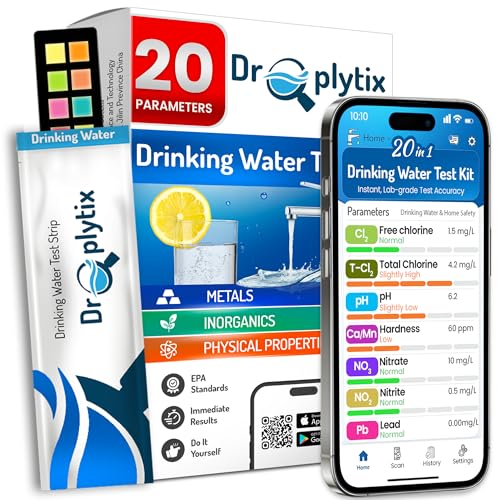
If you have ever squinted at a beige patch and tried to decide whether it is closer to the 120 or the 180 swatch, this kit is the answer. The DROPLYTIX app analyzes the test strip with your phone camera and hands back a numerical result instead of a guess. That removes the single biggest source of error in every other strip on this list. It also stores your past tests, so you can see whether hardness is drifting after a filter change or a plumbing job.
One box answers far more than a hardness question. This kit covers pH, hardness, chlorine, nitrate, nitrite, fluoride, iron, lead, heavy metals, alkalinity and more — 20 parameters in one box. You are not buying a hardness tester, you are buying a household water panel. The listing says it is designed for tap water, well water, filtered water and municipal water. It will tell you whether your reverse osmosis system, whole-house filter, or softener is actually doing its job.
Owner feedback centers on how easy the app is to use and how much ground the kit covers. The completeness is what people notice — one box instead of five single-parameter kits. The honest trade-off is the pricing tier: this is the mid-tier option, and you are paying for the app and the breadth rather than a pure hardness specialist. If your only question is hardness, a cheaper strip wins. If you are moving into a new home or need to know what is in your well, the 20-in-1 earns its place.
The case for the app
- Phone camera reads the strip, so no human color-matching guesswork
- Stores past results to spot trends after filter or softener changes
- Covers 20 parameters, including lead and heavy metals, in one kit
- Works for tap, well, filtered, and municipal water
What it costs you
- Pricier than a plain hardness strip if hardness is all you need
- Relies on the app, so a phone battery is part of the equation
- 10 strips per kit, so routine testing will use it up
The sharpest fit: new homeowners, well owners, and anyone who wants to know what is in their water, not just how hard it is.
A waste of money for: a single hardness reading on a kitchen faucet.
5. AQUAX Total Water Hardness Test

Drops instead of patches — the hardness reading you can actually see change.
Paper strips struggle here for one reason: you are judging a color, not watching it shift. AQUAX sidesteps that entirely with a drop-and-see method. It uses two components, a hardness indicator solution and a test container, and the color changes in a single drop. You get a result in a few seconds without matching a patch against a chart. For anyone who has fought with a strip that read somewhere between two unclear swatches, this is a genuine step up.
The kit runs on the titrimetric method, which is the same drop-count approach the Hach kit below uses. Each container holds 100 drops, which gives you a solid run of tests depending on how hard your water is — hard water eats drops faster. It also handles calcium bicarbonate calculation, and the box includes the conversion from German hardness to grains per gallon (1 dH equals 1,04 GPG) so you can translate the result into the unit your softener manual uses.
Two honest notes. First, the kit ships with no owner reviews, so you are buying on the spec sheet and the maker’s published method rather than a crowd of feedback. Second, it is a small kit — 5.3 ounces, which is light enough to stash in a pool caddy or a test bag. The trade-off is that you need to actually read the included instructions once; this is not a dip-and-forget product. Do that, and you get the most visual, tactile hardness test on this list.
Why the drops win: you watch the color change instead of guessing a patch, which cuts out the classic strip error.
The unit wrinkle: the kit reads in German hardness units and gives you the GPG conversion on the box — check your softener’s manual before you compare.
Pick it for: pools, spas, and aquariums where you want a visible, drop-by-drop reading.
Know going in: there is a short learning curve and an instruction read before your first test.
6. Culligan Essential Water Lab Test Kit

A household screening kit that pairs hardness strips with a handheld TDS meter.
The extra piece that separates this kit from a plain hardness strip is the digital TDS meter. TDS stands for Total Dissolved Solids — a broad measure of everything dissolved in your water, not just calcium and magnesium. It gives you an immediate number for overall water quality, while the strips handle the named parameters: lead, bacteria, nitrates, nitrites, chlorine, copper, iron, pH, and hardness. That is ten-plus contaminants out of one box.
This is built for homeowners and renters who want a first look at their water before deciding whether to call in a professional. It works with municipal water and private well water, which matters because well water can carry contaminants that tap water treatment strips out. The Culligan name comes with a long history in water treatment, and the kit is designed for at-home use without needing any lab work.
The trade-off here is balance. Its 150+ ratings at 4.0+ stars are the lowest on the list, consistent with a broad screen rather than a precision instrument. If your exact question is how many grains of hardness are in your water, a dedicated drop-count kit answers it more sharply. If your question is “is there anything in my water I should worry about,” the TDS meter plus the contaminant strips answer a wider question. Buy it for breadth, not for a decimal reading.
The wider question: lead, bacteria, nitrates, and a TDS reading alongside hardness make this the broadest screen on the list.
The honest limit: it screens; it does not specialize, so treat the hardness result as a starting point, not a final number.
Pick it when: you are moving into a new place or on a well and want a first-pass look at everything.
Skip it when: hardness precision is your only concern.
7. Hach Total Hardness Test Kit, Model 5-EP
The kit that turns a hardness reading into a number you can count on.
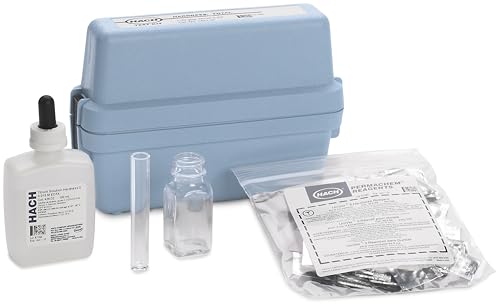
You get a finer reading because you count drops instead of matching color patches. You add drops until the water changes color, and you count the drops. That is drop-count titration (a lab method that counts drops to measure concentration), and it is the same science a water lab uses. Paper strips top out at a fixed set of patches, so this reads finer. The listing claims finer readings than test strips, which is the reason to pay for titration over a bottle of strips.
You get a full kit, not just reagents. The box holds the reagents, the measuring tools, and clear instructions, all organized in a sturdy carry case. At 1.1 pounds it is the heaviest item here — the AQUAX drop kit above weighs 5.3 ounces — but the case is exactly why, and it keeps the glass parts protected when you take the kit to a site. For a waterfront property owner or anyone checking well water on-site, that portability is a real feature.
Owner feedback on this kit is the most consistently positive on the list. Build quality and effectiveness are what get talked about, and the same notes keep repeating: it is simple to use, the storage box is a nice touch, and for softener owners it is close to essential. The value story that comes up is a softener user who wanted to verify the machine before spending on another one — this kit answered the question. Its 200+ ratings at 4.5+ stars match the best overall on score, and drop counting beats that strip on precision. For a kit you can re-verify a softener with year after year, this is the one.
What you get for the money
- Drop-count titration reads finer than any strip on this list
- Full kit with reagents, measuring tools, and instructions
- Sturdy carry case keeps the glass protected on-site
- Softener owners find it reliable enough to verify a machine before replacing it
Where it asks more
- Heaviest option here at 1.1 pounds, so it is a kit not a pocket tool
- Drop counting takes patience and a steady hand for repeatable results
The pick for you if: you want the most precise hardness number on this list and a kit that travels.
Look elsewhere if: you want a two-second reading — go with the top strip instead.
Know the Specs
Parts Per Million (ppm) vs Grains Per Gallon (GPG)
Both are ways of stating how much calcium and magnesium is in your water. PPM counts the mineral particles per million parts of water, and strips usually report in ppm. GPG counts grains per gallon, and softener manuals often use this unit. If a kit reports one and your appliance speaks the other, you need a conversion, and AQUAX builds the German-hardness-to-GPG formula right into the box.
Detection Levels (the steps a strip can hit)
A strip does not read a smooth number. It reads one of a fixed set of patches. The WaterWorks strip has eight levels: 0, 40, 80, 120, 180, 250, 425, and 1000 ppm. More, tighter levels mean a sharper bracket. A wide range with few levels is a rough answer, not a precise one. That is why drop-count kits exist for anyone who needs the finer number.
Titration (the drop-count method)
Titration is adding drops of a solution until the water changes color, and counting the drops. It reads finer than a patch because you are counting, not guessing. Both the AQUAX and Hach kits use it. The trade-off is time and care — it is a process, not a dip, and a steady hand helps.
TDS (Total Dissolved Solids)
TDS is everything dissolved in the water, calcium and magnesium included but not limited to them. A TDS meter gives you one broad number fast. It tells you something is in there, but not exactly which minerals. Use it as a quick screen, and drop count when you need the hardness figure specifically.
Common Questions
What is the difference between a test strip and a drop-count hardness kit?
Can I use a pool hardness kit to test my drinking water?
What does ppm mean on a hardness strip?
How often should I test my water hardness?
Is a TDS meter the same as a hardness tester?
Why does my strip color not match the chart?
What hardness level means my water is hard?
Can I test well water with these kits?
How do I convert German hardness to grains per gallon?
The Bottom Line
For most people sorting out a water hardness question, the water hardness tester that wins is the Industrial Test Systems WaterWorks 481108. It reads in three seconds, gives you eight detection levels from 0 to 1000 ppm (parts per million, the standard hardness unit), and lands on a number you can act on. If you plan to test often and want the most tests per bottle, the 100-pack strips are the stock-up choice. And if you want a number you can defend to a softener installer or a lab, the Hach 5-EP kit is the one to reach for.
How we choose
We do not accept paid placement. Every pick is matched to a real buyer and a real use-case; we do not hands-on test units.
Sources
Specifications: manufacturer listings and product documentation. Review insights: verified customer reviews, as of November 2026. Pricing: not shown on this page (it changes often); check the current price via the retailer link.
As an Amazon Associate, Tactical Gear Guy earns from qualifying purchases. This does not affect which products we feature.