Specs are compiled from manufacturer listings and verified buyer reviews and can change over time — please confirm the key details on the product page before buying.
If you are watering a garden, filling an RV tank, or metering a line in a home rig, the question you actually want answered is simple: is the water going where I think it is, and how much did I just use? A flow meter answers that in gallons or liters on a small screen, so you stop guessing. The picks below are sorted by how reliably they do that job outdoors, indoors, and around water you plan to drink.
This guide is built by comparing the manufacturers’ published specifications and the patterns across verified customer reviews, so you get each pick’s real strengths and trade-offs instead of marketing spin.
The Restmo brass-inlet meter is the safest all-round buy for most outdoor hose and RV setups, and it holds 4.5+ stars across 4,000+ ratings. Below you’ll find how each meter measures, where it installs, and which one suits your line, all inside this breakdown of the best water flow sensor.
Top Picks

How To Choose The Best Water Flow Sensor
The first split in this category is not brand — it is what you are attaching the meter to. A hose-thread meter screws onto a 3/4 inch faucet or garden hose and shows you a number on its own screen. An inline sensor is a bare plastic or metal body with a cable, and it needs a controller to make sense of its pulses. Buying the wrong one of those two is the mistake almost every first-time buyer makes.
Match the thread before anything else
Hose meters use a standard garden thread, so they twist straight onto a spigot, a sprinkler, or an RV fill line. The inline sensor here uses a G3/4 inch male thread, which is a machine thread — it does not mate with a garden hose without adapters. Check your fitting first, because a perfect meter with the wrong thread will not seat.
Read the flow range, not just the max
Every meter has a window of flow it can read. The Restmo model covers 0.3 to 12 GPM, the MOES covers 1 to 45.0 L/Min, the GREDIA sensor covers 1-60L/min, and the GRYVOZE turbine covers 2.6-26 GPM. If your trickle sits below the bottom of that window, the meter may not register it at all.
Decide whether it touches drinking water
Water you plan to drink, brew with, or run through a purifier needs a body rated for it. The GREDIA sensor states food grade plastic and ROHS compliance. The GRYVOZE unit is built around fuels and warns to keep it dry. Those are two different jobs, and crossing them is not worth the risk.
Side-by-Side Comparison
| Model | Best For | Flow Range | Waterproof Rating | Body Material | Amazon |
|---|---|---|---|---|---|
| Restmo Water Flow Meter★ Best Overall | Outdoor hose and RV fill | 0.3 to 12 GPM | IPX6 | Brass inlet, ABS body | Amazon |
| MOES Water Flow Meter | Measuring tolerance on a budget | 1 to 45.0 L/Min | IPX6 | Brass | Amazon |
| GREDIA 3/4″ Flow Sensor (2-Pack) | Inline builds and drinking-water lines | 1-60L/min | — | Food grade plastic | Amazon |
| GRYVOZE 1″ Fuel Flow Meter | Fuel and solvent metering indoors | 2.6-26 GPM | Not waterproof | Aluminum alloy, stainless steel turbine | Amazon |
Detailed Reviews
1. RESTMO Water Flow Meter with Brass Inlet Metal Thread
Our pick — 4.5+★ from 4,000+ verified ratings; the strongest balance of quality and price.
The hose meter that survives weather, threads on brass, and keeps a weekly average.
For a garden spigot or an RV fill line, this is the one to buy. The inlet is solid brass with a metal thread, so it takes the on-and-off cycle of a hose season without the plastic threads stripping out. It is weatherproof to IPX6, which is the grade that means it shrugs off rain and hose spray rather than needing to be tucked away between uses.
Four modes do real work. Flow mode shows your live rate, Consumption mode shows the last draw, Average mode gives you the daily average of a week counted from the next day, and Total mode tracks everything. Long-press at flow mode to flip between US gallons and liters. The screen sleeps on its own after 1 minute of no operation, so it is not draining its CR2032 battery on your shelf. The measurable range runs 0.3 to 12 GPM (1 to 45.5 LPM), and Restmo’s own advice is to run the faucet at a moderate setting rather than wide open.
The catch is the display over the long haul. Readability is a mixed point and durability comes up as the roughest aspect, with the screen turning hard to read for some owners over time. Treat it as an outdoor tool, not a piece of lab gear. What wins people over, meanwhile, is plain functionality — it counts gallons reliably, and RV owners filling fresh tanks get the number they came for.
What earns its keep
- Brass inlet and metal thread hold up to repeated hose swaps
- IPX6 rating means rain and spray are not a problem
- Four modes including a seven-day average of daily use
- Auto-sleep after 1 minute protects the CR2032 battery
Where it asks for care
- Screen readability can fade over a long season
- Best readings come at moderate flow, not full blast
Buy this one if: you water a garden or fill an RV tank from a standard hose thread and want the gallon count without fuss.
Look elsewhere if: you need a bare inline sensor wired into a controller — this is a hose-end meter, not a pulse output.
2. MOES Water Flow Meter with Brass Inlet & Outlet
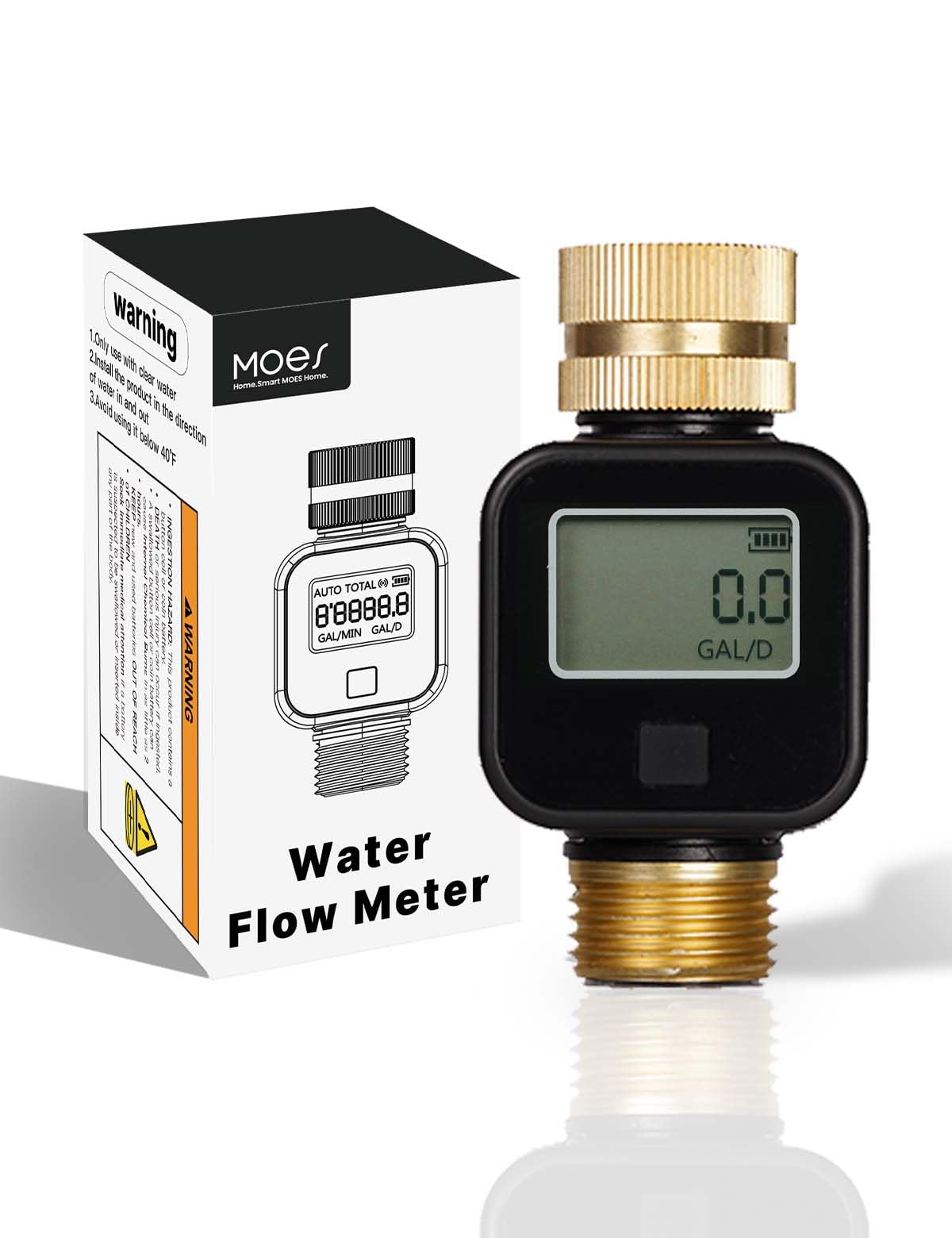
Brass on both ends, a stated tolerance figure, and a screen that flips for upside-down installs.
Where the Restmo gives you one brass end, this MOES unit makes both the inlet and the outlet brass with a metal thread. That matters if you leave the meter in place and swap hoses on the far side, because the outlet takes the same wear. The stated measurement tolerance is ±5%, which is the number to know if you are counting gallons for a tank fill and want to understand how close the reading really sits.
The spec sheet is complete in a way budget meters often are not. Flow rate runs 1 to 45.0 L/Min, working pressure is 0.5 to 10.0 Bar, and the water temperature window is 3℃ to 65℃. It is IPX6 rated and made for a 3/4 inch standard faucet hose, so sprinklers and nozzles fit without hunting for adapters. Four measurement modes track flow and consumption, and holding the button flips units.
That upside-down screen is not a defect. MOES built it so you can mount the meter in either orientation, and you reverse the digits by switching to auto mode and long-pressing. What owners praise most is straightforward function, with accuracy right behind it, and RV tank filling is a common use. The honest gripe is battery life — opinions split on how long the cell lasts, so keep a spare on hand if the meter lives outside.
Why it reads clean: a ±5% tolerance is stated outright, the pressure and temperature windows are published, and brass covers both threads so the whole fitting resists stripping.
The one to plan for: battery life is the mixed note in this meter’s feedback, so treat the cell as routine upkeep rather than a set-and-forget part.
The short version: a brass-bodied hose meter that publishes its accuracy figure and mounts either way up.
Not the pick for: anyone expecting the battery to last indefinitely in year-round outdoor service.
3. GREDIA 3/4″ Water Flow Sensor Hall Effect Flowmeter (2-Pack)

Two bare sensors with a pulse output, sized for a controller rather than a screen.
This is the pick for a builder, not a gardener. There is no LCD here — just a G3/4 inch male thread body with a hall effect output that reports flow as a pulse signal. You power it with DC 5-24 V and read the frequency, where the published formula is F=(5.5*Q)±2% with Q in L/Min. Flow range is 1-60L/min and max water pressure is 1.2Mpa.
Two things make it stand out in this group. The body is food grade plastic with all raw materials stated to meet the ROHS standard, which is what puts it in drinking-water, purifier, and beverage-machine territory rather than hose duty. And it arrives as a pack of two, so a project with a supply and return line is covered in one order. It weighs 7.7 ounces, against 15.8 ounces for the GRYVOZE fuel meter below — the GREDIA is the lighter body of the two by that margin. Its footprint of 6.3 x 4.72 x 1.5 inches is larger than the GRYVOZE’s 4.65 x 2.17 x 2.44 inches, though most of that is packaging for the pair.
Be realistic about the accuracy claim. The ±2% figure is what the listing states, and feedback on precision is genuinely split — plenty of builds run well, but not every unit lands on that number. The recurring complaint lands on the thread quality and on long-term durability, so treat the fitting gently when you torque it in. If you are simulating flow with small pumps and valves, reliable pulse output is where this sensor earns its praise.
Reasons builders reach for it
- Food grade plastic rated to the ROHS standard for potable lines
- Wide 1-60L/min range suits purifiers, coffee machines, and beverage gear
- Two sensors in the box for multi-line projects
- Works across DC 5-24 V supplies
What to weigh first
- Accuracy does not reliably hit the stated ±2% on every unit
- G3/4 inch machine thread needs adapters for a garden hose
- No screen — it needs a controller to show you anything
Reach for this if: you are wiring a sensor into a purifier, heater, or beverage machine and can handle a G3/4 inch thread.
Pass if: you want a screw-on meter with a readout — this one expects a controller behind it.
4. GRYVOZE 1″ Fuel Flow Meter with 3/4″ Adapters

A turbine meter for fuel and solvents that states the tightest accuracy figure here.
If your line carries diesel, gasoline, kerosene, methanol, or E15 rather than drinking water, this is the meter in this group built for it. It states ±1% accuracy, the tightest figure on this whole list, and it handles water too. The casing is aluminum alloy with a stainless steel turbine inside, rated for working temperatures of -10°C to 80°C. Flow range is 2.6-26 GPM at 87 psi working pressure.
Unit flexibility is where it leads the group. The LCD shows real-time rate, instantaneous flow, and accumulated totals on separate counters. Its display shuts off after 10 minutes idle, wakes automatically when liquid moves, and can be roused with any key. Standby is stated as over 1 year, so storage is not a worry.
Here is the trade-off, and it is a real one. This meter is not waterproof — the maker says dry environment only, away from rain, humidity, and condensation, and never immersed. Feedback on water resistance is poor, with housings reported filling with water, and durability is the weakest point, with units failing inside a few months. Installation is easy, but it is a heavier body at 15.8 ounces versus the GREDIA’s 7.7 ounces, so mount it where it will stay dry and supported.
The standout spec: ±1% accuracy and five switchable units on an aluminum alloy body make it the most precise meter here on paper.
The honest caveat: keep it dry — this is a sheltered-bench meter, not an outdoor one, and the housing does not tolerate moisture.
The verdict: the right meter for a fuel or solvent line where you need unit flexibility and a tight accuracy spec, indoors.
Wrong tool for: garden hoses, rain exposure, or any spot where the body will get wet.
Know the Specs
GPM and LPM: what the meter is actually counting
GPM means gallons per minute and LPM means liters per minute — both are how fast water moves through the meter right now. Most hose meters let you flip between US gallons and liters with a button hold. The window matters more than the top number. A trickle below the meter’s minimum may not register a pulse, so check the low end first if you water gently.
Hall effect sensor: the chip behind the count
A hall effect sensor is a small chip that detects a magnet passing it. Inside a flow meter, water spins a tiny rotor with a magnet, and the chip counts each pass to work out flow. That is why accuracy figures like ±1%, ±2%, and ±5% appear in the specs — they describe how close that count lands to reality.
IPX6 and “not waterproof”: read the grade
IPX6 is a water-jet rating, meaning the housing shrugs off spray and rain from a hose. A meter labeled not waterproof is the opposite — dry shelter only, away from humidity and condensation, never immersed. That single line decides whether a meter lives outdoors or on a bench.
Thread size and adapters: the fit question
A standard garden hose thread twists straight onto a spigot or RV fill line. A G3/4 inch male thread is a machine thread and needs adapters for a hose hookup. Some meters ship with 3/4 inch adapters to bridge the two. Get this wrong and the meter will not seat, no matter how good its accuracy is.
Common Questions
Will a hose flow meter fit my RV fresh water fill port?
Can I use the GREDIA sensor with drinking water?
Is the GRYVOZE fuel meter safe for gasoline and diesel?
Why does my MOES meter display upside down?
What flow range do I need for a slow garden trickle?
Does the inline sensor need a separate power supply?
Is a ±1% meter noticeably more accurate than a ±5% one?
Can I leave a brass flow meter outdoors all season?
How long does the battery last on a hose flow meter?
Can I use these meters on hot water lines?
The Bottom Line
For most people with a garden hose or an RV fill line, the Restmo brass-inlet meter is the one to grab — it threads on brass, shrugs off rain at IPX6, and tracks a weekly average that actually tells you something. If you want both threads in brass and a published tolerance figure, the MOES meter is the smarter mid-range call. For a drinking-water or purifier build, the GREDIA sensor pair is the inline pick. And if your line carries fuel or solvent, the GRYVOZE turbine meter gives you ±1% and five units — just keep it dry. Start with the hose meter that matches your thread, and you will know your gallon count from the first fill.
How we choose
We do not accept paid placement. Every pick is matched to a real buyer and a real use-case; we do not hands-on test units.
Sources
Specifications: manufacturer listings and product documentation. Review insights: verified customer reviews, as of November 2026. Pricing: not shown on this page (it changes often); check the current price via the retailer link.
As an Amazon Associate, Tactical Gear Guy earns from qualifying purchases. This does not affect which products we feature.