Specs are compiled from manufacturer listings and verified buyer reviews and can change over time — please confirm the key details on the product page before buying.
Here is the short answer: if you want genuinely clean water straight from your kitchen tap, an under-sink system beats a pitcher every time, and the iSpring RCC7AK is the one to beat for most households. It carries NSF/ANSI 58 certification for the whole system — the full-unit reverse osmosis standard, not a single-filter claim — and reduces lead, fluoride and more. Everything below sorts nine real options by where they belong in your kitchen and your routine, so you can pick the right one in one read.
This guide is built by comparing the manufacturers’ published specifications and the patterns across verified customer reviews, so you get each pick’s real strengths and trade-offs instead of marketing spin.
The plumbing underneath your kitchen sink is the real battleground here, and the right pick depends on whether you have space, a spare outlet, or nothing but a tap. Below you will find the honest lineup for the best water filtration for tap so you can buy once.
Top Picks

How To Choose The Best Water Filtration for Tap
Two things decide your pick before anything else: how much room you have under the sink, and what is actually in your water. A municipal supply and a private well need different tools, and a tiny cabinet rules out some of the biggest systems here.
Start With Your Water Source
If your water comes from the city, a carbon or ultrafiltration system in the mid tier handles chlorine taste and odor well. If you draw from a well, you need reverse osmosis or a dedicated pre-filtration stage, because several under-sink carbon systems here are built for municipal water only and will clog on untreated well water.
Match the System to Your Cabinet
A reverse osmosis unit needs its own storage tank and more vertical clearance. A tankless RO design frees up that footprint, while a compact three-stage filter fits into tighter spaces. Measure before you buy, because a full RO system and a small faucet-mounted unit are not in the same size class.
Know the Certifications You Need
NSF/ANSI 42 covers taste, odor and chlorine. NSF/ANSI 53 covers health-related contaminants like lead. NSF/ANSI 58 is the whole-system standard for reverse osmosis. NSF/ANSI 372 confirms low lead in the materials themselves. The best under-sink picks carry at least two of these.
Side-by-Side Comparison
| Model | Best For | Filtration Type | Capacity | Filter Life | Amazon |
|---|---|---|---|---|---|
| iSpring RCC7AK-BN★ Best Overall | Whole-home lead and PFAS removal | 6-Stage Reverse Osmosis | 75 GPD | 6 months | Amazon |
| Amazon Basics Under SinkBudget Champion | Budget municipal water upgrade | Activated Carbon Block | 11,000 gallons | 12 months | Amazon |
| Brita Faucet MountEasiest Install | Renters and no-tool installs | Carbon Block Faucet Mount | 100 gallons | 4 months | Amazon |
| Filtrete 3US-AS01 | Fridge and icemaker hookups | Carbon Under-Sink | — | 6 months | Amazon |
| Waterdrop TSB-UF | Fluoride and heavy metals on a budget | 9-Stage Ultrafiltration | 8,000 gallons | 18 months | Amazon |
| Aquasana AQ-6300M-BN | Fast flow without a tank | 3-Stage Claryum | 800 gallons | 6 months | Amazon |
| Brondell Coral UC300 | Annual filter changes | 3-Stage Carbon | 600 gallons | 12 months | Amazon |
| Waterdrop G5P500A | Tankless RO with minerals | 8-Stage RO + Alkaline | 500 GPD | — | Amazon |
| AquaTru Glass Carafe | No plumbing, no drilling | 4-Stage Reverse Osmosis | 4 pounds / 0.5 gpm | 6 months | Amazon |
Detailed Reviews
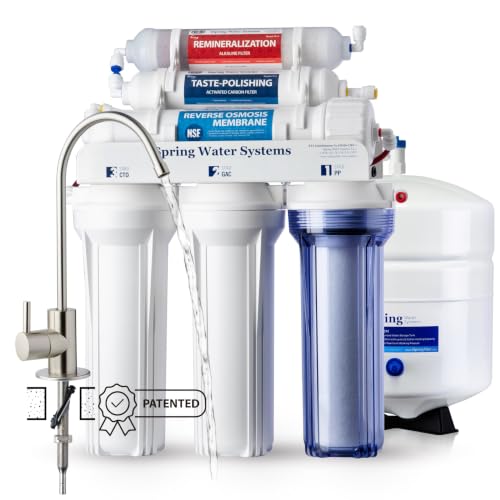
1. iSpring RCC7AK-BN Reverse Osmosis System
Our pick — 4.5+★ from 21,500+ verified ratings; the strongest balance of quality and price.
Six stages, a mineral stage, and a certification most rivals cannot print on the box.
The headline here is a full-system certification to NSF/ANSI 58 — the whole-unit reverse osmosis standard, not just a single filter element. Plenty of RO systems on shelves carry no certification at all, so this is the number that earns the top spot. It pairs that with a 75 GPD rating (gallons per day, meaning roughly enough drinking water for a busy family) and a 6-month filter life cycle.
Then comes the part that changes how the water actually tastes. The patent-pending natural mineral AK stage adds back minerals and balances pH, so the output tastes like clean spring water rather than flat, stripped water. That matters because reverse osmosis alone removes minerals along with the bad stuff. Across 21,000+ owners the crowd verdict is strong: it holds 4.5+ stars, and the reviews keep returning to how the finished water compares to bottled.
Buyers praise water quality above all, and their TDS readings back it up: well water drops from 698ppm to 70ppm, and municipal water from over 300 to 41. Installation is the second big theme, helped by the patented top-mounted fastener that lets you tighten everything from above the counter instead of crouching under the sink. The catch is honest and worth planning for: this is a large unit at 15.5″L x 16″W x 18″H and 12.5 kg, so measure your cabinet first. Also, RO (reverse osmosis) systems drain some water during filtration — a trade-off that comes with the technology, not this brand.
What holds up in daily use
- Full NSF/ANSI 58 system certification covers the whole unit, not one cartridge.
- The mineral AK stage restores pH and taste that plain RO strips away.
- A clear first-stage housing lets you watch sediment build up and time the change.
- Top-mounted fastener means countertop-only tightening — a genuine install shortcut.
What to plan around
- Big footprint and 12.5 kg of heft demand a roomy cabinet.
- RO filtration drains a share of feed water, and the faucet finish is the weak link.
- Six-month filter intervals mean a replacement routine you have to keep.
Reach for this if: you want certified whole-system lead and PFAS removal with mineral-balanced taste and have the cabinet space to host it.
Look elsewhere if: your under-sink area is cramped or you want zero water waste — a tankless or carbon block unit fits better.
2. Amazon Basics Under Sink Water Filter System, 11,000 Gallons
Eleven thousand gallons of cleaner tap water for the price of a couple of pitcher refills.
The capacity number reframes the budget tier: 11,000 gallons per cartridge against the iSpring RO system’s 75-gallon-per-day rating — a 146.7x gap on paper, though the two measure different things. What it really means is up to a full year of household drinking water from one cartridge on municipal supply. That service life is a 12-month ceiling, and the twist-and-lock housing with push-to-connect fittings is built for a genuinely short install.
Installation is the clear winning theme with this one — by far the most-praised aspect of the system, which tells you the design delivers on its promise. Buyers report the water going from chemical to clean and losing that faint sink smell within a day of hooking it up. The IAPMO certification against NSF/ANSI 42 covers chlorine, taste and odor, and NSF/ANSI 372 covers low-lead materials.
The honest trade-off is water flow. A fair number of buyers notice a slight dip in pressure at the tap, and that is the nature of a carbon block — it slows the stream to do its job. It is a small step down, not a trickle, and most people stop noticing within a week. If you want the fastest possible fill for big pots, look at the higher-flow picks instead.
The value math: a year of filtered water on one cartridge, backed by two NSF certifications, makes this the smartest entry point for renters and first-timers who just want the chlorine gone.
The honest ceiling: it filters chlorine and sediment, not lead or PFAS, and it expects a cold municipal feed — well water needs a pre-filter ahead of it.
Best for: city-water households wanting clean-tasting tap water on a small budget with a fast install.
Not the pick for: anyone chasing lead or PFAS removal — step up to a certified RO unit for that.
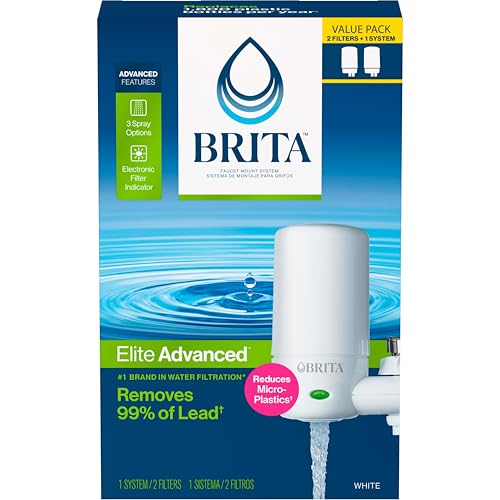
3. Brita Faucet Mount Water Filter System with 2 Filters
Clips onto the tap in minutes and gives you filtered water with zero cabinet space.
For renters and anyone who cannot drill or plumb, this is the simplest path to filtered tap water. It screws onto a standard faucet with no tools, and its carbon block is certified to cut chlorine taste and odor plus 60+ contaminants, including 99% of lead. Three spray options and a filter indicator handle the day-to-day, and the unit is made without BPA.
On size, the Brita is 6″L x 2.37″W x 9.84″H — small enough to sit on the counter without crowding the sink, and in a completely different class from the iSpring’s 15.5″ x 16″ x 18″ cabinet footprint. Filter life is 4 months, shorter than the iSpring’s 6-month cycle, so you will swap cartridges more often. A single 100-gallon capacity rating per filter keeps expectations realistic for a two-person kitchen.
What buyers praise most is the taste, and it is easy to see why — the water reads clean and the first filter often stretches well past the calendar estimate. Installation is close behind, since even a self-described non-plumber can have it running in one sitting. The catch is durability: this is a plastic faucet mount, and leaks around the housing are the recurring complaint, especially after a few months of use. Treat the collar gently when you twist it on and off, and expect to replace the unit eventually rather than repair it.
Where it shines: no drilling, no plumbing, no cabinet cleared — just screw it on and drink, with a lead reduction claim most faucet mounts skip.
Where it asks patience: four-month filters and plastic fittings that can seep over time; check compatibility with your faucet before buying.
Pick it when: you rent, you cannot drill a counter, or you want lead reduction from a tap that already exists.
skip it if: you want a permanent fixture or have a pull-out or spray-style faucet, which this will not fit.
4. Filtrete 3US-AS01 Water Filtration System

The under-sink filter that quietly feeds your fridge and icemaker too.
Quality is the aspect owners praise most here, and it is backed by a design that does more than serve one tap. This system is a genuine plumbing component — you can tee it off to feed a refrigerator’s icemaker and water dispenser as well as the sink, which is why it keeps showing up in kitchens with older fridges. It reduces sediment, chlorine taste and odor, and swaps its cartridge with a quick-change design that takes seconds.
Installation is the close second in owner praise, and it earns that with a kit that includes everything needed — head, bracket, cartridge and manual. Filter changes run on a 6-month cycle, which lines up neatly with a twice-a-year habit. The materials are polypropylene, and it carries ANSI external testing, so the build quality matches the modest footprint.
Pressure and leakage are the honest notes. Some buyers see a slight drop at the tap, and a smaller group has dealt with seeping connections — both are the trade-offs of any carbon under-sink filter, and both are fixable with a careful install and fresh Teflon tape. For a simple, low-cost way to clean up a kitchen tap and a fridge line at once, it is a sound choice.
Why it earns a spot
- Feeds both the sink and a fridge icemaker from one cartridge.
- Quick-change cartridge takes the fuss out of twice-a-year swaps.
- Complete kit ships with head, bracket, cartridge and manual.
- Slim enough to fit tighter cabinets than a full RO system.
Where it asks care
- Some users notice a modest pressure drop at the tap.
- Connection leaks turn up for a few buyers — tape and torque matter.
- Carbon filtration only; no lead or PFAS claim.
Good fit for: kitchens that want one filter feeding both the sink and the fridge, with easy cartridge swaps.
Think twice if: you need certified lead removal — this one is about taste, odor and sediment.
5. Waterdrop TSB-UF 9-Stage Ultrafiltration Under Sink System
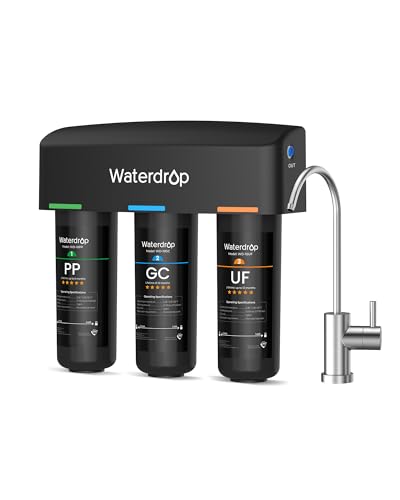
Nine stages of ultrafiltration and a dedicated faucet, without the RO tank or waste water.
The spec that earns its place is the 0.01μm (micrometer) ultrafiltration membrane — a pore size small enough to catch particles, rust and sediment far finer than a standard carbon filter, backed by KDF (a copper-zinc filter media) and ion-exchange resin layers that target fluoride and heavy metals. It also keeps your minerals, because this is not a reverse osmosis system and does not reduce TDS (total dissolved solids). For buyers worried that RO strips the good stuff out, that is the point.
You get two faucets out of one install: the main tap handles washing, while a lead-free brushed stainless-steel drinking faucet serves coffee, tea and pet bowls. Output is brisk at 11.5oz in 5 seconds, and the filter life is genuinely long — up to 6 months on the PP (polypropylene) pre-filter and up to 12 months on the carbon and UF (ultrafiltration) membranes, with the whole system rated at an 8,000-gallon capacity and an 18-month life cycle line.
What owners praise most is effectiveness, and the install is right behind it — a 3-minute setup and 3-second cartridge swaps make it approachable for a first-timer. Two honest limits: it is built for municipal water only, so a well supply needs a pre-filter, and a handful of buyers have seen cloudy water or white particles in the first flush. Run the tap for a minute after any filter change and that settles out.
Best of both worlds: ultrafiltration depth for particles and metals, plus a separate drinking faucet, all in a compact 6.9-pound body with no tank and no waste water.
Know going in: municipal water only, cold feed only, and the first pour after a swap may look cloudy — that is normal, not a defect.
Reach for this if: you want fluoride and heavy-metal reduction plus a dedicated drinking tap without the bulk or water waste of reverse osmosis.
Look elsewhere if: your water comes from a private well or you specifically need TDS reduction.
6. Aquasana Claryum 3-Stage Max Flow AQ-6300M-BN
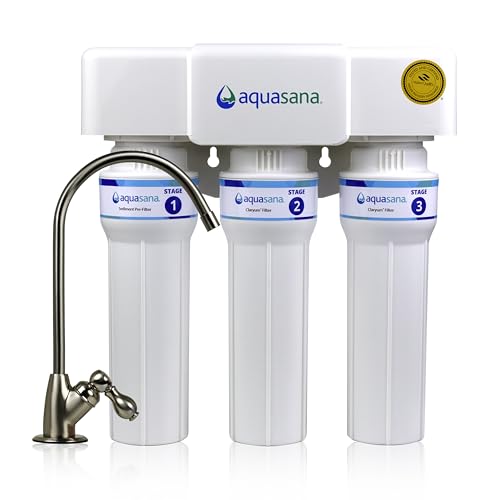
A three-stage filter that pours fast enough to fill a stockpot without a wait.
Flow is where this one wins — 0.72 gallons per minute out of a carbon block is quick, and it is what makes cooking and bottle-filling feel normal instead of a chore. That number, and the certification stack, is why it lands in the mid-range as a serious contender. It is WQA certified to NSF 42, 53 and 401, which covers taste, health contaminants and emerging compounds including pharmaceuticals and microplastics, and it reduces up to 99.99% of 78 contaminants while leaving the minerals in. Unlike the iSpring and Waterdrop RO pick, it does not lower TDS — the water keeps its mineral profile.
The filter lasts up to 6 months or 800 gallons, and the twist-off housing makes the swap a no-tool job. Installation needs about 15.85″ of under-sink clearance, which is tighter than the RO units here but still worth measuring. A one-year limited warranty covers the kit.
The honest trade-off sits in the fittings. Quality and water taste get the most praise, and flow is a recurring bright spot, but a fair few buyers feel the included install components are less sturdy than they would like. If you are handy with basic plumbing, add a better shut-off valve to the kit and you sidestep the concern entirely. The faucet finish is also modest, so treat it as a working part rather than a showpiece.
The draw: 78 contaminants handled under three NSF certifications, with fast 0.72 gpm output and no RO tank or waste water.
The catch: budget a little extra for sturdier fittings and a better faucet if your sink gets heavy daily use.
Built for: cooks and bottle-fillers who want certified filtration at a fast pour without giving up minerals.
Skip if: you need TDS reduction or have a cramped cabinet under 15.85 inches of clearance.
7. Brondell Coral UC300 Under Sink Water Filtration System
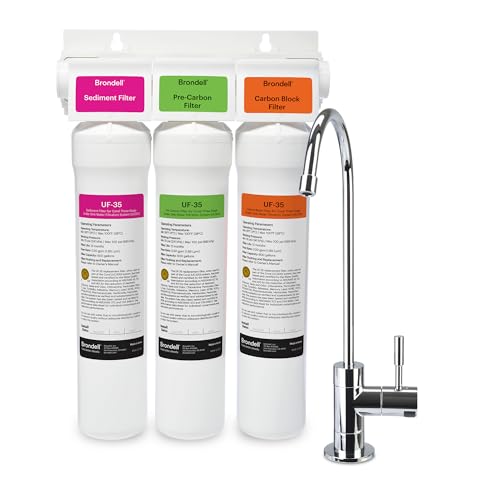
One cartridge a year, three filtration stages, and a chrome faucet that looks the part.
A 12-month filter life is the number that decides this one for a lot of buyers — replace the cartridge once a year and forget it. The three-stage set pairs a sediment filter, a pre-carbon filter and a carbon block, all with a double O-ring seal to keep leaks at bay, and the whole thing carries WQA Gold Seal certification plus NSF/ANSI 42, 53 and 372 and CSA B483.1 for lead. Capacity is 600 gallons, so the annual cadence holds up for a normal household.
Quality is what owners praise most, and taste and installation run close behind. The water reads as good as or better than bottled, and the designer chrome faucet gets its own share of compliments for appearance. It reduces PFAS, lead and chlorine while leaving beneficial minerals in place — unlike the mineral-stripping RO systems here.
Two honest issues to know. The body is mostly plastic, so the build feels lighter-duty than the price might suggest, and leaks after the first filter change have come up for a few buyers. Sourcing replacement cartridges can also take some searching in some regions. Press the housing firmly into place on each change and buy your replacement filter set at the same time you buy the unit.
Why it appeals: annual cartridge swaps, WQA Gold Seal backing, and a chrome faucet that suits a finished kitchen.
What to watch: plastic construction and occasional leak reports after a filter change — just seat the housing firmly.
Made for: owners who want once-a-year maintenance and PFAS plus lead reduction with a faucet worth looking at.
Not ideal if: you want a metal-bodied unit or need easy replacement filters available everywhere.
8. Waterdrop G5P500A 8-Stage Reverse Osmosis System
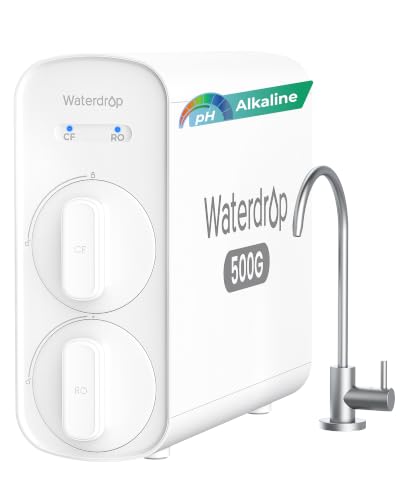
Tankless RO that reclaims cabinet space and puts minerals back in every pour.
The design story is the space saving: a tankless build frees up to 70% of your under-sink room compared with a traditional tank system like the iSpring. It runs a precision 0.0001μm RO membrane plus an alkaline stage that adds back calcium, magnesium, sodium and potassium, so the water tastes rounded rather than flat. Capacity is 500 GPD, and a 6-ounce cup fills in 8 seconds — fast enough that filling a pot does not feel like waiting.
The 2:1 pure-to-drain ratio is a meaningful efficiency number for anyone put off by RO waste — it sends two parts clean water into your cup for every one part down the drain. It carries NSF/ANSI 58 and 372 certification, connects out to an icemaker or fridge with the Waterdrop XT accessory, and holds a 21.4-pound heft and a slim 5.69-inch width.
Owners are largely won over by quality and taste, with TDS readings dropping sharply and the water comparing well against bottled. The honest downside: this is a machine with a pump, and a few units have failed early or acted up when a replacement cartridge went in. Change filters with the system powered and seated correctly to cut that risk. Faucet install also needs a drilled hole in the countertop, so plan for that up front.
What makes it a top performer
- Tankless build frees cabinet space and fits slim footprints.
- Alkaline stage restores minerals most RO systems strip out.
- 2:1 pure-to-drain ratio cuts the usual RO waste substantially.
- NSF/ANSI 58 and 372 certified, with an optional fridge/icemaker hookup.
What keeps it from perfection
- Pump-based build means an occasional early failure.
- Faucet mounting needs a drilled countertop hole.
- At 21.4 pounds it is heavier than carbon-block units.
Go here for: tankless RO that saves space, adds minerals back, and wastes far less water than a tank model.
Look elsewhere if: you cannot drill a countertop hole or want the simplest possible install.
9. AquaTru Glass Carafe Countertop Reverse Osmosis System
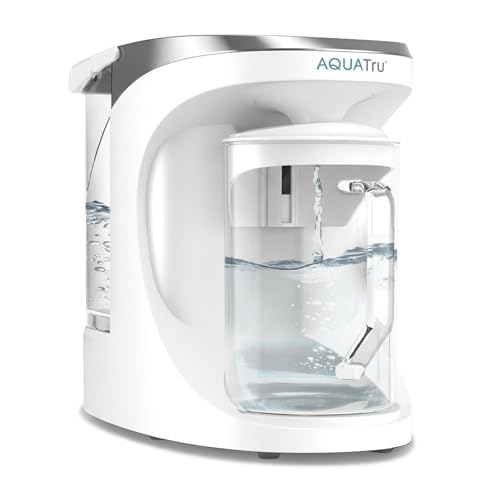
Full four-stage RO that plugs into a wall and pours into a glass carafe — no plumber.
This is the answer for anyone who rents, cannot drill, or simply wants to skip the plumbing. It plugs into any standard outlet, sits on the counter, and dispenses purified water into a borosilicate glass carafe with a lid — a different product class entirely from the under-sink systems here. Its four-stage RO filtration is certified to NSF standards by IAPMO and reduces PFOA, PFOS, lead, microplastics, fluoride, chromium-6 and arsenic. It has a 0.5 gpm maximum flow rate and measures 14″L x 7.5″W x 13″H on the counter.
Water quality is what wins people over, and taste is a close second. Owners describe smell-free, taste-free water with no bottle aftertaste, and the glass carafe gets its own praise for the pour spout and lid. Filter intervals vary by stage: the pre/carbon filter runs 6 months or 300 gallons, the RO filter a year or 600 gallons, and the VOC carbon filter a year or 300 gallons.
The honest trade-off is ownership over the long haul. Filters run on the pricey side, and this is a machine that some owners have had to replace after a year of use — a few report the flow slowing to a drip and needing a decalcify cycle. One reviewer noted the plastic lid over the reservoir feels flimsy. If you are okay with filter costs and a countertop footprint in exchange for true no-install RO, it is a strong fit.
Where it wins: real four-stage RO with no drilling and no plumbing, certified to NSF standards and delivering into glass.
Where it costs: pricier filters and possible reliability issues after a year — factor the replacement filters into your plan.
Pick it when: you want certified RO purity but cannot or will not plumb anything in.
Skip if: you want zero countertop footprint or the lowest ongoing filter cost — an under-sink unit serves better.
Know the Specs
GPD, gpm, and Filter Capacity
GPD stands for gallons per day — the total volume a reverse osmosis system can make across 24 hours, so 75 GPD or 500 GPD tells you the drinking-water ceiling for your household. gpm is gallons per minute, the flow rate you feel at the tap, so 0.72 gpm feels noticeably faster than a slow drip filter. Capacity in gallons is different again: it is how much water a cartridge treats before needing replacement. Read all three together, because a system can have a big capacity but a modest flow.
NSF 42, 53, 58, and 372 Explained
NSF/ANSI 42 covers aesthetic claims like chlorine, taste and odor. NSF/ANSI 53 covers health-related contaminants such as lead. NSF/ANSI 58 is the whole-system standard for reverse osmosis units, testing the full assembly rather than one element. NSF/ANSI 372 certifies low-lead materials. A system carrying more of these does not automatically perform better, but it tells you which specific claims were independently checked rather than taken on the maker’s word.
TDS and Remineralization
TDS means total dissolved solids — the mineral content that shows up as a number on a meter. Reverse osmosis lowers TDS heavily, which strips minerals along with contaminants; remineralization stages add some back for taste. Carbon and ultrafiltration systems often keep TDS intact on purpose. Neither approach is inherently better — it depends on if you want minerals removed or retained.
Micron Ratings
A micron is one-millionth of a meter, and a filter’s micron rating describes the smallest particle it catches. A 0.01μm ultrafiltration membrane catches particles far finer than a coarse sediment screen. A 0.0001μm reverse osmosis membrane goes finer still, which is why RO also removes dissolved minerals. Smaller pores mean finer filtration but often slower flow.
Common Questions
Will an under-sink system fit my cabinet and connect to my existing pipes?
Does reverse osmosis remove the healthy minerals from my water?
How often will I actually need to change the filters?
Can I use a municipal-water filter on well water?
Is a faucet mount filter worth it versus a pitcher?
Do reverse osmosis systems waste a lot of water?
Will these systems slow my kitchen tap water pressure?
What is the difference between NSF 42, 53, and 58 certification?
Can I install these myself without a plumber?
Which type suits a renter who cannot change the plumbing?
The Bottom Line
For most households, the water filtration for tap winner is the iSpring RCC7AK-BN because whole-system NSF/ANSI 58 certification and a mineral-restoring stage deliver the cleanest, best-tasting water with the fewest doubts. If you want certified filtration at a fast pour without a tank, grab the Aquasana AQ-6300M-BN. And for renters who cannot touch the plumbing, the AquaTru Glass Carafe delivers true RO from a countertop outlet.
What tips the whole guide is confidence: the top pick is the crowd favorite at 4.5+ stars across 21,000+ owners, backed by a full-system certification most rivals skip. Start there if space allows, and size down only when your cabinet or your lease says you must.
How we choose
We do not accept paid placement. Every pick is matched to a real buyer and a real use-case; we do not hands-on test units.
Sources
Specifications: manufacturer listings and product documentation. Review insights: verified customer reviews, as of November 2026. Pricing: not shown on this page (it changes often); check the current price via the retailer link.
As an Amazon Associate, Tactical Gear Guy earns from qualifying purchases. This does not affect which products we feature.