Specs are compiled from manufacturer listings and verified buyer reviews and can change over time — please confirm the key details on the product page before buying.
If your whites keep coming out grey and your washer’s inlet screen keeps clogging with grit, a small inline filter that screws onto the supply hose fixes it. Start with the FA20 Brass Sediment Filter. It catches particles down to 40 micron (a micron is one millionth of a meter, so 40 micron is roughly half the width of a human hair) in a reusable stainless steel screen. Its brass body also won’t crack the way plastic housings can. That brass-and-steel combination earns it the top spot here.
This guide is built by comparing the manufacturers’ published specifications and the patterns across verified customer reviews, so you get each pick’s real strengths and trade-offs instead of marketing spin.
Below you’ll find eight inline filters sorted by what they actually do — sediment trapping, scale inhibition, or chlorine removal — because those are three different jobs and no single cartridge does all three well. Every pick here screws onto a standard washer supply line, so the real question is which job your water needs doing. This breakdown of the best water filter for washer covers mesh ratings, thread sizes, and flow rates in plain terms.
Top Picks


How To Choose The Best Water Filter for Washer
The first thing to settle is what is actually in your water. Sediment — sand, rust flakes, grit from a well — needs a physical screen. Hard-water scale needs a media that interferes with mineral crystallization. Chlorine and odor need activated carbon. These are separate jobs, and a filter built for one will not do the others no matter what the box promises.
Match the micron rating to the problem
A micron rating tells you the smallest particle the screen will stop. A 40 micron mesh holds back sand, silt and rust flakes — the stuff that clogs an inlet valve screen. A 2 micron cartridge goes much finer and is typically a carbon unit aimed at chlorine and taste. Finer is not automatically better: a very fine screen loads up faster and needs cleaning more often.
Get the thread standard right before you buy
Washer hoses in the US usually use 3/4″ GHT (garden hose thread). Some inline units ship with 1/2″ NPT or 3/4″ NPT plumbing threads instead, which means you need an adapter — and several picks here include one in the box. Measure your existing connection before ordering; a filter that will not thread on is the single most common reason these get returned.
Decide if you want reusable or replaceable
A stainless steel mesh screen can be rinsed and put back, which means no cartridge purchases. A carbon or polyphosphate cartridge has a finite service life and gets swapped out. Reusable wins on long-term cost; replaceable wins when you need chemical removal that a bare screen cannot provide.
Side-by-Side Comparison
| Model | Best For | Filtration Rating | Connection | Type | Amazon |
|---|---|---|---|---|---|
| FA20 Brass Sediment Filter★ Best Overall | All-round sediment protection | 40 micron, 40 mesh | Standard US washer connections | Reusable stainless screen | Amazon |
| LVFEITIN 85470 Metal FilterFinest Mesh | Hard water and heavy sediment | 25 micron, 98% of solids | Standard washer hookups | Aluminum alloy, 5 stage | Amazon |
| Inline Water Filters 85470Whole-Home Pick | Proven long-running design | Sediment reduction | Standard washer hose | Replaceable cartridge | Amazon |
| AIWSH QZ10 Spin Down | Well water and whole-house pre-filtration | 40 micron, 316L mesh | 1″ MNPT, 3/4″ FNPT, 3/4″ MNPT | Spin-down, flushable | Amazon |
| ZHYUUAX YH-A1 ACF Filter | Chlorine and chemical removal | 2 micron | 1/2″ NPT and 3/4″ GHT | Carbon block cartridge | Amazon |
| H&G lifestyles Scale Inhibitor | Limescale in hard water | Polyphosphate media | 3/4″ NPT brass | Scale inhibitor cartridge | Amazon |
Detailed Reviews
1. FA20 Brass Sediment Filter, Reusable Washer Water Filters
Our pick — 4.0+★ from 50+ verified ratings; the strongest balance of quality and price.
A brass-bodied screen filter that rinses clean instead of asking you to buy cartridges.
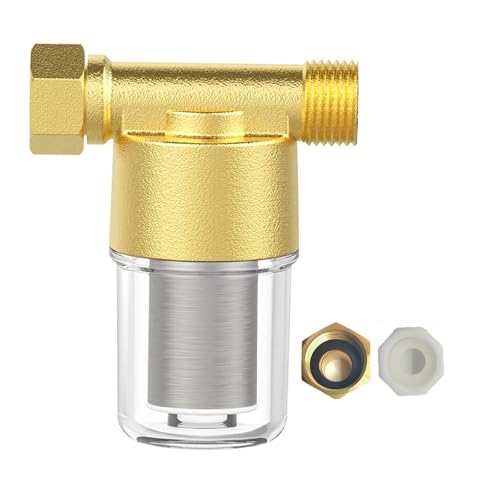
Your washer’s inlet valve screen is a tiny stamped mesh that fills with grit and then restricts flow, which is why machines slow down and sometimes throw a fill error. The FA20 puts a bigger, serviceable screen upstream of that valve. Its 40 mesh 304 stainless steel element catches particles down to 40 micron, so the sand, rust and silt from a well or an old municipal line stop here instead of inside the machine. The clear bowl lets you see the load building up before it becomes a problem.
The construction is the part that separates it from the plastic-bodied units further down this list. The head and threads are precision-cast brass, frosted and polished, so hot and cold inlets both hold up without the cracking that thin plastic develops over a few seasons. The bowl is BPA-free and transparent, and the whole thing installs between the hose and the washer with no tools. Connectors for American washer machines are in the box, so you are not hunting for a converter before you can hook it up.
Capacity is rated at 1600 gallons and the filter life cycle is listed at 12 months, and because the element is reusable you simply open the housing and rinse the screen rather than reorder anything. What buyers talk about most is straightforwardly that it does the job and goes on easily. The honest catch is pressure and placement: keep supply under 0.6 MPa, and install it somewhere with a floor drain, because wood floors and carpet are specifically not recommended. It also removes sediment only — it does nothing about chlorine, so if odor or skin irritation is your complaint, look at the carbon pick instead.
Where the FA20 earns its keep
- 40 micron 304 stainless mesh rinses and goes back in — no cartridge reorders
- All-brass head and threads resist cracking and leaks on hot and cold inlets
- Clear bowl shows the sediment load so you clean on evidence, not a calendar
- Washer connectors included, so no adapter purchase before first use
- Rated for 1600 gallons and a 12-month filter life cycle
What to plan around
- Sediment only — no chlorine or chemical removal
- Needs supply pressure under 0.6 MPa and a floor drain nearby
- Not intended for wood floors or carpeted areas
- At 7.8 ounces with a clear bowl, it hangs off the hose and wants support
Reach for this if: you have visible grit, rust or sand in the supply and want to stop it before the inlet valve.
Think twice if: your complaint is chlorine smell or skin irritation — that calls for the carbon cartridge pick, not a screen.
2. LVFEITIN 85470 Washing Machine Metal Filter
Five stages and a 25 micron cut-off for water that carries more than just sand.
If the FA20 above stops the visible grit and you still find deposits forming, this one goes finer. The LVFEITIN 85470 runs a 5 stage filtration process and is built to trap 98% of solids larger than 25 microns — a tighter rating than the 40 micron screens that dominate this category. Deposits that fine are exactly what builds up on the inlet valve screen and slowly strangles your fill rate, so the extra tightness translates into fewer slow-fill mornings.
The body is aluminum alloy, and it will sit on either the hot or cold intake, handling water up to 320F (160 C). Two installation notes matter more than any spec here: use PTFE thread tape to prevent leaks and the fitting jumping out, and do not crank it hard when tightening, because excess force cross-threads the connection. The filter changeout itself is a quick swap with no hassle once the housing is seated correctly.
Owners consistently report that the filtration side does its job, and quality is the other thing that comes up favorably. Installation is genuinely divided — plenty find it simple, others hit trouble, usually thread-related rather than the filter itself. Leakage opinions split the same way. The practical read: this is a good filter that rewards careful fitting, so give the threads a clean start and tape them properly. One more note on size — at 7.3″D x 3.2″W x 4.8″H it takes up real space behind the machine, unlike the tiny hose-end units, so check clearance before you commit.
Who it fits: hard-water households fighting recurring sediment deposits, or anyone whose inlet screen keeps fouling. The 25 micron rating and 98% solids capture are the strongest numbers on this list for pure particle removal.
The fitting tax: teflon tape and a light hand on the wrench are not optional. Cross-threaded connections are the failure mode here, and the aluminum threads are less forgiving than brass, so treat the install as the real job.
Worth it for: anyone who wants the tightest particle screen in this lineup and will tape the threads properly.
Skip the rush if: you want a zero-fuss screw-on — this one asks for careful handling at the connection.
3. Geokin L Port Reusable Brass Inline Sediment Filter
The longest-running design in this category, and the track record shows it.
This is the veteran of the category — a US-made housing that removes sediment before it reaches your machine, built from Celanese acetal copolymer and carrying NSF certification. The pitch is simple: it traps sediment, and when the cartridge loads up you swap in a #84470 replacement. No screen to rinse, no rebuild, just a fresh cartridge.
The numbers behind it are what make it worth a look. Hundreds of owners have run this exact model and the consensus on functionality is overwhelmingly favorable, with ease of use close behind. That is a deep service record for one cartridge housing. The recurring gripe is the plumbing end — leakage at the washer hose connection, and durability notes about parts blowing apart or threads stripping out. Value draws split opinions too. Sized at 2.12″D x 6.62″W x 7″H, it is a substantial housing that needs room behind the machine.
The fair conclusion: this filter works well when the hose connection is sealed properly. Seal the hose connection properly, do not overtighten, and the longevity record speaks for itself. If you would rather rinse a screen than reorder cartridges, the FA20 at the top is the cleaner answer. If you like the idea of a certified, well-known housing with a defined replacement schedule, this is the established choice.
Why it has lasted this long
- NSF certification on a housing made in the USA
- Deep track record — hundreds of washers running it
- Replacement #84470 cartridges swap in quickly
- Straightforward install on a standard washer hose
Treat the connection with respect
- Leaks at the washer hose joint are the common complaint
- Thread stripping and parts separating show up in the durability notes
- Acetal copolymer housing, not metal
- Replacement cartridges are a recurring cost a screen does not have
Pick it for: the certified, cartridge-swap approach and a design with a long service history.
Be careful with: the hose connection — seal it properly and do not overtighten, because that joint is where this unit’s reputation gets tested.
4. AIWSH QZ10 40 Micron Spin Down Sediment Filter
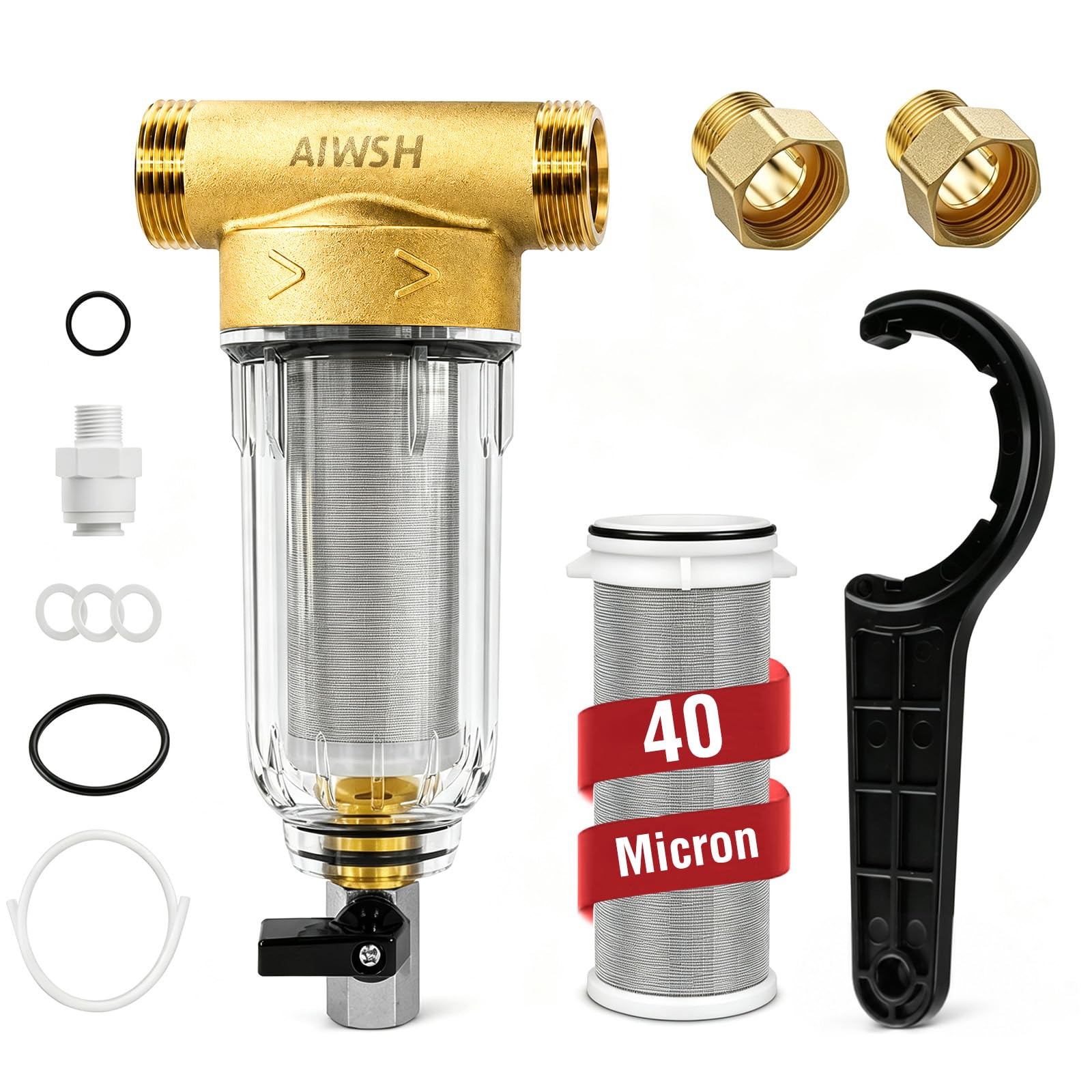
A spin-down unit that flushes its own screen instead of making you open it up.
Well water is a different animal — the sediment load is heavy and constant, and a cartridge filter becomes a chore. The QZ10 handles that with a 40-micron 316L stainless steel screen and a bottom flush valve: open the valve, water flow carries the accumulated sediment off the mesh, and filtration performance comes back. For municipal water the maker recommends cleaning every 1-3 months; for well water or other high-sediment sources, weekly cleaning may be needed to keep it at peak efficiency.
Flow is where this leaves the inline units behind. It is rated at 25 GPM (gallons per minute), which makes it viable as whole-house pre-filtration ahead of the washer rather than a single-appliance add-on. The valve body is high-strength lead-free brass, corrosion resistant, and the transparent housing handles burst pressures exceeding 870 PSI while resisting water hammer and freezing. The 316L mesh and all components are BPA-free. Fittings include 1″ MNPT, 3/4″ FNPT and 3/4″ MNPT, so it works with most threaded connectors — pick the fitting based on whether your pipe is copper, PEX or CPVC.
It weighs 2.2 pounds and measures 2.6″D x 6.1″W x 8.3″H, so it is a proper piece of plumbing hardware that needs mounting space, not a hose-end gadget. The maker backs it with a 1 year manufacturer warranty. Quality is what buyers highlight most, followed by function, and trapping thin sediment from a well is specifically the use it gets praised for. Installation is described as a few minutes of work if you follow the manual.
The pre-filter play: install this at the main supply and every appliance downstream — washer included — sees cleaner water. The 25 GPM rating and flush valve are what make whole-house duty realistic here.
Space and pipe knowledge required: this is not a screw-on hose fitting. You are working with 1″ MNPT and 3/4″ NPT plumbing threads, so plan the mounting and know your pipe type before ordering.
Choose it when: you are on a well or heavy-sediment supply and want one flushable filter protecting the whole house.
Not for you if: you want a five-minute install behind the washer with no plumbing work.
5. ZHYUUAX YH-A1 2 Micron ACF Washing Machine Filter
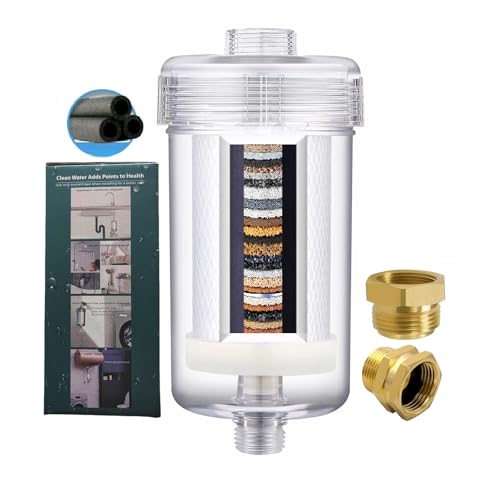
The only pick here that goes after chlorine and chemicals, not just grit.
Every other filter on this list is a screen. This one is a cartridge — activated carbon, carbon fiber and PP cotton layered together to go after chlorine, chloramine, fluorine, rust, lead, cadmium, heavy metals, fine particles, sediment, odor and pigment. The mesh rating is 2 micron, an order of magnitude finer than the 40 micron screens, and the cartridge is rated to hold 12000 gallons of water at that depth. Flow is 10 GPM, so the washer still fills promptly.
If your complaint is dulled whites, a chlorine smell in the laundry room, or the residue hard water leaves behind, this is the type of media that addresses it rather than a bare stainless screen. The housing is thick transparent pressure-resistant material with a brass inlet connector, sized 6.7 inches tall, and the waterproof O-ring seals the hose connector. Installation is tool-free: it takes US standard 1/2″ NPT and 3/4″ GHT internal and external threads directly.
The trade-offs are real and worth planning around. Working pressure must stay between 0.2 and 0.4 MPa, strictly not above 0.6 MPa. The cartridge is listed with a 3-month filter life cycle, with replacement advised after 3-5 months — so unlike the reusable screens, this one has an ongoing cartridge cost, and durability is the most-discussed shortcoming. Water pressure opinions split, which makes sense for a finer carbon block. What owners praise without reservation is the filtration itself and the quality of the filter media, plus easy installation and noticeably cleaner results in the machine.
Chemical removal, handled: a 2 micron carbon-and-fiber cartridge at 10 GPM is the only configuration here that targets chlorine and odor. The 12000 gallon capacity figure tells you the media is substantial.
Budget for cartridges: a 3-month life cycle means recurring replacement, and the fine media will show pressure drop sooner than a coarse screen. Check your supply pressure sits inside the 0.2-0.4 MPa band first.
Right answer for: chlorine, odor and chemical removal where a sediment screen would be the wrong tool entirely.
Wrong answer for: anyone who wants a set-and-rinse part — this one is a consumable cartridge by design.
6. H&G lifestyles Anti Scale Filter
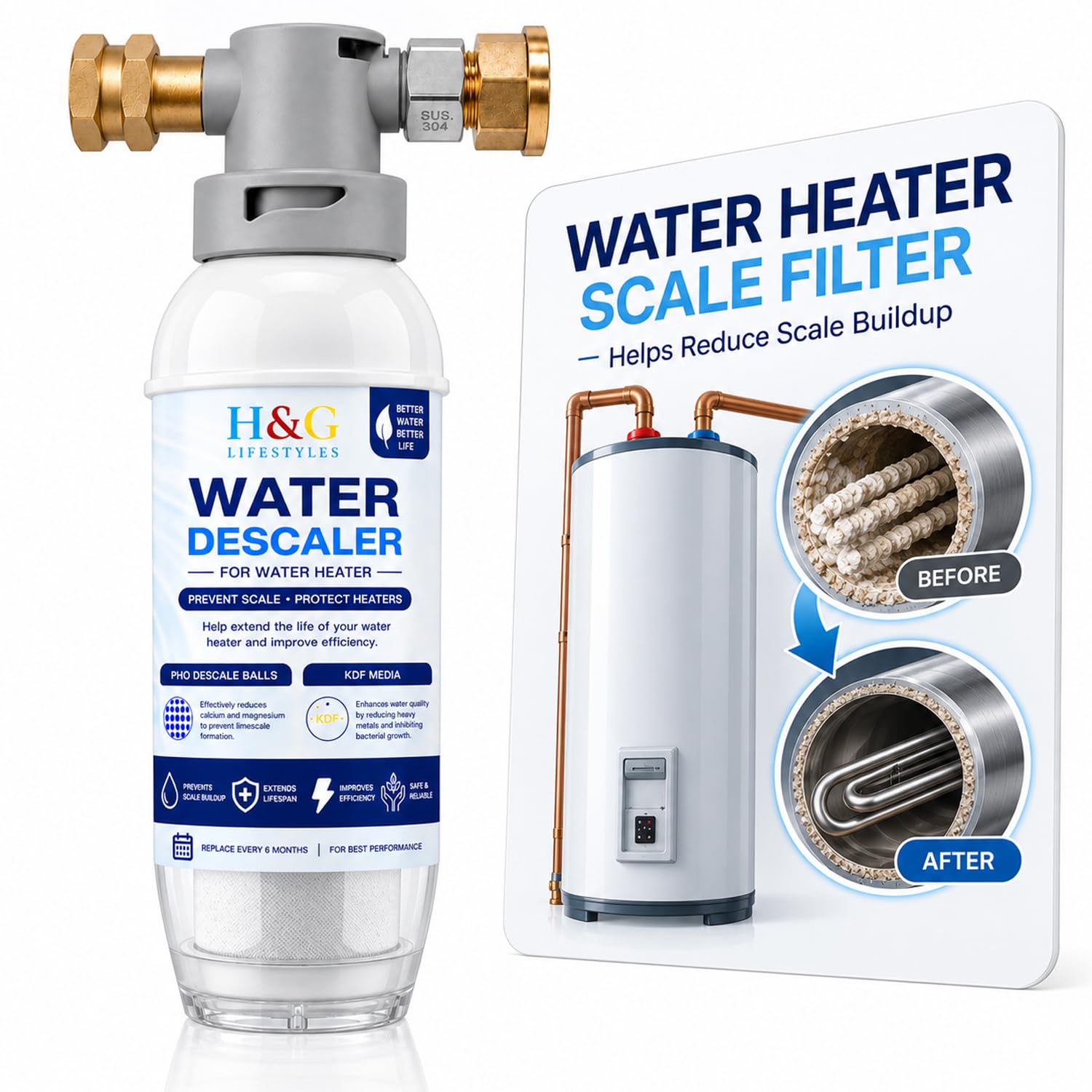
Built for limescale rather than grit, and it will treat the water heater too.
Hard water does its damage invisibly — calcium and magnesium settle out as scale inside inlet valves, water passages and heat exchangers. This cartridge uses polyphosphate anti-scale media to inhibit that formation, and it works on tankless and traditional water heaters as well as the washer. The important nuance in the listing is that it controls deposits without removing dissolved hardness minerals and does not function as a traditional water softener, so it is a scale inhibitor, not a softener.
The fittings are 3/4-inch NPT brass, which is plumbing thread, not hose thread. For a machine with standard 3/4-inch GHT hose connections you may need separately purchased NPT-to-GHT adapters, so check your plumbing and connection sizes before installing. Maintenance is genuinely easy — the housing twists off so you swap the cartridge without disconnecting the pipes. Service life is listed as up to 6 months under suitable conditions, with actual frequency depending on water hardness, consumption, temperature and overall quality.
On performance, the filter media itself gets the favorable mentions, including chlorine and impurity removal from well water. Quality and fit are where opinions divide sharply, and fit is the topic that comes up most often overall: threads that do not align properly and a unit that does not sit well on laundry faucets. That is a plumbing-compatibility problem, not a media problem. If your connection matches 3/4″ NPT cleanly or you buy the right adapter, this is a reasonable scale-control cartridge. If your faucet is GHT, work out the adapter situation first.
What it brings to hard water
- Polyphosphate media targets calcium and magnesium scale specifically
- Works on the washer and on tankless or traditional water heaters
- Twist-off housing swaps the cartridge without touching the pipes
- Up to a 6-month service life under suitable conditions
The adapter question
- 3/4″ NPT brass fittings — GHT washer hoses may need adapters bought separately
- Thread alignment and fit on laundry faucets is the most-raised problem
- Does not soften water; dissolved minerals stay in
- Replacement frequency shifts with hardness and usage
Make it yours if: scale is your problem and you know your supply line is 3/4″ NPT or you are ready to adapt it.
Handle with care if: your washer faucet is standard GHT — settle the adapter fit before you thread anything on.
Know the Specs
Micron Rating and Mesh Count
A micron rating is the size of the smallest particle a filter will hold back, and it is the number that decides what job the filter does. The 40 micron screens here stop sand, silt, rust flakes and grit — the visible stuff that clogs an inlet valve. Drop to 25 micron and you capture finer deposits that form slowly. A 2 micron carbon cartridge goes after particles small enough to carry chlorine and odor with them. Finer media loads faster, so a 2 micron cartridge needs replacing on a schedule while a 40 micron stainless screen can simply be rinsed.
Thread Standards: GHT, NPT and Adapters
The thread on your connection determines whether a filter screws straight on. GHT (garden hose thread) is what most US washer hoses use, and a 3/4″ GHT filter goes on by hand with no tools. NPT is plumbing thread — 1/2″ NPT and 3/4″ NPT units are built for supply lines and often need an adapter to meet a hose. A 1″ MNPT fitting shows up on whole-house units. Check the thread on your existing faucet and hose before ordering; adapter mismatch is the most common reason a washer filter gets sent back.
Common Questions
Will a 3/4″ GHT filter fit my washing machine hose?
Does a 40 micron filter remove chlorine from my wash water?
How often does a reusable washer filter need cleaning?
Is a scale inhibitor the same thing as a water softener?
What water pressure can these filters handle?
Can I install one of these on hot and cold water lines?
Do I need a floor drain near the filter?
How much flow does a washer filter cost me?
Can a washer filter help with yellowing clothes?
What does NSF certification on a filter actually cover?
The Bottom Line
For most homes, the water filter for washer that makes the most sense is the FA20 Brass Sediment Filter. A reusable 40 micron stainless screen in a brass body handles the everyday sediment problem without a cartridge subscription. If you want the tightest particle capture in this lineup, the LVFEITIN 85470 goes to 25 microns and traps 98% of solids above that size. For chlorine and odor rather than grit, the ZHYUUAX YH-A1 is the only carbon cartridge here, at 2 micron and 10 GPM (gallons per minute, the flow rate it handles). And if you are on a well and want the filter upstream of everything, the flushable AIWSH QZ10 spin-down is the one that scales to whole-house duty. Match the media to your water and the thread to your hose, and you buy once instead of guessing.
How we choose
We do not accept paid placement. Every pick is matched to a real buyer and a real use-case; we do not hands-on test units.
Sources
Specifications: manufacturer listings and product documentation. Review insights: verified customer reviews, as of November 2026. Pricing: not shown on this page (it changes often); check the current price via the retailer link.
As an Amazon Associate, Tactical Gear Guy earns from qualifying purchases. This does not affect which products we feature.