Specs are compiled from manufacturer listings and verified buyer reviews and can change over time — please confirm the key details on the product page before buying.
You want a water detection sensor that shrieks the moment a pipe starts weeping — not one that quietly dies in a damp basement. The catch is that they split into two very different families, standalone alarms that blast a siren where you can hear it, and smart sensors that push a notification to your phone while you are away. Deciding between a standalone siren and an app-connected sensor is the choice that shapes everything else.
This guide is built by comparing the manufacturers’ published specifications and the patterns across verified customer reviews, so you get each pick’s real strengths and trade-offs instead of marketing spin.
Below you will find a nine-sensor shortlist, from five-packs that blanket an entire basement to app-connected units you can check from a hotel room. Each entry covers loudness in decibels, how little water it takes to trigger, and whether it works without a hub — everything you need to pick the right water detection sensor for your home.
Top Picks


How To Choose The Best Water Detection Sensor
A water detection sensor is a small battery-powered puck that sits on the floor near a water heater, sink, washing machine, or sump pit and waits. When water bridges its metal contacts or probes, it sounds an alarm, flashes a light, or sends a phone alert. Four things decide which one you buy: how loud the alarm is, how little water it takes to trigger it, if you need an alert on your phone, and how long the battery lasts before you have to remember it exists.
Where the water will actually show up
Before you compare decibels, walk your house and find the failure points. Water heaters, under-sink cabinets, dishwasher bases, washing machine pans, refrigerator ice lines, sump pits, and air-conditioner drip pans are the usual suspects. A sensor needs to sit flat on the floor directly where the first puddle forms — a puck tucked behind the appliance or propped on a shelf will miss a slow drip running toward the drain.
Standalone alarm or app-connected sensor
Standalone sensors are the simplest: battery in, place it down, done. No WiFi, no account, no hub, and they keep working when the power goes out. App-connected sensors add a push notification to your phone, which matters enormously if you are away or if a basement leak might start while you sleep. The trade-off is that most app sensors require a hub or gateway that often ships separately — check that before you buy, because a sensor alone may not connect to anything.
How little water counts
Sensitivity is measured in fractions of an inch, and a lower trigger number means an earlier warning. A sensor that trips at 1/32 inch catches a backed-up dishwasher before the cabinet floor is soaked, while a slower trigger means the puddle is already spreading toward the drywall. Look for multiple probes, top-mounted drip sensors, and a bottom contact arrangement that senses from more than one direction.
Side-by-Side Comparison
| Model | Best For | Alarm | Battery | Smart / Hub | Amazon |
|---|---|---|---|---|---|
| Zircon Leak Alert 5 Pack★ Best Overall | Blanket coverage of a whole basement | 90 dB | 9V alkaline, not included | No — standalone | Amazon |
| Shackcom Water Alarm 2 PackBudget Champion | Loud whole-house warning on a tight budget | 110 dB | 9V, not included | No — standalone | Amazon |
| YoLink Water Leak Sensor 2Longest Range | Long-range sensing where WiFi cannot reach | 105 dB | 2 AAA, included | Yes — YoLink hub required | Amazon |
| TECKNET WiFi Water Leak Detector | Phone alerts without buying a hub | 120 dB, adjustable | 2 AAA, included | Yes — 2.4GHz WiFi only | Amazon |
| Basement Watchdog BW-WA360 | Squeezing into tight spots under a water heater | 110 dB | 9V alkaline, not included | No — standalone | Amazon |
| Stechro 5 Pack WD76 | Adjustable volume and drip detection | 0–120 dB, 4 levels | 10 AAA, included | No — no WiFi or app | Amazon |
| GoveeLife H5059 3 Pack | Set-and-forget with a five-year battery | 105 dB, adjustable | Built-in, 5 years | Yes — gateway sold separately | Amazon |
| Aeotec SmartThings Sensor | Automating a shut-off valve with SmartThings | Siren alert option | Battery included | Yes — SmartThings hub required | Amazon |
| GoveeLife H5058 3 Pack | Drip alerts plus app snooze control | 100 dB with mute | AAA, 5-year claim | Yes — H5043 gateway required | Amazon |
Detailed Reviews
1. Zircon Leak Alert Water Leak Detector 5 Pack
Our pick — 4.5+★ from 900+ verified ratings; the strongest balance of quality and price.
Five alarms in one box, and the one that keeps screaming even as it floats.
You get five sensors for the price of a single connected one, and that is the right way to buy leak protection: one under the water heater, one behind the washing machine, one in the basement corner you never check. Each puck runs on a single 9V alkaline battery (not included), so there is no wiring, no pairing, and no app to babysit. You put it down on its back with the metal contacts touching the floor and it is live.
The 90 dB alarm is the piece that wins people over — loud enough to carry through several floors of a house, so a leak in the basement reaches you in an upstairs bedroom. What owners praise most is simply that it works, and the review pages back that up as the dominant theme by a wide margin. It also flags when there is a problem, not just when there is a flood: the contacts trigger on direct water contact, so a slow seep under the dishwasher sets it off.
What earns this the top spot is what happens in a real flood. The unit is built to float on top of the water and keep signaling for up to 72 hours, so it does not drown and go silent while the water keeps rising the way a floor-level sensor would. Compare it to the Basement Watchdog: the Zircon is 4.34″L x 2.42″W x 1.43″H versus 2.38″L x 1″W x 3.25″H, so the Watchdog wins on tucking into a narrow gap while the Zircon wins on staying above the waterline. It also carries a limited lifetime warranty from the manufacturer.
The honest trade-off is the battery. The reviews are split on how long a 9V lasts, so treat the battery as a yearly chore you put in your calendar rather than something to forget. That, plus the fact that there is no phone alert — this is a hear-it-or-miss-it alarm, so it is best for a home you are actually in. For the money, it is the strongest all-round pick in this set, with 4.5+ stars across 900+ ratings behind it.
What earns its keep
- Five sensors blanket every leak-prone spot in the house in one purchase
- Floats and keeps signaling for up to 72 hours during a real flood
- 90 dB alarm travels through multiple floors of a house
- No wiring, no hub, no app — one 9V battery and it is running
- Limited lifetime manufacturer warranty
Where it asks patience
- 9V batteries are not included, so budget for five of them
- Battery life is the mixed note in the feedback — plan a yearly swap
- No phone notification, so it only helps when someone is nearby
Reach for this if: you want to cover an entire basement, laundry room, and kitchen in one go without setting up a smart home.
Look elsewhere if: you travel often and need a leak to reach your phone — a connected sensor is the better tool for that.
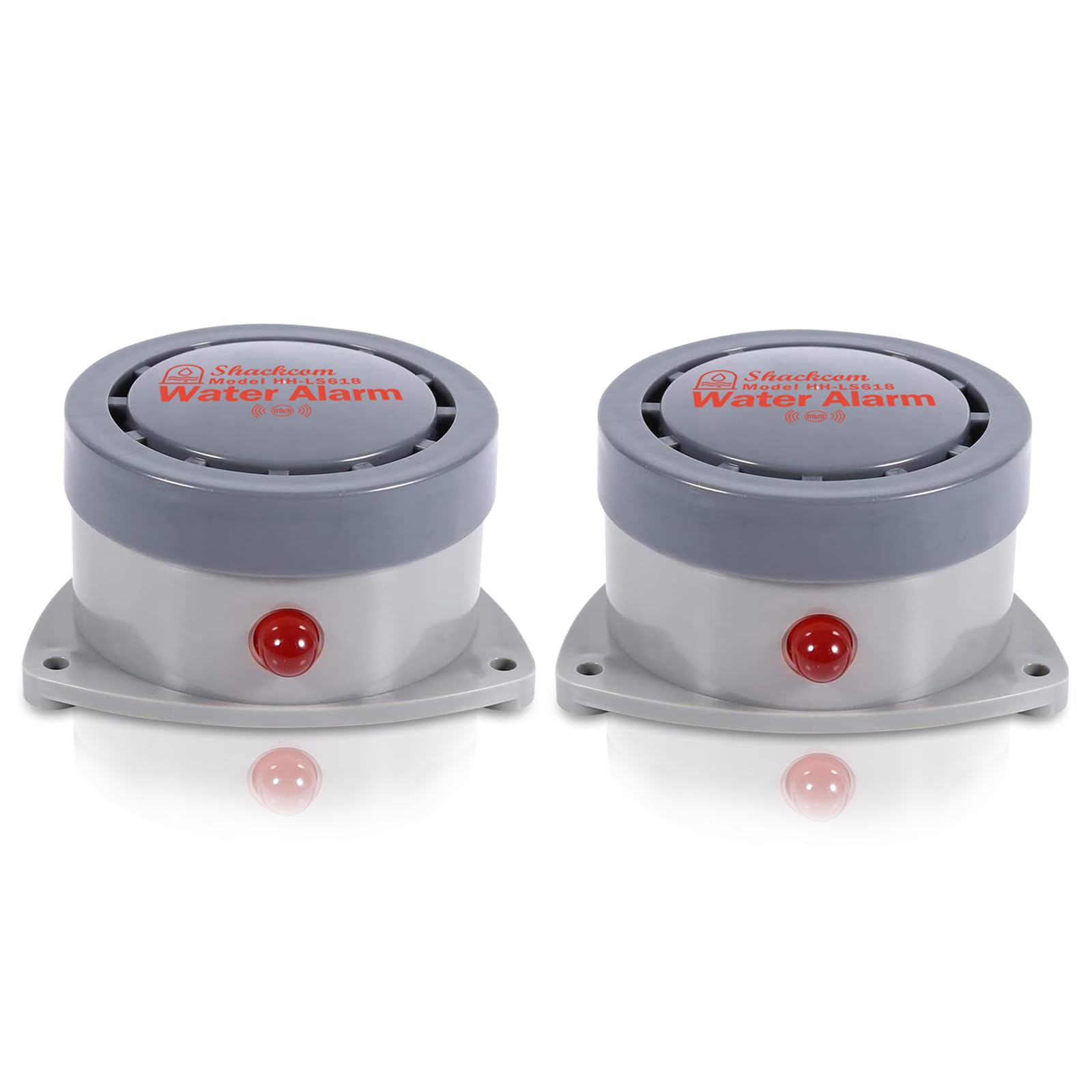
2. Shackcom Water Alarm 2 Pack
Two 110 dB alarms that trip on a thirty-second of an inch of water.
If your only worry is being heard, this is the pair to buy. Each unit carries two metal sensors on the bottom that pick up as little as 1/32 inch of water — a thin film you would not notice until the cabinet floor was warped. When it triggers, a 110 dB alarm tears through the house and a light flashes alongside it, so you get sound and sight at the same time. That combination makes it a better alert than a pure siren, because someone walking past sees the flash even over a loud TV.
Setup is a place-it-and-forget-it job. There is no wiring to snag, which also means no cable to yank loose and re-install later. A built-in battery-saver circuit means the unit only draws real power while the alarm is sounding, which stretches the single 9V battery you supply. The 2 pack covers a water heater and a washing machine, or one under each sink — sensible starter coverage. It has the smallest footprint savings of the standalone crowd in one sense (this is a two-pack against the Zircon’s five) but the loudest alarm of the non-app group at 110 dB versus the Zircon’s 90 dB.
The limitation is the same as every standalone alarm: if you are not home, nobody hears it. And you do need to buy the 9V batteries separately. For a small flat where two sensors cover the real risk areas, the math is easy — this is a cheap way to buy a genuinely loud early warning.
Where it wins: 110 dB on a two-pack budget, plus a flashing light so the alert is both audible and visible, and a sensitivity down to 1/32 inch of water.
The trade to weigh: no app, no phone push, no hub — it is a room-level alarm only, and the 9V batteries are on you.
Suits: renters and small-home owners who want maximum noise for minimum spend.
Not for: anyone who needs to know about a leak while they are at work.
3. YoLink Water Leak Sensor 2, 105 dB Alarm, YS7904G
A rope you wrap around the water heater, and a radio signal that crosses the whole property.
The sensing element here is a 4.2 foot (1.2 meter) water-sensing cable rather than a pair of metal nubs, and additional cables can be added. That changes what you can protect: you can trace the cable around the base of a water heater, or send it into the cramped void under a dishwasher where a puck would never fit. Instead of waiting for water to reach one spot, you define the whole detection area.
The wireless side is what separates it from every WiFi sensor in this guide. It runs on a LoRa-based network (a long-range radio link that does not need WiFi) with a 2,034 foot open-air range, and it does not depend on your WiFi or internet at all. YoLink’s Control-D2D device-to-device pairing lets sensors talk to each other, so the alarm can still fire even if the internet drops or the AC power dies. The 105 dB siren is on board, and the manufacturer lists a 2+ year battery life from two AAA cells that come in the box.
Now the catch, and it is a big one: a YoLink hub is required and is not included. Without one, this sensor does not operate at all. It is also worth knowing that the hub is a separate purchase, and the app setup relies on a QR “Scan and Play” scan, which makes the pairing quick once you have the hub in hand. Buy it as part of the YoLink system, not as a one-off.
The real draw: a sensing cable you can route around a heater or into a tight cabinet gap, plus a radio link that works when WiFi and power do not.
The prerequisite: no hub, no function — factor a YoLink hub into the plan or this box stays dead.
Pick it for: a big property or a detached garage where WiFi will not reach the leak point.
skip it if: you are not ready to buy into the YoLink hub ecosystem.
4. TECKNET WiFi Water Leak Detector
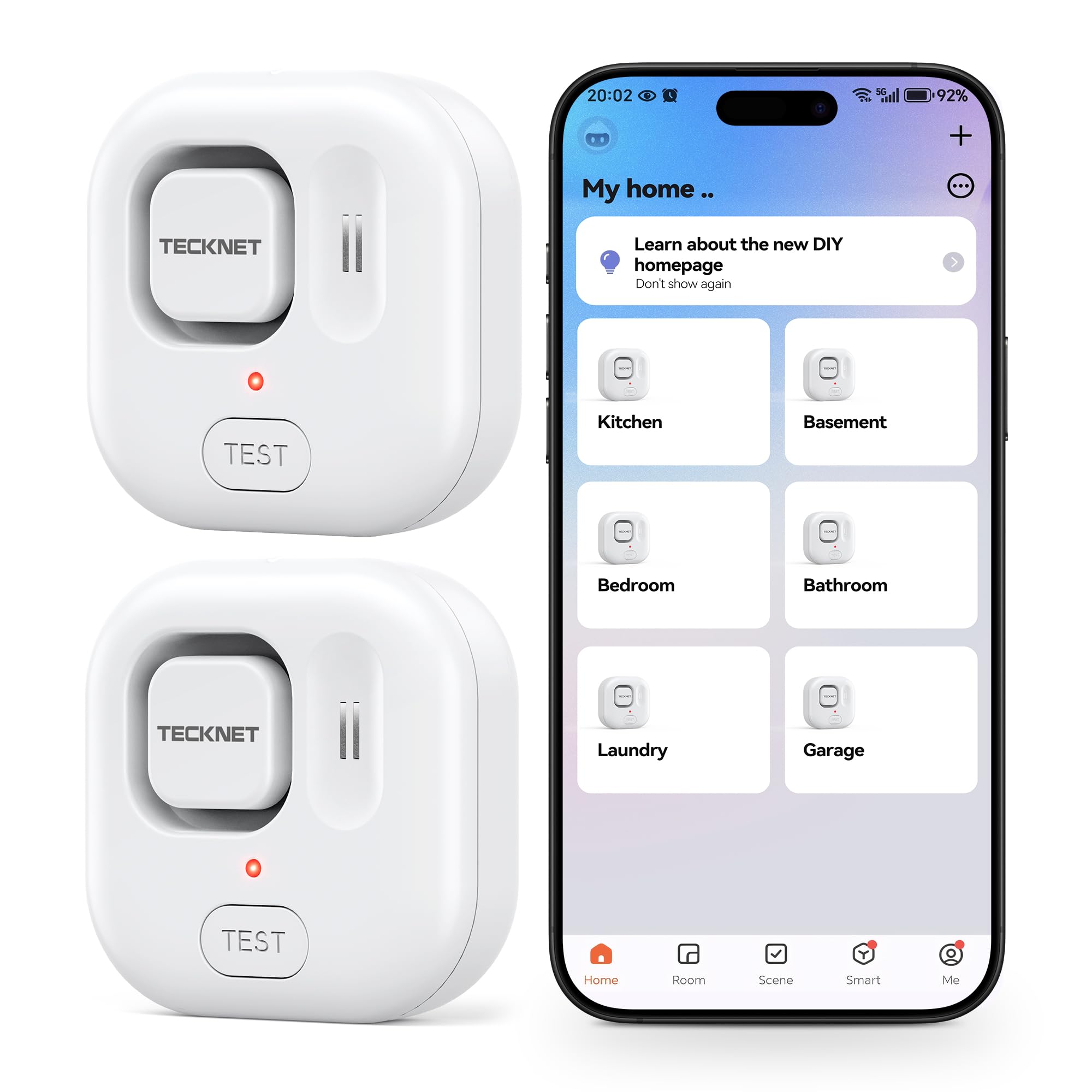
The 120 dB siren is the loudest in this set, and it pings your phone too.
Here is the number that matters: 120 dB, the highest alarm in this whole shortlist, and it is adjustable so you can turn it down in a quiet flat. The TECKNET also packs six sensing points — two probes on top and four on the bottom — so it catches water arriving from more than one direction. That makes it a sharper trigger than a single-contact puck when a leak creeps in under a door rather than pooling directly under the sensor.
Alerts come through the Tuya Smart app the moment water is detected, whether you are home or away, and that app alert is the whole reason to pay for a WiFi sensor. The housing is rated IP67, meaning it is sealed against dust and can survive being submerged — sensible for a basement or laundry room where humidity is constant. Batteries are included (two AAA per unit, four in the box), and TECKNET lists up to 2 years of battery life plus a low-battery reminder in the app.
The catch is connectivity. This is 2.4GHz WiFi only and will not talk to a 5GHz network, so check your router band before you set it up. Some owners find the Tuya app less than intuitive on first use. Still, the combination of the loudest siren here and hub-free phone alerts is a strong one for a home you want to monitor remotely.
What stands out: 120 dB siren, six-probe detection, IP67 sealing, and app push — all without a hub, and batteries in the box.
Check before buying: it will only join a 2.4GHz WiFi network, and the app has a learning curve for some.
Right for: a remote-monitoring setup with no appetite for buying a hub.
Think twice if: your home WiFi is 5GHz-only or you want a plug-and-play app.
5. Basement Watchdog BW-WA360 Water Alarm
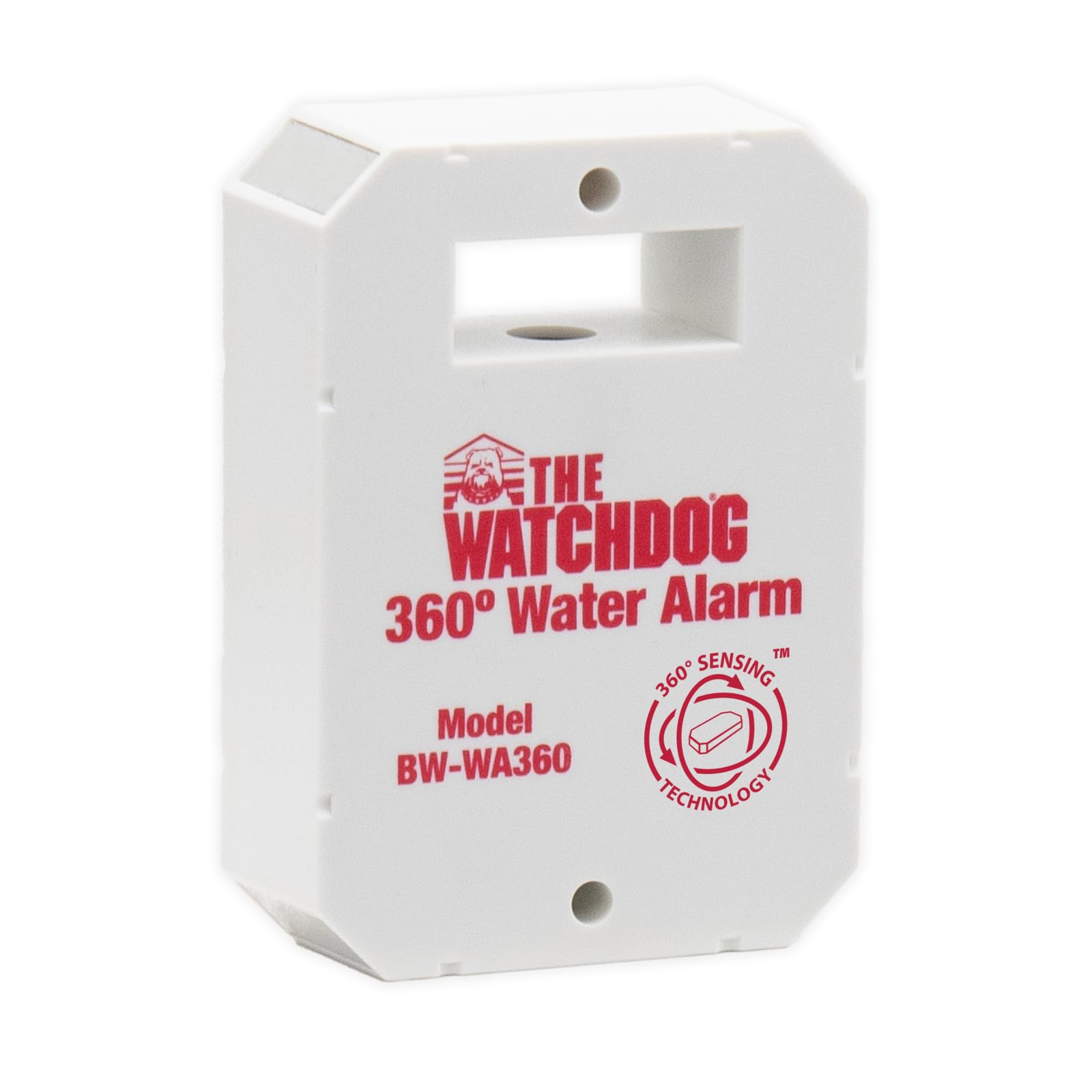
Small enough to slide under a water heater, and it senses water on any side.
Most sensors have a bottom face that must sit flat on the floor. This one uses a patented design that detects water on any side, so it works even when it gets nudged or lands on its edge. At 2.38″L x 1″W x 3.25″H it is the slimmest unit here — narrow enough to slip into the gap under a hot water heater or behind a refrigerator. That footprint is the reason to choose it over the bulkier Zircon, which is wider and flatter.
The trigger is 1/32 inch of water — the same fine sensitivity as the Shackcom — and the 110 dB alarm is meant to be heard throughout the house. Solid-state circuitry handles the sensing, and a battery-saver feature means the unit only draws energy while the siren is sounding, which is easy on the single 9V alkaline battery (not included). It comes with a 5 year limited warranty, one of the longer coverage terms in this group.
The design fits a specific job rather than every job. It is meant for sump pits, water heaters, dishwashers, refrigerators, and AC drip pans — the tight, unglamorous places. If those are your risk spots, this is one of the smartest placements you can make.
The placement advantage: 360° water sensing in a 2.38″L x 1″W x 3.25″H shell, so it tucks where a flat puck cannot go.
The honesty note: it is battery-only and standalone — no app alert, and the 9V cell is not in the box.
Best used: directly under a water heater, sump pit, or AC drip pan where space is tight.
Less useful if: you need a phone alert rather than a house-level siren.
6. Stechro Water Sensor Alarm 5 Pack
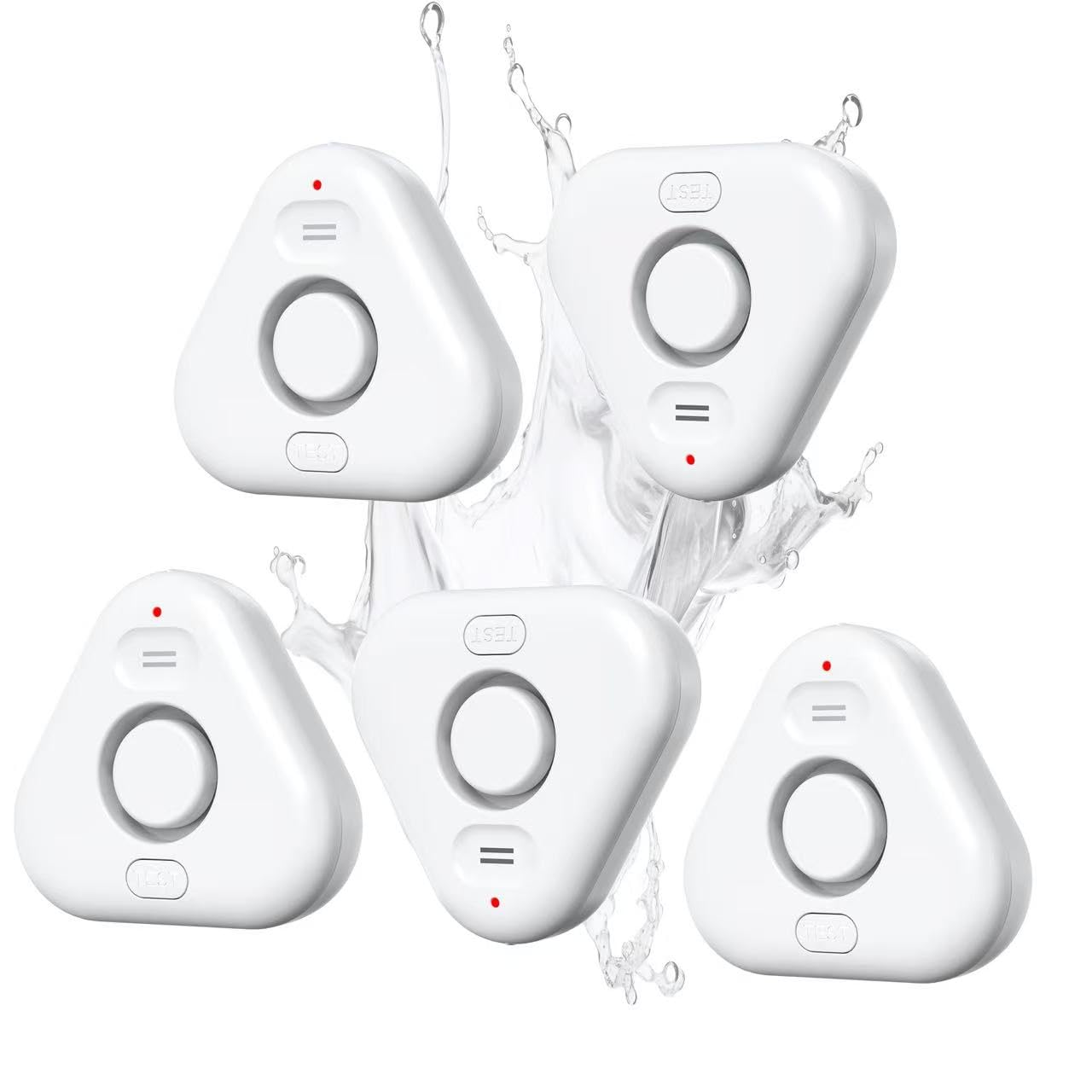
Five alarms, ten batteries, four volume steps, and one alarm that listens for drips.
The standout spec is the drip sensor on top. Most units only detect a puddle at floor level, but this one adds a top sensor for dripping water, alongside four bottom flood probes. That dual mode covers a leaking pipe joint above the sensor as well as a puddle below it. Volume is where it gets interesting: you can set the alarm anywhere across 4 levels from 0 to 120 dB, so a basement unit can be set loud and a bedside one soft. A mute button silences a false alert without disarming the sensor.
The 5 pack gives you real coverage. Each sensor uses two AAA cells, and the box includes 10 batteries, so all five are ready to place on day one. The housing is IP66 rated (sealed against dust and strong water jets) for humid areas like laundry rooms and basements. A low-battery alert reminds you when to swap cells, and the manufacturer lists up to 3 years of use per battery set. What wins people over here is that it simply works — with the second-strongest reliability read of any standalone unit in this guide — and the triangular shape stands out on a shelf, so you can spot an alarm even when it is quiet.
The catch is connectivity, and it is deliberate. This model has no WiFi, no Bluetooth, and no app, and it will not pair with the Stechro gateway or the store’s other SKU. It is an alarm you hear, not one that phones you. That is fine for a house that has someone home most of the time — a limitation only if you need remote notification.
What you get in the box
- Five sensors plus ten AAA batteries, so placement day needs no extra shopping
- Drip detection on top plus four flood probes on the bottom
- Volume adjustable in 4 steps from 0 to 120 dB
- IP66 housing rated for damp basements and laundry rooms
- Up to 3 years of battery use per set, with a low-battery alert
The limits to know
- No WiFi, Bluetooth, or app — it cannot alert your phone
- Won’t connect to the Stechro gateway or the store’s other sensor model
- Needs to be placed where you will hear it
Perfect for: a whole-home battery-on-board setup where adjustable volume and drip sensing matter.
Not the one if: remote alerts through an app are your priority.
7. GoveeLife Water Leak Detector 3 Pack
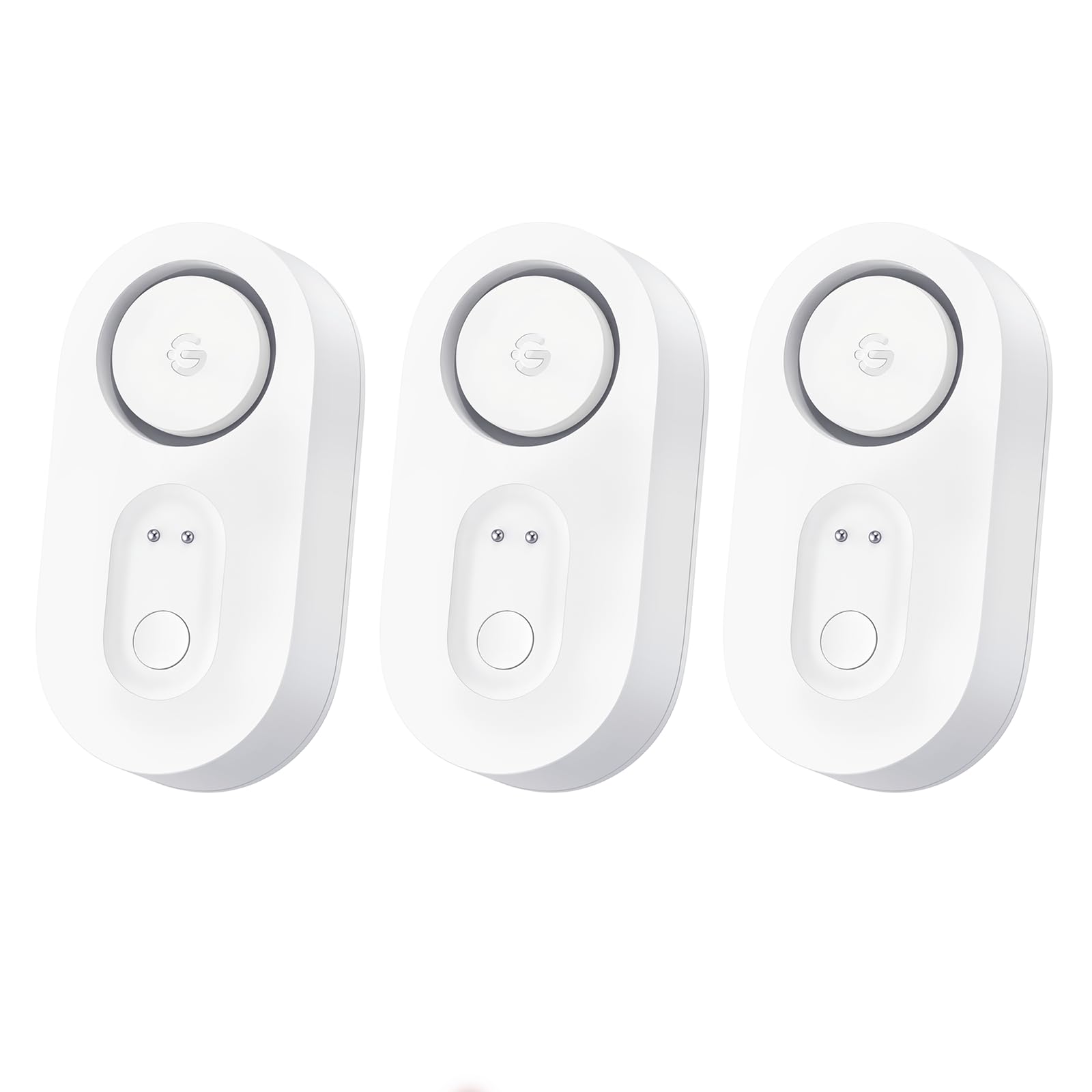
A built-in battery rated for five years, so you may never change it.
Five years of operation from a built-in battery is the number that sells this one. Where the Zircon asks you to remember a yearly 9V swap, the GoveeLife is built to be forgotten — which is exactly what you want from a device whose whole job is to sit quietly until something goes wrong. Each sensor carries two sets of probes for early detection near dishwashers, water heaters, and washing machines.
The 105 dB alarm is adjustable across 4 volume levels, so you can set a quiet bedroom unit and a loud basement one from the same app. The housing is IP67 rated, meaning it is sealed against dust and can take being submerged, which suits under-sink and sump-pump placements. When you want remote alerts, the sensor connects through the GoveeLife H5044 gateway so you can monitor for leaks from your phone. Setup is straightforward and the app notifications arrive quickly, so it works well as a real monitoring setup once the gateway is in place.
Here is the thing to get right at checkout: the gateway is not in the box, and without it the sensor cannot be added to the app. Those H5059 sensors also do not work with the older H5040, H5043, or other gateways, so the pairing has to be the H5044. Some owners find the connectivity side fussy when pairing. Buy it as a kit with the gateway and it shines.
Why it earns a premium: a 5-year built-in battery, IP67 sealing, 105 dB adjustable alarm, and dual probe sets — low maintenance, high coverage.
The pairing detail: needs the H5044 gateway (sold separately) and will not work with older Govee gateways, so confirm the model before ordering.
Buy this for: the low-maintenance homeowner who wants to place a sensor and forget it for years.
Avoid if: you already own a different Govee gateway that this sensor will not pair with.
8. Aeotec SmartThings Water Leak Sensor

Not just a leak alarm — it watches temperature and can shut your water off.
This is the sensor for someone already living inside the SmartThings ecosystem. Beyond moisture, it also monitors temperature across a 32 to 104 degree measuring range, so it flags a basement that is dropping toward freezing just as readily as a puddle under the washer. You can set it to a light-up alert or a siren when moisture or temperature goes abnormal — useful in a room you rarely enter, where a light is easier to spot than a sound you might miss.
The automation is where the real value sits. You can program other connected smart devices to shut off water flow or power down electronics when a leak is detected, which turns the sensor into the trigger for a whole shut-off routine rather than just a noise. Reliability is the thing owners trust it for above all, and it connects quickly to a SmartThings hub. ZigBee wireless range is 50 to 130 feet depending on how the house is built, and the battery is included.
The requirement is a hub — either an Aeotec Smart Home Hub or another SmartThings hub such as the Samsung SmartThings Hub Gen 3, or a compatible ZigBee hub. It is also indoor-only and covered by an Aeotec 1-year limited warranty. Water resistance and battery life draw mixed feedback, so mount it where it will not sit in standing water and keep an eye on the cell. For a SmartThings home, this is the pick that does the most.
The automation edge: leak and temperature sensing together, with the ability to trigger a connected shut-off valve — a level of control the standalone picks cannot match.
The prerequisites: a SmartThings or ZigBee hub is mandatory, it is indoor-only, and water resistance is the mixed note.
Choose it when: you run SmartThings and want leaks to trigger an automatic water shut-off.
Otherwise: a hub-free alarm gets you protection with none of the setup.
9. GoveeLife Water Leak Detectors 3 Pack

Loud enough to find the leak, quiet enough to mute before it drives you mad.
Most alarms you cannot silence without pulling the battery. This one puts a mute button right on the sensor, and once triggered you can also silence it from the app or the base station. A 100 dB alarm is loud enough to hear when you are hunting for the leak, and then you press the button and it stops. There is also a snooze function worth knowing: if the probe is not dry after an hour, the sensor sounds the alarm again, so a slow leak keeps nagging until you actually deal with it.
Each unit handles both leak and drip alerts, uses three AAA cells with a 5-year battery life claim, and carries IP66 protection for damp rooms. A low-battery alert beeps and flashes red when the cell runs down or when you press to test the level. The three-pack covers a kitchen, a laundry room, and a bathroom in one buy. Setup is simple — press twice to cycle the volume — and the app interface is easy enough to get through without a manual.
The key detail is the gateway again. Remote phone alerts require the H5043 gateway, which is not included. The H5058 sensor is not compatible with the H5151, H5040, or H5044 gateways, so the pairing must match exactly. If pairing stalls, the maker’s fix is a power cycle on the gateway and a firmware update to version 1.00.11. Buy the matching gateway up front and this is a tidy three-pack.
The part that sells it: drip plus leak alerts, a true mute and snooze, 100 dB output, and IP66 sealing — the noise-control features are the differentiator.
The gotcha: remote alerts need the H5043 gateway (sold separately), and it will not pair with the other GoveeLife gateway models.
Go for this if: you want app control and a mute button so a false alarm does not mean unplugging anything.
Think again if: you cannot confirm which Govee gateway you already own.
Know the Specs
Alarm loudness in decibels
The decibel (dB) rating tells you how far the siren will carry. A 90 dB alarm is loud enough to be heard through several floors of a house, while a 120 dB alarm is roughly the level of a chainsaw at close range — plenty to snap you out of sleep or over a running washer. Louder is not always better: some units let you dial the volume down, which is useful if you place a sensor in a bedroom. A 120 dB siren is wasted in a sealed basement corner you never pass.
Sensitivity and probe layout
How little water it takes to trigger is the second spec to check. Sub-1/32 inch sensitivity means a thin film is enough to set it off, catching a leak before it spreads across the floor. The layout of the probes matters too: bottom contacts detect pooling water, a top-mounted drip sensor catches a leaking joint above, and 360° designs sense from any side so the unit still works if it is knocked over. A unit with top and bottom probes catches both a dripping joint above and a puddle below.
Battery type and life
Most of these sensors run on a 9V alkaline or two to three AAA cells. A battery-saver circuit only draws real power while the alarm sounds, which stretches how long a cell lasts. Some models advertise multi-year life from a set of cells; others use a built-in battery rated for a fixed number of years. Either way, check whether batteries are included, and enable the low-battery alert in the app or listen for the test beep.
Hub, WiFi, and range
Standalone alarms need nothing but a battery. WiFi sensors connect straight to your router (usually 2.4GHz only) and push alerts to an app with no extra hardware. Hub-based sensors — YoLink, SmartThings, and the Govee gateway models — need a separate hub or gateway, which extends range and lets sensors talk to each other even when WiFi or power fails. Always confirm the hub is included or in your hands before buying a hub-based sensor.
Common Questions
Do I need WiFi or a hub for a water leak sensor to work?
How much water does a leak sensor need to detect a leak?
Will a water leak alarm work if the power goes out?
How loud should a water alarm be to hear it upstairs?
Can I connect a WiFi leak sensor to a 5GHz network?
Where should I place a water leak detector?
Do these sensors come with the batteries included?
Do I have to change the battery every year?
Can a smart leak sensor shut off my water automatically?
Should I buy a multi-pack or a single sensor?
The Bottom Line
For most homes, the water detection sensor winner is the Zircon Leak Alert 5 Pack because five floating, battery-only alarms cover every risk spot at once — no hub, no app, and a 72-hour signal that survives a flood, with 4.5+ stars across 900+ ratings behind it. If you want to be alerted while you are away, the TECKNET WiFi Water Leak Detector pairs the loudest 120 dB siren here with hub-free phone alerts. And for a tight gap under a water heater or sump pit, the Basement Watchdog BW-WA360 slips into a space the flat pucks cannot reach.
One honest note before you decide: a single sensor only protects the one spot it sits on. Start with a multi-pack and place one at the water heater, washing machine, under-sink cabinet, and sump pit.
How we choose
We do not accept paid placement. Every pick is matched to a real buyer and a real use-case; we do not hands-on test units.
Sources
Specifications: manufacturer listings and product documentation. Review insights: verified customer reviews, as of November 2026. Pricing: not shown on this page (it changes often); check the current price via the retailer link.
As an Amazon Associate, Tactical Gear Guy earns from qualifying purchases. This does not affect which products we feature.