Specs are compiled from manufacturer listings and verified buyer reviews and can change over time — please confirm the key details on the product page before buying.
If your tap water tastes like a swimming pool or crusts the kettle white, a single sized system fixes it without a plumber or a monthly bottled-water bill. You need one system sized to the job: a countertop purifier for drinking water only, or a whole-house unit that treats every faucet, shower, and washing machine at once. This guide sorts that decision by filtration type, flow rate, and what each pick actually removes, so you can match a system to your water instead of guessing.
This guide is built by comparing the manufacturers’ published specifications and the patterns across verified customer reviews, so you get each pick’s real strengths and trade-offs instead of marketing spin.
Micron rating, flow rate, and install type are what separate a good match from a bad one. Below you will find the real differences between gravity, reverse osmosis, and whole-house cartridge systems, all in everyday terms, so the right water cleaning system for your kitchen or your main supply line is an easy call.
Top Picks

How To Choose The Best Water Cleaning System
Start with one question: are you fixing the water you drink, or every tap in the house? A countertop purifier handles a glass, a coffee pot, and a water bottle. A whole-house unit sits on your main supply line and treats the shower, the laundry, and every tap downstream of it. These are different machines with different jobs, and picking the wrong type is the most common mistake buyers make.
Match the filter pore size to what is in your water
Pore size tells you the smallest particle a filter can stop, measured in microns (a micron is one millionth of a meter). A 5-micron sediment filter catches sand and rust. A 0.01-micron hollow-fiber membrane stops far finer material, which is why gravity and reverse-osmosis systems can claim tighter filtration than a basic cartridge housing. If you are on well water with visible grit, start coarse and go fine. If taste and chlorine are the complaint, a carbon block stage does the heavy lifting.
Check the flow rate before you buy
Flow rate is how much water moves through the system per minute, written as gpm (gallons per minute) or GPD (gallons per day). Whole-house systems here run in the 4 to 15 gpm range, enough to feed a shower while the dishwasher runs. Countertop and gravity units are far slower, and that is fine for filling a glass or a pot. A slow unit in a whole-house spot means weak pressure at every faucet.
Decide how much maintenance you will actually do
Filter life cycle is the interval the maker says to swap cartridges. Across the whole-house systems here it ranges from 3 months up to 12 months, and reverse-osmosis sets are measured in years for some stages. Factor that rhythm into your choice. A system with cheap, widely available standard cartridges is easier to keep running than one locked to proprietary filters. Pressure and temperature limits matter too, so confirm you have the space and the supply to feed it.
Side-by-Side Comparison
| Model | Best For | Install Type | Max Flow Rate | Filter Life | Amazon |
|---|---|---|---|---|---|
| Ninja HydraSense WF1001★ Best Overall | Countertop drinking water | Countertop | — | 6 months | Amazon |
| Aquaboon 20″ x 4.5″Budget Whole-House | Entry whole-house coverage | Whole House | — | — | Amazon |
| GE GXWH40LSediment Specialist | Sediment and rust at the main line | Whole House | 4 gpm | 3 months | Amazon |
| Purewell PW-KS | No-power countertop filtration | Countertop | 0.06 gpm | 6 months | Amazon |
| APEC ROES-50X | Under-sink ultra-pure drinking water | Under Sink | 0.03 gpm | 2 years | Amazon |
| Waterdrop G5P500A | Tankless RO with minerals added back | Under Sink | 1.31 liters per minute | — | Amazon |
| Waterdrop WHF3T-PG | High-flow whole-house chlorine reduction | Whole House | 15 gpm | 90 days | Amazon |
| iSpring WGB22B | Whole-house filtration with standard cartridges | Whole House | 15 gpm | 1 years | Amazon |
| SimPure DB20P-3 | Heavy-metal reduction for well water | Wall Mount | 15 gpm | 6 months | Amazon |
Detailed Reviews
1. Ninja HydraSense WF1001
Our pick — 4.5+★ from 950+ verified ratings; the strongest balance of quality and price.
Plug it in, fill it once, and stop buying bottled water for the kitchen counter
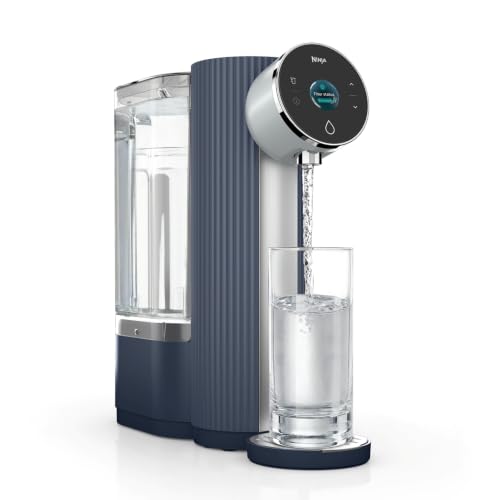
This is the pick for anyone who wants cleaner drinking water without touching a pipe. You set the Ninja HydraSense on your counter, plug it in, and fill the extra-large 96 oz reservoir — that is roughly six standard water bottles before you refill. From there a one-touch button fills your glass, coffee reservoir, or bottle to the volume you set, and you never lift a pitcher again.
What you get for your money is serious filtration. It removes up to 99% of 80+ contaminants, including microplastics, pharmaceuticals, and PFAS “forever chemicals” (industrial compounds that resist breaking down). IAPMO R&T independently certifies it to NSF/ANSI 42, 53, and 401 — the standards that cover taste, health-related contaminants, and emerging compounds. It also keeps the natural minerals and electrolytes in, so the water tastes clean rather than flat. Filter life is 6 months or every 120 gallons, and the touchscreen tracks exactly how much you have used so you replace on schedule, not by guesswork.
The honest trade-off is capacity and speed versus a plumbed system. The 96 oz reservoir is generous for a household’s drinking water, but it is still a countertop appliance that needs refilling and occupies 14.37 inches of counter length. Pour-in ice plus the recirculate cycle chills it, though it will not match a dedicated fridge dispenser. And the certification label is the reason it sits at the top: this is the system that does the most contaminant filtering of any countertop unit here without a single tool.
Why it earns the top slot
- Certified to NSF/ANSI 42, 53, and 401 — a full contaminant panel from one box
- 96 oz reservoir limits refill trips for a household
- One-touch volume dispensing instead of a slow pitcher pour
- Touchscreen usage tracking keeps filter swaps accurate
- No plumbing, no installation — plug in and fill
Where it asks something of you
- Counter space is real: 14.37 inches long by 5.07 inches wide
- You refill the reservoir; it does not connect to your supply line
- Chilling depends on adding ice or fridge storage
- Filters must be swapped twice a year to keep certification-level performance
Point it at: renters and kitchen-counter households who want certified drinking-water filtration with zero install.
Not the one if: you need every shower and appliance treated — that calls for a whole-house unit further down.
2. Aquaboon 20″ x 4.5″ Whole House
The entry ticket to treating every faucet in the house at once
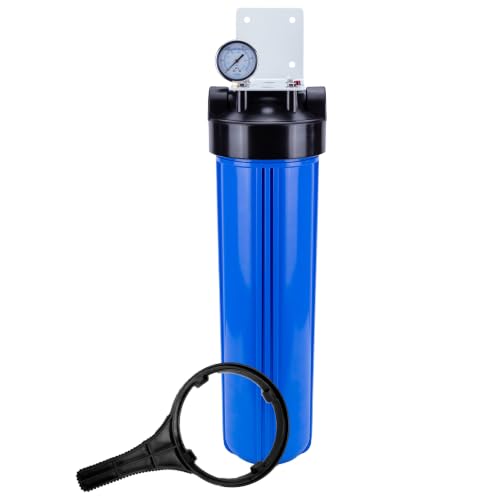
If you are on a budget but still want whole-house coverage, the Aquaboon is the lowest-cost way onto the main line here. It is a single-stage housing in reinforced polypropylene (a tough plastic that resists chemicals) with 1-inch inlet and outlet ports, so it handles high-flow applications without choking your pressure. One housing, one cartridge, and it treats both drinking and utility water for the whole house.
Set expectations on the filtration before you buy. This is a sediment and chlorine-reduction stage — it is built to stop grit and cut chlorine, not to match the multi-stage contaminant list of a reverse-osmosis unit. What it does deliver is the physical build: a 100-gallon capacity rating and a pressure release valve that makes cartridge swaps far less messy than a housing without one. The 10.4-pound unit mounts to a bracket, and the 1-inch ports are the standard most home supply lines run.
One caution keeps it out of the top spot. Buyers report leakage at the input and output connections, and threading gets mentioned too — so use thread sealant, do not overtighten, and check the joints under pressure before you button up the wall. Get the connections right and it is a solid, low-cost first whole-house stage. Rushing the install is where these go wrong.
The value read: a single-stage whole-house housing with a pressure release valve at the entry-level tier. Buy it as a sediment/chlorine first stage, pair it with good thread sealing, and it earns its keep.
Know before you plumb: leakage and threading need careful handling at install — this is not a snap-together job.
Reach for this if: budget leads and you want one filter treating the whole house’s sediment and chlorine.
Look elsewhere if: you want heavy-metal or pharmaceutical reduction — this housing does not carry that filtration load.
3. GE Whole House Water Filtration System, GXWH40L
Watch your filter fill up without opening a thing
The GE GXWH40L leans on one feature you will appreciate every month: a clear sump (the see-through bottom housing) that lets you eyeball the cartridge and know exactly when it is loaded with sediment. No disassembly, no guessing. The kit also includes a three-way bypass valve so you can swap filters without shutting the whole house down, plus a pressure relief valve, mounting bracket, and a 1-inch plumbing connection.
What it filters is sediment, scale, dirt, and rust — the stuff that gums up appliances and leaves stains. It is certified for that job, not for chlorine or heavy metals, so treat it as a pre-filter stage that protects the plumbing and fixtures downstream. The 4 gpm flow rate is the figure to respect: this is a lighter-duty main-line unit suited to smaller applications rather than a large household running several fixtures at once. Filter life runs 3 months on FXHTC or FXHSC cartridges, which are not included.
The comparison worth making is on flow. The Waterdrop and iSpring whole-house systems below move 15 gpm to this unit’s 4 gpm, so if pressure at the far shower matters, the GE is the more modest choice. Where the GE wins is simplicity and that clear housing — it is the easiest whole-house unit here to live with if your water is mainly gritty and rusty.
What owners like most: the clear housing and bypass valve make maintenance genuinely easy to see and do. It is built for sediment and rust, and it does that without fuss.
Mind the throttles: 4 gpm limits it to smaller setups, and you buy FXHTC or FXHSC filters separately every 3 months.
Match it to: a smaller home or cabin where sediment and rust are the problem and a 4 gpm line is plenty.
Skip the pairing if: you need high flow for a busy household — step up to a 15 gpm system.
4. Purewell 2.25G Gravity

Tight 0.01-micron filtration that runs on nothing but gravity
For a cabin, a camper, or a kitchen where you do not want another plug, the Purewell is the answer. It is a two-chamber stainless steel countertop unit: pour unfiltered tap water in the top, let gravity pull it through the filters, draw filtered water from the spigot below. No electricity required, which is also why it travels well. The transparent water-level window lets you check the top chamber without lifting the lid.
For a gravity system, the filtration is remarkably fine. A 0.01-micron hollow-fiber UF membrane (UF means ultra-filtration, a membrane fine enough to block particles far smaller than a grain of sand) plus a silver ion membrane and activated carbon block reduce chlorine and intercept rust, sediment, organic matter, and heavy metals. Against tight filtration the trade is speed: the flow rate is 0.06 gpm, so filling a large pot takes patience. What wins people over is taste — the water quality is the reason this sits high on owner lists, and the 2.25-gallon capacity keeps a steady supply on hand.
Two filters come in the box, each rated for up to 3000 gallons, with a recommended swap every 6 months. It does not lower TDS (total dissolved solids), so if your goal is mineral-free water this is not that machine — it targets contaminants and taste instead. The practical tip from the manual: do not pour tap water into the top chamber while the bottom is still full of filtered water, or you invite a leak. Respect that and it is a dependable, cord-free purifier.
What makes it worth the counter space
- 0.01-micron membrane filtration without any power draw
- Water-level window shows supply at a glance
- Two filters included, each up to 3000 gallons
- Stainless steel body suits kitchen or off-grid use
The catch worth knowing
- 0.06 gpm flow means slow refills for big pots
- Does not reduce TDS — this is a taste and contaminant filter
- Overfilling the top chamber with a full bottom invites leakage
- Chlorine reduction, not a full reverse-osmosis contaminant strip
Best fit: off-grid, camper, or power-free kitchen setups where fine filtration beats speed.
Pass if: you want fast fill rates or TDS reduction — this one is deliberate and mineral-preserving.
5. APEC Water ROES-50X 5-Stage Under Sink RO System
Five stages of reverse osmosis tucked out of sight under the sink
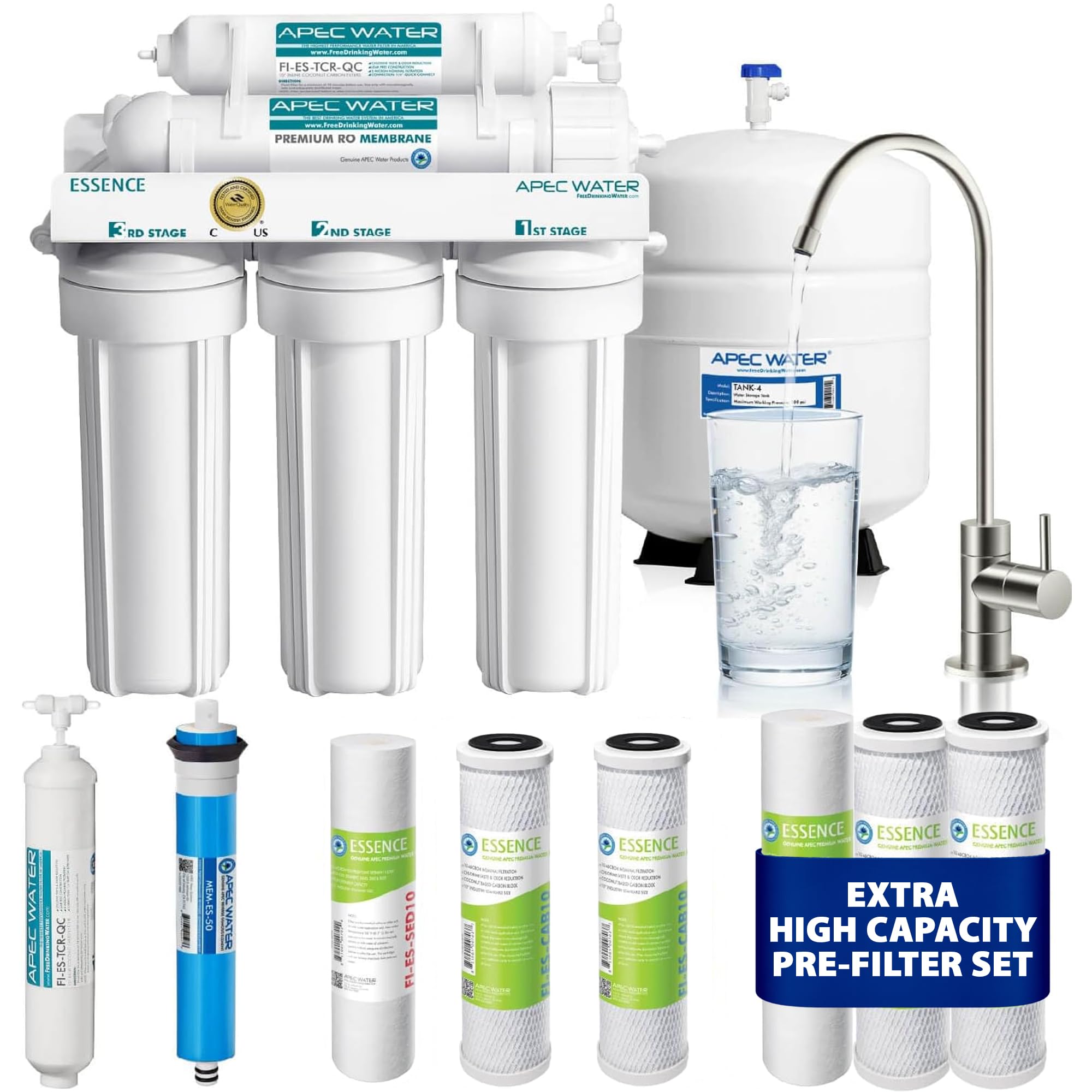
For drinking water that has been stripped to near-pure, reverse osmosis is the tool, and the APEC ROES-50X is a five-stage version rated at 50 GPD (gallons per day of output). It cuts up to 99.99% of impurities — arsenic, chlorine, lead, fluoride, heavy metals, PFAS, and microplastics — and carries NSF 372 (lead-free materials) and NSF 58 (reverse-osmosis performance) certification. It comes with the brushed nickel faucet, a water tank, an installation kit, and an extra high-capacity pre-filter set.
Installation is the part owners talk about most, and happily: quick-connect fittings and color-coded tubing make the DIY setup manageable, which is why it is a popular under-sink choice. The filter life is the standout metric — a 2-year cycle on the spec sheet, with a recommendation to swap stages somewhere between 6 and 24 months depending on your incoming water. That long interval is the reason the higher upfront tier pays off over time. The included extra filter set is a genuine bonus; opinions on how generous that set is do vary.
The honest side: leakage around connections shows up in the feedback, so treat the fittings with care during install and check them once under pressure. Durability notes are rarer but present. At 25 pounds it is a substantial unit, so confirm under-sink clearance before you commit. Route it right and you get a quiet, ultra-pure tap for years between filter changes.
The value read: a 2-year filter cycle and an extra pre-filter set offset the premium better than a shorter-cycle system would. The 50 GPD output keeps a household drinking supply topped up.
The install caveat: quick-connect fittings make it DIY-friendly, but leakage at connections rewards careful, pressure-tested assembly.
Made for: households that want the purest drinking water on the market and can spare under-sink space.
Not ideal if: you only need taste and chlorine fixed — a countertop or whole-house unit gets there with less plumbing.
6. Waterdrop G5P500A Reverse Osmosis
A tankless RO that fills a cup in seconds and puts minerals back
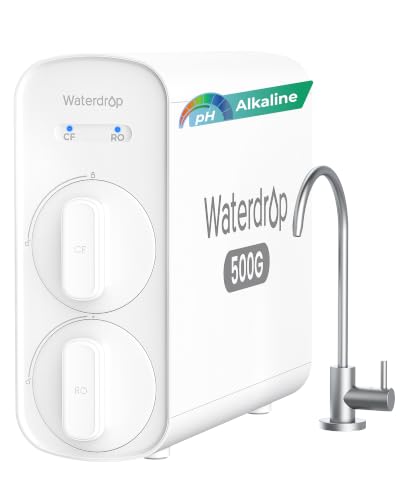
Where a tank RO gives you a big storage bladder, the Waterdrop G5P500A goes tankless and frees up to 70% of your under-sink space. The output is the headline: 500 GPD, enough to fill a 6-ounce cup in about 8 seconds, so you are not waiting on a slow trickle for every glass. Eight filtration stages reduce PFOA, PFOS, chlorine, lead, fluoride, heavy metals, and other impurities, and the unit is NSF/ANSI 58 and 372 certified.
what separates it from the APEC RO system is the mineralization stage. After a 0.0001-micron RO membrane (fine enough to stop essentially all dissolved matter), an alkaline stage adds back calcium, magnesium, sodium, and potassium — so the water lands clean but not stripped. The 2:1 pure-to-drain ratio is another efficiency point, producing more clean water per gallon of waste than conventional RO designs. It also supports connecting to an ice maker or fridge via the manufacturer’s accessory line.
Two things to plan for. Faucet installation requires drilling a hole in your countertop, so this is a more permanent commitment than a countertop unit. And the noise feedback is genuinely split — some owners find it quiet, others report persistent beeps, so placement away from living space is wise. Pair those with the tankless footprint and the mineral stage, and it is the under-sink pick for anyone who wants fast, remineralized water without a bulky tank.
Speed and minerals: 500 GPD filling a cup in about 8 seconds, plus an alkaline stage that restores calcium, magnesium, sodium, and potassium. Tankless footprint keeps your cabinet usable.
Two real commitments: countertop drilling for the faucet, and mixed noise reports including beeping on some units.
Choose it when: you want fast, remineralized RO water and can spare a drilled countertop hole.
Think twice if: you cannot drill the counter or need dead-quiet operation under a bedroom wall.
7. Waterdrop WHF3T-PG 3-Stage Whole House Water Filter System
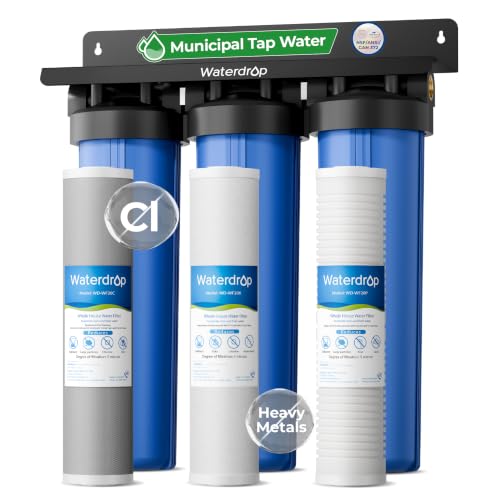
Whole-house flow at 15 gpm with strong chlorine reduction
When you want a shower that does not smell of chlorine and appliances protected downstream, the Waterdrop WHF3T-PG is built for the job. Its three stages cut up to 98% of chlorine and also reduce heavy metals, sediment, and odors. It supports both well and municipal water, and the 15 gpm flow rate means it keeps up with a busy household rather than starving the far faucets the way the 4 gpm GE unit can.
The parts that touch your water come with their own paperwork. IAPMO R&T certifies it to NSF/ANSI/CAN 372 for lead-free materials, the KDF media (a copper-zinc blend that helps pull out heavy metals and chlorine) meets NSF/ANSI 42, and the components are tested to REACH SVHC and RoHS requirements. In plain terms, the parts that touch your water are checked for what is in them. The 15 gpm rate and 1-inch inlet and outlet make it a proper main-line install, and 3-stage cartridges are included along with a wrench and mounting hardware.
Plan the maintenance around a shorter cycle than you might expect. The spec sheet lists a 90-day filter life, so this is a four-swaps-a-year system, not a once-a-year one — the maker notes actual life depends on water quality. Budget for cartridges accordingly. Weigh that against the 15 gpm throughput and the certified materials and it is a strong high-flow choice for a chlorine-heavy municipal supply.
Where it wins: 15 gpm throughput with up to 98% chlorine reduction and certified lead-free, KDF-based filtration — a full main-line treatment.
Set the calendar: a 90-day filter life means quarterly swaps; water quality can shorten it further.
Built for: larger households on chlorinated municipal water that need strong whole-house flow.
Consider another if: you want a once-a-year filter interval — this one wants quarterly attention.
8. iSpring WGB22B 2-Stage Whole House Water Filtration System
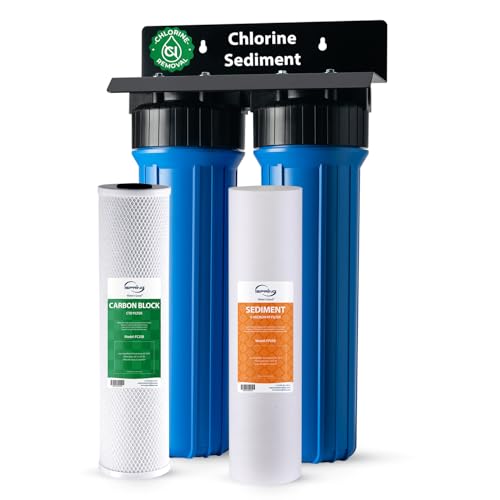
The whole-house unit that keeps to standard cartridges you can find anywhere
Here is the whole-house choice for anyone tired of proprietary cartridges. The iSpring WGB22B runs two standard 20″ x 4.5″ filters — a 5-micron sediment stage and a coconut-shell carbon block — so replacements are widely available and budget-friendly over the life of the system. That one decision saves money year after year compared with systems locked to their own cartridges.
Independent testing rates it for up to 99% chlorine reduction plus sediment, rust, odors, and bad tastes, at 15 gpm through 1-inch FNPT connections. It is rated for up to 100,000 gallons of filtered water, typically about a year of use, and it preserves naturally occurring minerals rather than stripping TDS the way reverse osmosis does. Installation is DIY-friendly, backed by detailed video guides, a heavy-duty 9-inch filter wrench, and double O-ring seals. It is a 36-pound unit, so mount it with support in mind.
Compared with the Waterdrop WHF3T-PG above, the trade is interval versus load: the iSpring publishes a 1-year filter cycle against the Waterdrop’s 90 days, so fewer swaps but a 2-stage rather than 3-stage treatment. Watch for the usual whole-house caveat — owners mention leakage around the fittings, so careful assembly and fresh seals matter. What earns it this spot is the quality reputation and the standard-cartridge economics that keep it cheap to own.
Why owners keep buying it
- Standard 20″ x 4.5″ filters — no proprietary lock-in
- Up to 99% chlorine reduction at 15 gpm flow
- 100,000-gallon / roughly one-year cartridge life
- DIY video guides, wrench, and double O-ring seals included
- Preserves healthy minerals instead of stripping TDS
What to handle with care
- Leakage at fittings shows up — assemble and seal carefully
- 36 pounds means solid mounting support
- 2 stages, so no dedicated heavy-metal media like a 3-stage unit
- Durability notes are a small but present part of the feedback
The obvious call for: whole-house buyers who want strong chlorine reduction without cartridge lock-in.
Weigh instead: if you need heavy-metal media, a 3-stage system covers more ground.
9. SimPure 3 Stages Clear
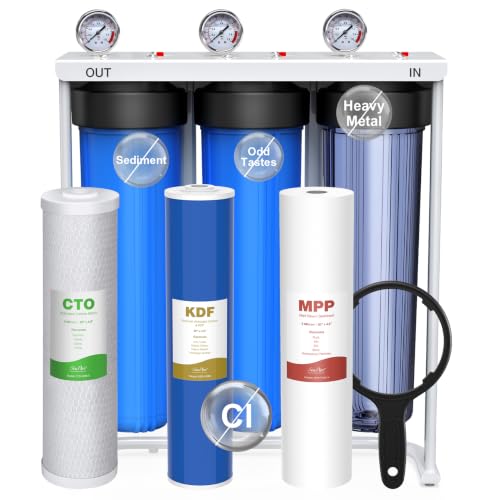
Three stages aimed squarely at well water with lead and heavy metals
If your well water carries metals, this is built for you. The SimPure runs three stages: MPP catches sand, rust, and sediment; KDF (a copper-zinc alloy media) helps reduce heavy metals such as lead and hexavalent chromium along with chlorine and odors; and CTO carbon block polishes residual taste and traps fine carbon. Brass fittings and 2×2 O-rings make for a secure seal on the 1-inch NPT connections.
Two practical touches stand out. The clear housing lets you watch cartridge wear without disassembling anything, which makes timely swaps easy. And the 15 gpm flow rate handles a whole home’s demand, from drinking to bathing to laundry, while the filtration protects your washing machine, water heater, and dishwasher from rust and sediment that cause clogs and corrosion. It takes standard 20″ x 4.5″ cartridges and is rated for up to 150,000 gallons.
Budget for a mixed maintenance picture. The carbon filter is listed at 3-6 months while the sediment and GAC filters can run 6-12 months, so the stages do not all fall due at once. The 48-pound wall-mount body needs solid support, and leakage around connections appears in the feedback, so careful sealing is the job. The build quality is the reason it earns its place on this list — treat the install with patience and it is a serious heavy-metal filter.
What stands out: KDF media for lead and hexavalent chromium reduction, a clear housing to watch wear, and 15 gpm flow — a well-water workhorse.
Plan around: staggered filter intervals (3-6 months for carbon, 6-12 for sediment and GAC), a 48-pound wall mount, and careful sealing to avoid leaks.
Right for: well-water homes dealing with lead, heavy metals, and sediment that need whole-house throughput.
Look at the iSpring instead if: you want simpler standard-cartridge swaps and a lighter body.
Know the Specs
Micron Rating and Filter Stages
A micron is one millionth of a meter, and the number on a filter tells you the smallest particle it can stop. A 5-micron sediment stage catches sand and rust; a 0.01-micron membrane (found on the Purewell) blocks far finer material, and a 0.0001-micron RO membrane (found on the Waterdrop G5P500A) is finer still. More stages usually means more types of contaminant handled — for example a KDF stage adds heavy-metal reduction — so match the stage count to what your water actually carries.
Flow Rate and Capacity
Flow rate is how fast water moves through, shown as gpm (gallons per minute) or GPD (gallons per day). Whole-house units here run 4 to 15 gpm, so a 15 gpm system keeps up with several fixtures where a 4 gpm one suits a smaller setup. Capacity is the total volume before a cartridge change — from a 2.25-gallon gravity reservoir up to 150,000 gallons on a whole-house system. Bigger capacity with a long filter cycle means fewer swaps; a short cycle like 90 days means more frequent changes.
Common Questions
Do I need a whole-house system or just a countertop purifier?
Does reverse osmosis remove minerals I actually want?
How often will I be replacing filters?
Can a gravity filter really match a reverse-osmosis system?
Why do so many whole-house systems mention leaks?
Will a whole-house filter lower my water pressure?
Do I need to drill a hole for an under-sink RO system?
Does a water filter reduce TDS?
What water pressure and temperature do whole-house systems need?
Can I use standard replacement cartridges instead of brand filters?
The Bottom Line
For most people, the best water cleaning system is the one matched to the job. The crowd favorite for all-around drinking water is the Ninja HydraSense WF1001 — 4.5+ stars across 900+ owners and certified to NSF/ANSI 42, 53, and 401 with no installation at all. If you want whole-house coverage with strong chlorine reduction and standard cartridges you can find anywhere, the iSpring WGB22B at 15 gpm is the pick to reach for. And for the purest drinking water with a tankless footprint, the Waterdrop G5P500A fills a cup in about 8 seconds and puts minerals back. Start with your water’s biggest problem — chlorine, sediment, or dissolved metals — then pick the type that solves it.
How we choose
We do not accept paid placement. Every pick is matched to a real buyer and a real use-case; we do not hands-on test units.
Sources
Specifications: manufacturer listings and product documentation. Review insights: verified customer reviews, as of November 2026. Pricing: not shown on this page (it changes often); check the current price via the retailer link.
As an Amazon Associate, Tactical Gear Guy earns from qualifying purchases. This does not affect which products we feature.