Specs are compiled from manufacturer listings and verified buyer reviews and can change over time — please confirm the key details on the product page before buying.
If you own an iPhone, most of your choice is already made for you: a watch that pairs cleanly over Bluetooth and pushes texts, calls and app alerts to your wrist. But many watches advertised as “iOS compatible” pair for notifications and stop there, with no replies, calls or app installs. The picks below all genuinely work with an iPhone, and they split into two clear camps a normal buyer can decide between in a minute.
This guide is built by comparing the manufacturers’ published specifications and the patterns across verified customer reviews, so you get each pick’s real strengths and trade-offs instead of marketing spin.
The nine watches below run from a do-everything Apple model to a solar-assisted outdoor tool, and they all talk to your phone the same way. Here’s the straight answer on the best watch compatible with iphone.
Top Picks

How To Choose The Best Watch Compatible with iPhone
Pairing is the easy part — almost anything with Bluetooth will connect to an iPhone once. The real question is what the watch can still do after it connects, and that answer changes completely depending on the watch’s software. These four specs decide whether a watch stays on your wrist or ends up in a drawer.
Native pairing versus companion-app pairing
An Apple Watch is built by the same company that made your iPhone, so it connects at the system level and pulls in messages, calls and Siri without a middle layer. Everything else on this list talks to your iPhone through a companion app (a separate program you install on the phone). That app pushes your notifications across and pulls your health data back, which works well but adds one more step if you switch phones. Just know that a companion-app watch may not deliver full reply-to-text support, and check that specific point before buying.
GPS: built-in versus connected
A watch with built-in GPS records your route on its own, so a run or ride is tracked even when you leave the phone at home. A watch with connected GPS borrows the phone’s location instead, which is fine for daily walks but means the phone has to come along. If you care about offline maps — pre-downloaded street or trail maps stored on the watch — that feature only exists on watches with built-in GPS and onboard storage. Watches with GPS supported by multiple satellite systems tend to lock on faster in tree cover and between buildings, which matters more than the satellite count itself.
Battery measured in days, not hours
A watch spec’d at 18 hours of battery is designed around a nightly charge, so that routine has to fit your life. Models listing 10 to 20 days of typical use can go a full week or two between charges, which is the difference between a device you maintain daily and one you forget about. Be realistic: those long figures usually assume typical use with the always-on screen dimmed or off, and heavy GPS use drops the numbers hard. Look for a stated continuous-GPS figure if you plan to run long distances.
Water ratings you can actually read
3ATM means the watch handles rain, sweat and surface swimming. 10ATM is rated for deeper pressure and is the usual bar for a watch you’d dive or surf with. If you swim laps or work outdoors in weather, choose based on that number rather than the marketing word “waterproof.” Also check the band material — silicone wipes clean and dries fast after a swim, while leather and resin need more care.
Side-by-Side Comparison
| Model | Best For | Battery (typical) | Display | GPS | Amazon |
|---|---|---|---|---|---|
| Apple Watch SE 3 GPS 40mm★ Best Overall | Full iPhone integration | 18 hours | 40mm case | GPS | Amazon |
| Military Smart Watch (SOUYIE)Rugged Value | Rugged outdoor tool | 10 days | 1.43″ AMOLED | Built-in, 6 systems | Amazon |
| Amazfit Bip MaxBattery King | Battery and screen size | 20 days | 2.07″ AMOLED | Built-in, 5 systems | Amazon |
| Amazfit Active 2 Premium | Training plans and maps | 10 days | 1.75″ AMOLED, sapphire | Built-in, 5 systems | Amazon |
| Garmin vívoactive 5 | Health insights and music | 11 days | AMOLED, 42mm | Built-in | Amazon |
| Garmin Instinct 3 Solar | Solar charging and toughness | 28 days | 0.9″ solar lens | Multi-band | Amazon |
| Apple Watch SE 3 GPS + Cellular 44mm | Phone-free calls | 18 hours | 44mm case | GPS | Amazon |
| Withings ScanWatch 2 | Hybrid analog looks | 35 days | Analog hands | Connected GPS | Amazon |
| Garmin fēnix 7X Sapphire Solar | Off-grid adventures | 28–37 days | 1.4″ always-on | Multi-band GNSS | Amazon |
Detailed Reviews
1. Apple Watch SE 3 GPS 40mm Smartwatch
Our pick — 4.5+★ from 5,000+ verified ratings; the strongest balance of quality and price.
The only watch here that pairs at the system level, with no companion app to install.
If you want your iPhone and your wrist to behave like one device, this is the pick. Because Apple builds both ends, the SE 3 pairs at the system level, so your texts, calls, music and Siri all land on the watch without a middleman. You can send a text, take a call, listen to podcasts and get notifications through the watch itself or your iPhone or Wi-Fi connection. It also detects a hard fall or a severe car crash and automatically contacts emergency services and your emergency contacts.
Battery is the number to plan around. Apple rates the SE 3 at 18 hours of all-day battery, which means a nightly charge just like your phone. The upside is charging speed — it charges up to twice as fast as the SE 2 and can reach up to 8 hours of battery in just 15 minutes, which covers the “I forgot to charge it before dinner” scramble. A 40mm case keeps the watch modest on smaller wrists, and you get dozens of customizable faces plus a wide range of bands in different colors, styles and materials to change the look without changing the watch.
This is the crowd favourite by a wide margin, and the evidence is the size of its following: 4.5+ stars across 5,000+ ratings. What wins people over most is sheer build quality, followed by how much it does day to day. The honest trade-off is the one Apple itself prints on the box — 18 hours is a daily charging habit, and that’s the single thing that pushes mellow users toward a multi-day Garmin. Sleep tracking, gym sessions, steps and heart rate all get the job done, and setup takes minutes.
What it does better than anything here
- Native iPhone pairing — no companion app, no notification lag
- Fall and crash detection that contacts emergency services automatically
- Charges up to twice as fast as the SE 2, with 8 hours of battery in a 15-minute top-up
- Dozens of customizable faces and a wide band selection
Where it asks something of you
- 18-hour battery makes a nightly charge routine non-negotiable
- GPS-only model — no offline maps or multi-day battery
- Wrist notifications will feel repetitive if you’re in a chatty group thread
Reach for this if: you want texts, calls and Siri on your wrist without fuss, and you’re fine plugging in each night.
Look elsewhere if: a daily charge is the deal you refuse to make — a watch listing 10 to 20 days fits you better.
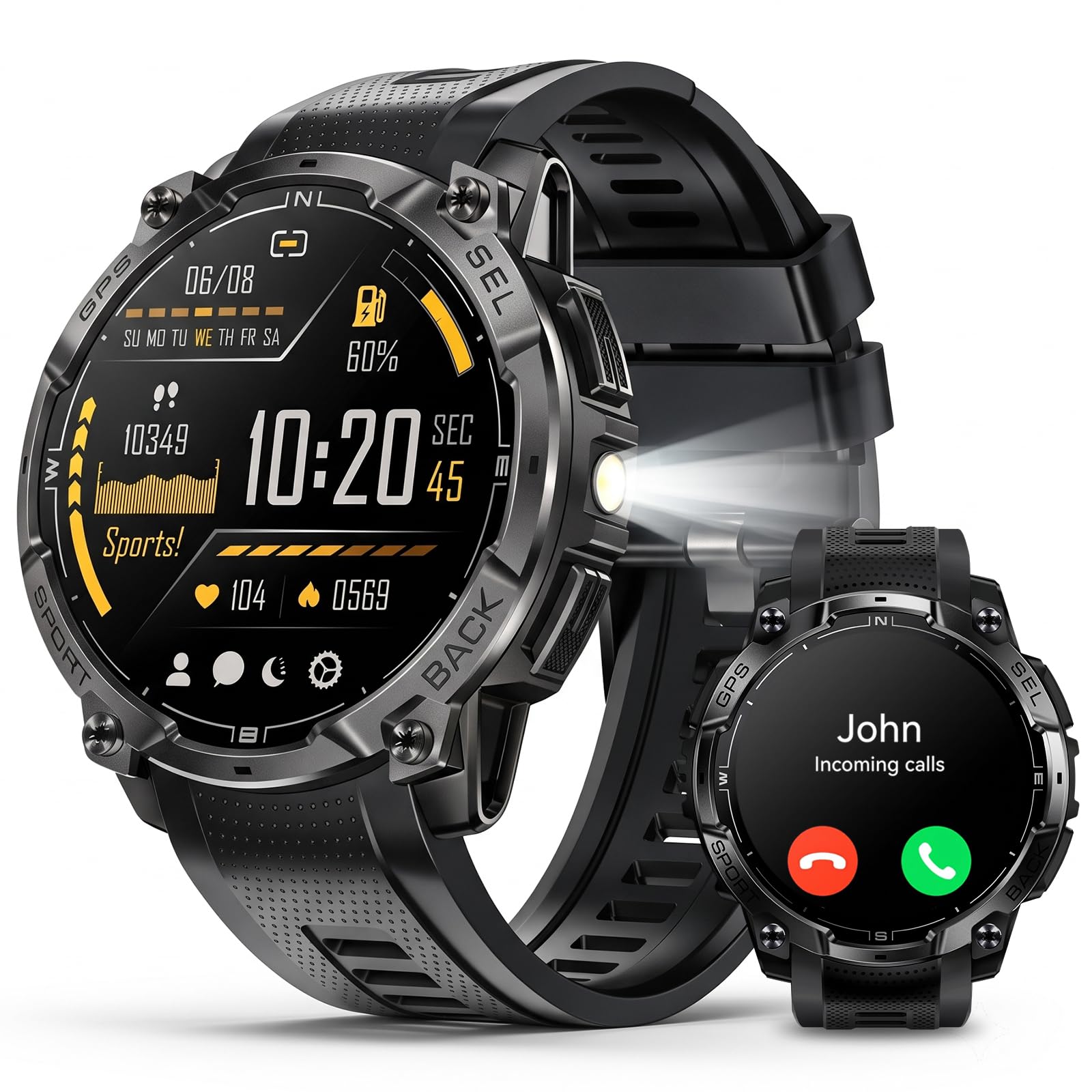
2. Military Smart Watch
A 530mAh battery, a built-in flashlight and six satellite systems in one zinc-alloy shell.
For hikers and campers who’d rather carry a tool than a status symbol, this SOUYIE watch is the interesting one. The 530mAh battery is rated for 7 to 10 days of normal use and up to 30 days of standby, with a full charge in about 2 hours. Put that next to the Amazfit Bip Max further down and you get the cleanest battery comparison on this list: 20 days of typical use versus the SOUYIE’s 10 days. Where the SOUYIE pulls ahead is in the outdoors kit — a built-in GPS that tracks your route and supports six satellite systems (GPS, GLONASS, BeiDou, Galileo, NAVIC and QZSS), plus a compass, altimeter, barometer and a high-brightness LED flashlight for night hiking, camping or an emergency.
The 1.43-inch AMOLED screen runs at 466×466 resolution, which is sharp enough to read time and notifications in direct sunlight, and you can pick from over 280 watch faces or use your own photo. The zinc alloy frame with tempered glass is built to shrug off scratches. It pairs with iOS 11.0+ and Android 5.0+, and call quality runs through its own speaker and microphone with up to 100 synced contacts and an SOS contact option.
The honest catch is the software layer. This is a companion-app watch rather than a native iPhone one, and the depth of iPhone integration won’t match the Apple Watch above. Its 3ATM rating covers rain, sweat and swimming but sits below the 10ATM Garmin Instinct 3 Solar in this list, so serious diving is out. The thing buyers respond to most is how it looks — the vacuum-plated zinc alloy and chunky build read as deliberate rather than cheap — with GPS accuracy the clear second. One spec quirk to note: the listing gives battery charge time as both 2 hours and 3 hours, so treat charging time as roughly a couple of hours, not a precise figure.
Who it’s built for: anyone who wants a real flashlight, compass and barometer on the wrist without paying premium-tier money, and who treats GPS as a convenience rather than a lifeline.
The honest limit: 3ATM water resistance is for rain, sweat and swimming — not diving — and the iPhone experience is app-mediated rather than native.
Best suited to: the camper or trail runner who wants gadgets on the wrist and doesn’t mind a companion app.
Less ideal for: the swimmer who wants a 10ATM rating, or the buyer who wants iPhone features to just work without setup.
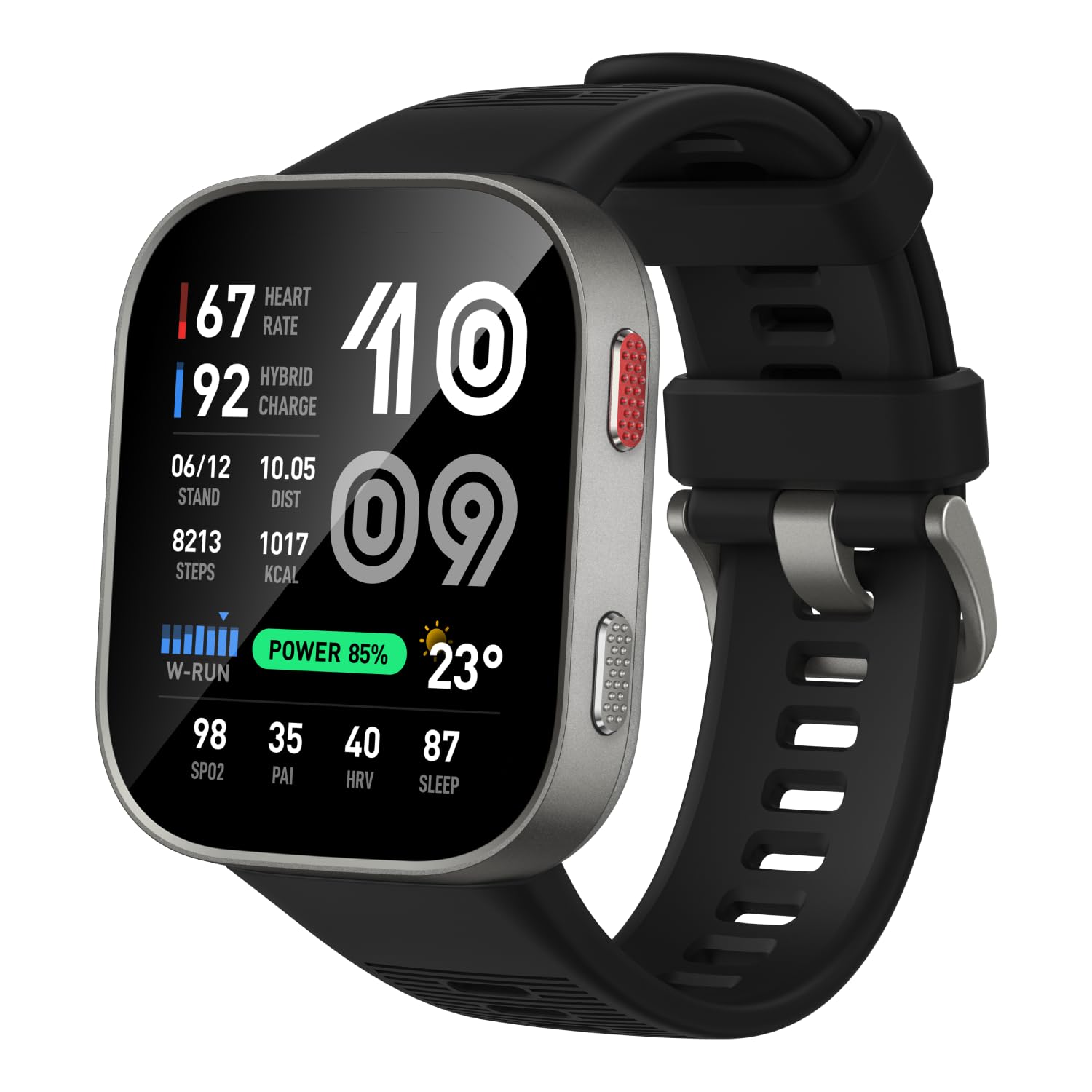
3. Amazfit Bip Max Smart Watch
Two weeks between charges, a 2.07-inch screen and maps that live on your wrist.
Twenty days of typical use is the headline here, and it’s a real change to how you live with a watch. If you’ve ever packed a charger for a long weekend, the Bip Max makes that charger optional. It also carries 4GB of onboard storage, which lets you store offline maps and media on the watch itself. As buyers put it: “With ample space for offline maps, this fitness tracker allows you to leave your phone behind and enjoy quick, easy access to your media while you explore.” That offline capability is the difference between a phone-tethered tracker and a watch you can genuinely take off-grid.
The 2.07-inch AMOLED display is the largest screen on this list, and it’s paired with an aluminum alloy body and a two-button layout, so navigating menus is straightforward without hunting through a touch grid. GPS is backed by 5 satellite systems and you can download free detailed maps from the Zepp App with turn-by-turn directions and off-track alerts. Training sits inside the subscription-free Zepp App, which handles 150+ sports modes, adaptive Zepp Coach routines and metrics like VO₂ Max and Training Load, plus a BioCharge recovery score that shifts with your sleep, workouts and stress.
Where this one earns its place is plain value. What owners bring up most is how well made it feels for the tier, with battery life the next thing they mention — one customer pattern is charging only about once every two weeks rather than nightly. The honest limit is that this is a companion-app watch, not a native iPhone one, so you’re relying on the Zepp App for your notifications and sync. If you want Siri and iMessage replies on the wrist, the Apple Watch above is the better fit. If you want to stop thinking about charging, this is the one.
The case for it: 20 days of typical battery life, the biggest screen at 2.07 inches, and offline maps without a subscription.
The catch: iPhone features route through the Zepp App rather than working natively — no Siri and no native message replies.
4. Amazfit Active 2 Premium Smart Watch

Sapphire over stainless steel, with 2,000 nits of brightness for midday glare.
The Active 2 is the one you buy when the watch has to survive getting knocked around without looking like a sports accessory. The screen is 1.75 inches of AMOLED at 2,000 nits — the brightness figure that matters, because it’s what keeps the display legible in direct sun rather than washing out to grey. Sapphire crystal covers it, which is the scratch-resistant glass used on premium watches, and the body is polished stainless steel. Add a black leather strap and a red silicone strap in the box, and you can switch from office to run without buying another band.
Battery is rated at up to 10 days with typical use, up to 5 days with heavy usage, and up to 21 hours with continuous GPS tracking. There’s a 260mAh battery inside, and this is where you should be honest with yourself: 10 days is the light-use number, and heavy GPS work pulls it down to hours. Training features are unusually deep for the tier, with AI-generated workout plans that adapt to your recovery, plans for races from 3K up to marathons, 160+ workout modes including swimming and skiing, and an official HYROX Race mode for Single, Double or Team events. Maps download through the Zepp App with turn-by-turn voice directions through the speaker or Bluetooth headphones, backed by 5 satellite systems.
Owners consistently enjoy the look and the battery longevity, with charging roughly every 10 days matching the spec in daily practice. The recurring caveat is that this is a companion-app watch — iPhone users get notifications, calls and texts through the app rather than natively. The barometer makes it useful for skiing and swimming tracking, but 10 days of battery means it still lands in the weekly-charge camp rather than the fortnightly one the Bip Max sits in.
Why it stands out: sapphire glass and a stainless steel body in a tier where most watches are plastic, plus the brightest display on this list at 2,000 nits.
What to know going in: 10 days is a typical-use figure, and continuous GPS drops it to 21 hours — fine for training, not for multi-day backcountry trips.
Pick this one if: you want a watch that looks smart with a leather strap and holds up to scratches without a screen protector.
Pass if: you’re chasing fortnight-long battery life — the 5 days of heavy-usage rating won’t stretch that far.
5. Garmin vívoactive® 5
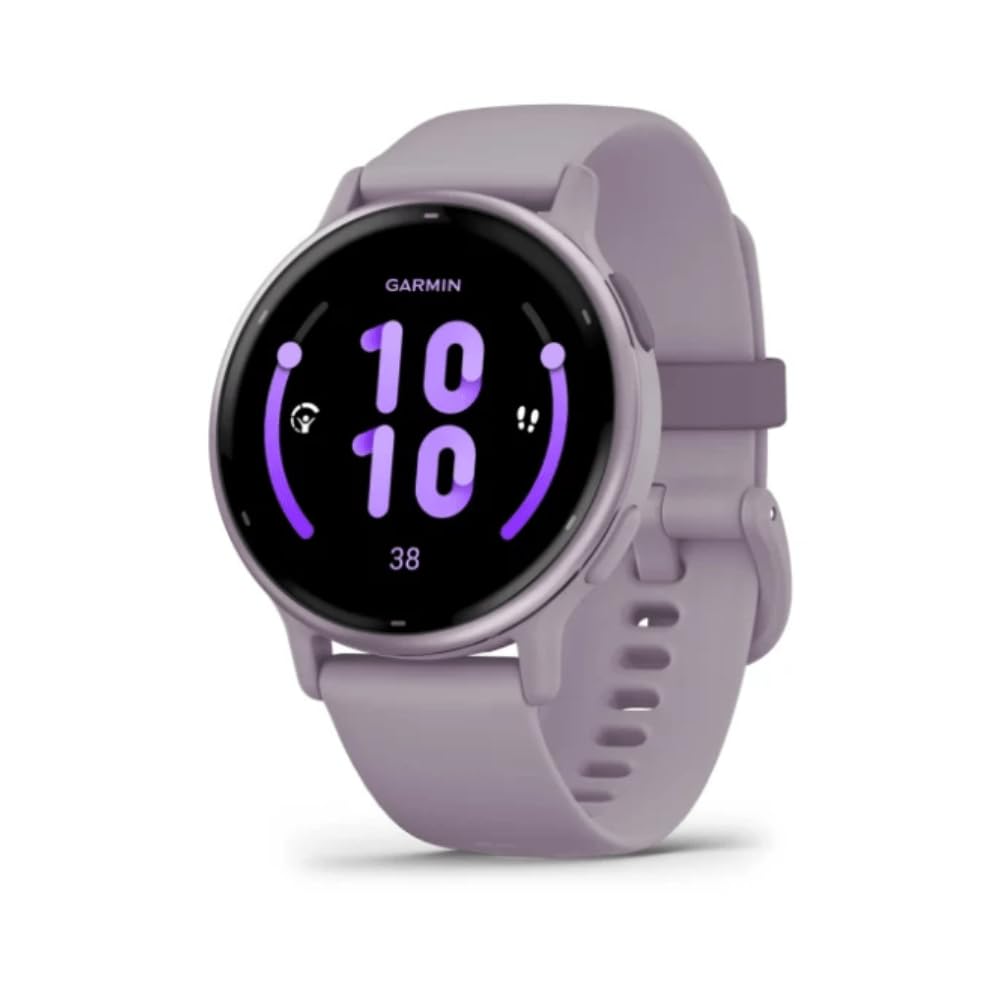
Up to 11 days of battery and a sleep coach that tells you what your body needs next.
If the reason you’d wear a watch is to understand your own recovery, the vívoactive 5 is built around that question. Garmin’s Body Battery energy monitoring shows when you’re charged up and when you need rest, factoring in sleep, naps, stress levels and workouts. It adds a sleep score with personalized coaching on how much sleep you need, plus HRV status as a key health metric — Garmin notes these figures are close estimations rather than medical readings, and this is not a medical device. Automatic nap detection logs your naps and shows how they affect that energy score.
Battery is rated up to 11 days in smartwatch mode, so roughly a week and a half between charges with the bright AMOLED display running. The activity list is long — more than 30 built-in indoor and GPS sports apps covering walking, running, cycling, HIIT, swimming and golf. A wheelchair mode tracks pushes instead of steps and includes push and handcycle activities with preloaded workouts and challenges built for wheelchair users. You can also download playlists from Spotify, Amazon Music or Deezer onto the watch and listen through wireless headphones without your phone.
Where buyer sentiment splits is depth versus simplicity — the watch earns praise for its looks and its sheer feature count, and owners find the setup easy, but a slice of them describe the menus as complicated to operate. Battery life also draws a mixed verdict from owners, with some getting outstanding runtime and others reporting less than hoped. That’s the pattern you should expect from a device this feature-dense: the more you use GPS and music, the shorter your eleven days become. It’s a fair trade for the breadth, but it means the flagship number is a best case.
What earns the wrist space
- Up to 11 days in smartwatch mode with an AMOLED display
- Body Battery energy monitoring plus a sleep score and personalized coaching
- Wheelchair mode with push-based tracking and dedicated challenges
- Music downloads from Spotify, Amazon Music or Deezer for phone-free listening
The friction to expect
- The menu system earns a complicated-to-operate note from part of the audience
- Battery gets a mixed verdict once GPS and music enter the picture
- Not a native iPhone watch — notifications arrive through Garmin Connect, not the system layer
Choose it for: recovery and sleep insight you’ll actually read, with a battery that clears a workweek comfortably.
Think twice if: you want set-and-forget simplicity — the depth here takes a few evenings to learn.
6. Garmin Instinct® 3 Solar, Rugged GPS Smartwatch, 45mm, Black

A 28-day battery, a solar lens and a 10 ATM shell built to MIL-STD-810.
Some buyers want a watch that can be dropped, soaked and forgotten about, and this is that watch. The fiber-reinforced polymer case with a metal-reinforced bezel is a 45mm chunk of deliberate overbuild, rated 10 ATM for water and tested to MIL-STD-810 for thermal and shock resistance — the military durability standard, in plain terms a bake-and-bounce test. The battery is rated at 28 days, and the solar charging lens can extend that with all-day wear and about 3 hours per day outside in 50,000 lux conditions. That’s bright sun, so treat solar as an extender rather than a replacement for the charger.
Lower down this list, the fēnix 7X pairs solar with a 1.4-inch always-on display and preloaded TopoActive maps; the Instinct 3 keeps things tighter with a 0.9-inch display and a more focused kit. What it does carry is genuinely useful in the field: a built-in LED flashlight with variable intensities and strobe modes, multi-band GPS with SatIQ technology to balance positioning accuracy against battery drain, and a 3-axis compass with a barometric altimeter. Garmin Pay contactless payments let you leave cards at home, and safety features include incident detection during select activities and an Assistance function that sends your live location to emergency contacts when paired with your smartphone.
This is the second-highest-rated watch in the article, and the buyer verdict backs the rugged pitch — durability, solar charging and fitness tracking all come up positively. The honest limit sits right in the spec sheet: a 0.9-inch display is small, and if you’re used to the 2.07-inch screen on the Bip Max it will feel cramped reading notifications. Setup is quick, though part of the audience finds the feature set takes real learning, and some feel the premium tier is a stretch on value. That’s a taste call rather than a defect.
Built for the outdoors: 10 ATM water rating, MIL-STD-810 thermal and shock testing, a built-in LED flashlight and multi-band GPS with SatIQ all point at one job — surviving weather and terrain.
The concession: the 0.9-inch display is the smallest here, and stretch solar charging depends on real sun exposure, not indoor light.
Made for: the hiker, climber or field worker who needs a flashlight, compass and a watch that shrugs off impact.
skip it if: you mostly want to read texts on a big, bright screen — the display size works against that.
7. Apple Watch SE 3 GPS + Cellular 44mm Smartwatch
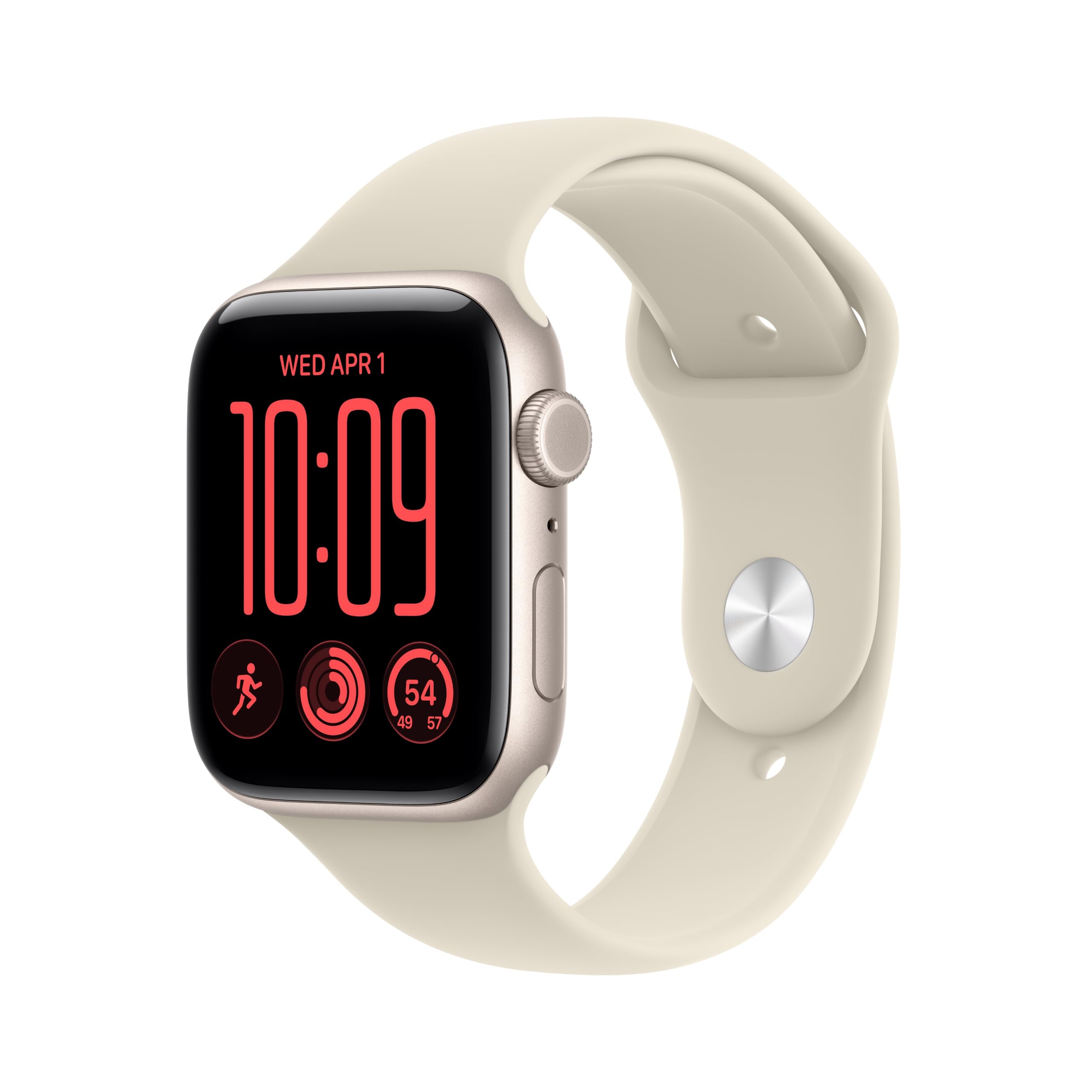
The same iPhone-native experience as the top pick, now with a bigger 44mm case and its own connection.
This is the SE 3 with two upgrades over the 40mm model at number one: a 44mm case that gives bigger wrists a better fit, and cellular, which means the watch can take and make calls, stream music and podcasts and play through your AirPods even without your iPhone nearby. That’s the feature that matters for a runner who doesn’t want a phone bouncing in a pocket, or a parent who wants a child reachable without handing over a phone. The Apple Watch For Your Kids setup lets parents set up the watch even when the child has no iPhone, so calls, texts and location sharing work without one.
The fitness and safety side matches the smaller model: workout tracking across running, strength training and 10K daily steps with real-time metrics and Workout Buddy, plus fall and crash detection that connects you with emergency services and notifies your emergency contacts. Battery is 18 hours of all-day use, with charging up to twice as fast as the SE 2 and up to 8 hours of battery from a 15-minute top-up. Siri AI is also here for questions, recipe ideas and post-workout stretch suggestions, with Apple noting it’s rolling out in English with usage limits.
Buyers are happy with how it works and what they get for the money, with the appearance and ease of use drawing steady praise, along with GPS tracking for heart rate and notifications out and about. The catch that comes with both Apple models remains the battery: 18 hours is a nightly charge. The other point to know is that cellular service runs through your carrier and adds a line, so check that cost before you commit. The 44mm case also carries a bit more weight on the wrist than the 40mm — 9.3 ounces for the package versus 8.6 ounces on the smaller model.
What cellular actually buys you
- Calls, music and AirPods playback without your iPhone nearby
- Apple Watch For Your Kids setup for a child without their own iPhone
- 44mm case suits larger wrists; Siri AI for on-wrist questions
- 8 hours of battery from a 15-minute charge
The costs to plan for
- Cellular needs a carrier line, which is an ongoing cost
- Still an 18-hour battery with a nightly charge
- Heavier on the wrist than the 40mm version
Worth it when: you leave your phone behind on runs or want a child reachable without a phone of their own.
Not worth it when: your iPhone is always within arm’s reach — the standard GPS model at number one does that job.
8. WITHINGS Scanwatch 2

Real watch hands on the front, health sensors underneath, and 35 days between charges.
Not everyone wants a glowing screen on their wrist, and the ScanWatch 2 is the answer for that crowd. It’s a hybrid — analog hands you tell time with the old-fashioned way, digital health tracking running underneath. The stainless steel case and sapphire glass give it the durability of a proper watch, and at 38mm with a rose gold finish and white resin band it’s the dressiest option in this group. The 35-day battery life is the longest on the list, well ahead of the 11 days the vívoactive 5 offers, and it’s designed to keep tracking through days and nights without interruption.
The health kit is the serious part. It records a 30-second medical-grade ECG and continuous heart rate with AFib detection through the Withings ECG App, plus high and low heart rate alerts. Sleep tracking covers stages and breathing, over 40 sports are supported with VO₂ max and heart rate zones, and a Vitality Score pulls it together. A month of Withings+ is included for the deeper insights. It connects to iOS and Android through the Withings App on its proprietary HealthSense OS, and GPS is connected rather than built-in, so it borrows your iPhone’s location for outdoor workouts.
Here’s the honest part: this is the lowest-rated watch on the list, and its buyer sentiment is genuinely mixed rather than a case of one grumpy voice. The design wins people over — the recurring theme is that it doesn’t read like a computer on the wrist. But functionality, accuracy, sleep monitoring and value all split opinions, and iOS compatibility is the one aspect buyers discuss in genuinely negative terms, which is unusual and worth flagging. If smooth iPhone integration is your priority, look at the Apple Watch picks above. If you want a watch that looks like a watch and goes over a month between charges, this is the one.
The draw: a 35-day battery, sapphire glass over stainless steel, and hands that sweep rather than a screen that glows.
The caution: iPhone compatibility is the weakest single review theme across this whole list — this is a watch for the buyer who prioritises looks and battery over tight phone integration.
Pick this for: a dress watch look with real health sensors and a battery that lasts over a month.
Pass if: you want bulletproof iPhone pairing — the app-based link here gets mixed reports.
9. Garmin Fenix 7X Sapphire Solar

Preloaded topo maps, a 1.4-inch always-on screen and a battery spec that runs past a month.
This is a serious navigation instrument that happens to tell time. The fēnix 7X pairs a scratch-resistant Power Sapphire lens with a 1.4-inch always-on display, and the solar charging runs alongside a lithium polymer battery for stated runtime of up to 28 days in smartwatch mode indoors, or up to 37 days with solar charging in 3 hours of direct sunlight at 50,000 lux per day. In GPS mode that becomes up to 89 hours indoors or up to 122 hours with continuous direct sunlight. Those are figures that let you take on a multi-day trek with a paper map backup and no charger anxiety.
Navigation is where it separates itself from the Instinct 3 Solar. It supports multi-band frequency and GNSS networks (GPS, GLONASS and Galileo) plus a 3-axis compass, gyroscope and barometric altimeter, and it comes with TopoActive maps preloaded along with thousands of golf courses and ski resorts worldwide. Built-in Wi-Fi lets you download maps for any continent without a computer, which is a real convenience on a trip. Training features include endurance and real-time stamina tracking, training status, advanced performance metrics and 30+ built-in sports apps. There’s a built-in LED flashlight for after-dark work, plus smart notifications from your paired phone, music storage and Garmin Pay in supported countries.
The thing to know before you commit is that this is a renewed unit — previously owned and restored rather than new. That’s why a 1.4-inch flagship-tier watch sits here, and it’s worth reading the listing’s condition notes carefully. Owner sentiment is positive on accuracy and versatility, with praise for how it handles both sports and smartwatch duties. Battery is the mixed point, with some owners getting close to the advertised days and others reporting less than 28 days. The 1.4-inch screen is bright and readable, though a slice of buyers report visibility could be better. If you want new-in-box, the Instinct 3 Solar above is the cleaner route to solar and flashlight features.
Made for: the hiker or trail runner who needs topo maps on the wrist, a battery spec beyond a month, and a watch that ignores scratches.
The caveat to weigh: this is a renewed unit, so read the condition terms closely and expect the thirty-seven-day solar figure to depend on real sunlight.
Know the Specs
Battery life in days
A “20 days” rating is a typical-use figure with the bright always-on display dimmed or off, so it measures the easy weeks, not the hard ones. The moment constant GPS or music streaming kicks in, expect a big drop — one watch here drops from 10 days typical to 21 hours of continuous GPS. Read both numbers if your plan is serious training or backpacking. An 18-hour rating means a nightly charge, full stop; anything listing 10 days or more means a weekly or fortnightly plug-in instead.
GPS and satellite systems
Built-in GPS records your route on the watch, while connected GPS borrows your iPhone’s location and needs the phone with you. Watchmakers often list how many satellite systems the watch can lock onto — GPS, GLONASS, BeiDou, Galileo and others — which affects how fast the watch finds you in tree cover or between buildings. Multi-band GPS is the tighter version of the same idea, improving positioning accuracy in difficult terrain. Offline maps only exist on watches with built-in GPS plus onboard storage, and they’re the feature that lets you leave your phone at home.
Water resistance ratings
3ATM covers rain, sweat and surface swimming. 10ATM is rated for the higher pressure of diving and surfing, and MIL-STD-810 is a durability standard for heat and shock — not a water rating at all. If you swim laps, use the ATM number as your filter. If you’re trail running in the rain, 3ATM is enough.
Case size and wrist fit
A 40mm or 42mm case sits lighter on smaller wrists, and a 44mm or 45mm case gives bigger wrists a better proportion. Band width matters for fit too: this group spans 20 millimeters up to 22 millimeters, so a replacement strap has to match that width. Strap material is a practical choice as much as a style one — silicone dries fast after a swim, leather doesn’t.
Common Questions
Will a Garmin or Amazfit watch work fully with my iPhone?
Do I need to install an app to use a non-Apple watch with an iPhone?
How long does the battery actually last on a watch rated at 10 days or 20 days?
Can I swim with a 3ATM watch?
What’s the difference between built-in GPS and connected GPS?
Is an Apple Watch SE 3 a better choice than a Garmin for iPhone users?
How big a watch case should I choose?
Are solar-charging watches worth it for regular use?
Is a renewed watch like the fēnix 7X worth considering?
The Bottom Line
For most iPhone owners, the watch compatible with iphone winner is the Apple Watch SE 3 GPS 40mm because it pairs natively — texts, calls and Siri arrive without a middleman app — and it carries the highest owner score in this group. If your bigger worry is charging, grab the Amazfit Bip Max, which lists 20 days of typical use and a 2.07-inch screen. And for trails, weather and night hiking, the Garmin Instinct 3 Solar is the one to reach for, with 28 days of battery, a 10ATM shell and a built-in flashlight.
One last nudge on how to decide: if you’d rather never think about a charger, the multi-day crowd here is where your money belongs. If you’d rather have your iPhone’s features land on your wrist exactly as they do on your phone, stay with Apple.
How we choose
We do not accept paid placement. Every pick is matched to a real buyer and a real use-case; we do not hands-on test units.
Sources
Specifications: manufacturer listings and product documentation. Review insights: verified customer reviews, as of November 2026. Pricing: not shown on this page (it changes often); check the current price via the retailer link.
As an Amazon Associate, Tactical Gear Guy earns from qualifying purchases. This does not affect which products we feature.