Specs are compiled from manufacturer listings and verified buyer reviews and can change over time — please confirm the key details on the product page before buying.
A watch battery tester tells you whether the cell inside a quartz watch is actually dead — or whether the problem is the movement itself. That distinction saves you from swapping a perfectly good battery, and it saves you from opening a watch case you did not need to open. Here is what matters most: pulse/impulse testing lets you check a watch circuit without removing the caseback, while plain voltage testing only measures what a cell can push out with almost no load on it. Both kinds appear in this list, and they answer different questions.
This guide is built by comparing the manufacturers’ published specifications and the patterns across verified customer reviews, so you get each pick’s real strengths and trade-offs instead of marketing spin.
You will see which units test button cells only, which handle household batteries too, and which add demagnetization for mechanical watches. By the end you will know exactly which Best Watch Battery Tester fits your bench.
Top Picks
How To Choose The Best Watch Battery Tester
The first thing to settle is what you are actually testing. A household-battery checker reads cylindrical and button cells but says nothing about the watch movement. A quartz analyzer reads the movement’s electronic pulse and tells you if the circuit is alive. Getting both jobs done means either two tools or one multi-function unit, and that single decision shapes everything else.
Pulse testing versus voltage testing
A pulse tester sends a brief signal through the watch and listens for the tick-back — the electronic pulse. It beeps or flashes to confirm the battery and circuit are working, and it can do that without opening the back. A voltage tester instead measures what the cell pushes out under a light load, which is useful for sorting a drawer of loose button cells. If you service watches for other people, the no-open pulse check is the feature that earns its place on your bench.
Which battery types the unit accepts
Watch work runs on button cells — silver oxide and lithium — at 1.5V and 3V. Some testers handle only button cells; others also take AA, AAA, C, D, 9V, CR123A, CR2, CRV3, 2CR5 and CR-P2. If you also maintain toys, remotes and smoke detectors, the wider compatibility saves you buying a second checker. If watches are the whole job, button-cell coverage is what counts.
Reading the result without a manual
A color-coded display that says Good, Low or Replace/Recharge is faster to read than a voltage figure you have to interpret. Bar-graph LCDs do the same job with segments. Analog needle meters are traditional and still common on watchmaker benches, but they ask more of you — you read the swing, not a printed verdict.
Side-by-Side Comparison
| Model | Best For | Testing Type | Min. Operating Voltage | Weight | Amazon |
|---|---|---|---|---|---|
| DLYFULL B2 Universal Battery Tester★ Best Overall | Household and button cell sorting | Voltmeter | 1.5 volts | 115 g | Amazon |
| Amprobe BAT-200Simplest To Run | No-battery-needed quick checks | Voltmeter | 1.5 volts | 1.6 ounces | Amazon |
| JADPES Quartz Tester and Demagnetizer | Mechanical watch demagnetizing plus quartz checks | Pulse Tester | — | 151 g | Amazon |
| Vruping Button Cell Tester and Quartz Analyzer | Button cells and coil testing | Battery Tester | 1 volt | 0.02 kg | Amazon |
| Imhoo Circular Pulse Tester and Button Cell Analyzer | Compact 1.5V and 3V button cell checks | Battery Tester | — | — | Amazon |
| Paylak QT2500 Quartz Watch Analyzer | Collectors wanting an analog needle read | Battery Tester | — | — | Amazon |
| ZTS Multi-Battery Tester MBT-1 | High-accuracy pulse load testing | Battery Tester | 1.2 volts | — | Amazon |
Detailed Reviews
1. DLYFULL B2 Universal Battery Tester
Our pick — 4.5+★ from 12,000+ verified ratings; the strongest balance of quality and price.
Clears a junk drawer of mystery cells in one sitting, from AA to CR2032.
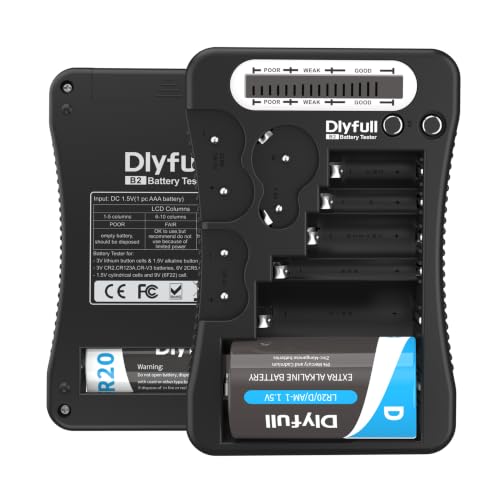
If your battery problem is a shoebox of unlabelled cells rather than a single watch that stopped, this is the unit that ends the guessing. It reads AA, AAA, C, CR123A, D, 9V, N, CR2, CRV3, 2CR5 and CR-P2 cylinders and also handles a wide variety of button cells — the CR2032 in a watch, the 3V lithium in a key fob, the 1.5V silver oxide in a calculator. The bar-graph LCD splits results into poor, weak or good so you get a verdict instead of a figure you have to decode.
Owners lean on it because it reads AA, AAA, C, D, 9V and button cells alike, so one tool settles most of the house. Drop a cell into the detector and the bars report its health in seconds, which is why owners treat it as the household referee and why it keeps rescuing otherwise-thrown-away cells. One point that trips buyers: it does not test rechargeable batteries and it is not powered by one — the included AAA alkaline runs the tester itself. At 115 g it sits in a hand easily, and the anti-slip chassis keeps it from sliding off a workbench.
Accuracy is the honest caveat. Some owners find readings on marginal cells drift from what a dedicated meter reports, so treat the bar verdict as a good/bad filter rather than a precision measurement. For sorting good cells from dead ones, that bar verdict is still enough. For 4.5+ stars across 12,000+ ratings, this is the crowd favorite in the whole group.
What it does well
- Reads AA, AAA, C, D, 9V, CR123A, N, CR2, CRV3, 2CR5, CR-P2 plus button cells
- Bar-graph LCD sorts cells into poor, weak or good at a glance
- 115 g with an anti-slip finish — grips a bench and a pocket alike
- Arrives with a AAA alkaline already fitted, so it works on day one
Where it asks patience
- Won’t test rechargeable cells — single-use batteries only
- No pulse/impulse function, so it can’t check a watch circuit with the caseback on
- Some owners see readings on weak cells differ from a dedicated meter
Reach for this if: you want one small tool that settles the “is this battery dead?” question across the whole house, watch cells included.
Look elsewhere if: you service watches and need a no-open pulse test — this one measures voltage only.
2. Amprobe BAT-200 Battery Tester
No batteries inside, no switches to learn — you just drop a cell in and read.
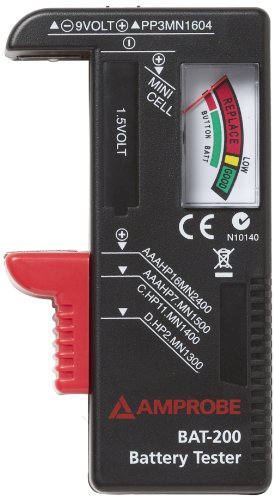
A tester that needs its own battery is a small irony waiting to happen. The BAT-200 sidesteps it entirely: no batteries are required to operate it, so the one time you really need it after a drawer has been sitting for a year, it still reads. Drop in a 9V, AA, AAA, C, D or 1.5V button cell and the color-coded display shows Good, Low or Replace/Recharge without any interpretation on your part.
Standard and rechargeable cells both work here — a genuine advantage at this level, since the DLYFULL B2 above refuses rechargeables outright. Across 4.5+ stars from a large owner base, that versatility shows up as the thing people lean on, with owners calling it particularly handy for chasing dead cells around the house and inside toys. At 7.5 x 4 x 1.25 inches it stores flat in a drawer, and the 1.5-volt minimum operating voltage matches what the vast majority of AA, AAA, C, D and 9V cells deliver.
The trade-off is muscle. There is no digital readout and no percentage — you get three words and a colour, which is faster than a number but tells you less about a cell that is only halfway down. It also will not pulse-test a watch circuit, so on a real watchmaker bench it is a supporting tool rather than the main one. If you check a dozen household batteries a year, the three-word verdict and no-battery operation are all you need.
The verdict in one line: a three-word answer for every household battery, with no setup and no batteries inside to go flat.
The honest limit: three words is all you get — no percentage, no pulse test, so weak-but-not-dead cells leave you guessing.
Best for: the householder who wants to grab a tool years later and have it still work.
Not the pick for: anyone who wants a numeric read on how much life a cell has left.
3. JADPES Quartz Tester
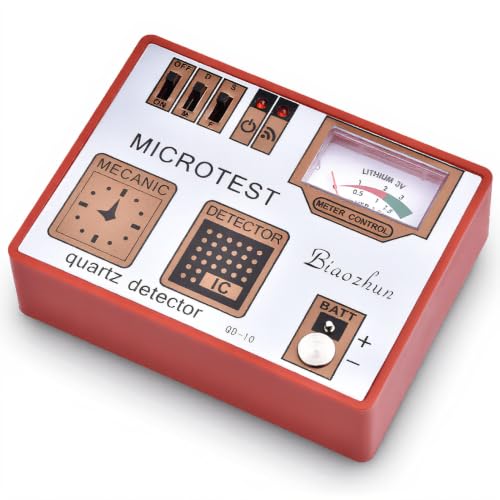
One bench box that demagnetizes a mechanical watch, then tests a quartz movement or a cell.
Three jobs sit inside this one plastic case, and they point at a different buyer than the household checkers above. The demagnetizer runs an alternating supply to build an alternating field, which is how a magnetized mechanical watch gets stripped of its residual magnetism — something a plain voltage tester cannot touch. The demagnetizing speed is adjustable, so you can dial it to the watch instead of hitting every one with the same burst. A quartz tester function then checks the state of a quartz movement, and a battery function reads remaining cell capacity.
The pulse test is the part that changes a workflow: it checks a battery without opening the watch case. On a dozen watches in an afternoon, not unscrewing each caseback is the difference between a quick tick-off and a full teardown. Buyers report the unit doing its job well, and it has rescued watches that had gummed up rather than genuinely failed. Empty 2 x 1.5V AA batteries are not included, which is worth knowing before it arrives.
This is a unit for someone with a bench in the first place. If your “watch battery” problem is a single quartz on your wrist, the extra demagnetizing and pulse functions are more than you need.
Three functions, one case: demagnetize a mechanical, check a quartz movement, read a cell — all without a separate tool for each.
The practical catch: it arrives with no AA batteries, so budget for two before you can switch it on.
Suits: the tinkerer or repairer who works on both mechanical and quartz watches and wants the demagnetizing in the same box.
Skip the upgrade if: quartz movements are all you ever open — the demagnetizer sits unused.
4. Vruping Button Cell Battery Tester and Quartz Watch Analyzer

Built for the tiny cells that live in watches, calculators and small electronics.
Watch and small-electronics cells are the whole brief here. The tester covers all button cells in watches, calculators and small electronics, and the analyzer adds the pulse feature that checks a watch’s electronic pulse without opening the back. When the battery and circuit are both alive, the unit beeps and a flash indicator confirms it — two signals at once so you are not squinting at a needle. A 1-volt minimum operating voltage means it is comfortable reading the small cells it was designed around.
The detail you will not find on most competitors is the detachable two-wire cords, which let you test the coils of a watch. That turns a battery tester into a diagnostic for a movement that has power but will not run — a step past what a simple cell checker can tell you. It weighs next to nothing, so it slides into a tool roll without adding bulk.
Where it asks something of you is the instruction set. This is a specialist piece, and it assumes you know what a coil test and a pulse indicator are telling you. If you do not, the two wire cords and the beep-plus-flash signal will need a little reading before they pay off. Once the coil test and pulse indicator make sense, it is a tidy bench companion for button-cell work.
The case for it
- Designed around button cells — watches, calculators and small electronics
- Pulse test checks the watch without opening the caseback
- Beep plus flash indicator confirms both battery and circuit together
- Detachable two-wire cords let you test watch coils
What to know first
- Assumes some watch-repair knowledge — the coil test needs interpreting
- Specialist tool, not a household battery checker for AA and 9V
Worth picking if: button cells and watch circuits are your whole job, and you want the coil test in the tool.
Think twice if: you also want to sort a drawer of AA and 9V cells — this one is button-cell focused.
5. Imhoo Circular Type Watch Battery Pulse Tester

A round handheld that checks 1.5V and 3V button cells and pulses a watch without a teardown.
The meter measures 56 x 56 x 24mm, and that round footprint is the point — it sits in a palm rather than across a bench. It handles watch batteries and both 1.5V and 3V button cells, covering the silver oxide and lithium chemistries that most watches actually run on. The electronic pulse tester checks a watch without opening the back, and the power comes from a single 23A 12V battery.
This is a pick for the home repairer rather than the professional bench — one tool to test the watch on your wrist and the spare cells in the drawer, then stop. It asks you to interpret a meter reading rather than print a Good/Low verdict, so it rewards a buyer who is happy reading a dial. The 23A cell that powers it is a less common size, so it is worth having a spare on hand before the tester itself runs dry.
Its score sits lower than the household checkers at the top of this list, and its review base is thinner, so treat it as a specialised option rather than the crowd pick. If pulse testing without a caseback teardown is the exact feature you want and you like a compact round body, it does that job. If you want breadth across household batteries, the DLYFULL B2 is the safer call.
The speciality: handheld pulse testing on 1.5V and 3V watch cells, without opening the back.
The cost of small: it runs on a single 23A 12V battery — an uncommon size worth stocking a spare of.
Fits: the home repairer who wants a pocket-sized pulse check on watch cells and nothing more.
Skip if: you want a verdict you can read without interpreting a meter.
6. Paylak QT2500 Battery Tester Quartz Watch Analyzer

A needle meter with a five-position switch, built in the older watchmaker style.
Some benches still prefer a needle over a screen, and the QT2500 is built for that. An analog meter with a 5-position selector switch reads most lithium and silver oxide batteries — both low and high drain — plus the button cells in watches, calculators and small electronics. The pulse feature tests a watch’s electronic pulse without opening the back, with a beep and a flash indicator to confirm the battery and circuit are both working. Detachable two-wire cords let you check watch coils when the battery is fine but the movement is not.
The honest note with this one is consistency. The feedback on it splits down the middle — some benches get years of service while others find it does not perform at all, and how worthwhile it feels follows the same pattern. At 3 7/8″ x 2 1/2 inches it occupies a modest corner of the bench, and it is made by Paylak Tool with instructions included. If you buy one, it is worth testing it thoroughly on day one.
For a collector or hobbyist who likes reading a needle swing and wants a coil test in the same box, the combination is still there. For someone who needs a result they can trust every time, the pulse and household checkers at the top of this list are the safer picks.
The appeal: a needle and a 5-position switch with coil-testing cords — traditional watchmaker feedback.
The gamble: feedback splits down the middle on whether it performs at all, so test it on arrival.
For the needle crowd: collectors and hobbyists who like reading a swing and testing coils.
Pass it by if: you need a result you can rely on without checking the tool first.
7. ZTS Multi-Battery Tester MBT-1

A bigger case and a bigger claim: pulse-load accuracy that shows battery life as a percentage.
Where the compact testers show Good or Low, the MBT-1 puts a figure in front of you. It runs the maker’s patented high accuracy Pulse Load Test and reports battery life as a percentage, which is the difference between “probably fine” and “eighty percent left.” There are no switches and no settings — drop a cell in and read. It is built for battery management and cell matching, so sorting a batch of cells into matched sets is exactly what it is for. It needs 4 AA batteries sold separately, and its minimum operating voltage is 1.2 volts.
Size is the first trade you make. At 4.5 x 1.25 x 8 inches the case runs longer than the bench boxes here — the Amprobe BAT-200 measures 7.5 x 4 x 1.25 inches, so the ZTS stretches further along one axis than that unit does. That is the cost of a bigger readout and battery slot. For high-accuracy work on cell matching, it is a fair trade.
Effectiveness and reliability are what carry this tester’s reputation — the consensus is that it works, and works the same way every time. Accuracy scoring holds up too, which is what a percentage readout demands. The real question is whether the premium fits your use: a collector matching cells for a set of watches gets their money back in less wasted cells, while a household checker with a dozen AA batteries is over-served. Its size earns a mixed note from buyers — great on a bench, not so great in a tight drawer.
The arguments for it
- Reports battery life as a percentage, not just Good or Low
- Patented Pulse Load Test aimed at accuracy
- No switches or settings — a cell in, a reading out
- Built for battery management and cell matching
What it costs you
- Needs 4 AA batteries sold separately before it will run
- At 4.5 x 1.25 x 8 inches, it needs real drawer or bench space
- The premium only pays off if you match cells regularly
Pick it when: you want a percentage figure and cell-matching capability, and bench space is not scarce.
Let it go when: a Good/Low verdict is all your household needs — this is more tool than the job requires.
Know the Specs
Pulse (impulse) testing
A pulse tester pushes a brief electrical signal into the watch and listens for the reply. If the movement answers, a beep or flash fires, and that tells you the battery and the circuit are both alive. The big practical win is that it works with the caseback still screwed down, so you avoid opening a sealed watch just to rule out a dead cell. A plain voltage tester cannot make that call — it only knows what the cell pushes out on its own.
Minimum operating voltage
This is the lowest voltage the tester itself needs before it will read anything. The household and watch testers here sit around 1 to 1.5 volts, which matches the small button and cylindrical cells they are built for. If a cell reads far below that, the tester may simply show nothing rather than a low result. It is the number to check if you plan to test very small or partly drained cells.
Button cell chemistry and voltage
Watch cells are most often silver oxide or lithium, running at 1.5V or 3V. Silver oxide holds a steadier voltage across its life, which is why testers designed for watches handle it specifically. Lithium button cells like the 3V types run at a higher voltage and need a tester rated for 3V. Check that the unit names both 1.5V and 3V if you keep a mix.
Demagnetizing for mechanical watches
A demagnetizer runs an alternating supply to build an alternating field, which strips residual magnetism from a mechanical watch — the kind of magnetism that drags a movement’s timing off. Speed is often adjustable so you can match it to the watch. This does nothing for a quartz movement; it is a mechanical-watch tool only. If you only service quartz, you can skip any unit that leads with demagnetizing.
Common Questions
Can a watch battery tester check a battery without opening the watch?
What is the difference between a pulse tester and a voltage tester?
Will these testers read 3V lithium button cells as well as 1.5V silver oxide?
Do I need to put batteries in the tester itself?
Can these testers check rechargeable batteries?
Is a demagnetizer useful if I only own quartz watches?
Will a household battery tester work for watch cells?
How do I know whether the problem is the battery or the watch movement?
What does a percentage readout give me that a Good or Low verdict does not?
Do these testers test coils as well as batteries?
The Bottom Line
For most people, the Best Watch Battery Tester is the DLYFULL B2 Universal Battery Tester — it reaches AA, AAA, C, D, 9V, CR123A and button cells alike, reads them on a bar-graph LCD that says Good, Weak or Poor, and grips a bench at 115 g. It measures voltage only, so it cannot pulse-test a watch circuit with the caseback on.
If you service watches rather than batteries, go the other way: the JADPES Quartz Tester adds demagnetizing, quartz checking and pulse testing in one bench box for the mechanical-and-quartz crowd. And if you want a percentage figure and cell matching, the ZTS MBT-1 delivers the Pulse Load Test that no other pick here matches.
The DLYFULL holds the highest rating in the group at 4.5+ stars across 12,000+ owners, and that consistency is why it takes the top slot. The Amprobe BAT-200 carries more reviews than the ZTS MBT-1, but they answer different questions: three-word household verdicts versus a percentage readout. Pick by the job on your bench: household cell sorting, no-open pulse testing, or percentage cell matching.
How we choose
We do not accept paid placement. Every pick is matched to a real buyer and a real use-case; we do not hands-on test units.
Sources
Specifications: manufacturer listings and product documentation. Review insights: verified customer reviews, as of July 2026. Pricing: not shown on this page (it changes often); check the current price via the retailer link.
As an Amazon Associate, Tactical Gear Guy earns from qualifying purchases. This does not affect which products we feature.