Specs are compiled from manufacturer listings and verified buyer reviews and can change over time — please confirm the key details on the product page before buying.
Most watch backs are stubborn on purpose — a threaded caseback with tiny notches, a pressure-fit lid with a hairline tab, or a screw-down plate that will not budge without the right leverage. The wrong tool slips, gouges the metal, and turns a simple battery swap into a scratch you stare at for years. A wrench opener seats its jaws in the notches and twists the back off without the jaws ever touching the case.
This guide is built by comparing the manufacturers’ published specifications and the patterns across verified customer reviews, so you get each pick’s real strengths and trade-offs instead of marketing spin.
What follows is a tight spread of wrench-type openers, pry knives, rubber friction balls, and full kits — and the first job is knowing which one your watch actually needs. Pick the right style and you can swap a battery at the kitchen table in minutes with a watch back removal tool that fits your exact caseback type.
Top Picks


How To Choose The Best Watch Back Removal Tool
The single biggest mistake buyers make is grabbing the cheapest opener on the shelf before checking what the watch back actually looks like. Three caseback types need three different tools, and no single design covers all of them well. Flip your watch over, look hard at the rim, then match the tool to what you see.
Notches, tabs, or smooth — match the tool to the back
If your caseback has small slots spaced around the rim, you need a wrench-type opener with jaws that seat into those slots. These twist the whole back off. If the back is pressure-fit with a small lip or tab on one edge, you need a pry knife or a thin metal blade that slides under the lip. A completely smooth domed back usually works best with a rubber friction ball that grips by suction and palm pressure.
Jaw spacing is the spec that decides fit
Wrench openers adjust their jaw gap, and that spread in millimeters is what matters. A narrow range will not clamp a bulky dive watch, and a wide range can still fail on very small dress cases. Check your watch case diameter, then confirm the opener’s stated minimum and maximum jaw spacing covers it with a little room.
Build quality beats tool count
A big kit with dozens of filler pieces can still ship with a flimsy opener that flexes under torque. Look for stainless steel or alloy jaws and a solid adjuster wheel. A wrench that slips mid-turn is the leading cause of scratched casebacks, so grip and stability matter more than variety.
Side-by-Side Comparison
| Model | Best For | Tool Type | Adjustable Range | Weight | Amazon |
|---|---|---|---|---|---|
| JOREST Watch Repair Kit★ Best Overall | One-stop home repair | Full kit with wrench opener | 15–55mm | 0.31 kg | Amazon |
| Watch Back Remover Tool for Rotate Open CoverBest Value | Notch-and-rotate backs | Wrench opener | 13–54mm | 112 g | Amazon |
| Mudder 2 Piece Watch Back Case Opener KitTwo-Size Set | Two opener sizes in one buy | Wrench openers (2) | 50mm / 58mm max | 3.84 oz | Amazon |
| TICFROG Professional Watch Back Removal Tool | Pressure-fit pry backs | Pry knife 6-in-1 kit | — | — | Amazon |
| BERGEON 8008 Rubber Ball | Smooth screw backs | Friction ball | 65mm ball | — | Amazon |
| FREEJOY Adjustable Watch Back Remover | Large-face watches | Wrench opener | 63–65mm | 115 g | Amazon |
| Singcci 2-Jaw Opener | Wide caseback coverage | 2-jaw opener | Up to 62mm | 5.29 oz | Amazon |
| BERGEON 4932 Back case Opener Knife | Precision pry work | Fixed-blade knife | — | — | Amazon |
Detailed Reviews
1. JOREST Watch Repair Kit
Our pick — 4.5+★ from 25,000+ verified ratings; the strongest balance of quality and price.
The kit that opens the back, swaps the battery, and resizes the band without a second trip.
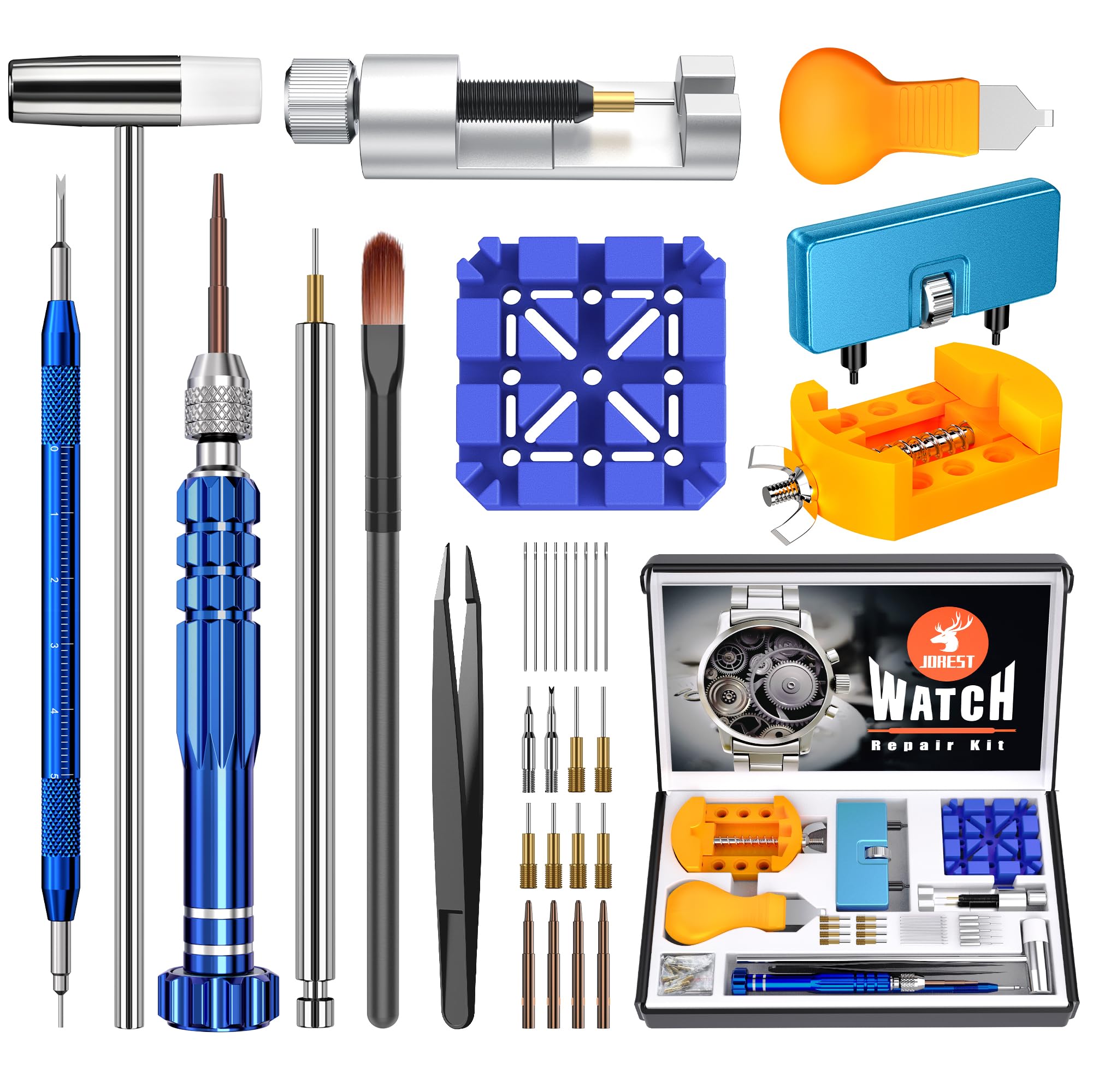
Buyers hunting a battery swap usually hit the same wall: the watch is openable, but nothing else in the drawer handles the band or the gasket. This kit closes that gap. The caseback opener clamps across a stated 15–55mm range by rolling its adjusting wheel to match your back’s groove spacing, so a slim dress watch and a chunky daily wearer both fit the same tool.
What wins people over is the sheer quality of the whole set rather than any one gimmick — it is the most-praised trait across the entire listing, with value for money close behind. The five-in-one screwdriver covers case screws, band screws, and even glasses screws, and its end cap opens to store the spare bits. Fifteen spare pins ship inside the box to keep the pin punch and link remover alive. The included watch case holder grips watches up to 50mm in diameter and holds the case steady so it does not slide while you work — the single biggest cause of scratched backs.
Here is the honest trade: this is a kit, not a specialist’s single tool, so the opener is one piece in a large box. If your only goal is prying a pressure-fit lid, a dedicated pry knife is a more direct route. But for a household with two or three watches and a strap that keeps loosening, owning one box that handles all of it is the smarter buy. It holds 4.5+ stars across 25,000+ owners, the largest review base on this list.
Where the JOREST earns its place
- Openers, link remover, hammer, and screwdrivers in one box for one home bench
- 15–55mm adjustable jaw range suits both small dress cases and larger sport watches
- Case holder up to 50mm keeps the watch fixed and lowers slide-and-scratch risk
- 15 spare pins protect the pin punch and link remover over repeated use
The catch worth knowing
- The opener is one tool inside a large set, not a specialist instrument for one job
- Takes a little practice to set the drill-bit spacing before the first twist
- No pressure-fit pry blade angle for smooth domed backs
Pick this if: you want one box that opens backs, changes batteries, and resizes bands for a small collection at home.
Think twice if: your watch has no notches or fixings to work with — a pry knife or friction ball is the correct tool instead.
2. Watch Back Remover Tool for Rotate Open Cover, Watch Wrench
A slim, single-purpose wrench for notched backs that twist rather than pry.
This wrench earns its spot on weight: 112 g here versus the FREEJOY at 115 g. It does one job in a small footprint. The LYECUN clamps into the notches around a threaded back and twists the whole cover off. Jaw spacing adjusts from 13mm to 54mm, so it fits most case sizes. It sits light in the hand and stores in a drawer without a dedicated toolbox.
Build quality is the headline here, and the stainless steel body with a powder-coated finish feels like a proper instrument rather than a toy. The thing to understand is that this is a notch-only tool. If your back has no slots to grip, the wrench has nothing to bite into — the listing itself flags that it is not for models opened any other way, so confirm your back cover type first.
The honest caveat is grip. Owners who love it praise that it does not scratch the case, but the recurring note is that the jaws can slip out of shallow notches during the twist. That is not a defect — it is a reminder to apply force slowly and gently, as the listing advises, so the tool does not shift unexpectedly. At 4.0+ stars, it is a solid pick for someone who has checked their back and wants a compact wrench without buying a whole kit.
The one-job strength: a 13–54mm jaw range in a 112 g stainless body covers most notched backs without a second tool in the drawer.
The slip you should expect: shallow notches let the jaws jump if you rush — turn slowly and seat the tips fully before adding pressure.
Reach for this if: your watch back has clear notches and you want a simple, durable wrench at entry value.
Look elsewhere if: your back is pressure-fit or smooth — this tool cannot grip a surface with no slots.
3. Mudder 2 Piece Adjustable Watch Back Case Opener Kit
Two adjustable openers in one buy so a large watch and a small one share the same drawer.
Most wrench openers top out somewhere below the biggest cases, which is why Mudder ships two. The larger opener reaches a maximum opening diameter of 58mm for bulky watch backs, and the smaller one reaches 50mm for ordinary dress and sport cases. Both are the same silver alloy wrench design, so the technique is identical across the two.
You run it with one roll of the adjusting wheel. Fix the watch on a stand or hold it firmly, set the wheel to match the cover, seat the tips, then turn the back off. The listing spells this out step by step for a first battery swap. Own both a big and a small watch? The dual-size range saves you from buying a separate wide-range tool.
The honest note is build quality, which splits opinion sharply — some call them quality tools while others find them lacking. They are workable openers rather than a watchmaker’s instrument, so keep the pressure steady and do not overforce them. If you have a single everyday watch, one opener would suffice; the value here is the pair covering your large case without a second purchase. It rates 4.0+ stars across a few hundred owners.
The pair that pays off: 58mm and 50mm openers cover both a chunky watch back and a standard case without a separate wide-range buy.
The honest split: the alloy build divides opinion — treat these as steady, careful openers rather than heavy-duty shop tools.
Pick this one if: your collection mixes a large case with a standard watch and you want both opener sizes in one purchase.
Skip those if: you own a single small watch — one adjustable wrench does the same job without the extra piece.
4. TICFROG Watch Back Removal Tool
The kit built for pressure-fit backs that pop off with a gentle pry, not a twist.
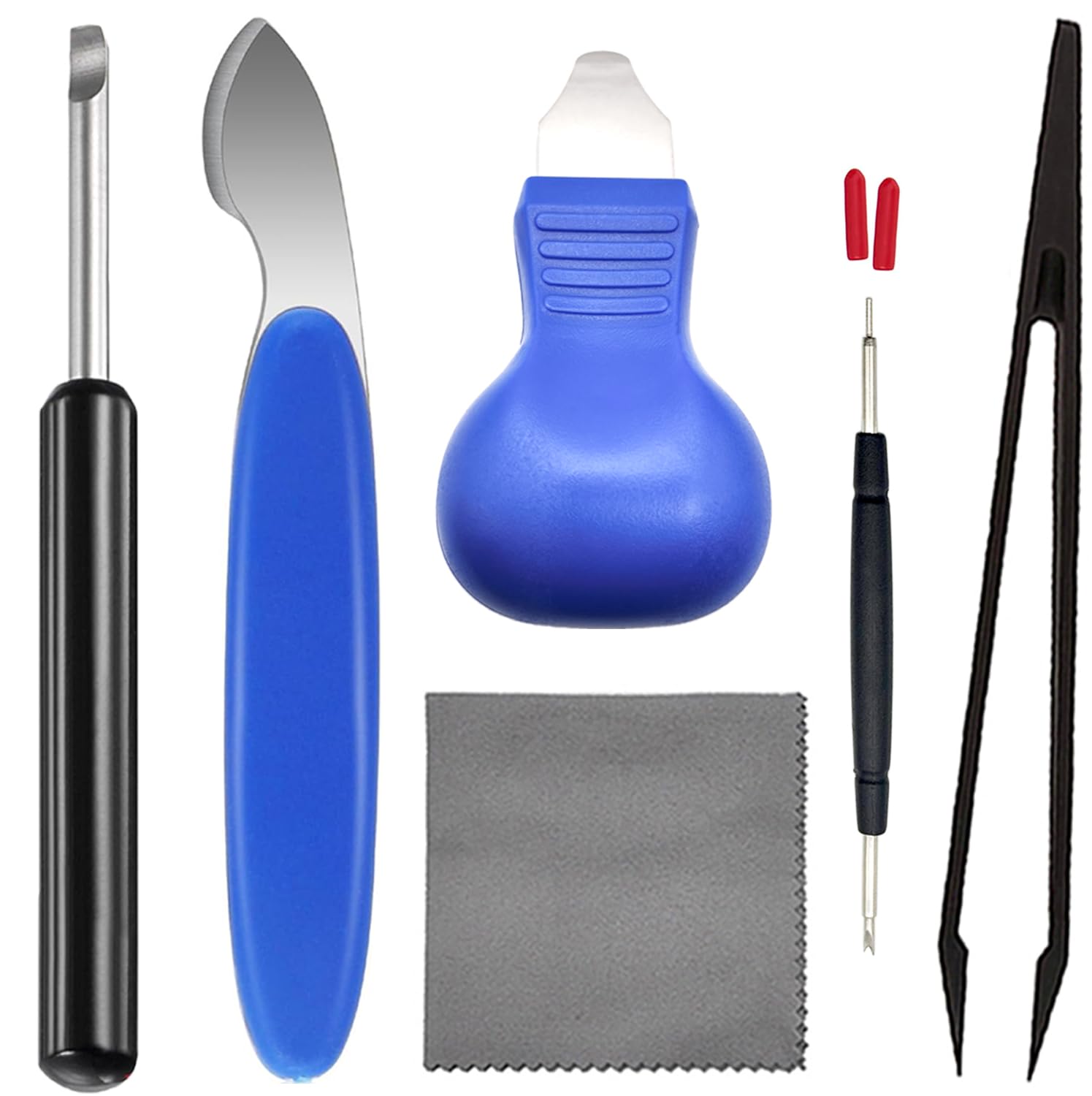
If your watch back has a small tab or notch on the side and no threaded rim, a wrench will do nothing for you. This TICFROG set is built around that exact case: a pry knife slides under the lip on a pressure-fit back and lifts it cleanly while the stainless steel and high-strength plastic construction holds up repair after repair.
The six-in-one kit pairs the pry opener with anti-static tweezers for lifting the battery without touching it with bare fingers, a double-sided fleece cloth for cleaning the case, and a dual-ended spring bar tool for band work. That combination means one small set covers the whole battery-swap routine from pry to refit, and it suits someone opening a watch for the first time as readily as a repeat task.
The trade-off is scope. This is a pry-focused set, so it will not twist a threaded back — you need a wrench opener for those. A brand new listing with a modest following means there is less long-term owner history to lean on, so the 18-month satisfaction guarantee is the safer signal here. If your watch pops apart, though, this is the tool that matches the job.
What makes this set fit pressure backs
- Pry knife slides under a tab or notch on pressure-fit backs
- Stainless steel with high-strength plastic for repeat repairs
- Anti-static tweezers, cleaning cloth, and spring bar tool in one kit
- 18-month satisfaction guarantee backs the new listing
Where it stops short
- No threaded-wrench function — it cannot twist a notched screw back
- Newer listing with less owner history to measure long-term wear
Best match for: a pressure-fit or tabbed caseback that opens with a pry rather than a twist.
Wrong tool for: threaded screw backs — those need a jawed wrench opener instead.
5. BERGEON 8008 Rubber Ball to Open and Close case Backs

No jaws, no blades — just press a rubber ball to a smooth back and turn.
Here is a tool with no metal contact at all. The Bergeon 8008 is a rubber friction ball, listed at a Ø65 mm diameter, that you press firmly against a smooth screw-down caseback and twist. There are no jaws to scratch the metal and no blade to slip — the ball grips by friction alone, which makes it the safest choice for a polished or engraved back you do not want to mark.
What earns it the Swiss pick is that this is a genuine watchmaker’s tool, made by a name watchmakers rely on. Owners find it easy to use and rate it highly for value, with scratch protection being a real strength. It works on the backs designed to unscrew without any notches or slots to bracket.
The friction grip is the honest variable. The ball works fast on a back with a firm, clean surface, but on a slick or slightly oiled lid it can spin without catching, and the size can feel fiddly on smaller cases. It is not for notched or pressure-fit backs at all — those need a wrench or a pry knife. For a smooth screw back you want to protect, though, there is nothing gentler. It holds 4.5+ stars across hundreds of owners.
The no-scratch champion: a Ø65 mm friction ball grips a smooth screw back with zero metal on metal — the safest way to preserve a polished case.
Where friction fails: a slick or oversize back can spin without catching, so this is not a universal opener for every caseback type.
Reach for this if: you are opening a smooth, polished screw back and want to protect the finish from any metal contact.
Not the answer for: notched, tabbed, or pressure-fit backs — those need a wrench or a pry knife.
6. FREEJOY Adjustable Watch Back Remover Tool, Wrench Type

Built for the oversized cases that ordinary wrench openers cannot reach.
Small jaws are useless on a large watch, and this is where the FREEJOY separates from the pack. Its maximum watch case opening diameter runs 63mm–65mm, a range that covers oversized cases ordinary wrenches leave behind. The body combines 316L stainless steel, zinc alloy steel, and brass plating across a roughly 18.5cm length, weighing 115 g.
Owners of big Invicta models are its natural audience, and it fits multiple sizes up to those large faces while holding a good grip. Build quality is what everyone raves about — the most-praised quality by a wide margin — and the tool is convenient to use once you get past the setup. The listed 115 g versus the LYECUN wrench above at 112 g is a difference you feel mostly in how solid it sits in the hand.
One catch to expect: adjusting it to each watch takes a little patience the first time, though it gets easier as you learn the wheel. It only suits backs with grooves on the rim, so a smooth or pressure-fit back is outside its remit. For a large grooved caseback, it is one of the few wrenches that reaches. It carries 4.5+ stars from a smaller owner base.
Why big-case owners want it: the 63–65mm opening range reaches oversized grooved backs that standard wrenches cannot.
The adjustment learning curve: first-time setup takes patience — the wheel gets easier with practice, but it is not instant.
Pick this if: you own a large grooved caseback and need an opener that actually spans it.
Not for you if: your watch back has no rim grooves or is pressure-fit.
7. Singcci Watch Back Removal Tool

Two jaw shapes and a one-hand knob for cases that refuse to cooperate.
Reach is what sets this one apart: the steel jaws open and close up to 62mm, a spread wide enough to span most watch backs and a lot of small clocks too. Unlike a plain wrench, it gives you two gripping heads — one round and one square — so you match the jaw shape to the back instead of forcing one design onto every case.
The adjuster is a knob rather than a fiddly ring, letting you open and close the jaws with one hand while the other holds the watch. Owners rate quality and build quality highest, with leverage and stability showing up as real strengths — the tool holds its position and applies torque without slipping, which is exactly what a stubborn back needs. Stability is the trait that keeps a scratch-prone back safe.
The recurring note is adjustability: some find the knob easy, others wrestle with it before it seats. It is a single-tool answer, so if you also need band work or a pry blade you are looking at a kit instead. But for a tough threaded back that needs leverage and does not slip, this is a strong late-list pick. It scores 4.5+ stars from over a hundred owners.
What the two jaws bring
- 62mm opening spans most watch backs and many small clocks
- Round and square steel jaws match different caseback styles
- One-hand knob adjuster while the other hand holds the watch
- Holds position and applies torque without slipping
What to watch for
- Adjustability divides opinion — some find the knob stiff to seat
- One-job tool with no band or pry functions
Reach for this if: you need wide reach, two jaw shapes, and slip-free leverage on a stubborn threaded back.
Look past it if: you want band sizing and pry functions in one kit.
8. BERGEON 4932 Back case Opener Knife

The watchmaker’s pry knife — a fixed blade for popping pressure-fit backs with control.
This is the traditional watchmaker’s tool for a pressure-fit lid, and it is built like one. The Bergeon 4932 is a fixed-blade case-opening knife with a straight 11.5cm blade, a black bakelite handle 115mm long, and right-hand orientation. It arrives Swiss made in a protective storage case, so it stays protected between jobs.
For anyone who works on watches and pocket watches, the point is control. A fixed blade lets you slide the tip under the back’s lip and lift with a steady hand rather than hacking at it, and owners note it can take a bezel off without damaging the case. The scratch-resistant design is a real draw for a tool you press against polished metal.
It is the premium, single-purpose end of this list, so weigh whether your watch actually needs a pry. If your back is threaded or smooth, a wrench or friction ball is the right tool, and this knife does nothing for those. But if you regularly open pressure-fit backs and want the steady, precise blade of a genuine Swiss watchmaker’s tool, this is the one that feels right in the hand. It tops the ratings at 4.5+ stars.
The watchmaker’s edge: a straight 11.5cm fixed blade with a 115mm bakelite handle gives steady control to lift a pressure-fit back clean.
The single-purpose buy: this is pry-only — threaded or smooth backs need a wrench or friction ball instead.
Best for: repeat pressure-fit pry work where a controlled fixed blade beats a thin kit knife.
Not the tool for: notch-twist backs or smooth screw-downs — a wrench or friction ball handles those.
Know the Specs
Jaw spacing range in millimeters
On a wrench opener, the jaw range is the spread the two tips can clamp between, listed as a minimum and maximum. A wider range fits more watch cases — for example an opener stated at 13mm to 54mm spans small dress cases up to larger sport backs. Always compare your watch’s diameter against the stated range before buying. If your back has no notches for the jaws to seat into, no range will help; that back needs a pry knife or friction ball.
Tool type: wrench, pry knife, or friction ball
The caseback shape decides the tool. A back with small slots around the rim is threaded and needs a jawed wrench that twists it off. A pressure-fit back with a tab or lip lifts off with a pry knife that slides underneath. A smooth screw-down back grips best with a rubber ball that turns it by friction. Buying the wrong type is the most common reason a tool “does not work” — it is not a quality problem, it is a mismatch with the case.
Build material and weight
Stainless steel and alloy jaws hold torque without flexing, which matters because a jaw that bends or slips is what scratches a case. Heavier tools tend to feel more planted in the hand — a 115 g wrench sits steadier than a featherweight one. But weight alone is not quality; check that the adjuster wheel moves smoothly and the jaws seat firmly before you trust it on a polished back.
Kit coverage versus a single tool
A kit bundles the opener with link removers, screwdrivers, tweezers, and a case holder so you handle a full battery swap and band adjustment in one go. A single tool does one job with no extras. If you own several watches and resize bands, a kit saves repeat purchases. If you only ever open one back type, a dedicated opener is cleaner and often sturdier for that specific task.
Common Questions
How do I know if my watch needs a wrench opener or a pry knife?
Will a wrench opener scratch my watch caseback?
What jaw size range do I need for a large watch?
Can I use a pry knife on a threaded screw back?
Does a rubber friction ball work on every watch back?
Is a full repair kit better than a single opener?
How do I stop the caseback opener from slipping mid-turn?
Do I need anti-static tweezers to change a watch battery?
What does a case holder do during a battery swap?
Are Swiss watchmaker tools worth the premium over budget openers?
The Bottom Line
For most people, the watch back removal tool to buy first is the JOREST Watch Repair Kit. Its 15–55mm opener, 15 spare pins, and case holder cover opening backs, swapping batteries, and resizing bands in one box. Would you rather buy the single right tool than a kit? Work out your caseback type first. The TICFROG 6-in-1 is the pick for pressure-fit pry backs. The Bergeon 8008 friction ball is the no-scratch route for a smooth screw back. The FREEJOY wrench reaches the oversized grooved cases most openers cannot. Match the opener type to your caseback and the battery swap takes minutes at the kitchen table.
How we choose
We do not accept paid placement. Every pick is matched to a real buyer and a real use-case; we do not hands-on test units.
Sources
Specifications: manufacturer listings and product documentation. Review insights: verified customer reviews, as of November 2026. Pricing: not shown on this page (it changes often); check the current price via the retailer link.
As an Amazon Associate, Tactical Gear Guy earns from qualifying purchases. This does not affect which products we feature.