Specs are compiled from manufacturer listings and verified buyer reviews and can change over time — please confirm the key details on the product page before buying.
Short answer: buy a braided stainless steel hose in the right length with 90-degree elbows. The 6FT Premium Stainless Steel Washing Machine Hoses with 90 Degree Elbow is the strongest all-round pick here — two hoses, a 10-year warranty, and a rating that holds up across hundreds of owners.
This guide is built by comparing the manufacturers’ published specifications and the patterns across verified customer reviews, so you get each pick’s real strengths and trade-offs instead of marketing spin.
A washer hose is a cheap part that can flood your laundry room when it bursts. This breakdown covers length, fittings, burst pressure, and temperature ratings for washer machine hoses.
Top Picks


How To Choose The Best Washer Machine Hoses
Four specs separate a hose that holds from one that bursts: length, fittings, burst pressure, and temperature rating.
Length: measure wall to washer, not the old hose
Hose length is measured in feet, and the common options run from 4 feet up to 10 feet. A 4-foot hose suits a washer sitting close to the supply valves; a 6-foot hose gives slack for pulling the machine out; a 10-foot run covers a laundry room where the faucets are far from the machine. Too short and the hose kinks under tension; too long and it loops and rubs.
Fittings: 3/4-inch FHT and NPT explained
The connection size on nearly every U.S. washer and supply faucet is 3/4 inch. FHT stands for female hose thread — a screw-on connector with threads on the inside. NPT means national pipe thread, the tapered thread standard on supply lines. Both appear in this category, and both fit standard U.S. machines. Confirm the fitting type on your faucet before ordering.
Burst pressure rating: the number that predicts a flood
Burst pressure is the water pressure, measured in PSI (pounds per square inch), at which a hose is rated to fail. In this list the ratings run from 1200 psi to 1600 psi. Higher is better insurance — but the rating only means something when the hose is also braided, because the steel mesh is what holds the inner tube together under pressure.
Temperature range and certification
Washer hoses in this category typically run from 15°F to 158°F, which covers cold supply water and a hot wash line. Certification marks — UPC (Uniform Plumbing Code), CSA (Canadian Standards Association), and NSF 61 (a drinking-water safety standard) — show the hose has been tested to a published standard. Not every hose here carries them.
Side-by-Side Comparison
| Model | Best For | Length (per hose) | Material | Burst / Pressure Rating | Amazon |
|---|---|---|---|---|---|
| 6FT Premium Stainless Steel with 90 Degree Elbow★ Best Overall | Tight spaces, all-round pick | 6 ft | Stainless steel braid over rubber | Burst-proof, 15°F–158°F | Amazon |
| Cenipar 4FT Stainless Steel 90 Degree ElbowBest Value | Short runs, small spaces | 4 ft | 304 stainless steel over PVC core | Explosion-proof braid, 10-year warranty | Amazon |
| MIFLUS 6ft Stainless Steel 90 Degree ElbowBest for Corners | Corner installs | 6 ft | 304 stainless steel braid, PVC core, nylon | 15°F–158°F, 10-year warranty | Amazon |
| MIFLUS Rubber 6FT with 90 Degree Elbows | Higher pressure rating on a budget | 6 ft | Rubber | 1500 psi | Amazon |
| GE PM14X10005 Stainless Steel | Brand-name replacement | 4 ft | Stainless steel with polymer coating | 1600 psi | Amazon |
| Eastman 6 ft Braided Stainless Steel | Certified, no-elbow installs | 6 ft | 304 stainless steel over PVC core | 1500 psi, CSA certified | Amazon |
| Certified Appliance Accessories 6 ft 2-Pack | Certified multi-standard safety | 6 ft | Stainless steel over PVC core | 1200 psi, UPC/NSF 61/CSA | Amazon |
| PLUMBINGMASTER 10FT Stainless Steel 90 Degree Elbows | Long runs, far faucets | 10 ft | EPDM core, 304 stainless braid | 15°F–158°F, UPC certified | Amazon |
Detailed Reviews
1. 6FT Stainless Steel Washing Machine Hoses
Our pick — 4.5+★ from 750+ verified ratings; the strongest balance of quality and price.
Six feet of braided steel with a bent elbow — the hose that lets a washer sit flush against the wall.
Start with the elbow. A 90-degree elbow (a right-angle bend built into one end of the hose) lets the hose turn the corner right at the machine instead of looping out behind it. That matters when your washer is pushed into a tight alcove or sits under a shelf, because a straight hose has to bend sharply and kink. Here the elbow carries the turn, so the hose stays flat against the wall.
The build is two layers: a 100% pure rubber inner tube that carries the water, wrapped in braided stainless steel that takes the pressure. In plain terms, the rubber holds the water and the steel mesh stops the rubber from swelling and splitting. It is rated to work from 15°F to 158°F, so it handles cold supply water and a hot wash line without complaint. The 3/4-inch female-to-female connections fit standard U.S. washers and supply lines.
The rating is 4.5+ stars, and 750+ buyers have weighed in — what wins people over is the build quality, which is the most-praised thing in the feedback by a wide margin. Owners talk about the connections feeling solid and the hoses fitting cleanly from wall to washer. There is a mixed thread on leakage, though: some report no leaks at all, and a few hit trouble at the hose end connector. The 10-year warranty gives you a route to a fix if yours is one of them.
What earns it the top spot
- 90-degree elbow saves space and keeps the hose from kinking behind the machine
- Two-layer build — pure rubber inner tube under braided stainless steel
- 10-year warranty backs the burst-proof claim
- Color-coded red and blue ends make hot and cold hookup obvious
The honest trade-offs
- Leakage feedback is mixed — most are dry, a few had trouble at the connector
- 6 feet can be more slack than you need if the faucets sit right beside the washer
Reach for this if: your washer sits tight against a wall and you want a hose that turns the corner cleanly plus a warranty behind it.
Look elsewhere if: your supply valves are a short hop from the machine — the 4-foot options below cut the slack and the tangle.
2. Cenipar 4FT Washing Machine Hoses with 90 Degree Elbow
Four feet of three-layer braid for the washer tucked into a small laundry closet.
Cenipar builds this hose from three layers: a PVC core that carries water, an explosion-proof braided layer, and a 304 stainless steel braid on the outside. PVC is a plastic inner tube — cheaper than rubber but resistant to aging and corrosion. The three layers are the reason it holds up under full flow instead of ballooning. It comes as a 4-foot pair with nickel-plated brass nuts and extra-thick rubber gaskets in the connectors.
Where this one earns its place is the fit in a cramped room. At 4 feet per hose, it suits a washer and faucets that sit close together, and the 90-degree elbows let it turn into the corner without a loop of slack. The 3/4-inch NPT connectors fit standard U.S. machines and supply lines, and the red and blue coloring makes it obvious which line is hot.
The value story is real: buyers praise the price most, with installation close behind — it goes on fast with basic tools and no plumber. The catch is durability. Some owners say it should last years, others report the hose breaking apart after three months, and the sealing gets mixed reports too. That split is the thing to weigh: this is the budget-friendly pick, and it is worth checking the connections after install and watching for drips at the fittings.
Who it fits: anyone with a short wall-to-washer run who wants a two-pack with 90-degree elbows and a 10-year guarantee without paying premium-tier prices.
What to watch: the durability and sealing threads are mixed, so tighten the gaskets carefully and keep an eye on the joints for the first few weeks.
Suits short runs: the 4-foot length is the neatest fit when your faucets sit close to the machine.
Weigh the build: PVC core costs less than rubber, and the split reports on durability mean the premium steel options are the safer long-term bet.
3. MIFLUS 6ft Stainless Steel Washing Machine Hose
Six feet and a genuine 90-degree elbow — built to turn a tight laundry corner without pinching.
The MIFLUS 6-foot pair is built like the best overall pick, so you get the same protection for less fuss. Outside sits a 304 grade stainless steel braid (a woven steel sleeve that guards the inner tube). Inside are two layers of PVC core (a flexible plastic tube that carries the water). Reinforced nylon and brass nuts, clamps, and joints resist corrosion (rust and chemical wear). The 15°F to 158°F range covers both a cold supply line and a hot wash line, so one hose works on either tap. Each hose ships with a thick rubber ring in the connector, and that ring is the real seal — it is what keeps water inside the joint instead of on your floor.
The 90-degree elbow is the headline here. It lets the hose reach into the corner behind the washer so the machine can push back against the wall, and it saves space in a room that is already squeezed. Compared to the GE 4-foot pair further down, this one gives you 6 feet of reach and the elbow to turn the corner, while the GE leans on a higher 1600 psi burst rating. If your washer sits deep against a corner, reach wins; if your valves sit right beside it, the GE is the cleaner fit.
Owners describe these as reliable and easy to install, with the tight-space fit as the recurring favorite — the elbow is what makes that work. There is a mixed thread on leakage and durability, so the seal is the thing to get right on install. Tighten the rubber ring with a hand-tight turn and check it before you run a full load.
Fit-first pick: the 6-foot length plus 90-degree elbow is what owners praise most — it lets the hose turn into a corner rather than kinking against a wall.
The caution: leakage reports are mixed, so the rubber-ring seal in each connector needs a careful hand-tight fit, not a wrench-and-hope approach.
Go with this if: your laundry alcove is deep and the supply valves sit behind the machine where a straight hose would fight the wall.
skip it if: a 4-foot hose already reaches comfortably — the extra length only adds slack to manage.
4. MIFLUS Rubber Washing Machine Hoses 6FT

Rubber over steel braid, rated to 1500 psi — a pressure-first pick for a 6-foot run.
This is the rubber-core sibling of the MIFLUS steel hose above, and the difference is the inner tube. Rubber flexes more than PVC, which can matter on a longer run where the hose has to bend. The headline spec is the 1500 psi maximum pressure (pounds per square inch — the water pressure it is built to withstand), a strong figure for a hose at this level. It ships as a 6-foot pair with 3/4-inch NPT brass-nut connections, pre-installed gaskets, and 90-degree elbows.
The color coding is useful: red for hot, blue for cold, so you are not guessing which line goes where. The 6-foot length gives you room to pull the washer forward without stretching the hose. Owners also use them beyond the washer — one buyer runs them for flushing a tankless water heater, so the same pressure rating travels well.
What wins people over is quality, the most-praised aspect here, with functionality close behind. The recurring gripe is durability and leakage — some report long service with no drips, others hit durability trouble, so it is not the safest long-haul bet. Treat the gaskets with care and check the joints after the first few cycles.
Where it holds up
- 1500 psi maximum pressure rating is strong for the tier
- Rubber core flexes more than PVC on a longer run
- 90-degree elbows plus color-coded hot and cold ends
What to know before you buy
- Durability and leakage reports are mixed
- Rubber can age faster than a stainless exterior in a damp laundry room
Worth it when: you want a 6-foot pair with a 1500 psi rating and flexible rubber that bends easily.
Think twice if: you want the longest service life — the mixed durability reports point toward the braided steel options instead.
5. GE PM14X10005 Stainless Steel Washing Machine Hoses

The 1600 psi burst rating and a domestic name — a 4-foot pair built for a straight, short run.
Of every hose on this list, this is the one with the highest published burst strength: 1600 psi, the point at which it is rated to give way. For a part whose whole job is not to fail, that number is worth something. The exterior is heavy-duty stainless steel with a non-corrosive polymer coating, which is a layer meant to shield the steel from laundry-room chemicals. It is made in the USA.
This is a 4-foot pair, so it suits a washer and supply valves that sit close together. There is no 90-degree elbow here — the hoses are straight, which is fine when the machine has room behind it but less helpful in a tight alcove. Install runs an average of 15 to 30 minutes with basic tools, and the maker’s direction is to unplug the washer and shut off the water before you start.
What holds up here is quality, the most-praised thing by a wide margin, and owners like that it is a straight replacement for an existing hose. The mixed feedback is on leaks and the material build — some report no leaks at all, others hit trouble. It is worth checking your faucet fitting before ordering, since GE notes this hose is designed for specific brands of washing machines.
The number that matters: 1600 psi burst strength is the highest on this page, so it is the pick for anyone who wants the toughest published pressure rating.
Where it falls short: straight ends with no elbow make it a tighter fit in a corner, and the material feedback is mixed.
Best for: a short, straight wall-to-washer run where the highest burst rating is the deciding spec.
Not for: deep corner installs that depend on a 90-degree elbow to keep the hose from kinking.
6. Eastman 6 ft Washing Machine Hose Connector 48369
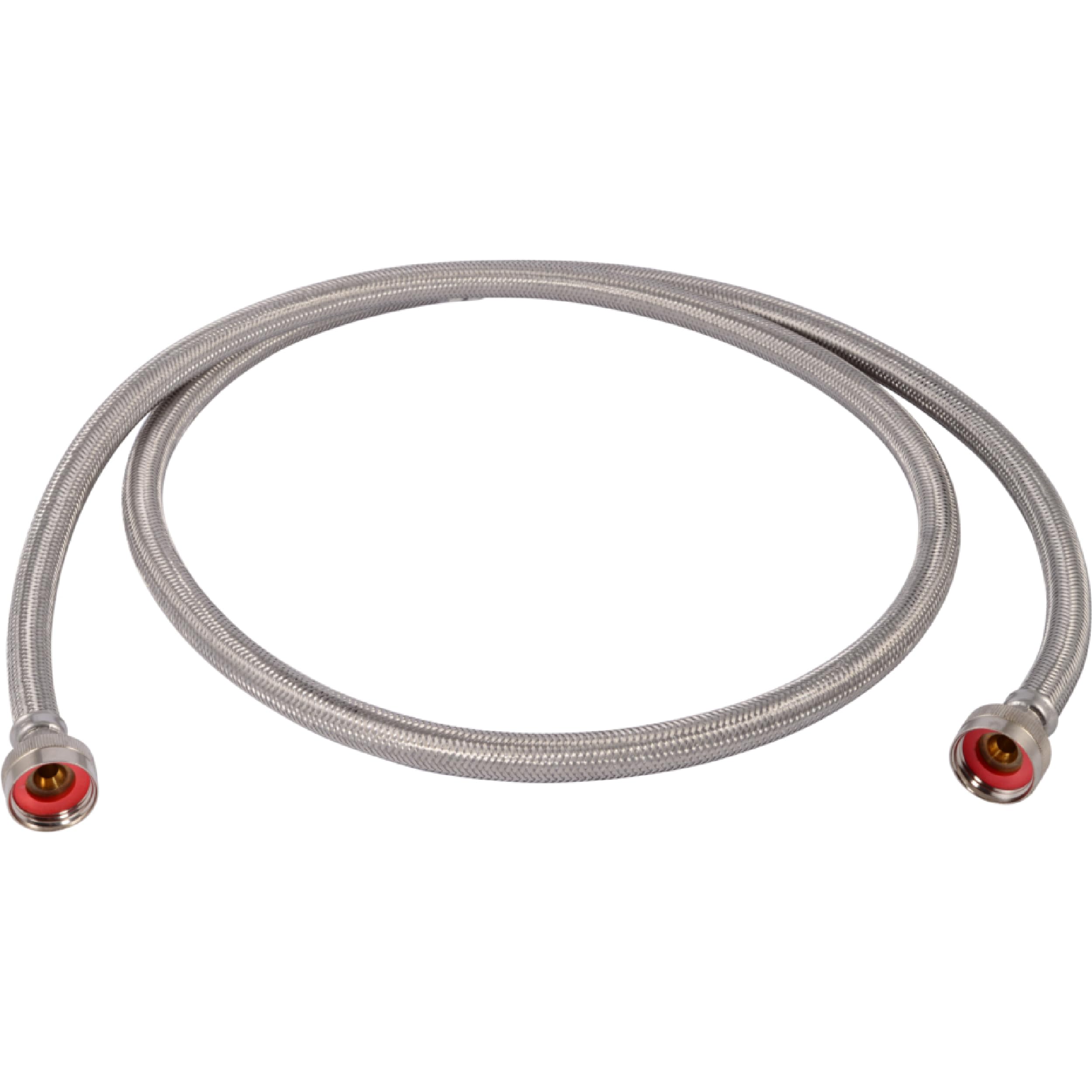
CSA certified and UPC approved — the hose for buyers who read the certification label first.
Eastman lays out the whole build: a PVC core, multi-filament braided nylon reinforcement, a clear vinyl outer shell, and a grade 304 braided stainless steel exterior. That stack is aimed at one job — stopping the hose from kinking or crimping under pressure. The nickel-plated brass nuts and stainless steel ferrules hold the connection secure. It is rated to 1500 psi burst pressure and works from 15 to 158 degrees F.
The certification is the standout. CSA certified and UPC approved means the hose has been tested against published plumbing standards, which is more than many budget hoses on this list can show. The 6-foot length gives you reach, and the flexibility lets it install in tight spaces without soldering, glue, or crimping — a screw-on job with basic tools.
The single-hose format is the one thing to note: this is one hose, not a pair, so you need two if you are replacing both hot and cold lines. That is not a flaw, just a buying detail that catches some people out. Owners use it for washer supply and beyond — one buyer runs it for the steam hookup on a clothes dryer, so it fits more than one appliance job. The 0.42 kg weight makes it easy to route without sagging.
Why buyers trust it
- CSA certified and UPC approved — tested to published plumbing standards
- Four-layer build with a 304 stainless steel exterior
- 1500 psi burst pressure and a 15–158°F range
The fine print
- Sold as a single hose — order two for a hot and cold pair
- No 90-degree elbow, so a tight corner needs a flexible route
The certification call: the label carries a CSA and UPC stamp (independent safety and plumbing marks), so this one suits you if those stamps ease your mind. If they mean nothing to you, the cheaper picks below do the same job.
Remember to double up: it ships as one hose, so two are needed to replace both supply lines.
7. Certified Appliance Accessories Washing Machine Hoses 2 Pack

Three certification standards — UPC, NSF 61, and CSA B125 — on a 6-foot braided pair.
This hose carries the longest certification list in the lineup: UPC, NSF 61, and CSA B125. In plain terms, that means it has been tested against the plumbing code, a sanitation standard for water-contact products, and a Canadian safety standard — three outside checks rather than a maker’s word. The build is a PVC inner core woven with polyester for strength, wrapped in a clear vinyl shell and a stainless steel outer braid that resists puncturing, crimping, and kinking.
The fittings are 3/4-inch FGH (female garden hose) on both ends with stainless steel couplings and brass stems. The 6-foot length covers a typical wall-to-washer distance, and the maker rates it for hot or cold supply. A five-year warranty backs it, and the two-pack includes the washers that resist weathering and aging. It is rated to a 1200 psi maximum pressure — the lowest burst rating on this page, so if the highest pressure number is your priority, the GE hose above reaches 1600 psi.
Owners describe these as high quality and easy to install, with durability and leak-proof performance getting consistent praise. One recurring note is that they work cleanly with a Samsung washer and dryer pairing. The five-year warranty is shorter than the 10-year terms on some picks, which is the trade-off for the certification depth.
What stands out: UPC, NSF 61, and CSA B125 certification on one hose is the deepest compliance stack here, and the braided exterior resists kinks in a tight space.
The trade-off: a 1200 psi rating is the lowest on the page, and the five-year warranty is shorter than the 10-year terms some rivals offer.
Choose it if: certification labels and outside testing matter more to you than the highest burst number.
Pass if: you want the longest warranty — the 10-year picks above beat the five-year term here.
8. PLUMBINGMASTER 10FT Stainless Steel Washing Machine Hoses

Ten feet of EPDM-cored steel for the laundry room where the faucets live far from the washer.
Length is the whole reason this hose exists. At 10 feet per hose, it reaches across a room where the supply valves and the washer sit far apart — a setup where a 6-foot hose would leave you stretching. The two-pack gives you a red hot line and a blue cold line, both with 3/4 FGH universal connectors and 90-degree elbows to save space at the machine end.
The inner tube is EPDM — a synthetic rubber known for resisting corrosion and oxidation better than PVC. An inner pipe widened to 7.7mm is the maker’s design tweak to move water faster through the hose, and the 304 stainless braid resists twisting, curling, and corrosion. It carries UPC certification and works from 15°F to 158°F. A five-year warranty covers the pair.
Buyers report the hoses staying strong after six months of use, and the 90-degree fittings get specific credit for two things: stopping kinks behind the machine, and letting the washer sit closer to the drain pipe. The elbows are doing real work here — on a 10-foot run, a kink behind the machine is the most likely failure point, and the bent end heads that off.
The long-run answer: when your faucets are far from the washer, the 10-foot length with elbows is the fit.
Skip the extra footage if: your valves sit close — 10 feet of slack creates loops that rub and tangle.
Know the Specs
Length and 90-degree elbows
Hose length is measured per hose, in feet — the models here run from 4 feet up to 10 feet. A 90-degree elbow is a right-angle bend built into one end that carries the turn at the machine so the hose does not kink against the wall. Longer is not automatically better: pick the shortest length that reaches comfortably from the faucet to the washer, and add an elbow if the machine sits in a tight corner.
Burst pressure and inner core material
Burst pressure is the PSI (pounds per square inch) at which a hose is rated to fail — the numbers here run from 1200 psi to 1600 psi. The inner core matters just as much: rubber flexes, PVC is a cheaper plastic that resists aging, and EPDM is a synthetic rubber known for oxidation resistance. A braided steel exterior is what holds the core together under pressure, which is why the safest hoses here are braided over a rubber or PVC core.
Common Questions
How often should I replace washer machine hoses?
Are 3/4-inch FHT and 3/4-inch NPT fittings the same thing?
Is stainless steel braid better than plain rubber for a washer hose?
Will a 6-foot hose fit if my faucets are far from the washer?
What does the 90-degree elbow actually do?
Do these hoses work with just cold water, or both hot and cold?
How long does installation take?
What do the UPC, CSA, and NSF 61 certifications mean?
Can I use a washer hose for anything besides a washing machine?
Why is my new hose leaking at the connector?
The Bottom Line
For most laundry rooms, the washer machine hoses winner is the 6FT Premium Stainless Steel pair with 90 Degree Elbow. It earns that spot by fitting tight spaces with its 90 degree elbow (a bent connector that turns the hose tight against the wall), then backing it with a two-layer rubber-and-steel build and a 10-year warranty. Its rating holds across hundreds of owners, so you are not gambling on an unknown brand. Want the highest published burst rating on the page? The GE PM14X10005 tops out at 1600 psi (pounds per square inch, the pressure it can take before failing). And if your faucets sit far from the machine, the PLUMBINGMASTER 10FT pair gives you the reach you need.
How we choose
We do not accept paid placement. Every pick is matched to a real buyer and a real use-case; we do not hands-on test units.
Sources
Specifications: manufacturer listings and product documentation. Review insights: verified customer reviews, as of November 2026. Pricing: not shown on this page (it changes often); check the current price via the retailer link.
As an Amazon Associate, Tactical Gear Guy earns from qualifying purchases. This does not affect which products we feature.