Specs are compiled from manufacturer listings and verified buyer reviews and can change over time — please confirm the key details on the product page before buying.
How much laundry do you actually generate in a week? A four-person household drowning in towels needs a different machine than a couple in a condo who runs one load every Sunday. The four pairs below cover both ends of that range, and each one is matched to a specific size of home and habit so you can pick the one that fits your routine instead of guessing from a spec sheet.
This guide is built by comparing the manufacturers’ published specifications and the patterns across verified customer reviews, so you get each pick’s real strengths and trade-offs instead of marketing spin.
The differences that matter here are drum size, how the dryer decides a load is done, and whether the pair fits your laundry closet without a remodel. Read on for the washer and dryer pairs that earn their floor space.
Top Picks

How To Choose The Best Washer and Dryer
Most first-time buyers shop for looks before measuring the doorway and the closet. A pair that cleans beautifully is useless if it will not clear your hallway or if the dryer door swings into a wall. Start with the room, then work backward to drum size and the drying method your home can support.
Measure the space and the path to it
Width, depth, and height all matter, but so does the route — a tight stairwell decides more installs than the laundry room itself. The GE Spacemaker, for instance, stands in a footprint of 23.75 inches deep by 27.38 inches wide, which is why it suits narrow closets that would reject a wider pair. Leave room behind a vented dryer for the duct to bend without kinking, because a crushed vent is what stretches a drying cycle.
Match drum size to your weekly pile
Washer capacity is quoted in cubic feet, and dryer capacity usually runs larger than the washer so the dryer can tumble what the washer just cleaned. A 4.7 cubic foot washer handles a king comforter in one pass, while a 2.3 cubic foot washer is a daily-loads machine that expects you to wash bedding in more than one trip. If your household runs through four or five sets of sheets a week, size up.
Decide electric versus gas before you buy
You cannot swap freely between the two after delivery. A gas dryer needs a gas line and venting, an electric dryer needs the matching power cord and a vent run to the outside. The pairs that ship with cords and a vent duct save you a separate trip, which is worth checking on the listing before you commit.
Side-by-Side Comparison
| Model | Best For | Washer Capacity | Dryer Capacity | Install Type | Amazon |
|---|---|---|---|---|---|
| Samsung 4.7 Cu Ft Washer & 7.4 Cu Ft Dryer★ Best Overall | Big households that want the app | 4.7 cubic feet | 7.4 cubic feet | Top load, electric | Amazon |
| Midea White Top Load Washer and Dryer Pair 3.9 Cu Ft | Set-and-forget families on a mid-range budget | 4.1 cubic feet | 6.7 cubic feet | Top load, electric | Amazon |
| GE GUD24GSSMWW Unitized Spacemaker 2.3 | Small closets and stacked installs | 2.3 cubic feet | 4.4 cubic feet | Unitized, gas | Amazon |
| Large Washer and Dryer Combo, 35lbs Washer & 3.6 Cu.Ft Dryer | King bedding in a tight apartment | 35 pounds | 3.6 cubic feet | Top load, electric | Amazon |
Detailed Reviews
1. Samsung 4.7 Cu Ft Washer & 7.4 Cu Ft Dryer
Our pick — 4.5+★ from 50+ verified ratings; the strongest balance of quality and price.
A 4.7 cu ft washer and 7.4 cu ft electric dryer that end the cycle when the load is dry, not when a timer runs out.
Two drums, one job: get a household’s worth of laundry through without babysitting the machine. The washer holds 4.7 cubic feet — enough to take a king comforter in a single cycle instead of spreading bedding across two loads. The dryer alongside it is the bigger half at 7.4 cubic feet, a size that lets wet towels and sheets tumble freely rather than balling up in a damp clump.
Sensor Dry is the feature that changes your routine: it ends the dryer cycle once the load is dry instead of counting down a timer. A timer either runs long and overdries your cottons or runs short and leaves everything clammy. Samsung also builds in a WaterJet faucet on the washer, so you can pretreat a stain inside the tub before the cycle starts rather than hauling the shirt to a sink. Wi-Fi through the SmartThings app lets you start or check both machines from another room, and the vibration reduction design keeps the spin quieter.
You lose choice, not money: the washer and dryer each list a single cycle option — Normal and Sensor Dry — so you are not getting a wall of fabric presets with specialty modes for delicates, wool, or a sanitize setting. Big families who sort by fabric type will notice that. Smaller households who just want clean clothes will not miss it.
The load-size advantage
- 4.7 cubic feet of washer drum takes a king comforter in one pass
- 7.4 cubic foot dryer gives wet bedding room to tumble, not clump
- Sensor Dry cuts power use by stopping when the load is done
- WaterJet faucet built into the tub for pretreating stains
- Self Clean cycle refreshes the tub without harsh chemicals
- Ships with both 3-prong and 4-prong dryer cords, washer hoses, an 8-ft vent duct, and a 1-Year CPS plan
What you give up
- One washing cycle and one drying cycle, so no fabric-specific presets
- Electric drying means no gas-line install
- Black finish shows lint and dust more than white
- Top load means the washer lid, not a front door, defines the reach
Go for this pair: a household that runs several loads a week and wants bedding handled in one go with an app to check progress.
Think twice if: you sort laundry into delicate and heavy modes — this set gives you Normal wash and Sensor Dry and little else.
2. Midea White Top Load Washer and Dryer Pair 3.9 Cu Ft

Eight wash cycles and three dry cycles, wrapped into one matched white set.
This is the pair for a buyer who wants dial-in control without climbing into premium pricing. The washer gives you 8 washing cycles to sort by fabric and soil level, and the digital controls make picking one a two-touch job. Size-wise the washer drum is listed at 4.1 cubic feet, so it swallows a bulky load of towels without splitting it in half. The dryer is the bigger partner at 6.7 cubic feet, sized for comforters and bedding rather than just shirts.
Where the Midea pulls ahead of the Samsung on paperwork is cycle count — 8 washing cycles and 3 drying cycles against a single wash and single dry option. Whether that actually improves your results depends on whether you use presets or just press Normal and walk away. The set also runs quiet, thanks to vibration and noise-reduction engineering, which matters when the laundry room shares a wall with a bedroom. It ships with two water lines, a dryer vent, and a power cable, plus a 12-month CPS protection plan.
Here is the honest catch: the pair weighs 260 pounds together and spreads out to a footprint of 52 inches deep by 60 inches wide, so this is not a closet machine. It wants a real laundry room with clearance behind it for the vent and hoses. Plan the delivery route before you order.
Where it wins: you get real separation between a quick refresh and a heavy load from the cycle spread (8 wash, 3 dry, 4 temperature settings), and the include list covers the cords and vent you would otherwise buy separately.
Room to plan for: that 52 inch depth and 60 inch width mean measuring the laundry room and the doorway before delivery day, not after.
The right fit for: a family with an actual laundry room that wants preset control over fabric types and a matching white set that reads as a pair.
Keep looking if: your only install space is a tight closet — this set needs breathing room around it.
3. GE GUD24GSSMWW Unitized Spacemaker 2.3

One stacked unit that turns a hallway closet into a laundry room.
When floor space is the whole problem, a unitized machine is the answer no separate pair can match. GE builds the washer and dryer into a single tower standing 74.88 inches tall but only 23.75 inches deep and 27.38 inches wide. Set that next to the Midea pair’s 52 inch depth and 60 inch width and the reason this machine exists becomes plain — it occupies a slice of floor instead of a wall of it. At 221 pounds it is also lighter than the Midea’s 260, which eases the delivery crew’s job through a narrow door.
The washer section uses a sensing system that measures each load and adds only the water it needs, so a half-full drum does not get drowned. The basket is stainless steel, which holds up to daily use better than a coated drum. Up top, the gas dryer gives you 4.4 cubic feet and rotary electromechanical controls — actual dials you turn rather than a touchscreen, which some people find faster when their hands are full of wet clothes. GE’s quiet package is aimed at keeping operating noise down in the rooms where a stacked unit usually lands.
The trade-off is drum size. A 2.3 cubic foot washer means bedding goes in as multiple loads, not one, and the gas fuel type means you need a gas line where you plan to install it. If you have an electric-only hookup, this pick is not for you regardless of how much you like the footprint.
The space math: 23.75 inches deep by 27.38 inches wide by 74.88 inches tall — a tower built for closets that cannot host a side-by-side pair.
The honest limit: 2.3 cubic feet of washer means comforters and big bedding split across cycles, and the gas dryer needs a gas line in place.
Built for: apartment and condo owners, or anyone converting a closet, who has a gas hookup and values floor space over drum size.
Not your machine if: you wash king bedding weekly or your laundry area is wired for electric only.
4. Large Washer and Dryer Combo, 35lbs Washer & 3.6 Cu.Ft Dryer
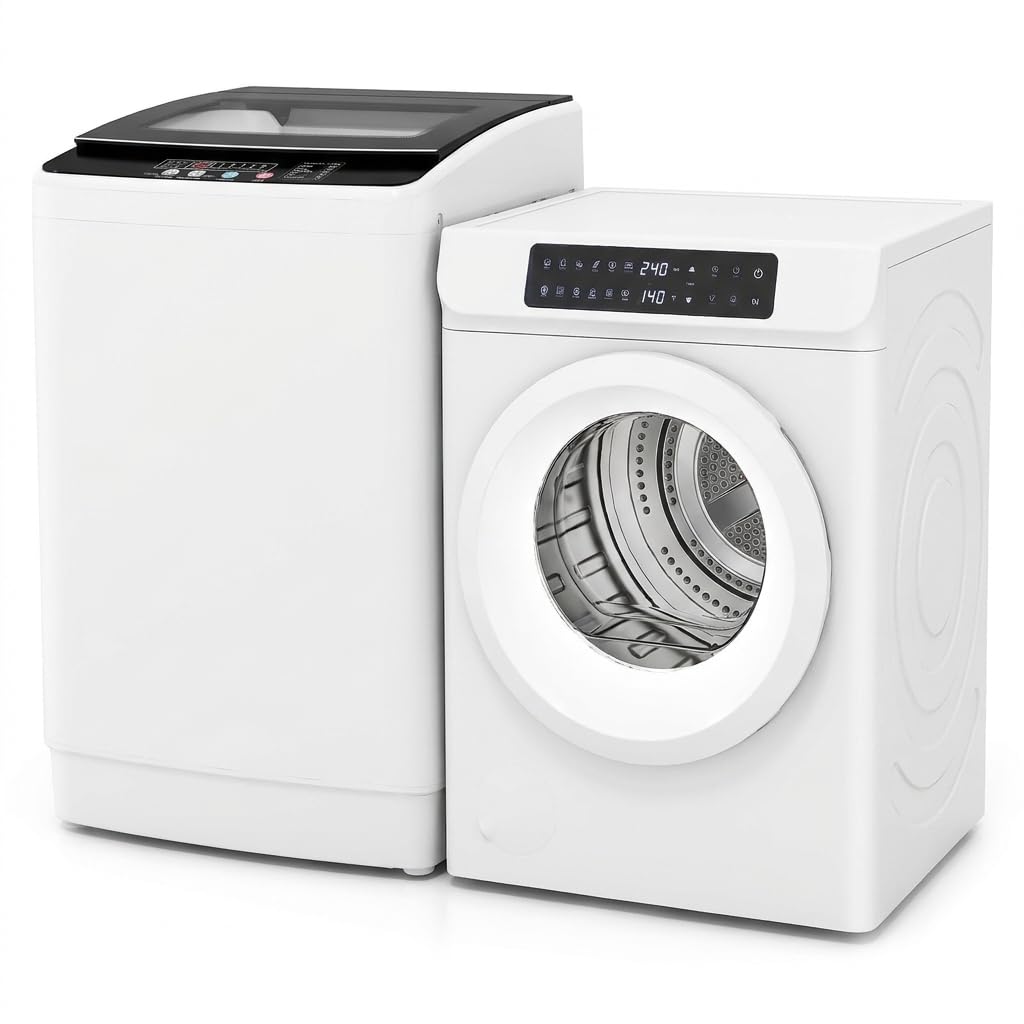
A 35 pound drum rated for a king comforter, in a footprint that fits a condo.
This is the pair you buy when the laundromat trips have to stop but the laundry room is small. The washer is rated at 35 pounds of laundry — the listing puts that at a king comforter, four to five sets of bed sheets, or a week’s worth of clothes for a family of three to six. Behind that capacity sits a 420W motor spinning at 1600 RPM, a high spin speed that flings water out of the fabric so the dryer has less work to do. You also get 12 wash cycles covering Bulky, Quick Wash, and Baby Care, plus 8 water levels.
The dryer side gives you 12 modes on a touch screen and a 1400W heating system that reaches up to 140°F. The drum rotates back and forth rather than one way, a motion aimed at keeping sheets from tangling into a rope. Loading bulky items is easier thanks to a 160-degree wide-angle door, and the lint filter sits at the front so you can pull it without dismantling anything. Both units offer 24-hour Delay Start, child locks, and the washer lid is tempered glass with a soft-close hinge so it will not slam. A 4.5 FT drain pump pushes dirty water to a sink or raised drain, which solves the bucket-emptying chore some compact machines still force on you.
Set your expectations on drying speed. Buyers report the cycle runs long — about three hours to dry a load — though the strong spin does pull most of the water out first, and that shortens the run. If you are used to a full-size vented dryer that finishes in half that, the difference will be noticeable on a busy laundry day.
Why it earns the budget slot
- 35 pound washer capacity rated for a king comforter or a week of family laundry
- 1600 RPM spin extracts water so the dryer starts with a lighter load
- 12 wash cycles and 12 drying modes give real preset choice
- 4.5 FT drain pump means no manual water hauling
- Delay Start on both units for off-peak running
The expectation to set
- Drying runs about three hours per load, longer than a full-size vented dryer
- 3.6 cubic feet of dryer drum is the smallest in this group
- Touch controls take a pass or two to learn
Reach for it if: you need king-bedding capacity and a small footprint on a value-tier budget, and you can plan around a longer dry.
Look elsewhere if: you run several loads back to back on the same day and need fast drying between them.
Know the Specs
Washer Capacity: Cubic Feet vs Pounds
Washers advertise capacity in two different units and they are not interchangeable. Cubic feet measures the volume of the drum, so a 4.7 cubic foot machine tells you how much space the tub holds. Pounds measures how much laundry weight the machine is rated to handle, which is why one pick here is quoted at 35 pounds. Cubic feet is the number most listings use for side-by-side comparison, but pounds is often the more useful figure when you are thinking about a comforter. Check which unit the listing quotes before you compare two models.
Sensor Dry vs Timed Dry
A timed dry runs for the minutes you set and stops, dry or not. A sensor dry reads moisture and ends the cycle when clothes are ready. The practical difference lands in two places: power use, because you stop paying to heat a dry drum, and fabric wear, because clothes are not cooked past done. On the Samsung set, Sensor Dry is the entire drying cycle, which keeps the decision simple but leaves you without a manual override timer.
Spin Speed and Why It Matters
Spin speed, quoted in RPM (revolutions per minute), measures how fast the drum turns to fling water out. A higher number pulls more water out before the clothes reach the dryer. The 1600 RPM spin on the value pick is the reason its drying time can stretch to several hours yet still finish a load — the dryer starts with less water to remove. A slower spin leaves wetter clothes and a longer dry.
Vented, Electric, and Gas Drying
Most electric dryers in this group ship with a vent duct because they need to push hot, moist air outside through a duct. A gas dryer burns gas to make heat and also vents outside, but it needs a gas line at the install spot. Choose the dryer type your home already supports — swapping one for the other usually means adding a new hookup, and that decision is set before any comparison of drum size matters.
Common Questions
Will a top load washer fit under a standard laundry closet shelf?
Does a washer and dryer pair need a vent to the outside?
What is the difference between a washer rated in pounds and one rated in cubic feet?
Is a gas dryer better than an electric one?
How long does a load actually take to dry?
Can I stack these machines to save floor space?
Do I need to buy power cords and hoses separately?
How do I keep the washer tub from getting musty?
Will a large-capacity washer handle a king comforter in one load?
Is Wi-Fi control on a washer and dryer worth having?
The Bottom Line
For most households the washer and dryer winner is the Samsung Smart 4.7 Cu Ft Top Load Washer & 7.4 Cu Ft Electric Dryer, because its 7.4 cubic foot dryer and Sensor Dry cycle stop overdrying and stop the timer guessing game. If you want more fabric presets than a single Normal wash, the Midea pair gives you 8 wash cycles and 3 dry cycles with a matching white body. And for a hallway closet or a condo with a gas hookup, the GE Spacemaker trades drum size for a 23.75 inch deep tower that fits where nothing else will. Measure the closet, confirm your fuel type, then buy — that order of operations saves more returns than any spec on a label.
How we choose
We do not accept paid placement. Every pick is matched to a real buyer and a real use-case; we do not hands-on test units.
Sources
Specifications: manufacturer listings and product documentation. Review insights: verified customer reviews, as of November 2026. Pricing: not shown on this page (it changes often); check the current price via the retailer link.
As an Amazon Associate, Tactical Gear Guy earns from qualifying purchases. This does not affect which products we feature.