Specs are compiled from manufacturer listings and verified buyer reviews and can change over time — please confirm the key details on the product page before buying.
If your room rings — a video call that bounces back at you, a TV you keep turning up, a home studio where every take sounds hollow — the fix is usually surface area, not more gear. Wall panel sound insulation works by catching sound before it ricochets off drywall and turning a live, echoey box into a calm one. Below are nine real panels, from wood slat kits that double as wall decor to thick pyramid foam that soaks up reflection points.
This guide is built by comparing the manufacturers’ published specifications and the patterns across verified customer reviews, so you get each pick’s real strengths and trade-offs instead of marketing spin.
You’ll see exactly which panels suit a bedroom, an office, or a rented flat you can’t drill into — plus the coverage math so a pack actually fills the wall you’re treating.
Top Picks

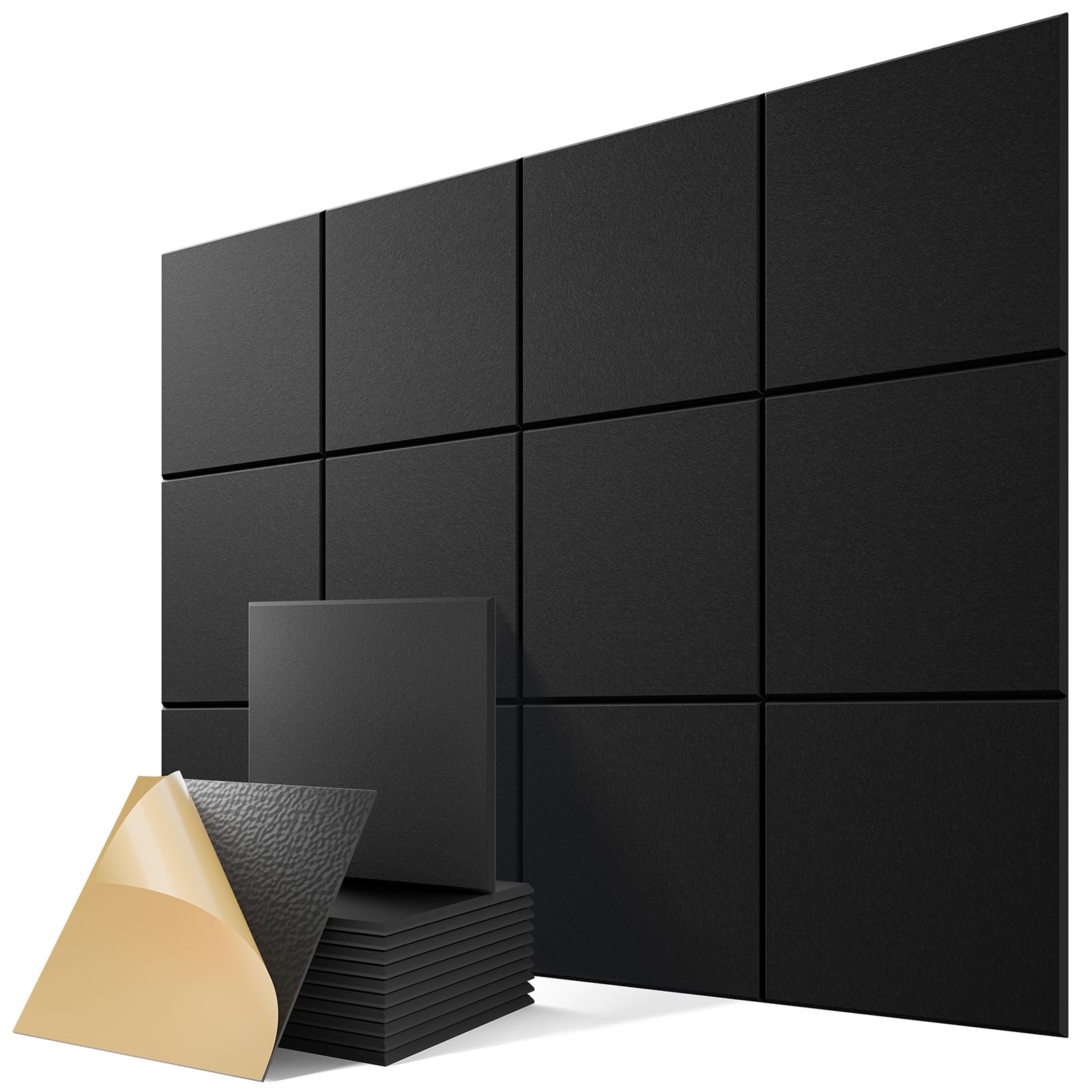

How To Choose The Best Wall Panel Sound Insulation
Start with the honest question: are you trying to stop echo inside a room, or stop noise getting through a wall? Panels absorb sound that’s already bouncing around — that’s what kills a hollow call, a boomy podcast, or a TV you keep cranking. They don’t knock down sound passing through drywall from the neighbours. Once you know it’s echo you’re fighting, the shopping gets simple: thickness, density, coverage, and how the panel sticks up.
Thickness and density: the two numbers that decide the result
Thicker material catches more of the sound wave. A 0.35-inch felt panel is slim wall decor that softens the room; a 2-inch pyramid foam panel gives the wave far more depth to die in. Density matters too — 30 kg/m³ polyurethane foam or a high-density polyester felt holds its shape and works consistently, where a squishy thin panel just looks the part. Match the thickness to the problem: a bedroom or office usually wants mid-weight felt; a studio corner wants the 2-inch stuff.
Coverage: buy by the square foot, not the pack
The most common mistake is ordering one pack for a whole wall. Makers recommend treating roughly 20 to 30% of a wall surface for real acoustic control. Do the math before you buy: a 12 x 12 inch panel is 1 square foot, so a 36-pack covers about 36 square feet. Large 47.2 x 23.6 inch panels cover much more per piece, which is why an 8-pack of them goes a lot further than an 8-pack of tiles.
Adhesive versus no adhesive: know your wall
Peel-and-stick panels install in minutes with no tools — ideal for renters and smooth drywall. But adhesive-backed panels can leave residue when they come down, and some struggle on textured or painted surfaces. Foam panels sold without adhesive let you choose double-sided tape, spray adhesive, or hook-and-loop strips, which gives you control (and a cleaner removal). If you’re mounting slat wood panels, screws are the safer long-term hold.
Side-by-Side Comparison
| Model | Best For | Coverage | Thickness | Panels Included | Amazon |
|---|---|---|---|---|---|
| NeatiEase Wood Panels for Wall (Teak)★ Best Overall | Wall decor with acoustic benefit | About 33 sq.ft. | — | 4 | Amazon |
| 12 Pack Self-Adhesive Acoustic Panels (Black)Best Value | Fast renter-friendly echo fix | — | 0.4 in | 12 | Amazon |
| Dailycooper 12 Pack Y-Lined Panels (Black)Top Performer | Flame-resistant full-wall styling | 7.5 sq.ft. | 0.4 in | 12 | Amazon |
| AUSLET 36 Pack Pyramid Foam | Big-area studio treatment | 36 sq.ft. | 2 in | 36 | Amazon |
| 4 Pack Acoustic Foam Panels 48 x 24 in | Fast-expanding large tiles | — | 2 in | 4 | Amazon |
| TONOR Dual-Layer Thickened Panels | Highway and street noise softening | 4428.48 sq.in. | 0.72 in | 4 | Amazon |
| Soon Global Art Acoustic Panels (Aqua Dreams) | Gallery-style rooms needing calm | 3348 sq.in. | — | 6 | Amazon |
| TONOR Large Acoustic Panels 8 Pack | Big walls, high absorption | — | 0.35 in | 8 | Amazon |
| Art3d 6-Pack Wood Slat Panels (Walnut) | Warm wood-slat accent wall | 31.5 sq.ft. | — | 6 | Amazon |
Detailed Reviews
1. NeatiEase Wood Panels 4-Piece 96″ x 12.6″
Our pick — 4.5+★ from 600+ verified ratings; the strongest balance of quality and price.
The pick that kills the echo and upgrades the wall at once.
Those four 96 x 12.6 inch slat panels cover about 33 square feet in one go — a genuine accent wall, not a patch. That’s the trade you’re making here: the same surface area that quiets a room is the surface area people notice when they walk in. The teak finish on MDF and high-density polyester fiber reads warm and modern rather than like a studio supply crate.
Installation is where it wins its keep. Screws or superglue, mounted on walls or ceilings, and it cuts to any shape — so you can run it vertically, horizontally, or wrap a corner around an awkward alcove. Build quality is the thing everyone raves about, and the finish follows right behind; this is a panel people photograph.
At 19.96 kg for the four-pack, it’s a genuinely heavy box — plan a second set of hands for overhead work. So plan a second set of hands for overhead work. The other honest note is shade: the color isn’t identical panel to panel, which some buyers love as natural variation and others find distracting on a wide wall. Set the layout dry before you commit adhesive.
What earns it the top slot
- Four 96 x 12.6 inch panels cover about 33 sq.ft. — a full accent run, not a token patch
- Installs with screws or superglue on walls or ceilings, and cuts to any shape
- MDF plus high-density polyester fiber, sourced from certified sustainable sources
- Acoustic damping and a real decor upgrade in the same panel
Where it asks for care
- 19.96 kg for the four-pack — an overhead install wants a helper
- Color varies slightly across panels; dry-fit your layout first
- Real wood look divides opinion — some see wood, some see a printed finish
Buy this if: you want one wall that both quiets the room and looks deliberate — a living room, bedroom, or office focal point.
Look elsewhere if: you’re covering a huge ceiling alone; the weight makes that a two-person job.
2. 12 Pack Self-Adhesive Acoustic Panels 12″ X 12″
The renter’s answer: peel, stick, and the echo behind your desk goes quiet.
No tools, no drilling, no landlord conversation. Each 12 x 12 x 0.4 inch panel carries a strong adhesive backing, so it goes straight onto smooth walls, ceilings, doors, even windows — and comes back off when you move out. For a home office desk corner or a podcast nook, that minutes-long install is the whole point.
The material is eco-friendly polyester fiber rather than cheap foam, which matters because it won’t shed or crumble into dust over time. It’s engineered to cut echo and reverberation, so video calls stop sounding like you’re speaking into a tin can. The geometric pattern also looks intentional on a wall — a good thing, since these stay visible.
What wins people over is the noise absorption itself, with the build quality right behind it. The catch is adhesion: it holds firmly on smooth, clean paint, but some surfaces leave residue or let go, so wipe the wall down first and test a spot. These come sealed in a 12-pack, so plan a couple of packs if you’re treating a real wall — twelve tiles is about 12 square feet of coverage, and makers recommend hitting a good chunk of the wall for a noticeable drop.
Why this is the smart entry point
- Peel-and-stick backing installs in minutes with zero tools
- Polyester fiber construction resists shedding and degradation
- Works on walls, ceilings, doors, and windows
- Non-permanent, so it suits renters
Before you stick them up
- Adhesion is surface-dependent and can leave residue on removal
- 12 tiles only covers a modest area — plan extra packs for a full wall
The one for: renters and home-office workers who want less echo this afternoon, without a drill.
Think twice if: your wall is textured or freshly painted — the adhesive grip is the weak link there.
3. Dailycooper 12 Pack Self-Adhesive Acoustic Panels 12″ X 10″
Dense felt with a flame-retardant edge, dressed up in a Y-lined pattern.
Here’s the number that does the work: 9.4 lb/ft³ density. That’s a tightly packed polyester fiber that soaks up echo, reverb, and flutter echoes instead of just sitting on the wall looking acoustic. For a recording corner or a room where sound quality actually matters, that density is the difference between treatment and decoration.
Twelve panels at 12 x 10 x 0.4 inches give you roughly 7.5 square feet of coverage — that’s a targeted patch over reflection points, not a whole room. The beveled Y-line edge lets these hang like art or accents, and if you bolt a few together they arrive in a black finish that matches most setups.
Two things to weigh. The material is 100% polyester fiber and flame retardant, odorless to the touch — that’s a real plus near a workspace. But the sound result is genuinely mixed: plenty of people hear a big drop in echo, while others treating a thin slice expect more than absorption can deliver. Size your expectations to 7.5 square feet and buy more if the echo is stubborn.
Density where it counts: 9.4 lb/ft³ packs material into a 0.4-inch panel, so it works harder than the thin foam it resembles.
The honest limit: 7.5 square feet per 12-pack is a patch, not a wall — the more you cover, the more you’ll notice.
Reach for this if: you want dense, flame-retardant felt that handles echo in a corner or on a feature wall.
Skip the single pack if: you’re treating an entire room’s face — order two.
4. AUSLET 36 Pack Pyramid Acoustic Foam Panels
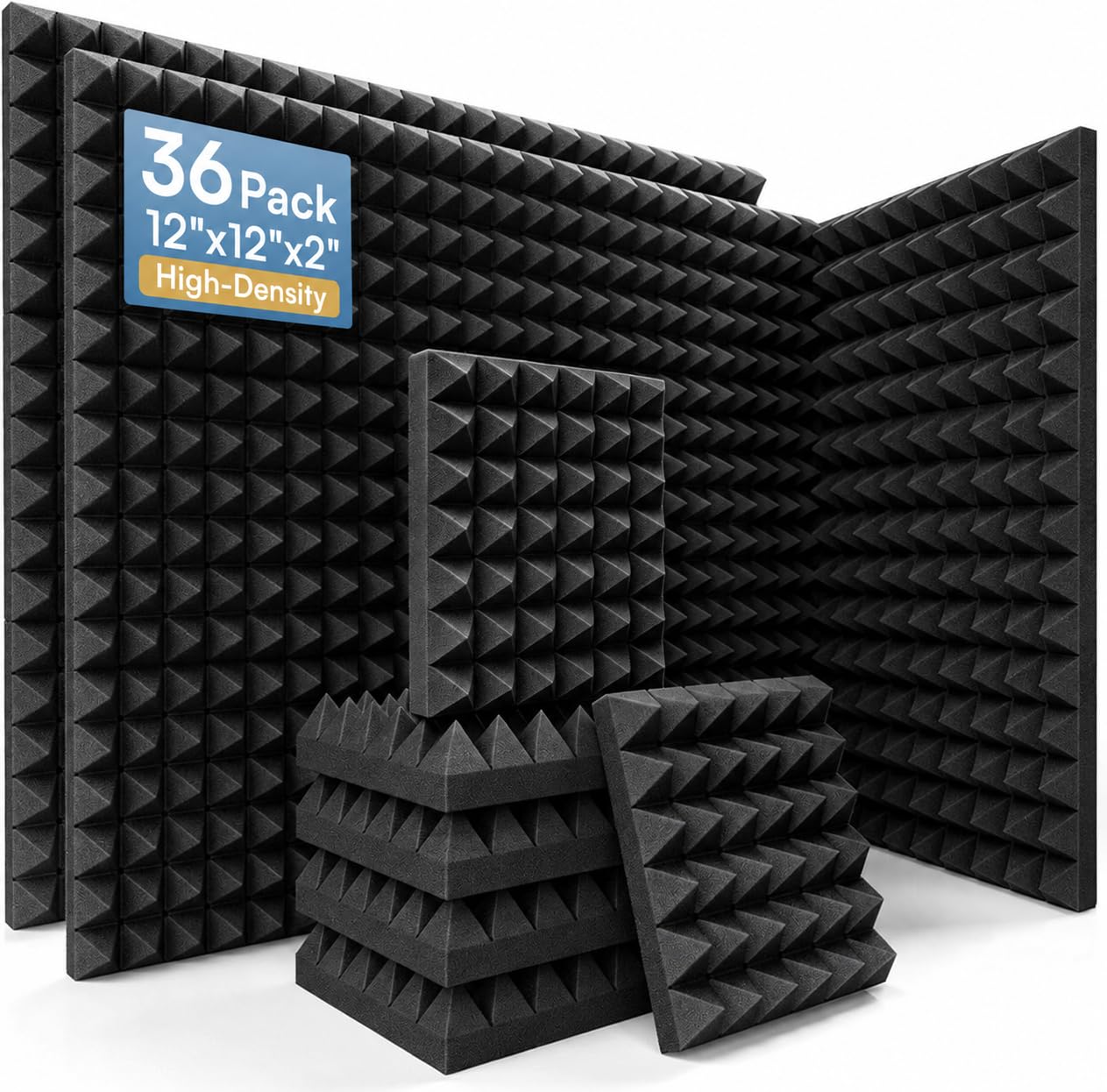
Two inches of pyramid foam and thirty-six tiles — a room-wide treatment, not a token.
Coverage is the headline: 36 tiles at 12 x 12 x 2 inches each, for up to 36 square feet laid edge to edge. That’s the kind of area that actually changes a room’s voice, laid out at the key reflection points around a desk, mic, or home theater. That’s three times the tile count of the 12-pack felt panels here.
The 2-inch profile gives the sound wave more depth to die in than thinner panels, and the 30 kg/m³ density keeps each pyramid holding a firm shape. The 3D pyramid surface adds surface area, which is how it manages reflections, echo, and reverb. Made from flame-retardant polyurethane sponge for indoor spaces — studios, podcast rooms, bedrooms, offices.
The important caveat, and it’s in the listing itself: these are for acoustic treatment, not soundproofing. They will clean up a room’s echo but won’t block a neighbour’s bass. There’s also no adhesive backing included — you choose double-sided tape, spray adhesive, or hook-and-loop strips. And the 0.06 kg shipping weight tells you how light and airy the foam is, so don’t expect the feel of solid board.
The coverage play: 36 square feet of 2-inch foam for full-wall or corner-to-corner treatment.
Know what it does: absorption of echo and reverb — not blocking noise through the wall.
Best fit: podcasters, streamers, and studio setups covering a serious amount of wall at once.
Heads-up: no adhesive in the box and no soundproofing — buy mounting tape and treat it as echo control.
5. 4 Pack Acoustic Foam Panels 48 x 24 x 2″

Four oversized 2-inch tiles that bounce back to shape in seconds, not days.
Big tiles, small pack count: four panels at 48 x 24 x 2 inches each. That’s a lot of surface per piece, so you cover a wide band of wall without a tower of little squares. It’s the opposite approach to a 36-pack of small foam — fewer, larger, faster to lay out.
The fast-recovery claim is the practical one. High-elasticity foam regains its shape within about 5 seconds of opening the pack, so you skip the usual wait for a compressed panel to puff back up. That said, the listing also warns the panels ship vacuum-sealed and may arrive in multiple boxes, so give up to 24 to 48 hours for full size. The foam is uniform in density and firmness, and easy to cut to size without losing performance.
What’s genuinely strong here is the build and the effect: this is a pro-grade-feeling foam, and people report recordings improve right after hanging them, with echo in a home studio dropping noticeably. The housekeeping note is adhesive — none included, so you supply the mounting method — and packaging can split your order across shipments.
The shape of the buy: four large 2-inch tiles for wide, fast wall coverage.
Plan on: your own adhesive, and a day or two for full expansion out of the sealed pack.
Pick it when: you want big, quick-to-hang tiles for a home studio or media wall.
Not ideal if: you’re mounting on a wall where you can’t use your own tape or adhesive.
6. TONOR Dual-Layer Thickened Acoustic Wall Panels 4 Pack

Double-layer felt that takes the edge off traffic noise, then dresses the wall.
Four panels at 47.2 x 23.6 x 0.72 inches, built in two layers of absorption material. This is the panel people reach for when a room has a highway or busy street on the other side of it — it softens the drone.
Installation is the easy part. A strong self-adhesive back means peel and stick, no extra tape. The classic stripe pattern reads as wall decor, and it cuts to fit awkward rooms — though the cut lines aren’t always razor-clean, so score slowly. Coverage runs 4428.48 square inches across the four panels, enough for a real feature area.
What’s consistently strong is the noise-level effect and the felt-like look; the panels hold their adhesive well once they’re up. The soft spot is cutting — the material doesn’t always slice perfectly — so measure twice and use a sharp blade. For a bedroom or home office with a street outside, this is a solid pick that adds polish as it quiets the room.
What it brings to a noisy room
- Dual-layer material disperses echo and softens traffic drone
- Self-adhesive back — peel and stick, no tape needed
- Stripe pattern doubles as wall decor
- 4428.48 square inches across four large panels
The fine print
- Cuts don’t always come out clean — use a sharp blade and score carefully
- Felt finish shows dust more than a glossy panel would
Suits you if: street or highway noise is the issue and you want it softened without a studio look.
Go a different way if: you’re covering very large walls — four panels cover a feature area, not a whole room.
7. Soon Global Acoustic Wall Panels Aqua Dreams 6-Pack

Panels designed to be looked at as much as listened to.
Six panels totalling 3348 square inches — 558 square inches apiece — of high-density polyester fiber, with designs curated from named artists. That’s the pitch: acoustic function wrapped in a limited-edition print, so a treated wall reads as gallery, not studio. In a room where you’d hate the look of grey foam, that’s the whole reason to buy this one.
The install kit is the thoughtful bit: the six-pack includes 30 transparent double-sided stickers, so there’s no drill and no glue bottle. Peel the backing, place precisely, done. Polyester fiber construction keeps it a safe, dust-free material to have at eye level in a living room or conference room.
The look is the consensus favorite, with build quality close behind — 122 separate appearance comments back up the finish. The one recurring snag: a share of panels start slipping off the wall over time, while plenty hold firm for months. Prep the surface properly and press each sticker down hard before trusting it with a heavy panel.
Looks first, acoustics too: artist-curated prints turn a treated wall into artwork, at 558 square inches per panel.
Give it a fighting chance: clean the wall and press the double-sided stickers firmly — panels that slip are usually the poorly prepped ones.
Made for: living rooms, offices, and conference rooms where treated walls have to look good.
Fair warning: if you can’t prep a clean, smooth surface, the sticker hold is the part to watch.
8. TONOR Large Acoustic Panels Self Adhesive 8 Pack
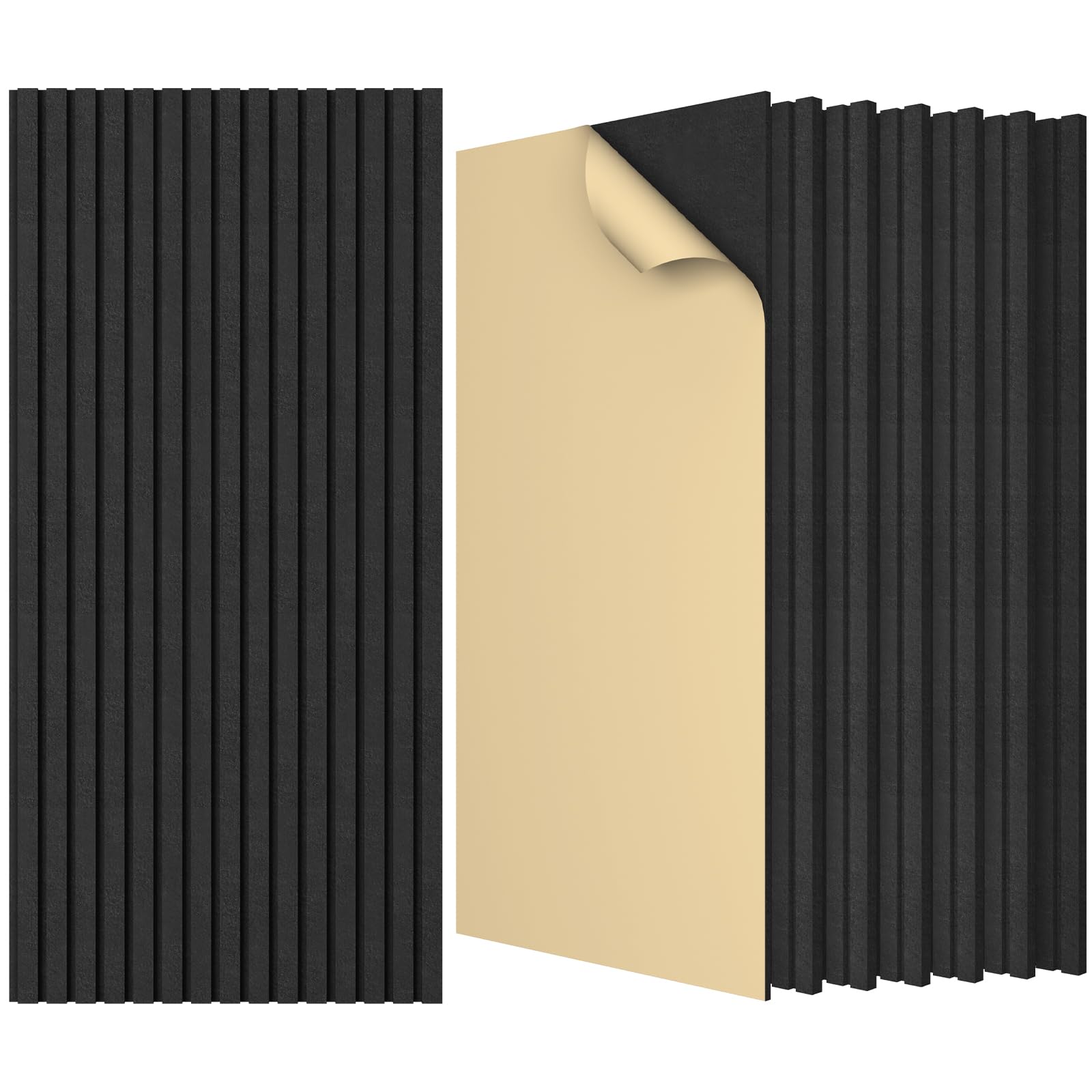
Eight oversize panels with the highest absorption rating in this lineup.
The spec worth knowing: an NRC of 0.9. NRC (noise reduction coefficient) is the industry score for how much sound a surface soaks up, and 0.9 is a genuinely strong number. Paired with a density of 212.2 kg/m³, that’s a tightly packed polyester fiber doing real absorption work. On paper it’s the most absorbing panel here — denser felt than the 0.4-inch sheets.
Eight panels at 47.2 x 23.6 x 0.35 inches cover a lot of wall for the count. The self-adhesive back makes peel-and-stick simple on smooth surfaces, and the classic stripe pattern fits a living room, bedroom, studio, or home theater. It’s 100% pure polyester fiber with an environmentally friendly adhesive, odorless to the touch.
Where it wobbles is the stick. The adhesive quality is praised by some and panned by others — some panels won’t hold on rough or dirty walls. That’s not a flaw to fear; it’s a prep step. Clean the wall, press firmly, and check daily for the first week. Don’t underestimate the adhesive, and don’t overestimate it on a textured surface.
The absorption number: NRC 0.9 puts this at the top of the group for sound soak-up.
Where it can slip: adhesion varies by wall type — smooth and clean means firm hold.
Choose it when: you need strong absorption over a lot of wall without a foam-pyramid look.
Reconsider if: your wall is rough or heavily textured — that’s where the adhesive loses its grip.
9. Art3d 6-Pack Soundproof Wood Slat Wall Panels
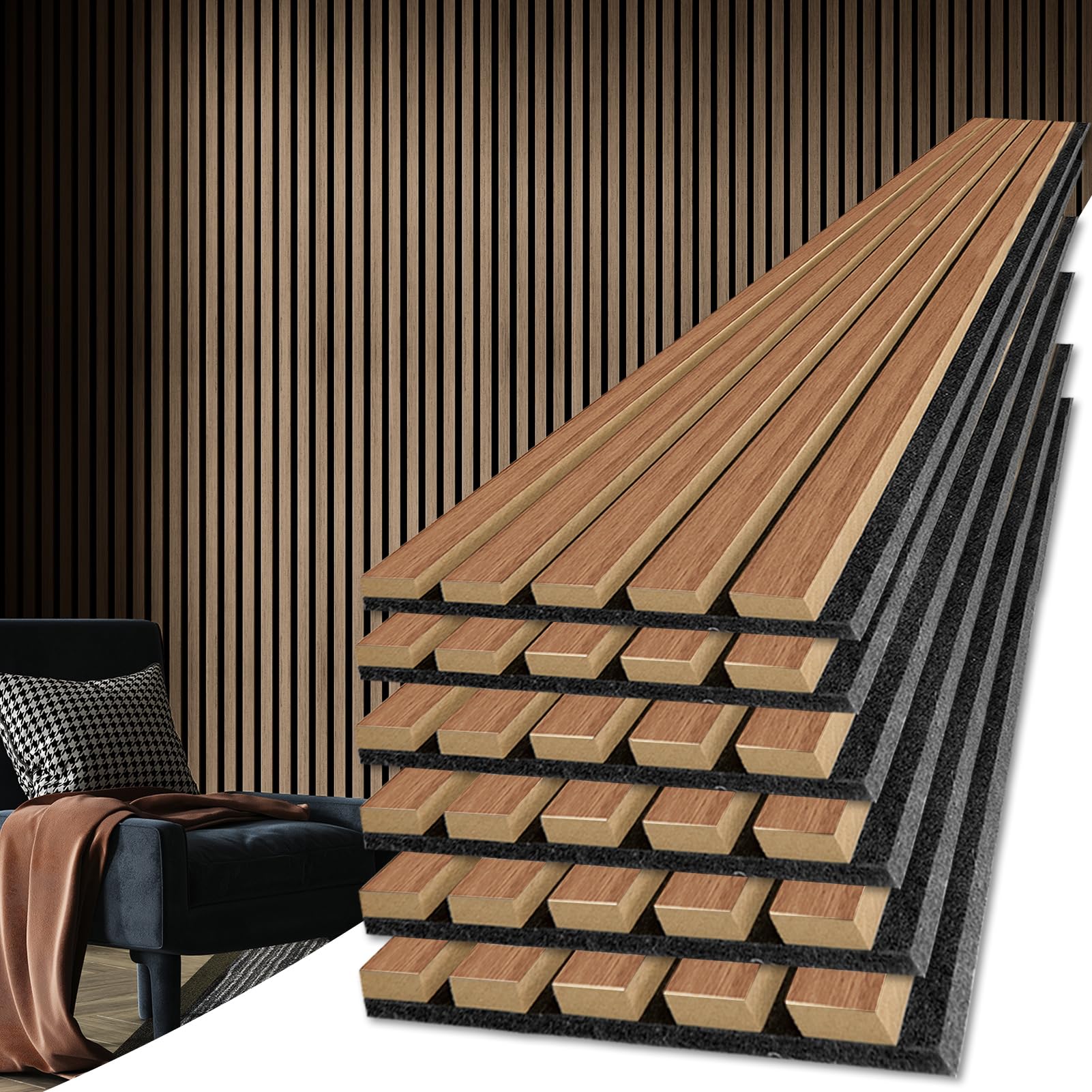
Six slim walnut slats that finish a room while they quiet it.
The slat format is the difference: six narrow 7.9 x 94.5 inch fluted panels that together cover about 31.5 square feet. Running them full-height gives you a modern fluted accent wall rather than a grid of tiles. The walnut grain finish is what people notice first — and it’s the panel most likely to make a room look finished.
Build is MDF with high-density polyester fiber, no harmful chemical emissions and low TVOC levels. Installation is quick with basic tools on walls or ceilings, and cutting is easy. The maker’s own advice is smart: order a sample pack to pick your finish before the full order, so you’re not guessing on a walnut tone across 31.5 square feet.
Quality is what everyone raves about, and the finish carries the look. If value is your yardstick, opinions split — some call it worth the spend, others want more coverage for the outlay. Either way, it’s the same acoustic job as the NeatiEase slat kit above, just in a narrower six-slat format instead of four wide ones — so pick the layout you prefer and measure your wall before committing.
For the finishers: slim fluted slats that cover about 31.5 square feet of full-height wall.
Be honest about value: it’s a premium wood-look finish — worth it if you want the look, arguable if you only want the echo gone.
Right for: anyone building a fluted, full-height walnut feature wall with acoustic benefit.
Not for: tight budgets chasing pure coverage — plain felt panels cover more per pack.
Know the Specs
NRC (Noise Reduction Coefficient)
The industry score for how much sound a surface absorbs. A higher number means more of the sound that hits the panel never bounces back into the room. If you’re fighting echo on calls or in a studio, this is the number that matters most — one panel here rates NRC 0.9, which is heavy absorption.
Thickness and density
Thicker foam (like a 2-inch pyramid panel) gives a sound wave more material to die in than a 0.4-inch felt tile. Density, measured in kg/m³ or lb/ft³, keeps the panel firm and working consistently across its surface. Together they decide how much echo a panel can quiet.
Coverage in square feet
Manufacturers usually recommend treating roughly 20 to 30% of a wall’s surface for a noticeable drop in echo. A 12 x 12 inch tile is 1 square foot, so a 36-pack is about 36 square feet; a 47.2 x 23.6 inch panel covers far more per piece. Always calculate coverage before you order.
Adhesive and mounting
Peel-and-stick panels install fast on smooth walls but can leave residue on removal and fail on textured surfaces. Panels sold without adhesive let you pick your mount — double-sided tape, spray adhesive, or hook-and-loop. Slat wood panels usually mount with screws for a sturdier, long-term hold.
Common Questions
Will acoustic wall panels actually stop noise coming through my wall?
How many panels do I need to cover a wall?
Do peel-and-stick acoustic panels damage paint when removed?
What does NRC 0.9 mean on an acoustic panel?
Are thicker acoustic panels always better?
Do foam pyramid panels need extra adhesive?
Can I cut acoustic panels to fit around a window or corner?
Are acoustic panels fire-safe enough for a bedroom or office?
Are wood slat panels or felt panels better for sound insulation?
Will acoustic panels help with noise on video calls?
The Bottom Line
For most rooms, the wall panel sound insulation winner is the NeatiEase Wood Panels for Wall because four 96 x 12.6 inch slats cover about 33 square feet and turn a noisy wall into a finished feature. If you want to treat a whole wall at once, grab the AUSLET 36 Pack Pyramid Foam for up to 36 square feet of 2-inch absorption. And for street noise with a clean felt look, the TONOR Dual-Layer Thickened Panels are the one to reach for.
How we choose
We do not accept paid placement. Every pick is matched to a real buyer and a real use-case; we do not hands-on test units.
Sources
Specifications: manufacturer listings and product documentation. Review insights: verified customer reviews, as of November 2026. Pricing: not shown on this page (it changes often); check the current price via the retailer link.
As an Amazon Associate, Tactical Gear Guy earns from qualifying purchases. This does not affect which products we feature.