Specs are compiled from manufacturer listings and verified buyer reviews and can change over time — please confirm the key details on the product page before buying.
You hang a wall mounted weather station at eye level and read barometric pressure (air pressure, which hints at coming weather), room temperature and humidity without picking anything up. For most buyers the Ambient Weather BA212 is the safest first buy: it packs a liquid barometer, a comfortmeter (a dial that shows how comfortable the room feels) and a cherry-finished wood frame into one unit that looks good on a hallway or study wall. One honest note before you shop: I match the wall-mounted requirement loosely, so a pick must be built to hang on a wall, not just sit on a desk stand. That means not every pick is the exact model you typed into the search bar; the nearest same-type instrument that does the same job is included instead. Nothing below is a tabletop-only gauge pretending to be a wall piece.
This guide is built by comparing the manufacturers’ published specifications and the patterns across verified customer reviews, so you get each pick’s real strengths and trade-offs instead of marketing spin.
Mechanical dials and digital screens behave very differently on a wall, so the guide below separates them clearly before you commit to one. Every pick here hangs, and each one is matched to a different room and a different reader — which is exactly what makes a wall mounted weather station worth choosing carefully.
Top Picks


How To Choose The Best Wall Mounted Weather Station
Your first decision is not brand or budget — it is if you want to watch the weather or be told the weather. A mechanical wall barometer makes you read a needle against a dial and work out the trend yourself. A digital station hands you a forecast icon, a humidity percentage and an alert. Pick the wrong one for your habits and it becomes wall clutter within a month.
Mechanical dial versus digital screen
A mechanical unit like the 3-in-1 Imperial runs on a metal dial with no display and no batteries, so it never needs charging and never goes dark. The trade-off: you read an analog needle, which is slower to interpret than a number. A digital LCD or VA screen (a colour panel that stays legible at an angle) shows exact figures and can raise an alarm when humidity climbs, but it depends on power and on a wireless link to its outdoor sensor. If your wall is in a hallway you glance at in passing, a dial works. If you want to act on the data, go digital.
What the barometer range tells you
Barometric pressure is the weight of the air above you, and falling pressure is the classic early hint of incoming stormy weather. Instruments quote their measuring range in inches of mercury (inHg), and a range of 28.75 to 31 inHg covers the normal spread of everyday weather. Check that the dial is actually marked in the units you think in. A Fahrenheit scale with an imperial dial suits most US buyers; a metric-only face means mental conversion every time you look up.
Humidity accuracy and where you hang it
A hygrometer measures relative humidity, the moisture level in the air as a percentage. A stated accuracy of ± 5% means the reading can sit five points either side of the true value, which is fine for a living room comfort read and not fine for a cigar humidor. Placement matters as much as the sensor: a wall above a radiator or beside a bathroom door reads the micro-climate of that spot, not your house.
Sensor range, power and mounting hardware
Wireless outdoor sensors transmit on radio frequencies such as 433.92 MHz, and range is quoted for open air — 330ft and 328ft/100M appear in this category. Walls, floors and metal cladding cut that figure hard, so treat the quoted number as a best case. Decide early whether the station will run on an AC adapter or batteries, because on several digital models the backlight only stays lit while plugged in. Finally, confirm the box includes mounting hardware; a wall bracket is the difference between a finished install and a return.
Side-by-Side Comparison
| Model | Best For | Type | Power | Outdoor Sensor | Amazon |
|---|---|---|---|---|---|
| Ambient Weather BA212★ Best Overall | Classic wood-framed wall piece | Liquid barometer + comfortmeter | None required | — | Amazon |
| AMTAST 3-in-1 ImperialMetal Dial Pick | No-battery metal dial | Mechanical barometer/thermometer/hygrometer | None required | — | Amazon |
| Raddy WM6Longest Unplugged | Cable-free wall display | LCD digital, atomic clock | 2000mAh rechargeable + adapter | 1x R3 included, 3 channels | Amazon |
| Classic Analog Weather Station | Vintage decor + analog dials | Mechanical barometer/thermometer/hygrometer | None required | — | Amazon |
| Geevon Wireless Station | Big colour readout on a budget | 7.5in colour VA digital | AC adapter or batteries | 1x TX16-3 included, 3 channels | Amazon |
| BluSon Wireless Station | Multi-room monitoring | 7.5in HD colour digital | Power cord or batteries | 3 sensors included | Amazon |
| SwitchBot E-Ink Dashboard | Calendar + smart home hub | 7.5in E-Ink | Battery (1 C included) | Via SwitchBot ecosystem | Amazon |
| Netatmo Smart Weather Station | App and voice access | Graphical, no wall screen | 2 AAA batteries (included) | Indoor + outdoor modules | Amazon |
| AcuRite Atlas 01001M | Full weather data + lightning | HD digital display | AC adapter + battery backup | Wind, rain, UV, lightning | Amazon |
Detailed Reviews
1. Ambient Weather BA212 Wall Mounted Weather Station
Our pick — 4.5+★ from 750+ verified ratings; the strongest balance of quality and price.
A wood-framed instrument that predicts the weather with coloured water instead of electronics.
The BA212 is the pick to start with because it does something no digital screen does: it lets you watch a liquid level physically rise and fall as air pressure changes. The mechanism is a sealed glass container half filled with water, with a narrow spout open to the atmosphere. When pressure drops, the water climbs the spout; when pressure rises, it falls below the level in the body. That single visual is the entire forecasting engine — no sensor, no calibration menu, no batteries to hunt for. It is indoor-only, so it belongs on a study, library or office wall.
Build quality is what wins people over here, and it shows in the frame rather than the dials. The unit measures 6.5″D x 6″W x 18″H in solid wood with a cherry finish, so it reads as furniture instead of a gadget. That 18-inch height is the number worth checking against your wall space before you buy — it is a genuine statement piece, not a small round gauge. For scale, the Classic Analog further down this list stands 12.59″H and is just 1.38″ deep, which makes the Ambient a considerably larger thing to hang. It weighs 1.8 pounds, light enough for most drywall with a proper fixing.
Alongside the barometer sits a comfortmeter, which pairs a thermometer and hygrometer with a comfort zone indicator — the needle parks in a band that tells you at a glance whether the room feels right. Here is the honest part: the pressure-to-weather link is a general relationship, not a forecast for your street, and the temperature and humidity side draws a split verdict from owners, some calling it very accurate and others disagreeing. Treat this as an elegant trend indicator for one room rather than a meteorological instrument, and you will be pleased with it for years. It is a looker first and a precise gauge second, and it owns that trade-off.
What it brings to the wall
- Solid wood construction with a cherry finish that dresses up a study or library wall
- Liquid barometer makes pressure changes visible as rising or falling water
- Comfortmeter adds temperature, humidity and a comfort zone indicator in one frame
- Zero batteries, zero cables, zero setup menus
Where it asks patience
- Indoor use only, so it cannot give you outdoor conditions
- Temperature and humidity readings split opinion on accuracy
- 18″H footprint needs real wall space
Reach for this if: you want a wall piece you enjoy looking at every day and a slow, visible read on pressure trends in one room.
Look elsewhere if: you need numbers you can act on from a phone — go digital instead.
2. 3-in-1 Imperial Weather Station
Three metal dials, no display, no batteries — and a face you can read from across the room.
Start with the coverage, because it is the reason to choose this one. The AMTAST dial packs a barometer, a thermometer and a hygrometer into one metal housing, with a stated measuring range of 28.75 to 31 inHg for pressure, -10 to 130°F for temperature and 0% to 100%RH for humidity. That 8.2-inch dial face is the other headline: it is a large analog readout, so you do not have to squint from a doorway. An imperial Fahrenheit scale means no mental conversion for a US household, and the dial can be hung horizontally or vertically depending on your wall.
Weight is where this separates from the vintage wood options. At 0.44 kg it is a heavier, more solid-feeling item than the Classic Analog at 0.4 kg, and the metal housing is what makes it easy to wipe clean and keep looking sharp. Unlike the BA212 above, this one has no liquid spout and no water to top up — it is a pure mechanical movement, which suits a kitchen or garage wall where a water column would be a liability.
The catch is honesty about precision. Amazon’s own summary of owner feedback is split right down the middle: some find it works well, others report it barely works. Mechanical movements do not self-calibrate, so the unit you hang is only as good as it arrived. It needs no power and no pairing, which is a genuine convenience, and the metal build gives it a long service life as a wall ornament that also reads the room. Buy it for the look and the three-dial convenience, and set your expectations on the accuracy accordingly.
The mechanical case: a 28.75~31 inHg range, -10~130°F and 0~100%RH across three dials, in a metal housing that installs either way round and never needs charging.
The honest limit: without electronics there is no self-calibration, so readings vary unit to unit.
Fits the workshop wall: a garage, shed or kitchen where you want a quick analog glance and no wiring.
Not the pick for: anyone who needs a reliable number to log or compare week to week.
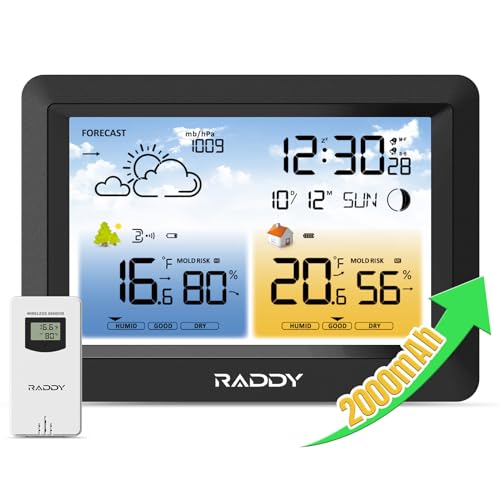
3. Raddy WM6 Wireless Weather Station
The wall display that hangs cable-free for up to 45 days on a built-in battery.
A wall station looks best with no wire dangling down the paintwork, and the WM6 is built around that idea. A built-in 2000mAh rechargeable battery claims up to 45 days of cable-free use, so it can hang high on a hallway wall without a cord running down the paintwork. You also get per-hour brightness scheduling — set 60% brightness from 18:00 to 23:00, for instance — which cuts glare in the evening without you touching it. A 433.92 MHz radio link pulls in the included R3 outdoor sensor.
You get an unusually deep feature list for the money. Alongside indoor and outdoor temperature in ℃/℉ (Celsius or Fahrenheit) and humidity, you get a barometer, a 12-hour forecast, comfort level, moon phase, high and low alerts, and an atomic clock that uses WWVB (the US radio time signal) so it sets itself and never needs manual adjustment. A dual alarm with separate weekday and weekend times turns the thing into a bedside clock too. Sensor support runs to 3 channels within a transmission range of up to 330ft (about 100m), which covers a baby room, kitchen or garden sensor set.
The honest caveat is the battery, and Raddy says so on the listing: for extended screen use, keep the adapter connected to avoid rapid drainage. Buyers report mixed battery life, with some getting as little as three days per charge — far short of the 45-day claim. Setup experiences are divided too, split between those who find it easy and those who find it confusing. Hang it where you can reach the adapter and it is a strong, feature-rich wall display.
Why it earns the middle spot: 2000mAh of built-in power plus a WWVB atomic clock and 3-channel sensor support give you a genuinely useful wall station without a permanent cable run.
What to plan for: heavy screen use drains that battery fast, so treat the adapter as the default and the battery as backup.
Best for: a hallway or kitchen wall where a clean cable-free look matters and the adapter socket is within reach.
Think twice if: you want to run the backlight all day on battery alone.
4. Classic Analog Weather Station

A slim gold-trimmed wall trio that reads the room and dresses the wall at the same time.
If the wall you have in mind is a living room rather than a workshop, this is the one that will not look out of place. The frame is cherry wood with gold-tone stainless steel and a lacquered cherry finish, and the whole thing is one of the slimmest units here: 1.38″D x 4.92″W x 12.59″H. That shallow depth means it sits close to the plaster instead of jutting into a hallway, and at 0.4 kg it hangs easily on most fixings. It arrives with mounting hardware in the box, so there is no separate trip for a bracket.
The dials cover the three classics — barometer, thermometer and hygrometer — on a simple analog face that is easy to read across a room. The hygrometer carries a stated accuracy of ± 5% relative humidity, which is adequate for a comfort read in a living space. The barometer detects short-term changes in atmospheric pressure, which is the useful part for anyone watching weather move in. Against the BA212 up top, this is a much smaller, thinner wall piece — 12.59″H versus 18″H — so it suits a narrow strip of wall the Ambient would overwhelm.
Owners describe the analog dials as easy to read and the vintage design as the draw, and it works as a gift for the science-minded. The catch is altitude and calibration: owners mention the functionality and accuracy receive mixed reviews, with some finding it accurate while others report it does not work above 3000 feet, and others note odd temperature measurements. If you live at elevation, that is a real consideration before you commit. Below sea-level-ish conditions it is a handsome, simple wall instrument with no power requirement at all.
Strengths that show on the wall
- Cherry wood and gold-tone steel frame suits a living room or office
- Shallow 1.38″ depth keeps it tight to the wall in a narrow hall
- Hygrometer rated to ± 5% relative humidity
- Mounting hardware included in the box
Things to weigh first
- Altitude sensitivity — reported trouble above 3000 feet
- Temperature readings draw mixed feedback
- Analog only, so no alerts or exact numeric logging
Choose it for: a low-altitude living room where the look carries as much weight as the reading.
Skip the wall mount if: you are above 3000 feet — this one may not behave.
5. Geevon Weather Stations Wireless

A big colour panel that squeezes serious data onto a wall for a modest outlay.
The 7.5-inch colour VA display is the whole argument for this one — a VA panel (a screen type that stays readable at an angle) means a station hung high in a hallway still works when you look up at it from below. The screen carries inside and outside temperature and humidity with tendency arrows, max and min values, hi/lo alerts, a 12-24 hour forecast, comfort indicator, barometric pressure, moon phases, an alarm with snooze, and the date. It supports up to 3 remote sensors within 200ft/60m in open air, though only 1 TX16-3 sensor comes in the box.
Two practical touches set it apart from other budget digitals. A USB charging port on the back lets you top up a phone or tablet from the same wall spot, which is genuinely handy in a kitchen. And the body is designed for both positions — a built-in stand bracket for a desk or a hanging hole for the wall — so it can move rooms. It runs on AC power or batteries, with a 6-month battery life figure quoted for battery mode.
What people enjoy most is the sheer amount of information packed into one readable panel, and the different colours do make each readout easy to pick out. The trade-off is brightness and reliability: backlight opinions are split, and accuracy draws the same divided view, with some finding it spot on and others reporting temperature readings that stop. The backlight also needs AC power to stay on — on batteries it cuts out after 10 seconds, which is normal for the class but worth knowing before you mount it. Solid value if you want data density over a single elegant dial.
The value read: a 7.5in colour VA panel, 3-channel sensor support and a USB charging port put a lot of daily utility on one wall mount.
Know before you hang: the backlight only stays lit on AC power, and accuracy reports are split.
Good match for: a kitchen or mudroom wall near a socket, where a bright multi-data readout earns its keep.
Less ideal if: you want a set-and-forget battery station with an always-lit screen.
6. BluSon Weather Station 3 Sensors

Three sensors in the box turn one wall display into a whole-home monitor.
Most digital stations include a single outdoor sensor and make you buy the rest. The BluSon ships with three, and supports up to three channels over a 328ft/100m open-area range — enough to watch a nursery, a basement and a garage from one wall panel. The 7.5-inch HD colour display shows indoor and outdoor temperature and humidity, a 12-hour forecast with icons, atmospheric pressure and moon phase. That three-sensor head start is the reason it sits this high on the list.
It also handles the daily chores well. The WWVB atomic clock sets itself daily and switches for daylight saving automatically across the PST/MST/CST/EST zones, with dual alarms and a snooze. Backlight offers four adjustable settings. Customisable temperature and humidity alerts will flag a nursery that has gone too cold or a basement that has turned too damp — the sort of proactive nudge that makes a wall display earn its place. It mounts on a wall or sits on a desk, and the body weighs 11.8 ounces.
One behaviour to plan around: on battery power the backlight switches off after 10 seconds to save energy, and batteries are not included, so the power cord is the route to a permanently lit screen. This is a newer model with a lighter review base than the long-established picks above, which is worth keeping in mind if you like to lean on a deep track record. For a family setup that wants three rooms monitored from one wall panel, though, the package is hard to argue with.
Pick this when: you want three rooms tracked from a single wall screen without buying extra sensors.
Plan around: battery mode kills the backlight after 10 seconds — run the cord for a lit display.
7. SwitchBot E-Ink Home Dashboard

An E-Ink wall panel that shows the forecast and the family calendar in one place.
This is less a weather instrument and more a wall dashboard that happens to include weather. The 7.5-inch E-Ink screen is the star: paper-like and glare-free, it reads like ink on a page and does not glow at you like an LCD. A built-in front light keeps it legible in low light. It displays indoor and outdoor temperature and humidity, today’s weather plus yesterday’s and the next 5 days, air quality, time and date, and sunrise and sunset. The E-Ink panel only redraws when the image changes, which is how it reaches a 365-day battery figure on a single C cell.
The calendar side is where it goes beyond the category. It syncs with Google, iCloud and Outlook, supports up to 5 family members with up to 30 events per day each, and runs scheduled reminders for shared tasks over 2.4GHz Wi-Fi and BLE. Two shortcut buttons trigger SwitchBot devices with a single tap — lights or curtains — though those actions need a SwitchBot Hub, and the remote-alert features do as well. Multiple view layouts, from a compact environmental view to a monthly schedule, can be set in the app.
The connectivity is the honest weak point, and it is the one aspect owners flag negatively. The app-driven setup and ecosystem features have a steeper curve than a plain dial, and Apple Home compatibility is among the reported sticking points. What wins people over is the display itself — a quality panel that is genuinely pleasant to glance at, and light enough on power to live on a wall without a cord trailing down. Buy it as a shared family board that also shows the weather.
What makes it different: a glare-free 7.5in E-Ink panel, a 365-day battery and a 5-person calendar — a wall board for the whole household, not just the hygrometer crowd.
The honest snag: connectivity is the most criticised part of the experience, and several smart features need a SwitchBot Hub you supply separately.
Ideal for: a busy family kitchen wall where the calendar matters as much as the temperature.
Not for you if: you want a plug-in-and-forget weather gauge with no app involved.
8. Netatmo Smart Weather Station
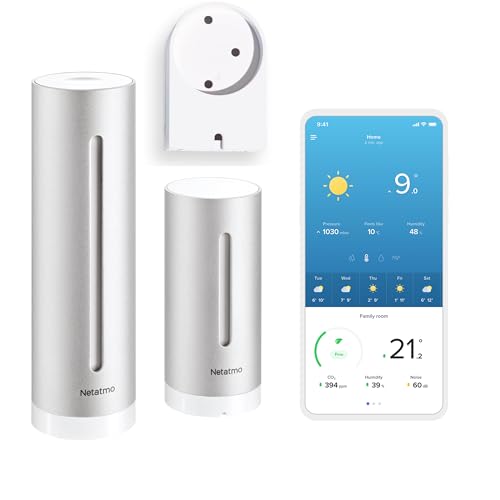
A wall-mounted sensor set that sends the numbers to your phone instead of a screen.
Here is the one that breaks the pattern: there is no wall display at all. The Netatmo is a set of modules — an indoor unit and an outdoor sensor — with the wall bracket included so the indoor module can mount where you choose. Temperature, humidity, indoor and outdoor air quality, indoor noise level and air pressure are measured in real time, then pushed to the Netatmo Weather app on your phone or tablet. If you would rather not have a screen on the wall, this is the pick.
The aluminium-bodied modules run on 2 AAA batteries, which come included, and connect over 2.4GHz Wi-Fi. You can configure warning messages for indoor and outdoor conditions and get them on your phone — there is a ventilation alarm that tells you when to air the room out. Forecasts cover the next 7 days, and trend graphs let you watch pressure and temperature move. Voice access works through Alexa, Google Assistant and Siri, so you can ask for the reading hands-free.
Two things to plan for. First, there is no subscription — the app and updates are free — but it does require a stable 2.4GHz Wi-Fi connection, and Netatmo recommends placing the unit near your router to minimise interference. Second, this is a phone-first system: if you want a glanceable dial in the hallway, it will not give you that. For anyone who checks their phone before leaving the house, the app-plus-voice approach is more useful than a screen they walk past.
Worth the leap if: your phone is your dashboard and you want air quality and noise alongside the weather.
Hold off if: you want a display you can read without opening an app.
9. AcuRite Atlas Professional Weather Station
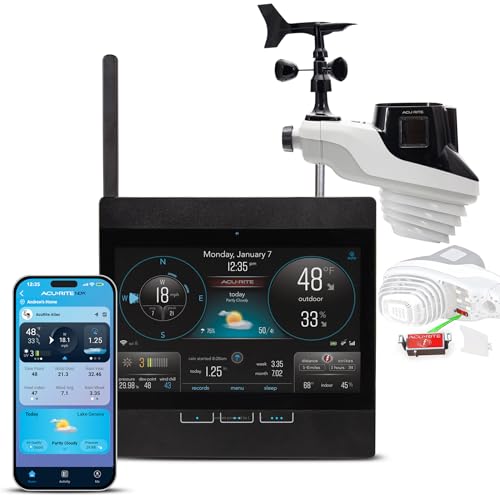
The most complete weather station here — wind, rain, UV and lightning in one system.
If you want to run a proper backyard weather station and hang the display on a wall, the Atlas is the most capable option on this list. The outdoor sensor array measures indoor and outdoor temperature and humidity, wind speed and direction, UV, light intensity, barometric pressure and rain totals — over 20 data points in all. It also detects lightning strikes from up to 25 miles away, giving you warning before a storm reaches the patio. The HD display shows it all with a wide viewing angle.
Two details make it flexible for a wall. The indoor display has integrated keyholes for easy wall mounting, or a fold-out stand for a tabletop. And it runs on an AC adapter with optional battery backup, so a power cut will not wipe your data and settings. It connects direct to Wi-Fi and can publish your readings to Weather Underground alongside more than 250,000 personal weather stations. It is the heaviest unit here at 4.35 kg, so plan the wall fixing accordingly.
The honest drawback is connectivity, which is the most criticised part of the experience — some customers note constant disconnections and trouble connecting to devices. Given that a station like this is at its best when feeding data to the app and the Weather Underground network, a shaky link is a real consideration. Patented self-calibrating technology combines elevation and atmospheric pressure for a personalised 12-hour forecast. Buy it as a serious data station, and budget some patience for the Wi-Fi side.
What a full station gets you
- 20+ data points including wind speed and direction, UV, rain and lightning
- Lightning detection up to 25 miles out
- Keyholes for wall mounting or a fold-out stand for a tabletop
- Battery backup keeps data and settings through a power cut
Where it can stumble
- Wi-Fi connectivity draws the most complaints — disconnections and pairing trouble
- Heaviest unit here at 4.35 kg, so the fixing needs to be solid
For the data obsessive: someone who wants wind, rain, UV and lightning captured from their own backyard.
Manage the risk if: your Wi-Fi is patchy at the wall you have in mind — that link is the weak spot.
Know the Specs
Barometric pressure and inHg
Barometric pressure is the weight of the air pressing down on you, and it is the number that predicts weather. Instruments quote their measuring range in inches of mercury (inHg), and a span like 28.75 to 31 inHg covers normal everyday conditions. A falling reading hints at unsettled weather on the way; a rising one points to clearer days. Mechanical dials show this with a needle, liquid barometers show it by raising or lowering water in a spout, and digital stations can log the trend for you.
Relative humidity and accuracy ratings
A hygrometer measures relative humidity — how much moisture the air holds, as a percentage. An accuracy figure like ± 5% means the reading may sit five points either side of the true value, which is fine for judging comfort in a room. Where you hang the station shapes the result as much as the sensor does: above a radiator or beside a steamy bathroom the air is not the air of the whole house.
Wireless sensor range in feet
Digital stations pair with outdoor sensors over a radio frequency, often 433.92 MHz. The quoted range — 330ft or 328ft/100m on the models here — is measured in open air, and walls, floors and metal cladding reduce it substantially. If your display sits in a basement and your sensor in the garden, test the pairing before you fix either one to a wall.
Power: adapter versus battery
Mechanical dials and liquid barometers need no power at all. Digital screens run on an AC adapter, batteries, or both, and on most models the backlight only stays permanently lit while plugged into power. On battery, the screen dims or shuts off after a short delay to save energy. Decide where the nearest socket is before you choose a digital station for a particular wall.
Common Questions
Do I need batteries for a mechanical wall barometer?
Why does my digital weather station screen go dark on battery?
How far can the outdoor sensor be from the wall display?
Will a barometer work if I live at high altitude?
Is a liquid barometer more accurate than a digital one?
Can I hang a weather station on an exterior wall?
What does the comfort zone indicator on a comfortmeter do?
Do I need a SwitchBot Hub for the E-Ink dashboard’s smart features?
Is a Wi-Fi weather station better than a radio-frequency one?
Can I mount these stations on any wall?
The Bottom Line
For most walls, the wall mounted weather station winner is the Ambient Weather BA212 because it does the job with no power, no pairing and no setup, and it looks like a piece of furniture rather than a gadget. If you want a digital readout that stays lit and does the calendar and alerts too, the Raddy WM6 is the one, with its 2000mAh battery and self-setting atomic clock. And for a backyard setup that tracks wind, rain and lightning, the AcuRite Atlas is the pick to reach for. Whichever you choose, hang it at eye level away from a heat source — the wall you pick shapes the reading as much as the instrument does.
How we choose
We do not accept paid placement. Every pick is matched to a real buyer and a real use-case; we do not hands-on test units.
Sources
Specifications: manufacturer listings and product documentation. Review insights: verified customer reviews, as of November 2026. Pricing: not shown on this page (it changes often); check the current price via the retailer link.
As an Amazon Associate, Tactical Gear Guy earns from qualifying purchases. This does not affect which products we feature.