Specs are compiled from manufacturer listings and verified buyer reviews and can change over time — please confirm the key details on the product page before buying.
A cord hider is just a channel or a pass-through plate that runs those wires out of sight — and the right one takes minutes to fit. This guide covers nine that actually hold their grip, sorted by how they install and what they hide.
This guide is built by comparing the manufacturers’ published specifications and the patterns across verified customer reviews, so you get each pick’s real strengths and trade-offs instead of marketing spin.
You will learn which hider suits drywall versus solid walls, and what separates a push-in grommet from a full recessed power kit. The crowd favorite here is the ECHOGEAR mini grommet set at 4.5+ stars, and our picks below cover every wall type you might face with a wall mounted tv cord hider.
Top Picks


How To Choose The Best Wall Mounted TV Cord Hider
The first decision is not brand or color — it is whether you are willing to cut a hole in your drywall. That single answer rules out half the options. If you rent, or you have brick or tile behind the TV, you want a stick-on raceway that never touches the inside of the wall. If you own the place and have hollow drywall, an in-wall pass-through kit hides the wires completely with nothing visible but a small plate.
Surface raceway or in-wall pass-through
A surface raceway is a channel that clings to the wall and covers the cords sitting on top of the drywall. It installs with pre-applied adhesive, needs no drill, and comes off with a little heat. An in-wall pass-through is a plate or grommet that lets the cables drop through the wall cavity itself, so nothing shows on the surface. The pass-through looks cleaner but demands a hole saw and, usually, drywall only.
Count your cables before you buy
Capacity is quoted in wire count, not width. A channel rated for 3-4 low-voltage cables will swallow HDMI, Ethernet, and speaker wire together, but the thick molded plug on a TV power cord is a different story. Measure the actual cord ends, especially any chunky surge protector plug, because bulky three-prong plugs often will not pass through a small grommet opening.
Adhesive versus screwed fixing
Most surface covers hold on with a peel-and-stick backing. That is fast, but paint and texture decide how well it clings — glossy or dusty walls are the usual culprits when a strip lets go. Many lengths can also be drilled and screw-fixed if you want it permanent, and a paintable finish lets you match the wall so it disappears.
Side-by-Side Comparison
| Model | Best For | Install Type | Coverage / Capacity | Material | Amazon |
|---|---|---|---|---|---|
| ECHOGEAR Wall Cable Hiders 2.25″ 4-Pack★ Best Overall | Clean in-wall look on drywall | Push-In | 4 grommets, 3+ cables each | Plastic | Amazon |
| D-Line 31.4in Half Round Cord HiderBest Value | Renters hiding a TV drop | Self-Adhesive | 31.4in total coverage | PVC | Amazon |
| VCELINK in-Wall Cable Management Kit 4-PackTop Performer | Multi-cable pass-throughs | Push-On | 4 grommets, 3-4 cables each | TPE / steel | Amazon |
| Yecaye TV Cord Hider 42in | Long wall runs and splices | Self-Adhesive | 42in, 3-4 wires | Plastic | Amazon |
| Delamu Cord Cover 113.4in | Whole-room wire tidy | Self-Adhesive | 113.4in total length | PVC | Amazon |
| D-Line TV Wall Mount Cord Hider 39in | smooth low-profile finish | Self-Adhesive | 39in, 2.36in wide | PVC | Amazon |
| HomeMount In-Wall Cable Management Kit | 4 thick HDMI runs | Screw-In plates | 2 plates, up to 4 HDMI | TPU / plastic | Amazon |
| Perlegear In-Wall Kit with USB & USB-C | Power and data in one cutout | Screw-In | 2 AC outlets + USB-A/C | ABS plastic | Amazon |
| Mount-It! Recessed Power Concealer | Full triple-outlet theater setup | Wall | Triple outlet, 9ft cord | Plastic / polypropylene | Amazon |
Detailed Reviews
1. ECHOGEAR Wall Cable Hiders — 2.25″ Mini Cord Hider, 4-Pack
Our pick — 4.5+★ from 800+ verified ratings; the strongest balance of quality and price.
The tiny grommet that makes your wall-mounted TV look professionally wired.
This is the pick for the person who wants the cleanest possible result with the least visible hardware. Each grommet measures just 2.25 inches across, so once the TV is up you barely register it against the drywall. You get four of them in the pack, which covers a TV drop plus a couple of speakers or a router you also want tidied.
The install is where these earn their keep. A 1.5 inch hole saw drill attachment comes in the box, so you cut a clean opening, press the ribbed grommet into the drywall, and route the cables through. The ribbed push-in design holds snug without screws. That is a genuine step up from the fiddly two-piece covers you have to line up by hand.
Buyers praise the sturdy plastic grommets and the minutes-long install with the included hole saw. Buyers describe a job that takes minutes rather than an afternoon, and the included hole saw is repeatedly the reason. The one honest caveat is the push-in grip on softer or uneven walls — a few folks find it needs a firm, careful press to seat fully, so keep the cutout tight and clean. Paintable white plastic means you can match it to any wall finish afterward.
What earns it the top spot
- Four 2.25″ grommets hide 3+ low-voltage cables each
- 1.5 inch hole saw drill attachment included — no extra trip to the store
- Ribbed push-in fit holds without screws
- Paintable white plastic blends into the wall
Where it needs care
- Push-in grip rewards a tight, clean cutout on uneven drywall
- Designed for low-voltage cords — no AC power routing
The clean-cut choice: Best if you have hollow drywall and want nothing visible but a small disc behind the set.
Look elsewhere if: You need to route an actual power outlet through the wall — that calls for a recessed kit below.
2. D-Line 31.4in TV Cord Hider, Half Round Cable Cover
A peel-and-stick cover that opens, swallows your cords, then snaps shut.
You get 31.4 inches of coverage from two 15.7-inch lengths, joined by a connector piece. That is enough for a standard wall-mounted TV drop without cutting. The profile is a half-round shape just 1.18 inches wide and 0.59 inches tall, so it hugs the wall and reads as decor rather than a repair.
The clever bit is the flexible hinged lid. Unlike a two-piece cover where you cut and line up a separate base and top, this is a single piece you stick down, pop open, drop your HDMI and power cords in, and click shut. That same hinge makes it easy to add a cable later when you upgrade a streaming box — no pulling the whole thing off. It is paintable too if you want a true match.
The adhesive is genuinely a split decision. It goes down well on clean, primed surfaces, but on fresh or glossy paint the strip can let go over time, and it can lift paint when removed. If your wall is textured or newly painted, plan to drill and screw-fix these lengths instead — D-Line builds them for that. A fair warning for renters: test a discreet spot first.
Where it shines: 31.4 inches total coverage from two lengths plus a connector, so a normal TV cord drop is covered without measuring and cutting.
The follow-up question: Will the stick hold? On smooth primed drywall yes; on glossy or fresh paint, screw-fix it for permanence.
Reach for this if: You want a no-drill channel with a re-openable lid for future cable swaps.
Think twice if: Your wall is textured or freshly painted — the adhesive may lift.
3. VCELINK in-Wall Cable Management Kit, 4-Pack
Four flexible pass-throughs for anyone running a whole entertainment stack.
This kit gives you four grommets and one included hole saw drill, so multiple low-voltage runs all get their own clean exit. Each opening measures 1.20 inches across, versus the D-Line half-round cover at 1.18 inches wide. Inside, the TPE opening is flexible at a 1.20-inch diameter, sized to hold 3-4 low-voltage cables without pinching them.
You get it on the wall in minutes, even on your first try. The included hole saw (a round cutting blade) carves the opening, and the grommet (the trim ring that covers the cut) pops in with a firm push — reviewers describe it as a job that takes minutes. That suits you if a TV, a soundbar, a router, and a security camera all need tidy cable exits. The white finish paints over easily, so you can match your wall for a smooth look.
There is one measurement you must respect before cutting. The kit is not suited to double-layered drywall or walls thicker than 0.87 inches, because the included hole saw only reaches so far. And any bulky three-prong power plug or a fat surge protector plug may not fit through the flexible opening. Check your plug size and wall thickness first — that step saves you a wasted cutout.
The capacity story: Four separate 1.20-inch grommets, each handling 3-4 low-voltage cables, so one pack tidies an entire media wall.
Read before you drill: Walls thicker than 0.87 inches and chunky power plugs fall outside the spec — measure both first.
Made for this: The multi-device setup — TV, speaker, router — where you want several tidy wire exits.
Not for this: Double-layer drywall or walls over 0.87 inches, or any run that ends in a fat three-prong plug.
4. Yecaye TV Cord Hider, 42in Cord Cover, Grey
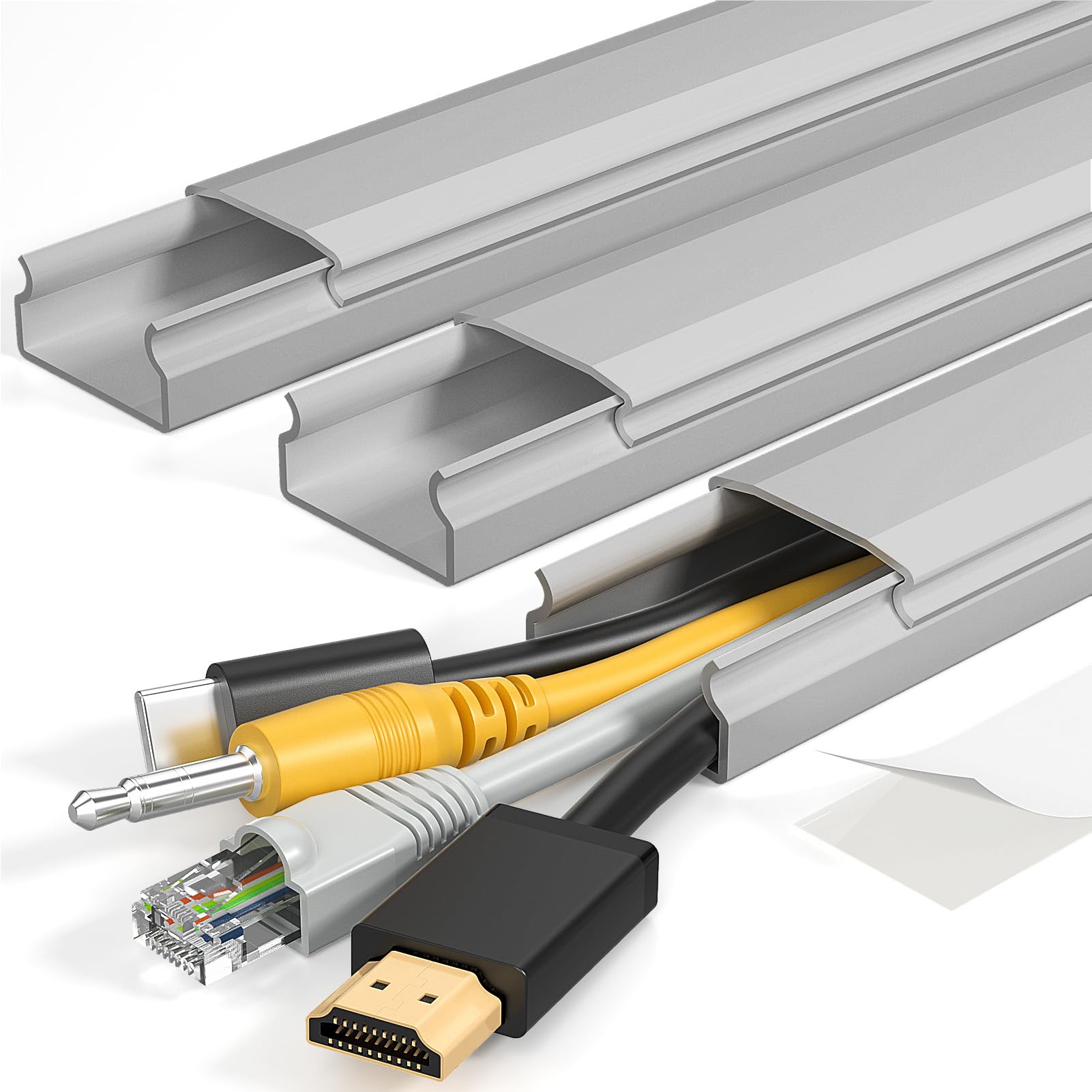
Forty-two inches of grey channel, sized for tall TV drops and low-hung screens alike.
Length is the headline here. At 42 inches this is the long continuous run, and the Yecaye runs 42 inches versus the ECHOGEAR mini’s 2.25-inch grommet. If your TV sits high, or the cords have to travel from the set to an outlet near the floor, one length stretches across the whole span without a mid-run joint.
You can also splice the three raceways together for a longer wall run, or use them as separate short sections under different screens. The internal space is 1.1 inches long by 0.52 inches wide, which holds 3-4 wires depending on cord thickness. The lid slides or snaps on, so you can pick whichever motion suits the space you are working in.
Reviewers single out the grey finish, which reads as a deliberate design choice rather than a cover-up. Installation is a single peel-and-stick, and disassembly is just as quick when you need to swap a cable. The catch is the adhesive’s pull: it holds firmly, but a few users find it rips paint off when removed, so treat it as a semi-permanent add. Measure your wire count first, since 3-4 is the realistic limit.
Why tall TV walls like it
- 42 inches of continuous coverage — the longest single run in this group
- Three raceways splice together or split for flexible layouts
- 1.1in x 0.52in internal space holds 3-4 wires
- Peel-and-stick install with no tools
The real-world caution
- Adhesive can lift paint on removal — plan for a semi-permanent fitting
- Capacity tops out at 3-4 wires depending on cord size
Pick it for: A high-mounted TV or a long drop where one continuous length beats piecing shorter covers together.
Skip if: You need the cover to come off cleanly again and again — the pull can take paint with it.
5. Delamu Cord Covers for Wires on Wall, 113.4in
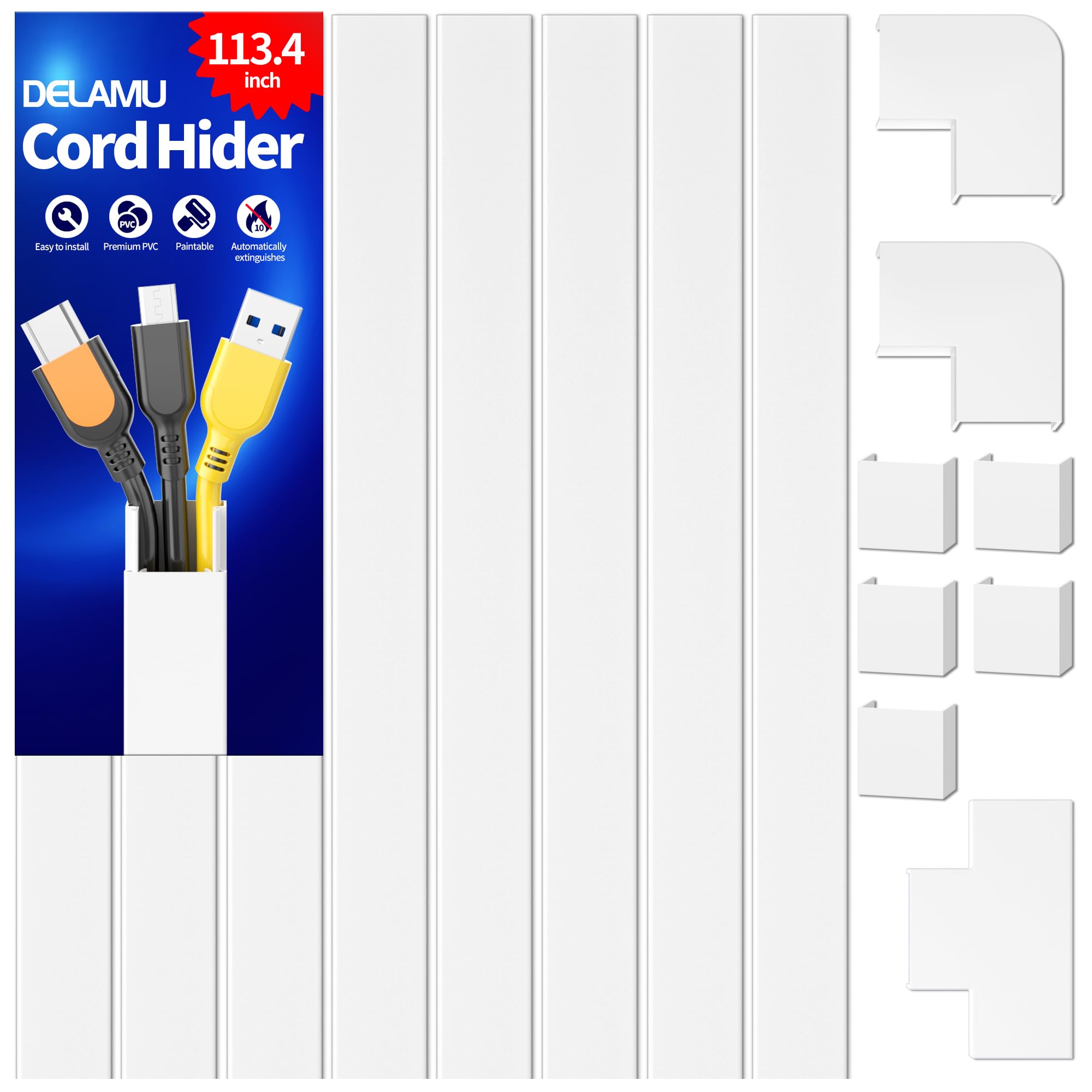
A huge multi-piece kit that hides the whole entertainment wall, not just the TV drop.
Where most covers give you one length, this kit runs 113.4 inches total across many pieces — enough to route cords along a whole wall and around corners if needed. The single-profile width is 0.95 inches with a 0.55-inch height, so it sits slim against the drywall. If your goal is a cord-free media corner, this is the volume play.
The safety spec is unusual for the category. It meets the UL94 V-0 flammability standard, which the maker says means the material self-extinguishes within 10 seconds and produces no flaming drips. That matters more when a cover sits over a cluster of cords than most buyers realize. The snap-on lid clicks open and closed for fast cable changes, and the lengths are cuttable to fit your run.
Buyers praise the rigid PVC, which feels solid rather than flimsy, and the generous 113.4 inches in the box. The upgraded snap design takes some force to seat, so give each joint a firm press. The one thing to watch is adhesion over time; on some walls the stick softens, so clean the surface well and consider a dab of extra tape at the ends. For a large, multi-run job the value is hard to argue with.
Big-job value: 113.4 inches of cuttable, paintable PVC that covers an entire wall run in one box.
Fit note: The snap lid needs a firm press, and the adhesive benefits from a spotless, dust-free wall.
Built for: Whole-room cable cleanup where you want plenty of length and a flame-retardant material.
Maybe not for: A single short TV drop where a compact grommet set would do the job with less leftover material.
6. D-Line TV Wall Mount Cord Hider, 39in Low Profile

The widest single cover here, built to look like trim rather than a cable channel.
At 2.36 inches wide and 0.59 inches tall over a 39-inch length, this is a generous single-piece run. The extra width is what lets it swallow a busier bundle than a slim channel, while the patented low-profile shape and a hidden flexible hinge make the finished line look almost continuous. If your TV drop has several cords in it, that width buys you breathing room.
Installation is peel-and-stick. Clean the wall, peel the liner, press it down, then open the hinged lid, lay your cables in, and snap it shut on the click-lock. It is paintable — key the surface with fine sandpaper and apply two coats if you want a true color match. That paintable finish is what turns a plastic strip into something that looks intended.
Owners pick this over cheaper strips for the sturdy PVC build and the click-lock hinge that keeps cords hidden behind a wall-mounted flatscreen. The honest trade-off is the adhesive, which some find less firm than the price suggests, and a handful feel the value is fair rather than outstanding. On a primed, clean wall it holds well; on gloss, expect to re-press.
Best fit: Bigger TV drops on walls where you want a wide, trim-like finish that paints to match.
Give it a miss if: You are working over gloss paint and want zero re-pressing — the adhesive wants a matte, primed surface.
7. HomeMount In-Wall Cable Management Kit, 2-Piece

An in-wall pass-through built for chunky HDMI connectors and a true zero-cord look.
This is a two-plate kit — an upper and lower pass-through — that hides the cables completely inside the wall cavity rather than covering them on the surface. The flexible openings fit up to 4 large HDMI cables with room for thicker connectors, which is exactly what a console and soundbar setup demands. Both plates are paintable to match your wall.
The self-closing TPU opening is the smart detail. It gently grips around the cords after they pass through, so the wall cavity stays covered and you do not see a gaping hole around the wires. You secure the bracket behind the wall by tightening the screws, which keeps it firm. A drywall hole saw attachment is included, and users report the job going in around 20 minutes.
There is a hard limit to know before you buy. It fits drillable walls 12-18 mm thick — that is 0.47 to 0.71 inches — including drywall and wood panels, but not tile, brick, or concrete. If your TV wall is plaster-over-brick, this kit is not the one. The pairing detail: it lists a 32-inch minimum screen size, so it is tuned for real mounted TVs rather than tiny monitors.
Room for the chunky stuff: Up to 4 large HDMI cables with clearance for thicker connectors, plus self-closing TPU openings that cover the cavity.
Wall check first: Drywall and wood panels in a 0.47-0.71 inch range only — tile, brick, and concrete are out.
Get this one if: You have drywall, thick HDMI plugs, and want the cords to vanish into the wall entirely.
Pick something else if: Your wall is tile, brick, or concrete — the bracket will not grip.
8. Perlegear In-Wall Cable Management Kit with USB & USB-C
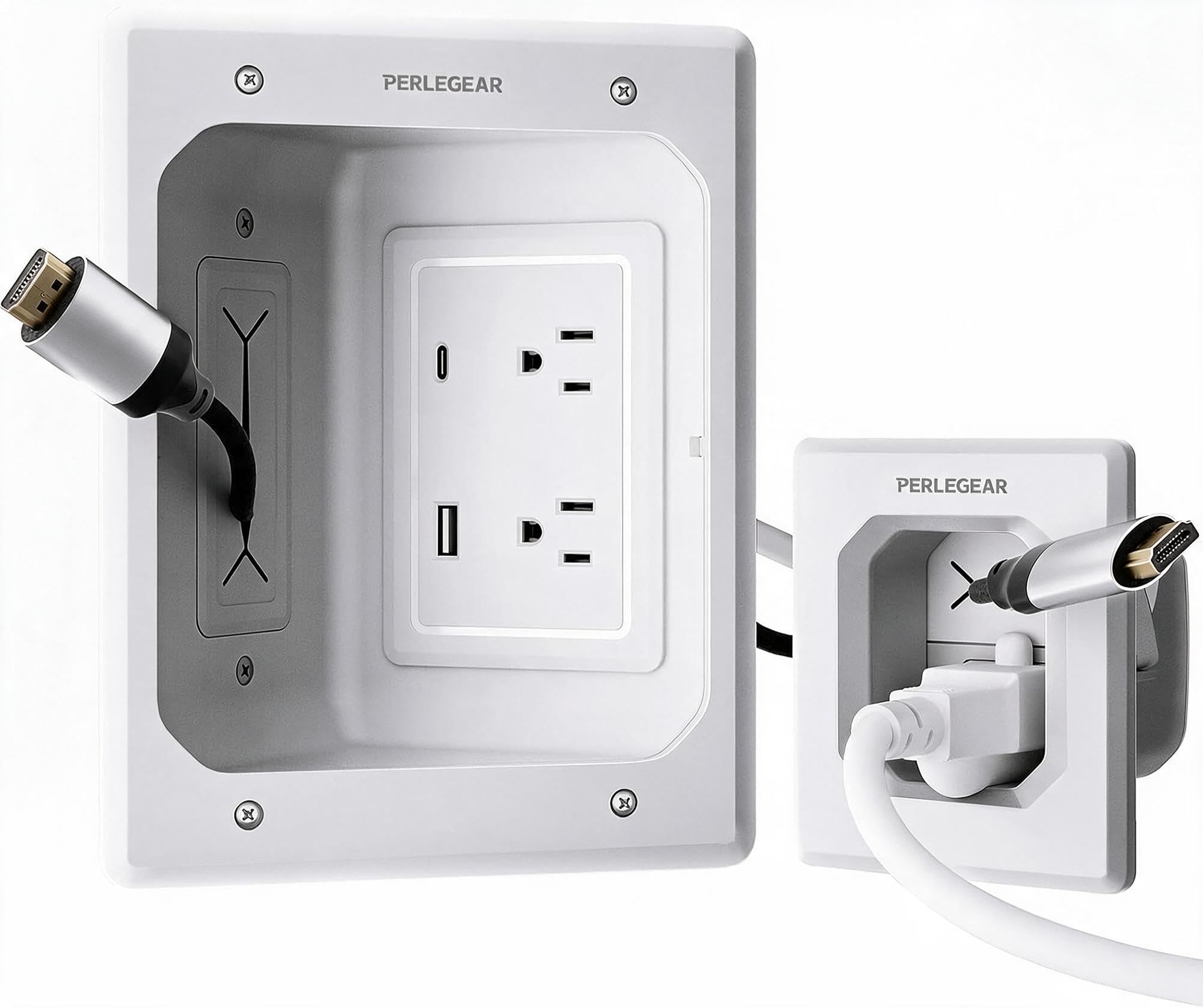
A recessed power module that puts outlets and USB charging behind the TV itself.
This is the upgrade for the setup that needs power in the wall, not just a channel over it. The kit packs two AC outlets plus USB-A and USB-C charging ports right at the wall plate, so your TV, a streaming stick, and LED lights all plug in behind the screen. Two 6-foot power cables connect the wall modules, and a 6-foot extension cord lets you position the screen at the height you want.
The box is genuinely everything-in-one: a drywall saw, a hole saw attachment, two cutting templates, two dust bags, and the two power modules. The maker says the job runs in under 30 minutes with the step-by-step instructions, and installation is the part owners single out most. It carries UL and SGS certification for safety, which matters when you are routing mains power through a wall.
Two measurements decide whether this works for you. First, the wall must be at least 3 inches deep to seat the modules. Second, there is a fitment theme worth planning for — alignment of the plates needs a careful, level cutout, so use the provided template and measure twice. The adjustable locking wings help hold the modules in place once it is in. Do the size check against your own wall before cutting.
Why it justifies the step up
- 2 AC outlets plus USB-A and USB-C charging at the wall plate
- 6 ft power cables and 6 ft extension cord for flexible placement
- Full kit: drywall saw, hole saw, two templates, two dust bags
- UL and SGS certified safety construction
Plan around this
- Needs a wall cavity at least 3 inches deep
- Plate alignment rewards a level, template-guided cutout
The right call when: You want to power devices from a recessed module and plug USB gear in behind the TV.
Hold off if: Your wall is shallower than 3 inches — the modules will not seat cleanly.
9. Mount-It! In-Wall TV Cable Concealer with Recessed Power
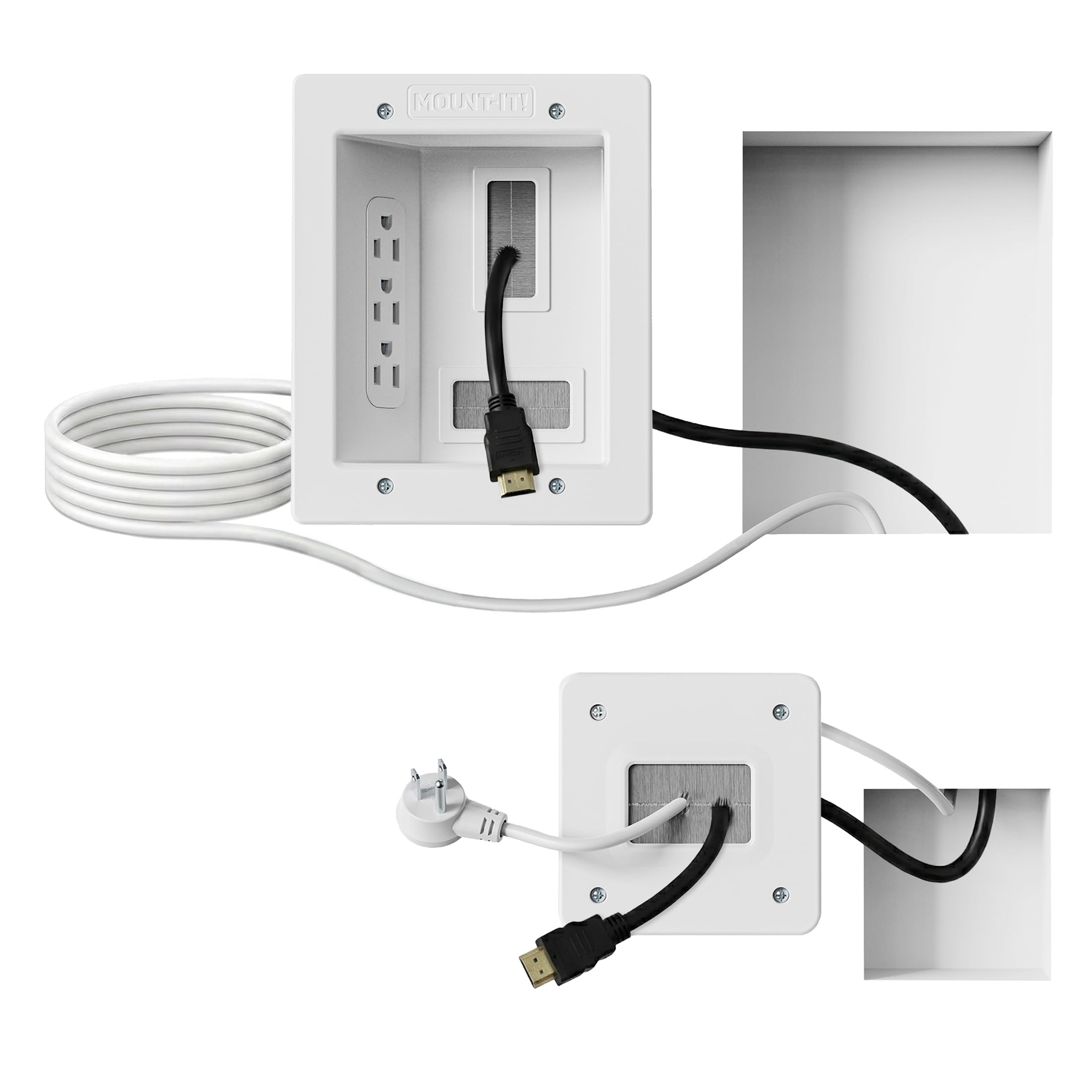
A plug-in recessed kit with a triple outlet, made for the whole home-theater wall.
The centerpiece here is the triple outlet — three places to power your TV, receiver, and console from behind the screen. A 9-foot extension cord runs to your existing wall outlet, so this is a plug-in system rather than a hard-wired one. That is the detail that lets renters and do-it-yourselfers get a pro-looking install without calling an electrician.
You get two wall plates — a large one at 6.3 x 7.9 inches and a small one at 4.5 inches — each with pre-installed screws to speed up assembly. Also in the box: the 9-ft power cord, a drywall saw, a cutting template, and instructions. The spacious recessed opening handles multiple HDMI, Ethernet, and A/V cables so everything routes behind the drywall and stays hidden. It is ETL in-wall certified for safety, and the low-voltage cables run behind the wall while the power cord connects to your outlet.
The pre-purchase check is the make-or-break. The large plate needs a cutout between studs and a minimum cavity depth of 2.4 inches, and standard walls are usually around 3.5 inches — so most homes are fine, but measure before you cut. Owners rank the substantial, weighted build second only to the easy install. Get the depth right and this is a complete, certified solution.
The all-in package: Three outlets, a 9-ft cord, two plates, a saw, and a template — one box for the full theater setup.
Measure twice: The big plate needs a between-studs cutout and a 2.4-inch minimum cavity depth, so check your wall first.
Suits you if: You are powering a TV plus several devices and want a certified, plug-in recessed kit with everything included.
Double-check first: A wall cavity under 2.4 inches deep will not fit the large plate.
Know the Specs
Low-Voltage vs Line-Voltage Cables
Low-voltage cables carry data or low power — HDMI, Ethernet, coax, speaker wire, and USB. These are what a standard cord hider or pass-through grommet is designed to conceal. Line-voltage cables carry mains AC power to your TV and outlets, and routing those requires a certified recessed power module rather than an open channel. Match the hider to the cable type before you buy.
Coverage Length vs Cable Capacity
Coverage length is how far a channel runs along the wall — for example 31.4 inches or 42 inches — while capacity is how many cables fit inside. A long run does not automatically mean more room inside; a 42-inch cover may still top out at 3-4 wires. Check both the total length and the internal measurements, then count your actual cords and their plug sizes.
Adhesive vs Screw Fixing
Self-adhesive covers peel and stick, which is fast and removable, but adhesion depends on a clean, matte surface and can soften over time. Many lengths are also built to be drilled and screw-fixed for a permanent hold. If you rent or need to remove it later, favor adhesive and test a hidden spot; if it must never budge, plan on screws.
Hole Saws and Cutout Fit
A hole saw is a round drill attachment that cuts a clean circle in drywall for a pass-through grommet or plate. The included saw sets the cutout size, so if your wall is thicker than the saw reaches, the module will not seat. Always check the maximum wall thickness the kit supports, and confirm the opening is wide enough for your thickest connector before cutting.
Common Questions
Will a wall mounted TV cord hider work on brick or tile?
How many cables can a cord hider actually hold?
Can I hide a TV power cord inside a regular cord hider?
Do I need to cut a hole in the wall for these?
Will the adhesive damage my paint when I remove it?
What is the difference between a surface raceway and an in-wall pass-through?
Can I paint these cord hiders to match my wall?
How long does installation take?
Will a chunky surge protector plug fit through a grommet?
What wall thickness do in-wall kits support?
The Bottom Line
For most walls, the wall mounted tv cord hider worth buying is the ECHOGEAR 2.25″ Mini Cord Hider 4-Pack. It hides your cables completely behind a tiny disc, includes the hole saw, and holds a snug push-in grip. Want a no-drill channel with a lid you can reopen? The D-Line 31.4in Half Round is the easy call. And for a full media wall that needs power and data in one certified kit, reach for the Mount-It! Recessed Power Concealer.
Here is the nudge that matters: match the tool to your wall first. If the wall is hollow drywall, a pass-through hides the cords best; if it is solid or you rent, a surface raceway is the smarter buy. Get that one decision right and the rest of the install falls into place.
How we choose
We do not accept paid placement. Every pick is matched to a real buyer and a real use-case; we do not hands-on test units.
Sources
Specifications: manufacturer listings and product documentation. Review insights: verified customer reviews, as of July 2026. Pricing: not shown on this page (it changes often); check the current price via the retailer link.
As an Amazon Associate, Tactical Gear Guy earns from qualifying purchases. This does not affect which products we feature.