Specs are compiled from manufacturer listings and verified buyer reviews and can change over time — please confirm the key details on the product page before buying.
A 75-inch TV is heavy, wide and unforgiving. Bolt it to a bracket that is too weak or too shallow, and you get sag, glare you can never escape, and a nagging fear every time someone bumps the wall. Before you order, match three numbers: your TV’s weight, its VESA hole pattern, and your wall’s stud spacing. Arm length, tilt and profile only matter once those three line up.
This guide is built by comparing the manufacturers’ published specifications and the patterns across verified customer reviews, so you get each pick’s real strengths and trade-offs instead of marketing spin.
Below you get nine mounts sorted by what a big screen actually needs, from a long corner arm to a near-flush panel. Every pick supports a 75-inch panel on paper, which makes the wall mount for 75 inch tv choice mostly about wall, weight and viewing angle.
Top Picks


How To Choose The Best Wall Mount for 75 Inch TV
Big-panel mounting rewards a two-minute check before you buy. A 75-inch set can sit anywhere from roughly 40 to over 100 lbs depending on panel type, and the bracket has to swallow that weight without flexing. Get those three numbers right and the install is a straightforward bolt-up job.
Start with VESA, not brand
VESA is the pattern of threaded holes on the back of your TV, written as width by height in millimetres. Most 75-inch sets land at 400x400mm or 600x400mm, so a bracket can reach at least 600x400mm to be safe. Look up your exact model’s VESA spec before ordering — a mount that caps out lower simply will not bolt on.
Match weight capacity to your panel
A mount’s capacity is the heaviest screen it is rated to hold. Aim for generous headroom above your TV’s published weight, because full-motion arms put extra leverage on the wall when the screen is swung out. Fixed brackets pull straight down and are more forgiving.
Know your studs before you drill
Wood studs behind drywall sit at set centres — commonly 16 inches, sometimes 12, 18, 24 or 32. Your bracket must span the studs you actually have. Drywall alone will not hold a 75-inch screen, and most mounts here state that in their own instructions.
Decide how much movement you need
A fixed mount holds the screen flat and close, which looks clean but locks the angle. A full-motion arm extends, swivels and tilts so you can aim the TV at a different seat or a kitchen. Corner setups and open-plan rooms usually need the arm; a straight-on living room wall often does not.
Side-by-Side Comparison
| Model | Best For | Max VESA | Weight Capacity | Motion Type | Amazon |
|---|---|---|---|---|---|
| MOUNTUP 37.2″ Long Arm★ Best Overall | Corner rooms and room-to-room viewing | 600x400mm | 99 lbs | Full motion | Amazon |
| Pipishell PILF3Best Value | First-timers wanting an all-round swivel | 600x400mm | 100 lbs | Full motion | Amazon |
| SANUS No StudRenter Friendly | Renters and tricky walls | — | 135 lbs | Fixed | Amazon |
| USX STAR Heavy Duty | Ultra-slim look on a big screen | 900x600mm | 220 lbs | Fixed | Amazon |
| IMtKotW Ultra Slim | Frame-style TVs flush to the wall | 600x400mm | 165 lbs | Fixed | Amazon |
| HOME VISION HV9901 | Tilt over a fireplace or high mount | 900x600mm | 220 lbs | Tilt | Amazon |
| USX MOUNT Ultra Slim Full Motion | Balanced swivel at a mid price | 600x400mm | 120 lbs | Full motion | Amazon |
| USX MOUNT XML925 | Big-room full motion with long reach | 600x400mm | 150 lbs | Full motion | Amazon |
| monTEK 40″ Long Arm | Very large rooms and heavy panels | 900x600mm | 265 lbs | Full motion | Amazon |
Detailed Reviews
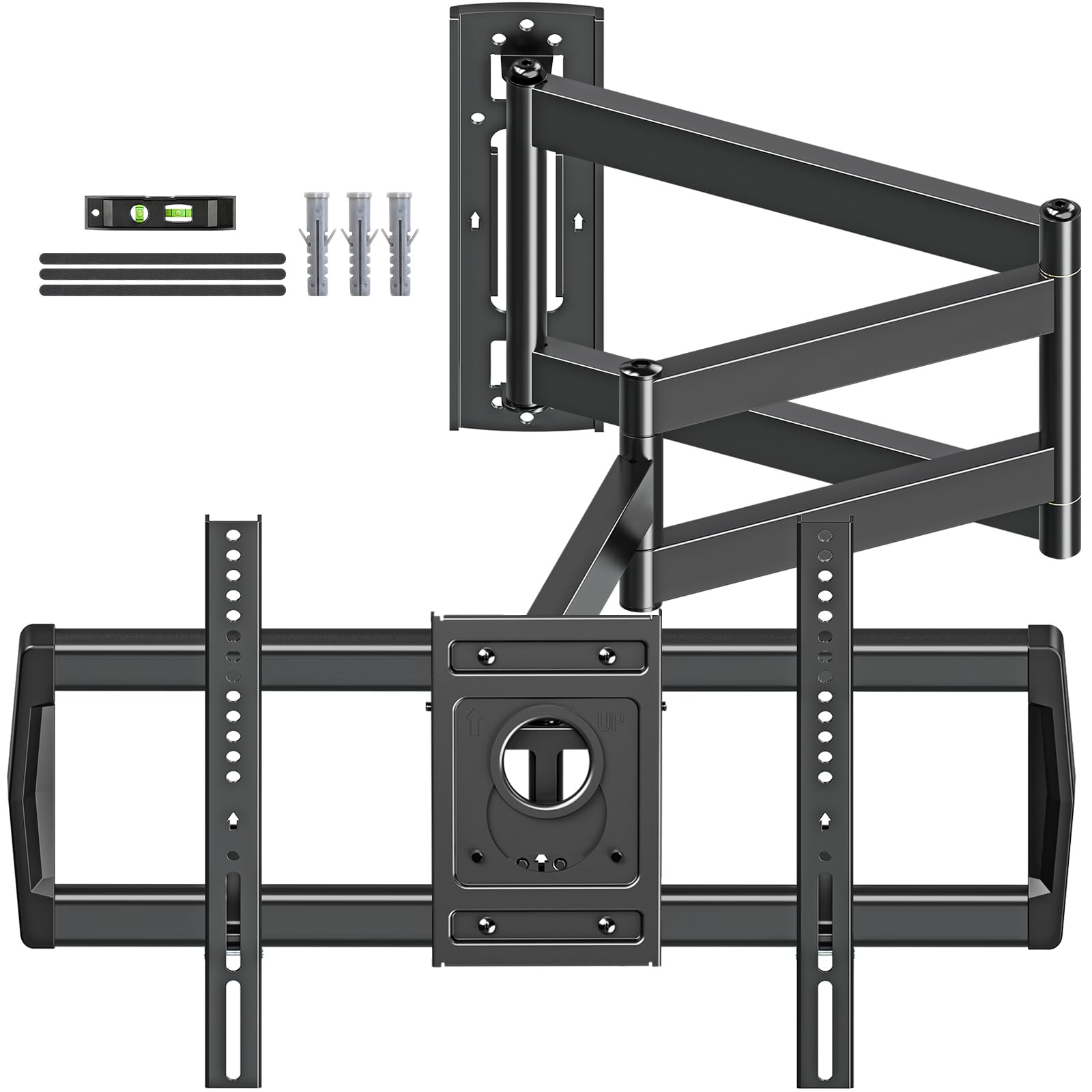
1. MOUNTUP 37.2″ Long Arm TV Wall Mount
Our pick — 4.5+★ from 800+ verified ratings; the strongest balance of quality and price.
The long triple-folding arm that drags your screen from one end of the room to the other.
Here is the number that decides this one: the arm reaches out 37.2 inches and folds back to about 2.5 inches from the wall. That reach is 37.2 inches versus the 16.73-inch extension on the Pipishell below, so a corner install stops being a compromise. You can pull the screen out toward the sofa, push it back flush for the evening, and aim it across an open-plan space without moving the bracket.
The swing is +/-90 degrees of swivel, which lets you cover most of a room without turning the whole mount. Tilt runs +5 to -9 degrees and leveling runs +/-4 degrees, so you can pull the top of the panel away to fight lamp glare and then nudge the frame level after it is hung. A single-stud design keeps the wall plate small, which is exactly what makes corner placement practical in the first place.
What wins people over is the build quality and the way the arm behaves once installed — the panel moves smoothly rather than drooping at the end of its travel. The trade-off sits in the spec sheet: capacity tops out at 99 lbs, so a heavy 75-inch set needs a weight check before you commit. The mount also has to bite into a stud or concrete, and MOUNTUP says plainly not to hang it on drywall alone. Drywall anchors are included only for concrete, so plan your wall first.
What earns it the top spot
- 37.2 inches of extension reaches across a room or into a corner
- +/-90 degree swivel covers nearly every seat in an open layout
- Single-stud plate suits tight corner space
- Folds back to about 2.5 inches for a tidy profile
Where it asks you to check twice
- 99 lb capacity is the lowest ceiling in this lineup — weigh your TV first
- Will not go on drywall alone; stud or concrete only
Grab this one if: your screen sits in a corner or needs to travel between two seating zones.
Think again if: your 75-inch panel is a heavy one and 99 lbs does not cover it.
2. Pipishell Full Motion TV Wall Mount PILF3
A solid-steel swivel bracket that quietly covers the basics for a first-time big-screen install.
If you have never hung a 75-inch TV before, this is the forgiving starting point. It fits most 37 to 75 inch panels up to 100 lbs, and the mounting bracket spans 8, 12 and 16 inch wood studs as well as concrete and brick.
The motion set is honest: +/-45 degrees of swivel, +5 to -15 degrees of tilt for glare, and +/-3 degrees of leveling for fine-tuning once it is up. The arm extends to 16.73 inches and folds back to 2.99 inches from the wall. Security locks and anti-drop end caps are the boring safety touches that keep the panel planted. In use, the frame holds larger sets without a wobble, and a 65-inch screen swings to whatever angle the room needs.
What buyers praise most is the quality of the steel, with sturdiness close behind and installation right there too — the consensus from the reviews is that the job is quicker than expected. The one snag is the hardware: a few buyers found the included bolts a mixed bag, so measure your TV’s mounting screws and be ready to swap a set. Stud spacing beyond 16 inches also puts this out of contention — Pipishell points you to a different model for wider walls.
Room-by-room angle: +/-45 degrees of swivel and a 16.73-inch reach cover a normal living room wall, kitchen sightline or bedroom setup without the flexibility of the long-arm MOUNTUP.
The honest snag: the included hardware is the recurring gripe — check your bolt length against the instruction sheet before drilling.
Made for: a first 75-inch install on standard 16-inch studs where you want real motion without fuss.
Not the fit for: walls with studs wider than 16 inches apart.
3. SANUS No Stud TV Wall Mount
Hangs a big screen on plain drywall with no stud hunt and no drilling drama.
The pitch here is simple and rare: this bracket goes directly onto drywall, no studs required, which is the answer for apartment walls, steel-stud construction, or a spot where the studs just will not line up. It covers 42 to 90 inch screens up to 135 lbs and asks for a quick install — Sanus quotes a 30-minute job with all the hardware in the box. For renters who do not want to hunt for timber behind the plaster, that is a genuine problem solved.
Fixed rather than articulating, it holds the panel 1.8 inches from the wall — tighter than the 2.56 inches of the HOME VISION tilt mount, though not as close as the near-flush panels further down. A built-in bubble level helps you get it straight, and a safety latch plus the included hardware round out the kit. After mounting you can slide the screen left or right for final placement, which is a small thing that saves a re-drill.
Installation and quality are what people talk about here, and both come back strong — clear directions, sturdy build. The built-in level is more divided: useful for some, not trustworthy enough for others, so bring your own spirit level and treat the on-board one as a backup. The bigger point is the fixed motion — if you want to swing a 75-inch panel toward a second seat, this is not that mount.
Why renters and odd walls like it
- Mounts on drywall with no studs to find
- 135 lb capacity covers most 75-inch panels
- Short install and a slide-to-adjust fit after hanging
What you give up
- Fixed — no swivel or tilt to aim at another seat
- On-board level is hit or miss; bring your own
Reach for this if: you cannot or will not drill into studs and want a flat, tidy hang.
Look elsewhere if: the screen needs to move to fight glare.
4. USX STAR Heavy Duty TV Wall Mount
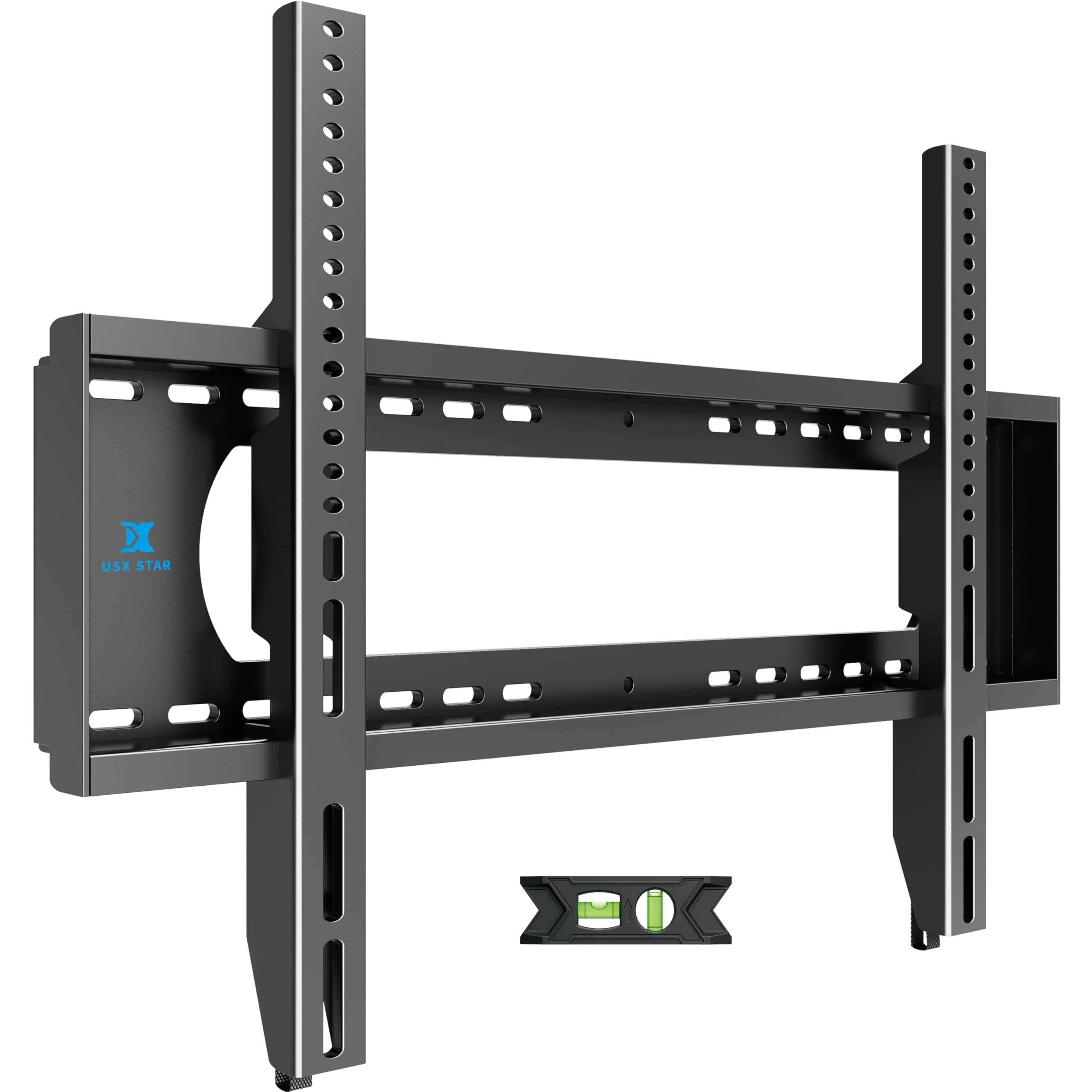
A one-piece steel slab that swallows 220 lbs and sits barely an inch off the wall.
Two figures set this apart. It holds up to 220 lbs and its VESA range runs to 900x600mm — wider than the MOUNTUP and the Pipishell, both capped at 600x400mm. If your 75-inch TV has mounting holes well spread out, or you simply want a big safety margin over its actual weight, this is the bracket that does not blink. It also fits 8, 16, 24 and 32 inch stud spacing, so awkward walls are less of a problem.
The profile is the other draw: about 1.1 inches from the wall, close to the 1.8 inches of the SANUS and slimmer than most articulated arms could ever fold to. You can slide the bracket left or right after hanging to centre the screen. That flat, tight look is what a fixed mount is for, and this one does it with a one-piece plate that resists wobble and slippage.
Durability and quality are what earn the high marks, with the sheer weight ceiling right behind them — buyers pushing 86 and 100 inch panels report the hardware simply holds. The honest limit is motion: it is fixed, so there is no tilt to fight glare and no swivel to redirect the screen. A paper drilling template would have helped here; the instructions rely on clear guides instead, so measure twice. Do not hang it on drywall alone.
The headroom argument: 220 lbs of capacity and a 900x600mm VESA ceiling give you room for heavier panels and unusual hole layouts the tighter mounts cannot take.
The plain caveat: fixed means fixed — no angle tweaks once it is up.
Best suited to: big, heavy panels and a clean flush look where the angle is already right.
Skip the idea if: you need the screen to move.
5. IMtKotW Ultra Slim TV Wall Mount

A 0.37-inch gap — the closest thing here to hanging your TV like a framed picture.
For the slimmest possible hang, this is the number: 0.37 inches between the back of the TV and the wall, tighter than the 1.1 inches of the USX STAR above. On a frame-style set that gap is the whole point — the panel reads as art rather than as a screen bolted to plaster. It handles 37 to 86 inch TVs up to 165 lbs and covers VESA 200×200 to 600x400mm, with stud spacing for both 16 and 24 inch walls.
The mounting hardware is built to keep that flush line tight: reinforced magnetic connectors pull the screen into place against the wall. The kit includes visual markers to align the TV holes fast and a level for positioning. A built-in kickstand keeps a little room behind the panel for cables, which is the detail that saves you from a bulge at the bottom edge. It goes on concrete, brick or wood.
Quality and installation come back strong, and the slim design is what people point to when they say it looks the part. The magnetic hold is the one point of disagreement — most find it secure, some want more reassurance, so seat the TV firmly and check the latch before you walk away. Measure the distance from your VESA holes to the edge of the TV first, as the listing warns, or the bracket can peek out past the frame.
Why the flush hang wins
- 0.37-inch gap is the tightest fit in this lineup
- 165 lb capacity and VESA to 600x400mm
- Kickstand leaves room for cables behind the panel
What to watch
- Magnetic hold is secure for most but debated by a few
- Fixed, so no swivel for glare
Built for: frame-style and shallow TVs where the gap is the whole design.
Pass on it if: you want to move the screen to a second seat.
6. HOME VISION Heavy Duty Tilting TV Wall Mount HV9901
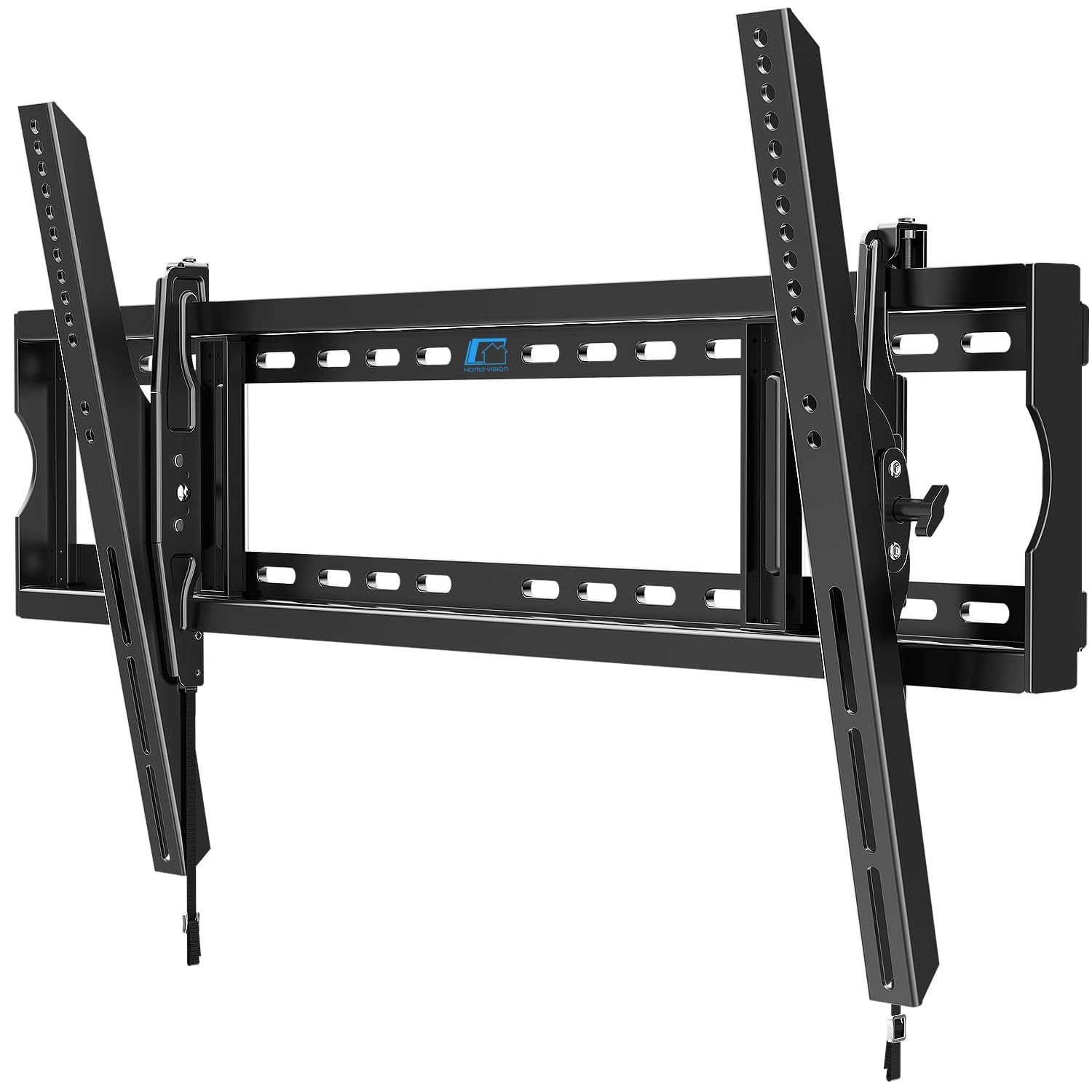
A fireplace-height tilt bracket built to point a 130-inch panel down at the sofa.
When the TV sits higher than your eyes — over a fireplace, on a tall wall — a flat bracket leaves you looking up at a washout. This one tilts 10 degrees down and 5 degrees up, and the adjustment needs no tools, so you can chase the glare away after the screen is hung. It fits 55 to 130 inch TVs up to 220 lbs on VESA 200×200 to 900x600mm, which puts it well beyond what a single 75-inch panel needs and leaves room to grow.
Stud flexibility is the practical edge: it spans 16, 18, 24 and 32 inch wood studs, wider spacing than most mounts here accept, so trickier walls are less of a headache. The 37-inch steel plate spreads weight to resist sagging, with reinforced bolts and welded construction. It rests 2.56 inches from the wall, and a pull-cord lock plus dual hooks hold the panel while +/-1 degree of leveling fine-tunes the frame.
Mounting quality is the thing buyers like most, with installation and stability close behind — a one-piece plate means fewer parts to line up. The tilt is where opinions split: handy for the right wall, shallow in range for anyone hoping to swing far down. If you want a steep angle to a low seat, expect a gentler result than the number suggests. An open-back design lets you mount it over an electrical outlet for a clean cable run.
Where it fits: high-mounted screens above a fireplace or on a tall wall, where a 10-degree downward tilt fixes the viewing angle.
What to know: the tilt range is modest — treat it as glare control, not a big angle swing.
Pick this when: the screen hangs high and needs to aim down at the room.
Keep looking if: you want full swivel motion.
7. USX MOUNT Ultra Slim Full Motion TV Wall Mount
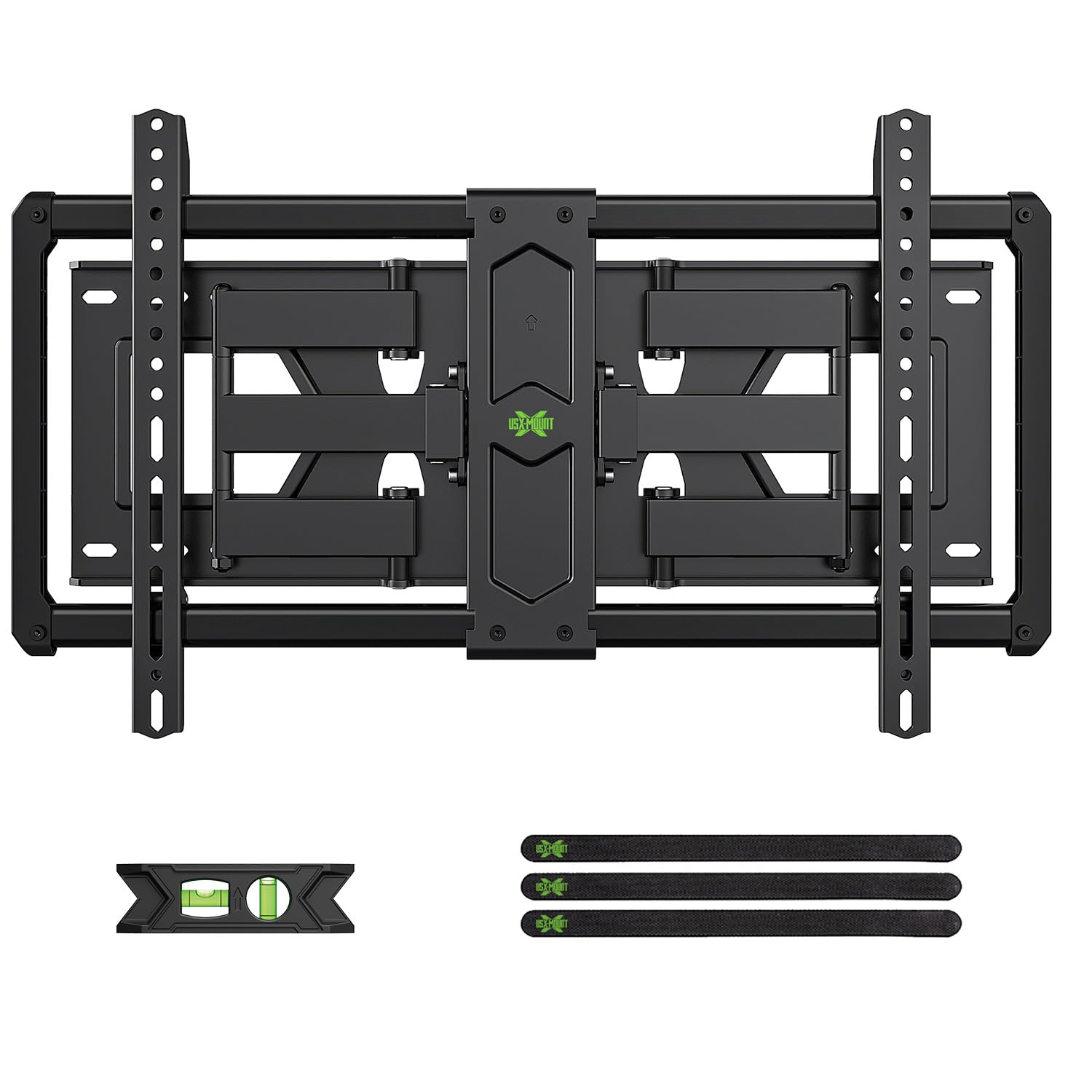
The full-motion arm that folds nearly flat and still swings to any seat in the room.
Most articulated mounts give up a low profile to gain movement. This one splits the difference: at rest the screen sits 1.45 inches from the wall, and when you pull it out the dual arms reach 11.92 inches for cable access or a closer angle. It suits 37 to 90 inch TVs up to 120 lbs on VESA 200×100 to 600x400mm, and it mounts to wood studs up to 24 inches or to concrete and brick. That 1.45-inch retracted figure beats the HOME VISION’s 2.56 inches while keeping the swivel.
Motion runs +/-10 degrees of tilt and +/-45 degrees of swivel, the swivel capped by how wide your panel is. Dual articulating arms carry the screen through tilt and swivel without a wobble, and the heavy-duty steel is load-tested to four times its 120 lb rating. A bubble level and cable ties ship in the box. It is the balance of flat-at-rest and moving-when-needed that makes this a sensible pick for a busy living room.
Sturdiness and smooth movement are the standout themes — the swivel and tilt glide rather than grit — and installation is straightforward enough for a first timer. Fit on 16-inch centre studs is well covered. If your 75-inch panel is on the heavy side, note the 120 lb ceiling: still generous, but check it against your TV before ordering.
What makes it flexible
- Retracts to 1.45 inches, extends to 11.92 inches
- +/-45 degrees of swivel and +/-10 degrees of tilt
- 120 lb capacity with dual-arm support
Where the trade-offs land
- 120 lb ceiling — verify against a heavier panel
- Concrete anchors may need a request to the seller
A smart pick for: a living room that wants a flat rest profile and real swivel for glare.
Look at heavier options if: your 75-inch set runs near the 120 lb mark.
8. USX MOUNT Full Motion TV Wall Mount for Large TVs
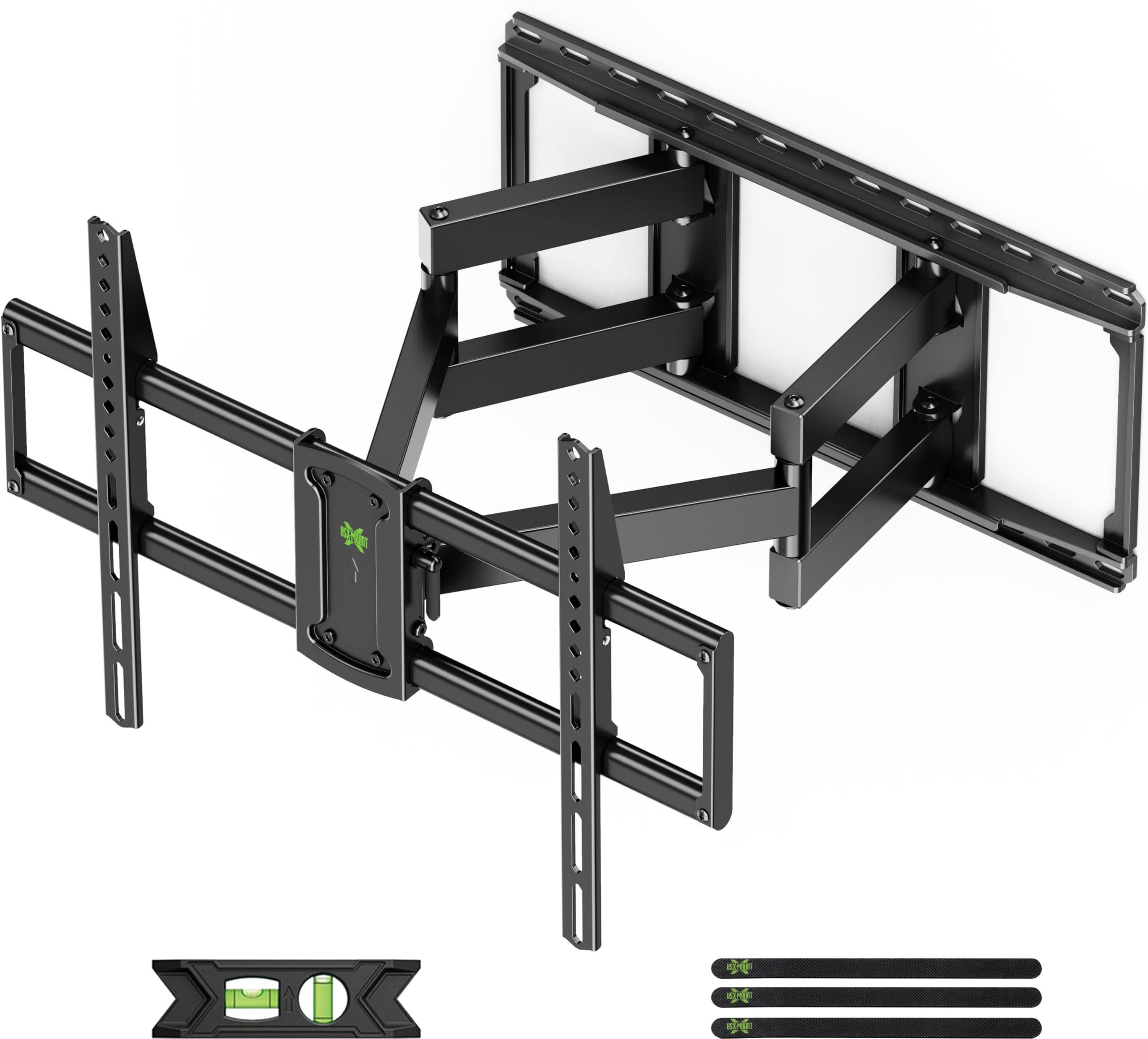
Twenty-three inches of reach and 150 lbs of capacity for the room that needs both.
Where the Ultra Slim arm stops at 11.92 inches, this one extends up to 23 inches — enough to bring a 75-inch screen out past a mantel or into an adjacent dining area. Mount it on 12, 16, 18 or 24 inch wood studs, concrete or brick, and slide-adjust after hanging.
The motion set is broad: +5 to -15 degrees of tilt, +/-45 degrees of swivel and +/-4 degrees of leveling, with the screen folding back to 2.6 inches when retracted. The heavy-duty front support arrives pre-assembled, which cuts installation steps and confusion. If you have a big screen in a big room and want to aim it around, this is the reach that makes that possible.
What buyers value most is the quality of the steel and how quickly it goes up, with sturdiness close behind — a pre-built front support is a real head start on a heavy hang. Stability under motion is well regarded, and a big panel stays put without drifting off the wall. The 150 lb ceiling is generous, though a heavier 85 or 97-inch panel should be weighed against it before you commit.
Room-scale reach: a 23-inch extension and +/-45 degrees of swivel let you pull the screen deep into a seating area, well past what the 11.92-inch Ultra Slim can do.
The one check: 150 lbs is the ceiling, so confirm your panel’s weight first.
Fits best: spacious rooms with big panels that need to swing far.
Not for tight spaces: a short wall may not need the long arm.
9. monTEK Heavy Duty 40″ Long Arm Full Motion TV Wall Mount
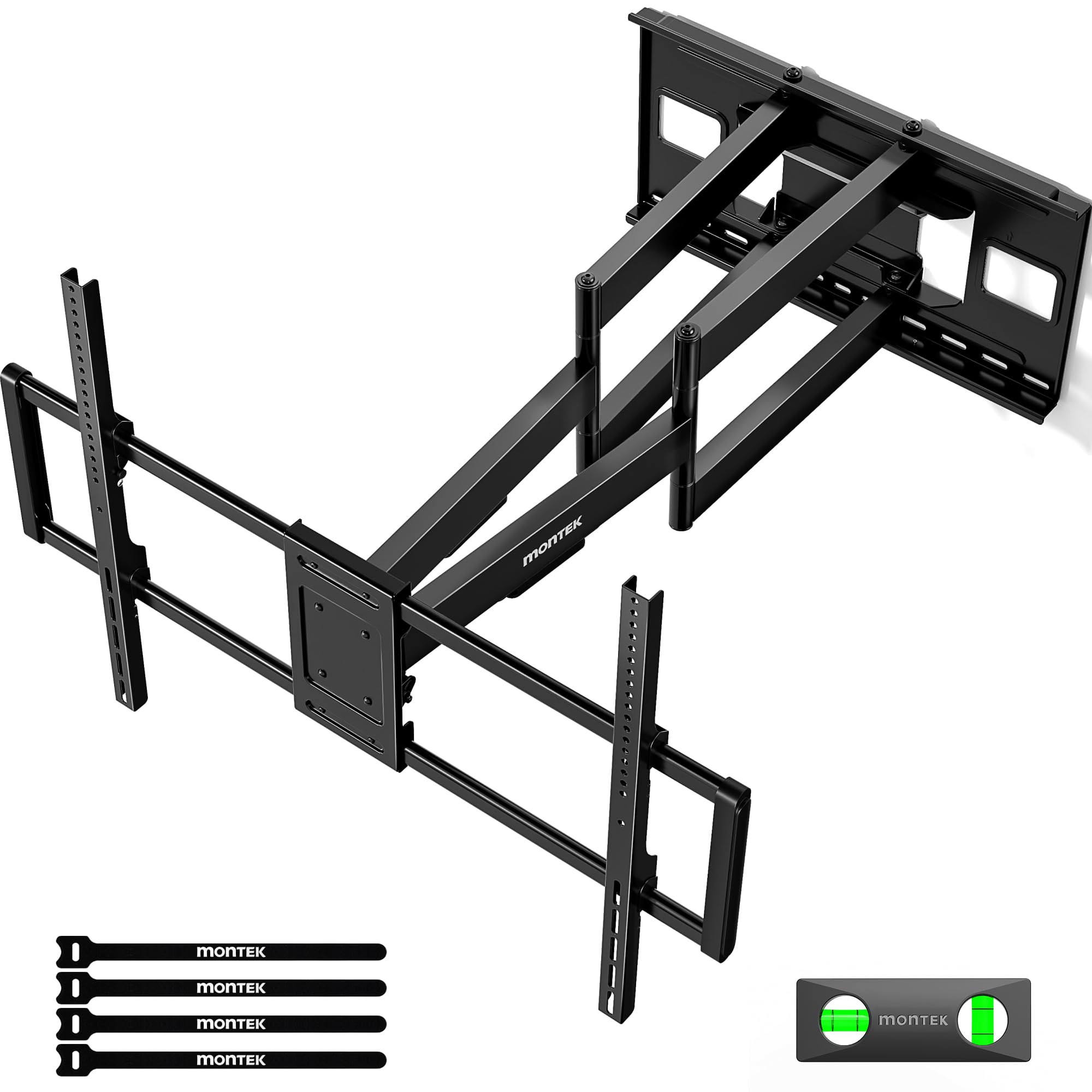
The arm that holds 265 lbs at full 40-inch stretch — the reach and the muscle to match.
Few articulated mounts swing far and stay level. This one is rated to hold 265 lbs at its full 40-inch extension, with six steel support arms keeping the alignment straight through repeated pulls. It fits 60 to 120 inch TVs on VESA 200×200 to 900x600mm, so a 75-inch panel sits comfortably inside its range with room to spare. Stud spacing runs 12, 16, 18 or 24 inches, and it goes on concrete and brick as well as wood.
The swivel turns up to 60 degrees left or right toward different seating zones, settling back to 3 inches from the wall when retracted. Tilt runs +5 to -15 degrees with no tools, and +/-5 degrees of leveling lets you true the frame after hanging. A preassembled main assembly and a quick-release lock make securing and removing the screen easier — which is a big help on an install this size. Two people are recommended, and the mount itself weighs 41.2 lbs.
Sturdiness is the quality buyers keep coming back to — one described it as built like a tank — and it holds a 100-inch panel with no trouble. The catch is real, though: at 41.2 lbs of bracket plus a large TV, this is a two-person job and a serious anchor point. Plan the stud placement and get help, or the install becomes the hard part.
Made for: open-plan rooms and conference spaces that need the screen to travel far and hold heavy panels.
Only if: you have a second set of hands and a solid stud or concrete anchor point.
Know the Specs
VESA Pattern
The VESA pattern is the square or rectangle of threaded holes on the back of your TV, written as width by height in millimetres — for example 600x400mm. Your bracket must reach at least as wide and as tall as that pattern, or the arms will not line up with the holes. Check your TV’s manual for the exact figure before ordering.
Weight Capacity
This is the heaviest screen a mount is rated to hold, in pounds. For a fixed bracket, a little headroom is fine. For a full-motion arm, the leverage grows as the screen swings out, so a bigger margin above your TV’s weight is wise. Never exceed the stated ceiling.
Stud Spacing
Wood studs sit at set centres behind drywall — often 16 inches, sometimes 12, 18, 24 or 32. Your bracket’s wall plate must span the spacing you have. Drywall alone will not carry a 75-inch screen; every mount here that needs studs or concrete says so in its own notes.
Extension and Profile
Extension is how far the arm reaches out from the wall; profile is how close it folds back when retracted. A longer extension brings the screen closer or into a corner, while a slim profile looks tidier at rest. Fixed mounts have the tightest profile but no reach at all.
Common Questions
Will a 75-inch TV fit a mount rated for 42-90 inch screens?
Do I have to mount into studs for a 75-inch TV?
What VESA pattern does a 75-inch TV usually use?
Is a full-motion mount safe for a heavy 75-inch panel?
How far should the TV sit from the wall?
Can I mount a TV over a fireplace?
Does a longer arm mean a weaker mount?
What tools do I need to hang a 75-inch TV?
Can the mount work with an OLED or curved 75-inch TV?
The Bottom Line
For most rooms, the wall mount for 75 inch tv winner is the MOUNTUP 37.2″ Long Arm because its long reach and corner-friendly single-stud design solve the real headache of a big screen that will not aim at the sofa. It holds 4.5+ stars across 800+ ratings, with reviewers praising how smoothly the arm moves. If you want a flatter, cheaper swivel for a standard wall, the Pipishell PILF3 covers 16-inch studs with +/-45 degrees of motion. And for the tightest, near-flush hang on a frame-style panel, the IMtKotW Ultra Slim sits just 0.37 inches off the wall. Match VESA, weight and stud spacing to your wall, and any of these nine will carry a 75-inch screen safely.
How we choose
We do not accept paid placement. Every pick is matched to a real buyer and a real use-case; we do not hands-on test units.
Sources
Specifications: manufacturer listings and product documentation. Review insights: verified customer reviews, as of November 2026. Pricing: not shown on this page (it changes often); check the current price via the retailer link.
As an Amazon Associate, Tactical Gear Guy earns from qualifying purchases. This does not affect which products we feature.