Specs are compiled from manufacturer listings and verified buyer reviews and can change over time — please confirm the key details on the product page before buying.
You do not need the biggest fan on the page — you need the one that moves enough air through the hole you can actually cut, without sounding like a leaf blower bolted to your garage wall. Every pick below mounts straight through a wall, so it exhausts heat, smoke, and damp air to the outside instead of stirring it around the room. The short answer: the AC Infinity AIRLIFT T12 is the one to beat for most people, with the addlon and KEN BROWN covering the budget and mid-range slots without embarrassing themselves.
This guide is built by comparing the manufacturers’ published specifications and the patterns across verified customer reviews, so you get each pick’s real strengths and trade-offs instead of marketing spin.
A fan that lasts usually has a reliable motor, an honest CFM rating, and shutters that seal properly. We explain each in plain terms, so the wall mount exhaust fan you pick fits your wall, your room size, and your noise tolerance.
Top Picks

How To Choose The Best Wall Mount Exhaust Fan
A wall-mount exhaust fan is a simple machine with three jobs: pull stale air out, keep weather out when it is off, and do both for years without rattling your fillings loose. The trap most first-time buyers fall into is chasing the biggest CFM number on the box and ignoring cutout size, motor type, and shutter seal. Here is what actually decides whether you are happy with it.
Match the CFM to the space, not the spec sheet
CFM stands for cubic feet per minute — the volume of air the fan moves out of the room each minute. A fan rated in the low hundreds suits a small shed or bathroom, while the 1200–1500 CFM class in this list is aimed at garages, attics, and greenhouses. If you oversize the fan for a tiny room you get a screaming wind tunnel and a wall you did not need to cut that big.
Decide early: plug-in or hard-wired
Some of these fans arrive with a power cord you plug into an outlet, and others are hard-wired, meaning they connect straight to your building’s electrical system with no plug at all. If you are not comfortable running wire, a prewired cord model saves you an electrician visit. Getting this wrong means a return or an unplanned electrician bill.
Understand what the shutters really do
The louver or shutter is the panel of flaps over the opening. On a powered fan it swings open while running and closes on shutdown, which helps block rain, dust, and small debris from finding its way back in. Look for a gravity or automatic shutter that closes tightly — a half-closing louver is a common complaint in this category and it undercuts the whole point of a through-wall install.
Think about noise and motor type before you cut the hole
A plain AC motor is cheap and proven; an EC motor (electronically controlled, it varies speed efficiently) tends to run smoother and sip power at lower speeds. The catch is audible: several fans in this category hum at certain speeds even when they are otherwise quiet. Since a wall fan vents open air, that hum can travel — so weigh the noise notes for whichever room you are cutting into.
Side-by-Side Comparison
Every fan below is a through-wall unit that pulls air out of your space. The three columns are the dimensions that decide the purchase: airflow, blade size, and mounting weight.
| Model | Best For | Airflow (CFM) | Blade Size | Motor / Weight | Amazon |
|---|---|---|---|---|---|
| AC Infinity AIRLIFT T12★ Best Overall | Smart climate control | 830 | 12 in | App-controlled / — | Amazon |
| addlon 12″ Shutter Exhaust FanBudget Champion | Budget plug-and-play | 1250 | 12 in | 25W DC / — | Amazon |
| VEVOR 12 in Steel Shutter FanRoomiest Airflow | Garage & shed ventilation | 1100* | 12 in | 40W AC / 7.8 lb | Amazon |
| Windigaga 10” Shutter Fan | Small-room thermostat control | 890 | 10 in | 36W / 5.1 lb | Amazon |
| VENTISOL 12 Inch Shutter Fan | High airflow, wired installs | 1450 | 12 in | 55W / — | Amazon |
| KEN BROWN 12 Inch Shutter Fan | Greenhouse & workshop airflow | 1400* | 12 in | Aluminum / — | Amazon |
| VEVOR 12″ Smart Controller Fan | Full climate automation | 1500 | 12 in | 50W EC / — | Amazon |
| iLIVING 12″ Shutter Fan | Large-space climate control | 960 | 12 in | EC / — | Amazon |
Detailed Reviews
1. AC Infinity AIRLIFT T12 Shutter Exhaust Fan
Our pick — 4.5+★ from 750+ verified ratings; the strongest balance of quality and price.
The fan that reads the room’s heat and humidity for you, then acts.
This is the climate-aware one. The AC Infinity AIRLIFT T12 pairs a 12-inch blade with an environment controller, so it does not just run on a dumb switch — it monitors temperature and humidity and responds to what the room actually is doing. With 830 CFM of airflow, it is the more modest number on this list, yet the design goal is control over raw volume.
You get a sturdy housing you mount once and leave alone, thanks to its installation engineering. Its 15.75″D x 15.75″W x 8.14″H frame is the largest footprint in this comparison, roughly a 2.0x foot-and-a-half jump over the compact Windigaga 10” fan at its 7.8″D x 10.8″W x 10.8″H. That means a serious wall cutout. The WiFi app extends that philosophy: program the fan, get alarms, and check the room’s climate data from your phone.
Where owners get the most value is in build confidence and how quickly you can get it hanging and running. Quality and reliability are what dominate the praise, with controls and clever programming coming in close behind. It also stays surprisingly discreet in operation for something moving this much air. The trade-off is honest: at 830 CFM it leads on finesse, not output. If your goal is moving more raw air than any other fan on this page, the VENTISOL 12 Inch trades in 1450 CFM — putting 620 more CFM behind the same 12-inch blade.
Why it wins: The pairing of a 12-inch fan, 830 CFM, and app-driven humidity and heat monitoring gives you a room that looks after itself. Build reliability is what people actually praise most.
Where it asks something back: 830 CFM is the lowest rating among these 12-inch picks, and the 15.75-inch square frame demands the largest wall cutout here.
Pick it for: the garage or workshop you want to program once and let the fan decide when to push air.
Weigh the cutout: if you are cutting through siding on a tight wall, check that larger frame against your opening first.
2. addlon 12″ Shutter Exhaust Fan
Eight speeds and a 25W motor that sips power while still hitting 1250 CFM.
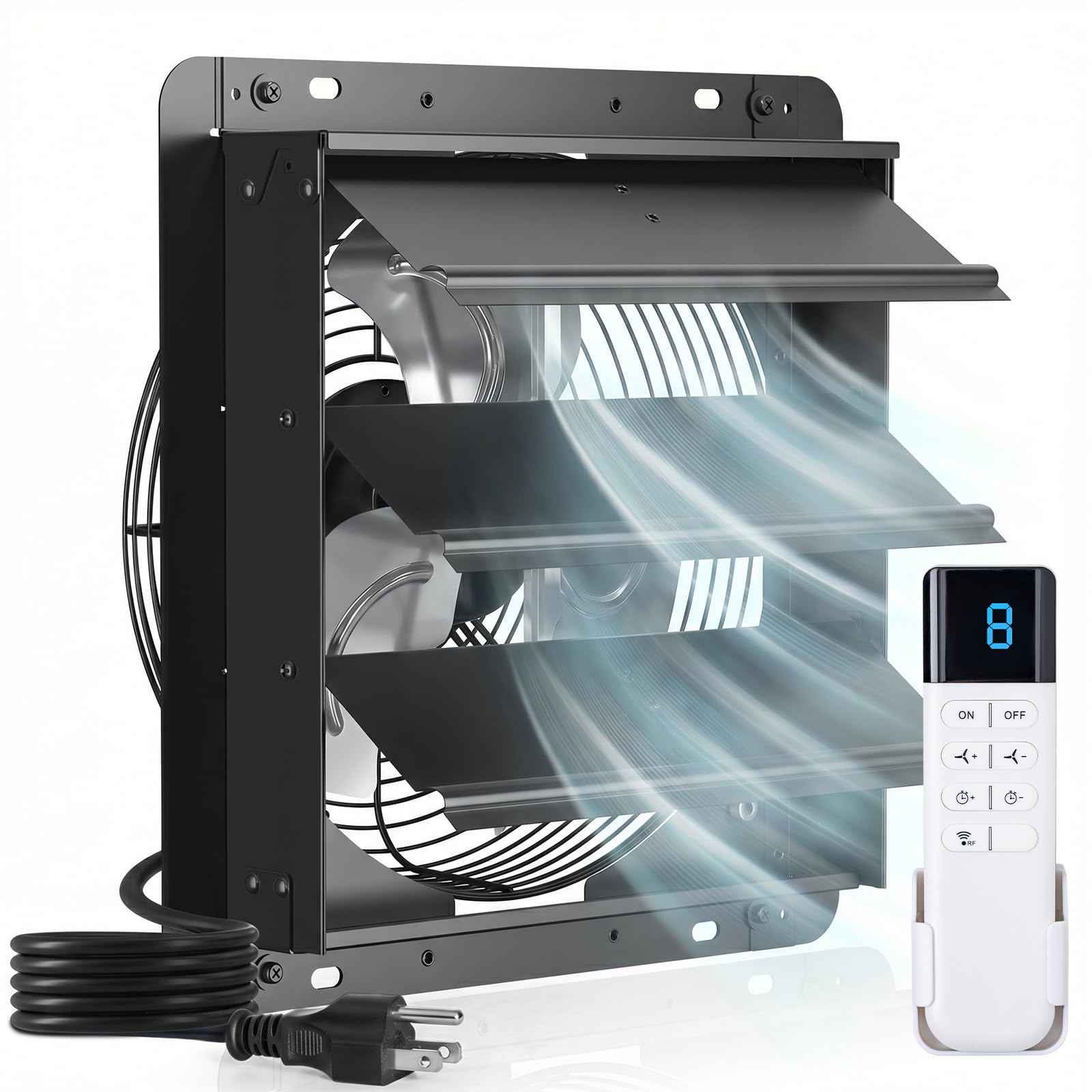
The addlon’s headline trick is doing a lot with very little electricity. A 25W DC motor turns a 12-inch blade up to 1948 rpm, and the spec sheet puts airflow at 1250 CFM. Eight selectable speeds mean you can run it quietly at the low end for everyday air movement and step it up only when the workshop gets smoky.
The build is all metal — shutter, mesh cover, body, and connecting parts. The included remote lets you power on and off, cycle speeds, and set a shut-off delay from 1 to 8 hours, and there is a bracket so the remote can live on the wall as a switch.
Plug-and-play is the real draw. It arrives assembled with a prewired cord, so in most cases you mount it and go. It is the lightest read of its class too — at 8-inch mountable thickness and a 6.56 ft cord, it fits tighter spaces than the thicker VEVOR 12 in Steel Shutter Fan at 7.8 pounds. If quiet operation is high on your list, the double-digit noise commentary is mostly favorable here, though a low hum at the top speeds is the honest caveat.
Sells itself on
- 25W DC motor with 8 speeds and a remote that can mount as a wall switch
- All-metal construction, including the shutter and mesh cover
- Pre-assembled, prewired, plug-and-play install
- 1250 CFM from a compact 8-inch deep housing
The fine print
- 1948 rpm at full tilt means you will hear it
- No thermostat or humidity sensor — you drive the speeds yourself
Reach for this if: you want a metal fan with real speed control and a remote without going to the top of the range.
Look elsewhere if: you want the fan to react to temperature on its own — that is the AC Infinity’s territory.
3. VEVOR 12 in Shutter Exhaust Fan
A steel-housed 12-inch vent built for damp sheds and stubborn garage heat.
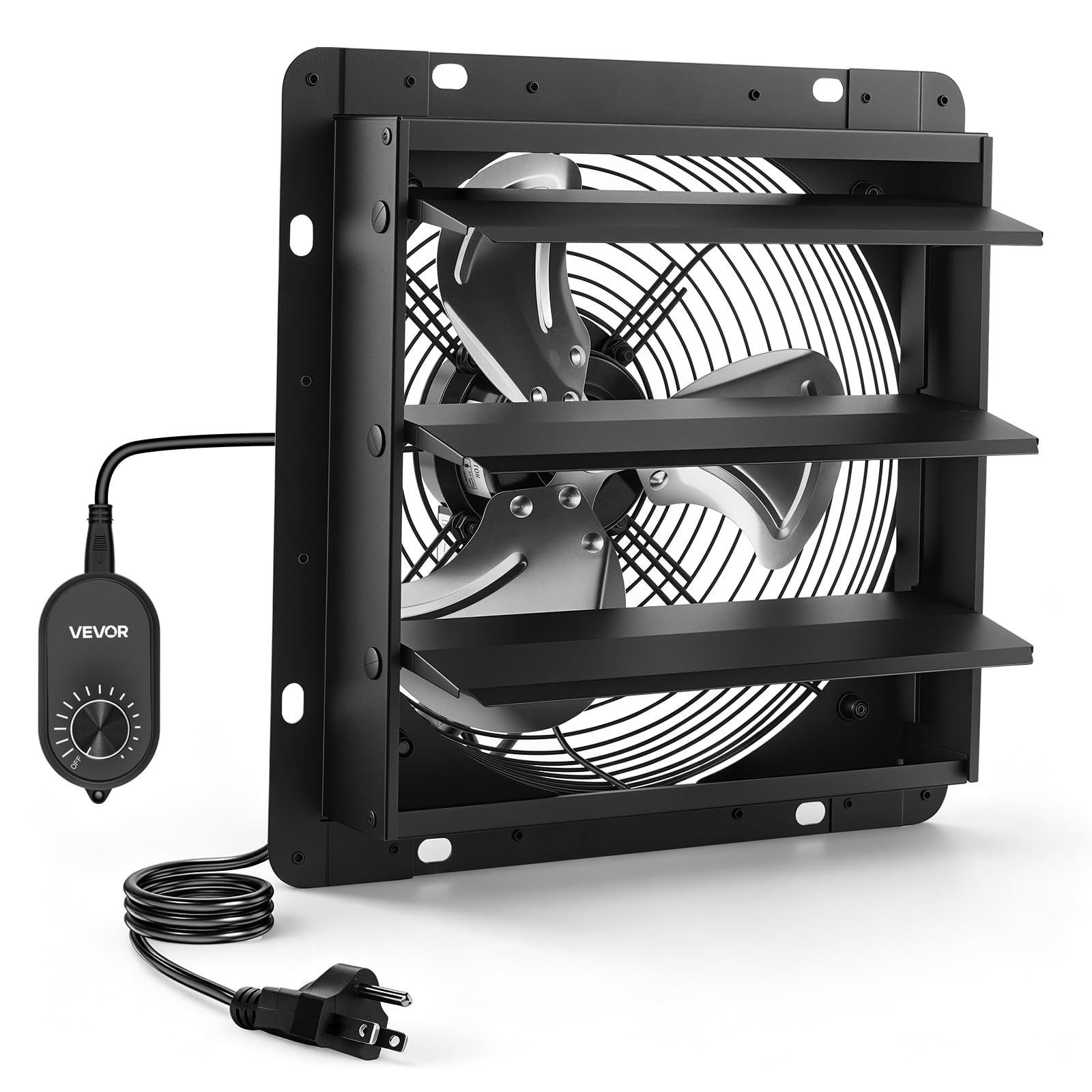
The build is the argument here: a steel housing that resists deformation better than plastic and holds up in damp conditions, which is why it turns up in barns and damp utility spaces. The fan moves air at 1347 CFM on its product description, with the technical spec sheet listing 1100 CFM. If you are installing in a space where weather and moisture are part of the deal, the heavier metal body earns its place.
You get strong airflow from its 40W AC motor, which spins at 1600 r/min (revolutions per minute) and delivers up to 7 m/s (meters per second) of airflow. The shutters open when powered and close when off, helping block rain and small debris from coming back through the wall. It comes prewired with a power cord, so no wiring is needed, and the 12-inch build sits in a 14.96″W x 14.96″D frame — a full 2.0-inch difference from the 15.75-inch AC Infinity, so it fits a slightly smaller opening.
Where it gives, honestly, is noise. The steel housing and AC motor are reliable and perform in heavy use, and owners repeatedly note it moves plenty of air even in chicken coops. But the noise level draws mixed reactions — some find it quiet for the output, others hear a hum at every speed. That is a real consideration if this is going into a room people sit in.
What earns its spot
- Steel housing resists deformation in damp, heavy-use spaces
- 1347 CFM airflow and 7 m/s velocity for garages and barns
- Prewired cord, no wiring needed
- 12-inch build in a 14.96-inch frame — smaller cutout than the AC Infinity
Where you might hesitate
- Noise divides opinion — a hum at every speed is the recurring note
- Speed control gets mixed feedback; it is a basic variable setup, not a thermostat
- 7.8 lb steel body needs proper mounting hardware
Best fit for: sheds, barns, and garages where a tough housing matters more than whisper quiet.
Second-guess it for: a living or sleeping space — the steel-housed hum is a known trade-off.
4. Windigaga 10” Shutter Exhaust Fan

A 10-inch fan that decides for itself when the room has had enough heat.
Smaller blade, smarter brain. The Windigaga 10” tops out at 890 CFM from a 10-inch blade, and it is the lightest full-featured unit here at 5.1 pounds. That narrow 7.8″D x 10.8″W x 10.8″H frame is the compact one in this group — compared to the AC Infinity’s 15.75-inch width, it is a noticeably smaller footprint to cut into the wall.
The thermostat is the reason to look at it. It reads a range of 32°F–140°F with 3 fan speeds and an 18-hour timer, and in Auto Mode it turns on and off by your set temperature — no manual adjustment. The remote has a claimed 66 ft range, which means you can control it from across a workshop floor. A 36W motor, ETL listed with a grounded cord, runs the show.
Where it earns trust is in doing the basics quietly. Owners value the temperature control and the straightforward installation, with a wall cutout template included so you are not holding the fan in the air while you trace. One honest gripe: not everyone feels the power is there. It is one owner’s take, not a pattern — but if you have a large volume to clear, this is the smaller fan of the bunch.
The draw: a precise 32°F–140°F thermostat with Auto Mode, 18-hour timer, and remote, in a 10-inch and 5.1-pound frame that is the lightest and most compact in this comparison.
The honest limit: 890 CFM from a 10-inch blade is the smallest absolute airflow picture here — sized for a small room, not a huge barn.
You will like it if: you want thermostat automation and a remote-driven setup for a smaller room and do not want to cut a giant hole.
Think twice if: you are moving serious volume — the 10-inch blade is deliberately modest.
5. VENTISOL 12 Inch Shutter Exhaust Fan

1450 CFM and a hard-wired heart for serious, permanent ventilation.
If you want the most airflow in this group, this is the one that delivers it. The VENTISOL 12 inch is rated 1450 CFM — a big jump over the 830 CFM AC Infinity, which means substantially more air moved for the same 12-inch blade size. It runs on standard 120 volts at 55W and 0.42 amps, with a 1680 rpm fan speed and a 9.5 m/s airflow velocity.
There is an important catch in the installation: no plug, no power cord. This is a hard-wired connection that you wire into your building’s electrical system. That is a job for someone comfortable with a screwdriver and a breaker panel. In exchange you get a permanent install with no dangling lead, plus a variable speed controller in the box for adjusting comfort.
The build is galvanized steel with 3 aluminum shutter blades and a fully enclosed ball bearing motor, powder-coated in black, backed by a 1-year warranty. It is ETL listed, and the self-closing shutters protect it from rain and snow when off. The thing to weigh honestly is durability feedback around the switches burning out on some units — not universal, but worth knowing if this is going into a load it will run constantly.
Why ventilation folks rate it
- 1450 CFM — the highest airflow rating in this lineup
- Galvanized steel body with 3 aluminum shutter blades
- Variable speed controller included for dialing in comfort
- ETL listed and backed with a 1-year warranty
Weigh before you buy
- Hard-wired install — no plug, no cord
- Durability complaints about switches burning out on some units
- Louvers only opening halfway is a reported annoyance
For the permanently installed garage or greenhouse where maximum airflow justifies wiring it in.
For everyone else: the hard-wired setup and switch durability notes mean a plug-in fan may be the safer route.
6. KEN BROWN 12 Inch Shutter Exhaust Fan

Plug-and-play airflow built to shrug off rust in a greenhouse.
This is the one that combines real airflow with the easiest install in the high-end tier. The description lists 1450 CFM at 120 volts, 60Hz, with 1650 rotations per minute and a 10.5 m/s velocity; the spec sheet lists 1400 CFM. Either way, you are getting serious volume from a 12-inch blade, and it arrives with a pre-installed 1.65m (5.4ft) power cord so you mount, plug, and go — no wiring required.
The material choice is the point. High-grade aluminum shutters and blades shrug off moisture and high temperature, and the design is meant to keep corrosive rust from forming. The automatic gravity shutters open and close with the fan, helping block the outside world when it is off. Its 6.8″D x 15″W x 15″H frame is a fair bit slimmer than the 8.14-inch depth of the AC Infinity at the same 12-inch class — another reason it is an easy hang.
Owners use it in greenhouses especially and appreciate how the heavy-duty construction holds up. It is also remarkably easy on the ears for the airflow involved, which is why it earns its place in workshops and sheds. It is not the quietest fan here, but it is far from the loudest.
What people applaud
- 1450 CFM high-speed airflow with 1650 rpm
- Aluminum body and blades resist moisture and rust
- Pre-installed 5.4 ft cord — genuinely plug-and-play
- 15-inch frame fits tighter wall openings than the AC Infinity
What to note
- At 1450 CFM you will hear it at full speed
- Automatic shutters, not a thermostat — you control it
Best for: greenhouse, workshop, or barn installs where rust resistance and quick setup matter most.
Skip for: a small room where 1450 CFM of aluminum airflow is more fan than you need.
7. VEVOR 12″ Shutter Exhaust Fan Temp Humidity
1500 CFM with a sensor that watches both temperature and humidity.
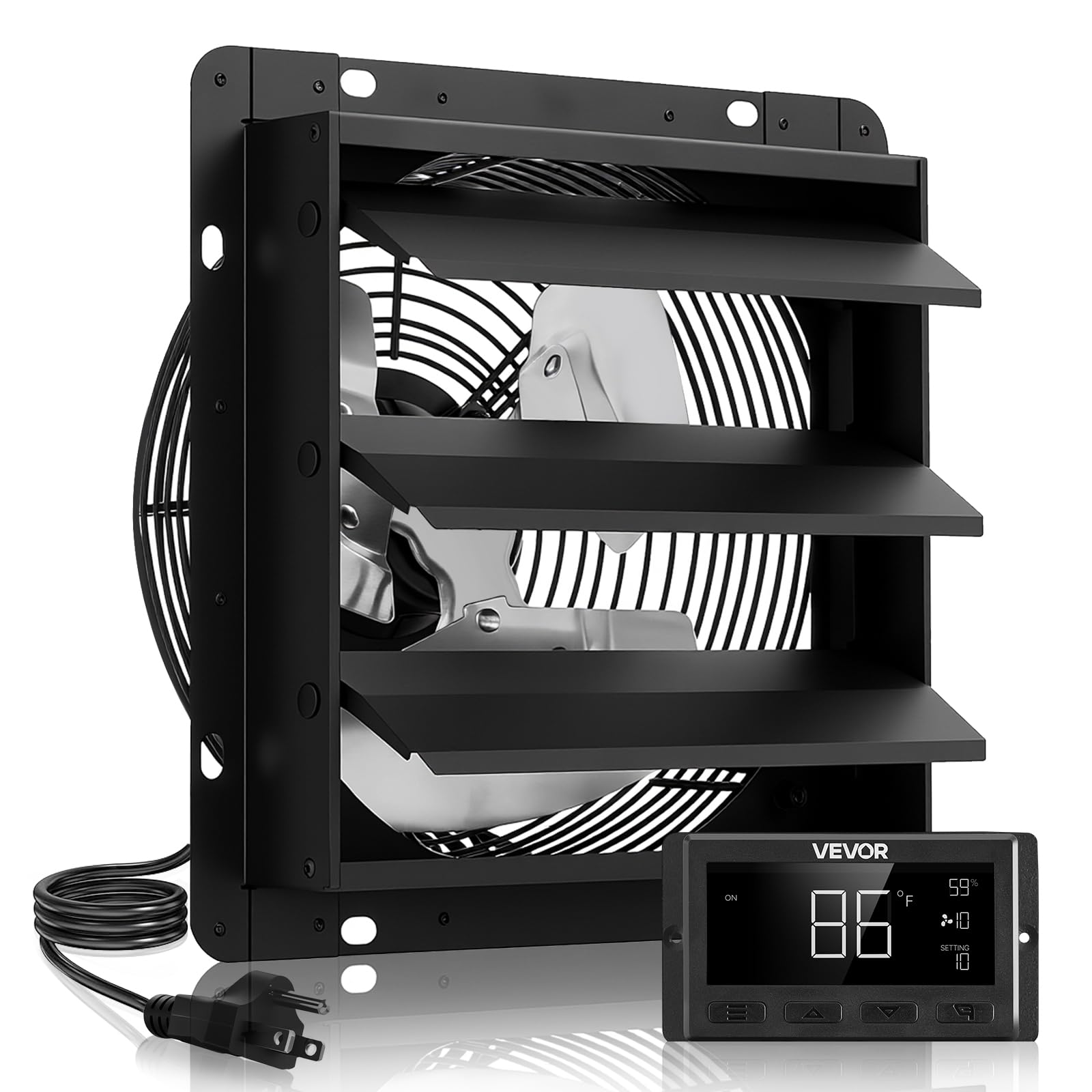
The big numbers are 1500 CFM and a 50W EC motor running at 1500 RPM. That puts it above the AC Infinity’s 830 CFM and near the VENTISOL’s 1450 CFM in raw air movement, but the real difference is the controller. It watches temperature and humidity and offers up to 10 speed settings that adjust automatically to the conditions you set.
Included with it is a temperature and humidity sensor cable at 2.5 m and a remote, plus timer and alarm functions. The EC motor is the efficient part — the maker states up to 8.8 m/s of airflow, and the EC design runs smoother and lower on power than a plain AC equivalent. The all-metal steel body resists deformation and damp, and the shutters protect the fan from rain when it is off.
What buyers praise is straightforward: it works, it installs without fuss, and it is quiet enough to go unnoticed at ground level. The recurring gripe, when there is one, is the louvers not closing properly after some use. That does not break the fan, but it is worth knowing when placing it in a weather-exposed wall.
The case for it: 1500 CFM, a 50W EC motor, and full temperature and humidity automation in one all-metal body — the most sensor-driven option under the iLIVING.
The catch to weigh: some units develop louvers that do not close all the way, which undermines the rain-blocking seal.
This is your fan if you want top-end airflow and hands-free climate control without being tethered to a smartphone app.
Keep looking if a guaranteed-tight shutter seal is non-negotiable for your wall.
8. iLIVING 12″ Shutter Exhaust Fan

A 12-inch DC smart controller built for ventilation up to 1400 square feet.
The number that matters here is 960 CFM across spaces up to 1400 square feet. It uses a 12-inch aluminum blade with a deep pitch angle to push that air, driven by an EC motor at 1600 RPM. It is the same blade size as the AC Infinity’s 12 inches but moves more air in raw CFM, and it targets a bigger room than the 10-inch Windigaga’s compact 10.8-inch frame.
The controller is the star. It regulates temperature across a 50–99°F range with up to 12 adjustable speeds and a 24-hour timer, and it responds to changes in both temperature and humidity. It includes a Type A USB port for control-wire extension, so the controller can live inside the house while the fan vents an outside wall. The 5.6 ft power cord makes for a plug-and-play setup.
Build confidence is where it shines — the galvanized steel frame, aluminum shutters and blades, and ETL-certified EC motor are all there, and buyers report it handling hot spells and venting a 20×25 tunnel without strain. OSHA-compliant wire guards cover the safety side. The one honest note on flexibility: the digital interface takes a few minutes to learn, and a user who wants a single on/off switch may find the programming overkill.
The standout spec: 960 CFM, a 1600 RPM EC motor, and a 50–99°F thermostat with 12 speeds that covers up to 1400 square feet.
The honest caveat: it will not beat the 12-inch VEVOR or VENTISOL on raw CFM, so it suits climate-sensitive rooms more than pure volume.
Choose it for: a room of up to 1400 square feet where you want thermostat and humidity automation from a controller you can wire indoors.
Less compelling if: you need the maximum airflow a 12-inch blade can deliver — this one prioritizes smart control.
Know the Specs
CFM (cubic feet per minute)
This is the volume of air a fan moves out of your space each minute. A small shed or bathroom needs a few hundred; a garage, attic, or greenhouse needs far more. Bigger numbers move more air, but they also need a larger wall cutout and a sturdier mount. Match the CFM to your room volume before anything else.
AC and EC motors
A plain AC motor is cheap and proven. An EC motor (electronically controlled) varies speed efficiently and often runs cooler and quieter at low speeds. The wattage figure — 25W, 36W, 40W, 50W, 55W — tells you how much electricity it draws; a lower wattage motor is cheaper to run, which matters if the fan stays on all day.
Shutters and louvers
The louver is the panel of blades over the opening. On a powered fan it opens when running and closes on shutdown to help block rain, dust, and debris. Automatic or gravity shutters do this on their own. A louver that only half-closes is a real-world flaw to watch for, because it leaves the wall exposed.
Thermostat and humidity control
A thermostat reads the air temperature and switches the fan on or off at a set point. A humidity sensor does the same for moisture. A fan with both can run itself, turning on only when the space actually needs it. That saves power and keeps a garage or grow room stable without you checking on it.
Installation: plug-in vs hard-wired
A prewired cord model plugs into an outlet — no electrical work. A hard-wired model connects to your building’s electrical system with no plug at all, and needs a proper electrician or a confident DIYer. Decide which you can handle before you buy, since it affects whether the fan ships with a cord or not.
Frame size and weight
The D x W x H figures tell you the housing footprint and the opening you need to cut. The weight tells you how sturdy the mounting has to be — a 7.8-pound steel fan needs more than a light aluminum one. Measure twice and check the frame against your wall thickness before you pick up a saw.
Common Questions
Will a wall mount exhaust fan work through an exterior wall?
Do I need an electrician to install one of these fans?
What is the difference between AC and EC motors in an exhaust fan?
How many CFM do I need for my garage or greenhouse?
Will the shutters block rain when the fan is off?
Can I control the fan with a thermostat instead of a switch?
Is a 12-inch fan always louder than a 10-inch one?
What is the difference between a wall mount exhaust fan and a window fan?
Can I add my own remote or smart controller to a basic fan?
How long should a wall exhaust fan last?
The Bottom Line
The strongest pick for most people is the AC Infinity AIRLIFT T12, because it pairs 830 CFM with app-driven temperature and humidity monitoring that keeps a garage stable without you touching it. Its 4.5+ star rating is strong, though it does not lead the category on review count. If you want maximum raw airflow and will wire it in, reach for the VENTISOL 12 Inch with its 1450 CFM. And for a compact, thermostat-driven setup in a smaller room, the Windigaga 10” is the one to grab — its 32°F–140°F Auto Mode does the thinking.
How we choose
We do not accept paid placement. Every pick is matched to a real buyer and a real use-case; we do not hands-on test units.
Sources
Specifications: manufacturer listings and product documentation. Review insights: verified customer reviews, as of November 2026. Pricing: not shown on this page (it changes often); check the current price via the retailer link.
As an Amazon Associate, Tactical Gear Guy earns from qualifying purchases. This does not affect which products we feature.