Specs are compiled from manufacturer listings and verified buyer reviews and can change over time — please confirm the key details on the product page before buying.
Walking indoors gets a lot safer when you have a handrail you can actually reach from heel to toe. Look for a deck long enough that you never step off the back edge, and a motor that starts slow enough for a cautious first minute. Everything else is detail. Below are eight walking pads with handrails, so you can match one to your space, your stride, and your balance.
This guide is built by comparing the manufacturers’ published specifications and the patterns across verified customer reviews, so you get each pick’s real strengths and trade-offs instead of marketing spin.
You will see deck sizes, motor ratings, and incline figures side by side, all pulled from the manufacturers’ own listings. Below is the practical breakdown of the walking pad with handrail worth your floor space.
Top Picks

How To Choose The Best Walking Pad with Handrail
A handrail changes the whole job of a walking pad. On a flat pad you step on and hope your balance holds; with rails on both sides you have something to grab the moment a step goes wobbly. That is why the rail design, not the top speed, is the first thing to sort out.
Match the handrail to the person using it
A short side rail above the console works for a standing-desk user who just wants a light touch point. A full-length rail that runs along both sides of the deck is what a senior or a rehab walker needs, because the grip is there for the whole stride, not just at the front. Some models add a front bar across the top so you can hold on with both hands in a natural position.
One more thing to check: whether the rail comes off. A detachable bar lets a family share one machine — the cautious walker keeps the rail, the confident one strips it off for an open deck.
Deck length is the spec tall buyers regret skipping
The walking surface is measured in inches of length and width, and it is the number that decides whether you stride freely or shorten your step. A 39-inch belt suits a shorter, slower walker fine. Once you are past average height or you want a jog, a 43-inch or longer belt gives your feet somewhere to land. Width matters too — a 15-inch belt feels snug, a 23-inch deck feels roomy.
Motor power and belt layers set the noise and the feel
Horsepower (HP) is the motor’s rated strength, and on a walking pad it mostly tells you how smoothly the belt holds speed under a heavier walker. A 2.5HP to 3.5HP brushless motor is the common range here; brushless means fewer wearing parts and generally quieter running. The belt layers and shock absorbers underneath are what soften each footfall, which matters if you walk on a hard floor.
Side-by-Side Comparison
| Model | Best For | Deck (L x W) | Motor | Incline | Amazon |
|---|---|---|---|---|---|
| WELLFIT Walking Pad with Auto Incline & Handle Bar★ Best Overall | All-round home walking and jogging | 40″ x 16″ | 3.5HP | 0–12% auto | Amazon |
| EVKRUN Treadmill with 20% Auto InclineSteepest Climb | Steep incline training at home | 41″ x 16″ | 3.5HP | 20% auto | Amazon |
| WalkingPad Z1R FoldableTightest Fold | Under-desk use in tight rooms | 47.6″ x 15.7″ | 2.25HP | — | Amazon |
| Redliro Treadmill for Seniors (0.3 MPH) | Low-mobility and rehab walking | 41″ x 16″ | — | 0–2% manual | Amazon |
| Redliro Walking Treadmill for Seniors (Long Rails) | Seniors wanting full side support | 41″ x 16″ | — | 0–2% incline | Amazon |
| HitGo Walking Pad with Full Length Handrails | Tall walkers needing a long belt | 43.3″ x 15.5″ | 2.5HP | 4% manual | Amazon |
| Aiteid Treadmill with Incline | Budget home-use walking | 39″ x 15″ belt | 3.0HP | 12% manual | Amazon |
| ZPUFDYM Treadmill with Handle Bar | Widest deck on a budget | 48″ x 23″ | 3.0HP | 12% manual | Amazon |
Detailed Reviews
1. WELLFIT Walking Pad with 12% Auto Incline & Handle Bar
Our pick — 4.5+★ from 100+ verified ratings; the strongest balance of quality and price.
The one that tilts uphill for you while you hold on with both hands.
The WELLFIT takes the top spot because its auto incline climbs from 0% to 12% at the press of a button, with no pin or foot pad to reset. Instead of stopping to reset a manual ramp, you press a button and the deck rises under your feet. For hill-style walking at home, that turns an occasional climb into something you can do every session.
The hardware backs it up. The brushless motor is rated at 3.5HP and carries up to 375 lbs, one of the highest weight ratings in this group. That 375 lb ceiling is the number that matters if two people of different sizes will share the machine. It also outpowers the ZPUFDYM’s 3.0HP motor on paper, and it runs under 40 dB — quiet enough that a shared room or an early-morning session will not wake anyone. The 40″ x 16″ belt sits on 7 anti-slip layers over 8 silicone shock absorbers, so the deck gives a little underfoot instead of feeling like a plank on tile.
Where the WELLFIT pulls ahead of a bare flat pad is the extended dual handrails. They give a continuous grip along the sides, which is exactly what a beginner or an older walker wants during the first wobbly weeks. You can also drive the whole thing four ways — six console buttons, the remote, voice, or the Wellfit App — and it pairs with Kinomap for virtual routes plus Apple Health for tracking. Setup is close to plug-and-play, and the frame folds to 5.5 inches so it slides under a bed. Owners praise the overall build quality; the recurring nitpick is that full assembly still takes a little patience before your first walk.
what separates it
- Auto incline from 0% to 12% — no manual ramp to stop and reset
- 3.5HP motor and a 375 lb weight rating, among the strongest capacities here
- Runs under 40 dB, so it suits apartments and shared rooms
- Extended dual handrails and a 40″ x 16″ belt over 8 shock absorbers
Before you commit
- Full setup takes some patience despite the near-ready arrival
- More machine than a pure under-desk stepper needs to be
Go for it if: you want incline training and real handrail support in one foldable unit that two people can share.
Reconsider if: you only ever want a slow flat stroll and would rather skip the app and incline features entirely.
2. EVKRUN Treadmill for Home with 20% Auto Incline
A 20% grade and handrail buttons, built for walkers who want the climb.
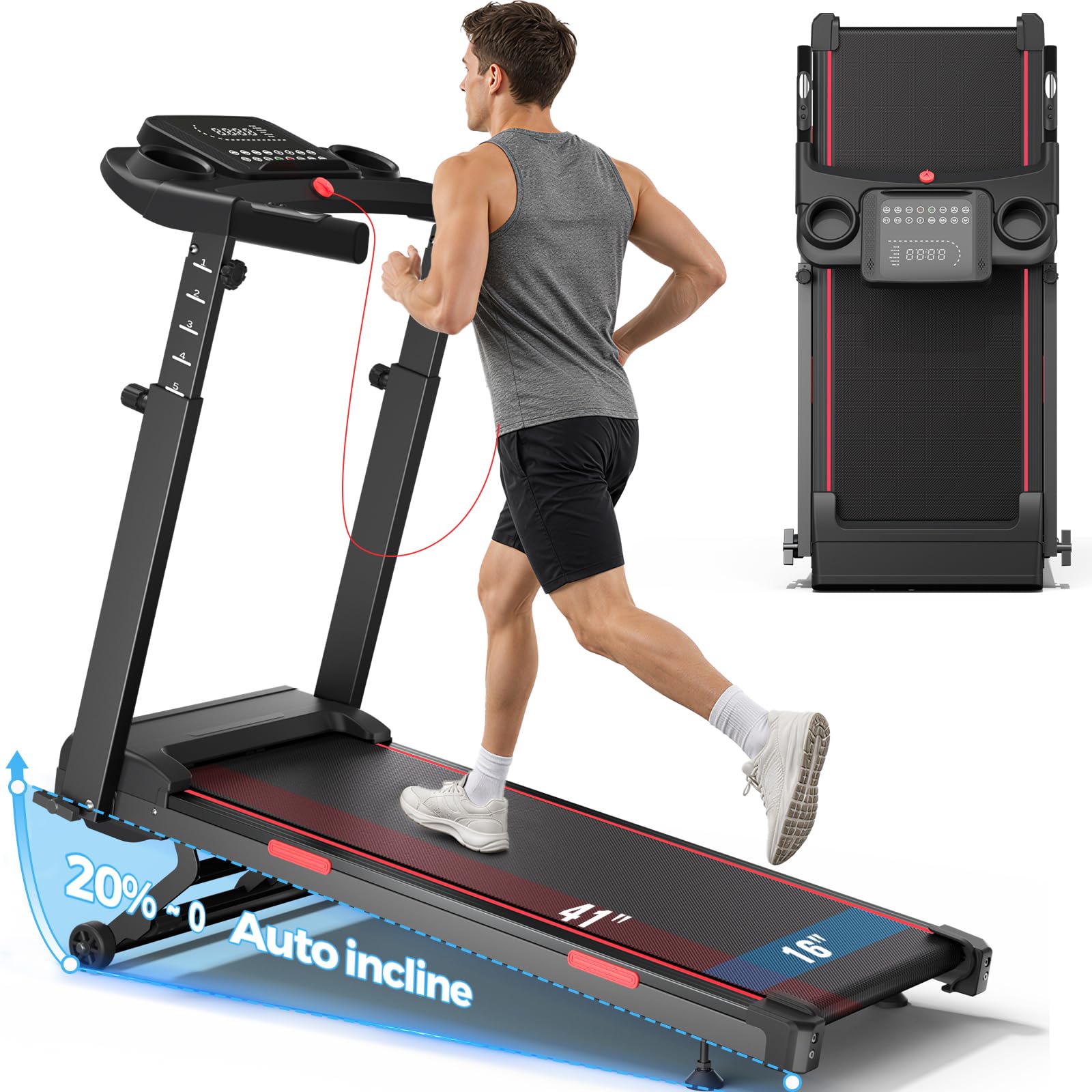
The highest score in this lineup belongs to the EVKRUN, and the reason is easy to see once you look at the deck. A 20% auto incline is the steepest grade here — the WELLFIT tops out at 12% — so if you want to simulate a real hill without leaving the room, this machine gives you more to climb. The deck itself is a 16″ x 41″ surface that folds flat for storage, roomy enough for jogging rather than just strolling.
Speed reaches 8.7 MPH on a 3.5HP motor, and the capacity is rated to 450 lbs, the highest in the group. Quick keys sit on both handrails, so you can bump speed or incline without breaking your stride or reaching for the console. The touchscreen tracks heart rate, speed, distance, time, and calories, and it connects to a fitness app if you like logging sessions. Under the belt you get independent suspension with 4 shock absorbers, aimed at softening the ride for home workouts.
The catch worth knowing: a 20% motorized incline and a heavy frame make this a machine you fold and tuck away rather than lift one-handed — the 63.9 lb weight tells you it is not the daintiest pad. Set it where you plan to walk and leave it. This is the pick for someone who has decided the incline button is the whole point.
Why the grade matters: the 20% auto incline leads the entire lineup, and the 450 lb capacity means a heavier walker gets headroom the lighter-rated pads do not offer.
Built for the hill-chaser: pick the EVKRUN if incline range and a big weight ceiling are what you came for.
Think twice if: you need to move the machine between rooms often, since the frame is on the heavy side.
3. WalkingPad Z1R Foldable Walking Pad with Handle Bar
Under-desk storage that slides away on a deck barely over an inch and a half thick.
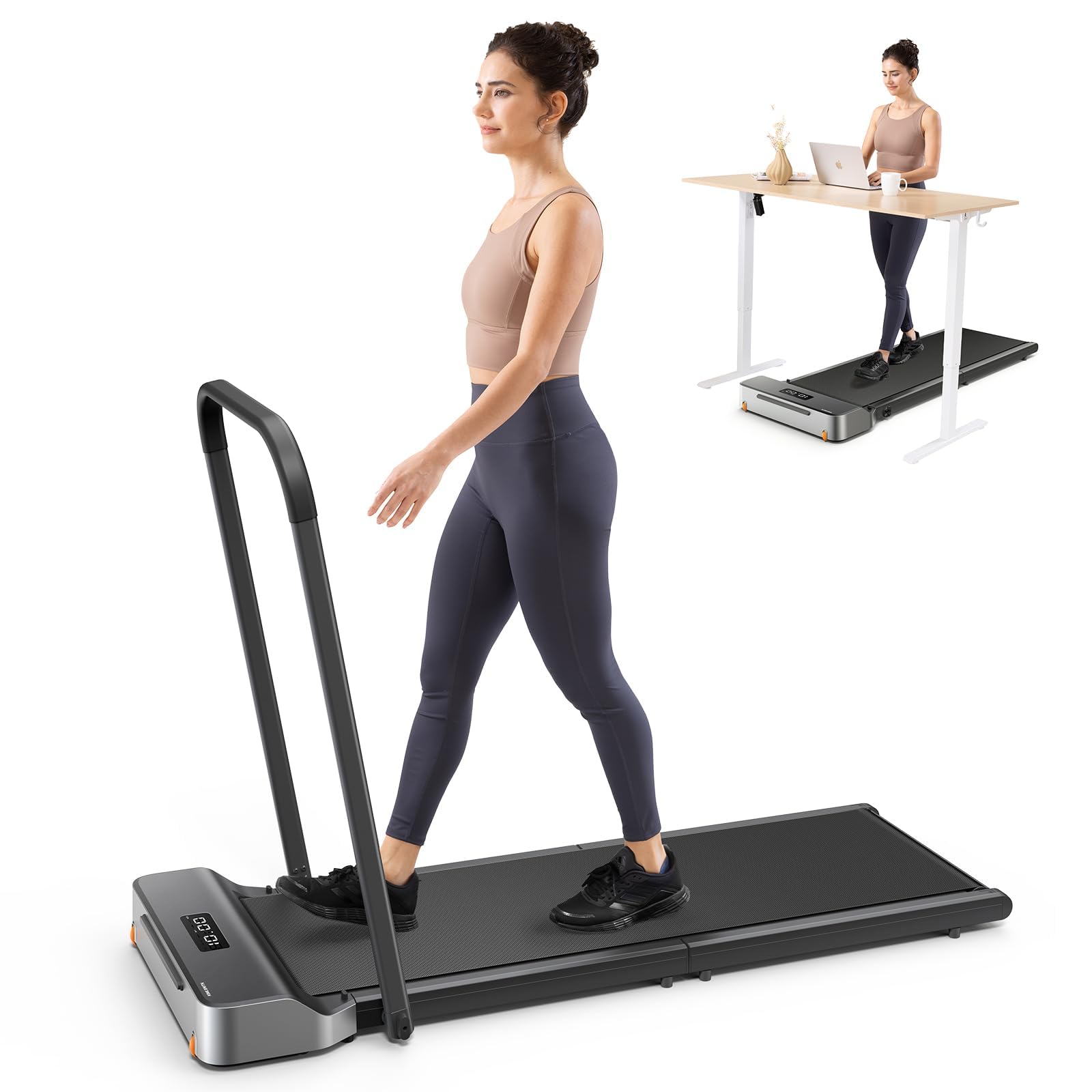
The Z1R’s defining number is its profile: an ultra-thin deck at about 1.69 inches thick, with a 180° fold so the whole thing tucks under a bed, sofa, or closet. That is the smallest folded footprint in this group, and it is why this machine suits a small apartment or a home office where floor space is genuinely scarce. As owners sum it up, it folds up and slides under the bed with a setup that takes seconds to open and close.
The handle bar is the clever part. It is sturdy and detachable, so you install it for warm-ups or supported walking and pull it off in seconds for an open deck when you want under-desk footwork. A 1–5 MPH range on a 2.25HP brushless motor covers light walking through light jogging. The belt measures 47.6″ x 15.7″ over 8 cushioning layers, and it holds walkers up to 242 lbs — noticeably lower than the bigger home treadmills here, so check that ceiling against who is using it.
Control is flexible: an LED display for speed, distance, time, and calories, a remote for start-stop and speed without breaking stride, and an app to log progress. Owners rave about the functionality, and the folding design earns its share of praise too. The honest wrinkle is noise — opinions split on how quiet it really runs, so it is fine for most rooms but not the whisper-quiet end of the range.
The folding case
- About 1.69 inches thick with a 180° fold — sleeps under a bed or sofa
- Removable handle bar swaps between supported and open-deck walking
- Remote plus app control for speed and start-stop
- 47.6″ x 15.7″ belt on 8 cushioning layers
The fine print
- 242 lb weight ceiling is lower than the larger home treadmills here
- Noise is a split verdict — some find it quiet, others do not
Reach for this if: space is your tightest constraint and you want a rail you can add or strip off in seconds.
Look elsewhere if: you need a high weight capacity or a whisper-quiet belt.
4. Redliro Treadmill for Seniors with 0.3 MPH Slow Start
Starts at a crawl so a nervous first step never gets away from you.
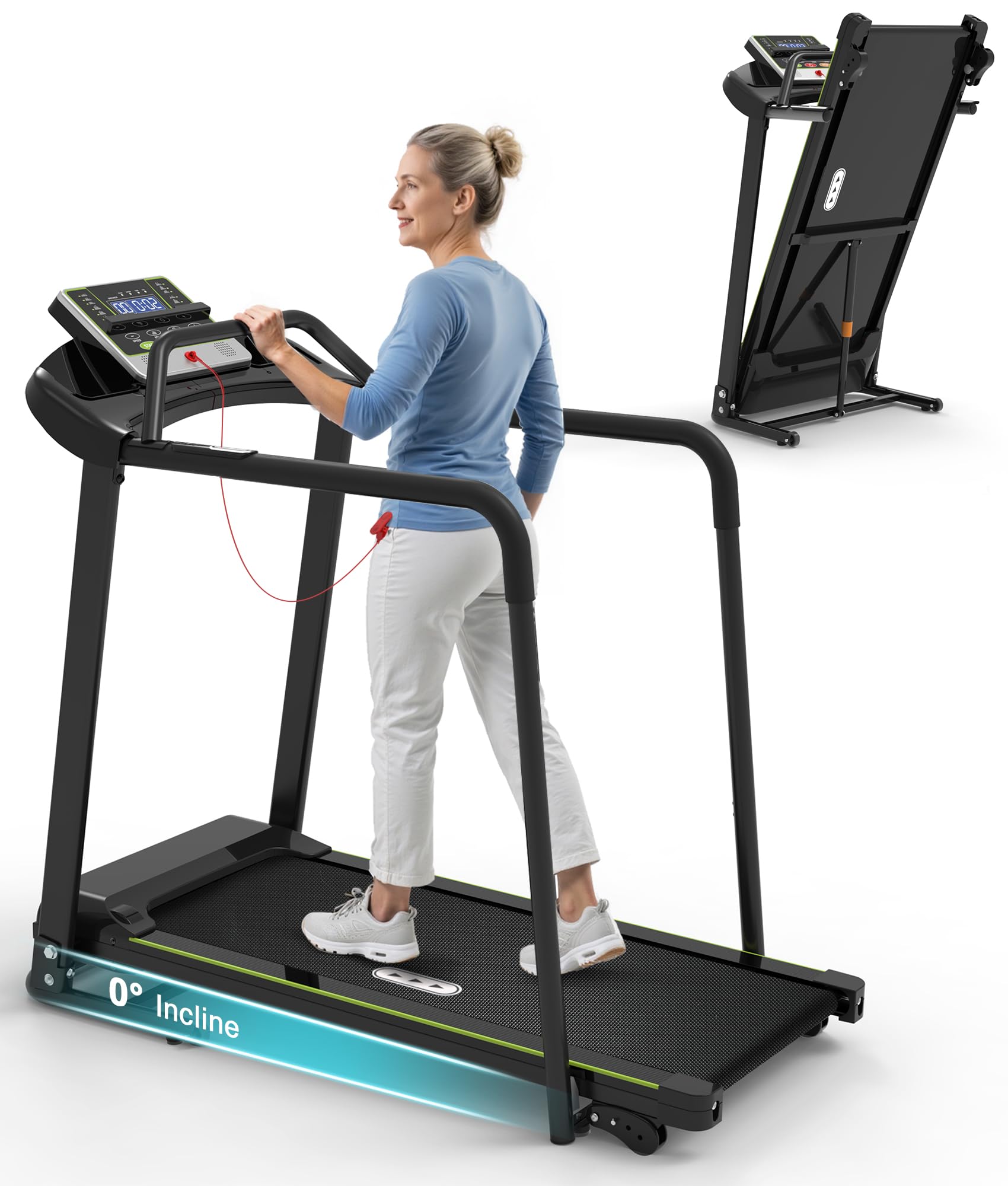
Most walking pads jump on at a speed that assumes you are already moving. This Redliro starts at 0.3 MPH, an ultra-low creep that lets a walker with limited mobility plant both feet before anything carries them. That single number is the whole reason this model exists, and it carries up to 300 lbs while doing it. For rehabilitation or a gentle daily walk, the slow start is the feature that matters more than top speed.
The rail design backs that up. You get both side handrails and a front bar positioned for a natural grip, so support is there for the full body, not just one side. The deck can also be set completely flat — the lowest of its 3-level manual incline settings gives a surface that does not tip at all, which is a steadier footing for anyone worried about joint stress. Built-in speed controls sit in the handrails, and pulse sensors track heart rate in real time.
Around the edges, maintenance is handled by a self-lubricating deck with an easy-access oil port on the right side, so you are not lifting the belt to oil it. Assembly is straightforward with the included tools, and the frame folds with a gas-spring assist so you are not wrestling the deck down. The nitpick is minor: folded size runs larger than the slimmest pads here, so measure your storage spot first.
The safety read: a 0.3 MPH start plus full front-and-side rails makes this the most cautious ride in the lineup for a walker who needs time to find their footing.
Made for the careful walker: choose this Redliro if a very slow start and a flat, level deck are your priorities.
Skip the climb: the incline maxes at 2%, so steep hill work belongs on another pick.
5. Redliro Walking Treadmill for Seniors with Long Handrails
Extended side rails and a front bar, built around the idea that balance comes first.
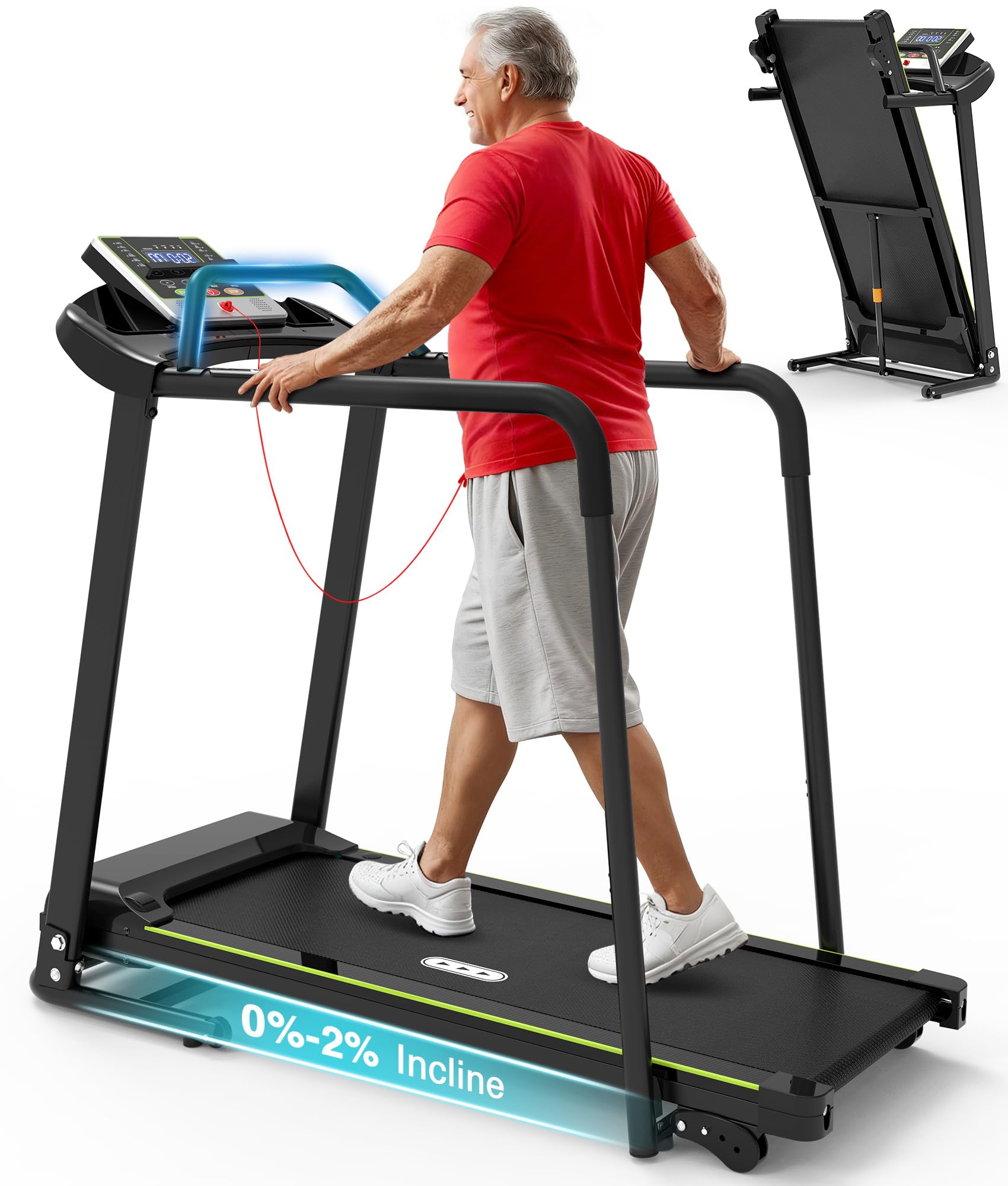
Here is a walking pad designed from the rail out. The dual handrail setup runs long side rails plus an ergonomic front bar, so a senior or rehab walker has continuous support down the whole stride and a natural two-handed grip up front. That is a step beyond pads that give you a short bar over the console and nothing else. Owners consistently describe the solid rails as stable.
Speed starts as low as 0.3 MPH and holds walkers up to 300 lbs, giving a controlled, low-impact first step. The backlit LCD is simple by design — distance, calories, heart rate, speed — with plain buttons and no clutter for a convalescent user. If a younger family member wants in, there are 12 preset modes to work through. A six-layer thickened belt sits over a shock absorption system aimed at easing each footfall.
The practical bonus: the armrest can come off entirely for a household member who finds it restrictive, and once removed the frame folds. Transport wheels let you roll it room to room. The trade-off to accept is that this is a senior-first machine — top speed and incline range stay modest, so a serious runner will want a different unit.
Where it earns its place
- Dual long side rails plus a front bar for full-stride grip
- 0.3 MPH slow start, 300 lb capacity, fully flat walking option
- Removable armrest so the whole household can share it
- 12 preset modes and a simple backlit LCD
The honest limit
- Speed and incline stay modest — not a runner’s machine
The household answer: buy this if an older or recovering walker needs rails for the whole stride and someone else wants the pad too.
Not for the speed-chaser: if you want fast jogging or a steep incline, this one stays gentle on purpose.
6. HitGo Walking Pad with Full Length Handrails

Seven extra inches of belt and rails that run heel to toe, made for taller walkers.
The number to lead with here is the belt: 43.3 inches of length at 15.5 inches wide. That is 7 inches longer than a typical compact walking pad, which is the difference between a tall user striding naturally and one who keeps stepping off the back edge. Full-length carbon steel rails run along both sides of the deck, so the grip is there from heel to toe — not just at the console. The reinforced frame carries up to 350 lbs.
For resistance, you lift the front deck by hand for up to 4% incline. A 2.5HP motor runs quietly enough for a shared room, and multi-layer shock cushioning under the belt softens each step. Up top, an eye-level LED console shows time, speed, distance, calories, and pulse without you bending down, and pulse sensors built into the handrails track your heart rate as you walk. Bluetooth pairing lets you pipe sessions to a fitness app.
Setup is genuinely quick — 12 bolts and you are walking — because it ships 90% pre-assembled. At 59.5 lbs with transport wheels, it rolls into a corner or flat against a wall. The trade-off is the flat-deck life it is: 4% is a mild incline, and this frame does not fold, so it wants a permanent-ish home against a wall rather than a spot under the couch.
The tall-walker fix: 43.3 inches of belt at 350 lb capacity delivers the stride room shorter pads simply do not have.
Best for long strides: choose the HitGo if you are tall and want rails running the full length of the deck with a quick bolt-together setup.
Skip if you must hide it: the non-folding frame needs wall space, not cupboard space.
7. Aiteid Treadmill with Incline, 3.0HP Walking Pad
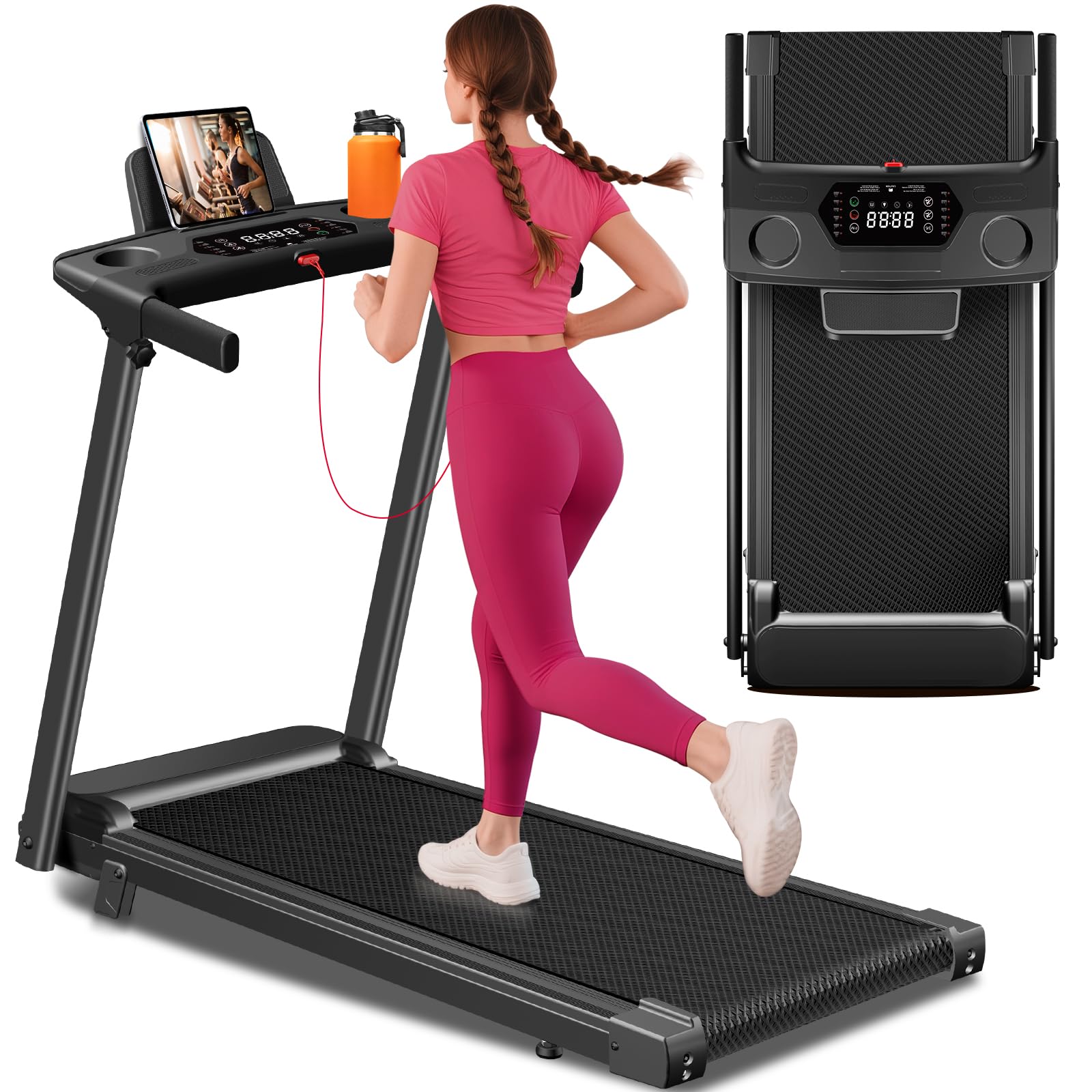
A lean 48-pound frame that still gives you a 12% incline and 3.0HP of motor.
The Aiteid punches above its light weight. At 48 pounds it is the easiest of the home treadmills here to roll under a bed, yet it still carries a 3.0HP brushless motor, a 12% manual incline, and users up to 300 lbs. Speeds run 0.6–6.2 MPH. The incline climbs via small black foot pads, so you lift and set it rather than press a motorized button — a small manual step in exchange for real hill training on a budget-friendly machine.
Underfoot you get a six-layer running belt, 4 high-density silicone shock absorbers, and 2 impact-reduction pads, all working to soften each stride. The belt measures 39 inches long and 15 inches wide. The LED display tracks time, calories, steps, speed, and distance, with 12 preset programs and a PAU pause button that holds your current data while you catch your breath. The plain, no-complications operation makes it easy to live with — there is very little to learn.
The honest note: this is a compact deck, and 39 inches of belt is snug once you want a longer stride, so a taller jogger may feel boxed in. Reliability and how easily it moves draw mixed feedback as well, so treat it as a dependable budget walker rather than a heavy-duty daily runner. The long belt warranty and low price still make it a strong entry point.
What you gain
- 48-pound frame with wheels — easy to tuck under a bed or sofa
- 3.0HP motor, 300 lb capacity, 0.6–6.2 MPH range
- 12% manual incline via foot pads
- 12 preset programs plus a pause button that keeps your data
What to keep in mind
- 39″ x 15″ belt is snug for a tall stride
- No complicated programming, but the incline is a set-by-hand affair
A smart budget entry: grab this if you want incline capability and a light, roll-away frame without much spend.
Size up for length: if you are tall, the 39-inch belt will feel tight and a longer deck above serves you better.
8. ZPUFDYM Treadmill for Home with 12% Incline & Handle Bar
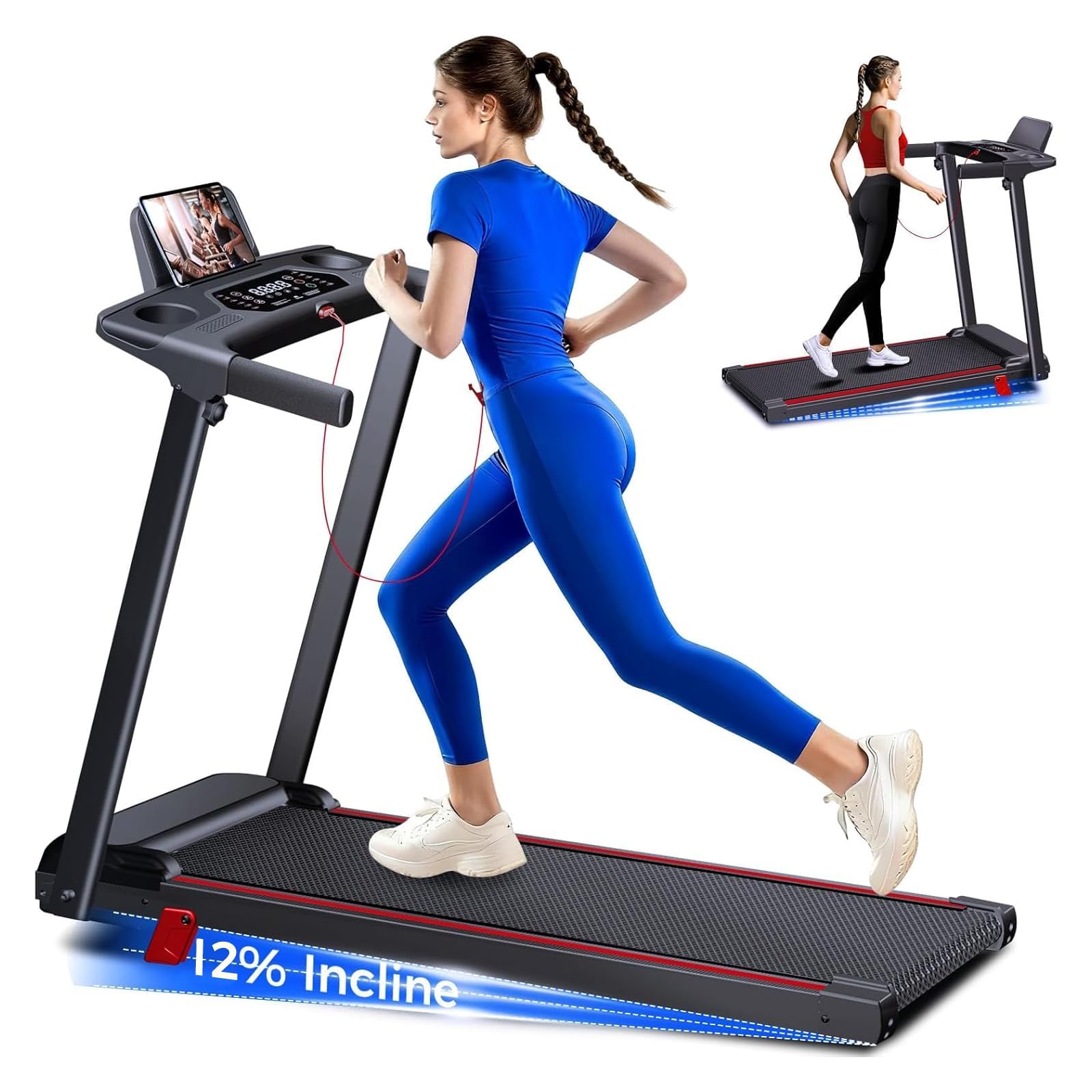
The widest deck in the group, at a price that keeps budget walking honest.
The ZPUFDYM wins on sheer surface area. A 48″ x 23″ deck is the biggest in this lineup — the WELLFIT deck measures 40″ x 16″ by comparison, so this one gives noticeably more room to walk, jog, and climb without feeling hemmed in. A 12% manual incline simulates a hill climb, and the maker claims it lifts calorie burn, though that figure is their claim rather than a tested spec.
The motor is a brushless 3.0HP rated to hold users up to 330 lbs, and safety handrails on the sides keep the workout secure — the reason it suits homes, apartments, and offices. A six-layer anti-slip running surface with 10 silicone shock absorbers and dual impact pads softens each stride. The full deck is also built for desk-friendly flat walking when you want to step while you work.
Speed runs 0.6–6.2 MPH, enough to move between running, walking, and incline work. The honest caveat is the size: the deck is generous, but the overall footprint is a larger machine, and some find it bigger than expected in a small room — so plan the spot before it arrives. Assembly and noise are commonly described as easy and quiet respectively, and the build feels worth its budget-tier price.
The space trade: a 48″ x 23″ deck is the roomiest walk surface here, but it is also a larger machine, so it wants a real corner rather than a tight slot.
Best for a big stride: choose the ZPUFDYM if you want maximum deck width and can give it dedicated floor space.
Check your room first: if square footage is tight, the generous footprint may overwhelm a small apartment.
Know the Specs
Deck Length and Width (Inches)
This is the walking surface, and it is the spec that decides how freely you stride. A 39-inch belt suits a shorter, slower walker; a 43-inch or longer belt gives a tall user room to avoid stepping off the back edge. Width matters for elbow room — a 14.8-inch deck feels snug, a 23-inch deck feels open. Measure both against who will walk on it before anything else.
Motor Power (HP)
Horsepower is the motor’s rated strength. On a walking pad it mostly tells you how steadily the belt holds speed under a heavier walker. The units here run from 2.25HP up to 3.5HP, and the higher figures pair with higher weight ratings. Brushless motors have fewer wearing parts and tend to run quieter than older brushed designs.
Handrail Type
A short rail over the console is a touch point for a standing-desk walker. Extended side rails give continuous grip down the deck, which is what a senior or rehab user needs. A front bar adds a natural two-handed hold. A detachable rail lets one machine serve a cautious walker and a confident one.
Incline (% Manual or Auto)
Incline is measured as a percentage grade. Manual incline means you lift and set the deck by hand; auto means the motor raises it on command. Higher percentages add challenge, but for recovery walking a flat, level deck is often the safer footing — some pads let you set fully flat.
Common Questions
How long should a walking pad deck be for a tall person?
Is a full-length handrail better than a short one?
What is the difference between auto incline and manual incline?
Can a walking pad with handrail be stored under a bed?
How much weight can these walking pads hold?
Are walking pads quiet enough for an apartment?
Do seniors need a slow-start treadmill?
Which walking pad is best under a standing desk?
How much assembly do these walking pads need?
The Bottom Line
For most people, the walking pad with handrail winner is the WELLFIT, because its 0–12% auto incline, 3.5HP motor, and extended dual rails cover hill training and stable walking in one foldable unit — and it earns a 4.5+ rating from 100+ owners. If incline range is the whole point, the EVKRUN climbs to 20% with the highest weight rating here. For a senior or rehab walker who wants rails for the full stride, the Redliro long-rail senior model is the one to reach for; and if floor space is your tightest constraint, the WalkingPad Z1R folds to about 1.69 inches and slides under a bed.
How we choose
We do not accept paid placement. Every pick is matched to a real buyer and a real use-case; we do not hands-on test units.
Sources
Specifications: manufacturer listings and product documentation. Review insights: verified customer reviews, as of November 2026. Pricing: not shown on this page (it changes often); check the current price via the retailer link.
As an Amazon Associate, Tactical Gear Guy earns from qualifying purchases. This does not affect which products we feature.