Specs are compiled from manufacturer listings and verified buyer reviews and can change over time — please confirm the key details on the product page before buying.
A walker without wheels is the pick when you want steady, planted support rather than a rolling frame that can get away from you. The trade-off buyers care about most is width: a frame that clears a narrow hallway or bathroom door is worth more than any gadget on the handle. This guide covers seven non-wheeled walkers — standard folding frames and one-handed hemi walkers — so you can match the frame to your doorway, your height, and how much weight it has to hold.
This guide is built by comparing the manufacturers’ published specifications and the patterns across verified customer reviews, so you get each pick’s real strengths and trade-offs instead of marketing spin.
You’ll see how width, height range, and weight capacity decide which frame works in your home. The Delog narrow walker stands out as the crowd favorite — 4.5+ stars across 700+ ratings — because its width slides from 18 to 22 inches. Read on for the full breakdown of the best walker without wheels.
Top Picks


How To Choose The Best Walker Without Wheels
A non-wheeled walker does one job: it plants four rubber feet on the floor and gives you something solid to lean on with every step. That means the buying decision depends on width, handle height, and tube thickness, not add-ons. Get the width and handle height right and the frame moves with you instead of catching on doorframes. Get them wrong and you’ll be lifting the frame over every threshold and stooping at every step.
Measure your narrowest doorway first
Walk the route you take every day — bedroom to bathroom, kitchen to living room — and measure the tightest doorway on it. Then compare that number to the walker’s stated width. The Delog frame adjusts from 18 inches to 22 inches, so it can be narrowed for a bathroom door and widened for the hallway. Frames with a fixed width leave you no margin if your home has a tight spot.
Match handle height to your wrist, not your shoulder
You want the grips to land at the crease of your wrist when you stand upright with your arms relaxed at your sides. Too low and you’ll stoop forward; too high and you’ll hunch your shoulders. Most non-wheeled walkers adjust in 1-inch steps, and the ranges vary a lot: the Stander tops out at 39 inches, while the Days hemi walker runs from 29.5 to 34.5 inches.
Decide between two hands and one
A standard folding walker needs both hands on the grips and lifts forward with each step. A hemi walker is built for one-handed use — it’s a single side frame you place beside you, and it suits people with weakness or limited use on one side. Both plant on rubber tips, but they walk completely differently, so pick the style that matches how you actually move.
Weight capacity is about tubing, not labels
A higher capacity figure usually means thicker metal in the frame. The Delog lists 1.2 mm tubing for a 350 lbs rating, and the VEVOR lists 1.25 mm for the same figure. That thicker metal adds a little weight to the frame, which is the honest trade-off you accept for a sturdier stand. Lighter frames, like the 3.5 lb Days hemi, trade some of that beef for easier lifting.
Side-by-Side Comparison
| Model | Best For | Weight Capacity | Height Range | Frame Weight | Amazon |
|---|---|---|---|---|---|
| Delog Narrow Walker★ Best Overall | Narrow doorways | 350 lbs | 30–37 in | 6 lbs | Amazon |
| VEVOR Folding WalkerTallest Reach | Tall users | 350 lbs | 32.3–39.4 in | 5.5 lbs | Amazon |
| PCP 5052 Folding Walker | Independent sides | — | — | 6 lbs | Amazon |
| Vive Hemi Walker | One-hand use | 300 lbs | Adjustable, 1 in steps | 3.85 lbs | Amazon |
| Days Hemi Walker | Lightest carry | 300 lbs | 29.5–34.5 in | 3.5 lbs | Amazon |
| Stander Wonder Walker Lite | Petite adults | 300 lbs | 32.5–39 in | 6 lbs | Amazon |
| Lumex 3-in-1 UpRise | Standing up | 400 lbs | — | 10.35 lbs | Amazon |
Detailed Reviews
1. Narrow Walkers for Seniors by Delog
Our pick — 4.5+★ from 700+ verified ratings; the strongest balance of quality and price.
The frame you can narrow to 18 inches, then widen back out for the hallway.
Most non-wheeled walkers give you one fixed width and hope it clears your doors. This one lets you change it — the frame slides between 18 inches and 22 inches wide, so a tight bathroom doorway isn’t a dead end. That single adjustment explains why door accessibility is one of the things buyers talk about most here, and why it works in older houses where the doorways were never built wide.
The trigger release is the other smart piece. You squeeze a lever on each handle to fold the frame, and you never have to lift your hands off the grips to do it. Each side folds on its own, so you can pull one side in to squeeze past a counter, then open it again. For anyone with limited finger strength, that beats a stiff push-button every time.
Weight capacity runs to 350 lbs from 1.2 mm tubing, and the frame itself weighs 6 lbs. Handles adjust from 30 inches to 37 inches in 1-inch steps, which covers most adult heights without leaving you stooped.
What earns its keep
- Width adjusts 18 to 22 inches — the only pick here that changes its footprint for a doorway
- Trigger release folds each side without moving your hands off the grips
- 350 lbs capacity from 1.2 mm tubing, at a manageable 6 lbs
- Height dials from 30 to 37 inches in 1-inch steps with soft ribbed grips
Where it asks for care
- Stability draws mixed feedback while frame quality draws praise — plant it squarely and keep the feet clean
- Heavier than the VEVOR and the hemi frames if you’re lifting it into a car often
Reach for this if: your home has a narrow doorway on the daily route and you want a frame that can be sized to it.
Think twice if: you want a walker you’ll fold and lift into a trunk several times a day — the lighter hemi frames suit that better.
2. VEVOR Folding Walker, 8-Level Height Adjustable
Eight height stops that reach 39.4 inches — built for the tall user nobody else fits.
If you’re tall, a walker that stops at 37 inches makes you hunch every step. This VEVOR goes to 39.4 inches across 8 height levels, and it starts at 32.3 inches, so it’s one of the widest height spans in this group. The Days hemi walker tops out at 34.5 inches for comparison — fine for a shorter frame, but a different job entirely.
The frame is aluminum with a 1.25 mm tube wall, rated to 350 lbs. That’s the same capacity figure as the Delog but a slightly thicker wall, and the VEVOR still comes in at 5.5 lbs — half a pound lighter than the Delog. Two buttons fold it down to a compact shape for a trunk or closet, and anti-skid feet add abrasion resistance for both indoor and outdoor use.
The catch is assembly. Reports split cleanly between “easy to put together” and near-impossible, which usually means a specific step trips people up rather than the whole frame being badly made. Set aside a quiet stretch and follow the sheet once — the frame itself holds up fine once it’s together. It also does double duty as a light armrest when you’re standing still.
Best for the long-limbed: the 32.3 to 39.4 inch range fits users who find most non-wheeled walkers too short, and the 350 lbs rating means the extra height doesn’t cost capacity.
The honest catch: give yourself an unhurried block of time for the first assembly, because feedback on that step is genuinely split.
Go with this if: you’re on the taller side and every other frame leaves you bending forward.
Look elsewhere if: you want something you can use the minute the box opens with zero setup.
3. PCP 5052 Folding Adjustable Walker
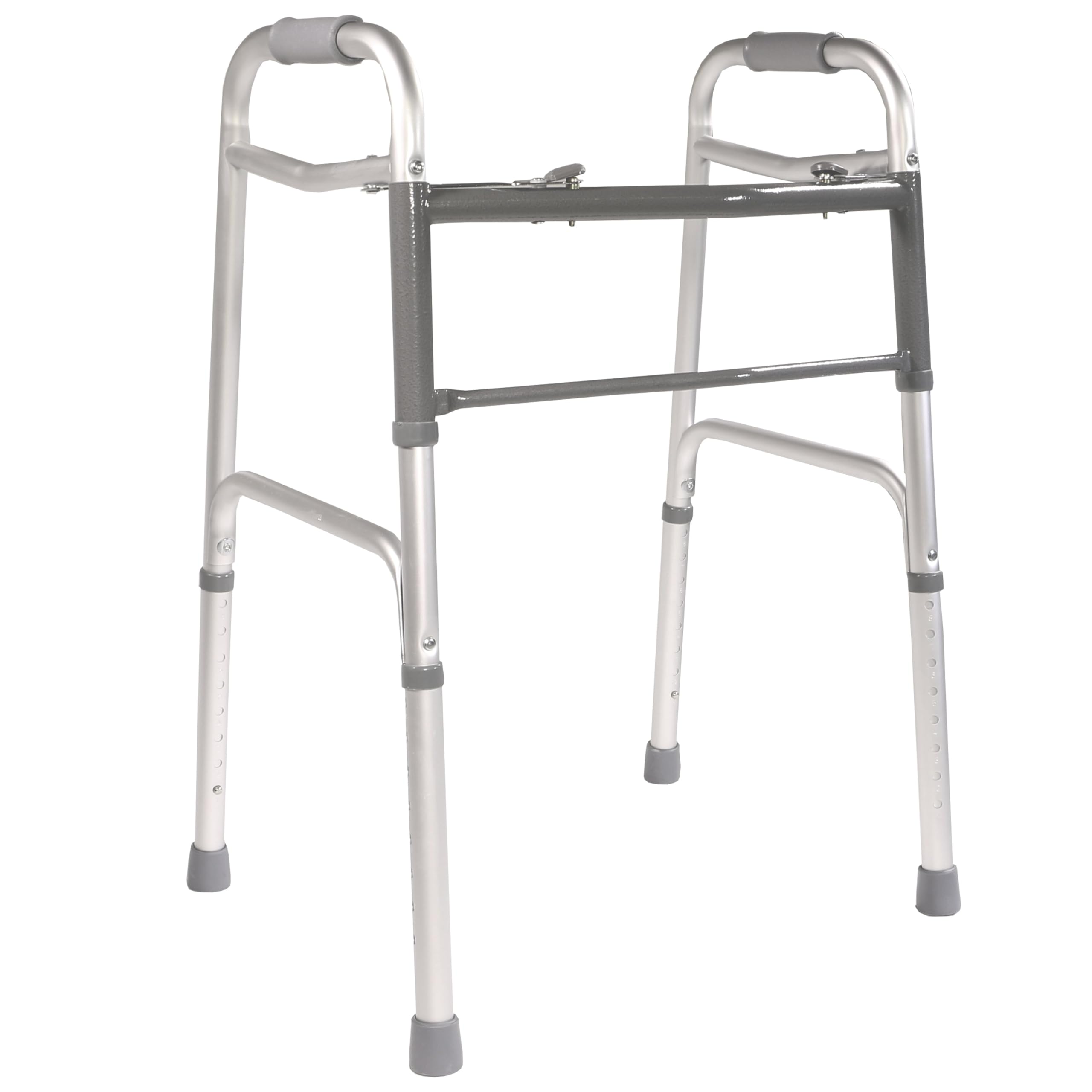
Two sides that fold on their own, so you shrink one half to slip through a gap.
The design idea here is simple and useful: each side of the walker folds independently. When a space gets tight, you pull one side in against your body and keep the other planted. When you’re rising from a chair, that same trick lets you draw the frame closer to you before you push up. It’s a different approach from the Delog’s sliding width — you’re folding one wing rather than narrowing the whole frame.
The walker weighs 6 lbs and is built for standard adult use, and the 5052 designation is the standard model in this line. It’s a plain folding design, and the double release is the mechanism that lets each side fold on its own. That’s the whole pitch: fold one side to slip through a gap, then plant all four feet again.
One thing to know going in: this model doesn’t come with the company’s own review commentary on its listing, so you’re buying on the design and the published frame rather than a track record of owner notes. If you want the confidence of a walker with a long comment history, the Delog or the Days covers that ground.
What you’re actually buying: a design choice — independent folding sides that let you shorten the frame on one side to clear a tight pass, then open it back up.
The trade-off: the thinnest owner feedback among the standard folding frames here, so the design case has to carry the decision.
Worth a look if: you like the idea of folding one side at a time to wiggle through tight spots.
Better matched elsewhere if: you want a walker with a deep well of owner experience behind it before you commit.
4. Vive Hemi Walker for Seniors

A cane’s maneuverability with a walker’s steadiness, held in one hand.
This is the pick if you only have reliable strength on one side. It’s a hemi walker — a single-side frame you set beside you and lean on with one hand — and it pairs a cane’s easy movement with the planted feel of a walker. The 18-inch wide, 17-inch deep footprint fits tight bathrooms and small rooms where a full two-handed frame would crowd you.
At 300 lbs capacity it holds a solid stand, and the cross-brace design is what gives it that steadiness. You can also use it in front of a couch or chair to push up from sitting, and the frame doubles as a grab bar in the bathroom. That stand-assist role is why people reach for it during recovery, when standing up is the hardest part of the day.
It weighs 3.85 lbs, arrives pre-assembled, and adjusts in 1-inch steps. Stability is the strongest impression it leaves, with build quality close behind — this is a frame that feels solid in the hand. The honest note is that one-handed operation takes some getting used to; a few people find the technique awkward at first before the rhythm clicks.
The standout number: 3.85 lbs in a frame rated to 300 lbs — light enough to move with one hand, steady enough to lean your weight into.
What to expect adjusting: one-hand walking is a skill. Give yourself a few days of practice rather than judging it on the first attempt.
Made for you if: one side is weaker and you need a steady handhold that moves like a cane.
Not your pick if: you want both arms braced on a wide frame with every step.
5. Days Hemi Walker

At 3.5 lbs, the lightest frame here — easy to lift with two fingers.
Weight is the whole story on this one. The aluminum frame comes in at 3.5 lbs, which makes it the lightest walker in this group. Compare that to the Stander Wonder Walker Lite at 6 lbs — you’re carrying a substantially lighter frame around the house and into the car. For one-handed use, that difference is the difference between easy and tiring.
The height range is the important limit to check. It runs from 29.5 inches to 34.5 inches, which suits shorter users well but tops out below the VEVOR’s 39.4 inches. If you’re tall, this isn’t your frame; if you’re petite or of average height, the range is comfortable. Capacity is 300 lbs, and it folds flat for storage.
Sturdiness is what leaves the strongest impression on owners, with quality right behind it — this is a frame that feels solid despite its light weight. Days makes daily-living aids for nursing homes and home users alike, and that background shows in the plain, no-frills build. Nothing decorative here — just a 3.5 lb aluminum hemi frame that folds flat and holds its 300 lbs rating.
Pick this one if: a shorter height range fits you and you want the lightest possible frame to move from room to room.
Cross it off if: you’re tall — the 34.5 inch ceiling will leave you reaching down for the grips.
6. Stander Wonder Walker Lite Short

An umbrella-style fold that collapses to a 5 by 7 inch footprint for travel.
This frame is built for petite adults, and the giveaway is the fold. It collapses to a 5 by 7 inch footprint — four times less space than the average walker, according to Stander — which means it slides into a car trunk or a closet corner without a fight. At 6 lbs it’s the same weight as the Delog, and noticeably heavier than the 3.5 lb Days hemi if you’re lifting it often.
The U-shaped 23-inch frame is meant to come closer to your body, which helps you keep posture instead of leaning out over the feet. Handles adjust from 32.5 inches to 39 inches, so it covers a wide span. It arrives ready to use with no assembly — you adjust the handles and go.
Build quality is what comes through strongest, and weight is close behind — this feels like a careful piece of aluminum rather than a budget stamp-out. The 23-inch U-shaped frame sits close to your body, so it clears narrow doorways and tight hallways without you leaning out over the feet. The black walnut finish also looks less clinical than most frames in this group, which matters if the walker lives in your living room.
What it does well: folds umbrella-tight to 5 by 7 inches for travel and storage, with a 32.5 to 39 inch handle range covering many body types.
The frame you accept: 6 lbs is not light once you’re lifting it repeatedly — the hemi walkers beat it on carry weight.
Suits you if: you’re petite, you travel, and you want a walker that stows like an umbrella stroller.
Keep looking if: carry weight is your top priority or you’d rather not adjust a handle range at all.
7. Lumex 3-in-1 UpRise

One frame that walks, helps you stand, and braces a toilet — a triple duty tool.
This is the pick when standing up is the hard part, not walking. The Lumex works three ways: as a lightweight walker, as a standing and rising aid, and as a toilet safety rail. The secondary handles sit low on the frame, so you can grab them to push up from sitting or lower yourself down with control — the motion that’s hardest during recovery or with weak legs.
It’s rated to 400 lbs, the highest capacity in this group, and that extra beef explains a lot of the design. Those low secondary handles are what make the sit-to-stand motion feel supported, and the contoured handgrips stay comfortable through repeated use. A single-release fold lets you collapse it with one hand, which helps when the other hand is on a counter or a cane.
The trade-off is weight. At 10.35 lbs it’s the heaviest frame here by a wide gap — nearly double the Delog at 6 lbs. That weight is the price of a frame rated to 400 lbs and built for load-bearing in three roles. It’s a frame you keep in place, not one you toss in the car; plan where it lives before it arrives.
Why it earns the versatility title
- Three roles in one frame — walker, standing aid, and toilet safety rail
- 400 lbs capacity with low secondary handles for controlled sit-to-stand
- Single-release fold you can work with one hand
What you give up
- 10.35 lbs is the heaviest here by a clear margin — this is a keep-it-in-one-place frame
- Lowest overall satisfaction of the seven, so it fits a specific recovery need better than everyday walking
The strong choice if: you need help standing from a chair or a toilet and want one frame that does all three jobs.
Skip the versatility if: you mostly need a walker to move around — the weight and capacity aren’t worth carrying.
Know the Specs
Weight Capacity and Tube Thickness
The capacity figure is the most weight the frame will hold, expressed in pounds. Behind it sits the tube wall thickness — the Delog lists 1.2 mm, the VEVOR 1.25 mm — and thicker metal usually means a sturdier frame that’s also a little heavier. A 350 lbs walker has more metal in it than a 300 lbs one, so you’re trading some carry weight for extra hold. Match capacity to your body weight with room to spare, and remember the frame weight itself if you plan to lift it often.
Height Range and Handle Fit
The height range is how far the handles adjust, usually in 1-inch steps. The Stander runs 32.5 to 39 inches, the Days hemi 29.5 to 34.5 inches — different jobs for different bodies. The right height puts the grips at the crease of your wrist with arms relaxed at your sides. Too low and you stoop, which strains your back; too high and your shoulders hunch. Check the range against your own height before you buy, because a frame that’s too short can’t be fixed with a cushion.
Width and Doorway Clearance
A walker’s width decides which doors it fits. The Delog adjusts from 18 to 22 inches so you can narrow it for a bathroom door and widen it for a hallway. Frames with a fixed width give you one number to work with, and that number either clears your tightest doorway or it doesn’t. Measure the narrowest door on your daily route before you decide. For a hemi walker, the footprint is much smaller — 18 inches wide and 17 inches deep on the Vive — so it slips into small bathrooms more easily.
Folding Mechanisms
Non-wheeled walkers fold in a few ways: a push-button on each side, a trigger release you squeeze without moving your hands off the grips, or a single-release lever you can work one-handed. The Delog’s trigger release is handy for limited finger dexterity; the Lumex’s single release helps when your other hand is busy. Folding matters most if you store the walker or travel with it — a frame that collapses to a 5 by 7 inch footprint, like the Stander, takes up very little space.
Common Questions
How do I know which width walker will fit through my doors?
Is a walker without wheels easier to use than a rollator?
What is the difference between a standard walker and a hemi walker?
How much weight will these walkers hold?
How high should the handles be set on my walker?
Can I use a non-wheeled walker to help me stand up from a chair?
Do any of these walkers arrive fully assembled?
How do I maintain the rubber feet on a non-wheeled walker?
How much does a non-wheeled walker weigh and does it matter?
The Bottom Line
For most homes, the walker without wheels winner is the Delog Narrow Walker, because its 18 to 22 inch width slides to fit the tightest doorway on your route while the 350 lbs frame holds steady. If you’re tall and every other frame leaves you hunched, grab the VEVOR Folding Walker with its 39.4 inch top height. And for one-handed support during recovery, the Vive Hemi Walker is the frame to reach for. Whichever you choose, start with fit — measure your narrowest doorway and set the grips at your wrist crease before anything else.
How we choose
We do not accept paid placement. Every pick is matched to a real buyer and a real use-case; we do not hands-on test units.
Sources
Specifications: manufacturer listings and product documentation. Review insights: verified customer reviews, as of November 2026. Pricing: not shown on this page (it changes often); check the current price via the retailer link.
As an Amazon Associate, Tactical Gear Guy earns from qualifying purchases. This does not affect which products we feature.