Specs are compiled from manufacturer listings and verified buyer reviews and can change over time — please confirm the key details on the product page before buying.
Your broom is the slowest tool in the garage. A walk-behind sweeper fixes that: you push it forward, two spinning brushes pull leaves, grit, and shop dust into a bin, and you empty the bin without touching the mess. The picks here range from a 20-pound outdoor unit you can lift with one hand to a 41-inch industrial machine that clears a parking lot in one pass. Below, each one is matched to the job it actually fits.
This guide is built by comparing the manufacturers’ published specifications and the patterns across verified customer reviews, so you get each pick’s real strengths and trade-offs instead of marketing spin.
Push sweepers differ on three things that matter most: sweeping width, bin size, and weight. The guide below sorts them by job, explains every spec in plain words, and flags the trade-offs before you commit to a walk-behind sweeper for your own garage, shop, or lot.
Top Picks


How To Choose The Best Walk-Behind Sweeper
A walk-behind sweeper is manual equipment, so the specs you ignore at purchase are the ones you fight every time you clean. Get width, bin size, and brush setup right and the job takes minutes instead of an hour. Get them wrong and you are pushing a heavy machine that fills up before the driveway is done.
Sweeping width decides how many passes you make
A wider path means fewer trips back and forth across the same stretch of concrete. On a two-car driveway, the difference between a 25.5-inch path and a 41-inch path is real time saved on every single cleaning. For a small patio or a garage floor, a narrower machine is easier to steer around parked cars and tight corners.
Bin capacity sets how often you stop to empty
The waste container collects everything the brushes throw backward. A larger bin lets you finish a bigger area before you stop, which matters most on leaf-heavy driveways and parking lots. Smaller bins are lighter to lift and dump, so they suit short, frequent cleanups better.
Weight and handle comfort affect how long you can sweep
Push sweepers range widely in weight, and that number decides who can use the machine comfortably. A lighter unit is easier to lift into a truck bed and carry up steps. A heavier industrial model tracks straighter over rough ground but takes more effort to turn.
Brush setup and surface type must match
Most walk-behind sweepers use a main roller brush plus side brushes that guide debris inward. Height-adjustable brushes let you dial in contact for smooth concrete versus rougher pavement. Fine dust needs a filter or dust-control design; heavier debris like leaves and gravel mostly needs brush contact and a big bin.
Side-by-Side Comparison
| Model | Best For | Sweeping Width | Bin Capacity | Weight | Amazon |
|---|---|---|---|---|---|
| KÄRCHER S 6 Twin★ Best Overall | Large driveways and workshops | 33.9″ | 10 gallon | 32.7 pounds | Amazon |
| Kärcher S 4 TwinCrowd Favorite | Everyday garage and patio cleanup | 26.8″ | 5.25 gallon | 22.5 pounds | Amazon |
| SUNMAX RT980S | Commercial hard-floor sweeping | 38″ | 12.7 gallon | 52 pounds | Amazon |
| PurpleWillow 41″ Industrial | Warehouses and parking lots | 41″ | 14.5 gallon | — | Amazon |
| LUSHIJIE 41″ Walk-Behind | Large outdoor hard surfaces | 41″ | — | 55 pounds | Amazon |
| Dapper Supply 25.5″ Push Sweeper | Sidewalks and patios | 25.5″ | 5.25 gallon | 20 pounds | Amazon |
| Takywep 25.6″ Sweeper | Budget garage and yard upkeep | 25.6″ | 5.25 gallon | 24.3 pounds | Amazon |
Detailed Reviews
1. KÄRCHER S 6 Twin Sweeper
Our pick — 4.0+★ from 300+ verified ratings; the strongest balance of quality and price.
The driveway clearer that covers a 33.9-inch path and swallows the whole pile in one bin.
Its 32,300 square feet per hour is the highest sweep rate here, measured on concrete at a steady walking pace. It pairs that rate with a 33.9-inch sweeping width and a 10-gallon waste bin. In practice, a long driveway or a warehouse aisle is finished in one run instead of three, and you stop to empty far less often than you would with a smaller canister.
It runs on push power alone — no cord, no gas, no battery to charge — and the motorless design keeps it at 42dB, quiet enough for an early-morning cleanup next to a sleeping house. That figure sits far below a leaf blower’s 93dB to 106dB, and instead of blowing dust into the air it collects it. At 32.7 pounds it is the heaviest of the Kärcher pair here, though the foldable handle and lightweight construction make storage and transport manageable. Buyers report one-pass floor cleaning and a 10-minute setup, with driveways finished in about 10 minutes.
Where it pulls ahead
- 32,300 square feet per hour — the highest sweep rate in this lineup, so big hard surfaces finish fast
- 10-gallon bin holds roughly double the 5.25-gallon canister on the Kärcher S 4 Twin below
- 42dB motorless operation captures dust instead of blowing it around
- 33.9-inch path with height-adjustable brushes for varied concrete
What to weigh first
- At 32.7 pounds it is heavy to lift into a truck or carry up steps
- Wide path makes tight turns around parked cars trickier than a narrow unit
Right for: anyone clearing a long driveway, shop floor, or parking apron who wants the fewest passes and fewest bin stops.
Think twice if: you need to haul the sweeper in and out of a vehicle often — 32.7 pounds gets old fast.
2. Kärcher S 4 Twin Sweeper
The lighter Kärcher twin that still clears 26,000 square feet an hour without breaking your back.
The S 4 Twin sweeps at 26,000 square feet per hour versus the S 6 Twin’s 32,300, and its bin holds 5.25 gallons versus 10. But it weighs 22.5 pounds instead of 32.7, which makes it the one you can actually carry to a neighbor’s patio or lift onto a shelf. If your cleaning area is a single garage bay or a modest patio, that trade leans in the S 4’s favor — you get the same 42dB quiet, motorless push operation and the same quick-release bin disposal that keeps your hands off the dirt.
Across its large ownership base, reviewers consistently praise its performance on flat hard floors, and it sweeps a whole space in a couple of minutes. Side brushes that spread across a 26.8-inch path are height-adjustable, so you can dial in contact for smooth concrete versus rougher pavement.
The one real caveat: dust pickup and long-term durability draw a mixed reaction in the review data, so treat the brushes as wear items and keep an eye on fine dust on smooth floors.
Bottom line: if you want the Kärcher brush design without the heft, this is the one that balances both.
Reach for it when your sweeping zone is a garage, workshop, or patio and you want something you can move easily.
Look elsewhere if you are clearing a long commercial run where the bigger bin and higher sweep rate of the S 6 Twin pay off.
3. SUNMAX RT980S Sweeper

A triple-brush commercial sweeper built to clear warehouse floors at up to 38,000 square feet an hour.
For commercial work, the SUNMAX RT980S pairs a 38-inch sweeping path and a 12.7-gallon debris bin with a rated efficiency of up to 38,000 square feet per hour. Its triple-brush system uses two rotating side brushes to funnel debris toward the central main brush, which means fewer passes down a warehouse aisle than a broom ever managed. The bin size and the sweep rate together cut the two things that slow a big cleanup — emptying and turning around.
It is push-powered with no battery, fuel, or cord, and the handle is both height-adjustable and foldable for storage. Owners mention it picks up roughly 90% of debris on smooth surfaces and works well on open hard floors. The trade-off sits in the spec sheet at 52 pounds — noticeably heavier than the 22.5-pound Kärcher S 4, so it tracks well but takes more muscle to steer. Ease of use draws a mixed reaction, which tracks with heft; plan your route before you start and it is a productive machine.
Its strength in one line: the combination of a 38-inch path, a 12.7-gallon bin, and up to 38,000 square feet per hour makes this the highest-rated sweeper in this list for large indoor floors.
Size it honestly: at 52 pounds it wants a flat, open floor, not tight corners around stored stock.
Best for: warehouse and workshop managers sweeping wide, flat concrete and wanting the fastest pass rate on open floor.
Not the one for: a small garage or a tight patio where a lighter, narrower machine is easier to handle.
4. PurpleWillow 41″ Floor Sweeper
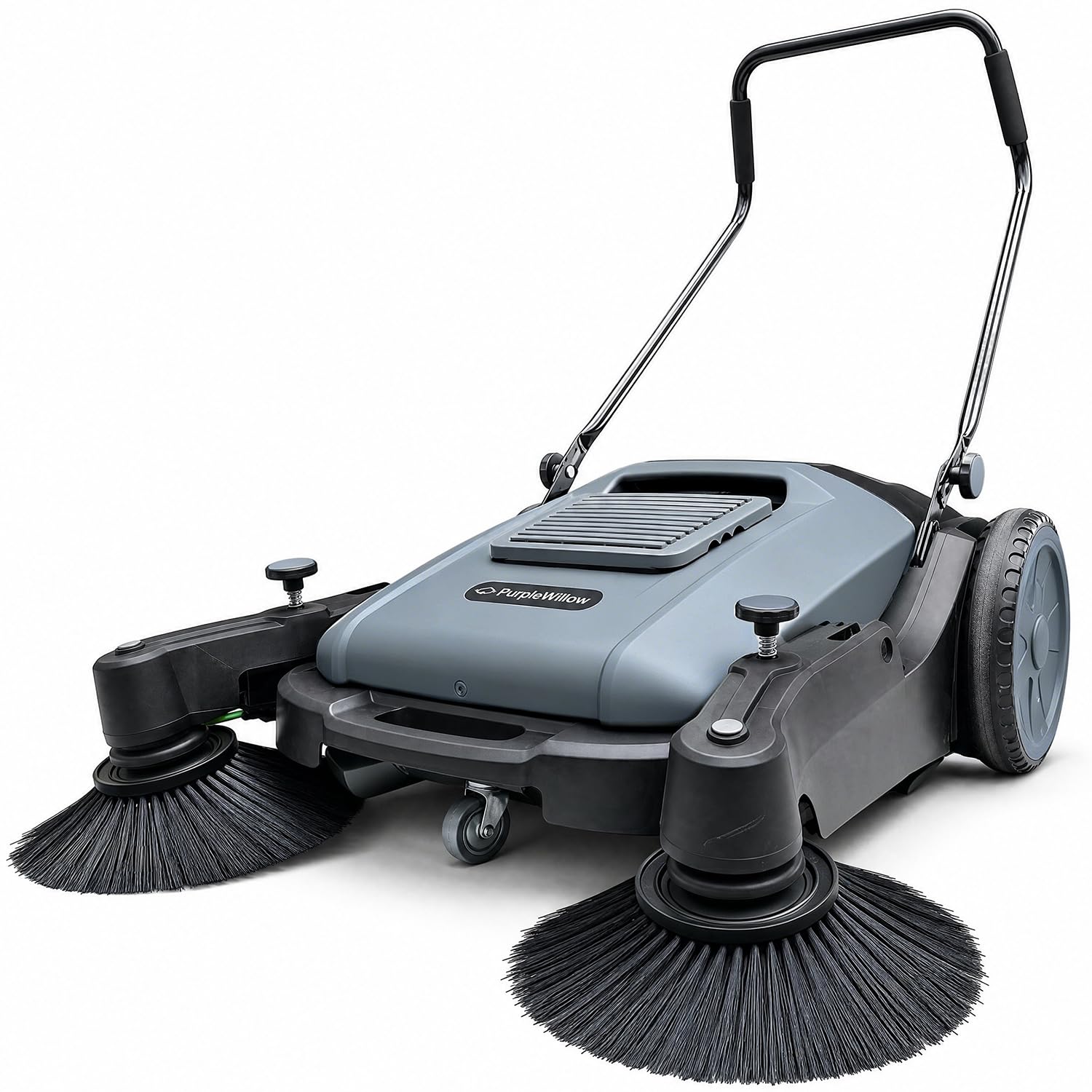
A 41-inch industrial sweeper that carries a 14.5-gallon bin — the largest here by a wide margin.
Two specs stand out on the PurpleWillow: a 41-inch sweeping path from dual side brushes and a 14.5-gallon waste bin. That bin dwarfs the 5.25-gallon canister on the Dapper Supply sweeper below, so you’re emptying far less often on leaf-heavy driveways and warehouse floors. The dust-proof ventilation cover is enlarged over the dust bin to reduce dust dispersion, which keeps the air cleaner than a broom pushing fine grit into a cloud. It runs quiet — comparable to normal conversation — and the reinforced metal push bar with 12-inch solid rubber rear wheels is built to track over rough ground.
You get a height-adjustable three-brush system with high-density polypropylene bristles that handle everyday debris, metal shavings, and fallen leaves on flat, dry, hard surfaces. A foldable handle lets it store upright and out of the way, and the package includes 2 spare brush heads and a main roller brush so replacement parts aren’t a near-term cost. With 10+ ratings, owner feedback is thin, so lean on the specs and the included spares rather than a deep track record — and if you are weighing big bins, this one and the SUNMAX compete on capacity directly.
What this machine brings
- 14.5-gallon bin — the largest capacity in this list, so fewer emptying stops
- 41-inch dual side brush path clears big lots in fewer passes
- Enlarged dust-proof ventilation cover reduces dust dispersion
- Spare brushes and a main roller brush included
What it costs you
- Owner track record is still limited, so specs carry more weight than long-term reviews
- Wide path and big bin mean it wants open floor, not tight corners
Choose it for: warehouses and parking lots where bin size and sweeping width matter more than portability.
Pass if: you want a machine with years of owner feedback behind it — the newer listing gives you less of that.
5. Industrial 41″ Floor Sweeper

Rated to clean about ten times faster than a broom, with a one-meter path for big open ground.
The LUSHIJIE claims cleaning about 10 times faster than a conventional broom, and its one-meter (41-inch) sweeping width suits roads, parking lots, factories, warehouses, and public squares. That path is the same 41 inches as the PurpleWillow above, but the build is heavier — 55 pounds, which tracks straighter on rough pavement and uneven ground but demands more push. The reinforced structure and rust-resistant polypropylene bristles take leaves, dust, gravel, and iron filings without complaint, and the height-adjustable handle adapts to uneven surfaces and to the height of whoever is pushing it.
Maintenance is deliberately simple: no charging or refueling, and you can rinse or wipe the bristles clean without disassembly or tools. The packing list is generous — 2 side brushes, 2 replacement side brushes, a replacement main brush, work gloves, a screwdriver, and a manual. Cleanliness and functionality carry the most weight in what owners say so far, though with 20+ ratings the history is still building. What it isn’t is a light machine, so consider it a dedicated floor sweeper rather than something you haul around.
Its play: the 41-inch path plus a reinforced metal body makes big outdoor paving and factory floors a matter of a few steady passes.
Real-world catch: at 55 pounds it is the second-heaviest pick here and the most demanding to steer across rough ground.
Good fit for: property managers sweeping parking lots, public squares, and factory floors who want a wide path on rough pavement.
Not ideal if: you need to move it between sites — the weight and bulk make it a stay-put machine.
6. Dapper Supply 25.5″ Sweeper

Twenty pounds, a 25.5-inch path, and up to 27,900 feet an hour — the easy one to grab and go.
Weighing 20 pounds, this is the lightest full-size pusher in the lineup, and that number is the whole pitch: it is easy to lift, easy to steer around a patio, and easy to store. A 25.5-inch sweeping width and a 5.25-gallon bin cover sidewalks and driveways at a rated 27,900 feet per hour, and it carries a 1-year limited warranty for confidence. For a homeowner with a modest area, that combination delivers satisfying performance without the heft of the industrial machines.
What drives its reputation is function: it does a fantastic job on hard floors, is well-built, and assembles quickly. The time-saving element is what buyers talk about — the sweep of a 6,000 sqft area in about 20 minutes — and the lightweight design makes it a natural for outdoor cleanup. The one honest note is the bin: at 5.25 gallons it is a third the capacity of the PurpleWillow, so on leaf-heavy days expect a couple more emptying stops, and value for money reads mixed in the feedback.
Why it earns a spot
- 20 pounds — the lightest machine here, so it is easy to carry and store
- Rated 27,900 feet per hour across a 25.5-inch path
- Assembles quickly and handles sidewalks, patios, and driveways
- Covered by a 1-year limited warranty
Where it tops out
- 5.25-gallon bin fills faster than the big industrial canisters
- Value-for-money opinion splits, so compare it against the Kärcher S 4 Twin on features
Pick this one if you are a homeowner clearing a patio, sidewalk, or short driveway and portability beats raw capacity.
Skip it for a lot or long commercial run where the 14.5-gallon bin and wider path do the work faster.
7. Takywep 25.6 Inch Sweeper

A budget way in: 25.6 inches of path, a 5.25-gallon bin, and a handle that folds flat.
If you are stepping up from a broom for the first time, the Takywep gives you the essential pushing-sweeper experience without a big commitment. A 25.6-inch path covers garages, patios, walkways, and driveways in a single pass, and the 5.25-gallon bin collects dirt, leaves, and dust as you go. At 24.3 pounds it sits between the lightest and heaviest picks, so it is manageable to carry while still feeling solid on uneven surfaces. It is non-electric — no cords, gas, batteries, or charging — so it works any time, anywhere outdoors, and the adjustable, foldable handle stores compactly in tight spaces.
The rugged construction is pitched at tough outdoor jobs and low-maintenance year-round upkeep, and the eco-friendly manual design keeps it quiet and zero-emission. This is also the listing with the least owner history behind it, so it is the most honest entry-level option here — you get the format and the folding convenience, and you lean on the spec sheet. For a first push sweeper on a modest property, that is a sensible starting point.
What you get: a 25.6-inch manual sweeper with a 5.25-gallon bin and a folding, adjustable handle for compact storage.
The honest limit: the smallest bin class here, so plan to empty more often on heavy leaf days, and compare its specs against the Kärcher S 4 Twin if capacity matters.
Best first sweeper for: a garage, patio, or short walkway owner who wants quiet, cordless manual cleaning at entry-level value.
Step up instead if: you need a long track record or a bigger bin for larger, leaf-heavy areas.
Know the Specs
Sweeping Width and Sweep Rate
Sweeping width is the width of the path the brushes cover in a single pass — 25.5 inches on the Dapper Supply, up to 41 inches on the PurpleWillow and LUSHIJIE. Sweep rate, usually quoted in square feet or feet per hour, is what that width plus your push speed produces over time — 26,000 square feet per hour on the Kärcher S 4 Twin versus 32,300 on the S 6 Twin. Wider is faster on open ground but harder to turn in tight spaces. Match the width to your surface: narrow for a cluttered garage, wide for a driveway or a warehouse aisle.
Bin Capacity and Weight
Bin capacity is how much debris the waste container holds before you stop — 5.25 gallons on the Dapper Supply, Kärcher S 4 Twin, and Takywep; 10 gallons on the S 6 Twin; 12.7 on the SUNMAX; 14.5 on the PurpleWillow. Bigger bins mean fewer trips to the trash, which matters most on leaf-heavy days. Weight runs from 20 pounds up to 55 pounds here, and that number decides who can carry the machine and how long they can push it. Lighter is easier to move and store; heavier tracks straighter on rough ground.
Common Questions
Will a walk-behind sweeper pick up wet leaves and mud?
What surface can a push sweeper handle?
How often do I have to empty the bin?
Does a wider sweeper mean I finish faster?
Do push sweepers need batteries or gas?
How do I maintain the brushes on a walk-behind sweeper?
Is the Kärcher S 6 Twin or S 4 Twin better for a large driveway?
Can a walk-behind sweeper handle gravel and iron filings?
How heavy is a walk-behind sweeper to push?
Will a push sweeper kick up dust indoors?
The Bottom Line
Across the board, the walk-behind sweeper winner is the KÄRCHER S 6 Twin because its 32,300 square feet per hour sweep rate and 10-gallon bin turn a big driveway or shop floor into one steady run. If you want a lighter machine you can carry between jobs, grab the Kärcher S 4 Twin — the same brush design at 22.5 pounds. And for a warehouse or parking lot where bin size and sweeping width matter most, the PurpleWillow 41″ pairs a 14.5-gallon bin with a 41-inch path. Whatever you choose, the shortlist is thin but reliable — the top two Kärcher models together carry thousands of owner ratings, and the higher-star S 6 Twin justifies being first.
How we choose
We do not accept paid placement. Every pick is matched to a real buyer and a real use-case; we do not hands-on test units.
Sources
Specifications: manufacturer listings and product documentation. Review insights: verified customer reviews, as of November 2026. Pricing: not shown on this page (it changes often); check the current price via the retailer link.
As an Amazon Associate, Tactical Gear Guy earns from qualifying purchases. This does not affect which products we feature.