Specs are compiled from manufacturer listings and verified buyer reviews and can change over time — please confirm the key details on the product page before buying.
Your lawn turns yellow in July because compacted soil seals the roots under a hard crust, no matter how much you water. A walk-behind aerator breaks that crust open. The right one for you depends on if you want plugs pulled out (coring) or holes punched in (spiking), and on how big your yard is. This guide covers both types, from an electric 2-in-1 that does two jobs to heavy manual rollers you push yourself.
This guide is built by comparing the manufacturers’ published specifications and the patterns across verified customer reviews, so you get each pick’s real strengths and trade-offs instead of marketing spin.
You will learn what tine depth really means for clay versus sandy ground, why a drum you fill with sand changes everything, and which units suit a small yard versus a half-acre. The short version: match the tool to your soil, not the label on the box, when you shop for the walk-behind lawn aerator.
Top Picks
How To Choose The Best Walk-Behind Lawn Aerator
The first fork in the road is core versus spike. A core aerator pulls small plugs of soil out and leaves them on the surface, which opens a real channel for air and water. A spike aerator pushes tapered tines into the ground, which is faster but compacts the sides of each hole slightly. On heavy clay, coring does more. On already-loose sandy soil, a spike roller is plenty.
Match the tool to your soil and yard size
Clay soil is the hard case — it needs weight behind the tines to punch through. That is why so many rollers have a hollow drum you fill with sand or water. Sandy or loamy ground opens up easily, and a lighter unit rolls fine. Yard size decides how much of that weight you want to push: a 24-inch roller covers more ground per pass but is heavier to steer, while an 18-inch unit turns tighter around beds and fences.
Understand the weight-versus-effort trade-off
Aerators work by concentrating force on a small point, so extra weight equals deeper holes. The catch is that same weight has to be pushed by you. Most rollers let you add ballast only when you need it — run light for a touch-up, load the drum for a first pass on hard ground. Water is easy to add but sloshes and can leak from a poorly sealed drum; dry sand stays put but takes longer to funnel in.
Look at the handle and the working depth
Handle height decides whether you finish with a sore back. A handle that extends past 58 inches lets most adults work upright. Tine depth is the other number that matters: a spike reaching 2 inches gets below the thatch layer where roots live, while a shallow scratch mostly makes a mess. Adjustable depth settings let you go gentle on thin grass and deeper on established turf.
Side-by-Side Comparison
| Model | Best For | Aeration Type | Tine / Blade Count | Working Weight | Amazon |
|---|---|---|---|---|---|
| Einhell Electric Scarifier / Aerator★ Best Overall | Small to medium lawns, two jobs in one | Electric scarifier + claw aerator | 42 stainless claws / 8 double blades | 9.71 kg | Amazon |
| Lawnira Heavy-Duty Push Aerator RollerTop Performer | Compacted soil, mower-like control | Spike roller | 30 heat-treated tines | 30 lbs (add sand) | Amazon |
| Seeutek 18 Inch Lawn AeratorBudget Starter | Budget entry, small yards | Spike roller (star tines) | 5 star tines, 10 tips each | 22 lbs (up to 220 lbs tray) | Amazon |
| Landzie Rolling Core Plug Aerator | True plug-pulling on tough soil | Core (hollow tine) | 7 hollow tines | 50.8 lbs | Amazon |
| Hubiiett 24 Inch Rolling Aerator | Larger lawns, spiral spike coverage | Spike roller | 42 spikes | 31 lbs (up to 70 lbs) | Amazon |
| Senvert Rolling Lawn Aerator | Beginner-friendly small-lawn work | Spike roller | Spiral spiked tread | 32 lbs (up to 55 lbs) | Amazon |
| AVVA Patented Rolling Core Aerator | Frequent use, plug removal | Core (rotary coring) | Rotary coring design | 43.7 lbs | Amazon |
| VEVOR Rolling Core Aerator | Entry-level coring experiment | Core (angled coring tines) | 16.6 in coring drum | 36.6 lbs (up to 46 lbs) | Amazon |
Detailed Reviews
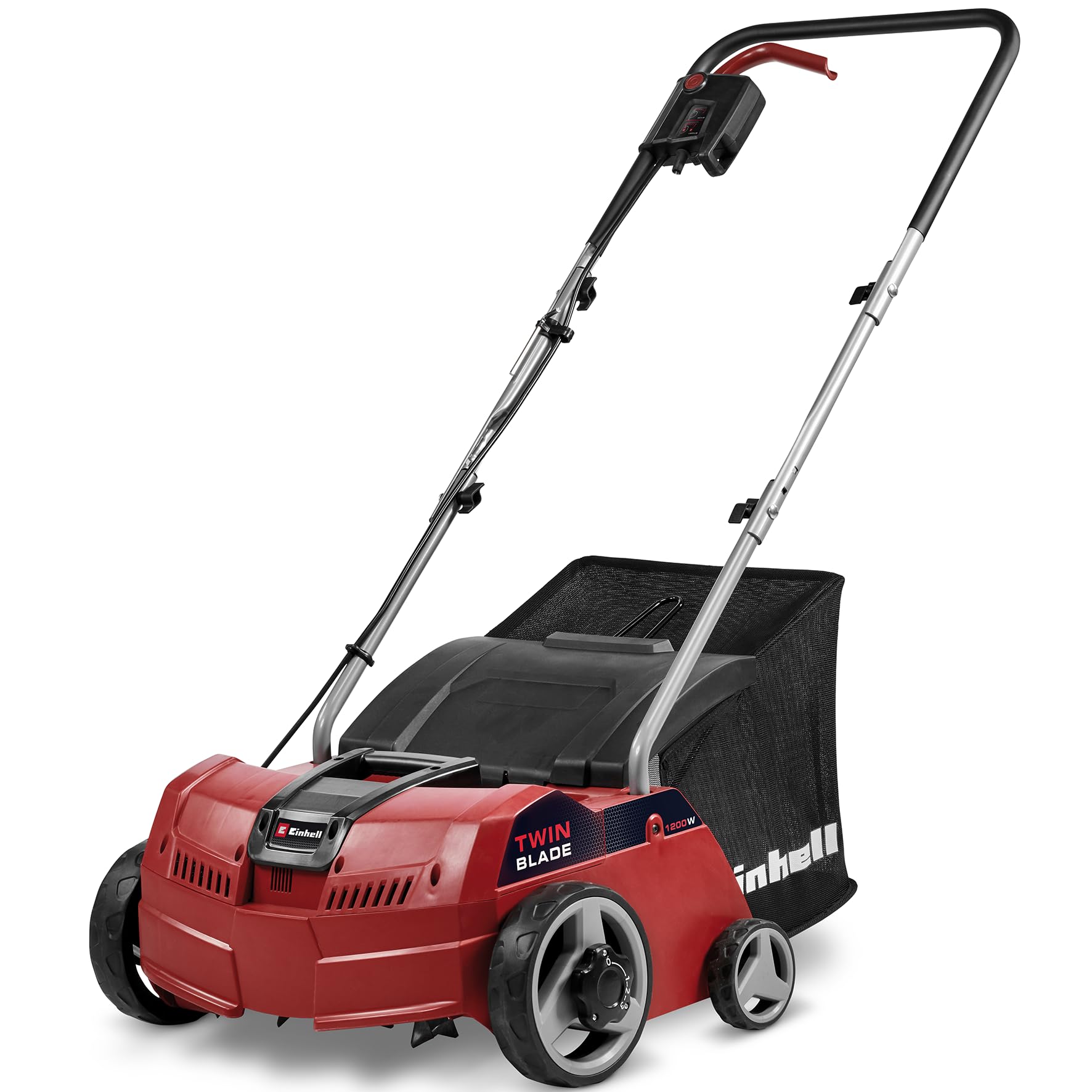
1. Einhell Electric Scarifier Fan, 230 V, 1200 W
Our pick — 4.0+★ from 2,500+ verified ratings; the strongest balance of quality and price.
The only pick that scarifies and aerates without you providing the muscle.
If you have spent an afternoon forking clay and want that job gone, this is the machine that replaces the fork. It runs on a 1200 W motor (a measure of pulling power) at 230 V, and covers up to 300 m² of lawn — roughly a small to medium garden — without you pushing weight against soil. Swap the roller and it does two jobs: eight high-grade stainless steel double blades rake out weeds and moss down to the roots, while 42 stainless steel claws punch into the soil to open it up. Debris lands in a 28 L catch bag (a 28-litre collection sack clipped to the back) so you are not raking afterwards.
The controls are where this earns its place. Three working depths let you go shallow on thin grass and deeper on established turf, and a transport position lifts the blades clear so you can wheel it across the patio without gouging it. The cutting height sits at 9 millimeters (about a third of an inch) — shallow, which suits scarifying rather than deep core work. For anyone with a modest lawn who wants both tasks from one tool, that 31-centimeter cutting width (roughly a foot of pass per lap) keeps the job quick.
What wins people over is that the motor replaces the fork. As owners put it, the combination of a powered scarifier roller and a claw aerator turns hours of forking into minutes of pushing. The honest catch is that this is a shallow-depth tool and it needs a power cable run out to the lawn — no battery, no engine. If your problem is deep compaction on a big yard, a heavy manual core roller does more down low. For maintenance on a smaller lawn, this covers both bases in one purchase.
What earns the top spot
- Two tools in one — swappable scarifier and aerator rollers
- 1200 W motor covers up to 300 m² without manual effort
- 42 stainless steel claws open soil; 8 double blades clear moss
- 28 L catch bag means no raking up afterwards
Where it asks more of you
- Fixed 9 mm working height — shallow vs a deep core pull
- Corded 230 V power needs an outdoor outlet and a cable run
- Plastic-bodied, so it wants dry storage between seasons
Worth it for: a small-to-medium lawn that needs moss control and light aeration from one powered unit, with a 3-year warranty as standard (2 years plus 1 on registration).
Look elsewhere if: your ground is hard clay that needs a 2-inch plug pulled out — go manual core instead.
2. Lawnira Heavy-Duty Push Lawn Aerator Roller
Mower-like steering and tines that reach 2.2 inches — the spike roller built for real compaction.
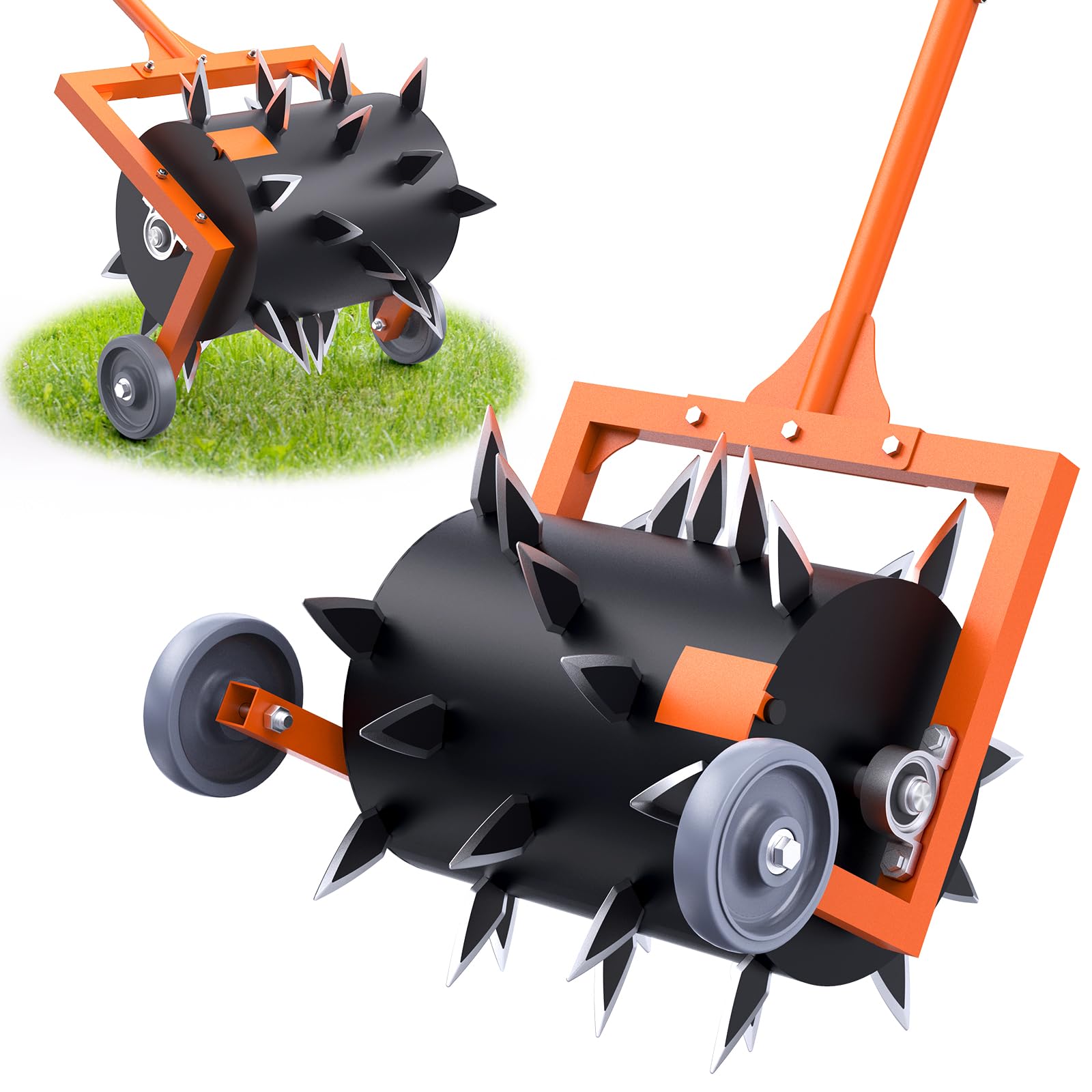
Most spike rollers make you drag a dead weight around corners. This one puts two smooth-swivel wheels under the drum so it turns like a mower, and the cushioned T-handle extends to 59 inches — tall enough that most adults work upright instead of stooped. That combination is why it suits a yard with beds, trees, and edges rather than one open rectangle.
The numbers behind the penetration are the real story. Thirty strategically spaced tines, each one 2.2 inches long, press into compacted ground up to 2.2 inches deep and 1.2 inches wide. The tines are industrial-stamped and heat-treated, which is the process that hardens steel so it resists bending season after season. The roller weighs 30 pounds on its own, enough to bite into most turf, and you can add sand for tougher ground. For hard, dry soil the maker’s own guidance is to water first and wait 12–24 hours — moist ground is what lets the tines actually sink.
One thing to plan for: adding sand means removing it if you ever want to lighten the unit, and the drum is not designed for a quick dump. The extra sand-filling funnel included in the box makes the first load cleaner. Setup is short because the body arrives mostly assembled — you attach the handle and wheels. If you want the firmest, most controlled spike pass on a lawn that fights back, this is the pick.
The coverage advantage: 30 tines at 2.2 inches deep and 1.2 inches wide give tighter hole spacing than a roller with fewer, shorter spikes, so you make fewer passes for the same soil opening.
One thing to weigh: 30 pounds plus sand is a genuine push on a slope, and emptying the drum later takes patience.
Reach for this if: your lawn has hard, compacted patches and you want steering control plus deep tine reach.
Not the one for: someone who wants to dump ballast out fast between uses.
3. Seeutek 18 Inch Lawn Aerator
Five rotating star tines that spin independently, so tight turns stop leaving bald patches.
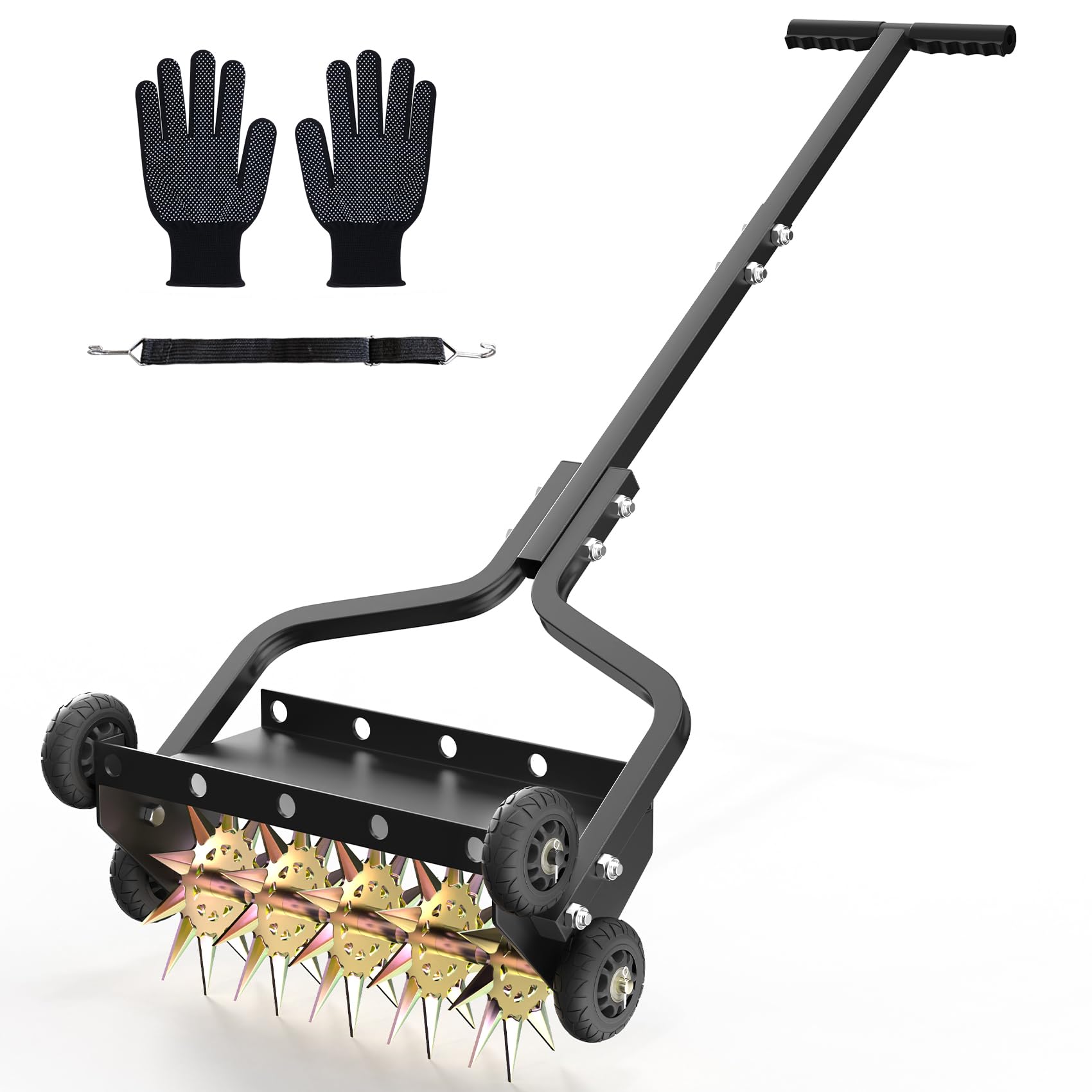
The clever bit here is the tine design. Five 8-inch 3D star-shaped tines each carry 10 sharp, irregular tips, and each star rotates independently — so when you turn a corner, the tines keep rolling instead of skidding. That reduces the missed spots you get from a fixed drum. The tips are thickened galvanized steel and reach up to 2 inches deep, which gets you below the thatch. What owners praise most is that ballast plus moist soil gets the star tines into clay.
Build is all-steel with reinforced side panels and a solid steel axle, and the loading tray supports up to 220 lbs of added weight for stubborn ground. That is a lot of ballast capacity for a walk-behind tool, and it is how you go from a light touch-up to a serious pass on compacted soil. The T-handle adjusts to three heights to keep your back out of it, and four rubber wheels keep it stable while rolling. Assembly is just the handle and two wheels, and the box includes gloves and a strap to hold weights down.
The catch is honest and worth sizing. At 22 pounds it is light enough to push, but add heavy ballast and you will feel every pass — this is a workout as much as a tool. And this is a budget-tier unit: some buyers find the finish is not premium, so expect to snug things up as you assemble it. For a first aerator on a smaller yard, the value is hard to argue with. One reviewer reports the lawn greened up after two passes.
Why it fits a first-time buyer
- Independently rotating star tines keep coverage on turns
- 2-inch penetration from 10 tips per tine
- 220 lbs tray capacity for hard ground
- Three handle heights and four wheels
What to expect at the entry level
- Finish quality is not premium — expect to snug the assembly
- Loaded with ballast it turns into real physical work
- Smaller 18-inch width means more passes on a big yard
Good fit for: a smaller yard, clay or loam, and a buyer who wants a capable spike roller without overcommitting.
Think twice if: you have a large lawn and expect a light, gliding pass every time.
4. Landzie Rolling Core Plug Aerator
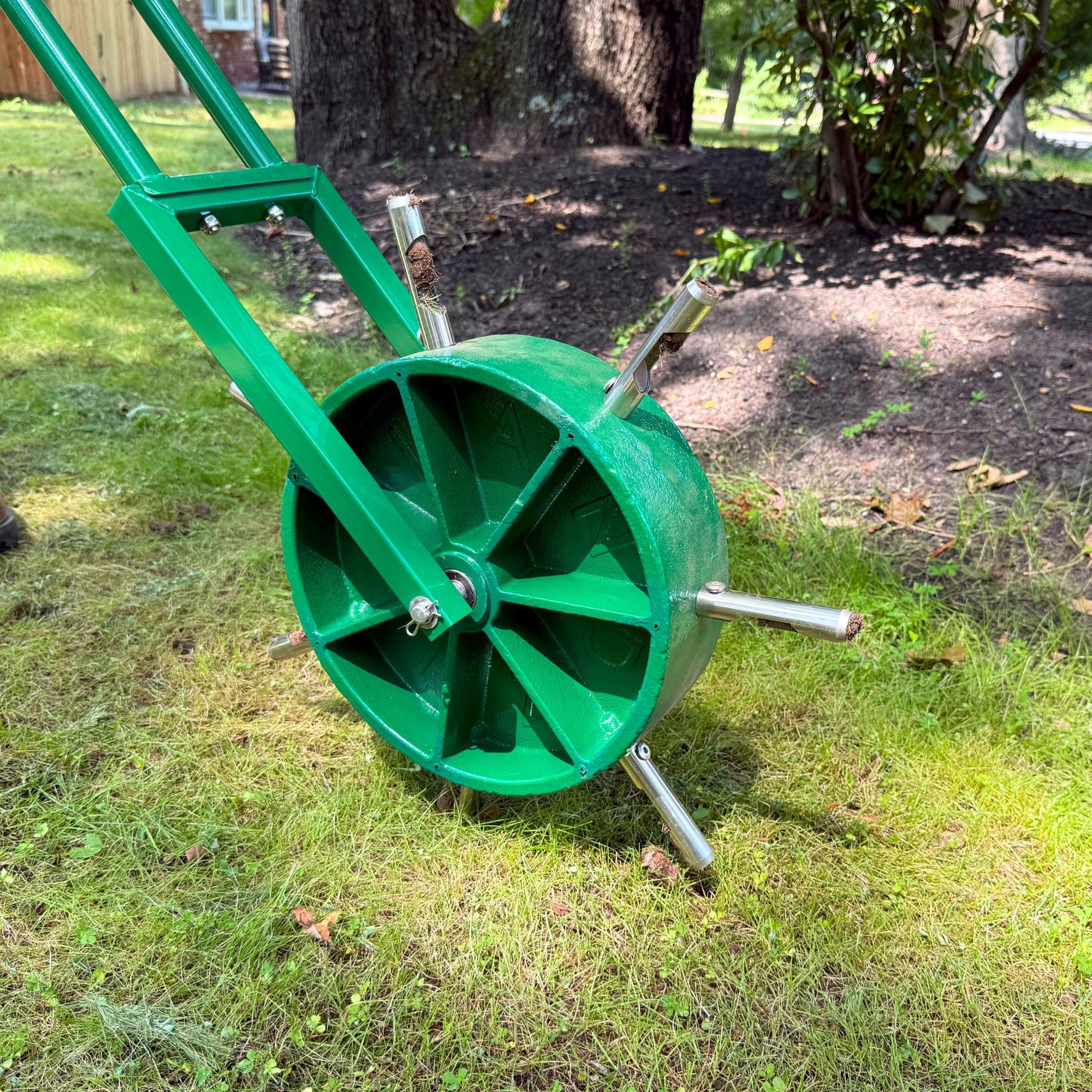
Seven hollow tines that pull actual plugs — the difference between opening soil and denting it.
This is a different animal from the spike rollers above. Instead of punching dents, its seven stainless steel hollow tines cut cylinders of soil out and eject them as the drum rolls, leaving real plugs on the surface. That is the only way to relieve compaction without pressing the hole walls tighter, and it is why coring is the gold standard for a lawn that has gone hard. Wide-diameter chamfered tines help the cores eject cleanly rather than clogging, and they are replaceable, so a worn tine does not retire the whole tool.
The build backs up the job. It tips the scale at 50.8 pounds and measures 49.5 x 12 x 3.75 inches — the heaviest and longest unit in this lineup, and 2.3 times the weight of the Seeutek spike roller’s 22 pounds. That mass is deliberate: a heavy cylinder is what drives the hollow stems into the ground while you simply roll. For contrast, it is 2.8 times the length of that same 18 x 9 x 8.7-inch roller, giving it a longer rolling footprint. The powder-coated steel body is built to handle silt, sandy, and loamy soil without bending.
Here is the honest trade-off: there is no free lunch at 50.8 pounds. It rolls forward and back, but you supply the push, and on a big lawn it is genuine effort — which owners describe as a good workout rather than a chore. Assembly is straightforward and the design is simple enough to last, and it needs no engine to winterize. Buyers report it covers a 2000 SF yard in a short session. If you want real plugs out of stubborn ground, this is where the money goes.
The core advantage: seven replaceable hollow tines eject soil cores instead of compacting hole walls — the deepest, most thorough fix for hardened turf in this list.
The push you pay: 50.8 pounds of drum is a real workout on a large lawn, so plan it as exercise, not a stroll.
Best served to: a homeowner with genuinely compacted ground who wants plugs pulled, not just holes dented.
Handle with thought: a very large lawn, where the weight becomes a long afternoon.
5. Hubiiett 24 Inch Rolling Lawn Aerator
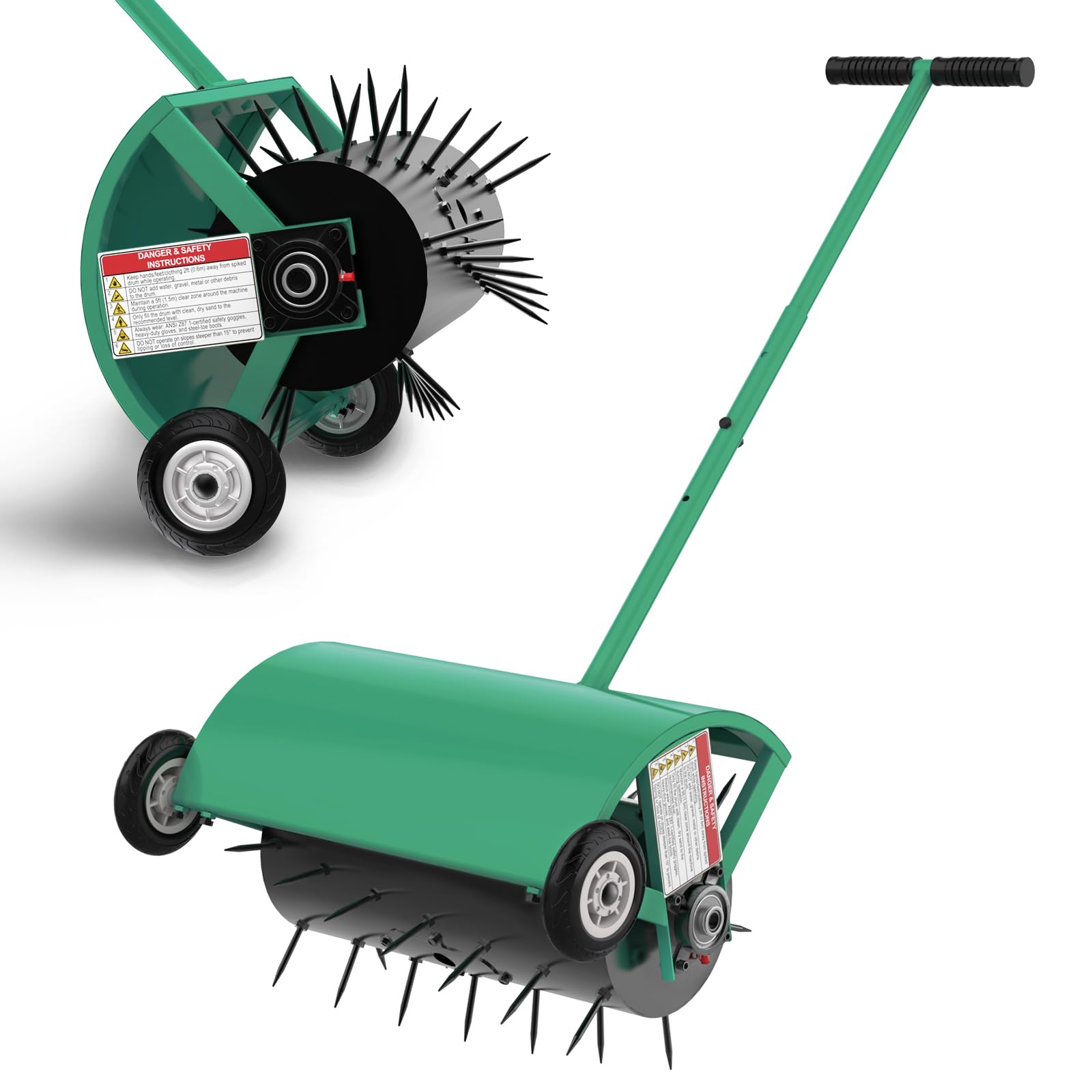
A 24-inch drum with 42 spiral-set spikes built to swallow a bigger lawn in fewer laps.
Coverage is the whole point here. At 24 inches wide with a spiral spike arrangement, it lays down more holes per roll than the narrower rollers, and the spiral pattern keeps the drum turning smoothly so it does not thump or stall. The 42 reinforced 3-inch spikes are heat-treated for hardness to resist bending — important when you are pushing through a lawn that has baked hard.
Weight management is smart. It rolls at 31 pounds, which handles most common soils on its own, and the built-in chamber takes sand to push that up to 70 lbs for deeper penetration on hard ground. The maker’s own tip is worth heeding: once you have loaded it, pull it rather than push it — a simple technique that spares your shoulders. The tripod handle connection and three-height adjustable T-grip keep the effort low, with silicone anti-slip pads for grip.
Construction is thickened high-density alloy steel with an anti-rust coating, so it takes wet grass and wet soil without spotting. Two silicone auxiliary wheels let you roll it across the driveway and patio without dragging spikes over the concrete. Assembly is a few minutes with the included parts. There is one technique note worth keeping: water the lawn thoroughly before you use it, which softens soil and extends spike life. For a mid-size yard where pass count matters, the extra width pays off.
The one for: small-to-medium lawns where a wide drum and 42 spikes cut your lap count down.
Careful of: overloading to 70 lbs and then pushing instead of pulling — a fast route to tired arms.
6. Senvert Rolling Lawn Aerator
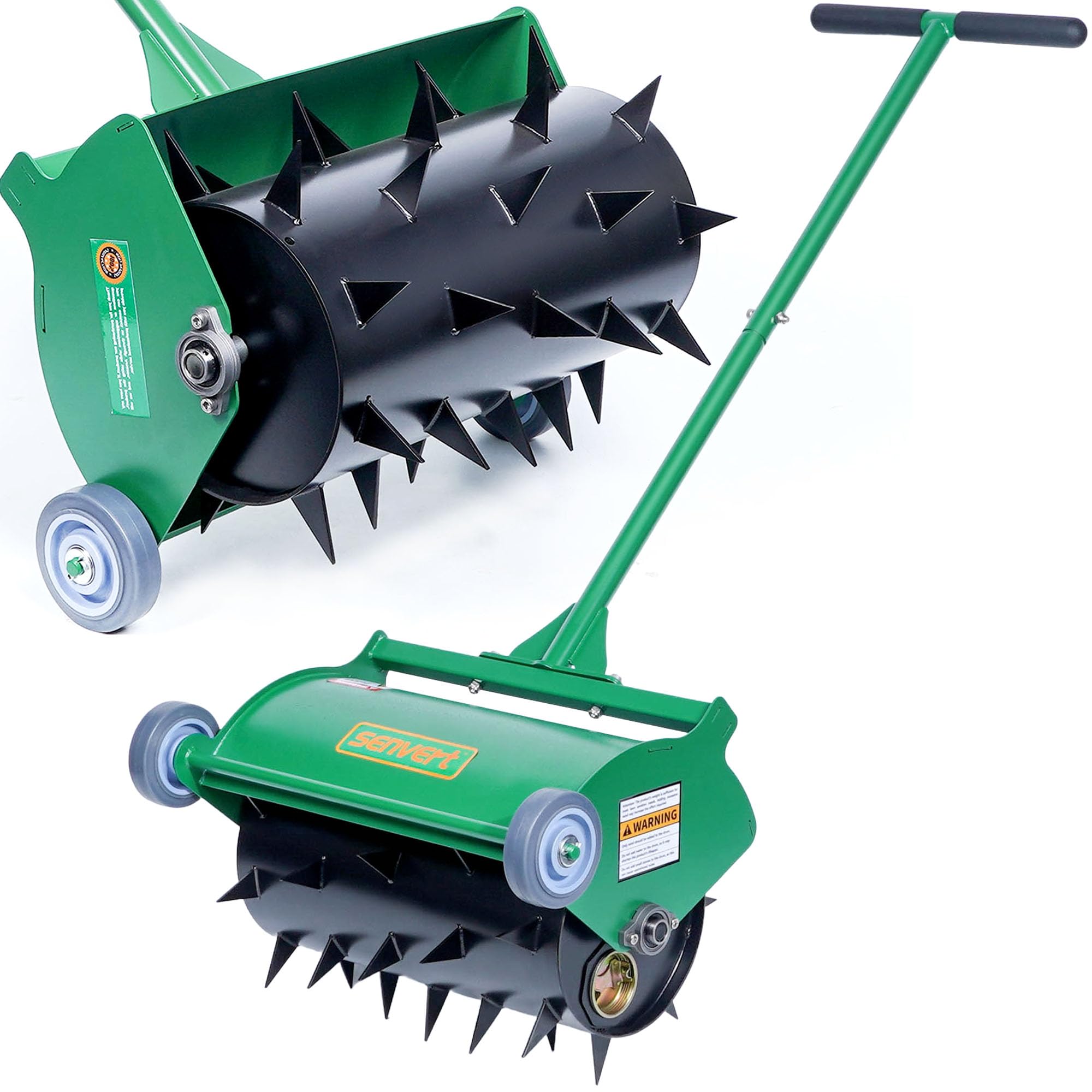
The one that arrives fully assembled apart from the handle — functioning for a total novice.
This roller rolls at 32 pounds and takes extra sand or stones through a covered opening to reach 55 pounds, so you dial in penetration for your soil. Its spiral-spiked tread keeps it turning smoothly and controllable in direction — easier than the fixed-drum designs when you are learning how to walk a straight line across a lawn. The one rule that matters: do not add water to the drum. Sand or stones only, because this one is not sealed for liquid.
Setup is where it wins beginners over. The main body ships fully assembled, so you only attach the handle and you are working in a few minutes. That ease carries through — what wins people over is how forgiving it is: owners note it cuts in deeply on soft lawns even without sand for weight, and it is easy to push and pull. A pair of durable TPR auxiliary wheels (a quiet, rubbery material) let you wheel it to and from storage without dragging spikes across the driveway.
Where it asks honesty of you: on a large yard, especially loaded with sand, it becomes a hefty push. It is squarely built for small lawns, and buyers with big properties point out that it gets tiring fast. For a typical suburban plot and someone aerating for the first time, that is a fair trade. Construction feels durable and the bearings roll smooth, so it holds up to a few uses a year.
Where beginners gain
- Body arrives assembled — just fit the handle
- Spiral spiked tread stays controllable
- 32 lbs standard, up to 55 lbs with sand or stones
- TPR auxiliary wheels protect hard surfaces
What to keep in mind
- Sand or stones only — the drum is not sealed for water
- Best suited to small lawns; big yards tire you out
- Weighted and loaded, it is a fair push
Pick this if: you are new to aeration, your lawn is modest, and you want minimal assembly and easy control.
Pass on it if: you have a large yard and want to cover it in one relaxed pass.
7. AVVA Patented Rolling Lawn Aerator
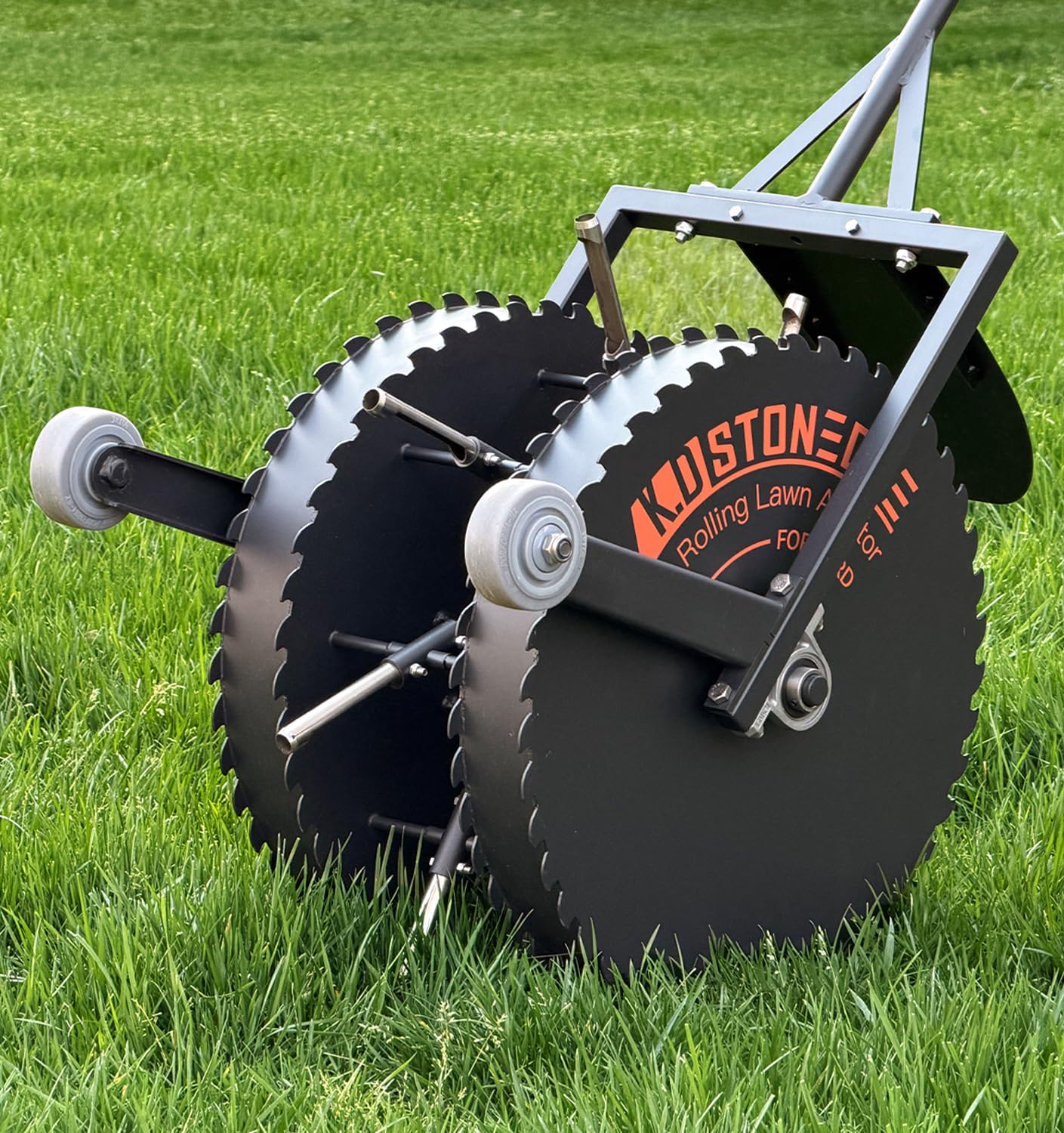
A patented rotary coring design that punches holes and lifts plugs as you roll — no special pulling motion.
This one is built around its patent. The rotary coring design punches down and extracts soil plugs as the drum rolls, opening the lawn for air, water, and nutrients. The push motion is a simple back-and-forth: owners find you can pull it back a few feet without it digging in, then push forward and it bites. That rhythm is gentler on your shoulders than fighting a fixed tine through hard ground, and the balanced weight design is engineered for exactly that. What owners praise most is that the hollow tines eject clean plugs instead of clogging.
The spec sheet points to real heft: 43.7 pounds of drum and a 60 x 17 x 11-inch footprint, with high-quality materials meant to hold up to regular use. That weight is what pulls the cores, and it is why this suits a repeat user who plans to aerate every season rather than once. Serviceability is a plus — a simple design with replaceable parts rather than a sealed disposable unit.
Two things to weigh. First, it is heavy — owners describe it as quite heavy, though it stays manageable, including a notably small-framed homeowner who reports pushing it fine. Second, filling it is the fiddly part: some find it hard to load with sand, and the instructions are not the greatest. The rotary coring performance, though, is what justifies its price. If you aerate every year and want replaceable parts instead of a disposable unit, this is the long game.
The coring payoff: patented rotary tines extract plugs on a simple pull-and-push rhythm, opening compacted soil without a forced digging motion.
The honest friction: loading sand takes patience and the instructions are weak — read them twice before you start.
Ideal for: a repeat user who aerates annually and wants a durable, replaceable-part core tool.
Not ideal for: someone who would rather not wrestle with a sand-loading jug.
8. VEVOR Rolling Core Aerator
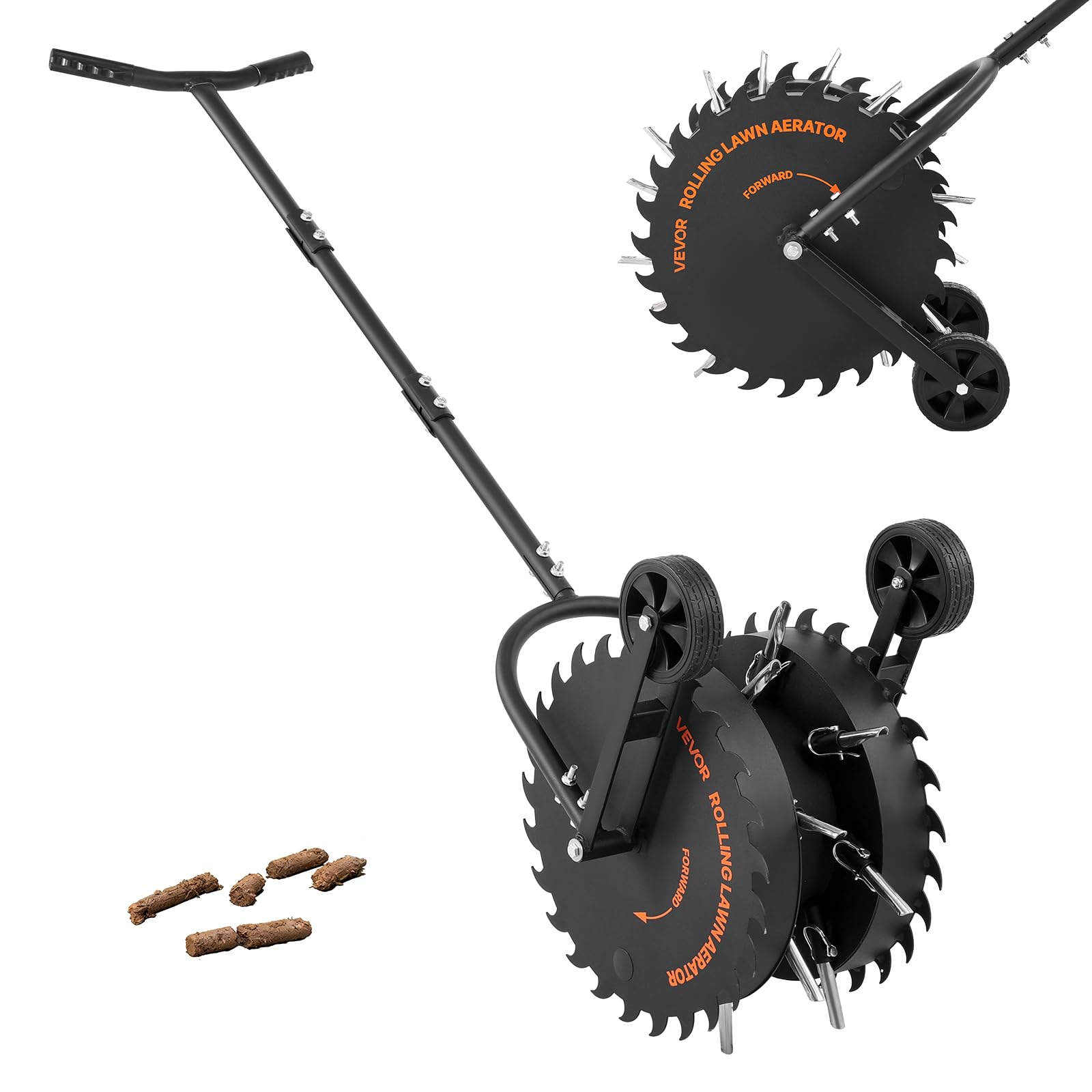
A 58-inch handle that lets you core without bending, at a weight that lets you try coring for less.
For anyone with a touchy back, the handle does the talking. It extends to 58 inches on 1.5 mm thick steel tubing, tall enough that most adults work upright and use leverage instead of bending. The drum carries angled coring tines that pull 2-inch soil plugs, with wide side slots to keep them from clogging as you roll. It runs from 36.6 pounds and you can load it with sand or water to add up to 46 lbs of downward pressure for harder ground. Rubber wheels drop down in seconds to turn it into a rolling cart for the trip back to the garage.
This aerator resists rust from wet soil and fertilizer thanks to its heavy-gauge steel body, a 2.0 mm drum wall, and a powder-coated finish. Its 16.6-inch coring drum with anti-clog tines suits a compact yard, so you can pull plugs without the tines jamming. That makes it a reasonable way to try coring, but the lighter build shows over time: some owners mention weld failures at the handle-to-yoke joint, and the drum can leak when loaded with water, so dry sand is the safer fill.
Where it fits: a small, compacted patch where a light corer at this weight is enough. Where it does not: a half-acre lawn or a long-term investment you expect to hand down. The handle height remains its strongest selling point for anyone who has been avoiding a bent-over manual tool, and the anti-clog tine slots keep the cores moving.
Where it stands out
- 58-inch handle means no bending for most adults
- 2-inch plug pull from angled coring tines
- Drop-down wheels turn it into a rolling cart
- 36.6 lbs base, up to 46 lbs loaded
Where it gives ground
- Lighter steel build than the premium corers
- Some units report a weld failure at the yoke
- Water fill can leak — use dry sand instead
Worth a look if: your back dislikes bent-over tools and your lawn is on the small side.
Skip the water fill: sand is the reliable ballast here, and expect the lighter build to limit its lifespan.
Know the Specs
Core Versus Spike Aeration
A core (hollow tine) aerator cuts and removes small soil plugs, leaving them on the surface. This opens a real channel for air and water without pressing the surrounding soil tighter — the standard fix for hardened clay. A spike aerator pushes tapered tines into the ground instead, which is faster and lighter but slightly compacts the hole walls. On loose sandy soil a spike roller is plenty; on dense clay the core tool does more.
Working Depth and Drum Weight
Depth is the number that decides whether aeration helps. A spike that reaches 2 inches gets below the thatch where roots actually live, while a very shallow tool mostly scratches. Weight is the fuel for depth: a heavier drum forces the tines down without you leaning on it, and fillable drums let you add sand or stones for a deeper pass. The trade-off is that same weight becomes your push effort, so lighter units suit small yards and heavier ones suit compacted ground.
Common Questions
Should I choose a core aerator or a spike aerator for my lawn?
How deep should a walk-behind aerator really go?
Is it better to fill the drum with sand or water?
How long does a manual aerator take on a small lawn?
Do I need to water the lawn before aerating?
Will a spike aerator compact my soil more over time?
What does a walk-behind aerator weigh when it is loaded?
Can an electric aerator replace a manual one for a small garden?
How often should I aerate a lawn I have just reseeded?
Will a rolling aerator damage my lawn or driveway?
The Bottom Line
The standout pick for a walk-behind lawn aerator depends on your soil and your back. For a small-to-medium lawn where you want scarifying and aeration without the effort, the Einhell Electric Scarifier/Aerator covers both jobs with 42 stainless claws and a 1200 W motor over up to 300 m². If you need real plug-pulling out of compacted clay, the Landzie Rolling Core Plug Aerator with its seven hollow tines and 50.8 pounds of drum is the one to reach for. And if you want mower-like steering with deep 2.2-inch tine reach, the Lawnira Push Aerator Roller is the sharpest spike tool in the lineup. Pick the one that matches your soil, load your drum with dry sand, and water the lawn a day ahead — that is the whole recipe.
How we choose
We do not accept paid placement. Every pick is matched to a real buyer and a real use-case; we do not hands-on test units.
Sources
Specifications: manufacturer listings and product documentation. Review insights: verified customer reviews, as of November 2026. Pricing: not shown on this page (it changes often); check the current price via the retailer link.
As an Amazon Associate, Tactical Gear Guy earns from qualifying purchases. This does not affect which products we feature.