Specs are compiled from manufacturer listings and verified buyer reviews and can change over time — please confirm the key details on the product page before buying.
A car that cranks slow on a cold morning is telling you something, and a plain voltage reading is a poor translator. To find out whether the battery is tired, the alternator is failing, or the starter is dragging, you need a battery tester that reads cranking amps (the burst of current that turns the engine) and charging output, not just a number on a screen. Below are the nine strongest options on that standard, from simple plug-and-play voltmeters to full diagnostic units, so you can pick the one that fits your driveway.
This guide is built by comparing the manufacturers’ published specifications and the patterns across verified customer reviews, so you get each pick’s real strengths and trade-offs instead of marketing spin.
You will see exactly what each tester measures, what its clamp cable and display actually deliver in a dim engine bay, and where the honest limits sit. The right pick is the one whose tests match how you actually diagnose a no-start, and this breakdown of every voltage meter for car battery covers that decision from every angle a buyer needs.
Top Picks


How To Choose The Best Voltage Meter for Car Battery
The mistake most first-time buyers make is buying a voltmeter when they need a battery tester that reads cranking amps. A voltmeter tells you the resting voltage — often a healthy-looking number even on a battery that can no longer turn the engine on a cold morning. A battery tester measures cranking ability and charging output, which is what actually predicts a no-start. Decide first which of those two jobs you want done, then read the specs.
Match the testing range to the batteries you own
Every tester here quotes an operating range, and that range is the fence around what it can read. The Clore Automotive SOLAR BA9 runs a 7-15V operating range, which comfortably covers a 12V car battery plus its charging voltage. The MOTOPOWER MP0514B spans 4 to 20V DC, so it can also check smaller 12V devices. The Battery Monitor BM2 BM3 needs 12 volts of direct current to wake up, which means it is a monitor you leave wired in, not a handheld you clip on a dead battery. If you work on motorcycles, look at the units with a dedicated 6V mode, like the VDIAGTOOL BT500 and the FOXWELL BT301.
Cranking amps and cold-cranking amps: the number that predicts a no-start
CCA stands for cold-cranking amps — the burst of current a battery must deliver to turn a cold engine, and the standard every tester on this list measures against. Most good testers here cover 100-2000 CCA, which spans small motorcycle batteries up to heavy truck units. The Clore Automotive SOLAR BA9 covers a narrower 40-1200 CCA, and the VDIAGTOOL BT500 goes wider with a 5-3000 CCA range. Pick a CCA range that covers the vehicles in your driveway, not the widest number on the page.
Conductance testing vs a plain voltage read
A conductance tester sends a small signal through the battery and measures how it responds, without drawing the heavy current of an old carbon-pile load tester. The ANCEL BST100 uses a 4-wire Kelvin method — separate paths for current and voltage — to keep cable and contact resistance out of the reading. That matters because a contact-resistance error can make a good battery look weak. For a casual owner checking one car’s resting voltage, a simple voltmeter is fine. For anyone replacing parts, conductance is the safer, more repeatable read.
Display, cable length, and clamp safety
You will be reading this tester in a dim garage or a hot engine bay, so the screen and the cable decide how pleasant the job is. A backlit LCD helps at night; a color screen like the 2.8-inch display on the FOXWELL BT301 or the ANCEL BT410’s 2.4-inch TFT reads clearly in both sun and shadow. Cable length is the quiet spec nobody checks until they are reaching under a seat — the ANCEL BT410 runs 800mm (31.5-inch) cables, the FOXWELL BT301 stretches to 6.5ft, and the MOTOPOWER MP0514B packs a 50cm extension. Finally, look for reverse-polarity protection so a wrong clamp does not fry the tester or the vehicle’s circuit.
Side-by-Side Comparison
| Model | Best For | CCA Range | Operating Voltage | Display / Cable | Amazon |
|---|---|---|---|---|---|
| Clore Automotive SOLAR BA9★ Best Overall | All-round accuracy | 40-1200 CCA | 7-15V | LCD | Amazon |
| MOTOPOWER MP0514BBest Value | Simple plug-and-test | — | 4-20V DC | 4-digit LCD, 50cm cable | Amazon |
| Battery Monitor BM2 BM3Best for Monitoring | Bluetooth monitoring | — | 6-20V | App-based | Amazon |
| ANCEL BST100 | Part-level diagnosis | 100-2000 CCA | 12V | Backlit LCD | Amazon |
| TOPDON BT50 | Fast results | 100-2000 CCA | 8V DC min | LCD, one-button | Amazon |
| Westinghouse MM600V10 | Full multimeter duty | — | 600V AC/DC | Backlit 4000-count LCD | Amazon |
| VDIAGTOOL BT500 | 6V/12V/24V versatility | 5-3000 CCA | 6V min | Color display | Amazon |
| ANCEL BT410 | Lead-acid + lithium | 100-2000 CCA | 12V | 2.4-inch color TFT | Amazon |
| FOXWELL BT301 | Long cable + big screen | 100-2000 CCA | 6V min | 2.8-inch color, 6.5ft cable | Amazon |
Detailed Reviews
1. Clore Automotive SOLAR Digital 12V Battery and System Tester
Our pick — 4.5+★ from 800+ verified ratings; the strongest balance of quality and price.
The tester that reads actual strength — and does it in a dim engine bay.
The whole point of this pick is that it hands you a real number, not a green light. Its LCD display shows the battery’s strength as a percentage along with the plain measured figures, so you can watch a battery slide over months instead of guessing from a resting voltage. That read works across Flooded, AGM, Spiral, and Gel Cell batteries — the four lead-acid types most owners will actually meet.
It earns the top spot because it keeps working on a battery that is too flat to start your car. The BA9 needs only 4.5 volts to wake up, versus 12 volts for the ANCEL BT410, so a deeply discharged battery still gets tested instead of leaving you with a blank screen. At 9.6 ounces it is light enough to hang off a belt loop while you work. Its 7-15V operating range covers a 12V battery at rest and at full charging voltage, and its 40-1200 CCA testing capacity (cold cranking amps, the current a battery can deliver in the cold) spans small motorcycle batteries up to most passenger and light-truck units.
The trade-off is range at the very top end. There is no 6V mode here, so a classic 6-volt motorcycle battery is out of scope, and 1200 CCA ceilings the heaviest diesel batteries. For a homeowner with a car, a lawn mower, and maybe a boat, the spec sheet fits cleanly. For a shop working on 24V trucks, look down this list instead. It is the crowd favorite here for good reason — 4.5+ stars across 800+ ratings — and that leads the group on score.
What Earns It First Place
- Reads strength as a real percentage, not a vague color code
- Handles Flooded, AGM, Spiral, and Gel Cell in one tool
- Wakes up at 4.5 volts, so a deeply drained battery still gets tested
- Backlit screen stays legible in low light
Where It Draws the Line
- No 6V mode for classic small batteries
- 1200 CCA ceiling leaves heavy diesel work to wider-range units
- Uses a plain LCD rather than a color screen
Pick it if: you want one reliable tester for the cars and boats in your own driveway and you value a percentage read over a color light.
Leave it if: you need 6V or 24V coverage — the wider-range tools below cover that ground.
2. MOTOPOWER MP0514B Battery Tester
Clip it on, read the number, know whether to call a jump start.
This is the entry-level tester for someone who wants an answer fast and does not want to learn a menu system. The 4-digit digital LCD reports voltage to 0.01 volts, and eight colored LED indicators sit alongside it to show whether the battery or the alternator is healthy. Clip the 30A alligator clips on, read without starting the car to see battery status, then start the engine and read again to check the alternator.
The wiring is where the real value sits. A 50cm extension cable with 30A clips (clamps rated for 30 amps of current) gives you comfortable reach at the battery post. Its 4 to 20V DC testing range covers 12V car batteries plus various small devices. Against the Battery Monitor BM2 BM3, which needs 12 volts of direct current just to power on, this one starts working at 4 volts of direct current, so a battery that has dropped well below nominal still gets a reading instead of a blank screen. Reverse-connection and over-voltage protection guard the tester and your circuit if you clamp the wrong way.
Owners lean on the functionality here more than anything. The one honest caveat is battery life — this runs on its own battery and that aspect draws mixed feedback — so keep a spare cell in the toolbox if the tester lives in the car. It weighs 150 grams and wears a black rubber paint finish that stays put in a sweaty hand. It is a quick-check tool, not a CCA analyzer: it will not tell you cranking amps.
Who this fits: the owner who wants to know “is it the battery or the alternator” in under a minute, at the lowest entry point on this list.
The one real limit: no cold-cranking-amp test — for that prediction, step up to a conductance tester like the ANCEL BST100.
Reach for this if: a fast plug-and-test voltage read on one or two vehicles is all you need.
Look elsewhere if: you want to see battery health as a percentage or measure cranking amps.
3. Battery Monitor BM2 BM3 Tester
The tester you leave wired in so your phone can warn you before the battery quits.
Different job, different tool. This one mounts on the battery and talks to your phone over Bluetooth 4.0, sending a status update to the notification bar whenever you walk into range. That is the whole point — a slow drain or a dying cell shows up as a warning on your phone instead of a no-start in a parking lot. It reads voltage, charge, cranking power, and detects engine starting automatically, across a 6-20V range for all 12-volt vehicle batteries.
You get two apps, and they split the job. The free BM2 app handles one battery, while the BM3 app, which is not free, monitors up to 4 devices at once — handy if you have a car, a boat, and a tractor to watch. Fireproof, high-temperature-resistant material with an upper temperature rating of 85 °C matters for something bolted near a hot engine. At just 0.1 kg it is the lightest pick here, a genuine contrast to the ANCEL BST100 at 0.3 kg.
Honesty time: the wireless part is the fussy part. Bluetooth connection and app functionality draw mixed feedback — many report the connection snapping right up and the app being easy to follow, while others hit connection dropouts and app bugs. It also never replaces a cold-cranking-amp test at the moment of purchase. So treat this as an early-warning system, not a diagnostic report card.
Where it beats a handheld: you get continuous, remote visibility instead of a one-time read — the tester watches the battery while you do something else.
Where it stops short: if the app and the Bluetooth link misbehave, the numbers are only as good as the connection carrying them.
Reach for this if: you want phone alerts on a battery that sits for weeks between drives.
Look elsewhere if: you need a rugged clip-on tester for a quick roadside check.
4. ANCEL BST100 Battery Tester
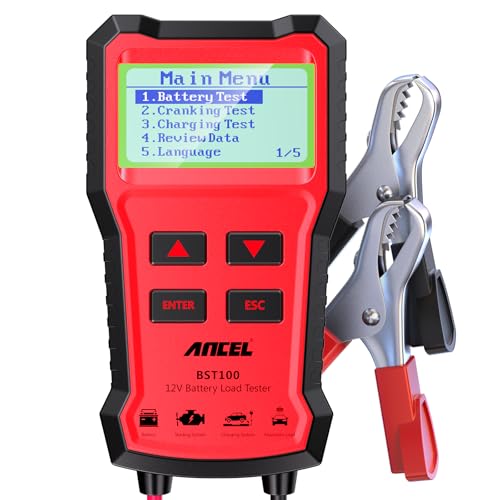
Three tests in one clip — battery, starter, and alternator — on a backlit screen.
This one earns its place on a single spec: the 4-wire Kelvin testing, where the current and voltage paths are kept separate to filter out cable and contact resistance. In plain terms, it stops a dirty clamp from making a healthy battery look weak. It then shows measured CCA, battery health, state of charge, voltage, and internal resistance in one result, rather than a lone voltage figure. It also checks cranking voltage and starting time while the engine turns, so a slow start shows up as data before it becomes a no-start.
Coverage is broad for a 12V unit — 100-2000 CCA — and it handles Regular Flooded, AGM Flat Plate, AGM Spiral, GEL, and EFB batteries. Those 10 testing standards (CCA, BCI, CA, MCA, JIS, IEC, EN, DIN, SAE, and GB) mean it speaks the same language as whatever rating is stamped on your battery. There is reverse-polarity protection, over-voltage protection, and loose-lead detection to keep a sloppy connection from damaging the tool or the vehicle. The trade-off versus the MOTOPOWER MP0514B is operating range: this tester needs 12 volts to work, while the MOTOPOWER starts at 4, so a deeply discharged battery may not power this one.
Functionality is what wins people over here, with value close behind — buyers see it as a low-cost way to estimate battery age before replacing parts. The multilingual menu and audible prompts walk you through each test, so you are not flipping through a manual in the driveway. One limit worth knowing: it works on 12V systems only, so 6V motorcycles and 24V trucks need a different tool from this list.
The case for it: a 3-in-1 battery, starter, and alternator check with resistance-compensated readings and 10 standards — a serious diagnostic for the price of a basic tester.
The catch: it needs 12 volts to power up, so a flat battery may leave you reaching for the MOTOPOWER instead.
Reach for this if: you want to know whether it is the battery, the starter, or the alternator without buying three tools.
Look elsewhere if: your vehicles run on 6V or 24V systems.
5. TOPDON BT50 Battery Tester

One button, seconds to a result, and a stored history to watch decline.
The BT50 is built around speed. Its conductivity testing method measures battery health, cranking capability, and charging output in seconds, and the one-button operation plus bright LCD means you are not scrolling menus to get there. It covers all 12V lead-acid batteries across a 100-2000 CCA range, then keeps a history of past tests so you can watch a battery fade over a season instead of discovering it dead.
Safety is spoken to directly here: spark-free testing avoids the explosion risk that comes with old load-test methods, reverse-polarity protection guards a wrong clamp, and anti-overheating safeguards are built in. The interface switches between six languages — English, Spanish, French, German, Italian, and Russian. It runs from an 8V DC minimum, which is a wider low-end tolerance than the ANCEL BST100’s 12-volt requirement, so a fairly drained battery still gets a read. It weighs 215 grams and fits in a glovebox.
What buyers notice most is test performance, with value close behind — the sense of catching a weak battery before it strands you is the recurring theme. The practical limit is that it is 12V only; it will not sweep a 6V motorcycle or a 24V truck system. For the typical car, SUV, or boat, though, this is a fast, safe, and repeatable diagnostic.
What Sells It
- Results in seconds with one-button operation
- Wakes up at 8V DC, so a drained battery still reads
- Spark-free testing with reverse-polarity protection
- Data review keeps a history of past tests
Where It Falls Short
- No 6V or 24V coverage
- Plain LCD rather than a color screen
Go for it if: you want the fastest read on a standard 12V car, truck, or boat battery.
skip it if: your garage holds motorcycles or 24V equipment that need the wider-range tools further down.
6. Westinghouse 600V Digital Multimeter
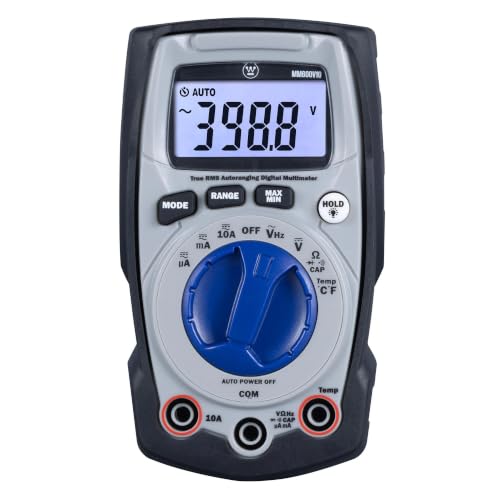
The one tool here that goes beyond the battery and into the whole electrical system.
This is a full multimeter, not a single-purpose battery tester, and that is exactly its draw. It measures up to 600V AC/DC and 10A current, plus resistance, continuity, frequency, capacitance, diode, and temperature — the broad toolset for household, automotive, and light industrial work. For car use, that means you can chase a parasitic drain, test a sensor, and check battery voltage with one meter in the glovebox.
You get reliable readings on non-linear AC waveforms (uneven alternating-current signals) thanks to its True RMS rating, which plain averaged meters can misreport. The auto-ranging setup skips the manual dial-juggling, and the backlit 4000-count LCD with MAX/MIN mode makes a fluctuating reading easy to catch and hold. It is CAT III 600V rated (safe for 600-volt measurements in fixed wiring) and certified to UL 61010-1, CSA C22.2, and UL/CSA 61010-2-033 standards, with overload protection to guard the meter during electrical testing.
The honest distinction versus the battery testers here is scope. This meter will tell you voltage, resistance, and continuity precisely, but it will not measure cold-cranking amps or converse in CCA the way the ANCEL or Clore units do. It also carries a smaller review base than the dedicated testers, so it is a newer entry. If your checklist includes checking a battery and checking the wiring that charges it, this covers both in a 6.4-ounce package.
The case for it: a genuinely broad multimeter — voltage, current, resistance, frequency, capacitance, diode, temperature — with True RMS accuracy and a CAT III 600V safety rating.
The catch: no CCA or cranking-amp test, so it diagnoses electrical faults rather than predicting a tired battery’s starting power.
Reach for this if: you want one meter that also chases wiring faults, sensors, and continuity across the car.
Look elsewhere if: cold-cranking-amp testing is the whole reason you are buying.
7. VDIAGTOOL BT500 5-3000 CCA Battery Load Tester

One tester that climbs from a motorcycle cell to a 24V truck system.
The standout number here is the 5-3000 CCA scope, which is the widest cranking-amp range on this list — well beyond the 100-2000 CCA shared by the ANCEL and TOPDON units. It handles 6V, 12V, and 24V batteries across Regular Flooded, AGM Flat Plate, AGM Spiral, GEL, and EFB types, and there is a dedicated 6V mode tucked into the “Motorcycle” menu. It reads voltage, resistance, State of Health (how much life the battery has left), and State of Charge (how full it is) — plain labels a first-time buyer can act on.
It goes past the battery, too. The BT500 checks alternator and starter behavior, so after a week of short trips you can verify whether the alternator is actually recharging, and tell a weak battery from a failing alternator before buying parts. It is built in a shock-resistant ABS body with an anti-slip grip for a messy garage, and its 5-in-1 protection covers reverse polarity and short circuits. There is support for 12 languages and a clear display that makes a full check fast.
The one line to read carefully is the compatibility note: not for lithium, deep-cycle, or golf-cart batteries. Owners rate utility highest by a wide margin, with accuracy right behind — the sense that it delivers real readings under load. It is powered by the battery under test, so no charging is required. For a household with a car, a motorcycle, and a truck, this breadth is worth the step up in range, while a simple single-car owner may never use the 24V capability.
The case for it: a 5-3000 CCA range with 6V, 12V, and 24V coverage — more span than the 100-2000 CCA testers here offer.
The catch: it will not touch lithium, deep-cycle, or golf-cart batteries, so check your chemistry before you buy.
Reach for this if: your driveway holds a mix of 6V, 12V, and 24V vehicles and you want one tool to cover them all.
Look elsewhere if: you own a lithium or deep-cycle battery bank — this one is ruled out for that.
8. ANCEL BT410 Battery Tester
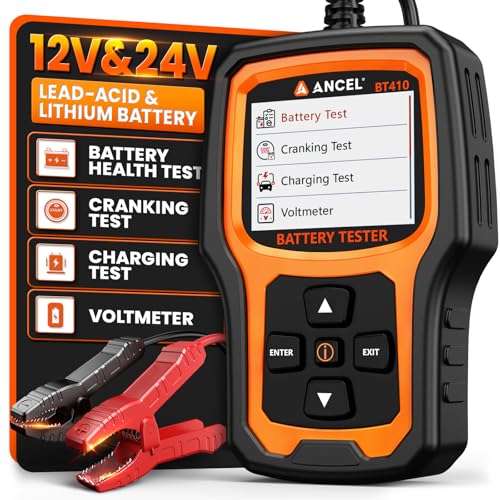
The rare tester that reads both lead-acid and lithium from the same clamps.
Most testers on this list stop at lead-acid; this one is dual-chemistry. It handles 12V and 24V systems and works on both lead-acid (AGM, GEL, Regular Flooded, EFB) and lithium-ion batteries, so you do not need a separate tool for an RV, a boat, or a newer lithium pack. Its running diagnostics cover State of Charge, State of Health, voltage, and internal resistance, then roll them up into one plain verdict — GOOD BATTERY, GOOD-RECHARGE, or REPLACE BATTERY.
The display is a 2.4-inch color TFT screen with adjustable contrast and a day/night mode, which reads cleanly in bright sunlight and a dark garage alike. It even generates a shareable QR report with all the test data, useful when you want a second opinion or a record for a shop. The 800mm (31.5-inch) cables reach hard-to-reach battery posts, and it runs reliably from -4°F to 158°F, clamped to the battery with reinforced ABS clamps and short-circuit plus reverse-polarity protection. Note it draws power from the battery under test — no extra batteries needed.
Functionality and build quality are the two highlights buyers keep returning to, and the compact size makes it easy to store. The honest read is that the fancy screen and QR reporting matter most to someone recording multiple vehicles; a single-car owner may not use the report feature at all. Compared with the VDIAGTOOL BT500, this one adds lithium support but tops out at 100-2000 CCA rather than the BT500’s wider range.
Where it earns its keep: genuinely dual-chemistry testing — lead-acid and lithium from one 12V/24V tool — plus a color screen that survives both sun and shadow.
Where it tapers: its 100-2000 CCA ceiling is narrower than the BT500’s, and the QR-report features add value only if you track multiple batteries.
Reach for this if: you run both lead-acid and lithium batteries and want one tester to log results you can share.
Look elsewhere if: you need the widest possible cranking-amp range and nothing beyond lead-acid.
9. FOXWELL BT301 12V Car Battery Tester with 2.8″ Color Screen
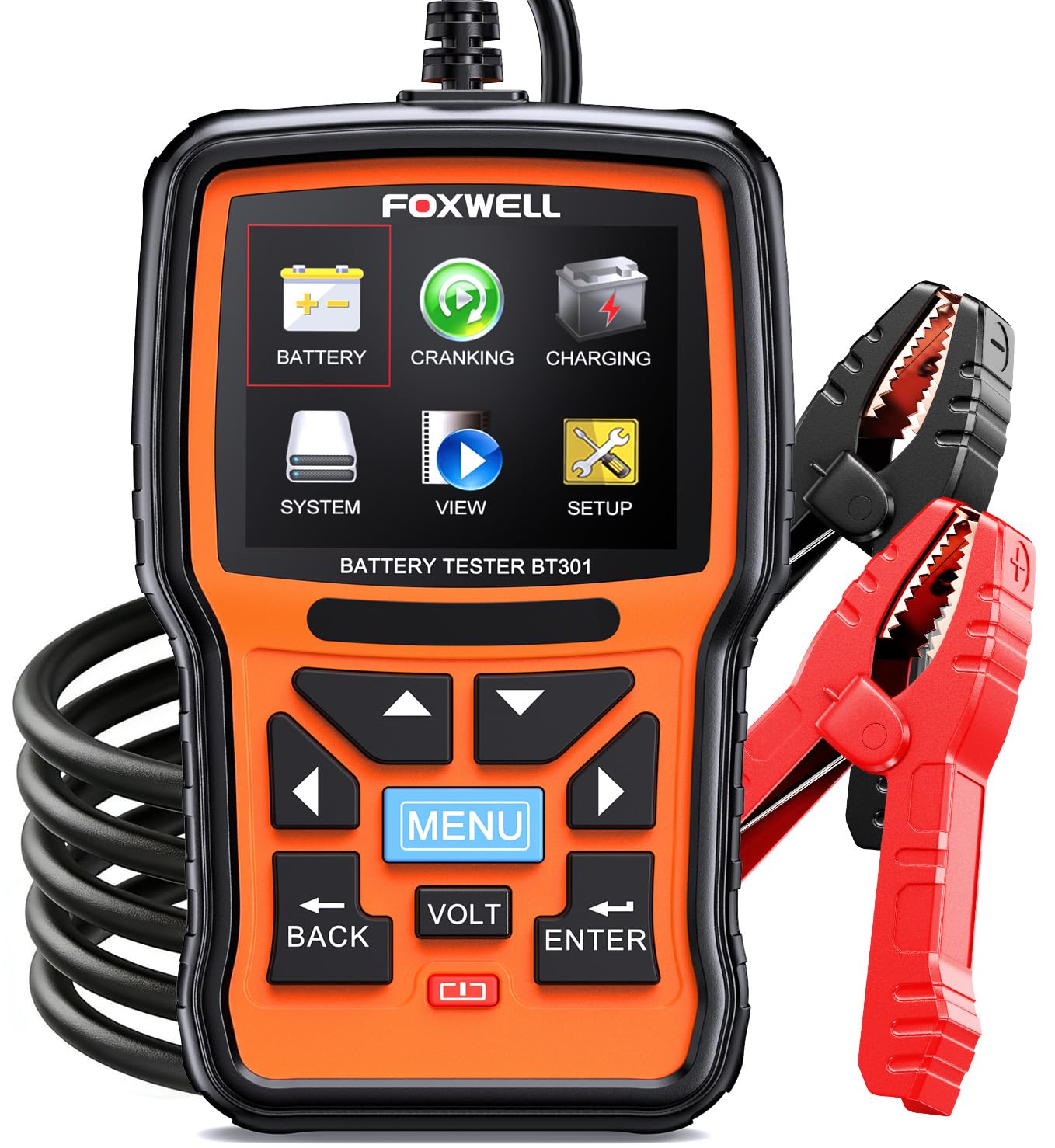
A 6.5ft cable and a 2.8-inch color screen — so you can test from the driver’s seat.
The spec that separates this from every handheld here is the 6.5ft cable. That length means you can sit in the driver’s seat, turn the key, and read cranking and alternator results without an assistant — a real advantage in tight spaces and colder weather. The companion is a bright 2.8-inch color display that stays legible in low light or direct sun, so the numbers are easy to read wherever the vehicle is parked.
It checks battery health, starter performance, and alternator output for all 12V lead-acid batteries — flooded, AGM (flat and spiral), EFB, and GEL — though not lithium. Its intelligent chip and tune algorithms are built for stable, repeatable readings, and it works in extreme cold or heat. Heavy-duty clips with reverse-polarity protection and an insulated copper clamp make the connection secure, and the compact ABS housing is built for a garage shelf. It runs off the battery being tested, so no separate power.
Value and accuracy are what buyers praise most, with versatility close behind — the 6V-to-12V flexibility shows up in how people use it beyond a single car. The caveat that shows up is durability over the long haul: a few report the tool giving up after a stretch of light use, so store it dry and protect the cable. For most DIYers who want a big, bright screen and the reach to test alone, this earns the premium placement.
What Makes It Stand Out
- 6.5ft cable lets you test from the driver’s seat
- 2.8-inch color screen reads clearly in sun and shadow
- Broad 12V lead-acid type support, plus 6V mode
- Heavy-duty insulated copper clamps with reverse-polarity protection
What to Keep in Mind
- Long-term durability draws some negative feedback, so treat the cable well
- No lithium support
Go for it if: a long cable and a big, bright screen make your roadside check easier — especially testing solo.
Look elsewhere if: you need lithium coverage or want to spend less on a basic 12V read.
Know the Specs
CCA Range (Cold-Cranking Amps)
CCA is the current a battery must deliver to turn a cold engine, and the tester’s CCA range sets the batteries it can grade. A 100-2000 CCA tester covers most cars, trucks, and boats; a wider 5-3000 CCA range reaches heavy equipment, while a narrower 40-1200 CCA unit leaves the heaviest diesel batteries to bigger tools. Match the CCA range to your own vehicles so you are not paying for coverage you will never use.
Operating Voltage Range
This figure is the lowest and highest voltage a tester can read. A wider low end — like the MOTOPOWER’s 4V or the TOPDON’s 8V minimum — lets the tester still read a battery that has drained well below nominal, which is exactly when you need the diagnosis. A 12V minimum, by contrast, means a deeply flat battery may not power the tester at all. Buy for the low end of the operating range if you often deal with dead batteries.
Conductance Testing & 4-Wire Kelvin
Conductance testers send a small signal and assess how the battery responds, instead of drawing the heavy load of an old carbon-pile test. The 4-wire Kelvin method keeps current and voltage paths separate, so a dirty clamp or corroded post does not skew the reading. The payoff is a safer, more repeatable result — especially valuable if you are deciding whether to replace a battery.
Cranking & Charging System Tests
A good tester goes past the battery to measure cranking voltage (the voltage sag while the starter turns) and alternator output including ripple. That is how you separate a tired battery from a failing starter or a weak alternator, so you replace the right part instead of the most expensive guess. Testers that show charging voltage with loads on and off give the clearest picture of the charging system’s health.
Common Questions
Will a 12V battery tester work on my motorcycle battery?
Do I need cranking-amp testing or is plain voltage enough?
What does the low end of the operating voltage range tell me?
Can a tester tell if the problem is the battery or the alternator?
Will a regular battery tester work on a lithium battery?
How long should the test cables be to reach the battery comfortably?
What does the 4-wire Kelvin method change about the reading?
Is a Bluetooth battery monitor better than a handheld tester?
Do these testers need their own batteries or charging?
Can a tester be damaged if I clamp it the wrong way round?
The Bottom Line
For most people, the strongest voltage meter for car battery is the Clore Automotive SOLAR BA9, because it reports battery strength as a true percentage across Flooded, AGM, Spiral, and Gel Cell chemistry and still wakes up at 4.5 volts to test a deeply drained battery. If you want to separate a weak battery from a failing starter or alternator, the ANCEL BST100 3-in-1 tester with its 4-wire Kelvin method (a four-wire setup that cancels lead resistance for a more accurate reading) is the sharper diagnostic. And for a driveway mix of 6V, 12V, and 24V vehicles, the VDIAGTOOL BT500 with its 5-3000 CCA reach is the one to keep in the toolbox — that breadth is why it is the pick to reach for when one tester has to cover everything. The best of the bunch hold 4.5+ stars, and the difference between a good tester and a great one depends on whether it measures cranking amps or just voltage.
How we choose
We do not accept paid placement. Every pick is matched to a real buyer and a real use-case; we do not hands-on test units.
Sources
Specifications: manufacturer listings and product documentation. Review insights: verified customer reviews, as of November 2026. Pricing: not shown on this page (it changes often); check the current price via the retailer link.
As an Amazon Associate, Tactical Gear Guy earns from qualifying purchases. This does not affect which products we feature.