Specs are compiled from manufacturer listings and verified buyer reviews and can change over time — please confirm the key details on the product page before buying.
Which home charger is actually worth putting on your garage wall? The short answer: match the amperage to your car’s onboard acceptance rate and your electrical panel’s spare capacity, then pick the unit whose safety certification and cable length fit your parking spot. Everything else — apps, screens, RFID cards — is secondary. This guide walks through eleven Level 2 stations that run on 240 volts, the same power class as an electric clothes dryer.
This guide is built by comparing the manufacturers’ published specifications and the patterns across verified customer reviews, so you get each pick’s real strengths and trade-offs instead of marketing spin.
You’ll see hardwired and plug-in designs side by side, plus the connector types that decide whether a Tesla needs an adapter. Every pick below is a true Level 2 station (a 240-volt charger that adds roughly 10–60 miles of range per hour, depending on the car). Each one is matched to the driver it suits best — read on for the breakdown of the volt ev charging station options that fit real garages and real commutes.
Top Picks
How To Choose The Best Volt EV Charging Station
The most common buying mistake is assuming a bigger amperage number always means faster charging. It does not. Your car has an onboard charger with its own acceptance limit, and the station can only feed what the vehicle will take. Before you compare a single spec, call an electrician and ask two questions: how much spare capacity does my panel have, and what circuit can it support?
Amperage and the circuit behind it
A 48-amp station needs a dedicated 60-amp circuit to run at full output, and that is a real electrical upgrade for many homes. A 40-amp unit typically lands on a 50-amp breaker, and a 32-amp unit runs on a 40-amp circuit — the smallest ask of the group. Smaller amperage does not mean worse; it means a lighter load on your panel and often a simpler install.
If your car accepts less than the station’s maximum, you paid for headroom you cannot use today. That is a fine reason to buy a 48-amp unit for a future vehicle, but it is not a reason to skip the panel check.
Hardwired or plugged into a NEMA 14-50 outlet
A hardwired charger wires straight into a circuit with no outlet in between, which is the route to the highest continuous amperage and the tidiest garage wall. A plug-in charger uses a NEMA 14-50 receptacle — the same heavy-duty outlet type used for large appliances — so you can unplug it and take it with you when you move.
Plug-in units are also easier to swap or service without an electrician. The trade-off is that outlet hardware adds a connection point, so the install must be done properly either way.
Safety listings you can actually verify
Look for a UL, ETL, or CSA mark on the unit itself. Those marks mean an independent lab tested the charger against a published safety standard, usually cited as UL 2594 for charging equipment. Several picks here also carry ENERGY STAR certification, which speaks to standby efficiency rather than charging speed.
Connector type: J1772 versus NACS
J1772 is the round connector used by most non-Tesla EVs in North America, and it is what nearly every charger here ships with. NACS is the Tesla-style connector. If you drive a Tesla or a newer vehicle with a NACS port, confirm the station is either NACS-native or that a J1772-to-NACS adapter is available — a few picks below include the adapter, and a few explicitly do not.
Cable length and where you park
Most stations here ship with a 25-foot cable, with one at 30 feet. Measure from where the unit will mount to the far corner of your parking spot, then add slack for a car parked nose-in. Too short a cable forces awkward parking every night.
Side-by-Side Comparison
| Model | Best For | Amperage | Connector | Install Type | Amazon |
|---|---|---|---|---|---|
| EMPORIA Level 2 EV Charger★ Best Overall | Best Overall | 48 A | J1772 | Hardwired | Amazon |
| MACH 2:Fast Hardwired Level 2Dual-Connector Pick | Dual-Connector Pick | 48 A | J1772 + NACS | Hardwired | Amazon |
| Level 2 EV Charger, 48A/11.5kWMost Informative Screen | Most Informative Screen | 48 A | J1772 | Hardwired | Amazon |
| IYILO Level 2 with Energy Meter | Best Load Balancing | 48 A | J1772 | Hardwired | Amazon |
| Grizzl-E 48A Ultimate | Best for Multi-Charger Homes | 48 A | J1772 | Hardwired | Amazon |
| Autel 50A Level 2 | Highest Amperage | 50 A | J1772 | Hardwired | Amazon |
| ChargePoint HomeFlex NACS | Best for Tesla Owners | 50 A | NACS | Hardwired | Amazon |
| Autel 40A Level 2 | Easiest Relocation | 40 A | J1772 | Plug-in (14-50) | Amazon |
| WOLFBOX Level 2 40amp | Best Value Smart Features | 40 A | J1772 | Plug-in (14-50) | Amazon |
| Grizzl-E Classic Connect 40A | Rugged Outdoor Build | 40 A | J1772 | Plug-in (14-50) | Amazon |
| Enphase HCS-40 | Longest Warranty | 32 A | J1772 | Hardwired | Amazon |
Detailed Reviews
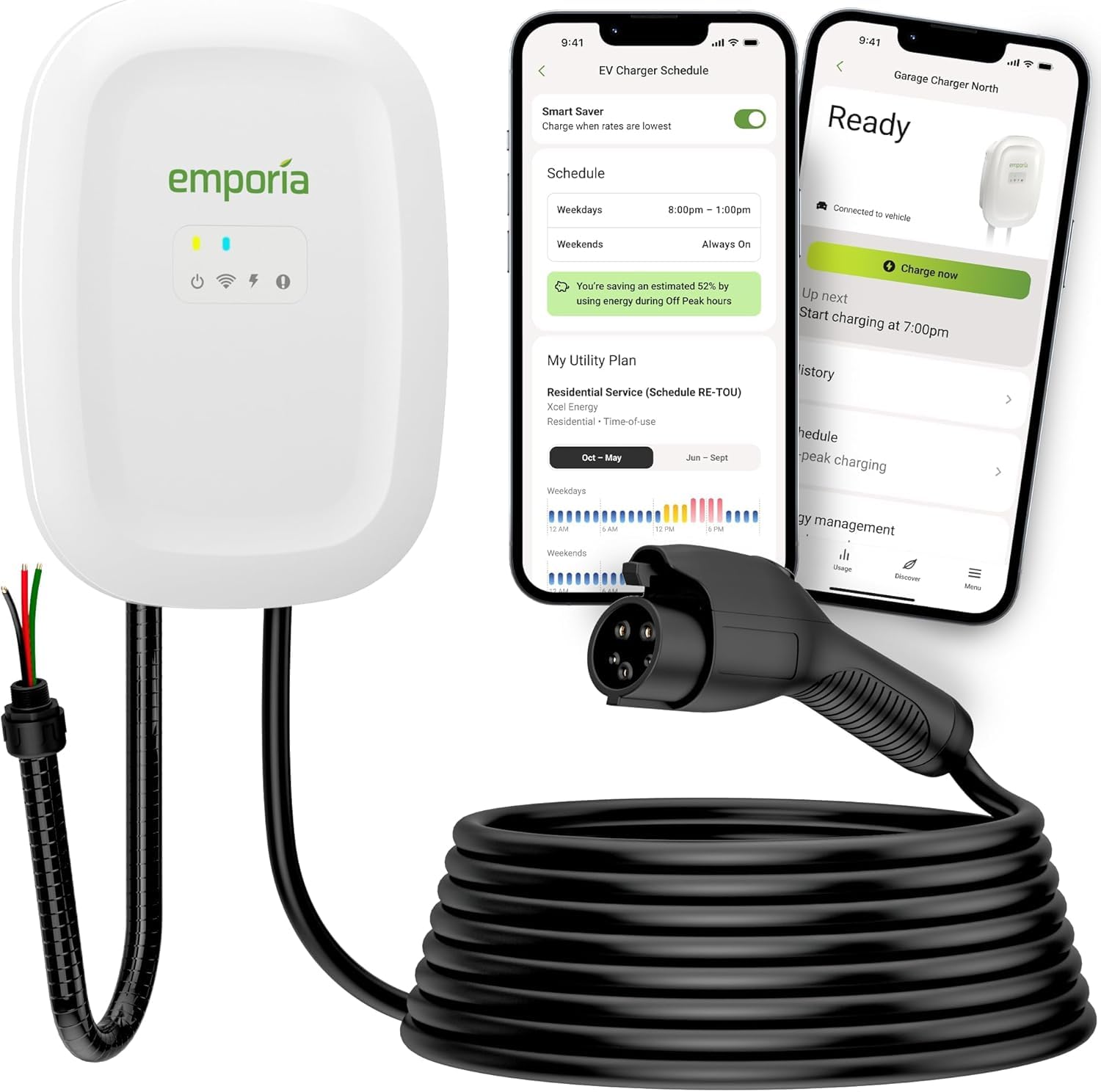
1. EMPORIA Level 2 EV Charger w/ J1772 Connector
Our pick — 4.5+★ from 500+ verified ratings; the strongest balance of quality and price.
The 48-amp hardwired favorite that folds your utility bill into the app
If you want one charger that covers speed, safety paperwork, and energy tracking without a second device, start here. The Emporia pushes 48 amps on a hardwired 240-volt connection, which the maker rates at up to 46 miles of range added per hour. That is the useful number for a 60-mile daily round trip: you are topped off well before the coffee finishes.
What you get in the box is the station itself, a 25-foot charging cable, a wall mount, a handle holster, and the mounting hardware. The J1772 connector is the round plug most non-Tesla EVs use — Chevrolet Bolt, VW ID 4, Nissan Leaf, Mustang Mach-E and similar. Tesla drivers will want Emporia’s separate NACS version instead, because this cable will not seat on a Tesla port without an adapter.
The safety side is unusually well documented: UL listed, ENERGY STAR certified, and built to reference standards including UL 2594 and SAE J1772. The 2.4 GHz WiFi link feeds real-time energy data and lets you schedule sessions around cheaper utility hours. Owners consistently describe setup as painless and the app as genuinely simple, and one practical detail that keeps coming through is how easily it pairs with Emporia’s own Vue3 energy monitor for whole-home tracking. A full charge on a compatible car lands in roughly 4-5 hours according to owner reports, which tracks with the amperage.
What earns it the top slot
- 48 amps hardwired, rated up to 46 miles of range per hour — real overnight coverage for a long commute
- UL listed and ENERGY STAR certified, with the specific standards named on the label
- 25-foot cable reaches across a two-car garage without stretching
- Scheduling in the app lets you shift charging into cheaper utility windows
Where it asks something of you
- Full 48 amps requires a hardwired 60-amp circuit and a licensed electrician — the maker recommends professional install outright
- WiFi is 2.4 GHz only, so a 5 GHz-only home network needs a band adjustment
- No NACS plug here; Tesla owners need the separate Emporia model
Reach for this if: you drive a J1772 car, want maximum hardwired speed, and like seeing your energy use in one app.
Look elsewhere if: your panel cannot spare a 60-amp circuit — a 40-amp plug-in pick further down asks far less of it.
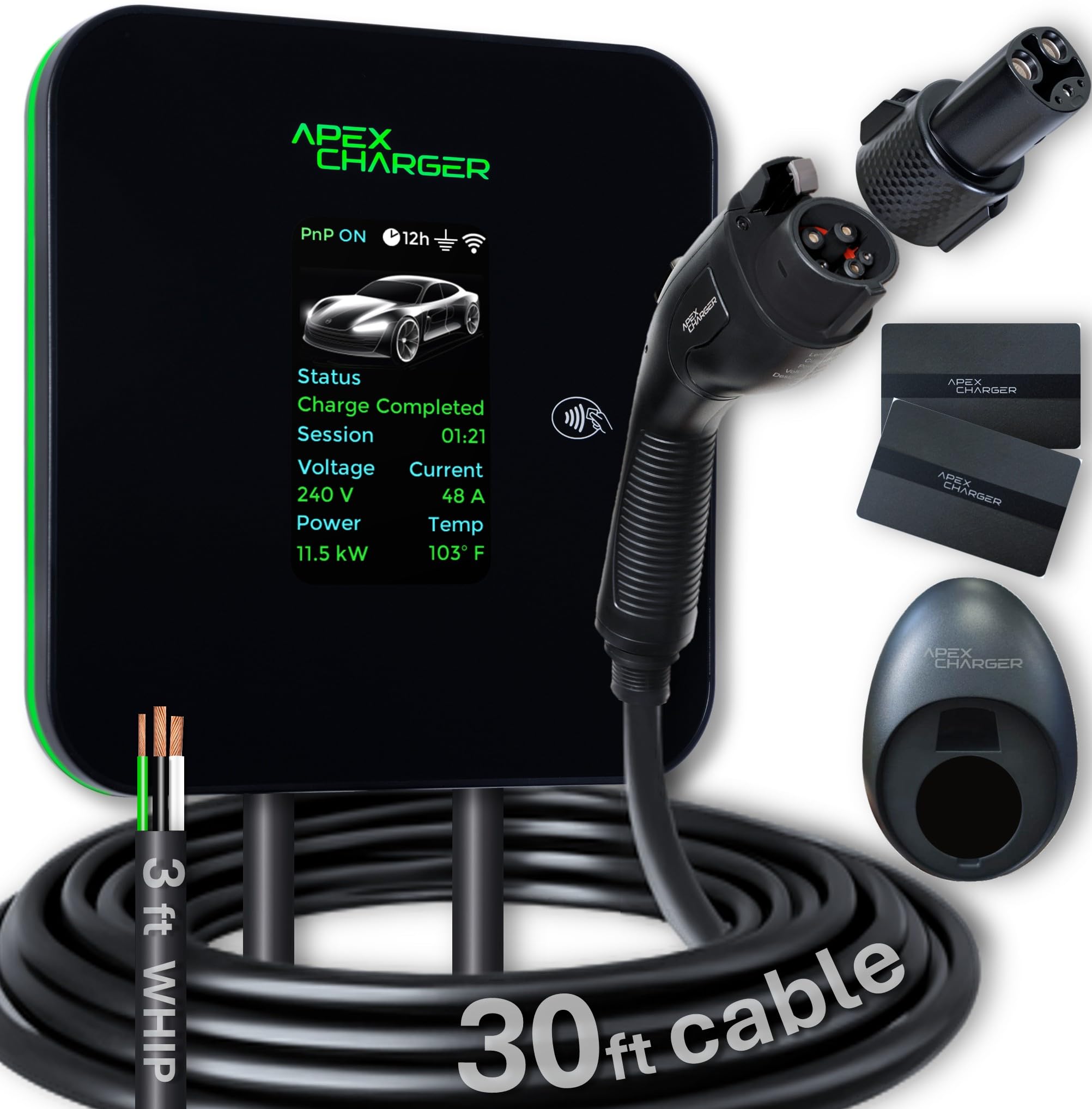
2. MACH 2:Fast Hardwired Level 2 EV Charger
One station, two connector standards, and a cable that reaches the far bay
A house with a Tesla and a J1772 car normally needs two chargers or a drawer full of adapters. The MACH 2 skips that: it ships with both a Type 1 SAE J-1772 connector and a NACS adapter in the box.
Power lands at 48 amps and 240 volts, and the unit is listed against UL 2594 along with ETL and ENERGY STAR certification. The panel on the front is a 4 3/4-inch LED display with a standby mode for saving energy, and there are two RFID cards for tap-to-start charging — useful if your driveway is accessible to others. A breathing light indicator shows status from across the garage, and an anti-theft bolt and fittings come included.
The install story is what owners talk about. It arrives complete enough that no extra parts are needed for the wiring job, and buyers report it working cleanly with plug-in hybrids such as a BMW X5 xdrive50e. Bluetooth and WiFi both onboard mean you can set it up even in a garage where WiFi is patchy. Coverage runs five years.
The honest read: this is a young listing with a smaller pool of long-term feedback than the Emporia or the Grizzl-E, so the five-year coverage is doing more of the durability argument than the track record is. If you want a decade of owner history before you commit, the Enphase pick near the bottom has it.
Best fit: a two-EV household running one Tesla and one J1772 car off a single hardwired station.
Think twice if: you want the longest confirmed reliability record — this one is newer to the market than its rivals.
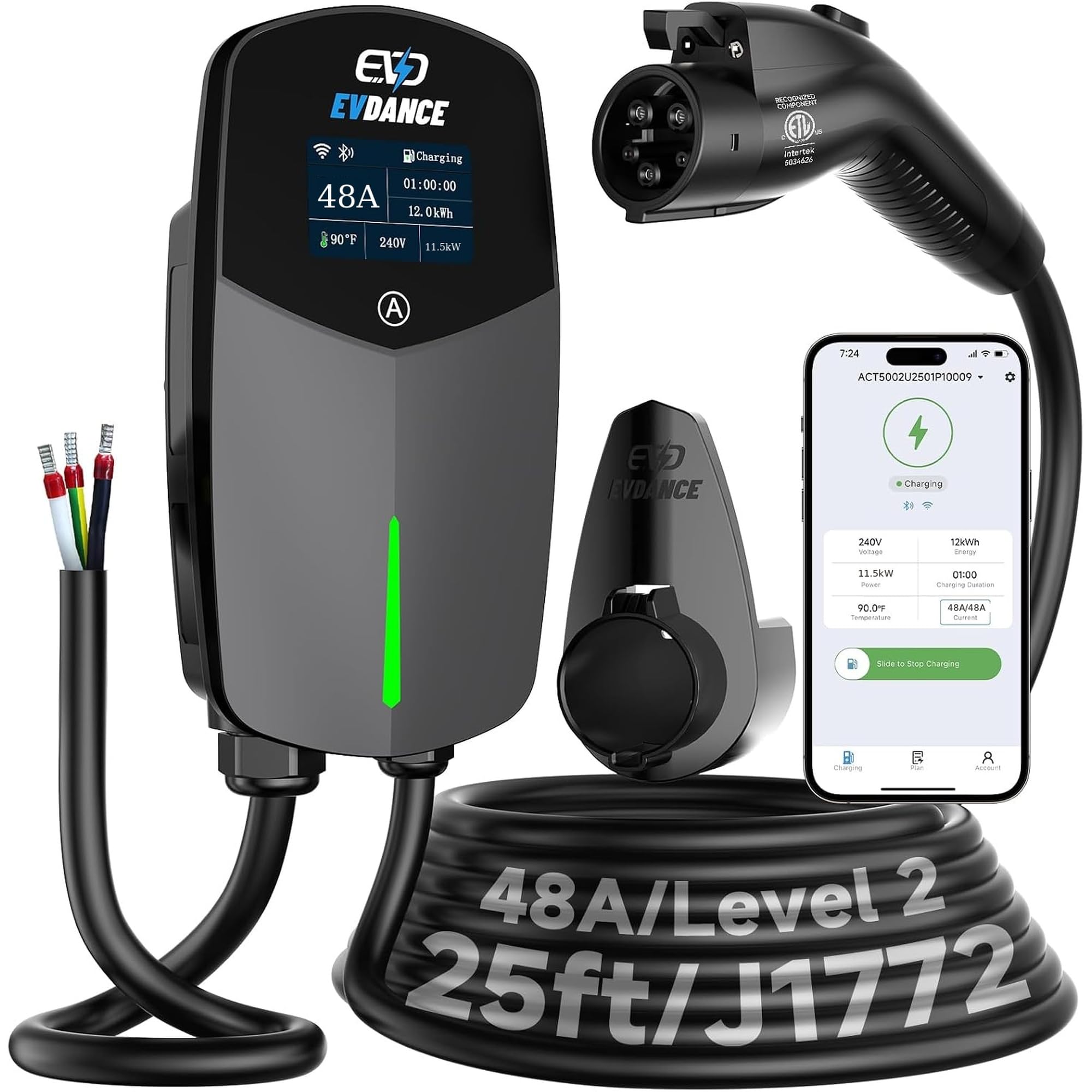
3. Level 2 EV Charger, 48A/11.5kW, J1772, Hardwired
The charger that keeps showing you the numbers when your WiFi quits
Most smart chargers go silent the moment your home network hiccups. This one has a 3.5-inch TFT color display on the body that reads out live voltage, current, power, kilowatt-hours, and plug temperature — no phone required, even with WiFi down. At 48 amps and 11.5 kW it delivers up to 44 miles of range per hour, and the current is adjustable anywhere from 6 amps to 48 amps so you can dial it back for a smaller circuit.
The temperature story is the standout engineering here. An NTC sensor in the J1772 plug — a small thermistor that reads heat at the connector — watches for a hot plug continuously. If it climbs into the 70-90°C band the charger cuts output to 8 amps, shuts off above 90°C, and resumes once it drops back under 70°C. That is the failure mode most home chargers do not handle in stages, and it is a genuinely reassuring piece of protection for a connection that carries this much current every night.
Certification covers ETL and FCC with a six-layer safety set: over-voltage, over-current, over-temperature, leakage, lightning surge, and an IP65 rating for dust and water. Up to six people can share the charger, each with their own app account, and weekly schedules can be set in-app. Bluetooth backs up the 2.4 GHz WiFi, which matters if your garage sits at the far edge of the signal.
Why the screen matters
- 3.5-inch TFT display shows live volts, amps, power, kWh and plug temp without a phone
- Three-stage plug overheat response — ramps to 8 amps, then shuts off, then resumes
- Adjustable 6A to 48A, so the same unit fits a smaller circuit at a lower setting
- IP65 rated and ETL plus FCC certified for garage or driveway mounting
What to weigh first
- Reaching full 48 amps takes a dedicated 240V/60A circuit and a licensed electrician
- Tesla and NACS vehicles need a J1772-to-NACS adapter that is not in the box
- Newer to the market, so long-term wear is not yet proven the way the Enphase’s is
Go here when: your garage WiFi is unreliable and you refuse to charge blind.
Pass if: you drive a Tesla — the NACS adapter is a separate purchase.
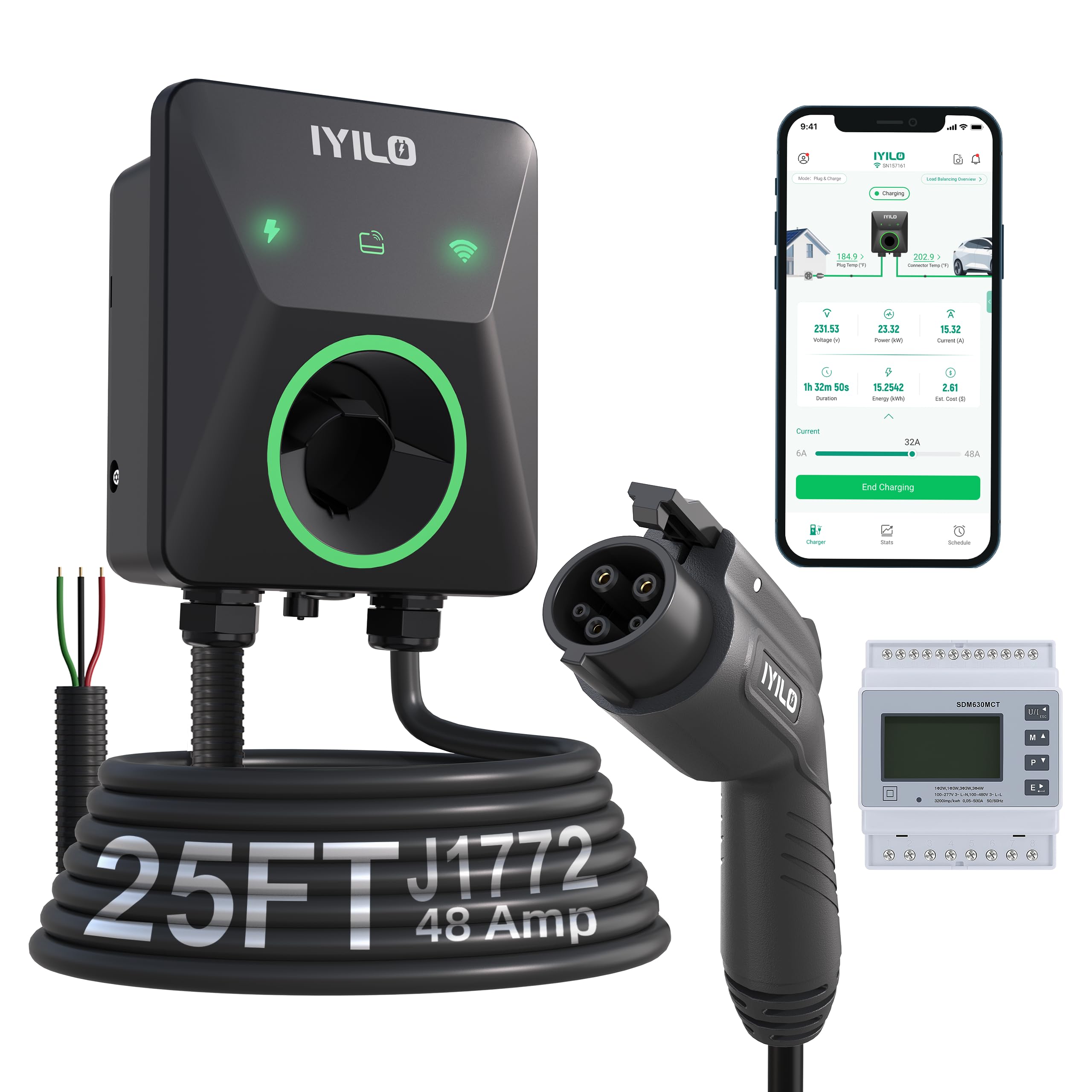
4. IYILO Level 2 EV Charger with Energy Meter
The panel-upgrade dodger — it measures your home’s headroom and charges into it
It ships with an energy meter rated up to 200 amps plus CT clamps — the clamp-on sensors that read current on your service lines — and a 16-foot RS-485 cable to connect them. The charger then adjusts its draw based on what your home actually has available, which means it can charge at 48 amps when the house is quiet and back off when the oven and dryer are running.
Raw output is 48 amps and 11.5 kW, rated up to 46 miles of range per hour, with current adjustable in 1-amp steps from 6 amps to 48 amps. That single-amp granularity is finer than most rivals offer, and it is what makes the load balancing actually useful rather than a rough three-position switch.
Thermal protection is the other half of the pitch: a built-in NTC sensor reads the connector temperature in real time and shows it in the app. Above 221°F the system stops charging on its own. Certification covers ETL, UL 2594, ENERGY STAR and CSA, and there is a built-in GFCI breaker plus a NEMA 4 water rating for outdoor mounting. Owners describe near-max-speed charging at any hour, straightforward installation, and sturdy connectors, with the temperature monitoring called out as a genuine comfort.
One thing to know: the 2.4 GHz-only WiFi is the limit here — a 5 GHz network will not connect, and some owners find the connectivity less consistent than the hardware itself. Keep the charger on a 2.4 GHz band and the rest of the package holds up well.
Built for you if: your panel is already loaded and you would rather balance power than pay for an upgrade.
Consider the Emporia instead if: you have panel capacity to spare and want the simpler app-first experience.
5. Grizzl-E 48A Ultimate Level 2 Charger
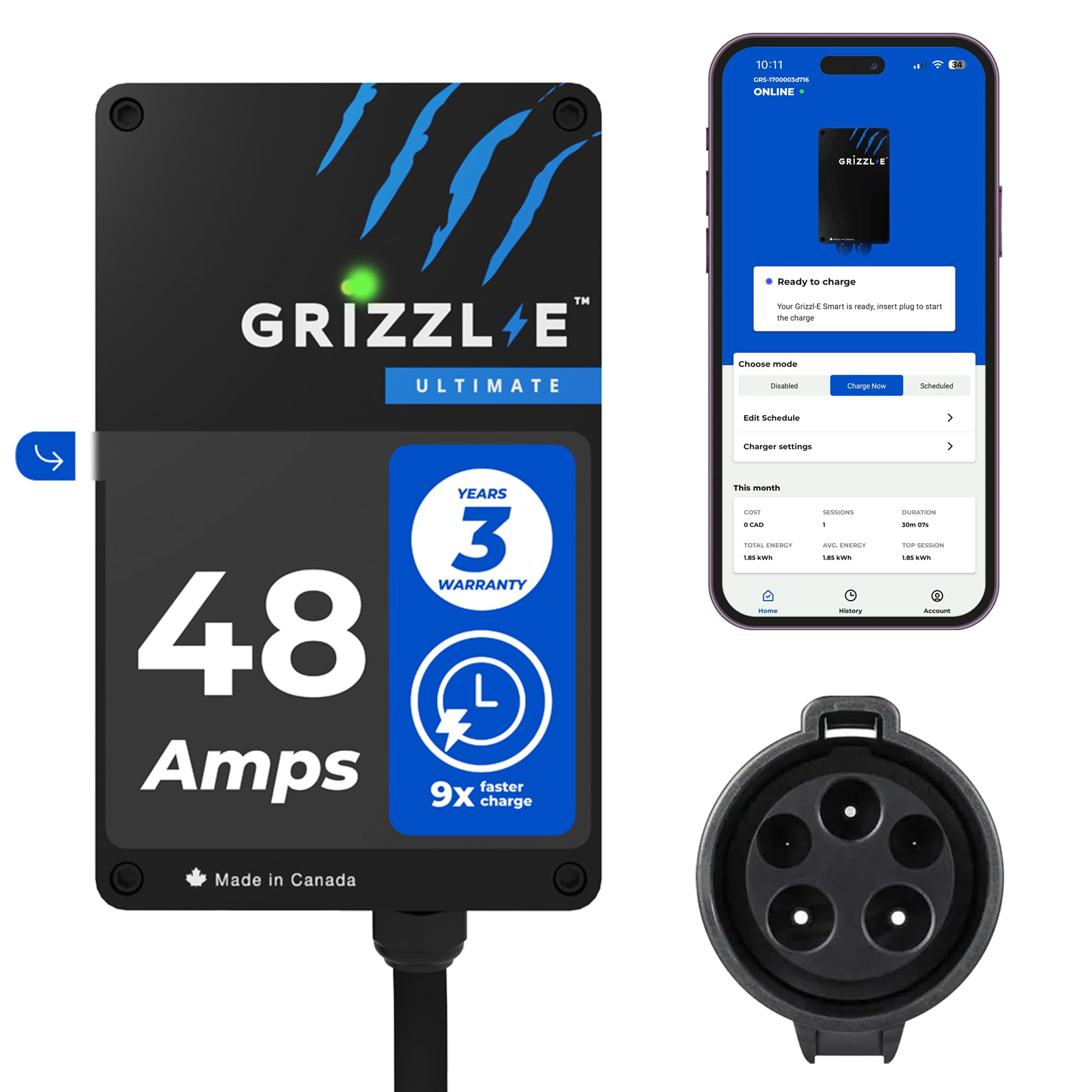
A cast-aluminum brick that splits power fairly between two cars
Two EVs and one electrical service is a scheduling headache until you buy a charger that solves it. The Grizzl-E Ultimate can balance charging power automatically across multiple chargers, and you choose the logic: equal sharing so both cars get a fair split, or priority charging so your daily driver fills first. It protects your electrical infrastructure while keeping both vehicles usable — a specific feature almost nothing else in this list offers.
The housing is a heavy-duty UL Type 4 rated aluminum cast enclosure, which is why this thing feels like a piece of outdoor equipment rather than a plastic box. It runs 48 amps and 11.5 kW, rated nine times faster than a basic charger, with UL and ENERGY STAR certification and a 3-year warranty. A hardwire kit with terminal lugs and heat shrink wrap is in the package, so the electrician has what they need on arrival.
Connectivity runs through Grizzl-E Connect software for monitoring, schedules, energy statistics, and diagnostics, with charging working whether or not you are online. There is an external antenna for weak-signal garages, and premium OCPP access carries a one-time activation fee — worth knowing before you plan around it. Owners describe setup as a breeze and full charges landing in about five hours.
The case for the Ultimate
- Automatic power sharing across multiple chargers, with equal or priority modes
- UL Type 4 rated cast aluminum enclosure built for harsh weather
- External antenna for garages where WiFi struggles
- Hardwire kit with terminal lugs and heat shrink included
The catches worth knowing
- Hardwire-only — there is no NEMA 14-50 plug option on this model
- Premium OCPP capability carries a one-time activation fee
- The Classic Connect sibling below costs less if you never need multi-charger sharing
Land here if: a second EV is on your driveway now or soon, and you want one service to feed both.
Skip the premium here if: you have one car and one charger — the Classic Connect covers that at a lower tier.
6. Autel 50A Level 2 EV Charger, Hardwired

Fifty amps from a company that has been in automotive electronics since 2004
This is the only charger here that pushes 50 amps, and it feeds 12 kW into the car — the highest ceiling of the eleven. The current is adjustable from 6 amps to 50 amps so you can match it to whatever circuit your home can support. If your vehicle’s onboard charger can accept that much, this is the fastest route to a full battery on this list.
Autel has built automotive diagnostic and energy equipment since 2004, and the maker says the MaxiCharger line took two years to engineer. The housing carries a NEMA 4X rating — dust-tight and water-tight against rain, snow, and ice — plus CSA certification and a built-in cable holster to keep the 25-foot J1772 cable off the floor. Hardwired 240-volt installation is the only route, since there is no plug option.
The Autel Charge App handles remote start and stop, schedules, and session monitoring over WiFi and Bluetooth. Owners describe easy installation, a design that looks better on the wall than most, a full charge in under two hours on a compatible car, and the app being genuinely useful for calculating charging costs. The build is the thing that gets praised most, and it feels like it.
Straight talk: the connected features are the weaker half. Connectivity and power output are the two areas where feedback is mixed rather than glowing, so if you want bulletproof app control, the Emporia at the top is the safer bet. If you want raw amperage from a brand with two decades in vehicle electronics, this is the pick.
The fastest route home: 50 amps and 12 kW for a car that can accept it, on a hardwired circuit.
Pair it with: a vehicle whose onboard charger actually takes 50 amps — otherwise the extra headroom sits unused.
7. ChargePoint HomeFlex Level 2 EV Charger, NACS

The one charger here that plugs straight into a Tesla port with no adapter
Every other station on this list asks a Tesla owner to add an adapter. This one ships NACS-native, so the cable seats directly into a Tesla charge port. It runs 50 amps at 240 volts, rated at up to 45 miles of range per hour — nine times a standard 120-volt outlet.
The reason to look at ChargePoint specifically is the network behind the hardware. The same app that controls your home charger also locates public stations, backed by a network of 274,000-plus stations across North America and Europe plus 565,000-plus roaming partners. For someone who splits time between home and public charging, having one login for both is a real convenience.
The unit is UL certified, rated for indoor or outdoor installation by an electrician, and ships with a cold-resistant cable — a meaningful detail if your garage regularly dips below freezing. The maker lists a 20A or 80A circuit requirement, so confirm your panel can support it before booking the install.
Read this before you commit: charging consistency is the soft spot. Some drivers report their car pulling maximum rate, while others have found it will not deliver the correct amperage — a gap worth watching during your return window. The build quality and daily usability draw no such complaints.
Made for: a Tesla household that wants one native cable, one app, and the largest public network as a backup plan.
Weigh the alternative if: you want consistently repeatable charging numbers — the IYILO above has a firmer record on that front.
8. Autel 40A Level 2 EV Charger, NEMA 14-50
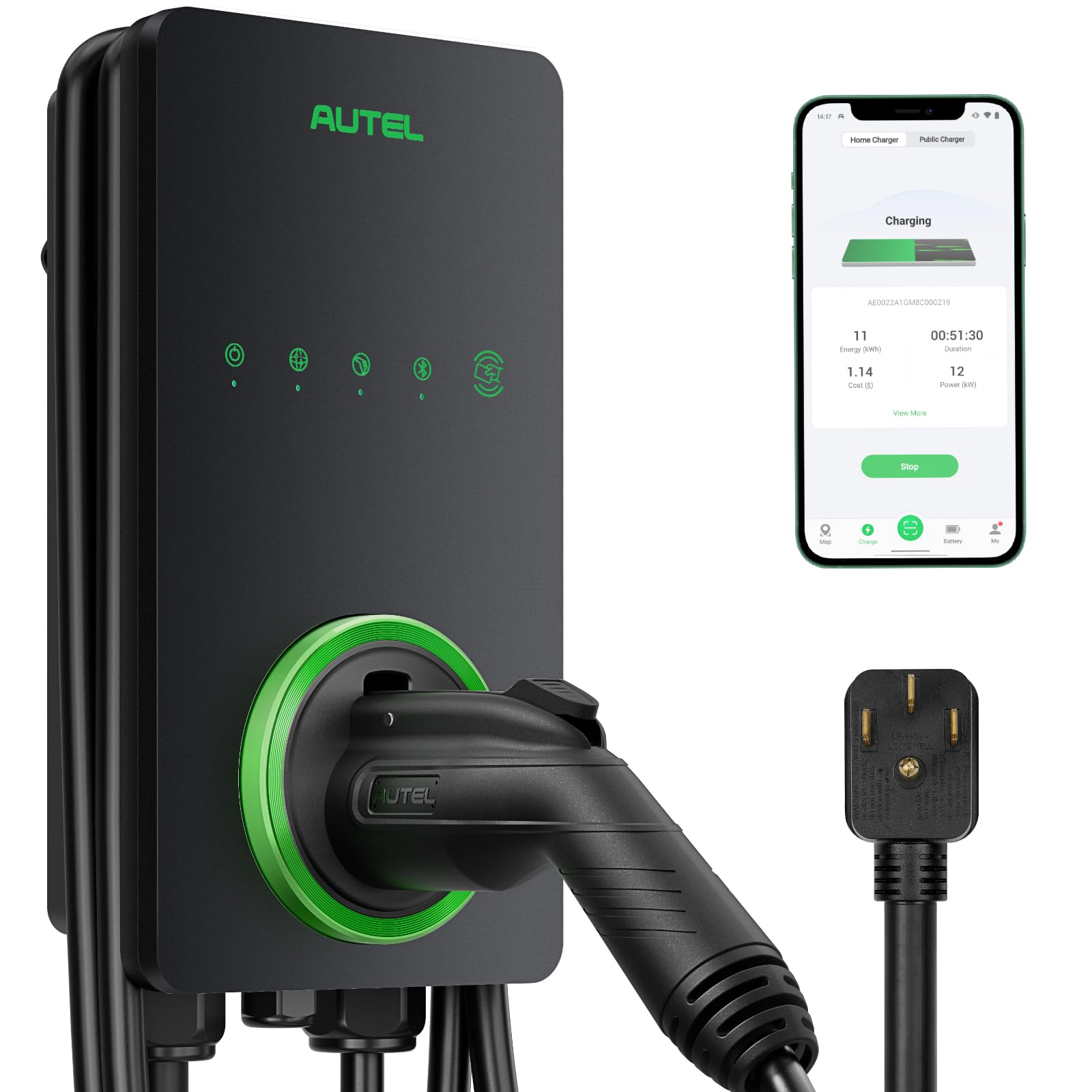
Plugs into an outlet and leaves with you when you move
Some drivers rent, some move every few years, and some just want the option to unplug. This Autel is a plug-in design: wire a standard NEMA 14-50 outlet, plug the charger in, and you are running in about five minutes of actual work. When you move, the charger goes in the trunk instead of staying screwed to the wall — a genuinely practical advantage no hardwired pick can claim.
Output is 40 amps, and the current is adjustable from 16 amps to 40 amps in the Autel Charge App. That range lets you stay within whatever your outlet and breaker allow. RFID start and stop access adds a layer of security against someone else using your cable, and the app handles schedules and off-peak charging so you can shift the load to cheaper hours.
The enclosure carries a NEMA 4X rating — dust-tight and water-tight, built for snow, rain, and ice — so a driveway mount is fine. The 25-foot cable reaches across a normal garage, and the unit ships with a built-in holster. Autel backs it with a 3-year warranty, OTA app updates, and 24/7 support. Owners describe it working well on 30-amp circuits, easy installation, and an app that is simple and helpful; cost tracking in the app comes up as a favorite detail. If you are on a Con Edison smart charging program, though, expect some friction getting it recognized.
Why the plug-in angle wins
- NEMA 14-50 plug-in — move the charger with you, no re-wiring required
- Adjustable 16A to 40A in the app to fit your outlet’s capacity
- NEMA 4X rated for outdoor use in snow, rain, and ice
- RFID access blocks unauthorized charging on a shared driveway
Constraints to plan around
- 40 amps, not 48 — below the fastest picks here by one step
- Compatibility with utility smart-charging programs is not guaranteed
- Needs a 14-50 outlet wired first; that work still calls for an electrician
Perfect for movers: renters, relocators, and anyone who wants a charger they can unplug and take along.
Only if the outlet exists: this route needs a wired 14-50 receptacle first, so factor that step in.
9. WOLFBOX Level 2 EV Charger 40amp

A plug-in box with a screen, voice control, and a price tier that undercuts the smart crowd
This is the value play for someone who wants a screen and app control without paying premium-tier money. The WOLFBOX runs 40 amps on a NEMA 14-50 plug, claiming 38 miles of range per hour — roughly seven times a Level 1 wall-outlet charger. For a typical 40-50 mile commute, that means a nightly top-up in well under two hours.
The interface is where it separates from the pack. A 4.3-inch LCD screen on the body shows charging rate, time, voltage, and charged amount, so you can read status without digging out a phone. It also ties into Alexa and Google Assistant for voice control, which is unusual in this category, and multiple people in the house can control the same charger simultaneously — a small thing that matters in a shared garage.
Certification is CSA plus a stated conformity to UL2594, and the housing is NEMA 4X rated for all-weather use. The 25-foot cable gets good marks from owners for its finish and durability, and the housing looks better on a wall than most budget-tier chargers. Install needs nothing more exotic than a 14-50R outlet.
The trade-off to know: the time-of-use scheduling is the weak spot — it draws a mixed reaction, with some users finding it effectively useless in practice. If scheduling charging around cheaper utility rates is central to your plan, the Emporia’s app handles that far better. If you mostly charge at a fixed overnight time, it is a non-issue.
For screen-first buyers: a large LCD, voice control, and multi-user access on a plug-in 40-amp unit.
Steer away if: you depend on precise time-of-use scheduling to keep your bill down.
10. Grizzl-E Classic Connect 40A Level 2 Charger

A heavy metal enclosure built for a driveway that gets pelted all year
The Grizzl-E Classic Connect ships in a heavy-duty NEMA-4 metal enclosure, made in Canada, with the kind of rugged feel to the charge handle that owners single out first. It is built for indoor or outdoor mounting and for whatever the weather decides to do.
It plugs into a NEMA 14-50 outlet on a 25-foot cable, running 40 amps and 9.6 kW. The adjustable amperage is unusually generous: 40 amps on a 50-amp breaker, 32 amps on a 40-amp breaker, 24 amps on a 30-amp breaker, or 16 amps on a 20-amp breaker. That means this one charger can be dialed to fit almost any circuit you already have. Charge rate scales accordingly — the maker lists 28-30 miles per hour at 40 amps down to 10-12 miles per hour at 16 amps.
Safety is thorough: UL tested and certified, built-in GFCI, and protection against over-current, over-voltage, under-voltage, ground fault, over-temperature, and a missing diode. There is self-monitoring with recovery and power outage recovery built in. Grizzl-E Connect software handles real-time monitoring, schedules, energy statistics, and diagnostics, and charging works with or without the online connection. A 3-year warranty backs it.
Where it lands: the app-controlled extras are its most modest strength, and the emphasis is squarely on the metal box and the protections inside it. This is the pick if your charger is going on an exterior wall in a wet climate and you want the enclosure to be the impressive part. Mounting it in a covered garage is almost overkill.
Point it at: an outdoor driveway post in a wet climate where the box needs to survive real weather.
Better fits exist if: you need high-end smart features — this one puts the money into the metal.
11. Enphase HCS-40 Level 2 EV Charger

The former ClipperCreek tank — 32 amps, no app, five years of coverage
Some buyers do not want another app to manage. The Enphase HCS-40, formerly known as ClipperCreek, is a deliberately simple charger: 32 amps, a 25-foot J1772 cable, a hardwired 240-volt install, and nothing to download. It runs on a dedicated 40-amp circuit, which is the lightest electrical ask of anything here, and the maker rates it at up to 31 miles of range per hour.
The design philosophy is durability over features. It is ETL certified to UL 2594 and ENERGY STAR certified, and the fully sealed NEMA 4 enclosure keeps the internals dry. The maker builds it for commercial charging use, where a unit runs hard every day for years. Its 5-year warranty is the longest here, two years beyond the 3-year coverage on most rivals.
What wins people over is the track record. Reliability comes in only a hair behind build quality as the thing owners praise most, and the same units are still charging Bolts and older Volts years after install. A charge that takes a full overnight session is normal at this amperage — an easy fit if you sleep while the car fills. There is an integrated cable wrap and a wall-mounted holster for tidy storage. One buyer’s summary frames the pitch well: no paying for apps or frills you will not use.
Who this is not for: a driver who wants maximum speed or a phone dashboard. At 32 amps, the faster hardwired picks above leave it behind on raw output — the 48-amp Emporia is a substantial step up in miles-per-hour. This is a buy-it-once-for-a-decade charger, not a smart one.
Choose it for: the longest warranty here, the lightest circuit demand, and a set-and-leave-it simplicity that skips the app entirely.
Not the one if: your commute is long enough that you need 48-amp speed to fill overnight.
Know the Specs
Amperage and miles per hour
Amperage is the flow rate of electricity, and it is what determines how fast miles go back into the battery. A 48-amp station adds range roughly in the mid-40s per hour; a 32-amp unit sits lower. The catch is that your car’s onboard charger sets the ceiling — a station that feeds more than the car accepts will simply run at the car’s limit. Confirm both numbers before you buy.
Circuit size and breaker rating
The breaker feeding your charger has to be larger than the charger’s continuous draw. Most installers size a 48-amp unit to a 60-amp breaker, a 40-amp unit to a 50-amp breaker, and a 32-amp unit to a 40-amp breaker. A licensed electrician has to confirm your panel can supply it. That is the step that turns a charger purchase into a real decision.
Hardwired versus plug-in installation
A hardwired charger connects straight to the circuit with no outlet between, which allows the highest continuous amperage and the tidiest wall. A plug-in unit uses a NEMA 14-50 receptacle, so it can be unplugged and moved. Plug-ins trade a small amount of installation simplicity for portability when you relocate. Either way, the wiring itself is electrician work.
Safety certifications explained
UL, ETL, and CSA are independent testing marks, not brand claims. Each confirms a charger was tested against a published safety standard, most often UL 2594 for charging equipment. A listing on the unit means the hardware passed those tests. It does not guarantee the install went right, so the two pieces — a certified charger and a proper circuit — work together.
Smart features that actually earn their place
Scheduling is the feature worth paying for: you shift charging into cheaper utility hours and the car fills while you sleep. Real-time energy monitoring is close behind, and load balancing matters most if your panel is tight. Screens, voice control, and RFID cards are conveniences. They are nice to have, but they will not change how fast your car charges.
Winter, outdoor, and water ratings
NEMA 4 and NEMA 4X ratings describe how well an enclosure keeps out water, dust, and ice. If your charger mounts on an exterior wall or a driveway post, those ratings matter more than any app. A cold-resistant cable also helps in freezing garages, since stiff cable is awkward to coil and route. Indoor-only mounting makes those ratings less important.
Common Questions
Do I need a 60-amp circuit for a 48-amp charger?
Will a J1772 charger work with my Tesla?
Is a hardwired charger better than a plug-in one?
What does UL 2594 on the label actually mean?
Can I run two EVs off one charger?
How long does a full charge take at Level 2?
Will my charger work if the WiFi goes down?
Do I need an electrician to install a home EV charger?
What is load balancing and do I need it?
Are outdoor-rated chargers safe in the rain and snow?
The Bottom Line
For most drivers, the strongest volt ev charging station pick is the Emporia Level 2 EV Charger because it pairs 48-amp hardwired speed with UL and ENERGY STAR certification and an app that handles scheduling without fuss. If your garage has two cars with different connectors, the MACH 2 ships with both a J1772 plug and a NACS adapter plus the longest cable here at 30 feet. And if you want to stop worrying about a panel upgrade entirely, the IYILO balances its draw against your home’s real headroom.
Two more routes worth knowing. If you drive a Tesla and want a native cable, the ChargePoint HomeFlex seats directly into the port with no adapter. And if you want a charger you will never think about again, the Enphase HCS-40 offers the longest warranty here at five years on the lightest circuit demand of the group. Match the amperage to your car’s real acceptance rate and your panel’s spare capacity, and any of these eleven will keep you filled overnight for years.
How we choose
We do not accept paid placement. Every pick is matched to a real buyer and a real use-case; we do not hands-on test units.
Sources
Specifications: manufacturer listings and product documentation. Review insights: verified customer reviews, as of November 2026. Pricing: not shown on this page (it changes often); check the current price via the retailer link.
As an Amazon Associate, Tactical Gear Guy earns from qualifying purchases. This does not affect which products we feature.