Specs are compiled from manufacturer listings and verified buyer reviews and can change over time — please confirm the key details on the product page before buying.
You want a phone that rings over your internet line and lets you walk the office while you talk. The catch is that a lot of handsets will only register with one specific base, so the brand you already own should decide the shortlist before the spec sheet does. This guide covers nine VoIP cordless phones and describes what each one actually does well, so you can match a handset to your base station and your building instead of guessing.
This guide is built by comparing the manufacturers’ published specifications and the patterns across verified customer reviews, so you get each pick’s real strengths and trade-offs instead of marketing spin.
Two things decide almost every purchase here: whether the handset pairs with your base station and whether the radio signal reaches the far corner of your space. Below you will find the picks ranked, the specs that matter decoded, and a straight answer on whether anywhere in the building works for this.
Top Picks


How To Choose The Best Voice Over IP Cordless Phone
The hardest part of buying one of these is not picking a feature list. It is confirming the handset will pair with equipment you already own. A cordless VoIP phone is a handset plus a radio base, and the handset typically registers only with a base from the same maker’s DECT family. A handset from the wrong DECT family will not register at all, so it never makes or takes a call.
Check the base compatibility line first
Every listing names the bases a handset will register with. Yealink handsets tend to be spelled out as compatible with specific Yealink base models, and Grandstream handsets name the Grandstream DECT bases. Read that compatibility line before you compare talk time or screen size.
DECT radio versus Wi-Fi coverage
A DECT phone uses a dedicated radio band for the handset-to-base link, which is why DECT models publish outdoor and indoor range figures. A Wi-Fi phone instead rides your existing wireless network, so its reach is your network’s reach. In a steel-framed warehouse riddled with interference, DECT’s dedicated band usually behaves better. In an office that already has strong Wi-Fi and no DECT base, a Wi-Fi handset saves you buying a base station at all.
Talk time, standby time and the quick-charge trick
Talk time is how long the handset chats on a full charge, and standby is how long it sits idle before it needs the cradle. Both are published “in ideal conditions,” so treat them as a ceiling rather than a promise. A quick-charge feature matters more than a big talk-time claim on a phone that lives in a cradle between calls — a short top-up gets you back on a long call without a full recharge cycle.
SIP accounts and simultaneous calls
These two numbers confuse people. SIP accounts are the separate lines your handset can register to your phone system. Simultaneous calls are how many conversations the system can carry at once. A small office with a reception desk needs the simultaneous-call number to be generous; a single home-office user rarely touches either limit.
Side-by-Side Comparison
| Model | Best For | Talk Time | SIP Accounts | Handsets Supported | Amazon |
|---|---|---|---|---|---|
| Yealink W73P★ Best Overall | All-day cordless calling | Up to 35 hours | Up to 10 | Up to 10 | Amazon |
| Grandstream DP720Best Add-On Handset | Adding a handset to an existing Grandstream base | — | — | — | Amazon |
| Grandstream DP730Longest Talk Time | Long-shift staff who roam | 40 hours | Up to 10 | — | Amazon |
| Grandstream WP826 | Wi-Fi offices with no DECT base | — | — | — | Amazon |
| Grandstream WP836 | Dusty or wet workplaces | 10 hours | 3 | — | Amazon |
| Panasonic KX-TGP600 | Multi-handset SIP deployments | — | Up to 8 registrations | Up to 8 | Amazon |
| Yealink W60P | Long-range home coverage | — | — | — | Amazon |
Detailed Reviews
1. Yealink W73P DECT Cordless IP Phone System
Our pick — 4.0+★ from 80+ verified ratings; the strongest balance of quality and price.
The one that answers twenty calls at once and still has battery left
Start with the number that changes how a reception desk works: up to 20 simultaneous calls. That is the system’s ceiling on parallel conversations, so a small office can have multiple lines active without anyone getting a busy signal. This is a complete kit — base station and handset in one box — so you are not hunting for a compatible base afterward.
Battery stamina here is the standout. Yealink rates it at up to 35-hour talk time and up to 400-hour standby time, both in ideal conditions. A 400-hour standby window means the phone can sit in a drawer over a quiet weekend and still be ready Monday morning. You also get up to 10 DECT handsets and up to 10 SIP accounts, so the same base can grow into a multi-desk setup later without replacing the core.
On sound, the Opus audio codec (a voice format that keeps speech crisp over internet lines) pairs with a Noise Reduction System and FNR, or Flexible Noise Reduction, which adjusts how aggressively background noise is filtered. That filtering matters when a dozen conversations share one open-plan floor. The 1.8-inch 128 x 160 TFT color screen keeps the menu readable for contact lists and call handling. Owners praise build quality most, with base compatibility a close second, since the base registers both older and newer Yealink handsets.
Where the W73P earns its keep
- Up to 20 simultaneous calls suits a busy front desk
- Up to 35-hour talk time and 400-hour standby keep it ready
- Opus codec plus a Noise Reduction System for clearer speech
- Base takes up to 10 handsets and 10 SIP accounts for growth
The honest caveats
- Talk and standby figures are rated “in ideal conditions”
- It is a DECT system, so the handset pairs only inside the Yealink base family
Made for: a small office or busy home line where several calls land at once and the phone must survive a long day off the cradle.
Think twice if: you already own a different brand’s DECT base — this kit brings its own, and the handset stays in the Yealink family.
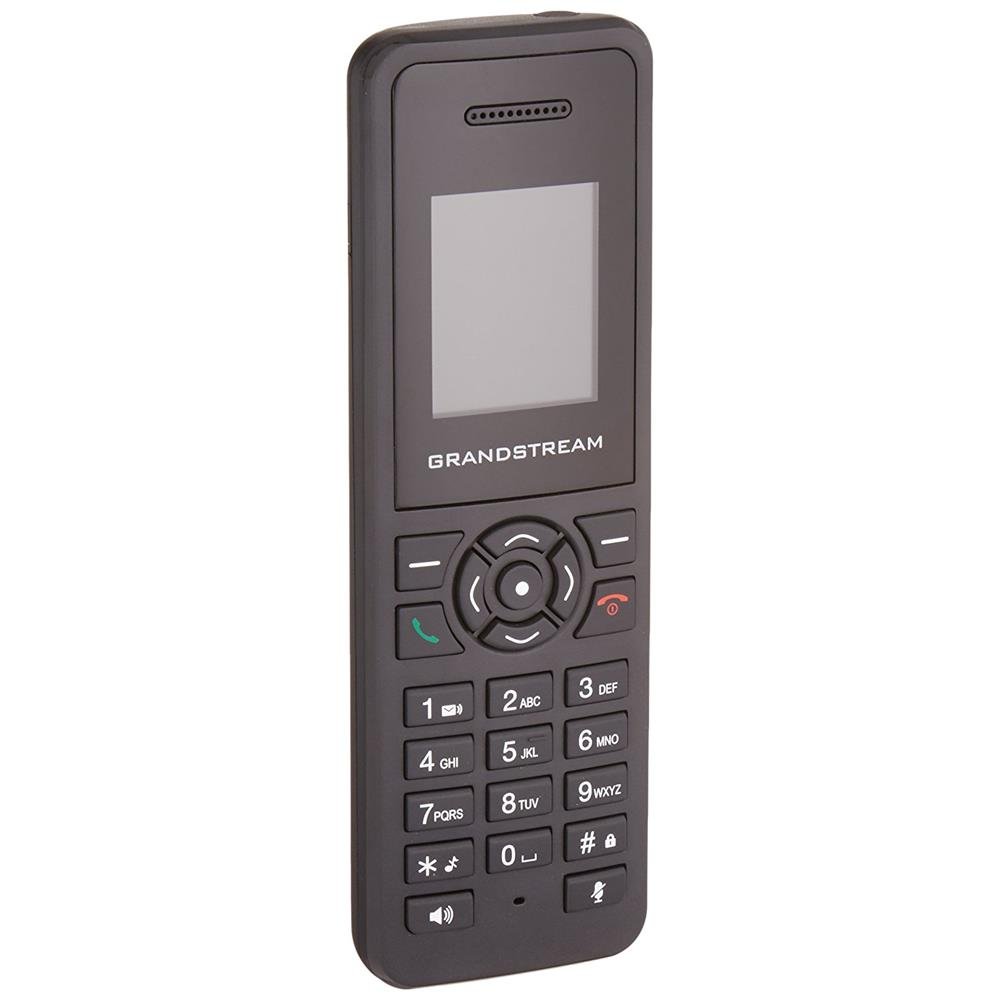
2. Grandstream DP720 Dect Cordless VoIP Telephone, Black
A second handset for the Grandstream base you already run
This listing is a handset, not a system. It registers to the Grandstream DP750 base station, so it makes sense only if that base is already on your shelf. Buy it as an extra phone for a second desk or a stockroom and it does that job cleanly, at 9.6 ounces in the hand.
The small feature that earns its place is the dedicated MWI LED — a message-waiting light that stays lit when someone has left a voicemail or a call was missed. On a shared desk, that light is the difference between catching a voicemail today and finding it two days later. The plain plastic housing shrugs off the knocks a handset takes when it is shoved around a stockroom.
Honest note on expectations: the feedback on this one splits by user. Setup and overall quality draw steady praise, while sound through the earpiece and general functionality get a divided reaction — some setups work great, others hit trouble. That pattern usually traces back to how the base is provisioned rather than the handset itself, so budget a little patience for the initial configuration and the phone settles in.
The clearest reason to buy: you are expanding an existing Grandstream DP750 deployment and want the cheapest, simplest way to add one more cordless position with a visible message light.
The catch to plan around: it will not act as a standalone phone, and per-unit sound impressions vary, so test your first one before ordering a batch.
Reach for this if: a DP750 base already anchors your phone setup and you just need another handset on it.
Look elsewhere if: you are starting from scratch — this box has no base, so a full kit is the smarter first step.
3. Grandstream DP730 DECT Cordless VoIP Telephone
Forty hours of talk time for the person who never sits down
No phone on this list outlasts it in a conversation. The DP730 is rated at 40-hour talk time and 500-hour standby, and that is a clean 4.0x the talk time of the rugged WP836’s 10 hours. If the phone lives on a belt rather than a cradle, that gap decides which one you carry.
The radio spec is what a warehouse manager should read twice. Grandstream publishes a range of up to 400 meters outdoors and 50 meters indoors when paired with the DP752 base, dropping to 300 meters outdoors on the DP750. Range in meters is only meaningful next to your base, so check which one you own before you count on the big outdoor number.
For mobile workers, this phone adds a dedicated push-to-talk button and built-in proximity and accelerometer sensors (motion sensors that enable gesture control and alert notifications). The 2.4-inch 240 x 320 color LCD has three programmable soft keys for your most-used functions. It handles up to 10 SIP accounts (phone line registrations) and 10 lines per handset with 3-way conferencing. At 454 grams, it is 2.5x the weight of the 180-gram WP836 — a heavier handset that sits differently in a pocket.
Built for the floor: long shifts, wide indoor coverage and a push-to-talk key make this the roaming-worker handset rather than a desk phone.
One thing to verify: the headline outdoor range depends on the DP752 base, and this is a handset that needs a compatible Grandstream base to do anything at all.
Best for: staff who are off the cradle for whole shifts and need one charge to cover it.
Skip if: you mostly sit at a desk — the 454-gram body is more heft than a desk-bound caller needs.
4. Grandstream Cordless WiFi IP Phone WP826 SIP Phone

Skips the DECT base and rides the wireless network you already run
Here is the practical difference from the DECT picks above: this handset connects over Wi-Fi, so there is no dedicated base station to buy or pair. It works with VoIP systems and Wi-Fi networks, and buyers report it dropping into a range of services from UniFi Talk to an 8×8 PBX without drama.
The 4-inch color LCD is the largest screen in this group, and at 0.4 kg the handset is a comfortable handful for navigating contacts and call queues. A user-friendly keypad and navigation buttons keep the controls obvious. What people rave about is connectivity — it holds its link well across the network — and functionality lands right behind it.
Setup is the one area that splits. Some find configuration simple, others find it takes real effort, which is typical of any Wi-Fi phone that inherits your network’s quirks. If your wireless coverage is patchy in a corner of the building, the phone will inherit that patchiness too. Strong Wi-Fi in, strong phone experience out.
Why the cordless Wi-Fi route appeals
- 4-inch color LCD is the biggest display on this list
- No DECT base to buy — it joins your Wi-Fi network
- Connectivity and everyday functionality are the standout strengths
- Multi-line operation for handling several calls
What to weigh first
- Setup effort divides opinion depending on the network
- Call quality rises and falls with your Wi-Fi coverage
Choose this when: the building already has solid Wi-Fi and you would rather not install a DECT base at all.
Pass on it when: your wireless signal is thin in the far rooms — a dedicated DECT radio would serve you better.
5. Grandstream WP836 Ruggedized WiFi Phone

Built to take a drop, a splash and a wipe-down without complaint
The rating that matters is IP67 — the handset is waterproof, dust-proof and resistant to cleaning chemicals. That last part is the detail that separates it from every other phone here.
The safety features are aimed at lone workers. Alarm functions include push-button, man-down, no-movement, running and ambient-sound triggers — so the phone can raise the alarm if the wearer stops moving or a sudden run is detected. Dual-band Wi-Fi 6 with an efficient antenna design and advanced roaming support keeps the connection handed off as the user moves through the site. Integrated Bluetooth connects a headset, and a Type-C USB port handles fast charging.
On the numbers: 3 SIP accounts and 3 lines with 4 conferences, a 3000mAh battery rated at 10 hours talk time and 240-hour standby, and 180 grams in the hand. Compared with the DP730’s 40-hour talk time, this 10-hour rating is a working shift rather than multiple days, so it belongs on a charging routine. Owners call out durability, connectivity and sound quality in equal measure, and the 2.8-inch screen with a dual-MIC design plus AEC, Noise Shield Technology and AI Noise Reduction keeps speech clear in a noisy plant.
The case for it: a sealed, chemical-resistant handset with lone-worker alarms and headset Bluetooth covers the environments where a standard cordless phone would not survive a week.
The trade-off: 10 hours of talk time means daily charging, and the smaller 2.8-inch screen is the price of the rugged body.
Pick this for: workshops, plants and field teams where phones get dropped, splashed and wiped down.
Not for you if: you want days of battery between charges — this one asks for a nightly cradle.
6. Panasonic KX-TGP600 SIP Dect Base Unit & Cordless Handset

One base that spreads eight handsets and eight conversations across a site
This is the multi-handset play. The base supports up to 8 DECT handsets and up to 8 SIP registrations, with up to 8 simultaneous network conversations. Set that against the Yealink W73P’s 20 simultaneous calls and you see the split plainly: the Yealink carries more concurrent conversations, while this Panasonic spreads more handsets across a floor. For a shop or clinic wiring several desks to one system, the handset spread is the number that matters.
Repeater registration rounds it out. Up to 6 repeaters can register, which extends coverage into a long building without adding bases. The 1.8-inch 65,000-colour TFT display keeps menus and caller details legible, and Panasonic pitches setup and maintenance as straightforward. Two AAA batteries power the handset.
Be realistic about the reception. Reliability draws a divided reaction — some owners run it for years without issue, others hit a unit that simply will not work. The battery is the recurring weak point, with reports of handsets that stop charging. Size the risk properly: many units run fine, and the ones that fail usually trace to the battery. Treat a fresh set of AAA cells as routine upkeep, not a surprise.
What it does best: scales a single SIP system to 8 handsets and 8 simultaneous calls across a building, with repeater support for coverage.
What to accept: battery replacements are part of ownership, and the reliability record is genuinely mixed rather than uniformly strong.
Worth it if: you are equipping several desks or rooms to one SIP system and need the repeater option for reach.
Give it a miss if: you want one handset for one desk — the multi-handset capacity is wasted there.
7. Yealink W76P DECT Cordless IP Phone System

The base runs on a single network cable and reaches the far yard
Power over Ethernet is the quiet feature that makes installation easy. The base draws its power over the 10/100 Ethernet connection via 802.3af PoE, so one cable handles data and power together — no wall socket needed at the base. A power adapter is included too if your switch does not supply PoE.
The coverage is what owners bring up most. This handset covers a whole house, garage and yard, which is the practical outcome of a DECT radio that is not sharing a crowded Wi-Fi band. Pairing is limited to Yealink W52H and W56H DECT handsets, so an expansion later means those models. Sound quality and build quality both draw steady praise, and the 2.4-inch color display keeps the menu usable.
The caveat sits with the dial pad. Reliability is divided — most units run well, but some hit trouble with keypad functionality. That is worth knowing before you buy in bulk. Buy one, live with it for a week, and confirm the dial pad behaves the way your staff expect before you commit to a full rollout.
The draw: PoE power over a single Ethernet cable plus whole-property DECT coverage make this a clean install for a home office or small building.
The honest caution: the dial pad is where the rare problem lands, so test a single unit before ordering more.
Suits you if: you need the handset to reach a garage or yard and want a one-cable PoE install.
Probably not if: you are adding a second handset — pairing is limited to W52H and W56H models.
Know the Specs
Talk time and standby time
Talk time is the maximum conversation time on a full charge, and standby is how long the handset sits idle before it needs the cradle. Both figures here are rated “in ideal conditions,” so treat them as an upper limit rather than a guarantee. A long standby rating keeps a rarely used handset alive over a weekend. A long talk rating matters more for a phone that is off the cradle for whole shifts.
DECT versus Wi-Fi connection
DECT uses a dedicated radio band between the handset and its base, which is why these phones quote outdoor and indoor range in meters. Wi-Fi phones instead join your wireless network and have no base of their own, so their reach is your network’s reach. DECT typically behaves better in a signal-hostile or multi-network building. A Wi-Fi phone saves installing a base but inherits every weak spot in your coverage.
SIP accounts and simultaneous calls
A SIP account is a separate line the handset registers to your phone system. Simultaneous calls are how many conversations the system can carry at once. A reception desk handling multiple lines wants a high simultaneous-call ceiling. A single home user rarely needs more than one account. Check the base supports the number of accounts you plan to add, since the handset alone cannot exceed it.
Base station compatibility and repeaters
A DECT handset registers only with a matching base family, so the compatibility line on the listing is the part to read first. Some bases accept up to 10 handsets; others accept 5. Repeaters extend coverage without adding bases — the Panasonic KX-TGP600 supports up to 6 repeaters. If you already own a base, buy the handset that matches it. If you are starting out, buy the kit that includes the base.
Common Questions
Will a Yealink handset work on a Grandstream base?
Do I need a base station to use a cordless VoIP phone?
How long will the handset actually run between charges?
What is the difference between DECT and Wi-Fi cordless VoIP phones?
How many handsets can one base support?
Can I use a cordless VoIP phone with UniFi Talk or a cloud PBX?
Does a VoIP cordless phone need a traditional phone line?
Which cordless VoIP phone handles the most simultaneous calls?
Are there rugged cordless VoIP phones for wet or dusty workplaces?
Can I plug a headset into a cordless VoIP handset?
The Bottom Line
For most buyers, the strongest pick among these Voice Over IP Cordless Phone options is the Yealink W73P, because it pairs up to 20 simultaneous calls with up to 35-hour talk time and a base that grows to 10 handsets and 10 SIP accounts (phone line registrations). If fast recovery matters more than raw stamina, grab the Yealink W76P — 10 minutes on the cradle returns 2-hour talk time. And for a dusty or wet workplace, the Grandstream WP836 is the one to reach for, thanks to its IP67 sealed casing (dust-tight and protected against water immersion) and lone-worker alarms.
How we choose
We do not accept paid placement. Every pick is matched to a real buyer and a real use-case; we do not hands-on test units.
Sources
Specifications: manufacturer listings and product documentation. Review insights: verified customer reviews, as of November 2026. Pricing: not shown on this page (it changes often); check the current price via the retailer link.
As an Amazon Associate, Tactical Gear Guy earns from qualifying purchases. This does not affect which products we feature.